
VooDoo Cable Stradivarius Amati Speaker Cable Review
A black briefcase, made of plastic but sturdy.
On both the front and back, a label is affixed in the center, displaying the VooDoo Cable brand and, in script, the model name: Stradivarius Amati.
Releasing the latches on either side of the handle, I lift the lid to reveal a gray, cone-shaped foam lining the interior, providing robust protection.
Nestled within, the speaker cables lie coiled, thick as water pipes, resting quietly.
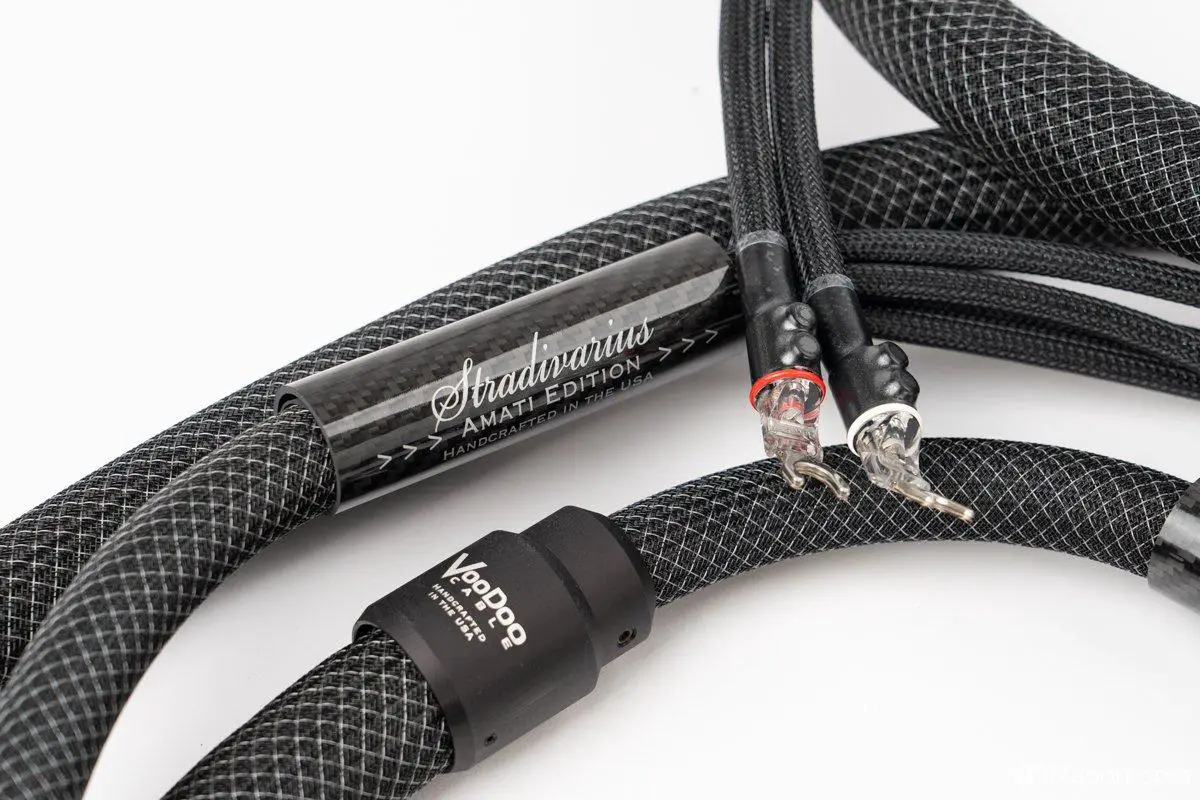
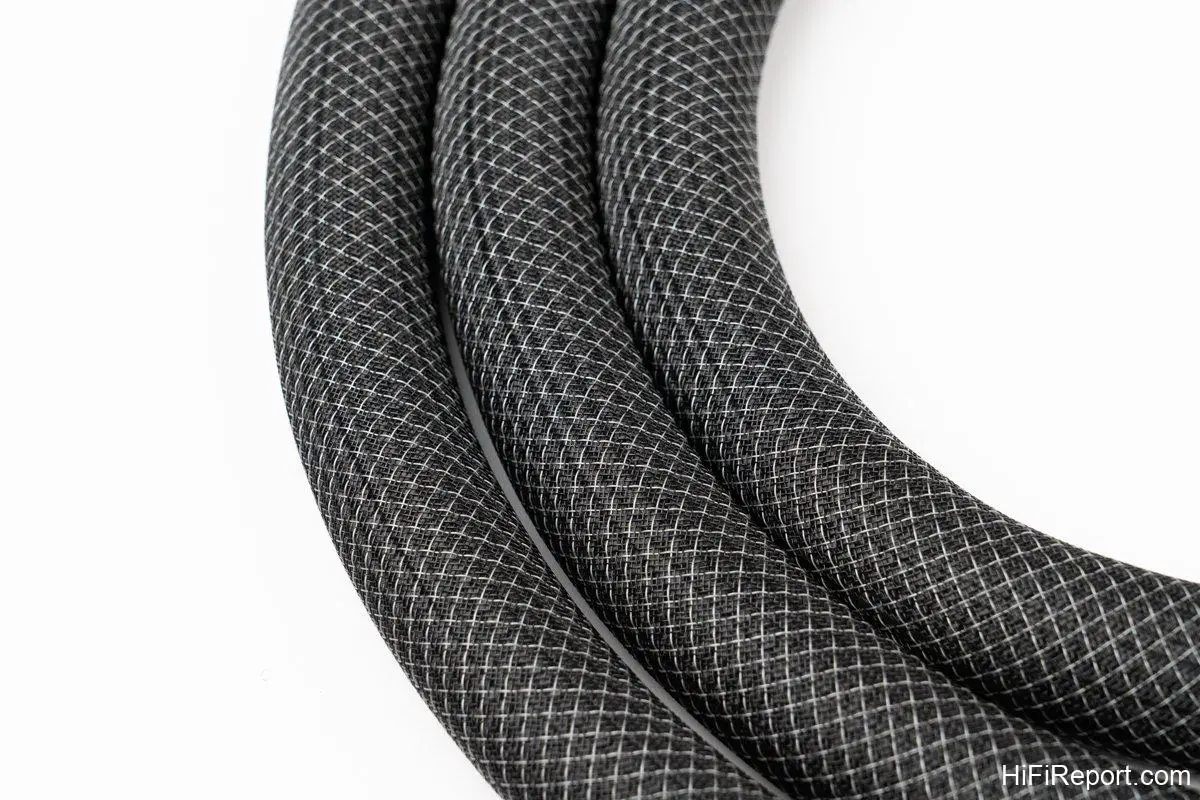
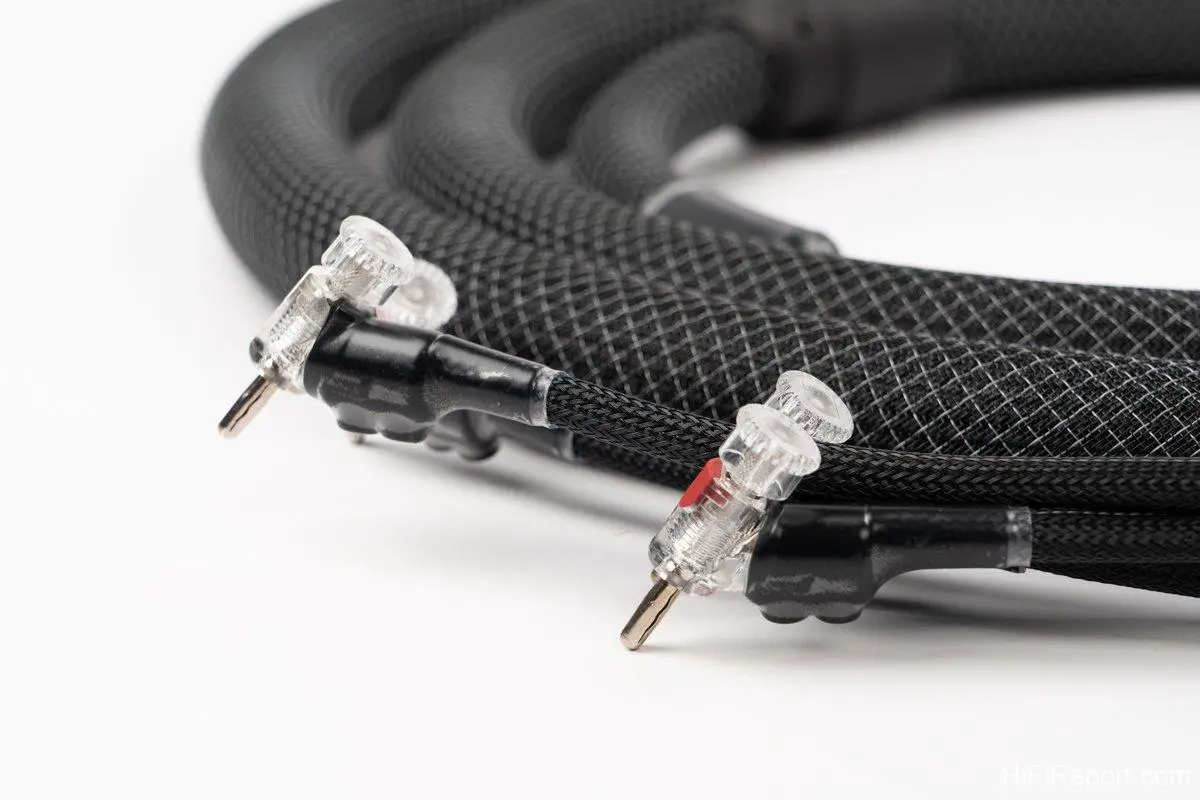
The all-black outer jacket is meticulously adorned with a diamond pattern rendered in fine white lines, exuding an aura of profound and refined elegance—understated yet undeniably luxurious.
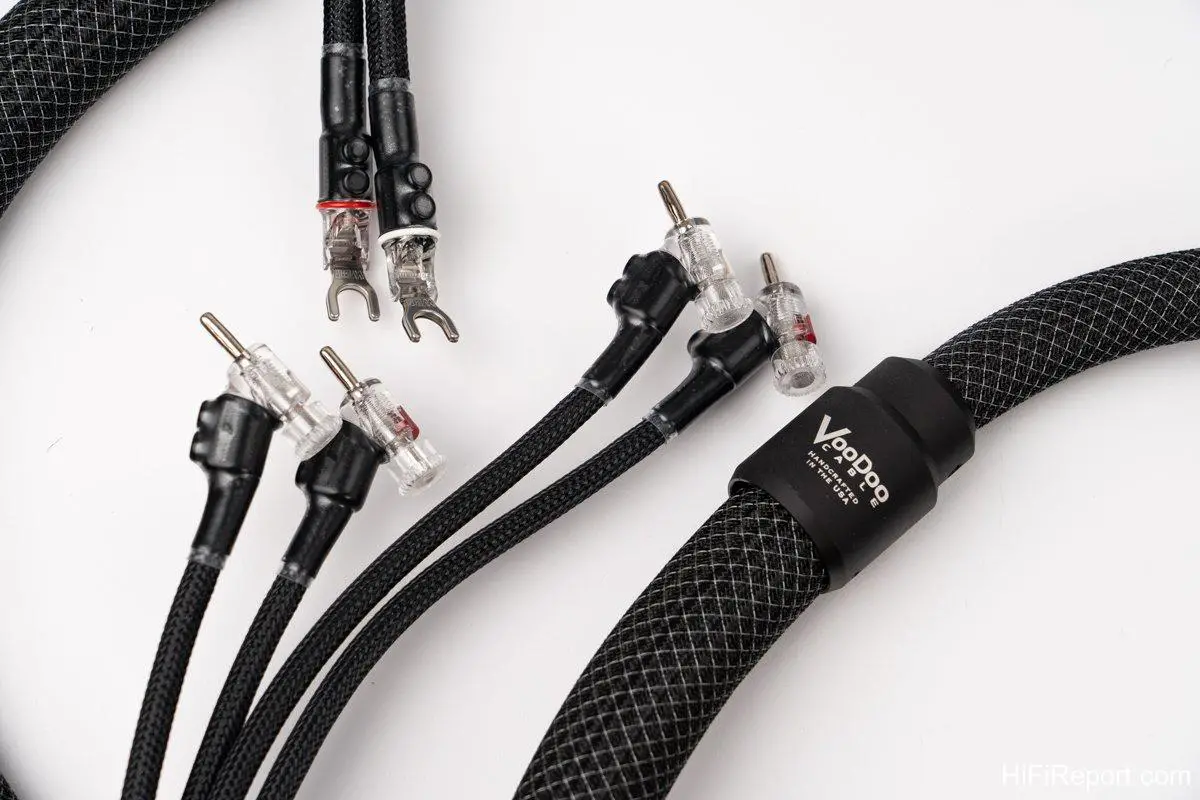
Closer to each end of the cable, a black aluminum metal ring is present, bearing the VooDoo Cable logo.
Beyond these rings, the cable diameter subtly decreases, suggesting that the manufacturer has reduced some internal structural layers at this point. This creates a gradual “slimming down” of the cable, facilitating termination and enhancing visual appeal.
The split point is marked by a roughly 10cm long black carbon fiber tube. Beyond this, the cable separates into single-pole terminations.
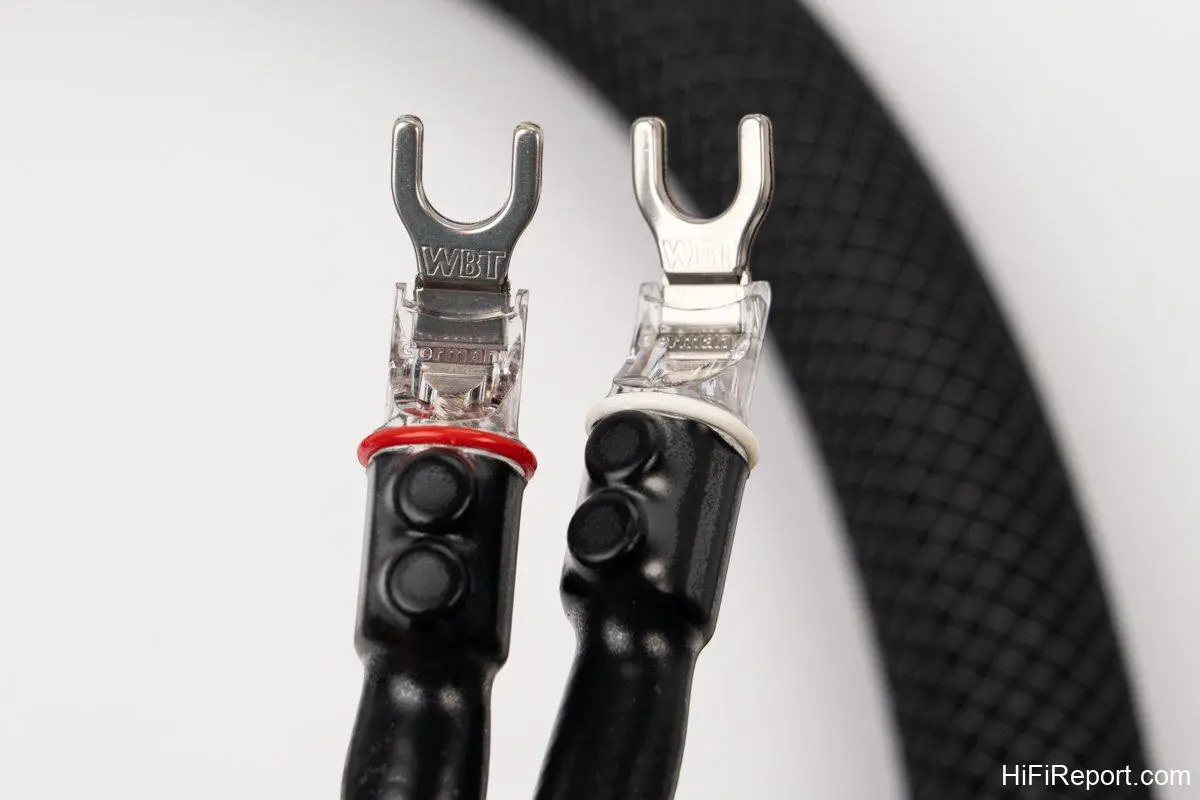
The connectors are equally sophisticated, uniformly employing WBT Nexgen pure silver components.
The overall “presence” is powerful! Truly befitting VooDoo Cable’s flagship speaker cable, the Stradivarius Amati.
I had long heard of VooDoo Cable’s esteemed reputation but had never had the opportunity to experience them firsthand. Now, that chance has finally arrived.
And my introduction is with their flagship speaker cable, no less.
How am I to proceed from here? Will everything else pale in comparison?
VooDoo Cable: Driven by Music
VooDoo Cable, hailing from Oakland, California, USA, states their sole purpose in crafting cables right on their official website: music.
While this might sound like a cliché, I appreciate such a clear declaration.
We all have different goals when listening to and purchasing audio equipment, and we derive pleasure from it in various ways.
For me, audio equipment exists to play music, and buying audio equipment is about enabling music listening at home.
Investing in high-quality audio equipment is about achieving high-fidelity music reproduction in my listening space.
Music is my ultimate objective, the source of my emotional connection.
My emotional response isn’t triggered by how “realistic” a sound is, but rather by how music resonates with my heartstrings.
My purpose in listening to audio is clear and unwavering: it’s for “music,” not merely “sound.”
This is why my reviews often focus on the emotional impact derived from the music itself, with less emphasis on describing the sonic characteristics in detail.
Music is the reason I engage with audio.
So, VooDoo Cable, give me five!
Cold Fusion Cryogenic Processing for All Products
Beyond their stated philosophy of pursuing superior music reproduction, VooDoo Cable emphasizes a key process applied to their entire product line: “Cold Fusion” cryogenic treatment.

According to the manufacturer, this process, involving immersion in liquid nitrogen and vapor, may appear similar to others, but VooDoo Cable stresses the precision of their execution. Temperature and time are meticulously controlled by computer, subjecting metallic components to ultra-low temperatures of -192 degrees Celsius, causing a realignment of the conductor’s metal molecules.
What are the benefits? VooDoo Cable explains that electrical conduction is essentially a flow of electron pulses. Electrons jump from one conductor molecule to the next. The more direct this path, the higher the signal integrity and accuracy, and the lower the noise.
They have found that cryogenic treatment makes the conductor molecules arrange more densely, reducing conductive resistance and harmonic distortion.
VooDoo Cable is consistent in their approach. Believing in the advantages of cryogenic processing, they apply Cold Fusion treatment to all metal components used in their entire cable range—conductors, shielding braids, and connectors.
This is the first key aspect to understand about VooDoo Cable.
Handcrafted in California
Secondly, VooDoo Cable proudly highlights that their cables are handcrafted from start to finish in their Oakland factory, based on customer-specified configurations.
This is not outsourced to Asian factories, subcontracted to other manufacturers, or simply bulk cable from a cable factory that is cut and terminated upon order.
VooDoo Cable establishes specifications for conductors, construction, jackets, shielding, and insulation for each cable model, and then crafts them entirely by hand.
This point of origin and craftsmanship is a source of pride for them.
Unique Conductor: Continuous Cast Alloy of Silver and Copper
As a flagship speaker cable, the Stradivarius Amati boasts a robust cable body. Examining the product description repeatedly, I gleaned a sense of its technology, yet it retained an air of mystery. It utilizes high-purity, cryogenically treated alloy (Cryo-Alloy) made from continuously cast pure silver and pure copper.
Is it a true alloy? A silver-copper alloy? An alloy of OCC silver and OCC copper? Or does “alloy” simply refer to a hybrid conductor made by mixing and stranding OCC silver and OCC copper conductors? The manufacturer doesn’t explicitly clarify, only stating that in the Stradivarius Amati, each pole uses seven discrete Cryo-Alloy conductor groups. The term “discrete” is also uncommon in cable descriptions, suggesting that each of the seven strands in the Stradivarius Amati speaker cable is individually insulated. (Presumably.)
Construction: An Industrial Secret, Definitely Not Voodoo
How is the insulation achieved? Each strand is encased in ISO-certified Teflon tubing and constructed using a concentric winding method. The total conductor gauge is a substantial 6 AWG. The construction aims for a balance between capacitance and inductance.
Despite being a speaker cable, shielding is incorporated, utilizing a silver-plated copper braid. What internal arrangements contribute to its thickness? The manufacturer remains vague.
Is this science or “voodoo”? Just kidding—it’s certainly science. How do I know? The phrase “striving for balance between capacitance and inductance” is a clear indicator. VooDoo Cable may use “voodoo” as a brand name, but they demonstrably understand the science of cable design, particularly the importance of capacitance and inductance.
Why am I so certain? I’d wager that if Bruce Richardson, the founder of VooDoo Cable, were asked, he would emphasize the significance of capacitance and inductance alongside cryogenic processing and conductor metallurgy.
While I don’t have direct access to Bruce to elaborate on VooDoo Cable’s design philosophy, I can explain why that specific phrase convinced me, “This isn’t voodoo, it’s science.”
Science-Based: Focusing on Capacitance and Inductance
In essence, signal transmission through cables, in the form of electrical current, is affected by three factors: resistance, inductive reactance, and capacitive reactance.
Resistance is primarily determined by the conductivity of the conductor material and the cross-sectional area (gauge) of the wire. For example, copper is better than gold, and silver is better than copper in terms of conductivity. A larger conductor cross-section (thicker wire) results in lower resistance, and vice versa. Resistance is relatively straightforward, relating to current flow and transmission speed.
However, capacitance and inductance have a direct impact on the sound quality. Inductance impedes the passage of high frequencies, while capacitance causes high-frequency signal loss. Reduced high frequencies diminish brilliance, detail, and information, consequently degrading the musical experience. Furthermore, high capacitance and inductance in speaker cables can introduce phase shifts, affecting focus and imaging.
Therefore, when VooDoo Cable mentions “striving for balance between capacitance and inductance” in their construction, it signals their focus on these critical parameters.
How do they minimize capacitance and inductance? VooDoo Cable doesn’t elaborate. However, they do mention using Teflon for insulation. The dielectric constant of the insulation material directly influences the capacitance value of the cable. To achieve low capacitance, a material with a lower dielectric constant (or relative permittivity) is preferable. Among common dielectric materials, Teflon (PTFE) has one of the lowest dielectric constants, second only to air. VooDoo Cable’s choice of Teflon insulation is, in my view, scientifically sound.
Moreover, to further reduce cable capacitance, the spacing between conductors can be increased. Greater distance between conductors lowers both capacitance and inductance. I’m unsure of the internal configuration of the Stradivarius Amati, but perhaps its substantial thickness isn’t just about using more materials for a more impressive appearance, but rather about increasing the spacing between individual strands to minimize capacitance and inductance. This is purely speculation on my part, and I welcome clarification from Bruce himself.
Sonic Performance: Listening is Believing
At this point, my written description already exceeds the information available on the manufacturer’s website. Some information is directly from their official content, while other parts are my observations, inferences, and explanations based on my knowledge. From the outset, my intention isn’t to persuade anyone, but to provide a more systematic clarification of my understanding of this cable and brand—highlighting what they explicitly state, what remains unclear, what is logically sound, and what is scientifically grounded.
Now, the crucial step is to verify through listening tests how the VooDoo Cable Stradivarius Amati flagship speaker cables actually perform. Specifications, data, and marketing materials are ultimately meaningless. Connecting them to a system and playing music will reveal their true character.
Are they good? Yes, definitively. What are their strengths? Initially, I couldn’t immediately pinpoint their specific sonic signature, tendencies, or qualities after connecting the Stradivarius Amati speaker cables. Truly, I couldn’t.
However, the more I listened, the longer I listened, the more I appreciated what I was hearing. I became increasingly reluctant to switch back to other speaker cables, even my own preferred ones.
Exquisite Balance, Exceptional Musicality
It was then that I realized the true brilliance of these cables. It’s not about exhibiting sonic pyrotechnics, but about conveying musicality with precision and integrity. Their balance is so seamless that I struggled to find any flaws.
Indeed, the most striking aspect of the Stradivarius Amati is its exceptional balance. This foundation of balance allows the music to emerge naturally and unforced. It almost dissolves the barrier of the audio system, bringing you closer to the performers, the composer, the score, and the very soul of the music.
Do you love music? If you prioritize the “sound” itself over the emotional impact of music, you might dismiss my preceding descriptions as mere flowery language. Conversely, if music holds deep importance for you—its essence, its texture, its emotive power, its brilliance, its atmosphere, even its sense of live presence—then you will undoubtedly appreciate the remarkable balance of the Stradivarius Amati.
Achieving such balanced musical performance doesn’t require exorbitant expenditure. It can bring you to the heart of music at a reasonable price point.
This sense of balance is, admittedly, difficult to articulate. The balance of a cable, or indeed any audio system, often subtly conceals the familiar sonic attributes we typically analyze. Are those attributes present? Yes, they are. But they are so integrated, so seamlessly woven into the fabric of the sound, that they don’t immediately jump out, demanding attention. This allows you to quickly move past the technicalities of the audio system and focus entirely on the music.
Rich Harmonics, Beautiful Tonal Colors
Take the compositions of Giovanni Bottesini, a contemporary of Verdi who uniquely dedicated himself to composing for the double bass. Due to the instrument, audiophiles often seek recordings of his works to experience the profound low frequencies and grand scale of the double bass.
With the Stradivarius Amati, is the double bass deep? Yes, profoundly so. But your attention is not solely drawn to the richness of the bass; you become more attuned to the melody led by the solo instrument. Bottesini, like many Italian composers of his era, masterfully employed bel canto techniques, crafting highly lyrical melodies. For instance, in “Elegy,” the theme is introduced directly, without a formal introduction. The distinctive “nasal” quality of a large string instrument, combined with the legato phrasing, creates a truly beautiful melodic line. In this piece, Bottesini demonstrates how to use arpeggios to extend the singing quality of the musical phrases. The unobtrusive accompaniment, with another double bass subtly punctuating from the rear right, occasionally humming or plucking, provides a counterpoint in the lower register, echoing the solo instrument. There’s so much artistry in these details! I listened to Rick Stotjin’s performance, a recent BIS recording, which is itself naturally balanced and unexaggerated.
My repeated affirmation of the VooDoo Cable flagship speaker cable stems from its ability to reproduce the rich harmonics inherent in the sound of a large instrument like the double bass. Harmonics are essential components of sound; variations in harmonic content are what allow us to distinguish different timbres and textures. In “Passione amorosa,” Bottesini employs two solo double basses, interestingly incorporating extensive mirror counterpoint, creating unique sonic textures in some bass ensemble passages. When the double bass notes descend, the sonorous low frequencies emerge, deep yet still richly textured and full of nuance. The Camerata RCO, a chamber ensemble composed of members of the Royal Concertgebouw Orchestra, delivers a transparent and refined sound with a smaller, more intimate ensemble size, further enhancing the balanced beauty of the music.
Interlude: Why the Name?
Listening to the double bass music, a question arose: why did the manufacturer name these cables “Stradivarius Amati”? These are two distinct families! VooDoo Cable’s previous flagship was named Stradivarius Cremona, which makes sense as Antonio Stradivari was from Cremona, a renowned violin-making center. However, Nicola Amati lived earlier, and there’s no clear documented lineage between them. What is the reason for linking these two individuals (or families)? Am I overthinking this? Has anyone else considered this? I must remember to ask someone from VooDoo Cable next time I have the opportunity.
Don’t Be Misled: Refined Sound Despite Robust Appearance
The double bass music sparked my “flights of fancy,” and the cable’s appearance might also lead to “misconceptions.” Despite the robust and weighty appearance of the VooDoo Cable Stradivarius Amati speaker cables, don’t assume their sound is equally imposing and forceful.
Quite the opposite. Their sound is transparent, pure, clear, and natural, with outstanding brilliance and nuanced expression. To ground these descriptive terms, I’ll use Mozart’s piano concertos as an example. My reference recording was Maria Joao Pires’ performance of Piano Concerto No. 20, conducted by Claudio Abbado with the Mozart Orchestra. This concerto, written in a minor key, which is less common for Mozart, opens with a unique approach in the first movement. The string section begins with accented beats, yet Mozart marks them with piano markings, creating a rhythmic displacement and adding to the music’s suspenseful character. The rising triplets in the cellos in the background rumble like distant thunder, setting a pre-storm atmosphere. This sonic image is remarkably transparent! The orchestra seems to unfold right before you. As the melody ascends, the orchestra’s energy surges, propelling the musical tension to a peak. Mozart then slows the tempo, ushering in the piano, which initially appears serene but quickly transitions into rapid sixteenth-note runs, further emphasizing the poignant first theme. The Stradivarius Amati speaker cables convey this musical passage completely and flawlessly, with balance and elegance between sections, and between the piano and orchestra. The piano’s brilliance is truly captivating—a touch of brightness, a hint of warmth, a trace of gentleness—it’s emotionally resonant. In the first movement’s brilliant and elaborate coda, after the piano’s extended solo in the recapitulation, it concludes with passionate and dazzling arpeggios and trills, announcing the movement’s end and leading to the orchestra’s glorious finale. Stradivarius Amati reveals all the subtle nuances and intricacies that Mozart embedded in the score.
Vivid and Realistic Vocals
These qualities make the Stradivarius Amati not only exceptional for instrumental music but also captivating for vocal performances. Consider Sara Bareilles’ live performance recording “Brave Enough: Live at the Variety Playhouse.” Sara’s vocal style and distinctive voice are vividly rendered. The dynamic nuances and inflections in her singing create a highly emotive musical experience, full of intensity. In upbeat songs like “Love Song,” you can hear her confident command of rhythm, the soaring vocals in the chorus, and the rapid vocal runs, all showcasing Sara’s vocal prowess. As a live recording, the audience’s reactions are integral to the experience. Sara’s close interaction with the audience, even inviting them to sing along, creates a palpable sense of being there. The expansive soundstage and energetic live atmosphere make this album a thrilling listen. In slower songs like “Manhattan” or “Goodbye Yellow Brick Road,” Sara uses varying vocal timbres to imbue the songs with emotional depth and dynamic range. The subtle textures of her voice, the dynamic shifts from soft to powerful, are all rendered with remarkable realism.
Jazz: A Clear and Bright Soundscape
How do they perform with jazz? I specifically raise this question because VooDoo Cable’s founder, Bruce, is a jazz enthusiast. Indeed, all the qualities described so far—the transparent soundstage, expansive space, vivid textures, and precise imaging—suggest that the Stradivarius Amati speaker cables would excel with jazz.
And they do. I used a Fone recording of Henry Mancini’s “Pink Panther Theme,” featuring a jazz trio version on the first track—tenor saxophone, piano, and drums. The tenor saxophone sound is rich and full-bodied, with vibrant textures. The cymbal crashes from the drum kit shimmer with golden brilliance. The second track is interesting, presenting the same theme arranged for guitar and double bass. The steel strings of the guitar produce clear, ringing tones, and the strumming creates a cheerful and lively feel. The double bass initially accompanies, then takes over as the lead instrument in the latter half, improvising on the theme with deep, resonant tones. This is where a system that is too heavy or dense might muddy the sound, but the Stradivarius Amati avoids this issue. If you hear muddy bass, it wouldn’t be the cable’s fault. The fifth track features a bluesy guitar arrangement with electric bass and electric guitar accompaniment. The music is wonderfully nuanced, the rich blues flavor enhanced by the electric instrumentation. The deep, full bass—is it muddy? Too thick? Listen to the textured and defined bass lines, and the colorful electric guitar—what do you think? The soundscape remains clear and bright!
An Understated Flagship
My VooDoo Cable experience unexpectedly began with their flagship speaker cable. However, the view from the summit is indeed broader and more beautiful, allowing me to clearly perceive the height of VooDoo Cable’s craftsmanship and recognize that their stated commitment to “music” is not just a slogan, but a genuine capability.
As a flagship speaker cable, the Stradivarius Amati’s price is not astronomically high in the market. It would be a mistake to underestimate it based on VooDoo Cable’s overall product pricing. This is a speaker cable that allows you to truly hear the music and focus on the musical experience.
Specifications
* Type: Speaker Cable
* Conductor: OCC Silver + OCC Copper (Cryogenically Treated)
* Connectors: WBT NextGen 0681 Ag Pure Silver Spade or Banana Plugs