
VRDS-701 Review
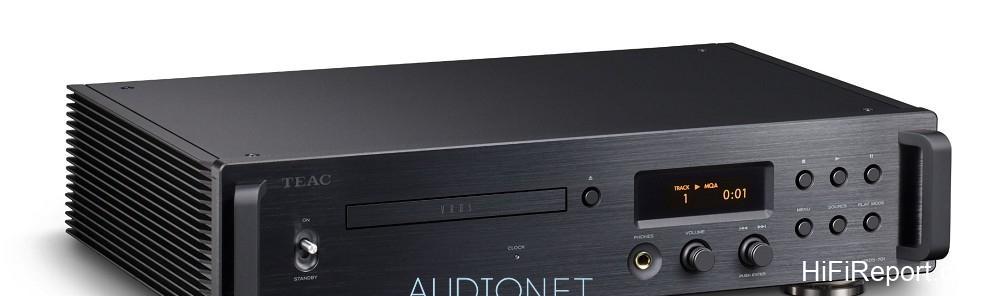
The VRDS-701 is far more than just a CD player. It incorporates USB Audio (Type-C) digital input and a headphone output, making it a fully functional USB-DAC and headphone amplifier. Its USB input handles high-resolution formats with high specifications: PCM up to 384kHz/32bit and DSD up to 22.5MHz. This allows users to play music files directly from a PC or music server, and with a streaming transport, it can also access streaming services.
Furthermore, the VRDS-701 can function as a preamplifier. While it lacks analog inputs, users can control the volume via the remote when using digital inputs or playing CDs. For those not interested in vinyl playback, the VRDS-701 paired with a quality set of active monitor speakers constitutes a minimalist, high-performance system. Users preferring passive speakers can connect the VRDS-701 directly to a power amplifier, eliminating the need and cost of a dedicated preamp.
Esoteric DNA
The VRDS-701 is the third model in the Reference 700 series. Early last year (2022), I reviewed its predecessor, the UD-701N (which could well be described as a streaming preamplifier). I was astonished to find that the UD-701N not only replicated the Esoteric N-05XD’s Master Sound Discrete DAC structure but also adopted its preamplifier and headphone amplifier circuits wholesale.
With the UD-701N priced at roughly one-third of the N-05XD, my actual listening tests confirmed that when paired with the TEAC CG-10M clock generator, its sound quality truly warranted the title of a “budget N-05XD.”
Having reviewed the UD-701N, it seems TEAC has become synonymous with “price disruption,” and nothing they do surprises me anymore. Given that Audio Art magazine’s Editor-in-Chief Tao recently featured the Esoteric K-05XD SACD/CD player in his “equipment outdoor shoot” feature, you can probably guess what I’m about to say. Yes, TEAC has employed the same strategy again: based on its hardware structure, the VRDS-701 can be considered a “budget K-05XD”!
Key Differences & Features
Now, as this is a “budget version,” I must be upfront about what the VRDS-701 lacks compared to the K-05XD. There are three main differences: First, the VRDS-701 is purely a CD player and cannot play SACDs. Second, the VRDS disc mechanism in the K-05XD is different. Third, the K-05XD boasts a significantly larger total capacitance in its power supply filtering (even utilizing supercapacitors).
While the VRDS-701 may not reach the K-05XD’s level in these specific areas, it is undoubtedly luxurious compared to other digital sources in its class.
Internal Architecture and Components
Allow me now to detail the hardware construction and features of the VRDS-701.
* CD Player
* USB Audio (Type-C) input
* S/PDIF digital input interfaces
* Headphone output
* Functions as USB-DAC, Headphone Amplifier, and Preamp
* USB Input support: PCM up to 384kHz/32bit, DSD up to 22.5MHz
* Latest VRDS disc mechanism
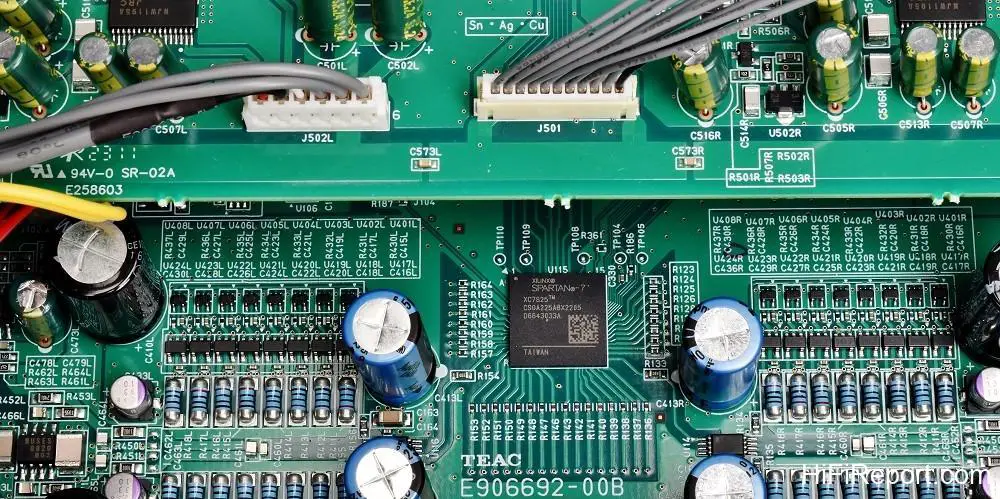
* FPGA-based delta-sigma DAC using Xilinx SPARTAN-7
* Proprietary discrete, fully-balanced DAC circuit (Master Sound Discrete DAC structure)
* Dual-mono, fully balanced preamplifier circuit
* Single-ended headphone amplifier circuit
* NJW1195A for volume control
* TI LME49600 amplifier chips (for preamp and headphone output)
* TEAC-HCLD 2 (High Current Line Driver) buffer amp on analog output
* Headphone amp: Low distortion, high S/N, 2000V/μs slew rate
* Linear power supply with separate toroidal transformers for disc mechanism, digital, and analog circuits
* Independent power supplies for left/right analog channels
* Sound tuning features: PCM Delta Sigma (Multibit/DSD), Delta Sigma Fs (128x FS, 256x Fs, 512xFs)
* External clock input compatible (tested with TEAC CG-10M)
* Cannot play SACD
The VRDS Mechanism
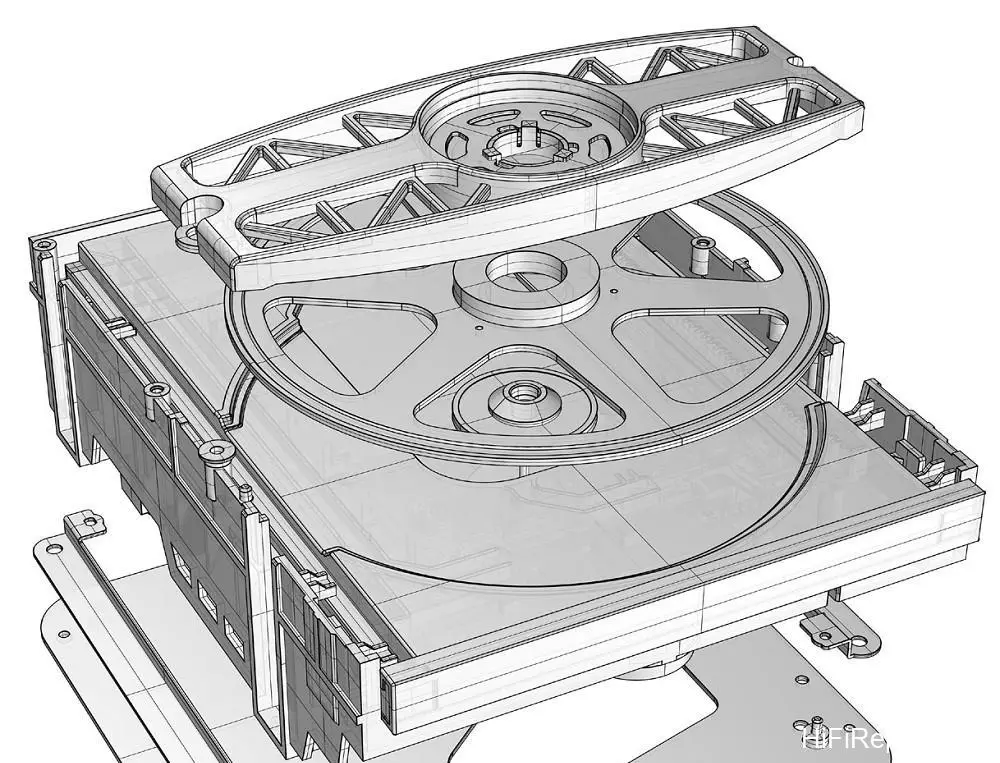
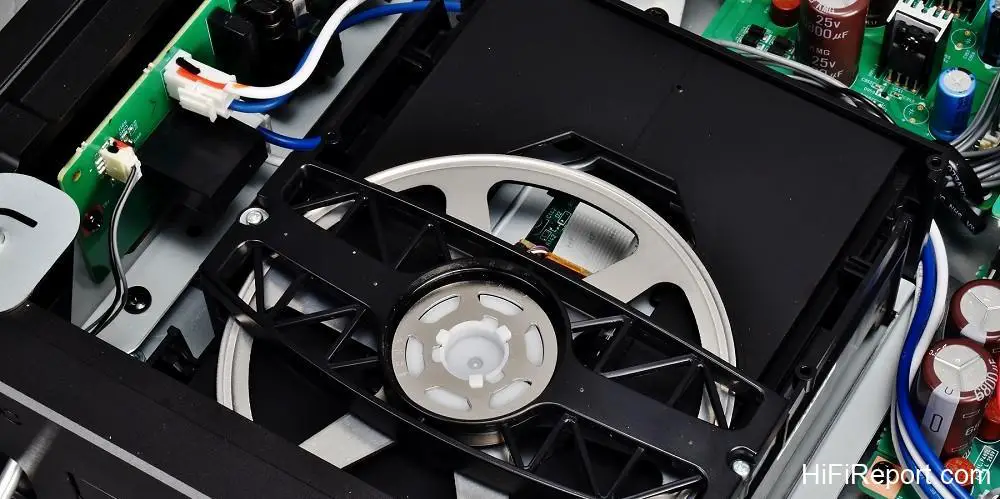
Let’s begin with the unit’s key feature: the latest VRDS disc mechanism. The biggest difference between VRDS and conventional CD drives lies in the upper section. Standard mechanisms feature a bridge-like truss spanning the top, with an “upper spindle” in the center that corresponds to the lower motor spindle. During playback, these clamp and rotate the disc together. However, CD discs often have slight warps, causing flutter during rotation.
TEAC’s VRDS mechanism is designed to combat this phenomenon.
Instead of an upper spindle, it uses an aluminum “CD clamp” of similar size to the CD itself, significantly increasing the moving mass of the mechanism and the CD during rotation. This boosts inertia and reduces flutter, ensuring not only stable rotation and reduced vibration but also allowing the laser pickup to read the CD with higher optical axis precision, minimizing errors.
It’s worth noting that the bridge truss in the K-05XD’s VRDS ALTLAS 05 is made of aluminum, whereas the VRDS-701 uses a resin material. While resin isn’t as rigid as metal, it possesses excellent damping properties (vibration absorption). TEAC deliberately fixes the resin truss only on the right side, preventing parasitic vibrations from bouncing back and forth between the ends of the truss, thereby suppressing resonance.
Beneath the VRDS mechanism, a special “semi-floating chassis” acts like a shock absorber with optimized rigidity and compliance, isolating the disc mechanism from chassis vibrations. This minimizes the impact of the mechanism on the electronic circuits and the impact of external vibrations on the mechanism itself.
Internal Design and Circuitry
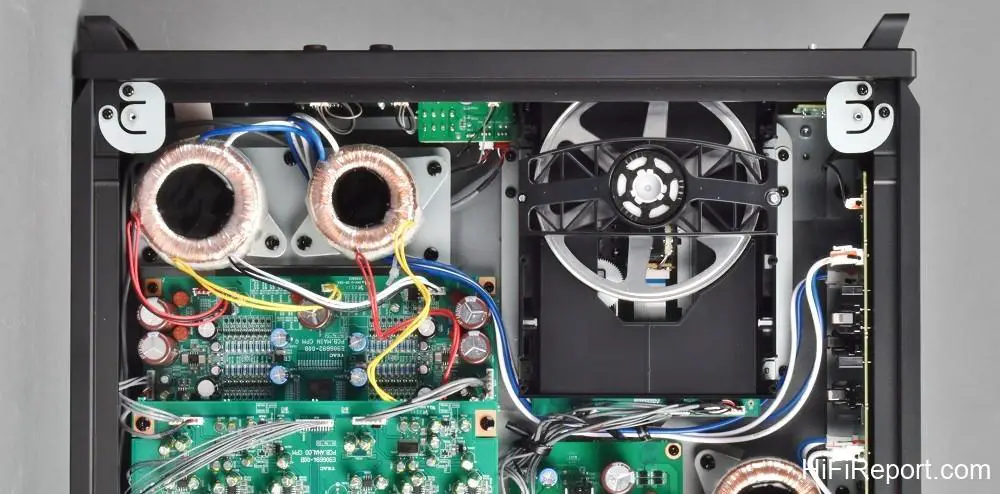
The main electronic circuitry is housed on two circuit boards. The lower board serves as the digital mainboard, equipped with USB Type-C and S/PDIF input interfaces, along with the digital-to-analog conversion circuits. It employs an FPGA-based delta-sigma DAC. A Xilinx SPARTAN-7 FPGA handles upsampling and delta-sigma conversion, controlling the operation of an array circuit composed of 16 flip-flops per channel and MELF thin-film resistors.
Finally, two MUSES8820 high-quality dual operational amplifier chips per channel perform low-pass filtering and buffer amplification on the output from the array circuit.
Don’t worry if the previous paragraph was a bit technical. Simply put, the VRDS-701 doesn’t use off-the-shelf DAC chips. Instead, it employs a proprietary discrete, fully-balanced digital-to-analog conversion circuit developed by Esoteric/TEAC. Clearly, TEAC aims to replicate the success of the UD-701N by incorporating the “Master Sound Discrete DAC structure” found in the Esoteric N-05XD and K-05XD, positioning the VRDS-701 as a budget-friendly K-05XD.
The VRDS-701 borrows more than just the DAC circuit from Esoteric. I observed that the audio circuitry in this unit adopts a structure and components very similar to what I saw in the N-05XD previously. This board houses a dual-mono, fully balanced preamplifier and a single-ended headphone amplifier circuit.
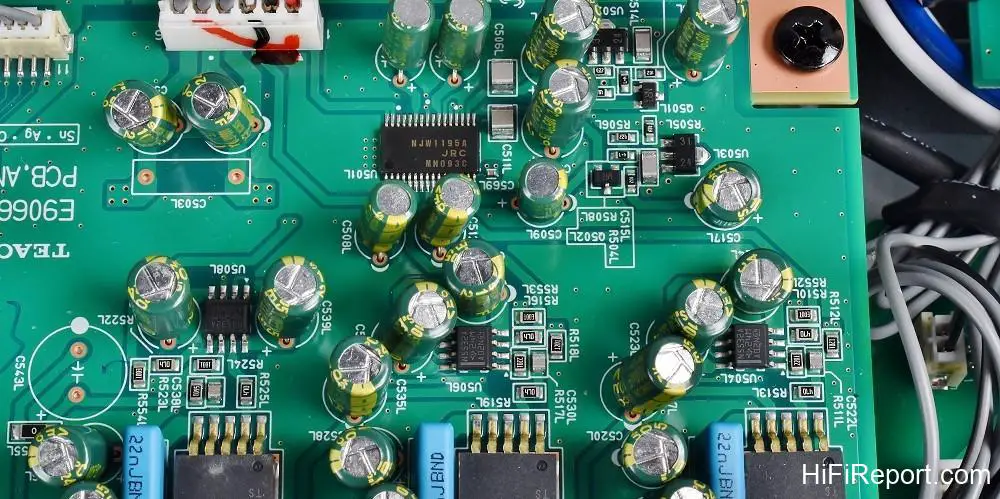
Each channel utilizes an NJW1195A at the input stage for volume control, followed by two single-channel, high-quality, high-current headphone buffer amp chips, the TI LME49600, for the preamplifier’s output amplification. An additional LME49600 is used for the headphone output.
Seeing this clarifies the manufacturer’s mention of the analog output featuring “TEAC-HCLD 2” (High Current Line Driver) buffer amplifiers and the headphone amplifier circuit, both boasting low distortion, high signal-to-noise ratio, and a fast 2000V/μs slew rate – all achieved using the same amplifier components. I had previously opened up the N-05XD and found it also used LME49600s for its preamp amplification.
Power Supply Sophistication
The VRDS-701’s power supply circuitry is also remarkably sophisticated for its class, relying entirely on linear power supplies. Separate toroidal transformers power the disc mechanism, digital circuits, and analog circuits, each with independent rectification, filtering, and regulation. The toroidal transformer dedicated to the audio circuits features two independent secondary windings and corresponding power supply circuits, feeding the left and right channels separately.
This maintains a consistent dual-mono structure from the power supply through to the amplification stages, ensuring excellent channel separation performance.
Performance and Sound Quality
For this listening session, I intentionally paired the VRDS-701 with a Proceed AMP5 power amplifier (using two channels) driving Pioneer S-1EX floorstanding speakers. I chose the AMP5 not only because I’m very familiar with it but also because it’s a late 1990s product. I believe its sonic characteristics would be similar to the power amplifiers many long-time CD enthusiasts have been using for over 20 years.
The first phase of listening involved playing music files from a computer, using the VRDS-701 as a USB-DAC and preamplifier.
In this configuration, the VRDS-701 acted as a digital source capable of fully showcasing the characteristics of high-resolution audio. It wasn’t just with Hi-Res files; even CD-quality files, after undergoing the “Upconvert: 8xFs” process, exhibited a level of sonic detail and refinement comparable to most sources in a similar price range playing 96kHz/24bit files.
The VRDS-701 offers high resolution, excellent overall balance, and a solid low end. Consequently, it shouldn’t strike veteran listeners as having a typical “digital sound.” On the contrary, the VRDS-701 includes two unique sound-tuning functions. The “PCM Delta Sigma” setting can be toggled between Multibit and DSD. Multibit yields greater brilliance, dynamics, energy (including bass), and resolution, getting closer to the “original recording.”
With capable equipment and proper tuning, you can discern the most minute details. DSD, on the other hand, imparts a distinct analog flavor, reminiscent of tape playback – more natural, relaxed, and closer to how natural instruments and voices sound in “everyday life.”
The second function is “Delta Sigma Fs,” offering settings of 128x Fs, 256x Fs, and 512xFs. Higher values result in a denser sound, with more pronounced textural refinement, subtle grain, and shimmer. By effectively utilizing these functions, users can tailor the VRDS-701’s sound, navigating between bright/crisp and rich/dense profiles.
Listening Impressions: CD Playback
Midway through the listening session, I introduced the TEAC CG-10M clock generator. I am absolutely certain this brought about a positive change. The slightly lively treble became just right, adding elegance and sophistication atop the VRDS-701’s already refined sound quality. The sonic performance elevated from “entry-level High-End audio source” to the standard of genuine High-End products. There was no way I was taking the CG-10M out!
Next, I moved on to listening to CDs. I must say, the VRDS-701’s CD playback had even greater charm than playing music files from a computer. Having just listened to files and then immediately switching to CD, I strongly felt that TEAC’s tuning for this unit was primarily centered around CD playback. Listening to Keith Jarrett Trio – Standards In Norway (I had the same album ripped to files for comparison) clearly demonstrated the prowess of the VRDS mechanism.
It made CD playback more composed, quiet, and stable.
The piano tone and texture were more beautiful and complete than the equivalent files. I would even argue that if the music file resolution doesn’t exceed 96kHz/24bit, it’s difficult for its sound quality to compete with the VRDS-701 playing a CD!
When playing Charles Mingus – East Coasting, with the unit converting the CD data to DSD before passing through the DAC, the result was a delicate texture, a smooth yet highly resolute analog flavor – it was like listening to a CD as if it were an SACD!
A Worthy Finale
After listening to CDs, I realized that the USB-DAC functionality could almost be considered a “bonus feature” of the VRDS-701. It’s one of the most “addictive” digital sources I’ve encountered in recent years, compelling me to pull out CDs I hadn’t listened to in a long time, one after another. It was incredibly moving; the excitement I felt playing these CDs was no less than the thrill of hearing a new release for the first time back in the day.
And I’m certain that even flagship CD players or transport/DAC combinations from the 1990s, costing anywhere from around $6,500 to $10,000 USD, couldn’t have delivered the level of CD playback quality the VRDS-701 achieved. It’s simply magnificent, truly more than enough! The VRDS-701 is worthwhile even used purely as a CD player (regardless of whether you utilize the DAC features). Add the CG-10M, and you might as well consider it a flagship CD player.
Some of the CDs I collected in my early years are showing signs of oxidation on the data layer from the edges. Like many enthusiasts, I’m unsure how many more years I’ll be listening to CDs. But for those who don’t want to settle and still wish to listen to CDs seriously, I believe the TEAC VRDS-701 allows listeners to truly enjoy and immerse themselves in the beauty of the CD format. It is absolutely worthy of being the “last CD player purchased” in an audiophile’s journey.