
Yamaha R-N1000A Review
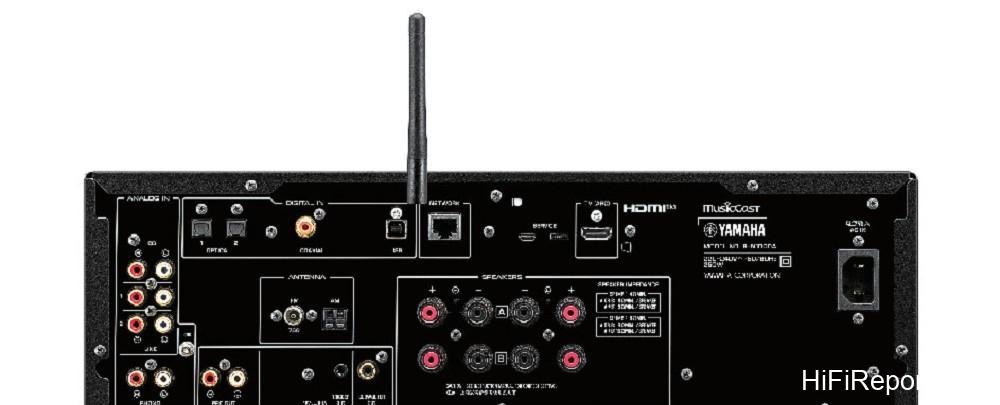
While both conditions are commonplace in AV receivers, they are rarely found together in a two-channel integrated amplifier. Only recently have many two-channel audio manufacturers begun to prioritize the inclusion of “HDMI ARC” in integrated amplifiers. Most home users set up their audio systems in the living room, where the smart TV serves as the entertainment hub, with content sources including streaming movies and music videos.
Many people are dissatisfied with their TV’s built-in speakers and opt for a soundbar, but frankly, most audio enthusiasts are reluctant to use soundbars. This is because the sound quality and power of a “proper” audio system are undeniably far superior to a soundbar.
To output digital audio from a smart TV to an audio system, the minimum requirement is that the audio system has digital inputs, allowing connection via optical cable from the smart TV’s digital output. However, HDMI ARC is much more convenient.
Features like the R-N1000A’s HDMI ARC include HDMI CEC linkage control: it automatically turns on and off with the TV, allows volume control using the TV remote when playing TV audio, and even automatically switches the input to TV (HDMI ARC) when you turn on the TV while listening to streaming music. Because HDMI ARC is so user-friendly, it allows full utilization of the audio system while watching TV.
Therefore, many consumers and enthusiasts abroad look for HDMI ARC when purchasing an integrated amplifier. Currently, the proportion of such integrated amplifiers is still low, but I believe it will increase rapidly.
YPAO Room Correction & 2.1 Setup
With greater awareness among consumers, many new-generation audio enthusiasts understand that room correction can effectively mitigate the negative effects caused by frequency response imbalances and asymmetrical reflections from left and right walls. The R-N1000A’s built-in YPAO performs precisely this function. Users don’t need to be audio experts; by simply following the test procedure steps, it can perform room correction for you, automatically optimizing the symmetry of the soundstage.
A particularly unique and thoughtful point is that the R-N1000A has two sets of speaker terminals (A and B). You can connect one pair of speakers in the living room and another in a different space (like a dining room or bedroom) to listen at different times, or you can use both sets of terminals for bi-wiring. The R-N1000A can perform and store separate YPAO test calibrations for each of the three speaker output states: Speaker A, Speaker B, and Speaker A+B.
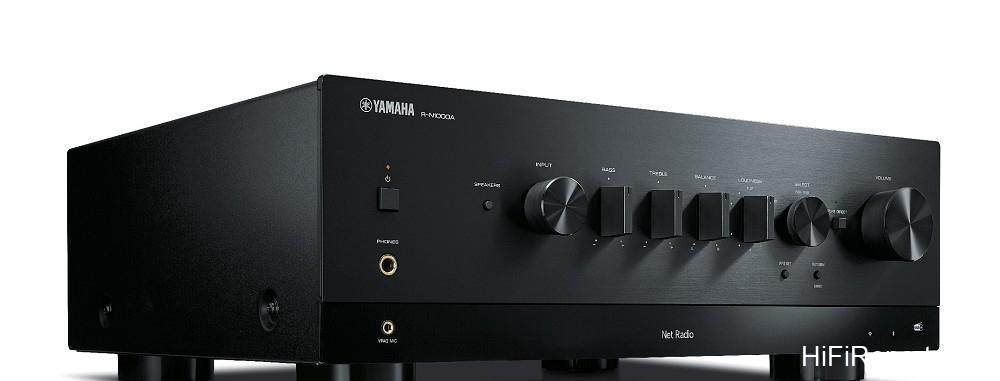
Therefore, if a user wants to install one pair of speakers in the living room and another in a room, sharing the R-N1000A (the main system can still have 2.1 channels), YPAO calibration suitable for the actual response characteristics of each space can be performed individually in both locations.
Another crucial point is that YPAO settings include bass management (subwoofer crossover point and volume level). This is incredibly useful if you want to set up a 2.1 channel system, as most two-channel enthusiasts are not skilled at adjusting subwoofers. Furthermore, most two-channel integrated amplifiers and preamplifiers lack bass management capabilities, making it even harder to accurately integrate the subwoofer with the left and right channel speakers.
Additionally, YPAO measures the direct distance from all speakers, including the active subwoofer, to the listener’s head, ensuring that the sound arrives at the listening position at the same time. This allows for more flexible subwoofer placement, eliminating the need to keep it close to the left and right speakers.
Streaming and Connectivity
The R-N1000A has built-in Wi-Fi and Bluetooth, supporting music streaming services (such as Spotify, TIDAL, Qobuz) and playback of music files from a home NAS, computer, or directly from a mobile phone using the Yamaha MusicCast App (via lossless Wi-Fi transmission). Compatible music file types include MP3, WMA, MPEG-4 AAC, WAV, FLAC, AIFF, and DSD. FLAC is supported up to 384kHz/24bit, WAV and AIFF up to 384kHz/32bit, and DSD up to 11.2MHz (DSD 256).
This coverage includes the highest specifications for most current digital music files.
Hardware Design and Technology
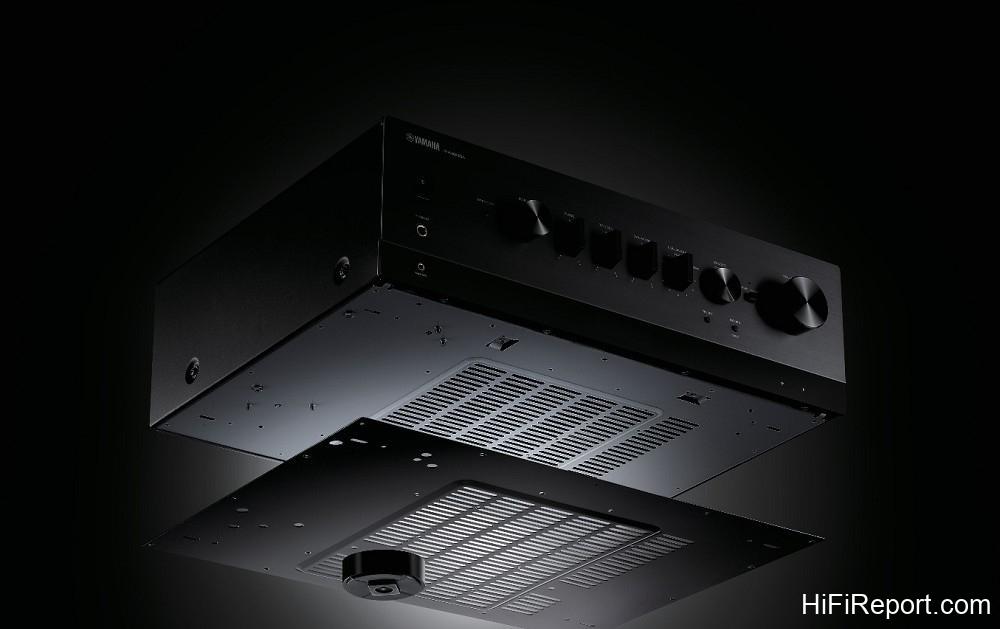
The R-N1000A’s hardware design and construction follow Yamaha’s ToP-ART (Total Purity Audio Reproduction Technology) concept. More specifically, this is divided into two parts: “circuitry” and “body structure.” The circuitry part ensures the path of the left and right channel audio signal from input to output is “direct and symmetrical” to reduce noise and distortion, achieving the highest sound quality purity. The body structure is designed to minimize vibration.
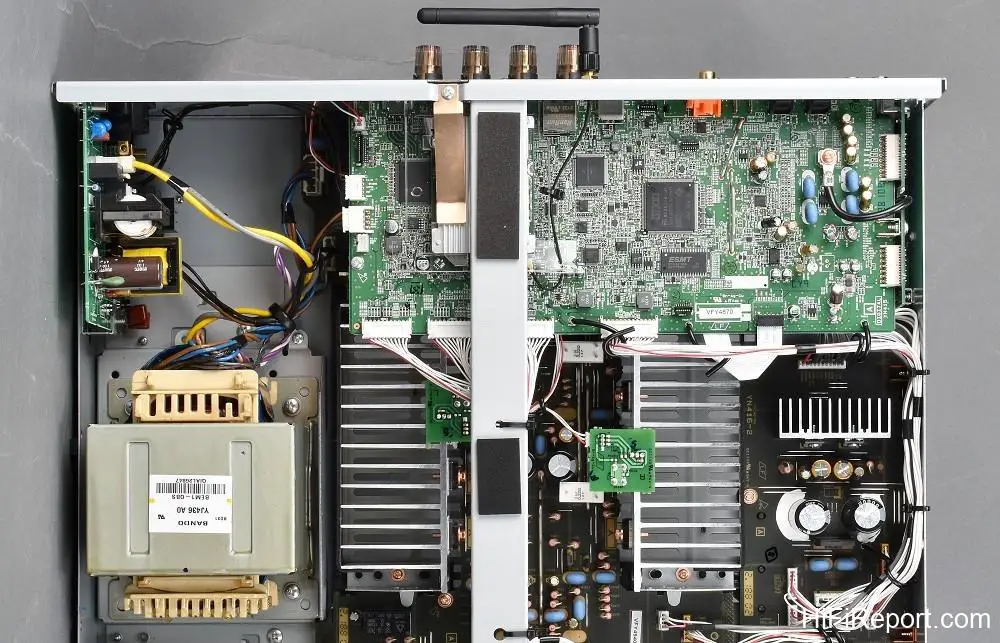
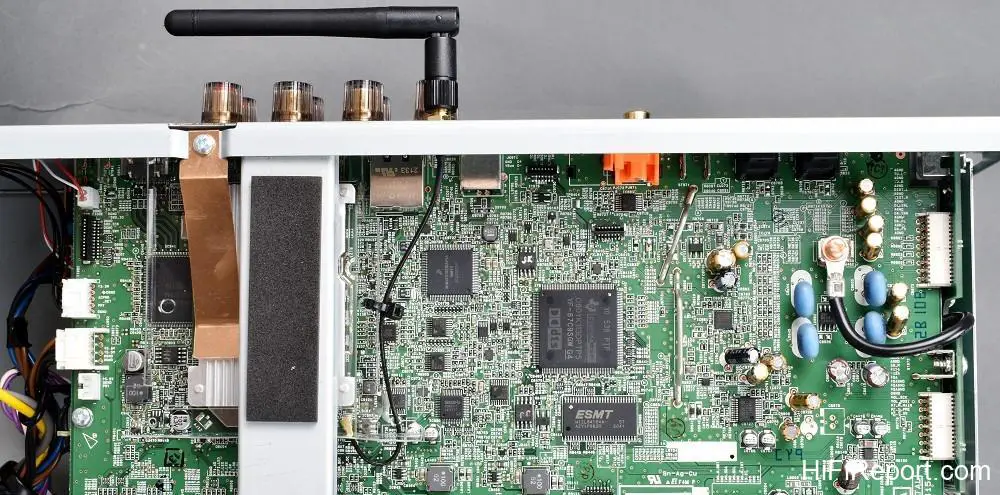
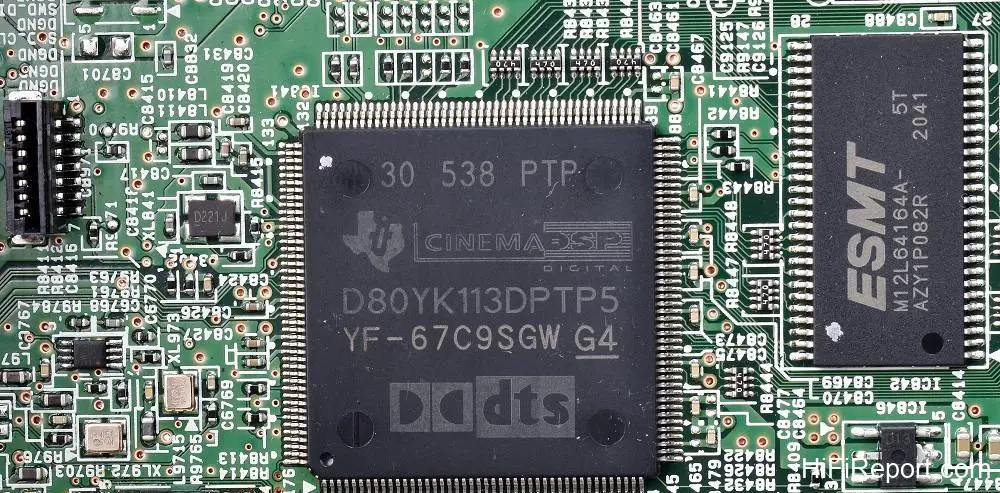
The main digital board is located at the rear top inside the unit, including the digital input interfaces, wireless network card, digital audio processing, and digital-to-analog conversion circuits. The unit uses an NXP MIMXRT1021DAF5A (Arm Cortex-M7 core) to integrate all digital input interfaces and system control. Yamaha’s custom Cinema DSP chip D80YK113DPTP5, ordered from TI, is used for digital audio processing.
Previously, Yamaha used this chip in AV receivers for standard multi-channel decoding, Yamaha DSP digital sound fields, and YPAO processing. In this case, its main function is YPAO, allowing for higher precision processing: supporting up to 192kHz/24bit input, expanded to 64 bit for the high-precision equalization processing required for room correction.
Some might wonder if 64-bit equalization processing is meaningful when even the highest-end DAC chips are still 32-bit. Digital equalization processing inevitably reduces dynamic range and signal-to-noise ratio. The R-N1000A significantly expands the bit depth as preparation; even with some loss, the remaining dynamic range from 64 bit is still much higher than 32 bit. Therefore, I believe its 64-bit high-precision equalization aims for “sound quality-preserving room correction.”
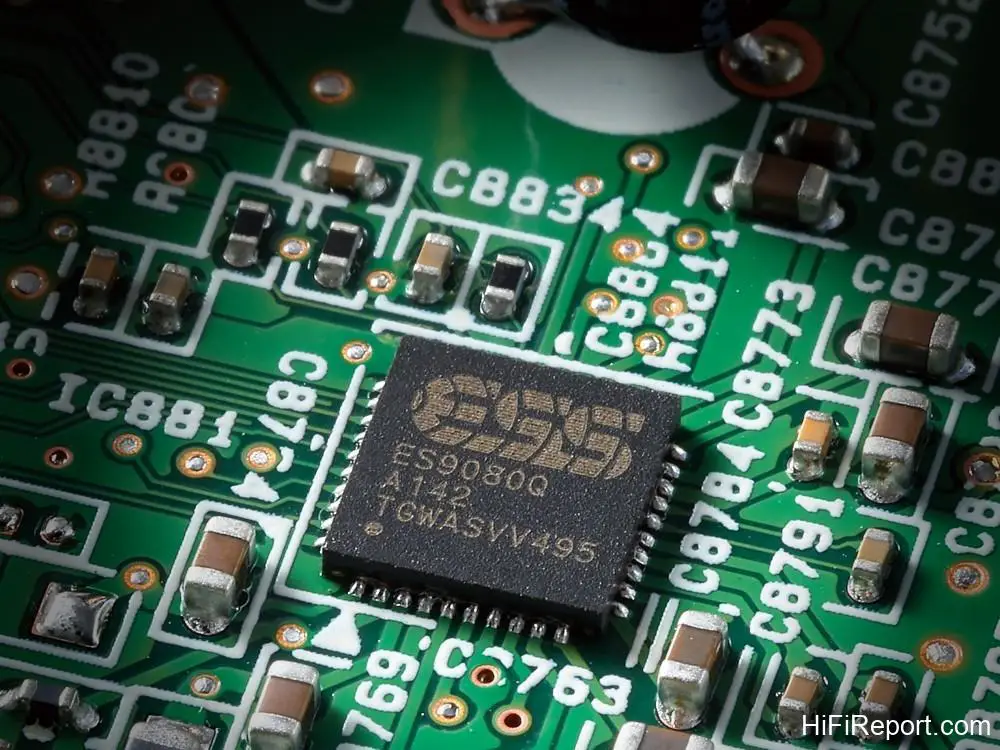
At the end of the digital audio processing chain, the signal is converted to 32 bit, compatible with the DAC chip. Then, the ESS ES9080Q high-performance 32-bit DAC chip is used for digital-to-analog conversion (see the diagram below). For the preamplifier circuit, the unit adopts a minimalist, ultra-short design. Its preamplifier board also serves as a connection board for the audio signal to “descend” from the digital main board to the power amplifier circuit.
Analog signals output from the digital-to-analog conversion circuit enter the top of the preamplifier board. A ROHM BD34703KS2 7.1 channel audio processing chip handles input audio switching and volume control. The Phono Stage for turntable input is constructed using low-noise Op Amps JRC NJM2068D combined with passive components.
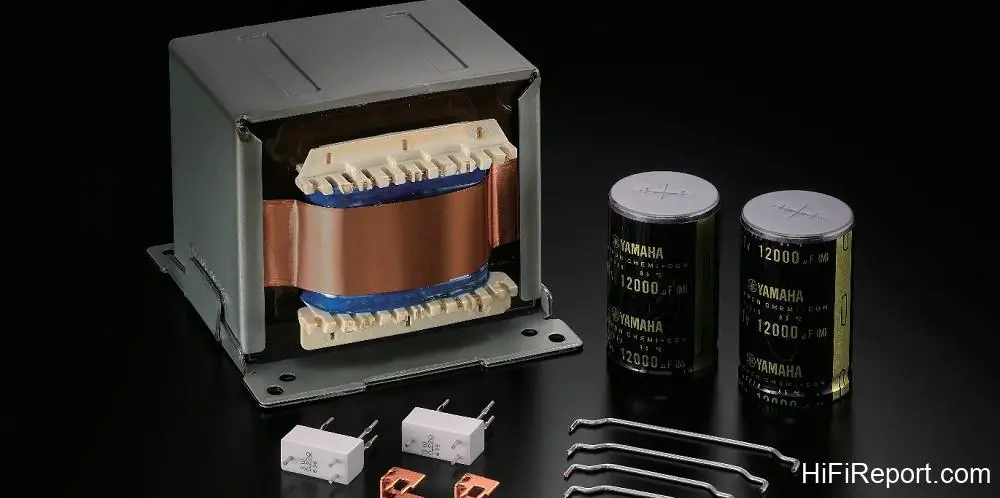
The power amplifier section uses a simple transistor amplifier circuit. A brief inspection reveals it’s a mid-range model prioritizing current output capability. Instead of using printed circuit board traces, copper bars connect the power supply to the power transistors to reduce internal resistance. Each channel uses two pairs of Sanken power transistors 2SA1694/2SC4467 in parallel push-pull output, known for their excellent high-frequency response characteristics (see the diagram below).
Listening Impressions
For the listening test, I paired the unit with Pioneer S-1EX floorstanding speakers and a Velodyne VI-Q 12 active subwoofer. Before the formal listening session, I completed the YPAO test procedure. What about the effect of room correction? Yamaha doesn’t elaborate much, so I’ll share my observations from comparing “with equalization” and “without equalization” using REW tests. After YPAO calibration, the frequency response clearly became flatter.
The primary effective range is roughly from 60Hz to 10kHz. It can reduce prominent “peaks” in the frequency response curve by up to 5dB, which is certainly quite effective in reducing the booming caused by bass room modes above 60Hz. It can fill in “dips” by about 2dB, so the overall difference between peaks and valleys in the frequency response curve is estimated to decrease by 7dB, and the symmetry of the full-range response between the left and right channels becomes much closer.
Comparing the difference between “Enable/Disable YPAO Speaker Setting Optimization,” my first focus was on texture. The 64-bit processing is truly impressive. Listening to the Sarabande from “Hilary Hahn plays Bach,” the difference in violin texture between the two states was quite small, indicating that its YPAO processing introduces almost no sound quality degradation. The speakers I used for testing cost over ten times the price of the R-N1000A and are equipped with beryllium dome tweeters.
When paired with speakers costing between $1,500 and $3,000 USD, such a small sound quality difference would be difficult to discern, so YPAO absolutely should be used! I also recommend enabling “YPAO Volume,” which automatically applies frequency loudness compensation, ensuring good three-frequency balance at low to moderate volumes.
The R-N1000A truly embodies Yamaha’s “True Sound.” With YPAO engaged, the soundstage exhibits a “precisely focused” state. It effectively reduces bass room modes, and the tight, sharp bass and sub-bass also improve the overall speed and purity of the sound.
The neutral, realistic presentation is not only close to the “restoration of the music’s original form” found in studio-style sound, but it also offers a silent background and an extremely clear and transparent soundstage, completely uncolored. It presents the sound with the clarity and visual sense of being directly in front of the live performance. A simple piano solo possesses a complete, pure, and beautiful timbre.
Since the unit has HDMI ARC, testing network video performance is a must. Users should definitely switch the Option PLL to Mode 3. This effectively reduces the clock jitter caused by dividing the video clock when using the HDMI interface. Compared to the factory default state, switching to Mode 3 reveals a sound that is more refined, with improved transparency, focus, and texture. It’s quite rare for HDMI ARC to also reduce jitter!
Playing the “YOASOBI’s Anime Songs from ARENA TOUR 2023 Denkou Sekka” concert recently uploaded to YouTube, the soundstage was quite wide. With a subwoofer connected, the volume could be turned up “quite assertively.” The vocals and instruments on stage, as well as the hall’s reverberation, were incredibly “lively.” During “Idol,” the enthusiastic audience of otaku members waved their glow sticks while shouting synchronized “Hey”s along with the song.
The ability to reproduce spatial information in a more concrete and clear manner enhances the listener’s sense of being immersed in the live experience.
During the listening process, I briefly set the left and right speakers to full-range output and turned off the subwoofer to test the unit’s ability to drive floorstanding speakers in Pure Direct mode. The R-N1000A allowed me to confidently turn up the volume, driving the S-1EX with energetic sound. It could be fierce and unrestrained.
Listening to “Liberation from the Curse” from the “Mobile Suit Gundam: The Witch from Mercury” soundtrack, the power, impact, and scale of the orchestral sound were impressively high quality.
However, if players want even greater sonic energy, I still recommend a 2.1 channel system with a capable subwoofer. For the left and right channels, choose bookshelf, on-wall, or in-ceiling speakers with high power handling. Bookshelf speakers can be placed close to the back wall (don’t worry, YPAO will handle the frequency response calibration), and the subwoofer can be tucked into a corner.
This way, the R-N1000A can not only allow the entire system to fully unleash the powerful bass and impact of movie soundtracks but also save valuable space at home. Don’t even ask how a soundbar compares to such a proper system; there’s truly no comparison!
Conclusion
A streaming amplifier simply needs a pair of speakers to become an audio system. The R-N1000A is even more special; add two pairs of speakers, and it’s almost equivalent to a dual-zone audio system, although for power amplifier load considerations, I recommend using them at different times. Even more impressive is that it is currently one of the few integrated amplifiers with room correction capability and 2.1 channel bass management.
As long as you choose the right speakers and subwoofer, it has the capability to deliver powerful energy and “rock the house”! The R-N1000A’s comprehensive performance, including sound quality, accuracy, power, and functionality, is hard to match under ~$1,500 USD. Such a powerhouse deserves our best recommendation.
Specifications
* Type: Streaming Receiver
* Signal-to-Noise Ratio (CD): 100 dB (Pure Direct On)
* Rated Output Power (20 Hz-20 kHz 0.07 % THD): 95 W + 95 W (8 ohms & 4 ohms)
* Dynamic Power / Channel (8/6/4/2 ohms): 105 / 130 / 170 / 215 W
* Frequency Response: 10 Hz-100 kHz 0±1.0 dB, 20-20 kHz 0±0.5dB (Pure Direct On)
* Analog Inputs / Outputs: Phono, CD, Line 1, Line 2 / Pre Out, Subwoofer Out, Headphone Out, Two Speaker Outputs
* Digital Inputs: HDMI ARC, USB DAC (Type-B), Optical 1, Optical 2, Coaxial, Ethernet
* Wireless Transmission: Wi-Fi and Bluetooth
* Compatible Music Files: MP3, WMA, MPEG-4 AAC, WAV, FLAC, AIFF, DSD
* Dimensions (W×H×D): 435×151×395 mm
* Weight: 12.3 kg

- Authentic Hi-Fi quality with high-resolution music streaming compatibility and HDMI connection
- ESS SABRE ES9080Q Ultra DAC for superior S/N performance
- YPAO-R.S.C. (Reflected Sound Control) and precision EQ for ideal listening environment
- High-performance USB DAC function supports DSD 11.2 MHz native playback and 384 kHz playback
- Phono input terminals to enjoy your vinyl record collection