
Arcam ST5 Streamer Review
To truly appreciate the ST5, one must understand it within the broader context of Arcam’s new generation Radia series. The ST5 isn’t just a standalone unit; it’s a vital component of this fresh lineup. Grasping the vision behind the entire Radia series reveals the deliberate design philosophy embedded in the ST5, from its features to its aesthetics.
Founded in 1976, Arcam (A&R Cambridge) is a venerable British audio brand nearing its fiftieth anniversary. Arcam has always been a pioneer, readily adopting new technologies. In the 1980s, for instance, they were among the first to introduce external DACs, setting a precedent that paved the way for more sophisticated Hi-Fi architectures.
Similarly, Arcam’s use of the relatively uncommon Class G amplification technology in their amplifiers demonstrates a commitment to finding a better balance between efficiency and sound quality than traditional approaches. Given this history, it’s natural that Arcam has actively embraced the recent surge in network streaming, launching several components with streaming capabilities or dedicated to streaming audio.
In 2023, Arcam undertook a significant refresh of its product line, introducing the Radia series. This range encompasses virtually all the components needed for digital listening, with each unit serving a specific purpose, allowing consumers to build a system tailored to their needs. The Radia series includes three integrated amplifiers – the A5, A15, and A25 – as well as two source components: the CD5 CD player and the ST5 streamer, the subject of this review.
The ST5 is clearly positioned to handle the streaming duties within the Radia family.
Design and Connectivity
To ensure optimal compatibility within the Radia series, the ST5 offers multiple audio output options. By default, the ST5 performs digital-to-analog conversion internally via its built-in DAC, outputting an analog signal. However, it can also be configured for digital output, allowing a downstream component to handle the decoding. Furthermore, settings enable users to choose whether the ST5 decodes MQA files internally or passes the decoding task to the subsequent device.
When paired with compatible Arcam integrated amplifiers like the A5 or A15, an Ethernet connection facilitates synchronized volume control and potentially enhanced sonic performance.
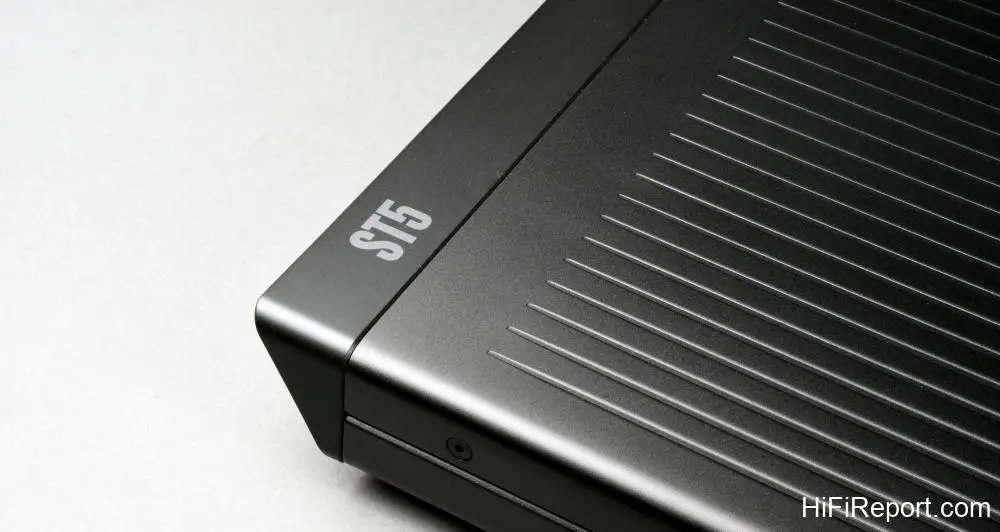
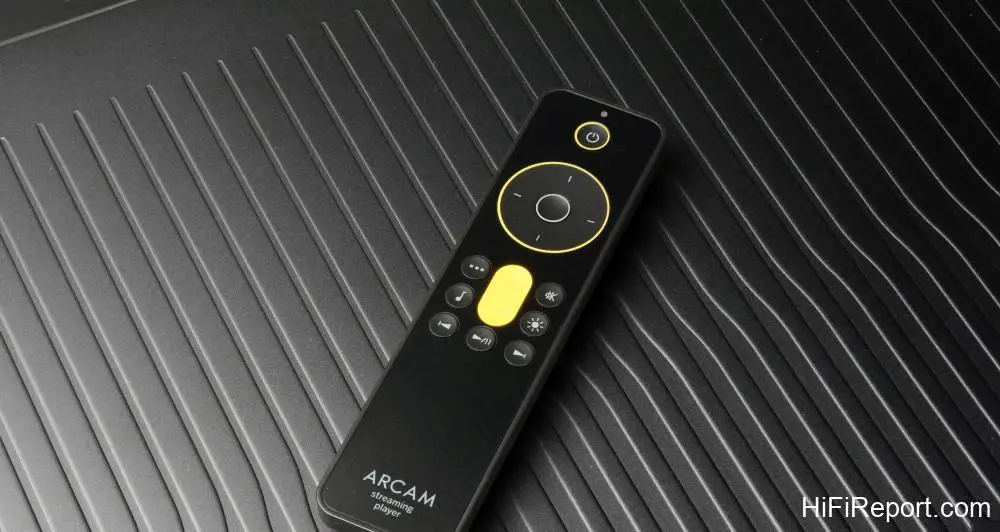
Aesthetically, the Radia series represents a dramatic departure from traditional Arcam designs, looking almost like products from a different brand altogether. All Radia components feature a black finish accented with yellow striping along the sides. The rear section of the chassis extends slightly upwards, creating a streamlined profile, while the top panel is adorned with decorative lines reminiscent of water ripples.
Arcam designed the Radia components with consistent width and depth to ensure they stack neatly and look cohesive. These shared design elements are clearly visible in the ST5’s appearance.
In 2024, Arcam continued to expand the Radia series at the Munich High End Show, introducing the ST25 streamer and two streaming amplifiers, the SA35 and SA45. This expansion solidified the Radia series as Arcam’s new generation identifier, suggesting a comprehensive brand revitalisation effort.
While these new models also feature streaming capabilities, they don’t diminish the ST5’s value. Many consumers already own a two-channel system with preferred preamps and power amps but simply need a pure streaming source. The ST5 is perfect for this role. The ST25, while also a streamer, is positioned at a higher tier, featuring a larger front display and a more sophisticated power supply, which naturally results in a significantly higher price point.
The ST5, in contrast, remains the accessible entry-level streamer, making it an affordable option for budget-conscious audiophiles.
Streaming Features
Despite being Arcam’s most entry-level and slender streamer (with a chassis height of only around 6 cm), the ST5 offers a comprehensive suite of core streaming functionalities. It supports popular services including Spotify Connect, Tidal Connect, Qobuz, Amazon Music, and Podcasts.
Tidal Connect is particularly noteworthy; its inclusion allows you to control playback and switch sources directly from the Tidal app, which is incredibly convenient and a feature still missing on many streamers today. Beyond this, the ST5 also supports Apple AirPlay 2 and Chromecast, ensuring seamless music playback control from both iOS and Android mobile devices. The ST5 is also Roon Ready, allowing it to be integrated into the excellent Roon playback environment.
Internal Hardware and Connectivity
The ST5 is equipped with an ESS ES9018 DAC chip, capable of handling PCM up to 24-bit/192kHz, DSD128, and MQA decoding. On the rear panel, the ST5 features an RJ45 Ethernet port and a USB Type A port as primary inputs. Digital outputs include one optical and one coaxial port, while analog output is provided via a single set of RCA connectors. An additional RJ11 port is present for control linking with other Arcam Radia components like the A5 or A15 integrated amplifiers.
The ST5 also supports Wi-Fi, allowing for wireless network connectivity.
User Experience
Moving on to practical use, I tested the ST5 with Linear Acoustic pre/power amplifiers and Sonus Faber Sonetto V G2 floorstanding speakers. It’s worth noting that the ST5 offers two primary control methods: a remote control and the Arcam Radia App. The app is designed to be very simple, primarily offering source selection and playback functions. Most other settings must be accessed via the remote control, viewed on the front panel display.
I suspect this design approach aims to encourage a relaxed user experience when using the app, focusing solely on music playback without delving into complex settings. Furthermore, if you’re a Spotify or Tidal user, you may not even need the Arcam Radia App at all, as you can control the ST5 directly from their respective apps. When streaming high-resolution music via the Arcam Radia App, the app conveniently displays the music format, sample rate, and bit depth, which I found sufficient.
However, for the initial setup, I recommend using the remote to review the key settings. Several are important and should be configured. Firstly, the Output Type: the default is Analogue output, with digital output disabled. There are two digital output options. Bitstream, as mentioned earlier, outputs a digital signal and passes MQA decoding to an external DAC. Digi Core mode, conversely, has the ST5 perform MQA decoding internally before outputting the digital signal.
Secondly, the Volume Output setting offers Fixed, Variable, and External modes. Fixed volume mode passes volume control to the downstream preamplifier. Variable allows the ST5 to control volume. External mode is for linking with Arcam’s own Radia series A5 or A15 integrated amplifiers.
This connection offers the most convenient control and, by allowing the higher-tier integrated amp to handle volume attenuation, theoretically minimises dynamic range compression and improves the signal-to-noise ratio. Thirdly, you can select the DAC Filter mode: Fast, Slow, or Min. It’s worth experimenting with all three to find your preferred setting.

Sonic Performance
In terms of sound quality, the ST5 struck me as neutral, warm, smooth, and possessing a slight sense of body – an approachable and friendly sonic character. Many digital components on the market emphasise extreme resolution to showcase their decoding prowess. While initially impressive, this can sometimes lead to a sound that feels aggressive or fatiguing over time.
The ST5 avoids this; it provides an appropriate level of detail without causing listener fatigue or harshness, resulting in a smooth and gentle sound.
The ST5 adopts a similar approach in the mid-range. It doesn’t exaggerate vocal thickness or scale, maintaining a neutral foundation. However, it doesn’t lack body. Combined with its gentle sonic style, vocals possess a lovely charm – a slightly warm yet unmannered quality. In the low frequencies, the ST5 leans towards a more restrained presentation. It won’t deliver earthquake-like impact but provides just the right amount of low-end solidity and definition.
This character makes the ST5 well-suited for playing gentle and comfortable music. For example, the first track, “Merry-Go-Round of Life,” from Joe Hisaishi’s “A Symphonic Celebration” album (the theme from “Howl’s Moving Castle”), sounded very smooth through the ST5. The opening piano had a light and sweet quality. As the strings joined, the music developed a waltz-like atmosphere, evoking the feeling of a breezy expanse, reminiscent of scenes from the film.
The ST5’s character is perfectly suited to conveying such musical imagery.
The mid-range, especially vocals combined with jazz elements, is an area where the ST5 truly shines, providing a very pleasant listening experience. Take Johnny Hartman’s “I Just Dropped By to Say Hello.” Vocals had good body without being overly exaggerated, maintaining a neutral base that allowed for natural emotional expression. The accompanying piano sounded relaxed and effortless, while the background brushwork on the drums subtly underpinned the music without being overly prominent.
It felt like the ST5 was painting Johnny Hartman’s performance with a slightly soft brush.
This inviting character led me to seek out other great vocal recordings. For female vocals, Melody Gardot’s “If You Love Me” is a must. Her voice is inherently sweet and soft. On systems that aren’t neutral and add artificial colouration, she can sometimes sound overly saccharine. The ST5 avoids this, capturing Melody Gardot’s captivating vocal style while maintaining appropriate mid-range body.
Each articulation and vocal turn possessed a seductive charm without becoming overly sentimental, resulting in a very comfortable listen.
Another track I particularly enjoyed was “In a Mellow Tone” by Delicatessen. This Portuguese jazz group is known for blending jazz and Bossa Nova styles, and the lead vocalist, Ana Krüger, has a fascinating voice – resilient yet tinged with a hint of melancholy and nostalgia. She excels at conveying emotional depth, especially in slower tempos.
Through the ST5, the accompanying instruments sounded lazy and relaxed, while Ana Krüger’s voice was warm, gentle, and full of emotion, making it impossible not to sway along.
Final Thoughts
In conclusion, the ST5 is Arcam’s most accessible streamer. While its features and sonic performance naturally differ from their higher-end models, its overall design is perfect for those new to streaming. Beyond being Arcam’s most affordably priced streamer (priced at 39,700 NTD, approximately $1240 USD), it boasts the slimmest profile and streamlined aesthetics, making it easy to place and visually appealing.
The ST5’s direct support for Tidal Connect and Spotify Connect makes music playback incredibly intuitive. Its gentle sound signature makes much of your music sound relaxing and enjoyable. If I owned an ST5, I’d likely have it playing background music all day, particularly favouring mid-range-centric vocals and instruments. If you’re looking to dip your toes into the world of streaming audio, the ST5 is definitely worth seeking out for a audition.
Specifications
* Type: Streaming DAC
* Maximum Decoding: PCM 24Bit/192kHz, DSD128, MQA
* DAC: ESS ES9018
* Streaming Technologies: Spotify Connect, Tidal Connect, AirPlay 2, Chromecast
* Input Terminals: RJ45×1, USB Type A, RJ11 (Control)
* Output Terminals: Optical×1, Coaxial×1, RCA×1 (Analog)
* Dimensions (WHD): 431×57×344mm
* Weight: 3.5 kg