
Arcam SA10 Review
For many audiophiles domestically, the Arcam brand is likely a familiar name. However, for the uninitiated, a brief introduction is in order. This British manufacturer was founded in 1976, boasting a history spanning nearly half a century. Arcam has previously introduced numerous classic components, such as the A60 integrated amplifier and the Black Box, a standalone DAC specifically designed for CD transports, both serving as excellent examples of their legacy.
These classic pieces consistently demonstrated the brand’s hallmarks: high-quality craftsmanship and incredibly robust construction.
The exceptional value for money offered by Arcam’s products meant they achieved significant visibility in the domestic audio market as far back as 20 or 30 years ago, becoming a favoured brand among many seasoned audiophiles. In fact, Arcam had a remarkably broad product line in the 1990s. Whether you were seeking an integrated amplifier, player, AV receiver, or DAC, you could reliably find an option within their range, establishing them as a forward-thinking brand ahead of its time.
Although Arcam experienced a period of absence from the domestic audio scene for quite some time, their visibility among younger audiophiles has significantly increased in recent years, thanks to the efforts of local distributor Carmen. Throughout this period, the brand has continued to launch new and innovative products, eagerly anticipated by audio enthusiasts.
Arcam’s Current Range
Looking at Arcam’s current lineup, it encompasses integrated amplifiers, AV receivers, CD/SACD players, streaming sources, and power amplifiers, ensuring there’s a suitable component available regardless of your specific needs.
Arcam’s current range of integrated amplifiers includes the SA30, SA20, and SA10, covering high-end, mid-range, and entry-level tiers. The SA10 is precisely that entry-level model. Despite its positioning, this digital integrated amplifier still incorporates the carefully developed tuning design that the manufacturer is known for.
Design and Connectivity
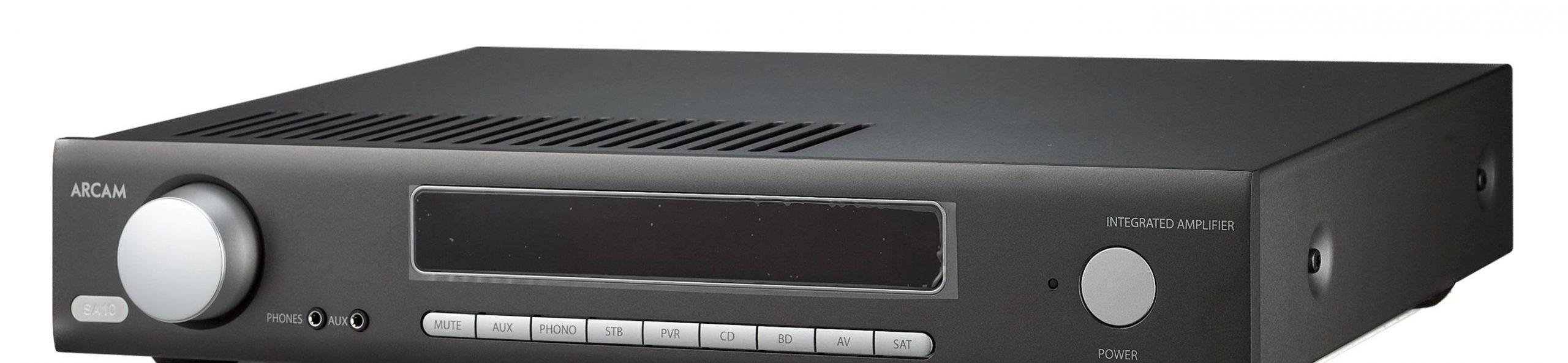
Visually, the SA10 shares a similar aesthetic with other models in its series, featuring a slim and minimalist design.

The front panel hosts a power button, volume knob, and a neatly aligned row of control buttons. It maintains the standard dimensions of a traditional British integrated amplifier while presenting a more refined and understated texture.
In terms of connectivity, the SA10 supports connecting a single pair of speakers. The rear panel includes digital optical, digital coaxial, three sets of RCA analogue inputs, and one MM phono stage input, making it capable of handling both digital and analogue sources with ease.

Additionally, it features a subwoofer output, allowing users to listen in a 2-channel stereo setup or enjoy movies and games in a 2.1 channel configuration, making it perfectly suited to serve as a hub for home entertainment.
Internal Design and Components
Let’s delve into the SA10’s circuit design. According to Arcam, its internal amplification circuit operates in Class AB, delivering 50 watts per channel into an 8-ohm speaker load. For an entry-level integrated amplifier, this is a perfectly adequate level of performance. Peeking inside the chassis reveals an extremely neat and organised arrangement of the internal circuitry.
Nearly all the electronics are concentrated on a single PCB, a design approach that not only saves on assembly costs but also contributes to this integrated amp’s outstanding value for money compared to competing models. This is a prime example of the robust componentry often found in their equipment.
Looking closer, the SA10 employs a large toroidal transformer, another signature design choice for the brand, which provides the amplifier with ample and stable power. For the preamplifier circuit, Arcam has selected the low-noise LM49723 operational amplifier chip, using the same chip for the phono stage. The volume control chip is the PGA2311U, chosen for its ability to reproduce a warm, analogue-like sound. As for the DAC chip, the SA10 is equipped with a 32-bit Sabre ESS9016K2M DAC.

According to the manufacturer, this amplifier can decode high-resolution audio up to 16-bit to 24-bit/192kHz, which is more than sufficient for an entry-level integrated amplifier.
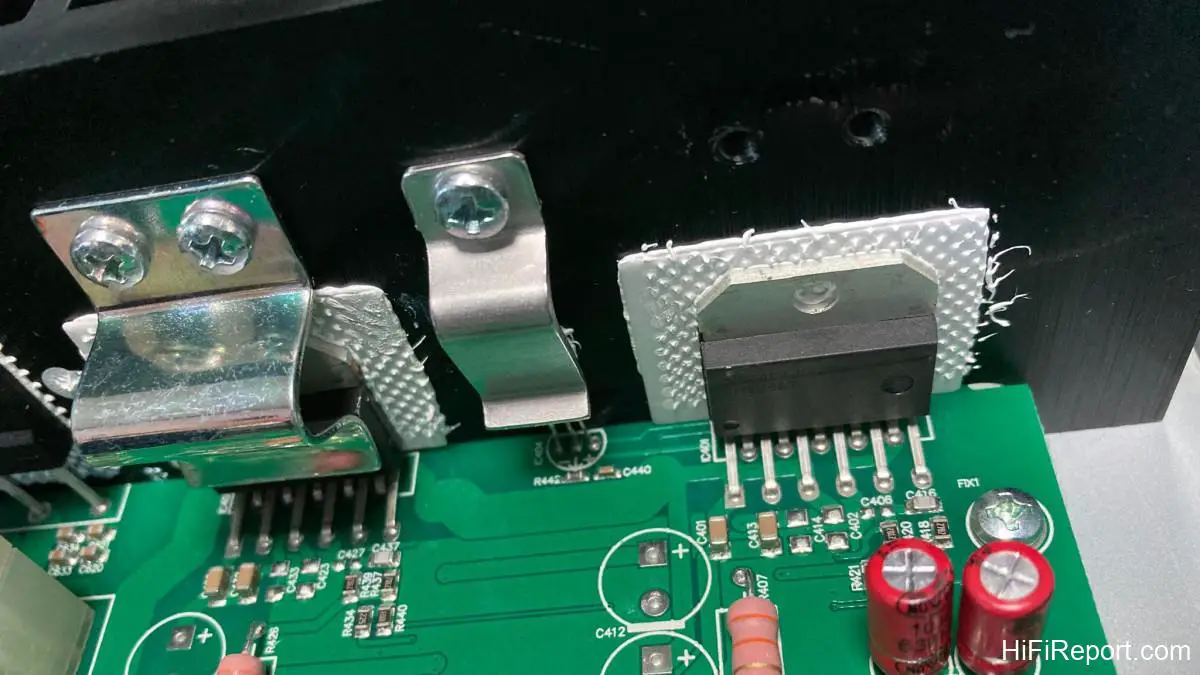
In the power amplifier section, the SA10 features two large 10,000µF filter capacitors to ensure more stable and abundant power quality. Notably, Arcam has specifically mounted the LM3886T analogue IC power modules responsible for outputting to the left and right speakers onto the heatsink using metal spring clips. This PA chip itself possesses low distortion and low noise characteristics.

The spring-loaded mounting method increases the contact area with the heatsink, resulting in superior heat dissipation and helping maintain excellent signal quality during transmission.
These various design elements and component choices highlight Arcam’s meticulous approach to tuning the SA10. Furthermore, the connections between circuits involve minimal unnecessary wiring. This technique significantly reduces power signal loss and interference during transmission, ultimately delivering a complete sound signal to the speakers that is faithful to the original source.
According to the manufacturer, the total harmonic distortion of this integrated amplifier is only around 0.003%, which is an excellent level for equipment in this class.
Listening Impressions
In practical listening tests, I paired the Arcam SA10 with both Yamaha NS-2000A floorstanding speakers and the magazine’s standard test equipment, Pioneer S-1EX floorstanding speakers. The source used was a Lumin D2 streamer, playing high-resolution audio from streaming platforms. After some listening time, I noted that this amplifier exhibits a more analytical character, with a very clear and abundant sense of detail.
It effortlessly renders the distinct forms of various instruments and objects within the soundstage. Furthermore, the contrast between loud and soft passages is reproduced with very noticeable layering.
For instance, when listening to the EP album “Ben-Haim: Symphony No.1” by the Israel Philharmonic Orchestra and Lahav Shani, I could hear very full drum sounds and French horns underpinning the soundstage at the lowest level, providing a solid and energetic drive to the entire piece. Even during passages where inner and outer sections played in unison, the smooth and bright texture of the violins remained audible. Every instrument was presented with a clear form.
The distinct dynamics between loud and soft also made it easier to perceive the position and complete form of instruments during listening.
After listening for a while, I confirmed that this amplifier possesses excellent resolving power, effortlessly bringing out the subtle textures of instruments. The abundance of detail also resulted in a finer and softer quality. For example, when listening to Nadia Labrie’s album “Flute Passion: Mozart,” I could hear the full breathiness as the flutist played.
The violin strings accompanying had a smooth, lustrous texture, yet with a delicate and gentle quality, allowing me to fully appreciate the warm texture of the wooden instruments.
Not only is the high-frequency detail excellent, but this amplifier’s mid-range performance is also very good. While not of the forward and massive type often associated with older British amplifiers, listening to singer Sandee Chan’s album “2004 Addiction Live Concert (Live)” revealed her voice positioned in the middle layer of the soundstage with a very focused and full vocal presence. Details like vocal inflections and breathing were clearly discernible.
Similarly, listening to the track “Tsuki ni Hoeru” by the band Roth Bart Baron featuring Kaho Nakamura, one could easily distinguish the completely different vocal textures of the male and female singers during their duet. The rich and full mid-range details allowed the listener to easily feel the genuine human emotion in the voices.
The SA10’s characteristics of abundant detail and clear layering also provide an excellent listening experience for genres like shoegaze and psychedelic rock. For example, listening to the band Lucid Express’s album “Floret,” one can feel the electronic synthesis filling the entire soundstage, immersing the listener in the psychedelic mist meticulously crafted by the recording engineer.
However, despite this, the electric guitars, electric bass, and the lead singer’s voice all retained a very focused and full presence, completely presenting the sonic image carefully produced by the recording engineer, making for a thoroughly enjoyable listen.
In terms of low frequencies, the SA10 leans towards a more elastic and fast type of bass. Therefore, if a track includes synthesised bass effects, they are presented with greater fullness, punch, and impact, making the entire soundstage more lively and vibrant. This characteristic is particularly well-suited for listening to genres like pop, rock, and electronic music.
For instance, listening to the band No Mercy’s EP album “No Mercy,” one can hear the full, impactful hits of the drums and the thick, robust lines of the electric bass. The clear and fast bounce added to the overall liveliness and vibrancy of the soundstage.
Listening to jazz with the SA10 also creates a very lively stage presence. For example, Art Blakey & The Jazz Messengers’ album “Moanin'” features very solid double bass strings and drum hits, which form a steady, focused foundation at the lowest layer of the soundstage. This is complemented by the brassy texture of the saxophone and trumpet, playing with full breathiness. The piano notes are distinct, clear, and transparent, with a smooth and colourful playing style that sounds rich and varied.
The entire presentation is lively and vibrant, and thanks to the excellent texture of the instrument details, one can perceive a richer sense of layering.
Conclusion
In conclusion, although the Arcam SA10 is positioned at the entry level, it successfully embodies the hallmarks of British integrated amplifiers: excellent value for money, versatile source options, and outstanding sound quality. Despite its output power of only 50 watts (into 8 ohms), it can drive floorstanding speakers without sounding unstable or underpowered. Instead, it delivers significant layering and fine detail.
The SA10’s sound leans towards being analytical and clear, while still retaining a touch of the warm texture inherited from its British heritage. This makes for a listenable and non-fatiguing style, highly recommended for newcomers or those with limited upgrade budgets. I believe it will absolutely meet your needs!
Specifications
* Type: Digital Integrated Amplifier
* Output Power: 50W (8Ω)
* Frequency Response: 20Hz-20kHz
* Total Harmonic Distortion: 0.003%
* Inputs: Analog RCA, Analog 3.5mm, Digital Optical, Digital Coaxial, Phono Stage (MM)
* Outputs: Speaker Terminals, 3.5mm Headphone Out, Pre Out
* DAC Chip: ESS9016K2M
* Total Harmonic Distortion + Noise: 0.0007%
* Signal-to-Noise Ratio: 115dB
* Digital Optical Supported Specs: 32kHz, 44.1kHz, 48kHz, 88.2kHz, 96kHz
* Digital Coaxial Supported Specs: 32kHz, 44.1kHz, 48kHz, 88.2kHz, 96kHz, 176.4kHz, 192kHz
* Bit Depth: 16bit-24bit
* Phono Input Sensitivity: 5mV @ 1kHz
* Phono Input Impedance: 47kΩ + 100pF
* Signal-to-Noise Ratio (Phono): 80dB
* Analog Input Sensitivity: 1V
* Analog Input Impedance: 10kΩ
* Analog Max Input: 6Vrms
* Signal-to-Noise Ratio (Analog): 106dB
* Preamp Output Level: 630mV
* Preamp Output Impedance: 230Ω
* Headphone Max Output Level: 5Vrms
* Headphone Output Impedance: 1Ω
* Headphone Load Range: 16Ω-2kΩ
* Dimensions (W.D.H): 433 × 87 × 310mm
* Weight: 8.4kg