
Audioplan Faraday S II Speaker Cable Review
Prejudice is a formidable thing. It can impede progress, narrow perspectives, and unknowingly confine us to a self-imposed prison of perceived superiority.
Last year, during an audition of the Marten Parker Trio at Shang-Rui Audio, Mr. Chang, the owner, specifically pointed out the cables used in the system. It wasn’t the Jorma cables he usually favored, but Audioplan.
While Mr. Chang elaborated on the virtues of these cables, my mind was preoccupied with starting the speaker audition. I didn’t pay much attention to the cabling at the time.
My initial impression of Audioplan was positive, but I couldn’t ascertain the cables’ precise contribution or sonic character. It was a complete system, and without direct comparison, it was impossible to isolate the effect of a single component.
Two Biases
Subsequently, I didn’t give much thought to Audioplan cables, largely due to two ingrained biases.
Firstly, in my mind, Audioplan was primarily a speaker manufacturer. How could they also produce cables? The audio industry, as is often said, sees clear divisions between specializations. Cross-domain manufacturing often requires external assistance. I was skeptical that a speaker company could excel at cable design.
Secondly, I had heard that Audioplan cables used silver-plated copper conductors. My personal preference leaned towards pure copper or pure silver. In my experience, silver-plated copper cables often lacked the smoothness and long-term listenability of pure conductors.
Doubts Arise
These two biases led me to overlook Audioplan for a year and a half.
During this period, my colleague, Zhi-Yu, auditioned both the Maxwell U and Maxwell S interconnects, and also tested the PowerPlant 100 S4 isolation transformer. His feedback on Audioplan was overwhelmingly positive. He repeatedly told me, “Audioplan cables are genuinely good.” This started to sway my opinion.
Zhi-Yu and I share a preference for lively, dynamic, and colorful sound. If he spoke highly of them, there was a good chance I would appreciate them too.
Around this time, Mr. Chang from HiFiReport further piqued my interest. During a presentation I gave at HiFiReport, I noticed he was using Audioplan Faraday U speaker cables. The red sheathing of the cables was quite striking. Previously, when using Wilson Audio speakers, Mr. Chang typically paired them with Transparent cables. Yet, this time, he was using Audioplan with Alexia 2s.
When I asked for his opinion, he simply stated, “These cables are very good; I really like them.” When I pressed for specifics, he just said, “They don’t sound like silver-plated cables.” Mr. Chang is a man of few words, but this single sentence directly challenged one of my major prejudices.
“Don’t sound like silver-plated cables?” What did they sound like then? At this year’s TAA Audio Show, I saw Audioplan speaker cables again in the Boeing Sound Technology room. This time it was the Faraday S II, paired with a full Spec Audio system and Piega Coax 811 speakers. The sound was remarkably convincing.
My curiosity finally got the better of me. After the show, I borrowed a set of cables from Mr. Chang at Shang-Rui Audio. Thus, the Faraday S II and Faraday U arrived at my doorstep, initiating a musical journey of exploration with Audioplan.
Audioplan’s History
To prepare for this review, I delved into Audioplan’s official materials. It was then I realized my first bias—that Audioplan was solely a speaker manufacturer—was a misinformed stereotype.
Founded in 1980, Audioplan launched its first speaker, the Kontrast I, in 1981 (hence my perception as a speaker company). Subsequently, in 1982, recognizing the impact of power fluctuations on sound, they developed the PowerPlant power processor. Simultaneously, they discovered the influence of cables on audio signals, and in 1983, in an era where audiophile cables were not yet mainstream, they obtained patents related to cable technology.
Reading this, I readily admit I had misjudged Audioplan.
(For a concise history of Audioplan, please refer to Lin Zhi-Yu’s article, “The Simplest Yet Richest—Audioplan Maxwell U Balanced Interconnects.” For insights into Audioplan’s power processing development and product efficacy, see also Lin Zhi-Yu’s “The Best Affordable Power Solution—Audioplan PowerPlant 100 S4.”)
“Less is More” Philosophy
Audioplan explicitly states their design philosophy for cables as “Less is More” (originally: “By making it sound as little as possible”). What does this mean? Audioplan suggests that many people hope to compensate for sonic shortcomings through cables, and even many cable manufacturers design with this mindset.
Audioplan believes this approach is fundamentally flawed. They argue that in audio reproduction, we cannot achieve a true “negative times negative equals positive” scenario. We cannot correct the distortions and colorations of component A by introducing complementary colorations from component B. At best, their respective “footprints” might offer some compensation or masking, but overall, this approach diminishes naturalness.
This is akin to adding sugar to an overly salty soup in an attempt to improve the flavor. We all know this doesn’t work. The only way to fix excessive saltiness is to dilute it with water. For Audioplan, their aim is to avoid serving an overly salty “soup” in the first place. They achieve this through meticulous research into mechanical vibration, dielectric electrical properties, alloy conductor materials, and the arrangement and structure of stranded wires, all to deliver a naturally pure and delicious sonic “soup.”
Hollow Silver-Plated Conductors
The Faraday S II speaker cable utilizes heavily silver-plated, high-purity copper conductors. Mr. Chang suggests that “copper-clad silver” might be a more accurate term to differentiate it from standard silver plating thicknesses.
Each Faraday S II cable consists of four conductors, two for positive and two for negative signal paths. The conductor design is also unique, employing a hollow structure. How is this achieved? They wind the heavily silver-plated conductors around a non-conductive damping fiber bundle. This serves two purposes: firstly, the damping fiber bundle provides mechanical vibration isolation, and secondly, it creates the hollow core structure, aiming for low inductance and low capacitance, and ensuring accurate phase transmission of the signal.
Handcrafted with CRC Technology
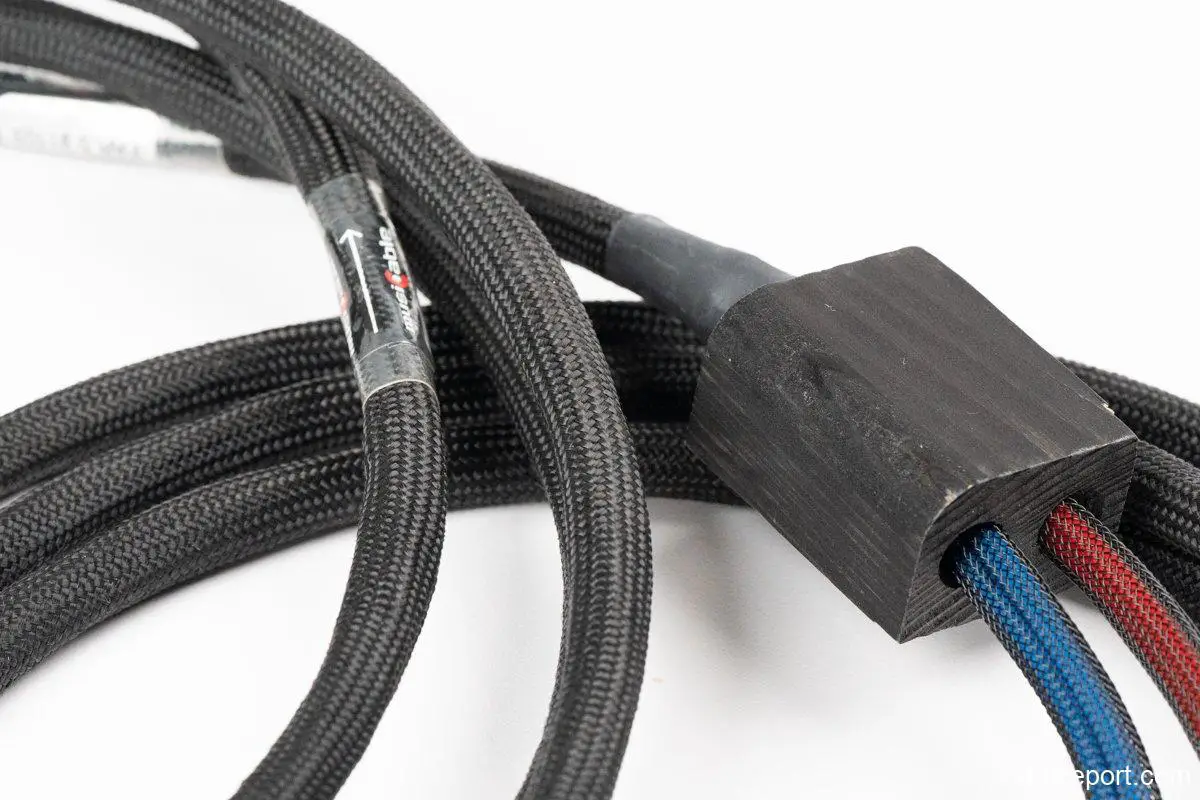
While the four internal conductors are machine-manufactured by a cable factory, the outer sheathing and other processing steps are all done by hand. The outer mesh covering the cable is not tightly fitted but maintains a degree of flexible space. The Faraday S II cable itself retains a certain flexibility, aiding in cable routing.
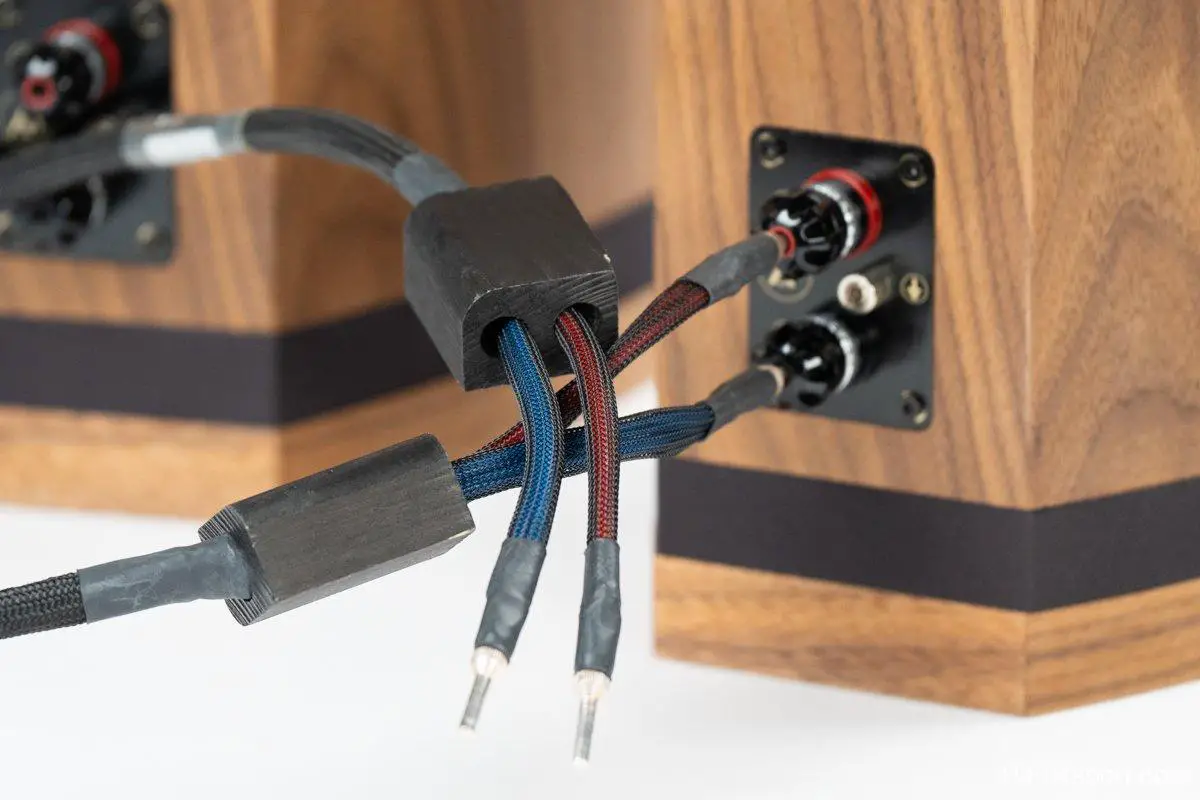
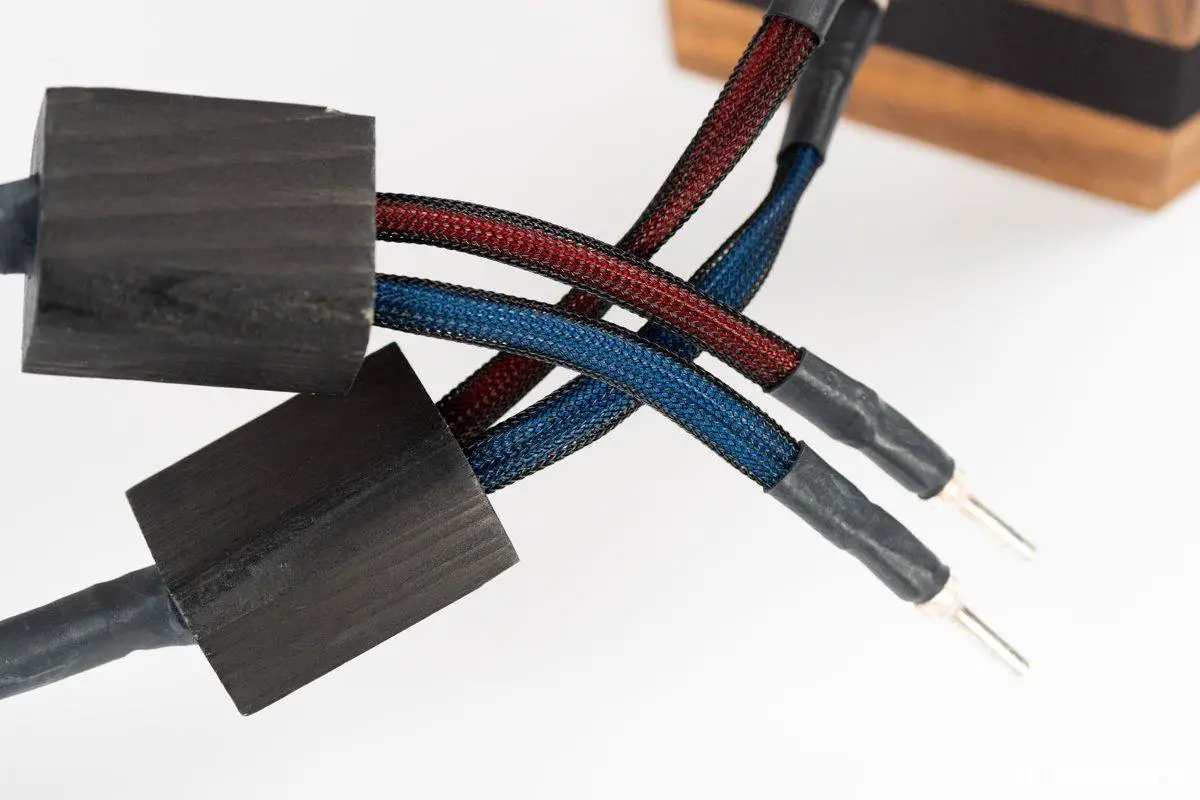
The connectors are also custom-made by Audioplan, available in silver-plated banana plugs, Y-spades, and pure copper banana plugs. The review sample I tested came with silver-plated banana plugs. The manufacturer states that they join connectors to the cable using a combination of crimping and their proprietary silver-tin soldering, ensuring secure connection and providing appropriate damping.
Another noteworthy design feature of the Faraday S II is the use of natural wooden blocks as cable dividers to suppress micro-vibrations in the cable body. All these aspects, from conductor structure to cable design and construction, emphasize resonance control. The manufacturer calls this CRC technology (Conductor Resonance Control), which is considered Audioplan’s core technology and a key to their reputation.
Natural Sound of Silver-Plated Copper
After thorough research, my initial biases started to lose their grip. The ultimate test, of course, is sonic performance. Would the Faraday S II sound like my preconceived notion of “silver-plated copper cable”? After using it at home for a month, I can definitively say: no.
Just as Mr. Chang from HiFiReport had told me, “It doesn’t sound like a silver-plated cable.” In what way? Naturalness. While silver-plated copper designs have their rationale, many silver-plated cables tend to sound somewhat unnatural and fatiguing over time. Initially, they often sound more vibrant and brighter than pure copper cables, but in terms of smoothness and naturalness, they often fall short compared to pure copper. This has been my experience.
However, the Faraday S II avoids these issues. Its tonal balance is natural, as is its frequency extension. It doesn’t artificially emphasize deep bass or bright highs, nor does it force out details or impact. Yet, the timbre is natural, the portrayed sonic images are natural, and the musical presentation is fluid. To a certain extent, it has overturned my prejudice against “silver-plated copper cables.”
Sweet and Delicious Sound
Take, for example, Vaughan Williams’ “The Lark Ascending,” with Hilary Hahn as violin soloist and Sir Colin Davis conducting the London Symphony Orchestra. Hilary Hahn’s violin tone is sweet and beautiful, with focused imaging. The vibrato adds a captivating shimmer, and the sections imitating the lark’s song are vividly rendered.
The composer designed numerous cadenzas for the solo violin, even unaccompanied passages, including sustained notes with soft vibrato, long sequences of leaping notes, and continuous trills. These musical depictions of the lark’s flight, as reproduced here, are not only vivid but also incredibly fluid. This piece alone clearly demonstrates that this “soup” is purely sweet, not overly salty, and guaranteed to be delicious.
Revealing Musical Nuances
Another violin piece that highlights the strengths of the Faraday S II is Anne-Sophie Mutter’s performance of Sarasate’s “Zigeunerweisen” (“Gypsy Airs”). The emotionally rich and powerful introduction, launched jointly by violin and orchestra, is full of virtuosity and imbued with a strong Gypsy flavor.
The music then slows down, focusing on the violin, with wide-ranging melodic variations leaping between high and low registers, interspersed with ornamentation, making the music both intensely emotional and technically brilliant. The slowly played Gypsy melodies are melancholic and poignant, creating a somber atmosphere through dynamic shifts, until the softly played harmonics fade into silence.
At this point, the powerful orchestra re-enters, launching into the wild and spirited Friska dance. Here, various virtuoso techniques reappear in dazzling display: spiccato bowing, double stops, and more, leaving the listener in awe. The natural fluidity that Faraday S II lends to this piece is particularly impressive.
Details such as ornamentation, the clarity of double stops, and the texture of harmonics are all distinctly rendered, yet without sounding artificial or contrived. Dynamic shifts are also smooth. The orchestra’s sudden fortissimo passages and the direct impact of the music all contribute to the emotional power of this passionate piece.
Expressing Violetta’s Emotions
Listening to Anna Netrebko singing Violetta’s famous aria “E Strano! – Ah, Fors’ è Lui,” followed by “Sempre Libera” from *La Traviata*, also proved to be a magnificent experience, with Claudio Abbado conducting the Mahler Chamber Orchestra.
This piece includes both recitative and aria sections. In the recitative, the accompaniment is sparse, but the emotional fluctuations are significant, especially in expressing Violetta’s inner turmoil—the anticipation mixed with shyness, the contradictory emotions of wanting to embrace love yet holding back. This is a highly challenging recitative.
Emotional shifts are evident in the pitch variations, suddenly soaring and then abruptly falling, with dynamic changes also fluctuating greatly. Netrebko’s performance in this section is truly remarkable. The high note at the end of the recitative serves as a prelude to the climax before the liberation of “Sempre Libera.”
Subsequently, we can appreciate how Netrebko flawlessly executes the demanding rapid vocal runs, extreme high notes, and legato phrasing, while also attending to the complexities of ornamentation, presenting a comprehensive and nuanced performance. The Faraday S II, with its vivid and natural presentation, conveys Netrebko’s brilliant singing, including her peak-period voice that is both sweet and substantial, and her interpretation that is both delicate and bold, with utmost clarity.
Beyond Atmosphere
Listening to Eva Cassidy’s “Nightbird” album, many of the live club recordings are most moving not for the sense of a live concert atmosphere, but for the immediacy of the live performance itself. The nuances born from emotion are evident in the vocal texture, dynamic range, emotional investment, and even the flavor of her guitar playing.
Faraday S II is truly adept in this regard. It’s hard to imagine how a pair of speaker cables could convey such a live performance atmosphere, yet it does. The vibrancy provided by Faraday S II makes the vocal textures sound more authentic. When the vocal power surges and the pitch rises, the unleashed emotional tension is striking.
Listening to her guitar, the clean tones are pure and bright, adorned with beautiful harmonics. Knowing that it’s amplified through pickups and amplifiers, it still sounds so beautiful. And Faraday S II makes these harmonics even more luminous and ethereal, and the notes more three-dimensional.
Clean and Detailed Bass
The bass performance of Faraday S II is clean and detailed. But please don’t misunderstand and assume this implies a lack of bass. Not at all. It clearly conveys low-frequency information, but because it’s so clear, even revealing textures, it might initially give the impression of bass deficiency, which is a misperception.
Take Chris Thile and Edgar Meyer’s collaborative album “Bass & Mandolin,” for example. The mandolin, of course, sounds nimble and lively, with short decays. The slightly hard timbre of the mandolin, when playing rapid passages, exhibits a dazzling virtuosity. In fact, what’s even more remarkable is Edgar Meyer’s double bass keeping pace with this speed.
The rugged and vigorous bass tones outline a vivid picture, as if one could see Thile holding the mandolin close to his chest, playing rapidly, while Meyer’s left hand busily explores the neck of his nearly half-body-length instrument. Listening to the double bass notes, the fullness of tone is rich, the rhythm is steady and nuanced. Even the occasional deep bass notes are full-bodied with clear texture.
A Change of Heart
For a month, the Faraday S II has hardly left my system. The wealth of information it conveys allows me to enjoy music at very low volumes late into the night. Its natural and pure timbre makes music incredibly engaging, completely dispelling the notion that silver-plated cables are fatiguing to listen to over time. Its balanced and fluid performance is the foundation of its rich musicality.
Having auditioned the Audioplan Faraday S II, I must revise my previous statement: “It is only poorly designed silver-plated cables that sound fatiguing and unnatural.” Does this sound like fence-sitting? Perhaps. But Audioplan has proven itself, and the Faraday S II has convinced me to eat humble pie.
Specifications
* Type: Speaker Cable
* Conductor: Silver-plated copper
* Capacitance: 320 pF/m
* Inductance: 0.12 µH/m
* Resistance: 10 mOhm/m
* Connectors: Silver-plated hollow banana plugs, pure copper banana plugs, 6/8 mm Y-spades