
B.M.C. System Review
Currently residing in the HiFiReport listening room is a complete B.M.C. system, featuring the previously reviewed PureMedia source and the yet-to-be-introduced UltraDac and PureAmp. PureMedia is an all-encompassing source unit, integrating data storage, audio-visual playback, multimedia tools, and network streaming into a versatile media player.
UltraDac represents a further refinement of the PureDac, boasting enhanced resolution and musicality, while also functioning as a preamplifier or headphone amplifier. PureAmp, from the Pure series, is an integrated amplifier delivering 100 watts per channel in mono. The three components share virtually identical dimensions and aesthetics, creating a cohesive and impressive system when placed together.

PureMedia: Integrated Media Center
The PureMedia is a comprehensive media source, encompassing nearly all entertainment media commonly used in modern households. Whether it’s watching movies, listening to music, network streaming, or storing audio, video, and photos, PureMedia provides fast, convenient, and high-quality service. Its diverse multimedia entertainment capabilities, coupled with intuitive smartphone and tablet control, readily establish PureMedia as the entertainment hub of any home.

Despite B.M.C.’s primary focus on audio equipment, PureMedia, while feature-rich, is meticulously engineered for superior sound quality. It caters to the high standards of two-channel audiophiles and, through HDMI connectivity, also accommodates AV system users.
Beyond ripping user-owned CDs for an enhanced playback experience, PureMedia allows for storing high-resolution music files or accessing them from network-attached storage (NAS) devices. It supports playback of PCM files up to 32bit/384kHz and DSD64 and DSD128 music files. PureMedia is compatible with virtually all mainstream file formats and even includes built-in tools for file format conversion.
UltraDac: Advanced Decoding
Those familiar with B.M.C. or HiFiReport’s coverage of the PureDac will recognize that UltraDac, while not officially part of the Pure series, is a subsequent and more advanced iteration. Released after PureDac, UltraDac shares a similar architecture but with significant optimizations and enhanced performance. It is essentially a higher-tier model, offering listeners greater musicality and resolution. Like many B.M.C.
components, UltraDac, PureDac, and PureAmp incorporate B.M.C.’s three core technologies: LEF, DIGM, and CI. UltraDac’s preamplifier and headphone amplifier volume controls both employ DIGM for volume and gain adjustment, preserving sonic naturalness. LEF technology is implemented in both the preamplifier and headphone amplifier’s independent circuits, separating current and voltage processing to minimize distortion.
Both the DAC and preamplifier circuits in UltraDac feature CI technology for further current and voltage refinement, which is fully realized when connected to B.M.C. amplifiers via the unique B.M.C. Link.
LEF – Load Effect Free technology is designed to separate the handling of current and voltage within the device. It provides the amplifier with a signal unburdened by transistor loading, preventing distortion and improving efficiency, ultimately achieving high output and high-quality music signal. The result is a vivid, detailed sound with rich dynamics and ample energy.

DIGM – Digital Intelligent Gain Management is a volume and amplification control system that recalibrates gain without dividing or degrading the input signal. Users can adjust left/right output balance in 66 steps of 1.5dB. It prevents unnecessary attenuation or over-amplification of the signal and eliminates the need for a preamplifier circuit, allowing a DAC or source to connect directly to the amplifier.

Fewer amplification stages mean less distortion and noise, resulting in more natural and faithful sound quality.
CI – Current Injection is a technology that processes the input current. It allows the incoming current from the source to pass through a specialized XLR-CI input, and only when the voltage is sufficient for loudspeaker use does it enter the amplification circuit. This enhances the purity of the amplified signal and the immediacy of musical reproduction by bypassing signal gain stages and utilizing the original music signal.
The UltraDac’s front panel offers clues to its design. Volume controls are positioned at the left and right ends. The left control is for preamp or B.M.C. Link operation, while the right control is dedicated to the independent headphone amplifier circuit, with each remembering its volume setting. On the left, there are also power and input selection buttons. On the right, there are two headphone jacks: a 1/4-inch jack and a balanced headphone jack.
The UltraDac’s rear panel features the AC power inlet on the far right. Digital inputs include one AES/EBU, one Toslink optical, one USB 3.0, and one coaxial input. Adjacent to the digital inputs is B.M.C.’s proprietary B.M.C. Link, with two optical fiber connectors and a switch. Analog outputs consist of one single-ended RCA and one balanced XLR. Both UltraDac and PureAmp employ balanced circuitry, making XLR balanced cables and B.M.C. Link the optimal connection method between them.
Given UltraDac’s high-resolution audio capabilities and its intended pairing with PureMedia, it must support high-resolution audio files. The asynchronous USB input can handle PCM up to 32bit/384kHz, and DSD64 and DSD128. AES/EBU, Coax, and Toslink inputs support up to 24bit/192kHz. Compared to its predecessor, the excellent PureDac, UltraDac presents several changes and improvements. It now incorporates a top-quality, low phase noise and vibration clock.
Power supply capacity has been increased by 70%. The updated LEF hybrid technology in both the line stage and headphone amplifier circuits provides 15A bipolar voltage output devices and MOSFET current handling, encompassing both preamplifier and headphone amplifier circuits. SPDIF digital inputs are upgraded to 192kHz capability. The chassis also features enhanced vibration damping.
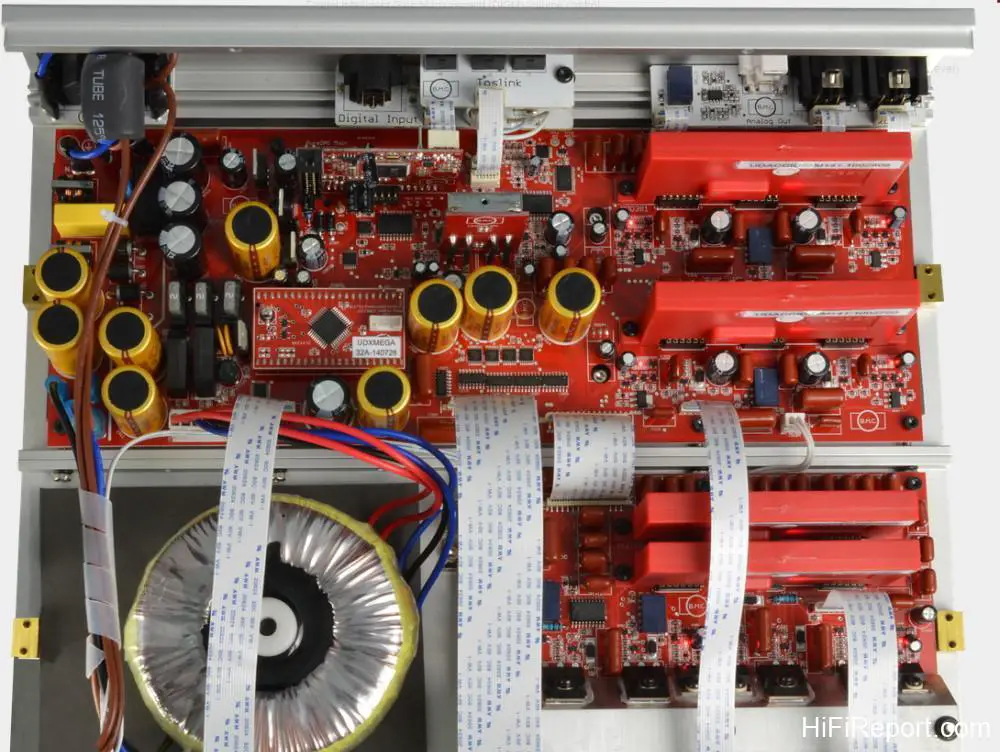
Internal photos from the official website reveal UltraDac’s internal layout. A toroidal transformer for power supply is located in the lower left. The upper section, close to the rear panel, houses the DAC circuit on the left and the analog and preamplifier circuits on the right, showcasing numerous capacitors and balanced circuit design.
The headphone amplifier circuit is positioned in the lower right, also with a balanced design and located directly adjacent to the front panel headphone jacks for the shortest possible signal path and reduced loss.
A side view of the headphone amplifier circuit emphasizes its substantial design, indicating it is far more than just an auxiliary feature. The headphone amplifier circuit is not only balanced but also utilizes Digital/Analog Power Conversion (DAPC), with volume control independent of the preamplifier volume, also employing LEF and DIGM technologies.
PureAmp: Powerful Amplifier
PureAmp, an integrated amplifier within the Pure series, also incorporates B.M.C.’s proprietary LEF, DIGM, and CI technologies and features B.M.C. Link for seamless integration with PureDac or UltraDac. Encased within the PureAmp’s aluminum alloy chassis is a robust 100 watts per channel (8 ohms) output and 180,000uF of capacitor energy. When PureAmp operates with B.M.C.’s DACs via B.M.C. Link, it leverages the advantages of LEF and CI technologies, delivering an optimal listening experience.
PureAmp’s music signal path is designed to be short, pure, and distortion-free. While other manufacturers often use feedback circuits to compensate for distortion, PureAmp, utilizing its LEF technology, bypasses this step. B.M.C. believes in preventing distortion at the outset rather than correcting it afterward. When PureAmp works with a B.M.C. DAC, connecting the two via B.M.C. Link optical fiber automatically upgrades and switches the internal operating state to CI mode.
The front panel features power, input selection, and mute buttons on the left, with volume control and display brightness adjustment on the right. The central display indicates volume level and selected signal source.
The PureAmp’s rear panel offers four analog inputs on the left: two balanced XLR inputs and two single-ended RCA inputs. In the center are two B.M.C. Link optical fiber connections, each corresponding to different analog inputs. When using B.M.C. Link, for example, if UltraDac’s XLR output is connected to PureAmp’s XLR1 input, the B.M.C. Link optical cable connecting the two should be connected to PureAmp’s XLR1 port. Remember to enable the B.M.C. Link switch on the UltraDac.
PureAmp uses SpeakON speaker output connectors, which required us to use a B.M.C. custom adapter as we did not have compatible speaker cables.
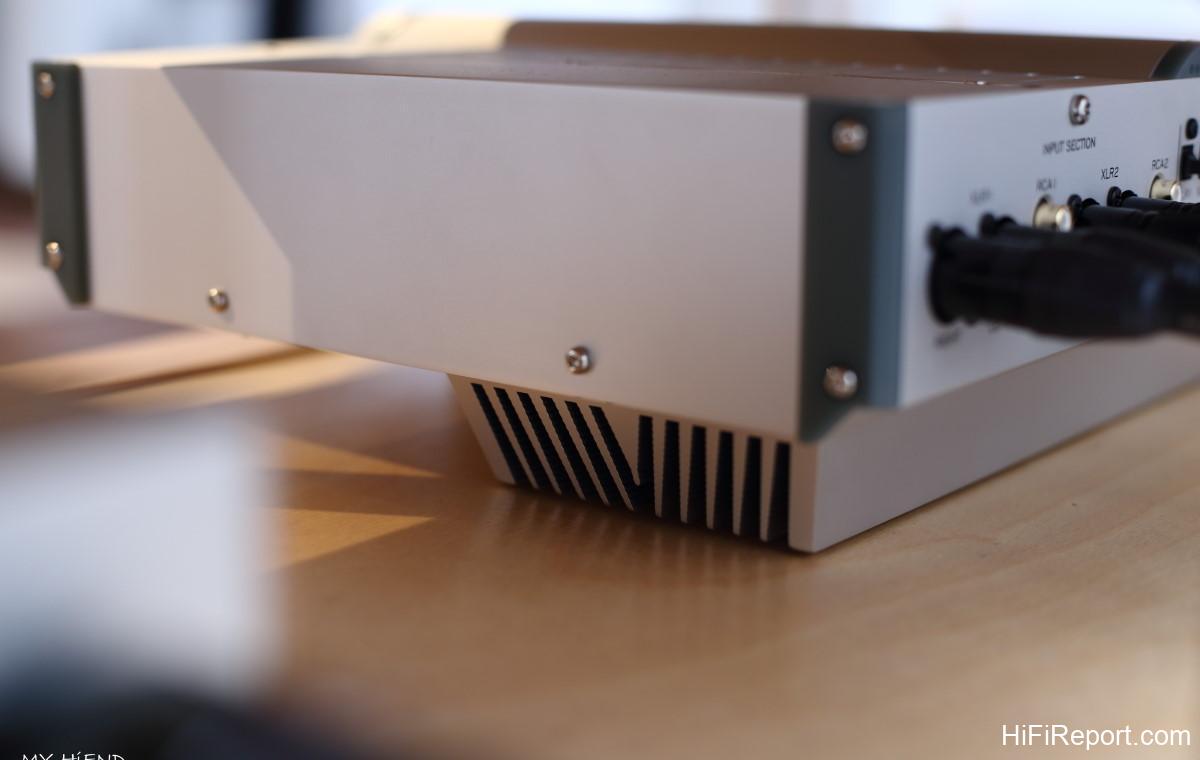
PureAmp operates at a noticeable temperature, necessitating a dedicated heat dissipation cooling system positioned beneath the chassis. This cooling system provides better temperature control than traditional Class A amplifiers and contributes to better linearity due to controlled operating temperatures, which is a crucial aspect in such a compact amplifier.
[Image of UltraDac connected to B.M.C. Link]
[Image of optical cable connected to PureAmp’s B.M.C. Link]
Once the B.M.C. Link is connected, PureAmp’s volume control becomes inactive, and “CI ACTIVE” is displayed, indicating that B.M.C. Link is operational and volume control is now handled by UltraDac. In this state, CI technology is engaged, with the two components communicating via B.M.C. Link, coordinating current and voltage states to deliver the purest and most faithful sound possible under B.M.C.’s technological framework.
Using PureMedia to play music files stored internally, I started with Diana Krall’s . The live concert atmosphere, conveyed through B.M.C.’s refined sound and precise imaging, felt remarkably real. Vocals were full-bodied and direct, with concentrated power and excellent penetration, and the balance between vocals and instruments was superb. This was one of the best renditions of Diana Krall I’ve experienced.
Moving to Norah Jones’ , this album, with its lower instrument and ambient sound ratio, focused more on vocals, revealing a surprising black background. The opening guitar plucks in <Don’t Know Why> had a distinct metallic resonance. In this track, Norah Jones uses dynamic contrast through instantaneous volume shifts. On poorly calibrated systems, loud, high-pitched vocals can sound jarring, but the B.M.C. system combination elegantly rendered the song’s nuances.
In the title track , a song with a tranquil atmosphere, the quiet background was even more pronounced. Even at very close listening distances, the B.M.C. system exhibited virtually no discernible noise. This black background made Norah Jones’ voice sound even more gentle and languid.
Playing Björk’s , the deep drumbeats resonated powerfully yet smoothly throughout the listening space, accompanied by rapid, marching-band-like mid-range drum strikes. The mid-low frequency range exhibited both fullness and speed. Björk’s ethereal vocals and sound effects created a vast and immersive soundstage with a sense of both reality and illusion. The B.M.C. system showcased the unique characteristics of different frequency ranges and its soundstage creation capabilities.
This highly psychedelic track is reportedly Björk’s expression of releasing work-related stress.
Etta James’ voice is distinctive, a neutral, sharp female vocal. B.M.C. revealed many subtle vocal details in , including her nasal resonance singing technique and vocal transitions. The background keyboard, harmonica, and guitar accompaniment, while understated, further highlighted the vocal depth and singing technique. B.M.C. faithfully presented the entirety of the song.
The group The Art Of Noise created astonishing sound effects in . [YouTube link provided in original article]. In this track, a background sound effect moves from the distance to the foreground, increasing in volume. During playback, this effect was striking. The sound originated clearly from my right side and, as the volume increased, circled around me, moving to the front, and then faded back to the right as the volume decreased.
Initially, I even mistook it for a neighbor’s noise. While I’ve experienced sounds appearing far to the left and right in two-channel systems, I’ve never perceived sounds originating from behind. This theater-like audio effect is truly rare. Both the sound design of this track and B.M.C. ‘s playback capability are remarkable.
B.M.C. Link: System Performance
Before engaging B.M.C. Link, I used UltraDac and PureAmp individually with other brands of equipment, and also together without B.M.C. Link. Without B.M.C. Link, the equipment already performed well, offering resolution, power, and a good soundstage. However, connecting the B.M.C. Link with an ordinary optical cable dramatically transformed the system’s sonic character. B.M.C. Link brought about an overall improvement in sound quality, precision, and sonic density.
The extension of frequencies and soundstage presentation jumped to a higher level. In terms of performance enhancement, B.M.C. Link is undoubtedly one of the most crucial technologies in this system. Experiencing such a significant change within the same system is truly rare.
UltraDac Specifications
* Top-grade Digital/Analog Converter with Current Injection current-to-voltage (I/V) conversion
* High-resolution asynchronous USB interface up to 32bit/384kHz
* USB PCM: 16…32bit; 44.1, 48, 88.2, 96, 176.4, 192, 352.8, 384kHz. * DXD support without FIR filtering. * USB DSD: DSD64, DSD128.
* ASIO driver for Windows; Linux and Mac compatible
* AES/EBU, coaxial and Toslink digital inputs up to 24bit / 192kHz
* Balanced, reference-class headphone amplifier with digital/analog power conversion (DAPC), load-effect free (LEF) technology, 15A bipolar Voltage output devices combined with MOSFET current sources, a super-low impedance LEF output stage, and lossless Digital Intelligent Gain Management (DIGM) volume control.
* Balanced LEF, CI-compatible preamp that optionally operates in B.M.C. Mode, with DIGM and bipolar voltage source combined with a DMOS current source and LEF-balanced output stage. * Separate volume controls for the line and headphone sections (the line volume position 59 represents a DAC standard output level)
* Second-generation DIGM with optimized gain distribution between power amps and internal and DIGM volume levels
* Optical B.M.C. Link for connecting with B.M.C.
amps like the PureAmp
* Remote Control including PureAmp functions. * Top grade parts like MPP (conductive film polypropylene, non inductive) and balanced current capacitors, precision metal film resistors…
* Massive and stylish extruded aluminum chassis
* Dimensions: 14.37 x 4.06 x 12.91 inches, W/H/D (365 x 103 x 328 mm)
* Weight: 7 kg