
Esoteric N-05XD Review
To be precise, I believe most streaming players that also function as preamplifiers don’t include full preamplifier functionality. They don’t feature analogue source selection, analogue volume control, and high-gain amplification circuits like “proper preamplifiers.” Instead, they often just use the DAC chip for digital volume control, adding a buffer amplification circuit after the DAC output. From a circuit perspective, they are essentially “streaming players with added volume control.”
The Esoteric N-05XD I’m reviewing here is a rare breed. It’s not only a streaming player with complete digital-to-analogue conversion capabilities, but it also houses “proper” preamplifier and headphone amplifier circuits. Objectively speaking, the Esoteric N-05XD is effectively a combination of a high-end streaming player and a preamplifier, packaged as a single unit and sold at the price of one component.
It can directly drive power amplifiers to push speakers or partner directly with active speakers to form a system. The N-05XD can also be set to a fixed output, functioning purely as a digital source.
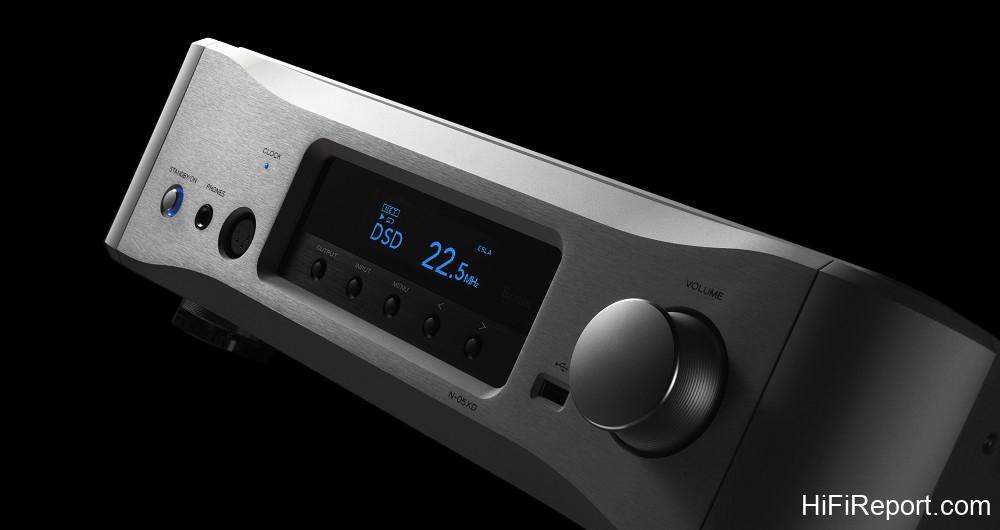
Streaming Features and Digital Inputs
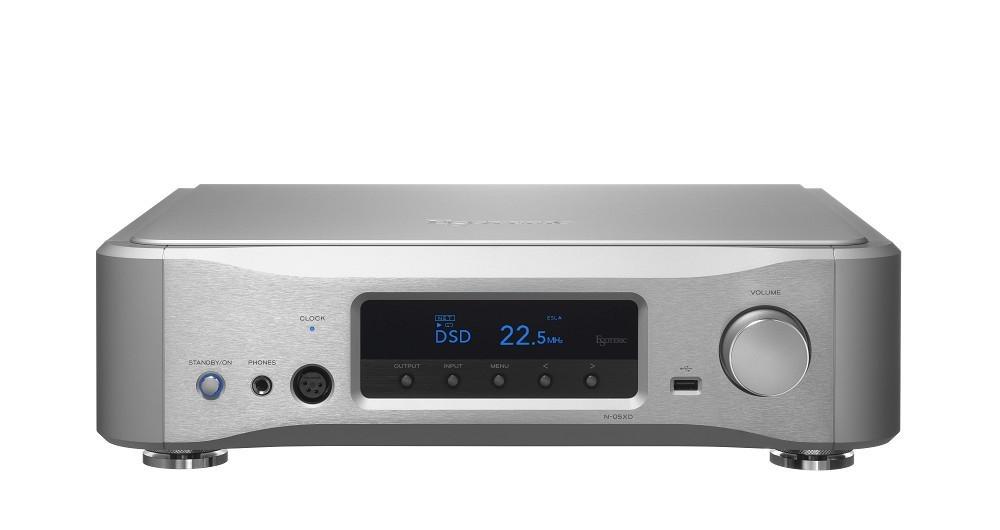
In terms of streaming capabilities, the N-05XD fully supports Tidal with complete MQA decoding and is compatible with Qobuz, Roon Ready, and Spotify. It can play various music file types via network or directly from USB storage devices (USB hard drives), including FLAC, Apple Lossless (ALAC), WAV, AIFF, MQA, DSD (DSF and DFF), MP3, and AAC. It is arguably one of the most compatible Hi-Res streaming products available today.
It supports multi-bit music files up to 384kHz/32bit and DSD up to a 22.5MHz sampling rate.
To play files of such high specifications, I recommend using a USB storage device (like a USB hard drive) as your music library and plugging it directly into the unit. This way, even with the highest resolution files, playback won’t be affected by network conditions causing interruptions. Most streaming players currently support FAT16, FAT32, and NTFS USB formats, while the N-05XD also supports exFAT.
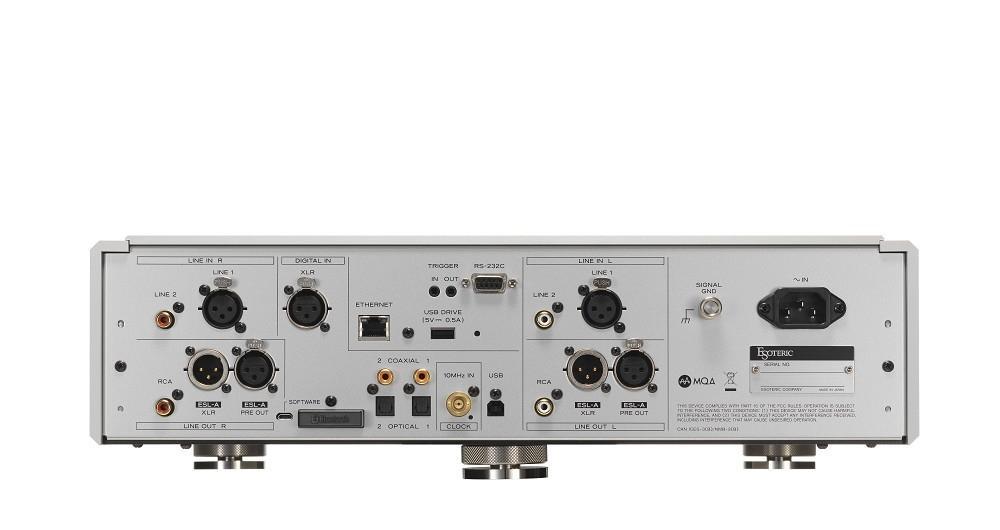
So, you can use a USB SSD (solid-state drive) with the N-05XD as your music library without issue. For DAC functions, the unit supports up to PCM 384kHz/32bit and DSD 22.5MHz via USB input, and up to PCM 192kHz/24bit and DSD 2.8MHz (DoP) via optical, XLR, and coaxial digital inputs.
Hardware Structure
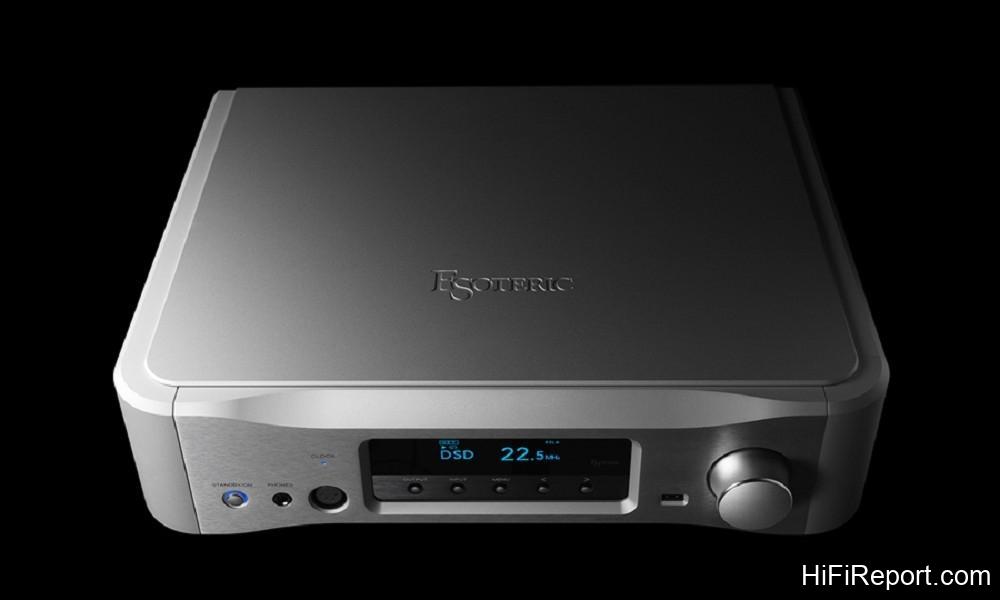
Now, let’s delve into the N-05XD’s hardware structure. The chassis retains Esoteric’s unique “floating” top panel design. The manufacturer believes this unscrewed top panel approach allows for a more open and lively sound. The three vibration-damping feet on the base (two in front, one at the rear) are a design that combines metal spikes with a base plate, another unique Esoteric feature. They provide the benefits of spikes without scratching the surface of your audio rack.
Master Sound Discrete DAC
I believe the N-05XD’s digital-to-analogue conversion circuit is a game-changer for its class. The K-05Xs SACD/CD player from the same series employs Esoteric’s typical dual-mono fully balanced DAC circuit, with each channel using one Asahi Kasei AK4493 high-end 32-bit DAC chip for D/A conversion. Although the N-05XD is also positioned within the brand’s “05” series, it applies the core technology from the flagship Grandioso D1X: the “Master Sound Discrete DAC.”
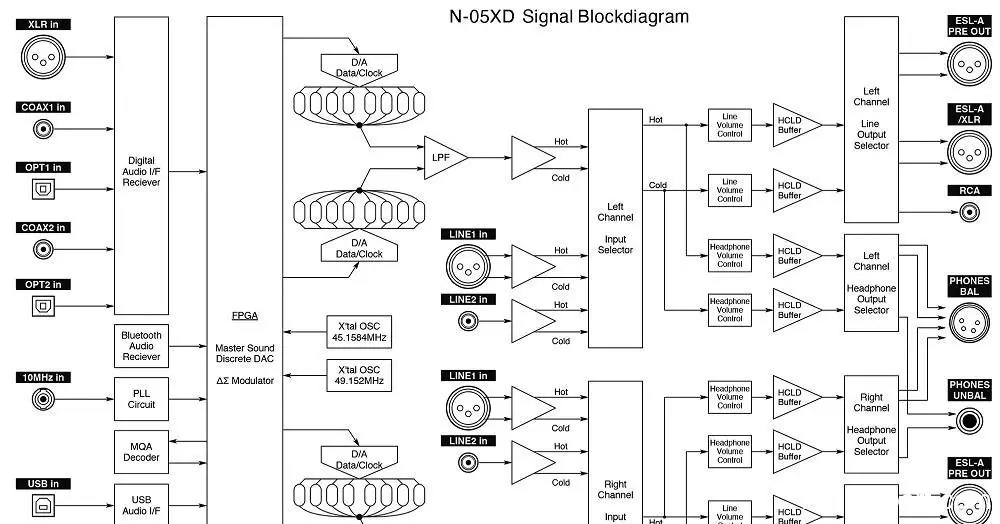
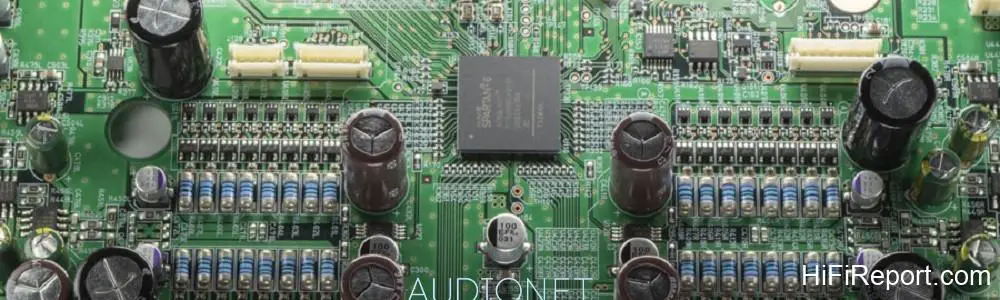
This design eschews DAC chips, instead using an FPGA chip for computation and modulation, combined with multiple flip-flops and resistors to create the D/A conversion circuit.
The FPGA chip handles two stages of digital audio processing. The first stage primarily performs Delta-Sigma modulation on the digital audio signal (applying different digital filters for PCM and DSD) and converts it into a PWM signal. The second stage uses the FPGA chip to control the circuit, composed of 32 sets of flip-flops, resistors, and other components (8 sets for the positive and negative phases per channel), based on the PWM signal.
Finally, each channel uses a JRC MUSES8920 (a high-grade JFET input OP Amp chip) and passive components to sum the outputs from the 16 sets of flip-flops (positive and negative) for low-pass filtering, followed by a JRC MUSES8820 (JFET input OP Amp chip) for buffer amplification, outputting to the preamplifier source selection circuit.
Upon reading this, audiophiles might be surprised: Is this a joke? The N-05XD’s discrete DAC is on par with the Grandioso D1X? Please don’t misunderstand; there’s still a difference in class. The Grandioso D1X has 32 sets of flip-flop circuits for *one channel*, totaling 64 sets for both channels (twice that of the N-05XD).
The layout of the D1X’s multiple flip-flop circuits on the PCB is circular (making the length of each circuit closer to equal distance), while the N-05XD uses a parallel layout. Therefore, theoretically, the D1X’s D/A conversion circuit has lower jitter. Although the N-05XD and D1X are ultimately in different classes, the N-05XD certainly possesses several advantages of the Master Sound Discrete DAC.
The square wave deformation from the flip-flop outputs is less pronounced, reducing jitter, and the research and development team can select discrete components or fine-tune the sound more deeply through the FPGA chip’s algorithm.
Preamplifier and Headphone Amplifier Circuits
The unit’s preamplifier and headphone amplifier circuits adopt a “dual-mono fully balanced architecture” for better separation and dynamic performance. Each channel uses a JRC NJW1195A 4-Channel volume control chip to provide independent balanced analogue volume control for the preamplifier and headphone outputs. Additionally, for analogue single-ended inputs, the audio signal is first converted from single-ended to balanced before entering the volume control chip.
Thus, the volume control and high-gain amplification remain fully balanced.
After the volume control chip, the unit’s preamplifier and headphone amplifier circuits are “identical.” The front-end uses TI NE5532A dual OP Amp chips for high-gain (balanced) amplification. Following this, each channel’s preamplifier and headphone outputs use two LME49600 chips (headphone amplifier chips with wide bandwidth, high speed, low distortion, and high current characteristics) as HCLD output stage balanced buffer amplifiers.
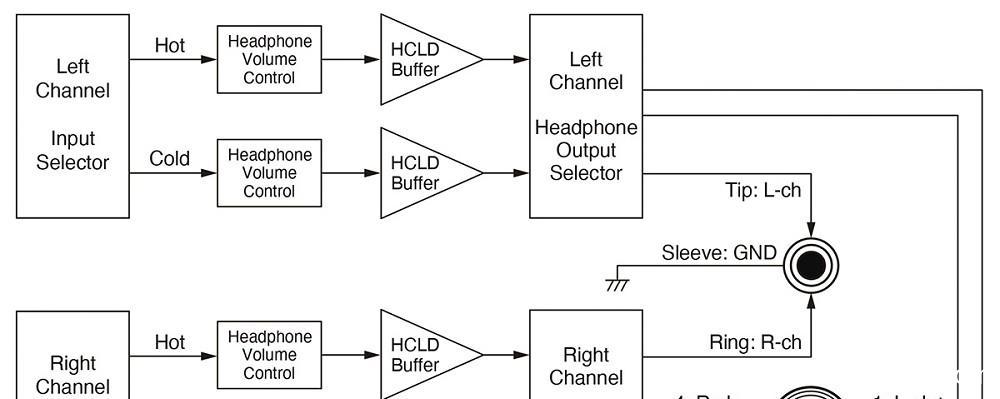
The LME49600’s slew rate of up to 2,000V/μs indicates its speed in reacting sensitively to audio dynamics.
Power Supply
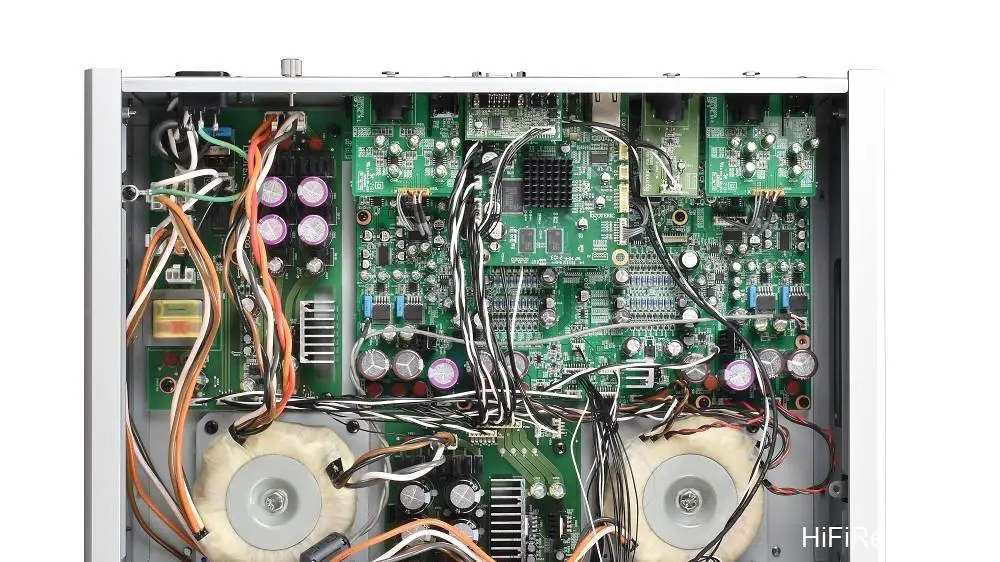
In the power supply circuit, the unit is primarily powered by two toroidal transformers. One supplies power to the digital circuits, while the other transformer has two independent secondary windings connected separately to the left and right channel preamplifier power supply circuits. Thus, it can effectively be seen as having independent power supplies for the left and right channels.
The unit’s power supply is designed for high speed and large capacity: using Schottky diodes for rectification and large-capacity electrolytic capacitors (including supercapacitors) for filtering. The total capacitance of the filter capacitors reaches a massive 2,333,333μF, mirroring the top-tier construction of the Esoteric N-01XD.
Usage Scenarios and Testing Setup
Most streaming players use digital volume control, so setting them to “fixed volume output” to function purely as a streaming player (without preamp function) generally results in better sound quality. The N-05XD, however, uses analogue volume control, and observing its circuit, there is no difference in the “path and number of components the audio signal passes through” whether it’s set to fixed or variable output.
Therefore, using the N-05XD as a “digital source and preamplifier,” directly pairing it with a power amplifier, is more cost-effective. Adding an extra preamplifier when using it as a digital source won won’t necessarily improve the sound. For this review, I paired it with the Esoteric F-05 integrated amplifier. To accurately assess the N-05XD’s performance as a streaming “preamplifier,” I connected the N-05XD’s output to the F-05’s EXT.
PRE IN, bypassing the F-05’s preamp circuit and using the F-05 as a power amplifier.
N-05XD users can select different PCM ΔΣ modulation sampling rates, PCM filters, and DSD filter types in the menu. Each option offers subtle differences in sound that can be used for tuning. After initial listening, I decided to conduct the review using the factory default settings.
Sound Performance
In terms of sound performance, I believe the N-05XD’s greatest characteristic is its simultaneous possession of two types of high-resolution qualities. The first is “high resolution for minute sonic details.” It instantly gives the listener the sense of an extremely quiet background, naturally allowing comfortable listening even at low volumes. With no impurities felt whatsoever, even subtle sounds are remarkably clear.
Listening to solo piano or violin pieces, the N-05XD clearly reproduces rich harmonic content, rendering acoustic instruments with exquisite detail and realism.
The other high-resolution characteristic relates to the time axis. Editor-in-Chief Liu once said that the biggest advantage of tape machines is the sheer amount of sonic information they convey. This is easy to understand because analogue recording captures audio as a continuous linear variation, which, from a digital perspective, approaches an infinite sampling rate.
Therefore, even if a tape machine doesn’t boast impressive bandwidth, it possesses unbeatable “sonic information density” along the time axis.
Interestingly, the N-05XD’s D/A conversion process pushes this “digital source” towards the characteristics of analogue sources like tape machines and turntables. During the FPGA processing, performing 512 Fs ΔΣ modulation on PCM increases the sampling rate to 22.579 MHz to 24.576 MHz, similar to ultra-high sampling rate DSD. Consequently, the N-05XD, despite being a digital source, sounds “very analogue.”
This is due to its high “sonic information density” on the time axis, providing a clear, smooth, and rich listening experience derived from the vast amount of sonic information.
As I’ve said before: the higher the digital audio specification, the more analogue it sounds. The N-05XD’s charm is not just in proving that higher resolution music files sound more refined and gentle, but also, and more remarkably, in how it elevates the sound quality of standard music files. If not compared to the N-05XD playing its own Hi-Res files, listening to CD-quality (44.1kHz/16bit) files on the N-05XD truly makes you believe you’re playing Hi-Res.
The “sound flavor” is even quite similar to SACD!
The N-05XD maintains the consistent characteristics of Esoteric products in its soundstage and imaging. Its high separation creates a broad soundstage. With fast, clean, and high-purity sound, it presents a strong sense of visual dimensionality. With proper speaker placement, its precise image focus allows the listener to clearly “see” the position and distance of instruments and vocals, while rich reverberations provide a more tangible sense of the performance venue’s space.
Headphone Output Performance
In the final stage of listening, I connected Focal Stellia headphones (using the 4-pin XLR balanced output). The result was unsurprising, as the N-05XD’s headphone output and preamplifier output share the exact same circuit (though they are two independent circuits). The refined sound quality, high density, high resolution, and the gentle yet fast character were consistent with the sound heard through speakers.
The high-current design provides stronger driving power, effortlessly driving the Focal Stellia with extremely stable sound and relaxed yet full mid-bass.
Value and Conclusion
I believe the N-05XD’s value lies in its ability to faithfully reproduce the recording without resorting to coloration or embellishment. It allows the music’s content to naturally reveal its charm, beauty, and captivating qualities. The Master Sound Discrete DAC further imbues it with an analogue flavor distinct from most digital sources.
Judging by the sound quality relative to its price, I believe it’s difficult to find a “streamer + preamplifier” combination with comparable sound quality at the N-05XD’s price point. The price-performance ratio is quite high.
Specifications
* Digital and Analogue Inputs: 1 x USB Type B, 1 x Coaxial, 1 x Optical, 1 x Ethernet (LAN), 1 x USB Type A (for storage), 1 x XLR (Analogue), 1 x RCA (Analogue)
* Analogue Outputs: 1 x XLR (Preamp), 1 x RCA (Preamp)
* Headphone Output: 1 x 4-pin XLR Balanced, 1 x 6.3mm Stereo Standard
* Supported File Formats: FLAC, ALAC, WAV, AIFF, MQA, DSD (DSF/DFF), MP3, AAC
* Supported Sampling Rates (USB In): PCM up to 384kHz/32bit, DSD up to 22.5MHz
* Supported Sampling Rates (Coaxial, Optical, XLR Digital In): PCM up to 192kHz/24bit, DSD 2.8MHz (DoP)
* DAC Architecture: Master Sound Discrete DAC (FPGA-based)
* Analogue Volume Control: Yes
* Preamp Functionality: Yes
* Headphone Amplifier: Fully Balanced, High Current (HCLD output)
* Power Supply: Dual Toroidal Transformers, Large Capacity Filter Capacitors (2,333,333μF total)
* Network Compatibility: Roon Ready, Spotify, Qobuz, Tidal (MQA full decoding)
* Dimensions (W x H x D): (Standard Esoteric 05 series dimensions – approx.445 x 131 x 377 mm, though not explicitly stated in the source, it’s implied by the series)
* Weight: (Not explicitly stated in the source)