
Bayz Courante 2.0 Floorstanding Speakers Review
Recently, I received a message from Mr. Chang of HiFiReport, inviting me to host a lecture at his venue.
HiFiReport and I have collaborated on music lectures for several years now. I always strive to bring new content, never repeating the same repertoire. Each time, I make an effort to prepare something fresh for the audience.
For this invitation, what topic should I cover? A clear theme provides direction, allowing me to select repertoire and prepare the material effectively.
I drafted a few potential options, but found myself undecided. So, I simply asked Mr. Chang what system he planned to use.
Knowing the speakers he’d be using might help me decide on the direction for the music selection.
He replied: “Bayz speakers.”
Ah, now this is interesting.
When HiFiReport first introduced Bayz speakers, I remember seeing their appearance and frankly, couldn’t believe that Mr. Yang, the owner of HiFiReport, would be interested in a speaker with such a avant-garde design as the Bayz.
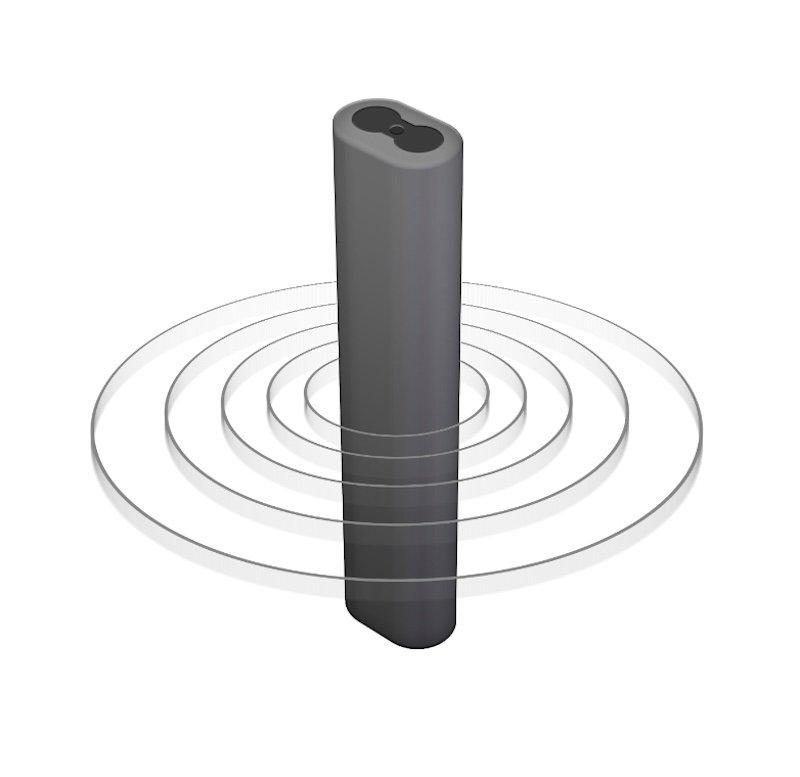
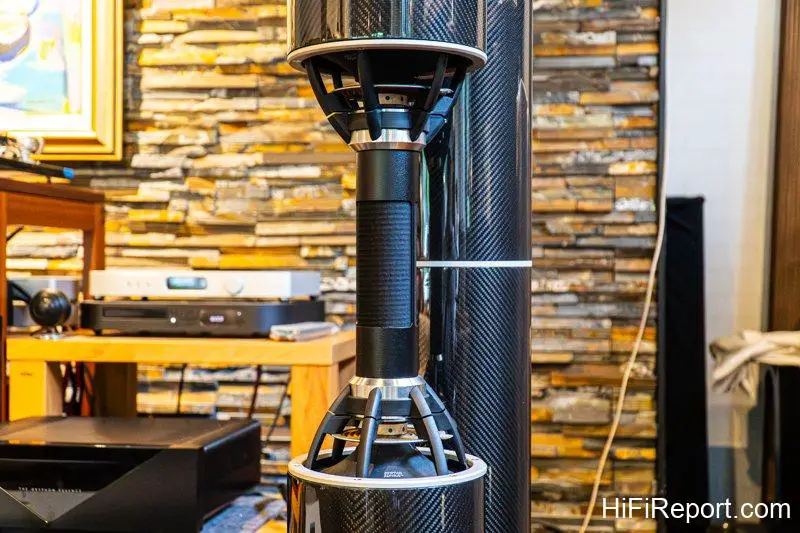
How avant-garde, you ask? Bayz speakers resemble water pipes, forming a tall, slender “C” shape. The drivers are positioned in an MTM (Midrange-Tweeter-Midrange) configuration at the opening.

Even more striking, the drivers themselves and the way they are mounted are highly unconventional, perhaps even unique in the audio world.
Using Bayz speakers? Alright, I have my topic.
Bayz is a brand from Hungary, so I drew inspiration from that and named the lecture “Hungarian Rhapsody,” introducing works by Hungarian composers.
Truthfully, I’m not intimately familiar with Hungarian composers’ works.
I listen to Bartók, Kodály, and Dohnányi, but not frequently.
I listen to Liszt more often; he was also Hungarian, but his musical style leans heavily towards Western Europe and doesn’t strongly embody a Hungarian national character.
Tackling this subject was definitely a new challenge. Selecting the repertoire alone was difficult, and after selecting the pieces, I had to invest significant effort into formal analysis. The preparation for that lecture was more demanding than any previous one.
However, everything paid off beautifully on the day itself.
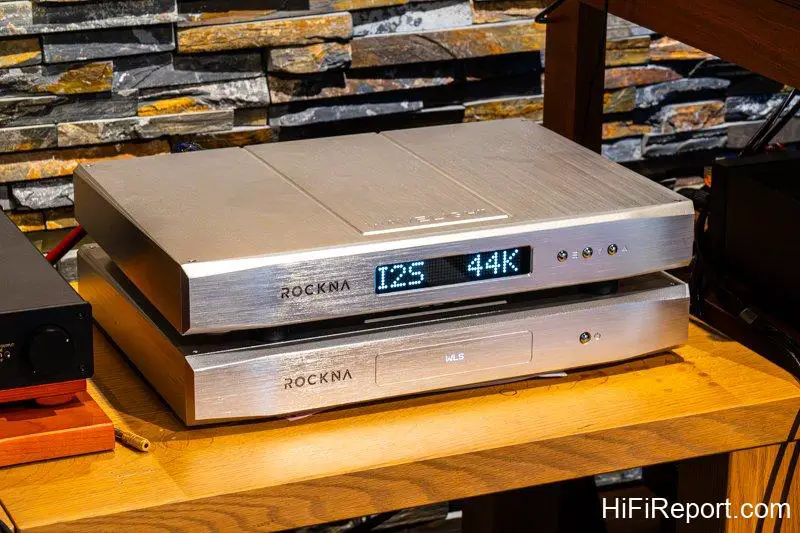
On the lecture day, given it was my first time experiencing the Bayz Courante speakers, I arrived at HiFiReport earlier than usual, wanting to spend some time understanding these speakers.
When I arrived, a couple was seated, listening.
They had heard that a pair of Bayz Courante 2.0s were at HiFiReport and had driven up specifically to audition them.
They played one piece after another, taking turns selecting tracks, presumably trying all the pieces they usually listen to before finally leaving.
Whether they ended up purchasing the Bayz speakers, I don’t know, but I certainly witnessed the look of satisfaction on their faces as they listened to the Courante 2.0. That feeling was clearly etched in their expressions.
Because even I, upon hearing the Courante 2.0, felt it was truly exceptional and unlike anything else.
After the lecture concluded, before leaving, I told Mr. Chang of HiFiReport, “I’d like to schedule a time to come back and listen to the Bayz properly.” These speakers are simply too special; the listening experience they create is vastly different from others.
I wanted to find another time to devote specifically to listening. It was also beneficial to have that initial window beforehand to clear my mind and preconceptions, removing any colored glasses before truly focusing on them.

Bayz Speaker: Unique Design from an Inventor
What makes Bayz speakers so special? There’s a multitude of unique aspects.
From the cabinet to the drivers, from the aesthetics to the sound, everything is extraordinary. I’d even go so far as to say it’s a work of genius.
Indeed, Zoltán Bay, the driving force behind Bayz Audio, is exceptionally talented. He hails from a family of engineers and scientists; his father was a radar astronomy observer, and his uncle was even a member of the Apollo program team. His father was also the inventor of the renowned Hungarian microphone, the BEAG MD-14N.
With such a distinguished family background, Zoltán Bay majored in medical engineering in university, designing electronic medical equipment.
But his passion for audio eventually led him to switch careers and enter the hi-fi industry. He’s worked on everything from powered amplifiers and source components to passive cables and speakers. He’s been involved in the audio field for nearly forty years now.
Zoltán Bay is not just an engineer and inventor; he is a true music lover and plays the piano himself. Driven by his passion for music and drawing from his experience as a musician, he sought to create speakers that reproduce sound more naturally.
In his view, traditional loudspeaker designs fundamentally differ from how sound is produced naturally, and he felt conventional speaker design had reached its practical limits, making further breakthroughs difficult.
Consequently, he shifted his research focus to 360-degree omnidirectional speakers. While such speakers exist – MBL, German Physiks, and Duevel are prominent examples – Zoltán Bay aimed for something more. He wasn’t content with designs that scatter sound waves via omnidirectional diffusers; he wanted to create a truly omnidirectional driver.
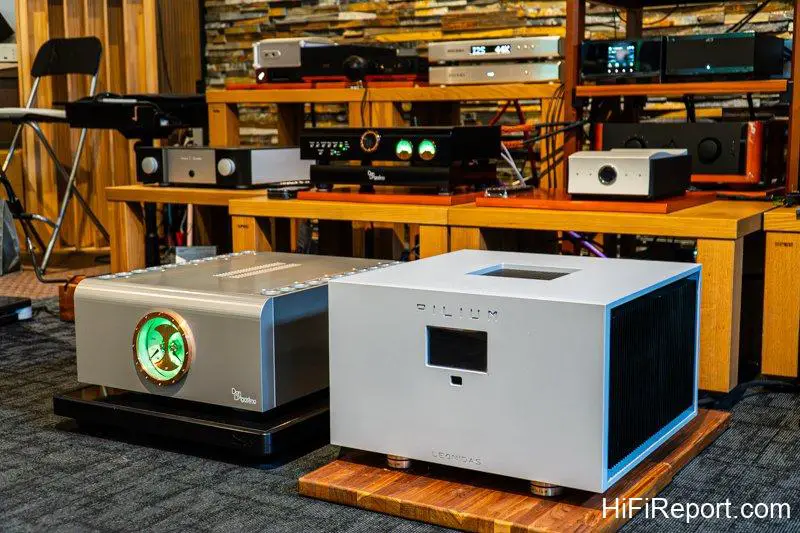
From his perspective, the ability of traditional forward-firing speakers to create good stereo reproduction depends heavily on their placement within the room. Speakers that use omnidirectional diffusers also face this limitation.
After years of research, in 2011, he successfully developed his patented product, the BRS (Bay Radial Speaker) omnidirectional driver.
The Unique 360-Degree BRS Driver
Conventional tweeters – whether dome, concave, planar, AMT, ribbon, or compression drivers – radiate sound primarily in a single direction.
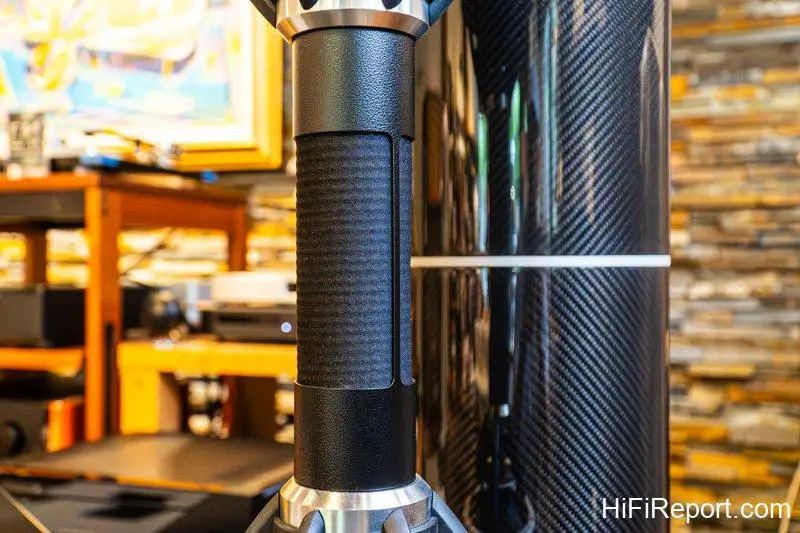
The BRS, however, is designed as a cylindrical shape, allowing it to radiate sound outwards 360 degrees in all directions.
Furthermore, the cylindrical BRS has a radiating surface area far larger than typical tweeters, approximately 30 to 50 times greater.
According to the manufacturer, the diaphragm of this cylindrical BRS driver is extremely lightweight, comparable to an electrostatic diaphragm. Despite its large area, extending high frequencies up to 20kHz is not an issue, and it operates within its effective range completely free from cone breakup distortion.
This is Zoltán Bay’s ultimate weapon in crafting a sound that approaches the realism of live performance.
Regarding the BRS, Mr. Yang of HiFiReport audio shared a “little secret.” The BRS mounted on the Courante 2.0 has a rotatable black sleeve on its exterior. This sleeve has an opening, and by rotating it to adjust the opening’s orientation, you can slightly alter the sound output level of the BRS in different directions.
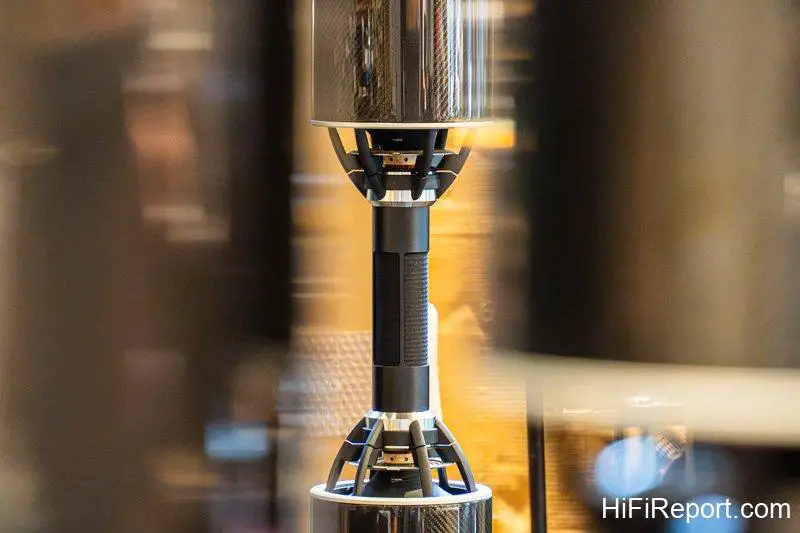
I hadn’t encountered any documentation mentioning this, neither in the manufacturer’s materials nor in international media reports. It shows how meticulous and dedicated Mr. Yang of HiFiReport is about the equipment he handles.
Dual Back-to-Back 7.5-inch Mid-Woofers with Egyptian Papyrus Cones
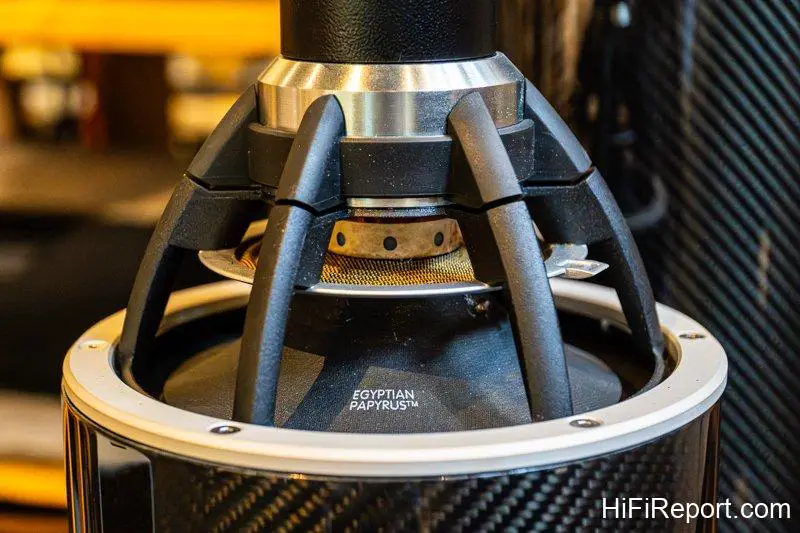
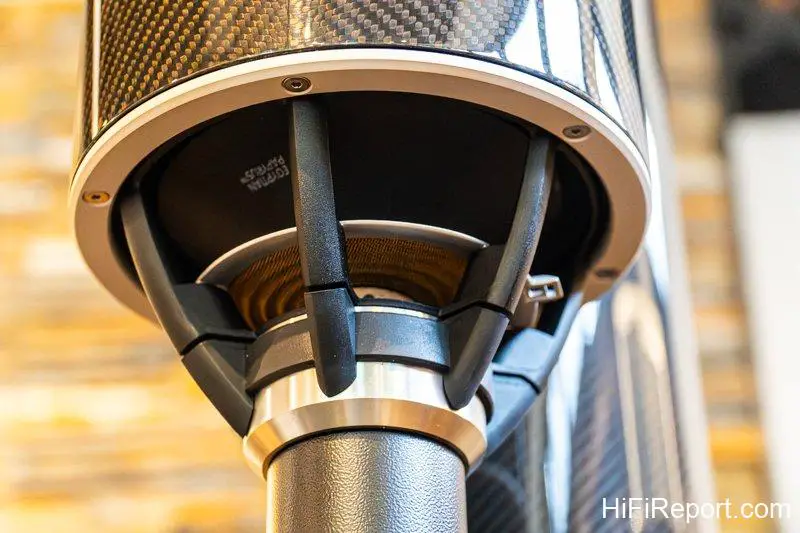
Connected to the upper and lower ends of the BRS driver are two back-firing 7.5-inch woofers. Their rear frames are tightly attached to the BRS driver assembly, forming the MTM structure.
The manufacturer’s specifications list them as 7.5 inches, but they visually appear more like 6 inches or even smaller. To convince me, Mr. Yang specifically showed me the original specifications document, which indeed stated 7.5 inches.
Perhaps the appearance from the rear perspective is deceiving, or perhaps the measurement includes the outer frame of the driver.
The two woofers utilize two separate tubular cabinets, one above and one below, providing the basis for the Helmholtz resonance, combined with bass reflex ports, allowing the low frequencies to reach down to 28Hz.
To find the most suitable drivers, Zoltán Bay enlisted the help of driver design expert Frank Nielsen. Who is Frank Nielsen? He is the CEO of Danesian Audio ApS and is highly renowned in the driver manufacturing industry. Over the years, he has designed countless drivers for major speaker companies including SB Acoustics, ScanSpeak, and Vifa.
Zoltán commissioned Nielsen to design a custom 5-inch Satori mid-woofer. The diaphragm uses Egyptian papyrus, a unique and proprietary material made by Nielsen’s company. What’s the difference compared to standard off-the-shelf versions? Speed. Because the BRS is very fast, the mid-woofer’s speed must also keep up. This custom driver is faster than the standard retail version.
Minimalist Crossover Design Focused on Low Loss and Distortion
Regarding the crossover, the crossover point is set at 2kHz, utilizing a -6dB per octave 1st-order slope. It is also specifically optimized for phase alignment.
The manufacturer emphasizes the crossover’s minimalist design, employing only two components: a capacitor and an air-core inductor. The components are carefully selected for very low energy loss, contributing to the Courante 2.0’s friendly efficiency.
Despite the moderate driver size, the speakers boast an efficiency of 90dB, making them relatively easy to drive.
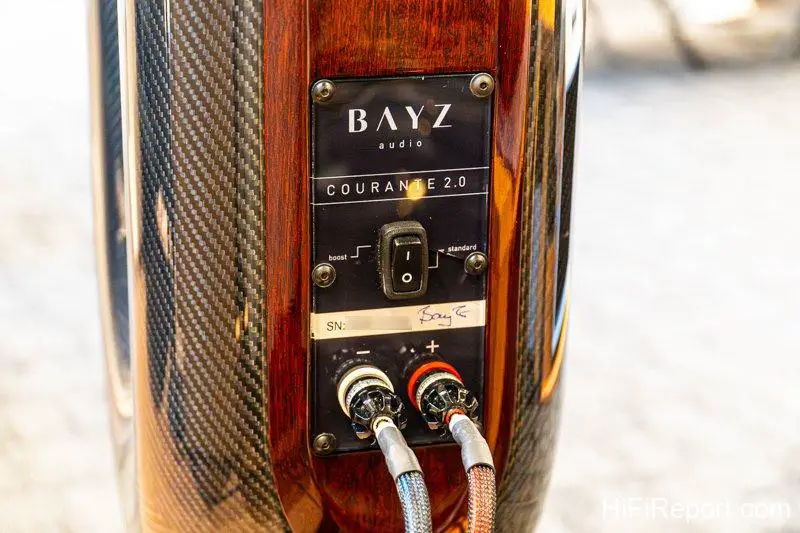
Above the speaker terminals on the rear panel, there is also a switch that allows toggling between “boost” and “standard” modes, providing an option to enhance or leave the BRS output at its standard level.
Collaboration with Racing Experts for Unique Tube Cabinet
The drivers are special, but the cabinet is even more so.
The tube-shaped cabinet of the Bayz speakers is constructed from carbon fiber. This material is inherently lightweight yet possesses extremely high rigidity. Zoltán enlisted the expertise of András Voloscsuk, whose team at Composite Project Kft has years of experience creating bodywork for F1 racing cars and Red Bull aerobatic aircraft. They are specialists in carbon fiber application and are highly skilled at forming it into various shapes.
If you know that Voloscsuk has even created carbon fiber pianos, you’ll understand that crafting the beautifully symmetric, smoothly curved tubular cabinets of the Bayz speakers presented no difficulty for him.
Decorative Panels and Adjustable Height
A solid wood veneer panel is added to the rear of the carbon fiber tube cabinet, enhancing the product’s sense of luxury and refinement.
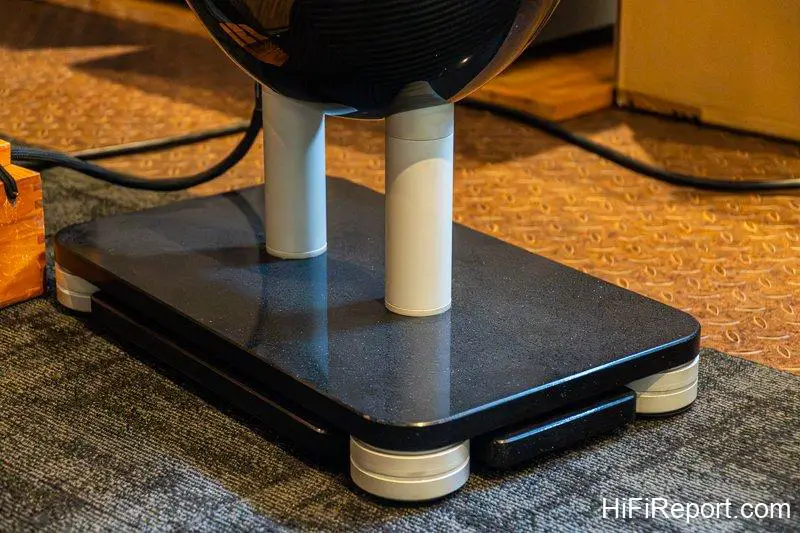
The tubular Courante 2.0 speaker rests on a solid graphite base, supported by aluminum feet at its four corners. The manufacturer also includes a set of aluminum cylindrical columns that can be placed between the speaker body and the base to increase the speaker’s height.
These height extension columns can be added or omitted depending on the listener’s height. The speakers were set up with the extension columns at the audition location. Mr. Yang of HiFiReport explained that his Tianmu store has high ceilings, and the HiFiReport venue’s ceilings are even higher. Adding the extension columns results in more uniform sound distribution and also looks better visually.
360-Degree Sound Blurs Sweet Spot, Wider Listening Area
Let’s rewind to the lecture day.
To avoid disturbing the customers who were test listening, I found a seat towards the back, near the window, to prepare for the lecture.
HiFiReport’s space is large with high ceilings, allowing the speakers’ energy to expand naturally. However, it’s a mixed-use venue combining audio equipment, coffee, and light meals. Besides the bar and audio equipment areas, most of the space is arranged with seating. The most popular seats in a café are those by the window, where sunlight streams in and you can view the streetscape. Customers always gravitate there first; I sat by the window that day.
Despite my non-ideal listening position, I was genuinely surprised by the sound of the Courante 2.0 – the frequency response, the soundstage, the imaging, the localization – this experience was profoundly different from past encounters.
The difference lies in this: the 360-degree sound of the Bayz Courante 2.0 blurs the boundaries of the “sweet spot.”
With traditional forward-firing speakers, the area where the sound from the two speakers converges forms the optimal listening zone, commonly known as the “sweet spot” or “” (emperor’s seat). We sit in this sweet spot and adjust speaker placement and toe-in to achieve the desired imaging, soundstage, localization, and other sonic characteristics within the listening area. This is a key part of the enjoyment for us audio enthusiasts.
360-degree radiating speakers, however, can create a more expansive soundstage and more effortless imaging. Listening to the Bayz Courante 2.0, even when I moved away from the so-called “sweet spot,” I still received more natural and complete information regarding the soundstage, imaging, and localization compared to conventional speakers.
While waiting for the customers, I sat in a corner of the room, probably the worst sounding location in the entire HiFiReport space. Before every lecture I give at HiFiReport, I play snippets of the day’s repertoire and walk around the room to check the sound effect. Over the years, this time, with the Bayz Courante 2.0, the difference in listening experience between the sweet spot and other areas was the smallest I’ve ever encountered.
Naturally, sitting far off-center, the balance and precision of the soundstage and imaging were not as ideal as in the center. However, compared to typical speakers, whether you sit precisely in the sweet spot or remain strictly on the center line is significantly less critical with the Courante 2.0.
At the beginning of the lecture, I shared this observation with everyone: “Today, no matter where you are seated, it’s a good seat.” This is something only 360-degree omnidirectional speakers can achieve.
Excellent Stage Transparency and Natural Timbre
So, what about the sound quality of the Bayz Courante 2.0? The first thing to praise is its exceptional transparency and excellent perspective.
In terms of perspective, the Courante 2.0’s performance is absolutely first-class. It doesn’t miss any details on the stage; in fact, it renders them with meticulous clarity right before you.
Regarding timbre, its tonal balance is natural, without obvious coloration. Whether listening to vocals or instruments, it offers very high timbral accuracy.
A Listening Experience Closer to the Concert Hall
Transparency and natural timbre are qualities found in other speakers, but the 360-degree omnidirectional Courante 2.0 possesses something unique: the ability to reproduce the feeling of natural sound radiation, making listening to music feel closer to a live performance.
What’s the reasoning behind this? Consider a concert hall, for example. When the sound from instruments reaches the audience’s ears, in addition to the direct sound, there are reflections from the hall’s walls, including first reflections, second reflections, and so on.
However, traditional forward-firing speakers primarily focus on delivering direct sound and creating imaging based on that direct sound. Omnidirectional Bayz speakers, much like instruments playing in a concert hall, radiate sound waves 360 degrees. Therefore, in addition to the direct sound, they generate more reflections than typical speakers.
The result of this is that 360-degree omnidirectional Bayz speakers sound closer to our experience in a live concert setting than traditional speakers. In this respect, the Bayz Courante 2.0 surpasses many others.
Excellent Harmonic Reproduction, Creating Rich Colors
The Courante 2.0’s high frequencies don’t possess the ethereal airiness of ribbon tweeters, nor the brilliant shimmer of diamond tweeters, nor the sharp incisiveness of metal domes. Instead, they extend naturally, adding color and creating a rich palette that enhances the music’s charm.
Its performance in the mid-range is particularly spectacular, not only rich in detail but also remarkable in the way it constructs the soundstage. It’s a delicate touch, less rigidly defined compared to typical forward-firing speakers, but with a greater sense of natural sound radiation. The sound is effortless and blends seamlessly into the space.
Turning to the low frequencies, its dual 7.5-inch woofer configuration combined with the unique tubular carbon fiber cabinet delivers satisfying bass extension and quantity. Reproducing double bass, electric bass, tuba, drums, or piano low notes poses no challenge.
Excellent Bass Extension, Quantity, and Resolution
One more point worth mentioning: from the mid-range down to the bass frequencies, the Courante 2.0’s sound remains clean and clear. I believe this is related to its carbon fiber cabinet.
While it’s hard to claim a direct causal relationship, based on experience, using carbon fiber in any vibration-related part of an audio system tends to result in a more direct and clearer effect.
There is also a version of the Courante 2.0 with a fiberglass cabinet; I don’t know if there is a difference in sound. However, the specifications state that the fiberglass version is 3kg heavier than the carbon fiber version, about a 10% difference. This might offer some room for speculation.
Such Transparency, It’s Like Bringing the Concert Stage Here
Let’s delve into the listening impressions, starting with a few pieces played during the lecture.
For those in attendance, listening to 360-degree omnidirectional speakers was a novel experience. They might have encountered other omnidirectional speakers like MBL, but it was surely their first time hearing the Bayz Courante 2.0.
When playing Bartók’s “Music for Strings, Percussion and Celeste,” the Bayz speakers transparently transported the stage into the foreground of the HiFiReport space. Taking the second movement, known for its excellent sonic effects, as an example, the Courante 2.0’s clean and fast response was perfectly suited to the scherzo character of the movement, flowing smoothly through the frequently moving passages. Long, continuous ascending and descending phrases were rendered with effortless ease.
The percussion is a highlight of this piece and is spectacular in the second movement. The forceful drum hits were strong and powerful, making a shocking declaration at the opening of the exposition where the first theme is introduced. These drum sounds were fast and strong, massive yet clear. Hearing this bass, I no longer doubted the “dual 7.5-inch” woofer specification.
Bartók wrote a very special development section in this movement, almost entirely composed of string pizzicato. Listening to this quiet section, the pizzicato details were clear, layering fragments of sound to build the string sections. Whether powerful drum hits, rapid string passages, or soft pizzicato, the Bayz Courante 2.0 performed exceptionally, making for an utterly satisfying listening experience.
Spacious, Open, and Effortless: Conveying Musical Momentum
Listening to Kodály’s “Háry János Suite,” the Bayz’s spacious, open, and airy sound was evident in its soundstage presentation and dynamic range.
In the Prelude, Háry János, the storyteller, boasts of his exploits in a tavern. The powerful opening tutti is the sound of a sneeze, signifying his tall tales. The low strings begin their leisurely melody, perfectly capturing the storyteller’s reminiscing tone. This phrase repeats continuously, gradually rising in pitch and intensity towards the end, building the energy to a climax. The sense of layered buildup, the repeated phrases moving between sections, leading to the brilliant energy of the final tutti – the Courante 2.0 portrayed the various surges within the music with a smooth, relaxed demeanor.
Furthermore, within those layers of sound, the texture of the string section was clear and vivid. The 360-degree BRS driver offers not only an open listening experience but also resolution that is arguably superior to any conventional tweeter type.
For instance, in the “Viennese Musical Clock” movement, the clock chimes were clear, bright, solid, and detailed, with rich overtones. The high woodwinds and brass painted a picture of urban prosperity. The BRS’s radiation provided an excellent foundation for rendering these upper mid-range frequencies and their harmonics. Not only was the texture of the woodwinds lively, but the rustling details of the snare drum in the background were also clearly audible. Even during the powerful tutti passages of woodwinds, brass, strings, and percussion, the placement of the sounds and the layout of the stage remained clear.
Grandly Displaying Large Orchestral Power
After listening to Bartók and Kodály, I naturally had to include their good friend Dohnányi. These three were senior and junior students at the Royal Academy of Music in Budapest and later made significant contributions to Hungarian music.
Dohnányi’s “Zrinyi Overture,” composed in his youth, is based on Miklós Zrínyi, a 17th-century Hungarian military leader and national hero. The orchestral work is grand and magnificent, possessing an epic quality. Playing such large-scale orchestral music, the Courante 2.0 seemed to effortlessly create a wider soundstage than any other speaker, with a relaxed and natural stage layout, bringing the music seamlessly into the HiFiReport venue.
If I were listening with conventional speakers, I might be more focused on the audiophile aspects of the sound during playback. Listening with the Bayz Courante 2.0, however, I was more captivated by the music’s flow and development. Dohnányi extensively uses brass to create a sense of grandeur and skillfully employs heavy, massive low brass to build musical weight and power, contrasting them with higher-pitched instruments like violins, woodwinds, and trumpets to create depth across a wide frequency range.
The piece begins with a solemn ensemble, a massive and powerful sound, full of impact. This recording has a warm and full tone. Heard through the Bayz Courante 2.0, whether the assertive brass, the successive woodwinds, or the overlapping sections, the Courante 2.0 could unravel the layers while still preserving the blended sound heard in a concert hall. As for the impactful bass drum in the piece, the Courante 2.0 delivered it fully, with massive and deep hits conveying the solemn mood of the tragic hero’s story. And the ensemble of low brass instruments possessed not only weight but also conveyed the rough texture of low brass playing, demonstrating its excellent resolution even in the low frequencies.
Impressive Performance Also Evident in Piano Recordings
When playing solo piano pieces, the Courante 2.0’s BRS driver demonstrated an exceptional quality. The BRS has a much larger radiating surface area than traditional tweeters, and according to the specifications, the manufacturer confidently lists an astonishing extension of up to 50kHz (-3dB).
The limit of human hearing is 20kHz, and most people’s hearing doesn’t even reach 20kHz. Does high-frequency extension matter? Absolutely, because sound generates harmonics, and harmonics alter the perceived sound. For manufacturers, better technology leads to higher performance, which is reflected in frequency response extension. For us listeners, what matters is how good the music sounds, how beautiful it is, and that lies in the harmonics. Therefore, high-frequency extension is indeed relevant. The beauty of piano music, specifically, lies in the harmonics, in the overtones. Every time a key is struck, harmonics are continuously generated. This is why the sound of a piano is so beautiful.
Clearly and Vividly Portraying Piano Sound, Revealing its Rich, Layered Timbre
Listening to Danilo Rea’s album “Lirico,” recorded on the EGEA label – known for its warm tone and full texture – the sound through the Courante 2.0 gained further richness and a more complex composition of piano tone. How can I make such a statement? You can truly feel it. It’s like evaluating the body of coffee or wine, combined with that lingering finish; this richness provides additional pleasure during the experience. The piano notes still retained their granular texture, but they became rounder, smoother, and more integrated.
Danilo Rea, a jazz pianist with classical training, personally arranged operatic arias, singing these romantic and deeply emotional passages through his piano. Listening on the Bayz Courante 2.0, whether it was the brilliance of arpeggiated chords or the depth of left-hand harmonies, the sound was richly composed. Within that richness, there were layers, and those layers brewed even more richness. Listening to the second track, “Mon cœur s’ouvre à ta voix” from Saint-Saëns’ opera “Samson and Delilah,” the lingering sound of the left-hand bass notes was simply exquisite. I genuinely didn’t expect the BRS driver paired with the two mid-bass drivers to portray the piano sound so clearly, vividly, and captivatingly.
Excellent Timbral Accuracy and Detail Reproduction
Based on its 360-degree omnidirectional characteristic, the Bayz Courante 2.0 excels particularly in reproducing live performance recordings, offering outstanding presence, liveliness, and intimacy.
Take Sara Bareilles’ “Brave Enough: Live at the Variety Playhouse” as an example. Sara Bareilles sings while playing an electric piano. The sound of an electric piano is quite close to that of a real piano, but due to different sound production principles, the tone quality is distinct. A real piano (grand or upright) produces sound through a complex mechanical structure where striking a key activates a mechanism that causes a hammer to strike a string; this is a purely mechanical process. An electric piano, however, when a key is pressed, uses electromagnetic principles to sense vibrations via pickups, convert these vibrations into electronic signals, which are then amplified and reproduced by speakers; this is a partially mechanical, primarily electronic process.
I’ve written several times about the BRS driver’s resolving power, and this recording further proves it. I had just listened to a recording of a real piano, and now I switched to an electric piano. The difference in piano sound was clearly discernible. The sound of the electric piano, whether the mid-bass chords or the scattered high notes, was distinctly different from that of the real piano.
As for the vocal performance, it’s a highlight of this album. Sara Bareilles’ voice is clear and clean, and her singing style varies with the mood of the song and the development of the melody. The sudden rise in pitch during emotional moments, that penetrating vocal quality, yet retaining a certain supple texture – the balance is perfectly struck.
Perfectly Reproducing Church Recording Acoustics
The Bayz Courante 2.0’s open sound is excellent for live concert recordings, and it’s just as effective at creating the illusion of being present when listening to choir recordings made in churches.
Taking the album “Christmas in Norway” as an example, the St. Olaf Choir, accompanied by a church organ, blended harmoniously within the stone hall of the church, providing an exceptionally cohesive listening experience. Religious music often emphasizes harmony, and the rich reverberation from a stone church hall is a significant contributor to shaping that harmonious sound. On this album, the choir itself possesses strong coordination, and the acoustics of the church architecture further enhance the richness of the choral voices.
The accompanying organ provides the best testimony to the Courante 2.0’s bass performance. The bass is deep, and it descends naturally and loosely. I mentioned earlier that the dual woofers on the Courante 2.0 appear smaller than the specifications indicate, but their ability to produce such effortless yet deeply extending low frequencies confirms that the 7.5-inch specification is not only accurate but also signifies a capable driver.
The brass and glockenspiel in the second track, “O Come, All Ye Faithful,” adorn the piece with vibrant colors. Their respective metallic textures sound natural and authentic. Paired with the layers of choral voices, the sound is both ornate and solemn – truly beautiful! Christmas should be like this, shouldn’t it?
Drums Both Delicate and Powerful, Electric Guitar Full of Color
Can it handle a wild side? Listening to Dire Straits’ “Telegraph Road,” whether the powerful drums or the tension-filled electric guitar, the Courante 2.0 handles it without hesitation.
The drum sound, in particular, is robust, massive, and full of energy. When the accompaniment is driving hard, combined with Mark Knopfler’s vocals, the sounds on each track are full-bodied, yet the overall structure of the song remains clear. Besides the robust and full-bodied aspect of the drums, the subtle snare sounds or stick clicks are also rendered clearly with a crisp texture. This shows the dual nature of the drums – both powerful and nuanced – which the Courante 2.0 reproduces comprehensively.
As for Mark Knopfler’s vocals, they’re like a storyteller or a reporter, recounting injustice and inequity in a calm tone. Paired with the colorful rendering of the electric guitar solos in the intermissions, that calm tone instantly gains power and spirit. The BRS’s sound is truly rich in color, vibrant, and strongly contrasting. It is this sense of color that gives the music so much flavor. Who enjoys soup without salt?
An Innovative Design Filled with Deliberate Engineering
The Bayz Courante 2.0 truly amazed me. The tube-shaped cabinet, paired with the BRS driver and the back-mounted dual mid-woofers – every design choice seems unconventional. Upon closer examination, however, one discovers that the Bayz speakers are filled with deliberate engineering and profound knowledge at every turn.
The more time you spend with them, the more music you listen to, the more you begin to realize that Zoltán Bay isn’t being unconventional for its own sake, but rather because he possesses extraordinary courage and a willingness to innovate.
If you had asked me earlier this year what audio product had impressed me the most, I might have listed several established brands, existing equipment, or even updated versions of existing models. However, if you ask me that question now, I would answer without hesitation: the Bayz Courante 2.0.
Specifications
* **Type:** 2-way, 3-driver, bass reflex floorstanding speaker
* **Drivers:** 1 x BRS cylindrical 360-degree radial mid-high frequency, 2 x 7.5-inch custom Egyptian papyrus cone mid-woofers
* **Frequency Response:** 27Hz ~ 50kHz (-3dB)
* **Crossover Point:** 2kHz
* **Sensitivity:** 90dB
* **Impedance:** 4 ohms (minimum 3.8 ohms)
* **Recommended Amplifier Power:** 50W and above
* **Maximum Power Handling:** 210W continuous output
* **Maximum SPL:** 113dB (360-degree omnidirectional)
* **Dimensions:** 1510 x 300 x 500 mm (HxWxD)
* **Weight:** 28.5kg (carbon fiber version), 31.5kg (fiberglass version)