
Crystal Cable Future Dream Balanced Interconnects Review
Experiencing a live performance is akin to savoring gourmet cuisine, while listening to a recording can sometimes feel like consuming canned food. If your audio system is subpar, recorded music can easily become bland and uninspiring. Conversely, a high-quality system strives to faithfully reproduce the recording, bringing us closer to the original live experience, much like enjoying freshly prepared gourmet dishes.
Upon auditioning the Crystal Cable Future Dream balanced interconnects from the Netherlands, I must commend the manufacturer’s expertise. Simply by swapping out a signal cable, the system’s sonic luster was significantly enhanced, harmonics became richer, and the sound’s focus and delineation imbued recordings with a newfound vibrancy and realism, effectively bridging the gap to the live musical event.
Signal Cables That Breathe Life into Music
Admittedly, the Crystal Cable Future Dream interconnects are not inexpensive. However, those who pursue top-tier Hi-End cables are not primarily concerned with cost-performance ratios, but rather with incremental yet absolute improvements. Similar to hypercars, where a mere 0.1-second difference in 0-to-100 km/h acceleration—comparing 4 seconds to 3.9 seconds—might seem negligible on paper, the actual driving experience reveals subtle yet significant enhancements. Listening to the Future Dream cables is analogous to this; within familiar recordings, they unveil a heightened sense of musical vividness and vitality, allowing me to discover a wealth of previously unnoticed details.
Founded in 2004, Crystal Cable celebrated its fifteenth anniversary in 2019. The Future Dream series was launched as a commemorative line for this milestone. While not limited in quantity, production was “time-limited,” with orders only accepted throughout 2019. Those interested in acquiring these cables needed to place their orders within that year.

As a fifteenth-anniversary tribute, Crystal Cable aimed to create something truly exceptional, and the Future Dream series embodies a “culmination of all their technological prowess.”
Fifteen Years of Technological Mastery
In what sense is it a “culmination”? Crystal Cable employs a Silver-Gold Alloy for its conductors, a technology originating from Siltech. Initially, Crystal Cable utilized coaxial structures exclusively. Subsequent research and development led to the introduction of higher-tier lines, Ultimate Dream and Absolute Dream, featuring Monocrystal Silver conductors. Thus, Crystal Cable’s conductor technology is spearheaded by Silver-Gold Alloy and Monocrystal Silver. For the fifteenth-anniversary Future Dream, they ingeniously combined these two core technologies, creating “Hybrid Technology.”
How is this hybrid approach implemented? The Future Dream retains Crystal Cable’s signature coaxial construction. The central conductor utilizes high-end Monocrystal Silver, inheriting technology from the Ultimate Dream and Absolute Dream lines. The first shielding layer is made of Silver-Gold Alloy, while the second shielding layer incorporates Monocrystal Silver. Kapton and Teflon serve as insulation materials.
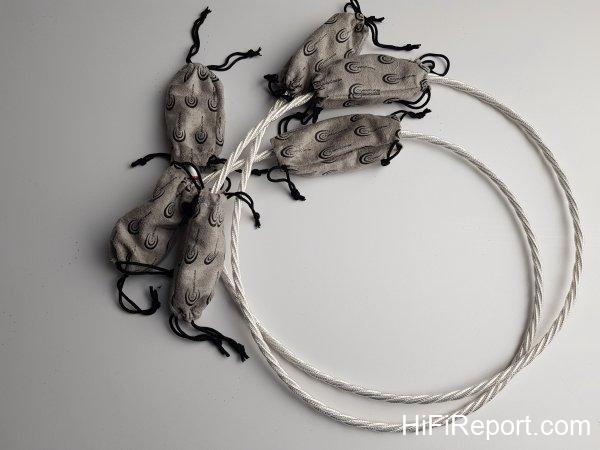
Therefore, from a design perspective, the Future Dream closely resembles the higher-echelon Ultimate Dream and Absolute Dream, differing primarily in the inclusion of a Silver-Gold Alloy layer within the shielding. However, the Future Dream is positioned as a significantly more accessible value proposition compared to Crystal Cable’s top-tier offerings.
Exquisite Craftsmanship Enhancing Authenticity
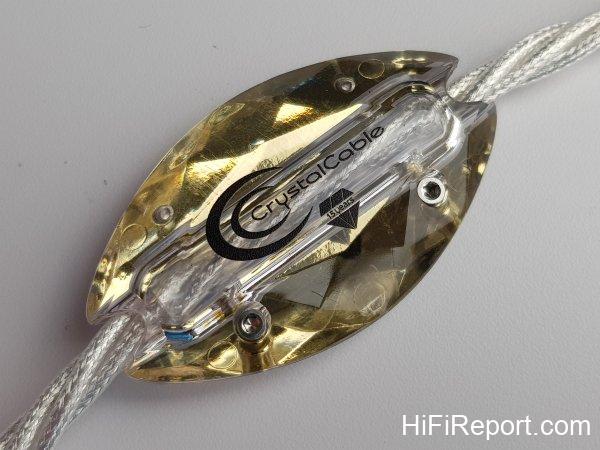
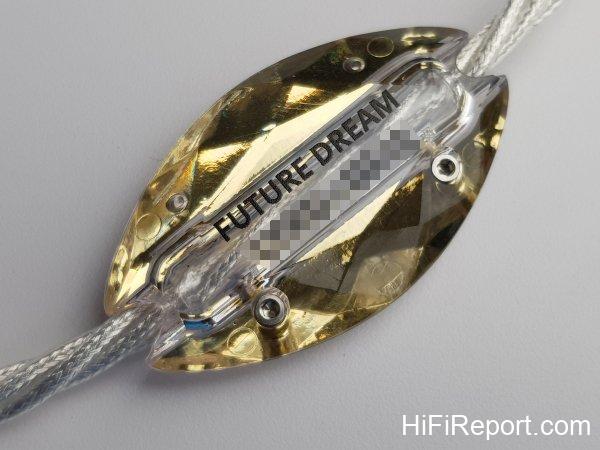
Visually, the Future Dream, with its Hybrid Technology, forgoes the opulent gold thread accents found in higher-end models. The cable itself maintains a silver-white aesthetic throughout. To compensate, Crystal Cable has meticulously crafted the acrylic decorative rings, cutting their surfaces into diamond-like facets and embedding gold leaf at the center, resulting in a sparkling, subtly regal appearance.
Furthermore, the Future Dream packaging includes an oversized acrylic diamond, which can serve as a paperweight, presented as an additional commemorative gift from the manufacturer.
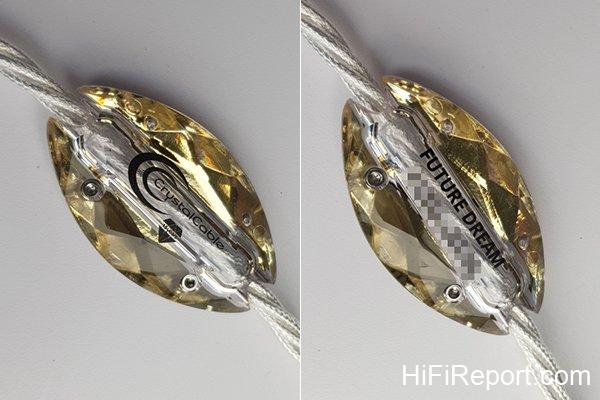
Some might argue that cable purchases should prioritize sonic performance, and that Crystal Cable’s focus on aesthetic embellishments and(gifts) detracts from sound quality, questioning the necessity of these non-sonic enhancements. The answer is straightforward: to increase the difficulty of counterfeiting. In early 2019, Crystal Cable’s principal, Gabi Kleij-Rijnveld, personally visited Taiwan to launch Future Dream. During that event, for which I served as translator, I posed this very question to Gabi. She explained that rampant counterfeiting necessitates measures to elevate manufacturing complexity. Without such efforts, the market would be flooded with fake Crystal Cable products. Gabi further revealed that all Crystal Cable products, in addition to serial numbers and warranty cards, contain hidden serial numbers. This allows Crystal Cable to cross-reference against their database and verify product authenticity.
Supporting Music Education Through Purchase
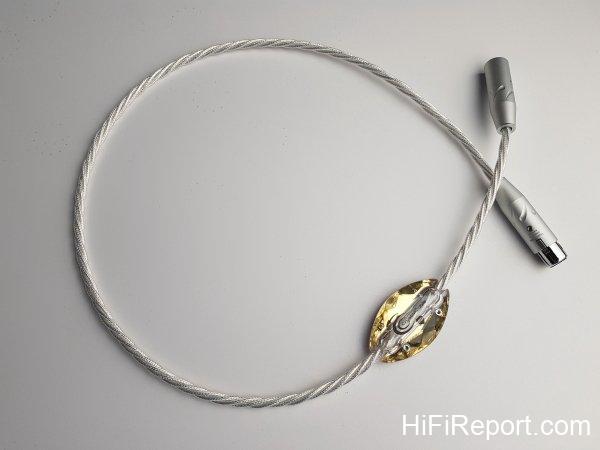
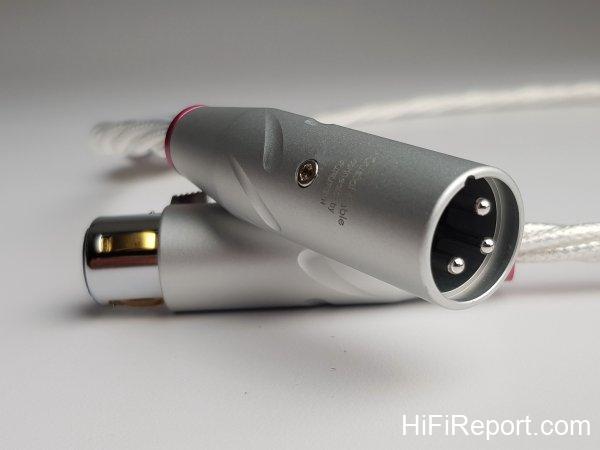
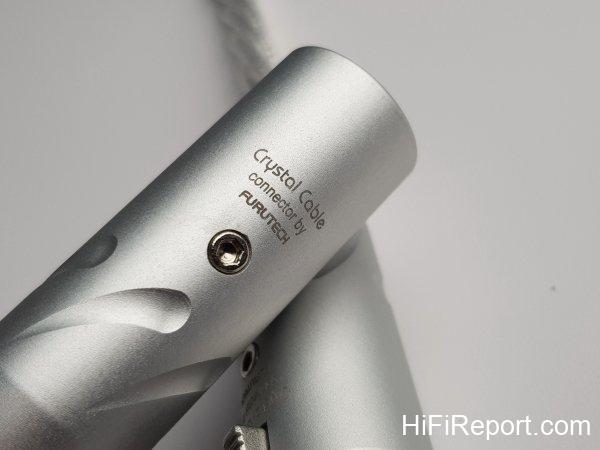
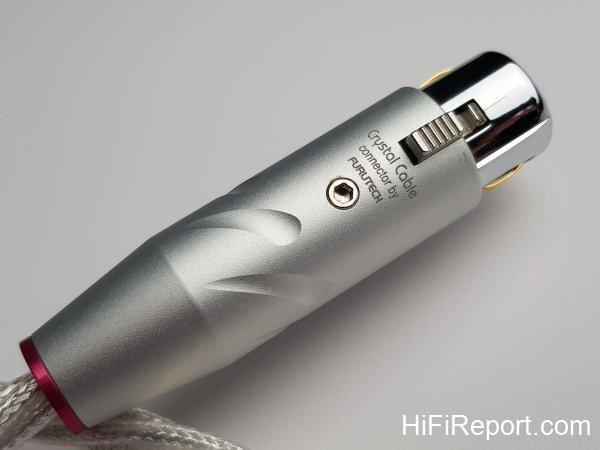
Beyond the Hybrid Technology combining Silver-Gold Alloy and Monocrystal Silver, the Future Dream interconnects utilize Furutech components for their connectors, incorporating the latest NCF technology. The version used in Future Dream, in keeping with the “Future” nomenclature, was a preview of Furutech products not yet available to the general market. Crystal Cable secured exclusive rights to this technology for six months, and the silver-white connectors were specifically developed for Crystal Cable, ensuring a consistent silver sheen from cable body to termination.
As a fifteenth-anniversary product, Gabi Kleij-Rijnveld aimed to imbue the Future Dream series with a deeper purpose, beyond showcasing Crystal Cable’s fifteen years of accumulated expertise.
Prior to her career in the audio industry, Gabi was a professional pianist. With her musical background, she felt a strong desire to contribute to the “future” generation of musicians. Therefore, Crystal Cable partnered with Leer Orkest, a Dutch charity organization. Leer Orkest accepts donations of funds and used instruments, providing free music education to children and teenagers in lower-income areas of the Netherlands, forming orchestras and arranging public performances.
Gabi deeply resonated with their mission. Starting with the Future Dream series, Crystal Cable pledged to donate 15 Euros to Leer Orkest for every Future Dream cable sold, contributing to the musical education of future generations.
Instantly Elevating Sonic Splendor
Having explored the narrative behind Future Dream, it’s time to delve into the sonic attributes of the Future Dream balanced interconnects. The coaxial Hybrid conductor, with its three strands—representing hot, cold, and ground—is intricately twisted. The silver-white cable, while not appearing particularly thick, is considered a substantial interconnect within the Crystal Cable family.
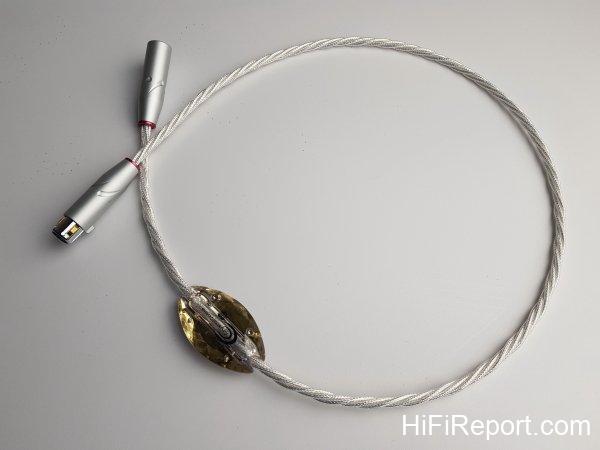
To simplify the system setup, I employed a North Star Design transport and DAC, connected via balanced outputs to a Linear Acoustic LAV60 MK II amplifier. The Future Dream balanced interconnects bridged the DAC and amplifier, driving Wilson Audio Alexia 2 loudspeakers for the listening session.
The HiFiReport editorial department primarily utilizes copper interconnects. Upon replacing them with the Future Dream balanced cables, the sonic opulence experienced a noticeable elevation compared to copper counterparts. The exceptional shielding facilitated a remarkably black background, further accentuating the purity of the sonic texture.
For instance, listening to Rubinstein’s rendition of Chopin’s Piano Concerto No. 2, specifically the slow movement, the Future Dream faithfully conveyed the vintage character of the analog-to-digital transfer of this older recording. Rubinstein’s piano emerged after the string section, exhibiting a rich, woody timbre. The Future Dream subtly enhanced the music’s brilliance and sheen, adding a touch of transparency to the lush piano tone. Rubinstein’s fluid and graceful playing conveyed a mature and restrained romanticism. Particularly when the main theme recurs, transposed an octave higher, the piano’s emotional intensity deepens, yet maintains a delicate poise.
Captivated by Chopin’s Adagio
Enthralled by Rubinstein’s Chopin performance through the Future Dream, I switched to another interpretation—Zimerman’s self-conducted version with the Polish Festival Orchestra. This rendition is notable for its exceptionally slow tempo. The string section’s opening adagio unfolds at a deliberate, almost glacial pace, with the woodwinds responding with measured caution. The Future Dream beautifully rendered the contrast between the strings’ subdued character and the woodwinds’ brighter response. The piano’s entrance, hesitant and restrained, felt like a soliloquy, a whispered confession.
Zimerman’s left hand maintained a steady, unhurried pulse, while his right hand explored a more liberated approach. The melody unfolded slowly, while ornaments were executed with fleeting brilliance. In this exceptionally slow adagio, Zimerman’s breathing could be discerned, mirroring each musical phrase. As the main theme returned, rising an octave, each note from his right hand sounded like a luminous pearl, distinct and well-defined. The Future Dream allowed every musical nuance to emerge. Especially in the dramatic middle section, the music’s atmosphere shifted dramatically. The exceedingly slow tempo granted Zimerman ample expressive flexibility. In moments of intensity, even the subtle percussive sounds of the piano pedals could be heard. The Future Dream’s ability to reveal such rich recording detail was mesmerizing. I closed my eyes, imagining Zimerman at the piano, intently focused, subtly guiding the orchestra with his body language and gaze to achieve a Chopin performance slower than most other interpretations.
Comparing with My Favorite: Pires
Which rendition of Chopin’s Piano Concerto No. 2 is my personal favorite? The answer is Pires, with Previn conducting the Royal Concertgebouw Orchestra on DG.
Previn’s tempo strikes a balanced middle ground, neither too fast nor too slow. However, Pires’ romanticism is anything but ordinary. Following the orchestral introduction, Pires’ piano enters with a free tempo, exhibiting a slightly hesitant quality. Before reaching the highest note, the piano sound momentarily cuts off—a fleeting pause, an unspoken emotion conveyed from the very first phrase. Then follows the recurring main theme. Pires’ tempo is free yet controlled. As the theme returns, ascending an octave, the piano’s brilliance is both luminous and smooth. The Future Dream not only showcased the pearlescent piano timbre but also vividly rendered the piano’s dynamic contrasts.
Am I reviewing the Future Dream balanced interconnects, or waxing lyrical about Chopin’s Piano Concerto No. 2? Apologies—encountering exceptional audio equipment can sometimes lead to a momentary lapse in focus. I truly forgot I was evaluating the Future Dream interconnects.
In truth, even immediately after installing the Future Dream cables and simply listening to Haydn string quartets, I instantly recognized their extraordinary ability to revitalize the vibrancy of recordings. However, upon listening to Rubinstein’s Chopin Piano Concerto No. 2, I became completely immersed in the music, momentarily forgetting my reviewer’s duty.
No Compromise on Sonic Performance
Regaining composure, I needed to employ some demanding recordings to thoroughly test the Future Dream balanced interconnects.
Switching to Fairfield Four’s “These Bones” album, I listened to “I Couldn’t Hear Nobody Pray.” The a cappella male quartet’s vocals possessed substantial weight and depth. The subtle breath sounds captured in the recording enhanced its realism. Many might perceive Crystal Cable’s slender cable designs as lacking in bass. Rest assured, even their entry-level Piccolo cables exhibit excellent low-frequency performance. The Future Dream’s mid-bass and lower frequencies were remarkably solid and deep. Male vocal ensembles sounded rich and rounded. The interplay of tenor and baritone harmonies in the background created beautiful vocal layers, further enhancing the sense of realism.
Moving to jazz, I selected TBM’s “Misty,” from the renowned Japanese Three Blind Mice label. TBM is known for its close-miking techniques, sometimes even placing microphones inside the piano. Increasing the volume, the piano’s sonic image became even fuller and more substantial. The Future Dream further accentuated the piano’s brilliance. The plucked double bass notes were clearly defined, contrasting beautifully with the luminous piano. The delicate brushwork on the cymbals behind the melody was not overlooked by the Future Dream. This style of ultra-close-miked jazz recording may present instruments with slightly exaggerated proportions, but it unveils a wealth of instrumental detail. Details such as the piano pedal movements became effortlessly apparent with the Future Dream in the system.
Clean, Fast, and Substantial Bass
Finally, I selected the theme song from the film soundtrack “Tricycle” to evaluate the Future Dream’s bass performance.
The track begins with a light piano melody, abruptly punctuated by a powerful bass drum strike, creating dramatic dynamic contrasts. The Future Dream’s bass response was both rapid and forceful, exhibiting excellent control and definition—certainly not loose or muddy, but rather solid and impactful. During the electric bass solo section, even with a bass-heavy instrument, the Future Dream maintained note-to-note clarity and articulation, brimming with rhythmic drive. In the final jazz drum solo segment, the rapid-fire drum strikes were rendered with effortless clarity and definition by the Future Dream, while retaining substantial impact.
What makes the Future Dream’s bass performance so impressive? It possesses ample quantity, exceptional speed, remarkable clarity, and depth. It maintains composure and layering even in complex musical passages, faithfully reproducing the energy of the recording. Truly a remarkable interconnect!
Musical Engagement Above All
The Future Dream’s ability to enhance sonic focus and brilliance significantly elevates sonic density. Each instrument’s image is beautifully delineated, and the layers within recordings are rendered with clarity. More importantly, the Future Dream conveys a sense of musical nobility. This isn’t merely about increased high-frequency brightness or extension, but rather the nuanced harmonic richness in the mid-to-high frequencies, which radiates captivating musical charm.
In essence, my experience listening to Chopin performances by Rubinstein, Zimerman, and Pires through the Future Dream interconnects already revealed its captivating musicality. This capacity to convey musical emotion is the Future Dream’s most invaluable quality, one that transcends monetary value. To pursue that extra measure of musical beauty is indeed worth seeking, regardless of cost!
Specifications
* Type: Analog Balanced Interconnect
* Connectors: XLR (RCA version also available)