
David Laboga Ethernet-Ruby Network Cable Review
For a long time, my closest connection to Poland was Frédéric Chopin.
Of course, I also knew of other figures, such as pianists Arthur Rubinstein and Krystian Zimerman, and composers like Karol Szymanowski and Krzysztof Penderecki.
Beyond music, the names I could recall were limited to Marie Curie, Lech Wałęsa, and the Polish football striker Robert Lewandowski.
I must admit, my understanding of Poland was rather limited.
However, in recent years, I’ve gained a new perspective on the country.
Poland’s Hi-Fi Scene and Growth
I don’t know the extent of the musical and cultural atmosphere within Poland, but the flourishing state of its audio industry is an undeniable fact.
The first half of the year features the High End Society audio show, held in Munich, which is the largest event in the global audio industry.
In the latter half, the liveliest event is undoubtedly the Audio Video Show in Warsaw.
With an increasing number of exhibitors and attendees, this show has grown beyond being just a local Polish exhibition or even a regional European show; it has achieved global influence.
Simultaneously, local Polish audio manufacturers have been encouraged and have become increasingly active.
From afar, accessing these European brands isn’t easy without proper import channels.
Fortunately, in recent years, there has been a growing recognition of Polish audio equipment locally, leading to active import efforts.
In terms of loudspeakers, hORNS, Divine Acoustics, and Pylon have successively arrived. For electronics, brands like Lampizator, Ferrum, and J. Sikora are competing fiercely in the digital and analog source markets. Power treatment specialist Gigawatt has also established a presence, while cable manufacturers like Albedo, Audiomica, and David Laboga have entered the market.
These “Polish Ambassadors” (or perhaps “Polish Army”?) have brought Polish audio culture and passion with them, invigorating both the market and the hearts of audiophiles.
From Guitar to Hi-Fi Cables
The David Laboga cable brand, imported by HiFiReport, might be relatively unfamiliar to audiophiles, but it resonates deeply with guitar players. That’s because guitar cables are David Laboga’s primary business.
Electric guitars require cables to connect to amplifiers, cabinets, or various effects pedals, and just like for us audio enthusiasts, cables significantly influence the sound of an electric guitar.
Admirers of David Laboga cables include renowned guitarists such as Al di Meola, Tommy Emmanuel, Steve Stevens, Joe Robinson, and Steve Lukather, as well as the band Rasmus.
Technical Prowess, Quiet Approach
Perhaps because of its origins as a guitar cable brand, unlike most audio cable companies we’re familiar with, David Laboga doesn’t emphasize the use of special conductors, detail the cable structure or sheathing design, or invent proprietary technical terms.
David Laboga simply presents its products for you to see and hear.
The manufacturer even publicly solicited media reviews on their Facebook page – implying that the best way to judge their products is to experience them yourself.
OFC Copper, Silver Solder, and Custom Connectors? Plenty of Substance!
Although the official website is sparse on details, the provided information states that David Laboga cables consistently use OFC (Oxygen-Free Copper) conductors, with different braiding structures depending on the cable’s application.
For soldering, they use a 4% silver-content solder.
For David Laboga, whether it’s instrument cables for the stage or High-End cables for home audio, a clean, fluid sound with wide bandwidth is always their relentless pursuit.
Their handmade home audio cables include power cords, speaker cables, interconnects, network cables, and USB cables, among others.
Remarkably, as a manufacturer “branching out” into audio cables, David Laboga even develops specialized connectors for their cables.
For instance, they have developed their own rhodium-plated connectors for their interconnects and speaker cables, and exclusive connectors with large black housings for their USB and network cables.
In the realm of network cables, David Laboga offers three models, from entry-level to flagship: the green-sheathed Emerald, the blue-sheathed Sapphire, and the red-sheathed Ruby.
My first encounter with David Laboga was the Ethernet-Ruby, their top-tier network cable.
It features ultra-high purity oxygen-free copper conductors with tin plating on the outside, and employs a mix of different wire gauges.
Calfskin Sheathing and Vibration Damping
While the manufacturer doesn’t elaborate on the cable’s internal structure, they state that they strive to minimize microphonic effects through measures beyond just shielding, specifically addressing vibration isolation.
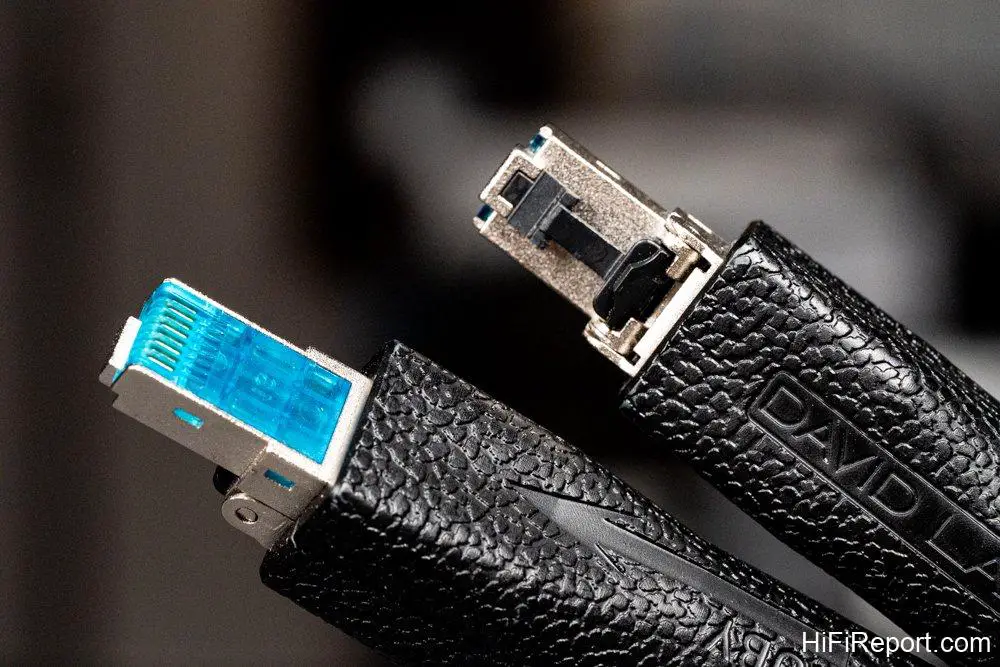
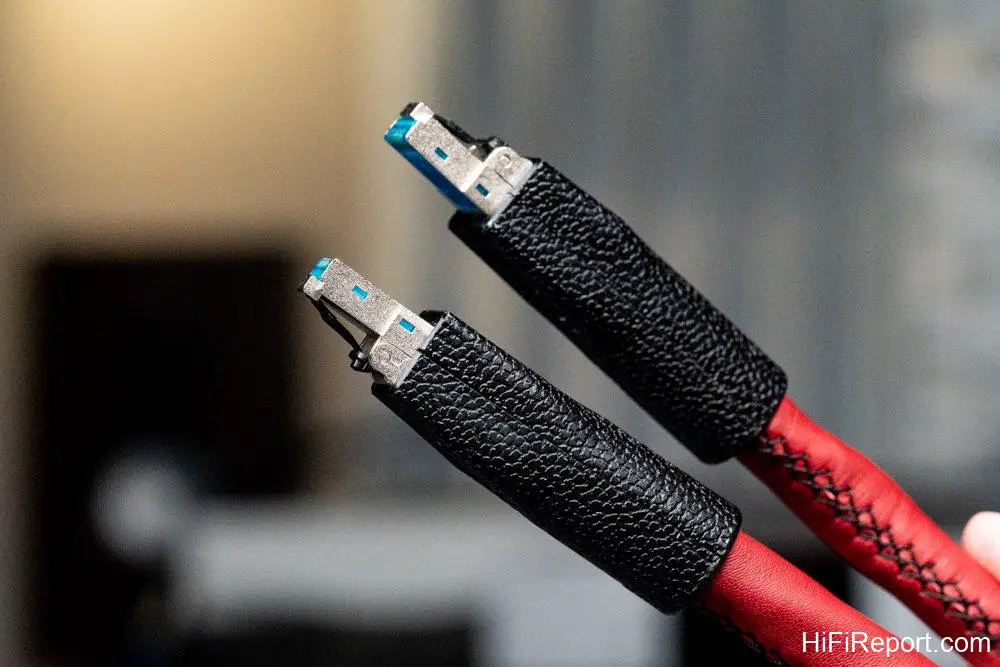
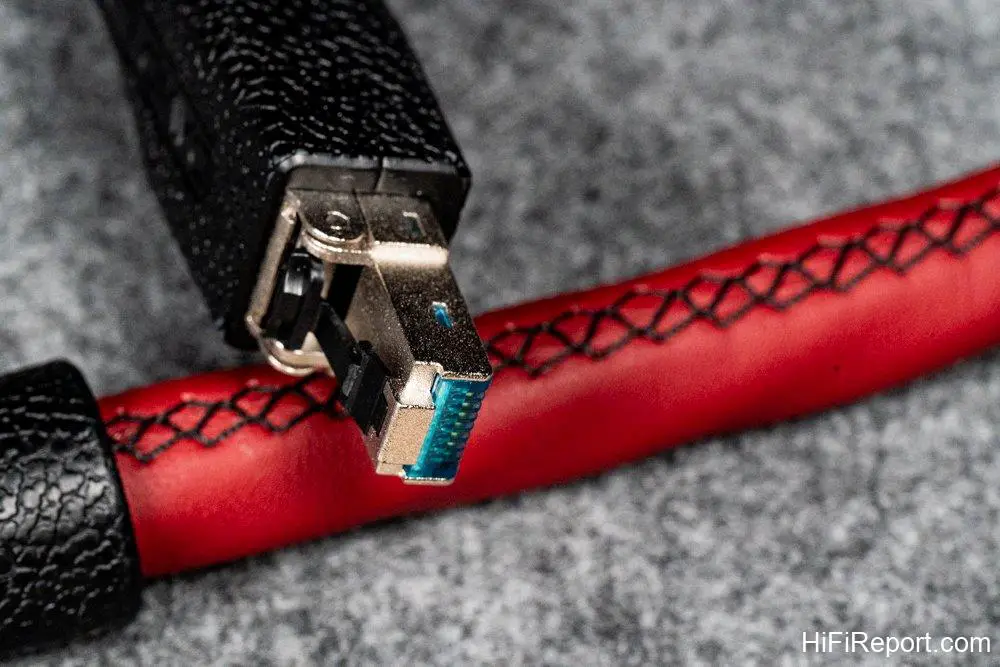
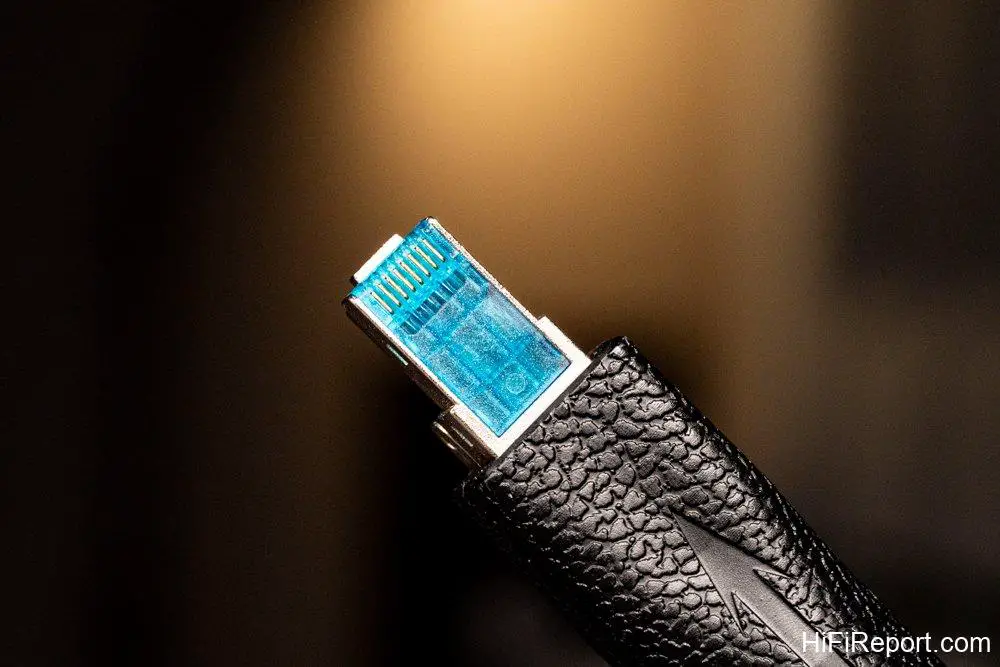
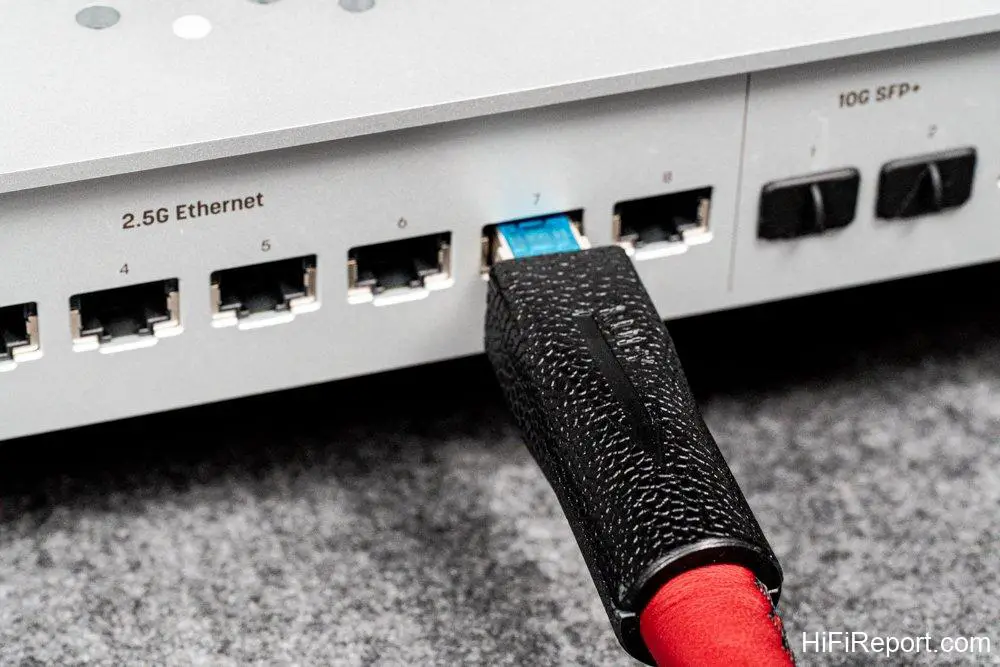
The custom RJ45 connector includes a black plastic housing bearing the David Laboga logo, making the entire connector bulkier than those from brands like Telegartner.

The connector contacts are pure copper plated with gold to prevent oxidation and ensure smooth signal transmission.
The most distinctive external feature is the calfskin sheathing applied to the Ethernet-Sapphire and Ethernet-Ruby models. Naturally, the Sapphire uses blue leather, while the Ruby features red leather.
The seams are meticulously stitched with a bidirectional cross-stitch pattern, radiating a sense of artisanal craftsmanship.
Exquisite Packaging
When writing reviews, I don’t always mention packaging, but after handling the box for the David Laboga Ethernet-Ruby, I simply must.
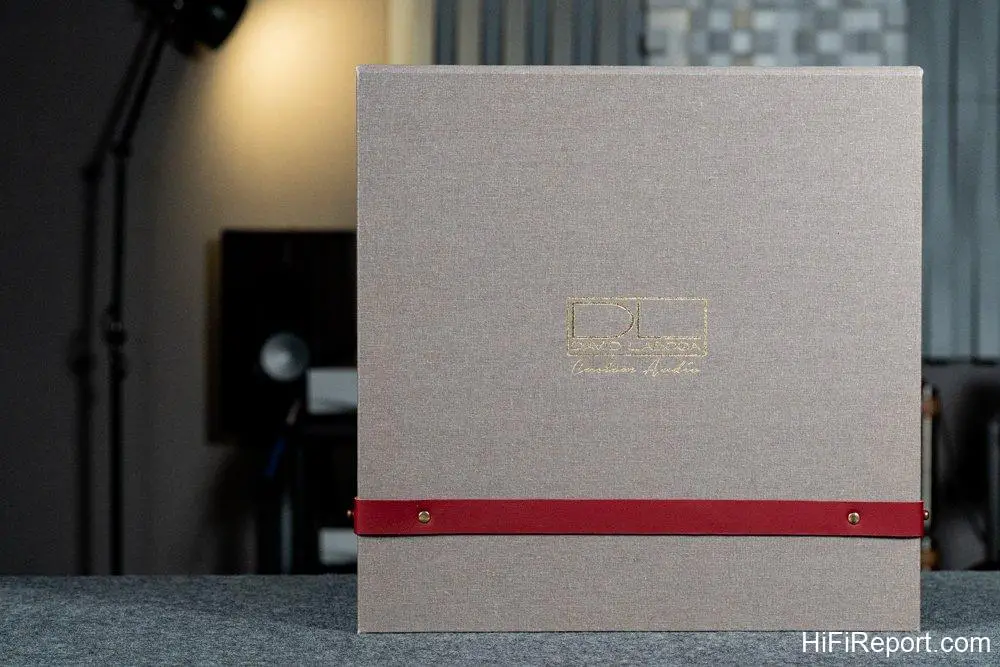
It’s a grey hard box with the words “DL David Laboga Custom Audio” hot-stamped in gold on the lid.
Just the explicit use of the term “Custom” hints at David Laboga’s background in guitar cables.
The lid is secured by a horizontal red leather strap with clasps on both sides. A slit at the end of the red strap engages with the clasp to hold the lid firmly.
The box itself is crafted from walnut wood veneer, expertly joined, giving it a premium feel.
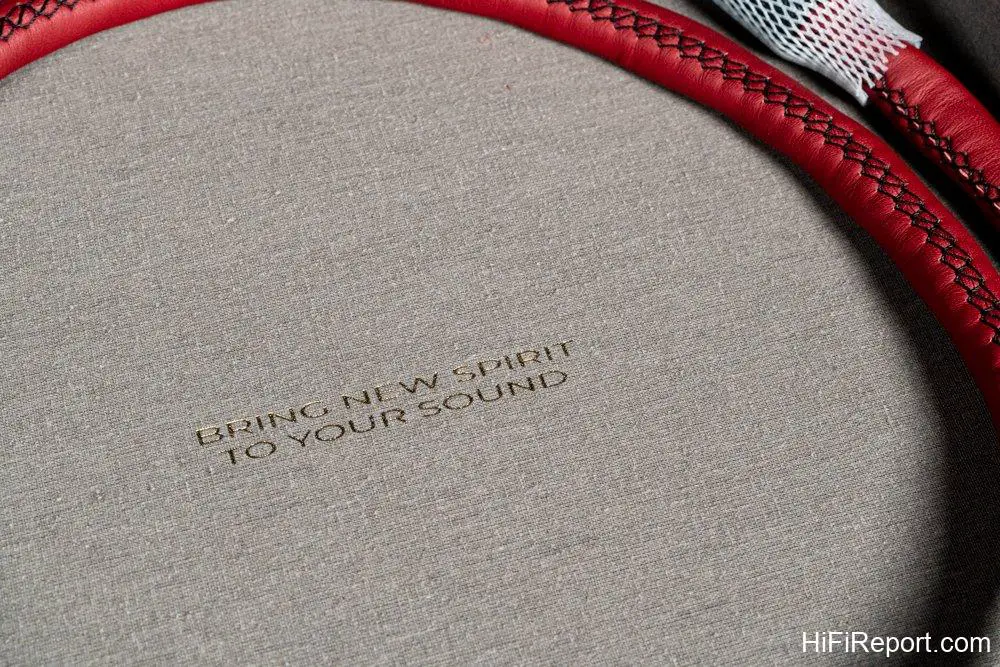
Inside, two lines of small gold-stamped text in the center read “Bring New Spirit to Your Sound,” proclaiming David Laboga’s confidence and ambition for their cables – a declaration to inject soul into the music.
The quality of this box, combined with the red calfskin-wrapped cable nestled inside, truly feels like a bespoke luxury item!
Full, Rich, and Effortless Sound
Regarding the sound, I must say, this “Ruby” cable truly opened my eyes (or should I say, ears?). The sonic improvement after integrating it into the system was immediately apparent.
The difference lies in the sound becoming fuller and richer, the timbre more opulent and vibrant, the soundstage wider and grander, and the overall presentation more fluid and relaxed.

In my personal experience, many network cables marketed as “audiophile grade” often enhance resolution and focus, which can sometimes make the sound feel less effortless.
The David Laboga Ethernet-Ruby takes a different approach. It makes the sound smoother, more harmonious, and more relaxed, yet the dynamic contrasts become even more distinct.
Wide Soundstage, Clear Layers
Taking Reference Recordings’ “Tutti” orchestral compilation as an example.
The Ethernet-Ruby network cable endowed the pieces on this album with a more substantial presence and more vivid tonal colors.
The lively “Dance of the Tumblers” by Rimsky-Korsakov begins with an introduction led by the low strings. After a rapid transition, the brass adds warmth, followed by a powerful fortissimo statement of the main theme accompanied by percussion.
The music then shifts to a playful, gentle rendition by the woodwinds, and the subsequent development of the theme unfolds through these contrasts of soft and loud.
The Ethernet-Ruby made this orchestral piece, with its expansive soundstage, sound even grander. The subtle percussion details on stage, along with the interplay between the woodwinds and strings, were revealed without any obfuscation in the highly transparent recording.
The rich dynamic variations of this piece sounded effortless and fluid. While details remained clear, they also seemed to gain more solidity. I was even more surprised by how changing the network cable increased the music’s power; the impact of the forte passages and percussion became more intense.
Its contribution to revealing micro-information was very evident. When the music softens, the sound should still retain clarity and substance.
The same album includes the second movement of Mozart’s Piano Concerto No. 21, recorded by the great American pianist Eugene Istomin with the Seattle Symphony.
In addition to the sparkling, luminous piano tone, the string pizzicato here, thanks to the abundant information provided by the cable, conveyed a sense of visual movement. The sustained string plucking created a rhythmic backdrop akin to a *basso ostinato*, while the piano sang its lyrical melody, occasionally joined by the woodwinds in harmony. The sense of perspective in this sonic picture was excellent.
Warm Tone, Rich Texture, Strong Musicality
When rendering chamber music, the rich texture and saturated tone brought by the David Laboga Ethernet-Ruby make the music not only sound warm but also deeply engaging.
Consider the three short pieces from Schumann’s Fantasiestücke for piano and clarinet, performed here by Helene Grimaud and Sol Gabetta. In this set, the clarinet part can be substituted with violin or cello, and here, Sol Gabetta plays the cello.
The three short pieces have distinct characters. The first is tender and lyrical, imbued with a nocturne-like quality. The cello’s tone is rich and full, while the piano’s notes have a warm sheen. In a beautiful interplay, they convey a subtle melancholy in the A minor melody, creating a truly wonderful atmosphere.
The second piece shifts to a major key, becoming lively and vibrant. Section A builds emotional tension through tempo shifts and dynamics, while Section B uses arpeggios to create a playful feel. The third piece is the most passionate, starting with a rapidly ascending motif. The rich cello tone climbs upwards, met by a cascade of piano notes like raindrops.
This network cable is named Ruby, a gemstone associated with passion and love. Listening through these three short pieces by Schumann, I gradually understood why this flagship network cable is called Ruby.
Captivating Vocals
When I say the David Laboga Ethernet-Ruby’s sound embodies the “passion” implied by the Ruby name, I don’t mean it has a white-hot intensity. It reveals details, and the information is rich, but it doesn’t emphasize details in any artificial way; it presents them effortlessly, making the music sound non-aggressive.
Its “passion” is more akin to a deep, intertwining emotion. When listening to vocal performances, this emotional quality makes the songs more compelling.

Listening to Eivor’s live album “Eivor Live,” specifically the track “Where Are the Angels,” the guitar notes are full and rounded with rich decay. As Eivor’s voice enters, the wealth of information clearly portrays the nuances of her performance – her articulation, breath sounds, vibrato, vocal style, and resonance are all distinctly audible.
On some systems, this recording might present certain sibilance and breath sounds excessively. However, as I listened, these details were certainly present, but without any unpleasant harshness.
The Ethernet-Ruby not only resolves musical details with finesse and smoothness but also delivers solid low frequencies. While the former pertains to the quality of the mid and high frequencies, the latter concerns the performance in the bass region. The track “Sum solja og bour” perfectly demonstrates the cable’s balance in both areas. Eivor’s vocals combined with the acoustic and electric guitar tones showcase the mid-high frequency balance and fluidity. The bass drum providing the “thump-thump-thump” low frequencies in the background has body and weight, indicating its reliability in bass reproduction.
Effortless Handling of Complexity
Although the Ethernet-Ruby is a network cable, not a guitar cable, knowing that David Laboga’s roots are in guitar might suggest adding more guitar music to the listening tests. Let’s use two tracks from Al di Meola’s album “Consequence of Chaos” as examples.
“Cry for You” has a simple arrangement – a piano and an acoustic guitar – yet it opens up a profound space. Chick Corea’s pensive piano, with its ornamentation and syncopation, creates a mesmerizing atmosphere. The piano tone is focused and solid. The acoustic guitar is incisive, with clean, bright notes from the strings and rich, resonant decay from the body. The two instruments sometimes converge and run parallel, while at other times they seem to go their separate ways, suggesting a dialogue yet also a sense of speaking to oneself. Indeed, the interplay of masters is truly something!
“Tempest” has a much richer arrangement, incorporating percussion, piano, electric guitar, and electric bass. The electric guitar’s tone is vibrant and colorful, sometimes teetering on the edge of distortion, expanding the performance’s tension. The percussion adds a lively scene to the music, and the piano contributes a splash of color. The drums and bass provide rhythm while also contributing solos. The electric bass sounds both full and deep, and the percussion and drums are crisp and impactful. Even Al di Meola himself said this piece isn’t simple. Listening to the shifting rhythms, the ensemble playing and harmonies between the musicians, and the electric guitar’s technical display, this nine-minute feast is truly abundant.
Persuaded by Musicality
The David Laboga Ethernet-Ruby network cable is indeed not inexpensive. Looking at the cable market, this cable falls into the high-price category. How does a network cable at this price point persuade someone? Appearance? Yes, it can, at least I find the stitched red calfskin alone quite eye-catching. Brand? Perhaps, at least among guitarists, David Laboga holds a certain prestige. When it comes to technology and specifications, the manufacturer’s reticence even made me a bit concerned for them.
It wasn’t until I used and listened to it that I understood its persuasive power. Yes, it’s that deeply musical sound. The Ethernet-Ruby makes streamed digital music feel more organic, more alive, more vibrant, and more emotionally impactful. While I wasn’t familiar with David Laboga’s reputation in the past because I don’t play guitar, I listen to audio and music, and David Laboga has a different way of making me remember it.
Specifications
Specifications
* Type: RJ45 Network Cable
* Conductor: Ultra-High Purity Oxygen-Free Copper
* Connector: Oxygen-Free Copper Gold-Plated RJ45
* Lengths: 1 m, 1.5 m, 2m, 3m