
dCS Rossini APEX DAC Review
When discussing automobiles, Porsche is an undeniable presence; in the realm of watches, who could overlook Patek Philippe; and when it comes to Scotch whisky, Macallan certainly springs to mind. Similarly, in the world of High End audio digital sources, dCS is a name that consistently rises to the top. Review
Military Origins, Hi-Fi Firsts
Founded in 1987, dCS initially wasn’t an audio company at all. They provided engineering design consultancy services, including electronic hardware and software, to the British military.
One of their most significant projects involved contributing to the development of the Blue Vixen radar system, fitted to the vertical take-off and landing Sea Harrier attack aircraft.
While continuing to contribute their technical expertise in the aerospace sector, dCS also recognized the growing need for digital audio processing in the civilian market.

In 1989, founder Mike Story developed a professional-grade ADC for a friend working in music recording. This became the dCS 900, the world’s first 24-bit analog-to-digital converter. Shortly thereafter, they released the dCS 950, the world’s first 24-bit digital-to-analog converter.
But dCS’s list of “world firsts” doesn’t stop there. They created the first 24-bit/96kHz ADC and DAC, the first 24-bit/192kHz ADC and DAC, the first PCM and DSD format converter, and the first transport capable of upsampling to DSD. dCS not only transitioned from military applications but also brought the highest standards of studio-quality audio into residential homes.

The Unique Ring DAC
Speaking of dCS, their most renowned feature is their unique Ring DAC decoding architecture. The digital-to-analog converter (DAC) is the heart of any digital audio system. Its job is to convert digital signals into analog signals, allowing speakers or headphones to transform them into sound energy so we can hear music.
dCS began using the Ring architecture for converters back when they were researching radar systems. This special architecture boasts extremely low noise, distortion, and jitter, coupled with remarkably high bandwidth. It proved effective for aerospace and military use, beneficial for recording engineering, and brought a nearly perfect effect to digital-to-analog conversion in home audio.

dCS believes that the voltage-division decoding architecture of traditional R-2R Ladder DACs can result in non-ideal voltage division due to component variations or thermal errors. The dCS solution is the Ring DAC.
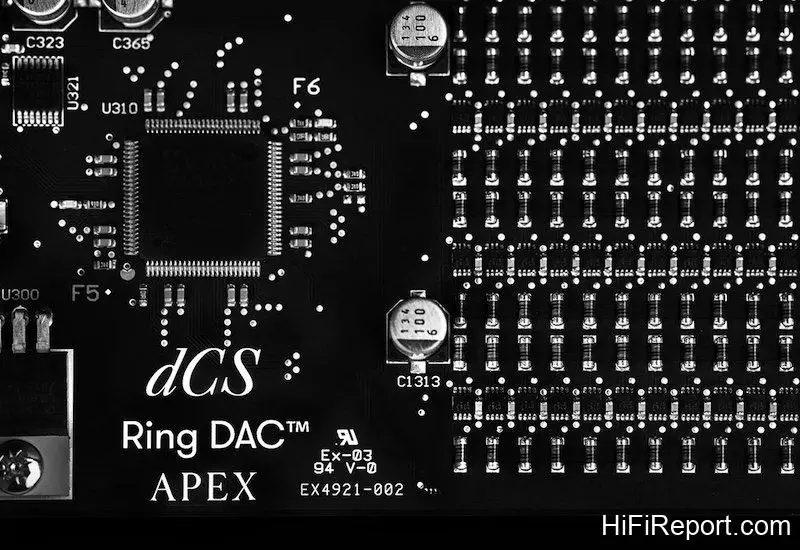
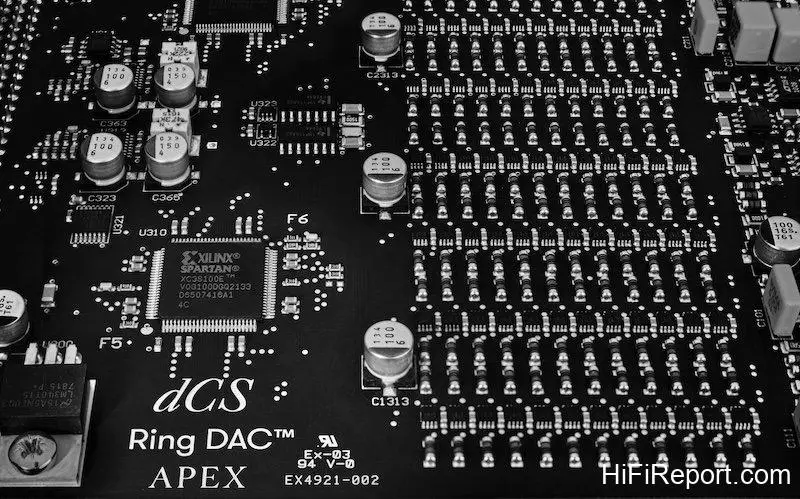
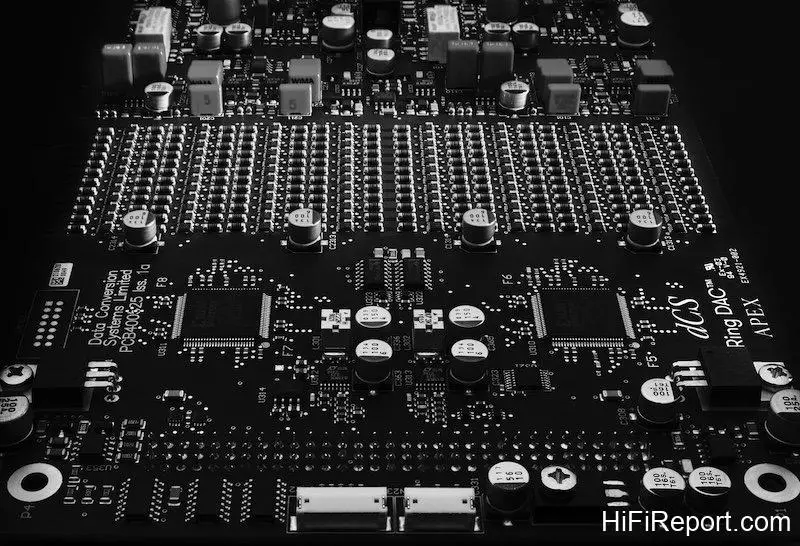
The Ring DAC uses a 5-bit modulator. Digital audio upsampled to 706.8kHz or 768kHz passes through the 5-bit modulator, converting it into a 2.822 MHz or 6.14 MHz signal. An FPGA chip acting as a Mapper, guided by a high-precision algorithm, determines which current sources need to be switched on or off to produce the correct signal. These current sources are implemented by groups of latches and resistors responsible for high-speed switching operations, controlling the flow of equal current sources.
On the surface, the Ring DAC might seem similar to a Ladder DAC, both relying on resistor switches for voltage division. However, the Ring DAC adds an extra step: through the 5-bit modulator and the FPGA Mapper, the sequentially generated current source values are averaged after being summed by an operational amplifier. This way, even with errors introduced by temperature or components, the error in each bit of data is minimized after summation and averaging.
The manufacturer explains the principle of the Ring DAC with a single diagram and a few paragraphs. Yet, the dCS Ring DAC is the product of over thirty years of continuous refinement and evolution, transitioning from military equipment to audio devices, from professional gear to home audio. The Ring DAC is like their core internal discipline, honed over time to reach peak mastery.

Beyond the Ring DAC’s Mapper, FPGA chips are widely used in dCS equipment. dCS writes its own code to handle audio processing, I/O encoding and decoding, oversampling, filtering, volume control, user interface, and memory functions. Because these numerous functions are configured on programmable FPGA chips, dCS engineers are not constrained by fixed chip limitations. System performance can be updated, enhanced, and evolved through software.
Apex Generation: Ring DAC’s New Summit
Current dCS models bear the designation “Apex,” signifying the latest generation of the Ring DAC. True to its name, meaning “summit” or “peak,” dCS considers this to be the best Ring DAC they have produced in over thirty years.

This significant upgrade traces back to 2017. That year, dCS introduced a new Ring DAC Mapping algorithm, allowing users to adjust the sound signature based on their listening preferences. After this major software upgrade, dCS set their sights higher: “How can we make the Ring DAC even better?” The 2017 upgrade was entirely software-based. In 2021, Product Development Director Chris Hales decided to tackle the hardware. After redesigning the Ring DAC and analog amplification circuits, the Ring DAC APEX was born and officially launched in 2022.
Apex Ring DAC: Five Key Improvements
What was changed? The manufacturer lists five major updates:
One: The Ring DAC APEX features revised DAC power reference supplies, resulting in reduced output impedance.
Two: The Ring DAC’s filter, summing, and output stages have been enhanced.
Three: The symmetry of the summing stages has been improved.
Four: The Ring DAC’s output stage has been redesigned.
Five: The main circuit board of the Ring DAC has been reconfigured.
Crucial Revision of Ring DAC Reference Power
The first item listed, “revising the Ring DAC reference power,” is particularly important. Chris explained that the Ring DAC’s reference power supply can directly influence the sound. In any electrical system, external signals (like noise) can interfere with the reference voltage. The Ring DAC is essentially a “multiplying DAC,” deriving its output by multiplying the reference voltage by the decoded digital value. Therefore, anything present in the reference power supply, whether its own frequency or noise, will be directly coupled to the output. Ideally, the reference power supply should provide only a pure DC voltage, free from any AC components or noise.
So, how can the reference power supply be made purer and cleaner? By lowering its impedance. The lower the impedance, the less easily interfering signals can couple in. Lowering the power supply impedance also has the benefit of minimizing voltage variations. Chris used the analogy of a ruler placed flat on a table to explain this. If it’s a thin metal ruler, we can easily change its shape by pressing it, perhaps lifting one end. If it’s a thick wooden ruler, it’s much harder to change its shape or pick it up by pressing down. A flexible ruler represents high output impedance; a stiff, inflexible ruler represents low output impedance. The former’s voltage is easily changed, the latter’s is not.
The signal received by the Ring DAC causes voltage variations, like the force we apply to the ruler. If the ruler is flexible (high output impedance), the reference voltage will easily vary. Voltage variations in the reference voltage caused by the signal are proportional to the impedance of the reference power supply – lower impedance means smaller variations. Based on these two points, they revised the Ring DAC APEX’s reference power supply, lowering its output impedance.
Output Stage Redesign: Apex Ring DAC Excels with Any Companion
Moving further down the signal path, we encounter the Ring DAC’s summing and output stages. The Ring DAC’s output stage can be viewed as a buffer for the analog signal produced by the Ring DAC. The dCS Ring DAC analog board comprises digital and analog stages. The digital stage receives data from the dCS digital processing platform, sends it to the Mapper for processing, and then distributes it to 48 sets of latches. The current output from the latches enters a summing stage composed of operational amplifiers and undergoes high-frequency filtering in the summing stage before being buffered in the output stage. We discussed this path earlier.
In the new Ring DAC APEX, dCS engineers optimized the summing stage and simultaneously improved the output stage. The manufacturer completely redesigned the Ring DAC APEX’s output stage. dCS engineers reasoned that they could only control the signal *within* the dCS unit. Once the signal is output and travels through cables to a preamplifier, they have no control over what happens. Therefore, their goal was to minimize sensitivity to these unstable factors. Cables inherently possess capacitance, resistance, and inductance, and the capacitive, resistive, and inductive reactances vary from one cable to another. Similarly, the input stage of a preamplifier will have capacitance and resistance, and the capacitance in the preamplifier’s input stage can lead to current loss, causing high-frequency roll-off.
As the source component, the dCS unit needs to output sufficient current from its output stage to drive the capacitance at the load end. Similarly, if the resistance of the input stage is low, it’s prone to variation, requiring sufficient current to drive it. The new Ring DAC APEX output stage has a higher output current, thereby increasing its compatibility with downstream equipment and cables, making dCS units easier to match.
Updated Analog Circuitry and Layout Topology
Other hardware modifications made by dCS for the Ring DAC APEX include replacing transistors in the Ring DAC’s analog amplification circuit and re-laying out components on the Ring DAC board. For a good DAC, the design of the analog circuit is as important as the digital design. dCS uses a compound amplification topology, stacking two operational amplifiers to form a complete amplification stage. The operational amplifiers in the input and output stages are different, selected specifically for their suitability in each position to achieve optimal amplification.

dCS states that their compound amplification topology provides higher gain and better utilizes feedback to improve linearity. This results in extremely low harmonic distortion, very low noise, and excellent overall performance. At the same time, they place great importance on circuit board layout, as components can interfere with each other – they gained extensive experience in this area during their work on radar and broadcasting systems. As a result, the Ring DAC APEX is quieter, and its linearity has improved by 12dB. Chris commented that even though they could already suppress harmonic distortion to -110dB, -120dB levels, this is still a highly significant improvement.
Developing Custom Measurement Equipment for Accuracy
Everything discussed above outlines the various improvements dCS has made to their Ring DAC APEX. Chris mentioned that they regularly review their Ring DAC to see where improvements can be made. However, the dCS Ring DAC was already so good that many characteristics were undetectable problems on traditional measurement equipment. Some measurement devices even introduce noise or distortion themselves. For example, when measuring harmonics, the measurement device’s own second harmonic might coincidentally cancel out the second harmonic being measured, leading to misinterpretations.
To address this, they had no choice but to design custom tools and equipment with higher specifications to more accurately measure various aspects of the system’s performance. When the true performance in these areas was discovered and properly adjusted, it led to unexpected improvements. What does it mean to be dedicated to excellence? This is it. To truly seek excellence, one must not overly consider the cost. So, the Ring DAC was already excellent, but dCS found a way to surpass themselves, reaching a higher “Apex.”
Factory Offers Paid Upgrade Program
Naturally, purchasing the latest dCS products equipped with the Ring DAC means you are getting the newest Ring DAC APEX version. Owners of older Vivaldi DAC, Vivaldi One, Rossini Player, Rossini DAC, or Bartok DAC units can inquire about the paid upgrade process to the APEX version. Software upgrades are simple, like updating a mobile phone’s operating system – download, update, restart, done. However, the Ring DAC APEX upgrade is a hardware-level change requiring the replacement of circuit boards by qualified personnel.
Rossini: The Essence of Vivaldi
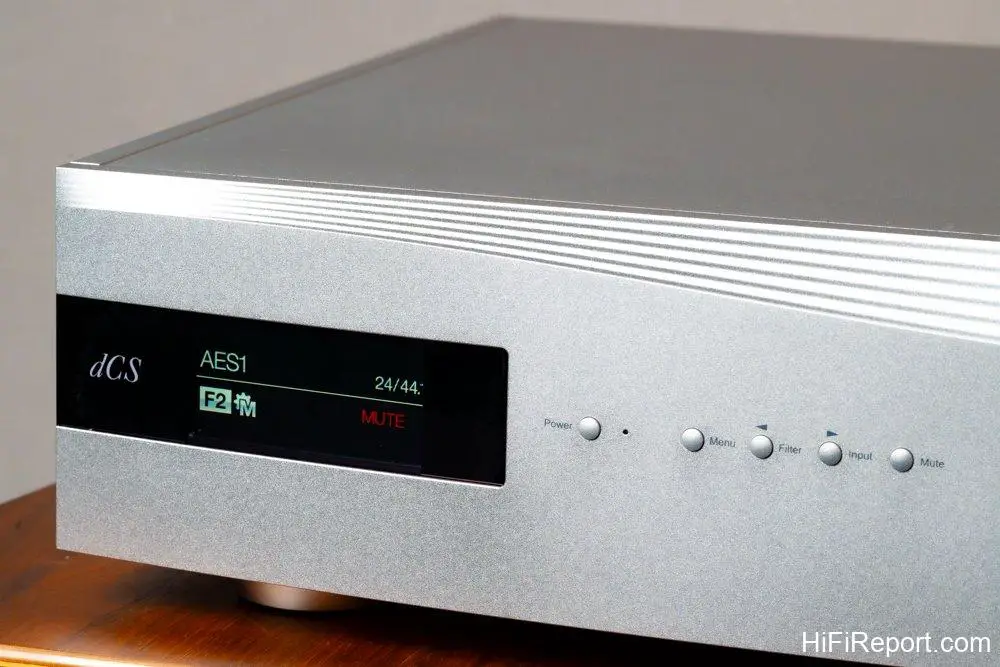
The subject of this review is the Rossini APEX DAC, dCS’s mid-range product. dCS created the Rossini series by condensing and simplifying elements from their high-end Vivaldi series (which was the flagship previously, before the introduction of Varese). The Rossini series includes a CD player with a built-in DAC, a pure transport, a DAC, and a master clock.
If you desire a simple system, purchasing the Player is sufficient – it not only plays CDs but also handles decoding and streaming. If you’re more discerning, you can opt for the combination of a pure transport and a DAC. This Transporter is a CD/SACD transport, specification-wise rivaling the Vivaldi.
Comprehensive Connectivity
The Rossini APEX DAC offers a full suite of connection terminals. For digital inputs, there are three S/PDIF inputs (one coaxial, one BNC, one optical), and two AES inputs (which can be used individually or as a dual-AES connection). There’s one USB type A and one USB type B input, plus an RJ45 network input. Common digital input interfaces, including those for streaming, are all present.
The network input, USB input, and dual AES inputs support the highest sampling rates, up to 24-bit/384kHz and DSD128. For analog outputs, there is one set each of RCA and XLR. The bottom row features three BNC terminals for connecting a master clock.
External Clock for Enhanced Performance
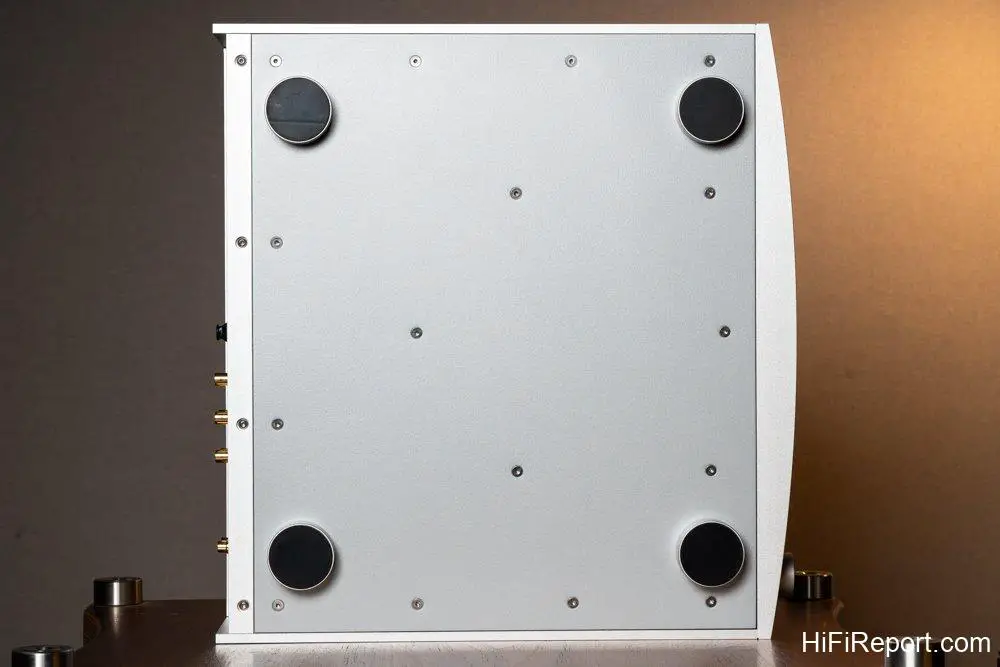
The three BNC connectors dedicated to connecting a master clock include two inputs and one output. dCS has consistently tried to communicate the benefits of adding a clock to the market. A digital device must have a clock for the system to know when to process which digital signal. If you have multiple digital devices, you need a master clock to synchronize their operation. Furthermore, using an external master clock isolates the sensitive clock circuitry from other circuits within the machine, protecting it from electromagnetic interference, power supply noise, vibration, and other disturbances. Therefore, whether using multiple digital devices or a single one, an external clock is beneficial. dCS’s belief in master clocks is so strong that even their entry-level Lina series includes a master clock. As a dedicated series, the Rossini naturally has its own series master clock, though it wasn’t available for this review.
Superior Craftsmanship, Exquisite Texture
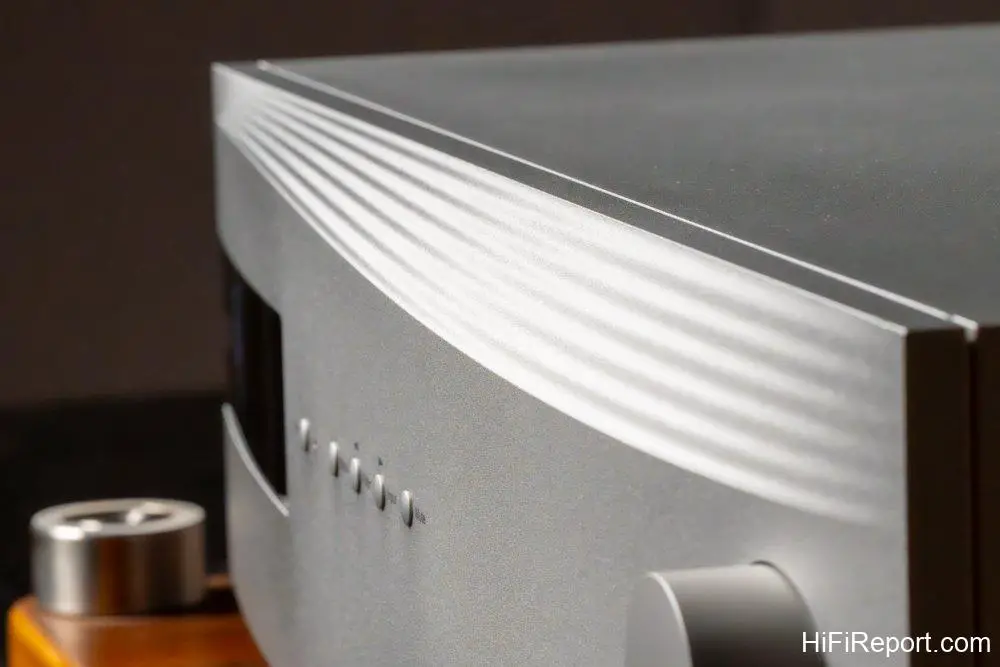
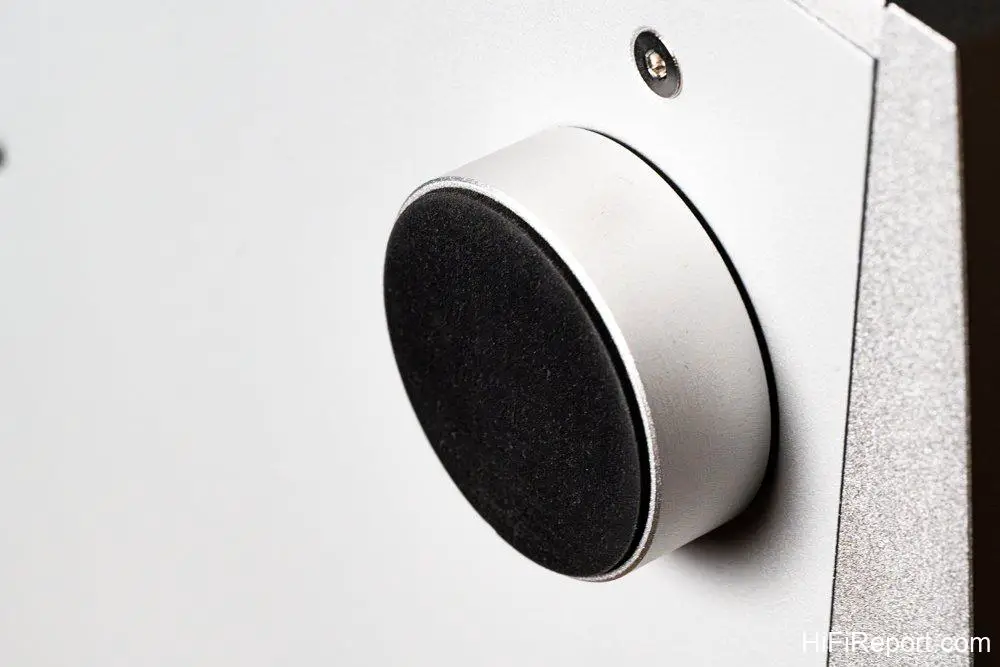
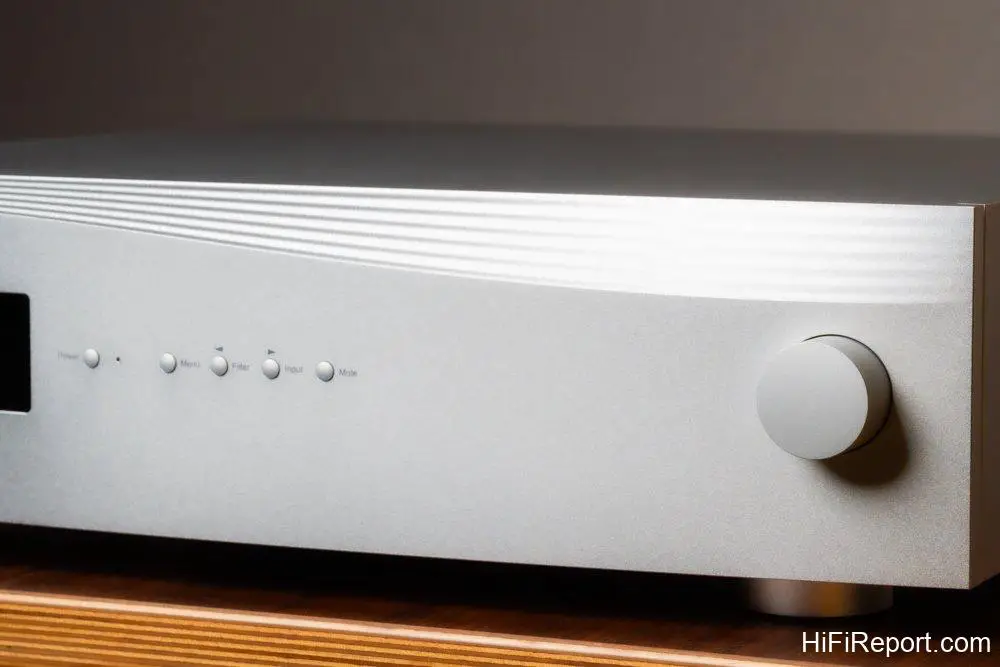
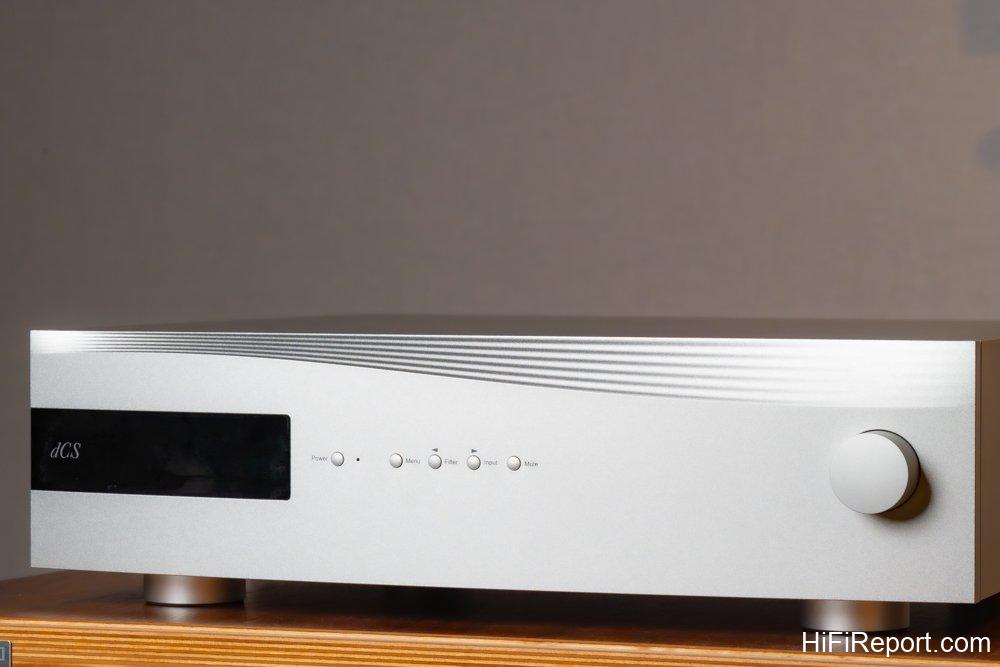
dCS builds its chassis from aerospace-grade aluminum alloy, assembled from thick aluminum plates. The robust chassis not only provides excellent vibration isolation and shielding but also showcases the unit’s exceptional texture through meticulous external finishing. The craftsmanship of the Rossini APEX series is slightly simpler than the higher-end Vivaldi, lacking its assertive, interwoven three-dimensional lines, but it is equally refined. The few lines cut into the upper part of the front panel resemble a flowing musical staff, creating a dynamic sense of ripples under light.
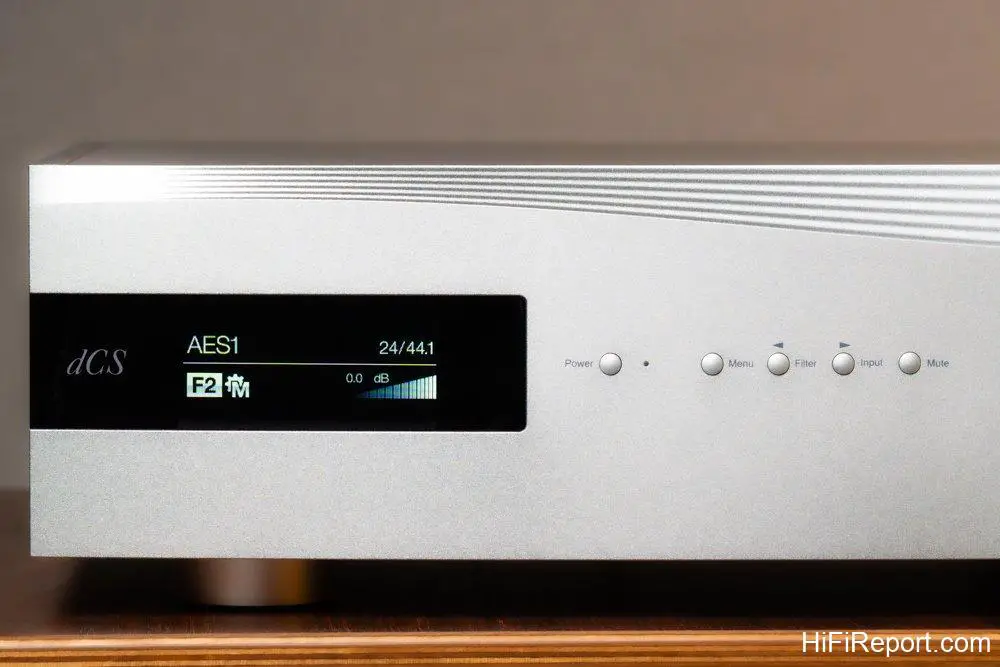
The display screen is located on the left side of the front panel. Apart from the dCS brand logo, the actual display area is not large. The text on the display is elegant, using icons combined with simple text to convey sufficient information within the limited screen space.
Complete and Believable Reproduction: Removing All Digital Edge
I auditioned the Rossini APEX DAC at the HiFiReport listening room. The accompanying amplifiers included an EAR Yoshino 868 preamplifier, a German Physiks Emperor preamplifier, EAR 509 MK2 power amplifiers, and a Linear Acoustics LA V120 integrated amplifier. The speakers were Wilson Audio Alexia V.
The Rossini APEX DAC consistently managed to clearly resolve the texture of the sound, with complete and believable detail reproduction. Because the information was so complete, the sound felt particularly vibrant. I was especially impressed by its depiction of fine details, such as subtle changes in timbre or the expression of microdynamics. Listening through the Rossini APEX DAC, I often perceived new nuances within the music. This isn’t to say the music took on a new character or was colored in some way. Instead, it faithfully restored the original nature and essence of the music. However, certain information that wasn’t fully revealed or clearly presented on other DACs was audible on the Rossini APEX DAC. This is why I describe its portrayal as complete and believable; its completeness lends it credibility.
Furthermore, its sound possesses a dense, rich, and solid texture, providing clear, well-defined, and tangible sound images. This kind of sound made digital streaming, often stereotyped as being airy, loose, and edgy, sound not at all like those preconceptions. Instead, it conveyed a sense of analog warmth.
High Fidelity is Just the Start; It Reaches Far Beyond
Let’s take the recording of Beethoven’s Triple Concerto featuring Yo-Yo Ma, Anne-Sophie Mutter, and Daniel Barenboim as an example. Beethoven’s Triple Concerto is a unique piece in classical music history. Piano, violin, and cello form the standard chamber music trio configuration. Beethoven seems to have paired this trio with an orchestra, expanding and extending the trio, giving new orchestral life to chamber music. In this piece, we hear the intimate conversation and interaction between the trio instruments. The orchestra’s role sometimes feels like a fourth instrument joining in, sometimes like an accompanying backdrop, and sometimes it seems to fill in and connect the trio’s dialogue.
The Rossini APEX DAC presented a clear and transparent soundstage, offering an almost penetrating sense of perspective. It not only captured the texture and grain of the solo instruments but allowed insight into the details even within the ensemble passages. This demonstrates the astonishing resolution capabilities of the Rossini APEX DAC. When discussing “resolution” in traditional audio circles, it often merely means hearing more information. However, when you hear more information, what is the relationship between those sonic details? It is those relationships that form a kind of sonic organization, and it is this coherent organization that constitutes the music. We are moved by the music, not just the sound. What the Rossini APEX DAC resolves is not merely sonic information but the structure and composition of the music.
High Fidelity only aims for the faithful reproduction of sound. High End Audio seeks something more; dCS allows the Rossini APEX DAC to reach further.
Rossini Understands Mahler, Drawing You In Detail by Detail
Mahler’s Fifth Symphony is complex, not just musically but emotionally. It begins with a funeral march of heavy steps, a peculiar opening that destines this piece to be an enigmatic and profound existence. Mahler himself said after the premiere: “My symphony is great; no one understands it.” With the help of the dCS Rossini APEX DAC, I once again realized the greatness of this piece, especially the second movement. From the first theme, full of anxiety like an approaching storm, to the slow and sorrowful second theme, through the turbulent development section, and even the chorale-like passage in the latter half of the development – each stage of transformation is Mahler writing about his own life! As I mentioned earlier, the dCS Rossini APEX DAC allowed me to appreciate that a good source component can interpret not just the truth of sound but also the beauty of emotion. Reaching the ultimate truth without evoking emotion is still not beautiful.

What the Rossini APEX provides is not merely information, information, information. It is true, but it is also beautiful. Where is the beauty? It is in its ability to touch your heartstrings. Mahler embedded a large number of “three short, one long” rhythmic combinations in this movement, but the composer explicitly stated that this is not a triplet, but a rhythm starting on an unstressed beat. It is through this weak-beat “three short, one long” rhythm that the piece is propelled forward, building emotional intensity. The widespread use of chromaticism also adds color to the music. Listen to how Mahler uses dance-like swaying phrases in the strings, paired with passionate brass, to lay out fluctuating musical emotions. Just as the chorale-like melody unfolds, seemingly parting the preceding clouds of sorrow, the music turns into a dark minor key, finally fading away in a faint breath.
This movement features dramatic dynamic shifts, with ebb and flow intertwining various sections and instruments. Complex harmonies and intense musical language make this piece difficult to approach; there’s a fear of being engulfed by the surging emotions if one gets too close. The Rossini APEX DAC played the accomplice, drawing me deep into it, unable to pull myself away.
Coloring Every Detail Uncovered
The Rossini APEX DAC can uncover many details hidden within recordings, revealing subtle changes and textures in the fine points of the music. The sense of color it presents is rich and natural, as if you have a box of dozens or even hundreds of colored pencils – when you draw, you never worry about not finding the desired color. I fully experienced the rich timbre and the mastery of microdynamic changes that the Rossini APEX DAC can provide while listening to Arturo Benedetti Michelangeli’s album of Chopin Mazurkas.
The Mazurka is a Polish dance in triple time. Chopin adopted the Mazurka form to experiment with various harmonies, scales, and rhythms. Precisely because it was Chopin’s musical creative laboratory, the pieces are filled with a variety of changes, resulting in the brilliant and colorful Mazurkas. Michelangeli’s control over timbre and rhythm stems from his profound understanding of the pieces themselves. Listen to the rich timbre created through the pedals, touch, and harmonies, and then listen to the fluctuating feeling brought about by rhythmic variations and ornaments, which together create layers of beautiful, shifting light and shadow.

Could you not hear these on another DAC? Of course you could. However, the Rossini Apex DAC doesn’t need to be compared to others. When you, like me, experience Michelangeli’s performance of the Mazurkas, striking the piano strings while also touching your inner heartstrings, that is enough. This kind of evocative experience is not something every piece of equipment can achieve.
Hearing Ebb and Flow Reveals the Beauty of the Human Voice
Let me use Patricia Petibon’s “Melancolia” album as another example to illustrate its skill in handling vocals. This album opens with a song by Granados, where the guitar and strings slowly present an introduction before the soprano enters. Listen to the fluctuations, sometimes soaring, sometimes whispering, listen to the elongated final notes interspersed with dynamic variations. The following two songs by Montsalvatge are even more varied. Listen to Petibon’s captivating voice singing the lullaby, then listen to the lively Black song. While the styles of the two songs are vastly different, what remains consistent is that whether the song is slow or fast, Petibon’s vocal line is clear, distinct, smooth, and flowing, and the texture of her voice is presented in meticulous detail. Listen to the breathing, vocal transitions, and finishing touches – the Rossini APEX DAC’s expression is always natural and open.
Understanding Why the Return Exceeds the Premiere
Finally, I will conclude the listening impressions of this review with “Tomaas” from Marcus Miller’s “Tutu Revisited” album. This piece, and this version’s recording, certainly has the weight to serve as a concluding statement. Compared to Miles Davis’s performance 25 years earlier, besides the different styles and interpretations of the musicians, the recording technology had significantly advanced. Furthermore, this is a live performance, making the overall musical performance effect intensely vibrant and profoundly impactful. Christian Scott’s trumpet, muted, has a sharp, slender sound, cold yet full of penetrative power. I really love how the Rossini APEX DAC interprets the trumpet – the cold metallic texture and the extremely dense sound vividly portray that cool, detached modern feel perfectly.
Of course, the synthesizers create a broad and expansive sense of space, combined with the rhythm provided by the drummer, shifting between speed changes, pauses, gaps, and rapid bursts. These factors together create this “return that surpasses the original.” The Rossini Apex’s ability to shape space is first-class. It doesn’t just push the soundstage outwards; it clearly delineates all the spatial arrangements within it. And its clean, detailed, yet highly cohesive sound makes the musicians’ performances sound lively and distinct. The trumpet, as just mentioned, is like this, the drum kit is like this, and Marcus Miller’s bass is also like this. Bright, springy, solid, full-bodied, and clear, while retaining depth and thickness, the bass solo lasting about 2 minutes in the latter half of the piece is truly spectacular. It was electrifying to hear live, and I was equally thrilled listening in front of the Rossini APEX DAC.
This Goodness Leaves Me Speechless
The dCS Rossini APEX DAC comes at a significant price, enough to assemble a very good audio system with just the cost of this one DAC. However, as a representative brand of High End audio and a market leader in digital decoding technology, the effort dCS has invested in the Rossini APEX DAC is clearly audible. Unparalleled balance, extraordinary naturalness, rich chromaticity, genuine texture, fluid expression, expansive space, effortless dynamics – all these descriptions fall far short of conveying the full extent of my appreciation. If there is any regret, it is not having paired it with a dCS master clock this time. However, if the Clock had been present, I fear I would have been even more utterly speechless in front of the dCS.
Specifications
* **Type:** Streaming DAC
* **Digital Inputs:** Coaxial x1, BNC x1, Optical x1, Dual AES x1, USB Type B x1, USB Type A x1, RJ45 x1
* **Analog Outputs:** XLR x1, RCA x1
* **Clock Connections:** BNC input x2, BNC output x1
* **Bit Depth:** 24bit
* **Maximum Sampling Rate:** PCM 384kHz, DSD 128
* **Weight:** 15.6kg