
Divini X-N12 Network Cable Review
In our ongoing quest to uncover the crucial elements that influence the sonic performance of network cables, we initiated the “Network Cable Roundup” special feature. To date, we have rigorously evaluated ten audiophile-grade network cables, and the Divini X-N12 marks our tenth test subject.
After listening to so many cables, have we found the answers we seek? Frankly, while network cables transmit data packets of 0s and 1s, rather than analog or digital audio signals, they, like other types of audio cables, exhibit distinct sonic characteristics and tendencies based on their design. Pinpointing specific design elements that directly correlate to sound quality remains elusive. However, one certainty has emerged: sonic excellence isn’t necessarily tied to price. The X-N12, for instance, is the most affordable cable in our roundup yet delivers a top-tier performance that is truly commendable and highly recommended.
Four Key Design Aspects
According to Divini’s research, the design of a superior network cable needn’t be extravagant or mystical. Instead, it should meticulously address four fundamental aspects: premium conductors, a precise structure, effective shielding, and reliable connectors—each indispensable for optimal performance.
For the conductor, the X-N12 employs 7N OCC single-crystal copper stranded wire of exceptional purity, with a 22 AWG gauge. This high-quality conductor minimizes signal loss through superior transmission.
Regarding structure, the X-N12 prioritizes precision over complexity or unconventional designs. Network cables must adhere to specific standards to guarantee accurate data transmission and sufficient speed. Only a correctly engineered structure can meet these requirements.
What constitutes a “correct” network cable structure? A network cable comprises eight conductors, twisted in pairs to form four pairs. This twisting serves to counteract magnetic interference. Therefore, the X-N12 demands strict adherence to the twisting method and pitch for each pair of conductors.
Furthermore, the material and thickness of the conductor insulation are carefully considered to maximize transmission bandwidth and optimize conduction speed.
Data transmitted within the conductors, being delicate and low-level, is susceptible to external electromagnetic interference. Shielding, therefore, becomes paramount. To this end, the X-N12 incorporates a triple-layer shielding system. Each twisted pair is initially wrapped in an aluminum foil layer. Subsequently, the four pairs are twisted together and encased in a thick copper foil layer. Finally, a silver-plated OFC braided mesh provides the ultimate shield. This comprehensive shielding effectively isolates any EMI noise or electromagnetic interference, preventing data corruption.
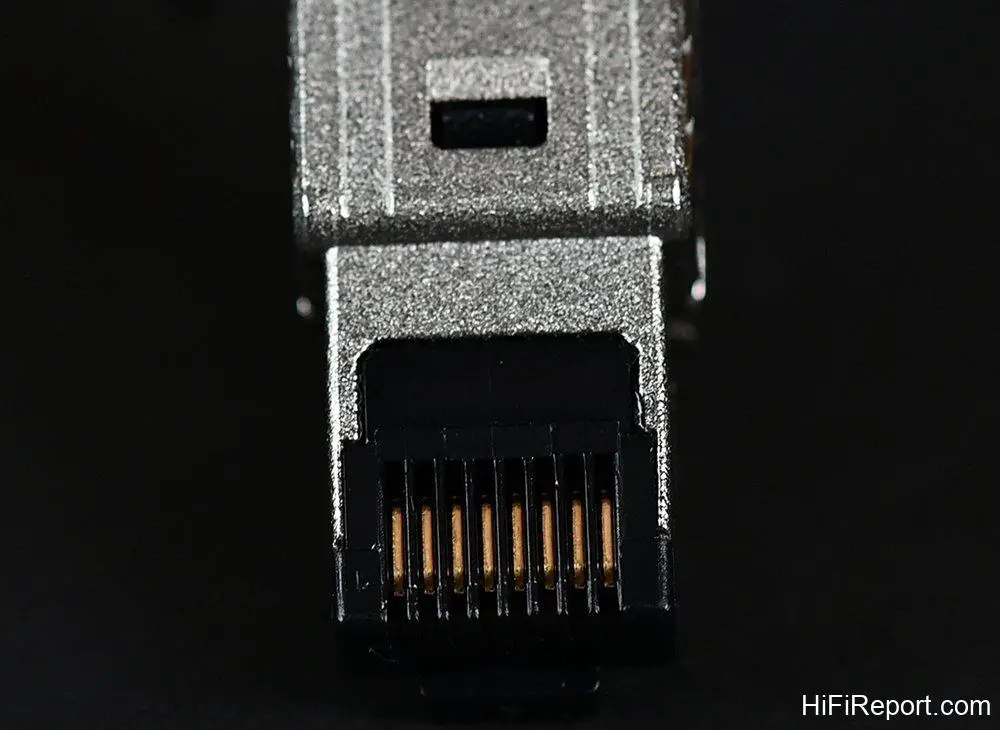
While the RJ45 connector of the X-N12 does not feature the German-made Telegärtner MFP8 connectors found in some high-end audiophile network cables, it utilizes CAT-8 specification connectors with full metal housings. These effectively block external electromagnetic interference and ensure long-term durability.
The connectors also incorporate circuit boards, and the metal contacts are crafted from high-quality phosphor bronze, plated with a substantial 24K gold layer to enhance conductivity.
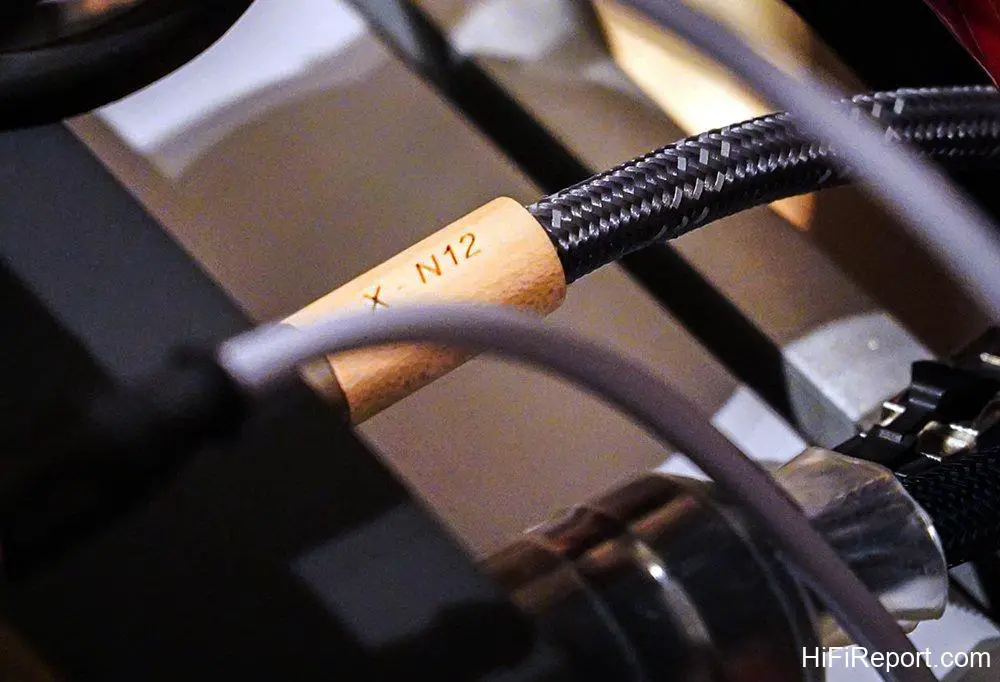
Moreover, the connector’s strain-relief section is fitted with a decorative wooden shell, enhancing the overall aesthetic and tactile quality.
In essence, the X-N12 focuses on enhancing network transmission quality through these four key design aspects. It is a fundamentally sound design, transparent in its approach, devoid of any obfuscation or marketing hyperbole.
Exceptional Natural Sound
The listening evaluation took place in the HiFiReport listening room, utilizing a system comprising a Marantz SACD 30n source player, Huihua OSA-FETRON Phantom preamplifier, EAR 509 monophonic vacuum tube power amplifiers, and Wilson Audio Alexia 2 loudspeakers. The X-N12 was connected between an Ansuz D-TC Supreme PowerSwitch network switch and the SACD 30n.
A Linkomm Cat-8 standard network cable served as the reference for A/B comparison.
Playing the Audio Physic 25th Anniversary CD, a collection of classical music, the immediate impression with the X-N12 was an exceptionally smooth and fluid sonic character. It rendered musical lines more elegantly and delicately without sacrificing clarity, agility, or high resolution. The timbre also gained a touch of richness and warmth.
For example, in track 6, “Ei du feiner Reiter Variations,” a concerto for harpsichord and string orchestra, the X-N12 imparted a softer, more flowing quality to the string textures. Dynamic gradations were enhanced, with a more pronounced contrast, allowing quieter passages to be heard more clearly and louder passages to possess greater impact. In contrast, the reference network cable presented a more rigid and monotonous dynamic contour, sounding comparatively flat.
Track 7, a lute piece composed by fifteenth-century Italian composer Giovanni Antonio Terzi, features a lute duet. Through the X-N12, the plucked note articulation became more distinct and tangible, with a richer and rounder tone. The plucking texture became more pronounced, conveying a greater sense of the force applied to the strings. The separation between the two lutes was also improved.
While the reference cable also offered clear imaging, it sounded flatter and lacked the dynamic impact of the plucked strings.
Another remarkable attribute of the X-N12 is its naturalness.
Among all the network cables tested in this feature, its level of naturalness is exceptional. It avoids any sense of artificial emphasis or contrived effects. The sound is clean, sweet, transparent, and lively, with rich textural detail and a sense of liquidity, making for a very comfortable listening experience, free from any discernible flaws.
Enhanced Musical Flow
Moving on to Sarah McLachlan’s renowned “Angel,” with its grand, expansive low frequencies and extended reverberation, creating an ethereal and spacious atmosphere.
With the reference cable, the sound became somewhat muddled, with a heavier, slower sonic presentation and less defined instrumental shapes—slightly congested, in simple terms.
Switching to the X-N12, the initial bass notes were immediately deeper, with richer layers and greater agility.
Furthermore, the X-N12 provided a more transparent and cleaner background, and vocal images appeared clearer and more three-dimensional. The overall sense of musical flow was significantly enhanced, creating a more atmospheric and immersive experience.
In another example, listening to Pletnev conducting the Russian National Orchestra performing Shchedrin’s arrangement of the “Carmen Suite” for percussion, the xylophone articulation in track 3, “First Intermezzo,” was rendered with enhanced clarity and crispness. The timpani at the back of the stage gained sharper outlines and more precise localization. The bowing texture of the string section on the left side also became more defined and richer. Remarkably, the soundstage expanded in depth, with a more distinct layering of the orchestra from front to back. Instrumental definition and separation improved, elevating the overall musical atmosphere.
Essentially, the X-N12 articulates the soundstage with greater clarity and layering. It enhances overall dynamics, quickens transients, and enriches timbral vividness. The listening experience becomes more engaging and exhilarating, yet remains relaxed and fatigue-free. It is undoubtedly a worthwhile investment in a high-quality audiophile-grade network cable.
Specifications
* Type: Ethernet Cable
* Conductor: 7N OCC
* Conductor Gauge: 22 AWG × 8
* Insulation: PE + Natural Cotton Filling
* Shielding: Aluminum Foil + Copper Foil + Silver-Plated OFC Braided Mesh (SF/FTP)
* Outer Diameter: 9 mm