
Esoteric Grandioso K1X SACD Player Review
Do you still listen to CDs? Asking this question 20 years ago would have been redundant.
Back then, the vast majority of people listened to music on CDs.
It was the era when the CD market reached its zenith. Digital recording technology had matured, the record market was thriving, and CD player manufacturing was at its peak.
During that time, CD players and transports in the audio market flourished. The core component—the disc transport mechanism—saw various manufacturers competing with their unique designs, such as Philips, Sony, Teac, CEC, Pioneer, and Denon. Many Hi-End manufacturers also adopted these mechanisms when developing their CD players.
It was the golden age of CD players.
After 2000, the market began to shift.
One change was the emergence of new optical disc formats. SACD and DVD-Audio began to emerge, initiating the long journey of high-resolution audio challenging the Red Book standard.
Pricier discs and players segmented the market, offering consumers willing to pursue higher sound quality an additional option.
However, the arrival of SACD and DVD-Audio did not hinder the development of CDs. They were still physical discs, and their existence and playback principles were consistent with traditional CDs. The only difference was that these newer formats could store higher capacity digital data.
Esoteric introduced their latest flagship integrated source—the Grandioso K1X SACD/CD player (top left), alongside the Grandioso G1 master clock generator and F1 integrated amplifier from the same series.
The promotional photo from the manufacturer above accurately depicts the system I auditioned this time.
The real blow to the CD market came from non-physical digital music.
MP3s, which emerged in the 1990s, allowed music to be obtained “for free” through online “sharing.”
Despite the compromised sound quality of lossy MP3 files compared to CDs, their ease of acquisition and zero cost made MP3s a popular trend for a time.
The rise of MP3s severely damaged the interests of record companies. In addition to pursuing and cracking down on illegal distribution, they also began to transition to legal “paid downloads”—want to listen to digital music files? Just purchase them.
Digital music slowly began to erode the physical record market. After 2010, online streaming services started to further carve up the pie.
The physical record industry shrank year by year, and audio manufacturers began to reduce or even cease production of CD (SACD/DVD-Audio) players.

Several major manufacturers, who were leading the way just a decade ago, closed down their CD production lines one after another.
The CD era had passed.
Holding the Line in the Post-CD Era
Amidst this trend, only one company has consistently stood firm and even strived for further improvement: Teac.
Back in the day, Teac’s VRDS (Vibration-Free Rigid Disc-Clamping System) was renowned.
Their solid mechanical structure used a CD-sized clamp to press down on the CD, ensuring the disc was firmly coupled to the upper and lower clamping mechanisms as one unit. This allowed the laser pickup to read signals accurately with almost no disc wobble. VRDS was regarded as one of the most stable disc-reading mechanisms ever created.
To differentiate market segments, Teac launched their high-end home audio products under the Esoteric brand. The legendary VRDS mechanism subsequently grew and flourished alongside Esoteric.
Even today, if you ask about the most stable, precise, and high-end optical disc reading mechanism in the world, the answer, apart from Esoteric’s VRDS, is none.
Those former competitors have successively succumbed to the trends in the music market. Only Esoteric continues to uphold the craftsmanship of optical disc reading.
This allows audiophiles with extensive CD and SACD collections to find a Hi-End option centered around VRDS—Esoteric—rather than settling for “universal players” built around BD or DVD drive mechanisms.
The Grandioso K1X embodies Esoteric’s latest two revolutionary technologies: the VRDS Atlas disc transport mechanism and the Master Sound Discrete DAC.
After all this talk, what do you see? Does it all sound like old news, something we’ve all been through? My intention isn’t to recount history, but rather to emphasize that only by examining Esoteric’s VRDS within its historical context can we truly appreciate its value—it’s not just a product, but a testament to a glorious era that is fading.
While all the once-dominant audio giants have fallen, and emerging brands are constantly gravitating towards new trends, Esoteric still stands for you and me, music lovers who cherish CDs and physical optical discs. They let us know that in the distance, there’s still Esoteric, a company whose heart beats with ours.
This might sound overly sentimental.
But if you’ve lived through the CD boom years, if you have thousands of CDs in your collection, if everyone around you is urging you to abandon CDs and embrace streaming, and you’re hesitating at the crossroads, Esoteric gently pats you on the shoulder and says: “Don’t worry, I’m still here for the CD realm.”
At this moment, when you see Esoteric equipment, you won’t think about specifications, or country of origin, or price, but rather the joy of finding a kindred spirit.
Understated Luxury with Beauty and Practicality
Standing in front of the Grandioso K1X, I felt exactly that.

Such meticulous craftsmanship reflects an attitude of pursuing the ultimate.
The K1X’s appearance follows the consistent HiFiReport aesthetic of the Grandioso series. Upon closer inspection, the wave patterns, three-dimensional engravings, curved surfaces, edge finishes, and chamfers—every detail showcases the difficulty of metal processing.
It appears understated, yet it fully embodies Esoteric’s luxury.
But it’s not just about looks. Esoteric’s equipment is often large and substantial. This CD/SACD player alone weighs a hefty 35 kg. The thick chassis structure provides the machine with high rigidity and stability.
The semi-floating top panel, not screwed down, allows for a more vibrant and open sound.
The feet are also exclusive to the Grandioso series. Esoteric specially developed composite structure footers, using effective mechanical grounding to dissipate vibrations.
Luxury is not just visible beauty, but also the craftsmanship and science hidden behind it.
The new VRDS-Atlas is larger, heavier, more stable, with a lower center of gravity, better vibration isolation, and less resonance than the previous VRDS-Neo mechanism. It’s a completely new design, with adjustments made in every conceivable aspect, all for one purpose: more accurate disc reading.
Two Revolutionary Technologies: VRDS-Atlas & Master Sound Discrete DAC
The real marvel lies within.
The K1X houses two major technologies, demonstrating Esoteric’s rigorous pursuit of the highest standards in CD playback. The manufacturer even calls them two revolutionary innovations: the latest VRDS-Atlas mechanism and the Master Sound Discrete DAC.
The former was first used in their flagship Grandioso P1X transport launched in late 2018; the latter debuted in the flagship DAC Grandioso D1X released around the same time.
Now, in the K1X, Esoteric has packed these two revolutionary technologies into a single chassis.
This is their gift to all HiFiReport enthusiasts.
Regarding VRDS-Atlas and Master Sound Discrete DAC, I’ve already covered them in detail in my report on the product briefing held by Business Manager Mr. Atsushi Sugiura in Taiwan, and later in my audition report of the Grandioso P1X/D1X. Furthermore, both the manufacturer and distributors have very detailed product introductions. I won’t elaborate further here.
If you want to delve deeper into their design, please click on the links mentioned above for reference.
I’ll just briefly reiterate the conclusion: the new VRDS-Atlas is larger, heavier, more stable, with a lower center of gravity, better vibration isolation, and less resonance than the previous VRDS-Neo mechanism. It’s a completely new design, with adjustments made in every conceivable aspect, all for one purpose: more accurate disc reading.

As for the Master Sound Discrete DAC, the name itself reveals Esoteric’s ambition—to pursue master tape-level sound performance.
In the past, Esoteric was renowned for using multiple DAC chips in parallel to create high-bit DAC circuits. However, starting with the Grandioso D1X, they adopted a discrete circuit design for the first time.
This in-house developed delta-sigma modulation circuit can achieve 64-bit bit depth, supporting DSD 22.5MHz and PCM 768KHz, surpassing any DAC circuit Esoteric had designed before.
All incoming digital signals are processed by an FPGA programmable chip for digital computation and then sent to this discrete Master Sound Discrete DAC, where digital-to-analog conversion is performed separately for the left and right channels.
Now, this discrete DAC circuit is transplanted into the K1X.
This Master Sound Discrete DAC can achieve 64-bit bit depth, supporting DSD 22.5MHz and PCM 768KHz, surpassing any DAC circuit Esoteric had designed before.
Is a discrete DAC so remarkable? In the early days, when chips were expensive, designing your own discrete DAC was a relatively cost-saving approach.
Today, with chip specifications continuously improving and prices declining, buying off-the-shelf DAC chips is the most convenient and cost-effective method. Conversely, discrete circuits emphasize component matching, which is very uneconomical considering today’s labor costs.
However, the spirit Esoteric aims to embody is the same as the few manufacturers in the market who adopt discrete DACs: it’s a display of craftsmanship and personal aesthetics.
The internal structure of the Grandioso K1X is divided into two layers: the power supply at the bottom and the DAC circuitry above.
“Building the K1X was even more difficult than designing the P1X and D1X”
“Building the K1X was even more difficult than designing the P1X and D1X,” stated Esoteric President, Yoshihiro Ohshima, during an interview.
Why was it more difficult? Precisely because integrating the VRDS-Atlas and Master Sound Discrete DAC into a single chassis, without compromising performance, was a challenging feat.
Yet, even with the difficulty, Esoteric overcame it.
Do I need to mention Esoteric’s other source technologies? HCLD (High Current Line Driver) output buffer circuits, ES-Link Analog terminals that maximize the performance of HCLD circuits, VCXO II (Voltage Controlled Crystal Oscillator) custom voltage-controlled crystal oscillator master clock common to P1X/D1X, multiple digital upsampling options, external clock generator connectivity, and more—the highest specifications Esoteric sources possess are all here.
Is there more? The Grandioso K1X is not only an SACD/CD player, but also features three digital inputs: coaxial, optical, and USB, allowing you to connect other digital sources and share the beauty of the Master Sound Discrete DAC. The K1X also supports MQA decoding, giving this seemingly traditional SACD/CD player the potential to step into the realm of high-resolution streaming.
Still more? Yes, Esoteric has also designed an external power supply for the Grandioso K1X, which users can purchase for further upgrade.
Finally, I must also tell you that Esoteric has launched a “Gold Edition Grandioso K1X” with full 24K gold plating, personally signed by President Yoshihiro Ohshima, limited to 50 units worldwide.
The gold-plated version is priced similarly to the standard version, but its collectible value is different, worthy of consideration for discerning audiophiles.
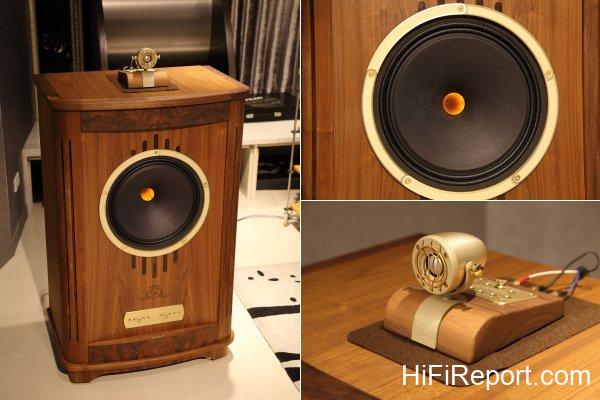
The speakers used for this audition were Tannoy Canterbury GR paired with Prestige GR SuperTweeter, employing the same 15-inch dual concentric driver as the Westminster GR.
No matter how sophisticated the technology, it must be transformed into music to demonstrate its value.
Half a year ago, I had the opportunity to listen to the four-piece Grandioso P1X SACD transport and D1X DAC combination in the HiFiReport listening room (five-piece if you include the Grandioso G1 master clock generator). I was deeply impressed by the performance of the new generation Grandioso flagship sources. Their sound made you completely forget that you were listening to CDs or digital audio. It was a truly wonderful experience.
This time, I returned to the same location, but the system was simplified. There was no two-piece preamplifier Grandioso C1, nor monoblock power amplifiers Grandioso M1. Instead, it was a Grandioso K1X with an external G1 master clock generator paired with an F1 integrated amplifier.
The speakers were also changed from the luxurious and dazzling Avantgarde Trio Luxury Limited 26th Anniversary Edition to the more understated yet elegant Tannoy Canterbury GR, complemented by the indispensable Prestige GR SuperTweeter.
Schubert’s Perspective
I selected several Esoteric SACDs from the HiFiReport shelf, all of which are recordings I greatly enjoy.
The first disc I played was Esoteric’s newly released album, featuring simple music—Maria João Pires playing Schubert’s Impromptus D.899 and D.935.
Schubert was a master of piano miniatures, and these 8 impromptus can be considered the HiFiReport of piano miniatures. Pires is not only adept at interpreting Chopin and Mozart, but also brings a captivating charm to Schubert, a beauty that adds elegance to simplicity.
In D.899 No. 1, a miniature piece composed in variation form, constantly transforming and evolving multiple facets through repetition and cycles.
I must commend the Grandioso K1X’s ability to extract musical information. Pires’ harmonies and counterpoint between different voices are rendered so clearly. In the seemingly simple melody, Schubert creates a sense of musical depth through tempo variations, and embellishes the musical canvas with sparkling starlight through ornaments.
Hearing these details reveals why I said earlier that Schubert’s piano miniatures are almost unrivaled throughout history, and why I described Pires’ Schubert as particularly captivating.
Listening to D.899 No. 2, the wave-like continuous arpeggios, surging upwards and downwards, are accompanied by chords in the left hand, bringing out the layers and weight of the music.
Driven by the Grandioso F1, the Canterbury GR produced a warm yet clear sound, shimmering with golden brilliance, rich in detail, and with clean bass.
The Canterbury GR is truly remarkable. The Westminster Royal GR’s back-loaded horn enclosure enhances bass extension and volume, but in comparison, the Canterbury GR’s slightly more restrained bass makes the sound more transparent and clear. A hint of nasality adds to the musical charm, while the transparent soundstage is impressive.

For example, in D.899 No. 3, the left hand continuously counterpoints the right-hand melody with broken chords. The colors interwoven and sparked from this interplay are truly beautiful.
When the left hand explores downwards by an octave, the bass descends, but it descends cleanly and crisply. The resonance of the piano body and the lingering vibrations of the strings are truly beautiful! Why am I talking about Tannoy speakers? Because this SACD sounds so wonderful that it fully captures the beauty of Pires and Schubert’s Impromptus.
The pianist’s interpretation, combined with the recording engineer’s efforts, leaves us with these beautiful recordings. It’s up to our audio system to translate them.
Faithful and accurate translation, expressing the musical beauty within, is what makes a recording moving and where audio equipment demonstrates its value.
Esoteric equipment is not inexpensive, and the Grandioso K1X is also costly. Where is the value of this entire system I’m listening to now? Value is not determined by price, but by whether the music you hear can move you.
I’ve been talking about both the player and the speakers because it’s a system. These components are indispensable to each other. When they come together and present Pires’ Schubert to me in this captivating beauty, that’s precisely why I’m so excited.
Shostakovich’s Perspective
The Grandioso F1 integrated amplifier is large and heavy, yet it only delivers 30W, albeit 30W in pure Class A.
I’ve reviewed it before. This integrated amplifier’s sound possesses a supple texture, warm and inviting, and it can drive most speakers without issue. Paired with the highly sensitive 96dB Canterbury GR, it’s even more effortless.
How effortless? I switched to Martha Argerich’s 2006 Lugano Festival live recording of Shostakovich’s Piano Concerto No. 1. This recording has excellent sound quality, but more importantly, Argerich’s performance is simply breathtaking.
The first movement opens with a rapid descending run on the piano, followed by triplets, then the mood shifts, and the theme is sung in a gentle tone. Behind the piano, the strings repeat the theme, but soon after, it transitions into a passionate passage.
The layering here is truly excellent! The instrumentation of this piece is actually quite small: a five-part string orchestra, accompanied by piano and a single trumpet—that’s it.
But at this moment, I heard a soundstage with high separation, the distribution of voices clearly defined.
The bass strings rumble and push from behind. Are you worried that my earlier praise of the Canterbury GR’s clean bass implied it lacked low-end extension? Listen to the bass strings in this piece—they are very distinct, with texture, line, and weight, absolutely magnificent.
The string texture is vibrant and substantial. No muddiness, no harshness—nothing of the sort.
The trumpet’s timbre is also captivating. I must say, Tannoy’s aluminum-magnesium alloy diaphragm compression driver is exceptionally good at rendering the texture of metallic instruments.
As for the piano, Shostakovich is different from Schubert. Schubert’s piano music is about balanced and delicate beauty; Shostakovich’s personality is multifaceted. You can hear tenderness and wildness.
When the piano is played forcefully, the notes are incredibly solid, demonstrating high sonic density.
When Argerich plays chords, the vibration of the piano strings within the chords, the lingering resonance, is full of beauty.
For example, in the opening of the third movement, starting with the piano, followed by rich string ensemble, then transitioning into a scherzo-like passage, the music is sometimes surging and unrestrained. Can you imagine a “flying” Tannoy? This was my first time experiencing it.
Beethoven’s Perspective
Shostakovich’s Piano Concerto No. 1 is not large enough in scale. Let’s listen to something with a fuller orchestra. How about Beethoven’s Symphony No. 3 conducted by Wand with the North German Radio Symphony Orchestra?
The first movement opens with two powerful chords. After a brief introduction, the first theme is played by the French horn, then repeated by the orchestra.
The soundstage is truly excellent, the voices unfolding in layers, orderly and structured.
In pieces with smaller ensembles, it’s easy to hear the texture of instruments. In large-scale orchestral works like this, hearing the texture of instruments requires a capable system, and a very capable one at that.
The Grandioso K1X truly excels in this aspect. The texture of various woodwinds, the string sound of violins, the mellow timbre of the French horns—all are rendered beautifully.
The second movement is a rare funeral march. It opens with the violins in the lead, with the double basses gently playing the rhythm in the background—heavy steps, each step filled with sorrow.
The oboe then repeats the theme. You can clearly hear the oboe’s unique timbre. This system’s resolving power is truly outstanding.
After the repetition of the second theme, the music, originally lingering in minor key, transitions to C major. Following a bright and glorious declamation, the first theme reappears, but in a varied form, and the music is driven to a climax. At this point, the most magnificent three-part fugue emerges.
Listen to the intertwined fugue soaring upwards, layer upon layer, evoking a sense of sacredness.
Speaking of fugues, the famous “Heroic Theme and Fugue” in the fourth movement is even more breathtaking.
Beethoven boldly used variations to write a symphony movement here. Following the frenzied, powerful, and rapid introduction, the strings pluck out the first theme, the wavering texture is so vivid! Then in the first variation, you hear a small fugue. The second variation is counterpoint between strings with tempo variations. The third variation incorporates winds, majestic and grand. The fourth variation again features a small fugue. In the fifth variation, broken chords appear, played by flute and oboe. The sixth variation becomes a dance-like form, and then another fugue variation.
Truly magnificent! When I reviewed the Esoteric K-03Xs before, I mentioned that Esoteric sources inspire confidence, allowing you to hear the information hidden between 0s and 1s. There are no secrets between the digital domain and me, making it worthy of being a teacher.
Now listening to the Grandioso K1X, it’s even more wonderfully unparalleled. It’s not just a teacher, but also transports me back to a scene even more real than live performance. Even without the score in hand, every musical notation is demonstrated, and I can hear it all.

Isn’t this magnificent?
Three Composers Say: A Master Among Masters
See, here I go again, constantly writing about music, but it’s truly because I’m hearing so much, so much that I can’t even keep up with recording it all.
The Grandioso K1X extracts and translates these messages hidden in the recording tracks, transforming digital 0s and 1s into analog music that we can feel, with warmth and emotion.
I’m moved by the richness of the content I hear, so I write it down.
In this Beethoven Symphony No. 3, I further appreciate the magnificence of the K1X.
In Schubert’s Impromptus, I heard the beauty of timbre and tone. In Shostakovich’s Piano Concerto, I heard the beauty of weight and speed. In Beethoven’s Symphony No. 3, I further enjoyed the rich layers and details.
In every aspect, the Grandioso K1X proves itself to be a master among masters.
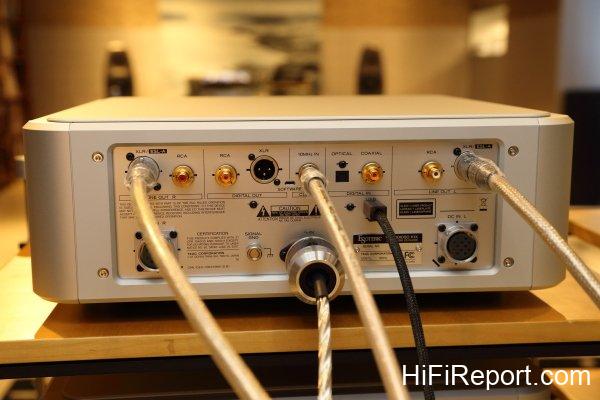
The Grandioso K1X can be further upgraded in the future by adding an external power supply. The terminals on both sides of the rear panel below are the power supply input sockets.
Jazz Masters Speak
Esoteric’s SACD releases started with classical repertoire, but later expanded to non-classical genres, especially with planned releases of jazz masterpieces, which is truly a boon for jazz fans.
For example, I found Oscar Peterson’s “We Get Request” album on the CD shelf. Upon playing it, another wave of surprise washed over me.
I’m very familiar with this album, having heard it on many systems, but hearing the SACD this time was a completely new experience.
This SACD playback has high sonic density, extremely precise imaging, and excellent separation of instruments on the soundstage. The timbre is warm yet vibrant.
The bass dives deep, the cymbals rise lightly, with natural extension at both ends.
I happened to have the CD version of this album on hand, and comparing the two, the difference was like night and day. The CD version’s sound is loose and soft, clarity is greatly reduced, with the typical sound of an older recording. However, the SACD sounds clear, clean, modern, and audiophile-grade.
What about using the K1X’s built-in upsampling processing? I directly upsampled to DSD in one go. Compared to the original 44.1KHz, upsampling to DSD does improve density and coherence, and the bass’s elasticity is better. However, it still can’t match the effect of the SACD version. The SACD sounds clearer, more solid, more three-dimensional, more open, and more lifelike.
I also deliberately brought two CDs that I listened to last time when I auditioned the Grandioso P1X and D1X, one of which was Cassandra Wilson’s “Rendezvous” album.

Listening to the first track “Old Devil Moon,” the array of percussion is truly colorful. The locations of sound sources are clear, separation is extremely high, and the distinct textures of each instrument are clearly audible. Especially noteworthy is the hand drum on the right side, with exceptional realism.
Jacky Terrasson’s piano notes are solid and full of luster. The bass notes are full and rounded, yet not muddy, clear and defined.
The second track is a dialogue between percussion and piano. The piano’s texture, beautiful timbre, and the percussion’s three-dimensionality and realism are all present here.
The third track, “Tennessee Waltz,” adds a rich and full-bodied double bass, low and deep, yet still maintaining clarity. This bass is truly excellent! Not only is the double bass texture in classical pieces good, but the pizzicato bass in jazz is equally impressive.
As for Cassandra Wilson’s vocals, the imaging is top-notch. The details of articulation and vocalization are rich, making it feel like she’s singing right in front of you. The Canterbury GR adds a layer of subtle honey to the vocals, making them slightly sweeter and adding a touch of charm.
Writing this, I must emphasize: auditioning equipment outside of one’s own system, without A/B comparison, and with different accompanying equipment each time, makes it impossible to definitively pinpoint the source of these beauties.
But I can say that the Grandioso K1X extracts all sorts of information from the CD, presenting it in a very harmonious manner, making listening to music a joy. This is the value of investing in Hi-End audio.
Esoteric Grandioso chassis feature exquisitely crafted metalwork.
The Grandioso K1X’s top panel is designed to be semi-floating, allowing for a more vibrant sound.
Faithful and Soulful
Another disc was Patricia Petibon’s Spanish song collection.
Her voice leans towards light soprano, allowing her to sing coloratura passages.
Listening to Petibon’s voice on the K1X, it’s focused and spirited, not loose or thin. When she sings high notes, the vocal energy is full and concentrated.
I speculate that a large part of this vibrant vocal presence is attributable to the Canterbury GR’s dual concentric driver’s compression horn tweeter, ensuring that even sitting four meters away, I don’t perceive any energy attenuation.
Energy is one thing, but even more wonderful are the vocal ornaments, the vibrato during sustained notes, sometimes soaring, then immediately descending—Petibon’s singing is masterful, and the audio system must also be capable of reproducing it well.
The Petibon’s voice I heard was truly lifelike! As for the accompaniment, the strings are silky smooth, gently presenting a warm luster. The plucked strings exhibit a powerful sense of bounce.
In the fourth track, Daniel Manzanas’ guitar accompaniment is resonant and spirited. It’s truly amazing how the Grandioso K1X sculpts sonic details, not only pursuing information retrieval, but also striving to reproduce this information with analog finesse.
For audio systems, achieving fidelity is relatively easy, but conveying soul is difficult.
The Petibon’s voice, Manzanas’ guitar, and the Spanish National Orchestra’s accompaniment I heard here were both faithful and soulful.
This time, I forgot to bring my “rock package,” but luckily, I found Dire Straits’ “Love Over Gold” in the stack of discs. Playing this CD was another shock.
The guitar texture in “Private Investigations” is vibrant. In the previous track, Manzanas played a nylon-string classical guitar. The guitar sound here is distinctly different, with steel strings sounding more lively and energetic.
Mark Knopfler’s vocals are focused and clearly defined. His distinctive voice is so present, as if he’s right in front of you.
This system made me listen to vocal recordings one after another, whether jazz, classical, or rock. Vocals always sounded so three-dimensional, with clear outlines and distinct vocal lines. This all relies on rich detail information.
Moreover, these details even portray the singer’s expressions.
You can assemble an audio system for $5,000, and have a decent system for $50,000. Why do we spend $500,000? The difference lies in those most subtle details.
Before you discover those nuances, you might think Hi-End audio is just a hobby built on money. Once you perceive the myriad beauties hidden in the subtle details, you’ll understand that Hi-End audio pursues the reproduction of what ordinary equipment cannot present.
When these nuances are all filled in, it’s not just fidelity, but soul; not just sonic images, but expressions.
Earlier, when discussing Shostakovich’s Piano Concerto No. 1, I mentioned that the Canterbury GR allowed me to experience Tannoy’s sense of speed. This time with Dire Straits, I witnessed Tannoy’s dynamics and power.
Both “Telegraph Road” and “Private Investigations” start from extremely low volume and gradually build up musical energy. As instruments enter, the orchestration and layering become richer.
These two tracks alone test the equipment and system’s mastery of dynamics and the reproduction of micro-dynamic information. From this, you can see that the K1X is indeed extraordinary. It can widen the contrast, and even when the music becomes flamboyant and unrestrained, it can still provide a composed and stable soundstage.
Listening to the grain of the electric bass, accompanied by the lingering harmonies of synthesizers, the drums are powerful and energetic, the drum beats crisp and clear, and the electric guitar explosively releases energy and emotion.
This time, I not only tasted Esoteric’s wild side but also experienced Tannoy’s charm in playing rock music.
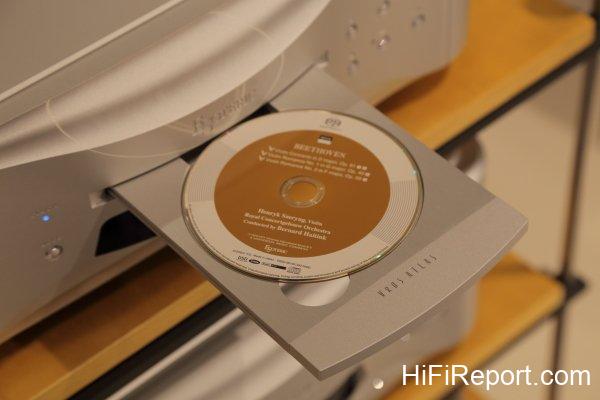
The VRDS Atlas logo on the Grandioso K1X is engraved above the disc tray, not on the tray cover, only visible when the tray is extended.
CD is Not Dead, Physical Media is Not Extinct.
A Toast to Esoteric!
Returning to the question I asked at the beginning of this article: do you still listen to CDs? Have you ever considered how much information is hidden within that thin CD disc, perhaps more than you’ve ever realized? As a music lover, I repeatedly find the joy of listening to CDs on Esoteric sources. This afternoon, I had intimate and profound dialogues with Schubert, Beethoven, and Shostakovich.
In the streaming world, I see convenience and vast resources. Turning back to physical discs, I touch music with warmth, memories, and a sense of presence.
Each CD is taken out of its case, placed into the CD player, and the play button is pressed. The process of music reproduction is organic. Listening to music this way, even the music itself seems to become organic.
I hope that the Hi-End spirit conveyed by Esoteric through the Grandioso K1X can be appreciated by more people. And I further hope that the emotions the Grandioso K1X brought me can become a shared experience for more CD collectors and music lovers.
CD is not dead, physical media is not extinct.
A Toast to Esoteric!
Specifications
* Type: SACD/CD Player
* Frequency Response: 5Hz – 75kHz (–3dB)
* Signal-to-Noise Ratio: 113dB
* Distortion: 0.0007% (1kHz)
* Analog Outputs: XLRx1; RCAx1
* Analog Output Impedance: XLR 40Ω; RCA 15Ω
* Analog Output Voltage: XLR 5.0Vrms; RCA 2.5Vrms
* Digital Outputs: XLR×1, RCA×1
* Digital Inputs: RCAx1; Optical x1; USB Type Bx1
* Clock Sync Input: BNC×1
* Clock Input Impedance: 50Ω
* Clock Input Frequency: 10 MHz (±10 ppm)
* Dimensions: Main unit 445×162×447 mm (W×H×D)
* Weight: Main unit 35 kg