
Furutech LAN-8 NCF Cat8 Network Cable Review
Furutech’s most emphasized technology in recent years is undoubtedly NCF. Furutech has previously utilized NCF to develop many original products, such as the NCF Booster cable lifter, NCF Booster-Signal-L cable support, NCF Booster-Brace power plug stabilizer, and more. Furthermore, NCF can also be used in power plugs, sockets, and IEC connectors to enhance electrical characteristics and damping effects.
Now, Furutech has another new NCF application: the LAN-8 NCF network cable. It combines NCF technology with α OCC conductors and a triple shielding design, endowing it with rich detail and a smooth sonic texture, making streaming playback even more captivating.
NCF Enhanced RJ45 Connector
The NCF composite material in the LAN-8 NCF is primarily used in the housings of the RJ45 connectors at both ends.
NCF is an abbreviation for Nano Crystal Formula, referring to a nano-level crystalline formula.
Furutech incorporates nano-sized ceramic particles into a unique formula with carbon powder, mixing it into resin to create a special polymer, which is then used to make various accessories.
NCF possesses two main active properties: first, it generates negative ions to eliminate static electricity and reduce interference; second, it converts thermal energy into far-infrared radiation, enhancing the electrical characteristics of the accessories.
In addition, the ceramic particles and carbon powder in NCF exhibit “piezoelectric” damping characteristics, providing excellent damping effects that reduce vibration and noise, resulting in a clearer sound.
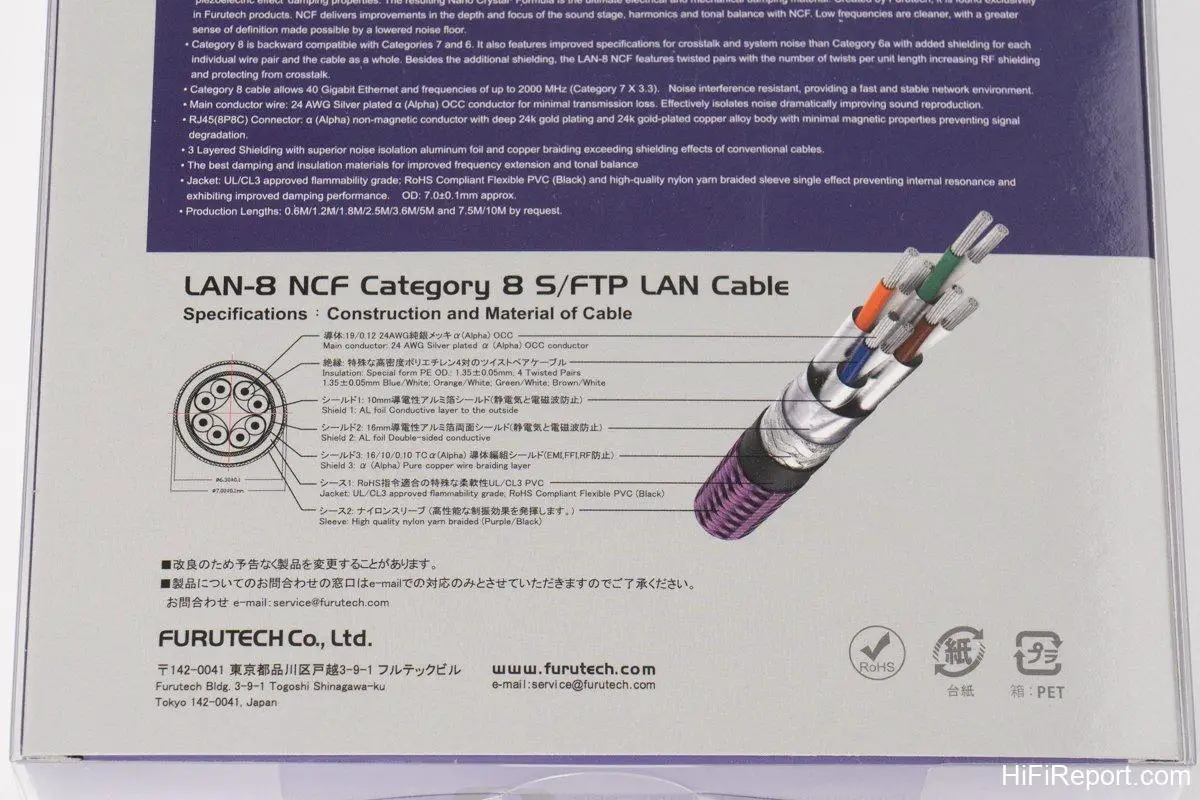
For the conductor, the LAN-8 NCF uses 24 AWG α OCC conductors.
OCC stands for Ohno Continuous Casting copper, which is single-crystal copper. α refers to Furutech’s proprietary metal treatment process, including super cryogenic treatment and demagnetization, which helps minimize transmission loss.
Moreover, the α OCC conductors in the LAN-8 NCF are silver-plated, further enhancing conductivity.
The LAN-8 NCF has a total of 8 silver-plated α OCC conductors. Every two conductors are twisted together to form a twisted pair structure, totaling 4 pairs, which is the standard configuration for network cables.
The LAN-8 NCF also pays considerable attention to shielding. Each twisted pair is first wrapped with aluminum foil to form the first layer of shielding. Then, the 4 pairs are twisted into a bundle, and the entire bundle is wrapped again with a layer of aluminum foil, which is the second layer of shielding. Finally, it is wrapped with a shielding braid made of α pure copper wire, forming the third layer of shielding.
This rigorous triple shielding effectively isolates external wireless noise interference, making the signal less susceptible to interference. This allows the LAN-8 NCF to achieve Cat8 specifications, providing a maximum transmission rate of 40 Gbps and a bandwidth of 2000 MHz, ensuring seamless signal transmission.
Cohesive Imaging and Enhanced Dynamics
The listening tests were conducted in my home, using a desktop computer as a streaming source. The LAN-8 NCF network cable was connected to a SOtM sNH-10G switch, then to a wireless router. The reference cable used for A/B comparison was a server-grade Belden Cat6 network cable.
First, I played track 1, “Looking for a Home,” from Blue Coast Records’ “The E.S.E. Sessions” compilation. This track features a rugged male lead vocalist with another male vocalist providing harmonies, accompanied by two guitars. The recording quality is excellent, with a clean and clear texture that reveals appropriate warmth and fullness, and natural, vivid dynamics.
After A/B comparison, it was immediately apparent that the LAN-8 NCF enhanced the soundstage’s three-dimensionality. The sound became more cohesive and prominent, with a more focused and solid image. The sense of localization was also clearer, resulting in a more focused overall presentation. Furthermore, both vocal power and overall dynamics became more distinct, making the musical atmosphere more vibrant.
In contrast, the reference cable presented a looser sound image with flatter dynamics. While not unpleasant, it simply sounded less engaging and somewhat bland.
Beyond making the sonic image more concrete, the LAN-8 NCF brought another change: it improved the timbre, making it more pleasing and delightful! I don’t recall encountering such a change with other network cables before; the LAN-8 NCF is the first.
Listening again to “Looking for a Home,” the folk guitars now possessed a touch more smoothness, with richer moisture and a sweeter tone, without compromising transparency or clarity.
The vocals became warmer and fuller, prompting me to listen even more attentively.
These changes were positive, adding to the richness of the listening experience without affecting detail retrieval.
I also noticed that the LAN-8 NCF created a deeper and taller soundstage, with a sense of rearward extension. The sonic background was also cleaner and blacker, improving the sense of air and spaciousness.
Adding Smoothness to the Sound
Next, I played track 9, Schumann’s art song “Ich kann’s nicht fassen, nicht glauben,” from the Audio Physic 25th Anniversary CD. This piece features a soprano accompanied by several string instruments.
Through the LAN-8 NCF, the separation of the accompanying strings behind the vocals was improved, and the layers became richer. I had previously heard similar improvements with other higher-priced network cables, and the LAN-8 NCF’s performance was comparable.
Additionally, the LAN-8 NCF reduced any hint of harshness in the sound, making the texture purer, the quality finer, and the dynamics smoother.
For example, when listening to Pletnev conducting the Russian National Orchestra performing Shchedrin’s percussion arrangement of “Carmen Suite,” specifically tracks 3 “First Intermezzo” and 4 “Changing of the Guard,” there was a significant difference in the soundstage presentation between the LAN-8 NCF and the reference cable. The LAN-8 NCF exhibited a deeper soundstage, with clearer layers between the front and rear sections. The reference cable’s soundstage was flatter, with less depth and a tendency to spread out to the sides, lacking focus and thematic clarity.
The LAN-8 NCF’s soundstage was deeper and more three-dimensional, with clearer instrument and section outlines, and improved separation.
Furthermore, the LAN-8 NCF also enhanced the solidity and weight of the low frequencies. Not only was the extension clearer, but the bass, when it hit, was more focused and cohesive, subtly enhancing the overall dynamics and making them more agile.
Although the LAN-8 NCF does not use Telegartner’s all-metal RJ45 connectors like some other high-end network cables, its NCF connectors seem to be just as capable. They not only maintain rich detail and enhance purity but also add an appealing smoothness, giving the sound both power, vibrancy, and beauty – making it undeniably enjoyable.
Specifications
* Type: Cat-8 Network Cable
* Conductor: 24 AWG Silver-Plated α OCC
* Shielding: Aluminum Foil + Aluminum Foil + α Copper Braided Mesh