
Furutech Lineflux NCF XLR Cable Review
Furutech’s newly launched Lineflux NCF series expands their flux-NCF product line, currently featuring balanced (Lineflux NCF XLR) and unbalanced (Lineflux NCF RCA) interconnects. Digital cables (Digiflux NCF), power cables (Powerflux NCF), and speaker cables are also in development, with Furutech refining speaker terminals for a near-future release.
The RCA and XLR versions of the Lineflux NCF share identical cable construction, differing only in their connectors.
This review focuses on the XLR variant.
My interest in Furutech’s flagship interconnect is rooted in my positive experience last summer reviewing the Furutech Powerflux NCF 18 power cable.
I titled that review “Unchanged Essence, Enhanced Finesse,” highlighting how the Powerflux NCF 18, when integrated into my system, unveiled a wealth of previously obscured musical details. This infusion of nuance rendered the music more expressive and captivating.
The question then arises: can the Lineflux NCF XLR interconnect replicate this transformative effect?
Alpha-Processed OCC Conductor
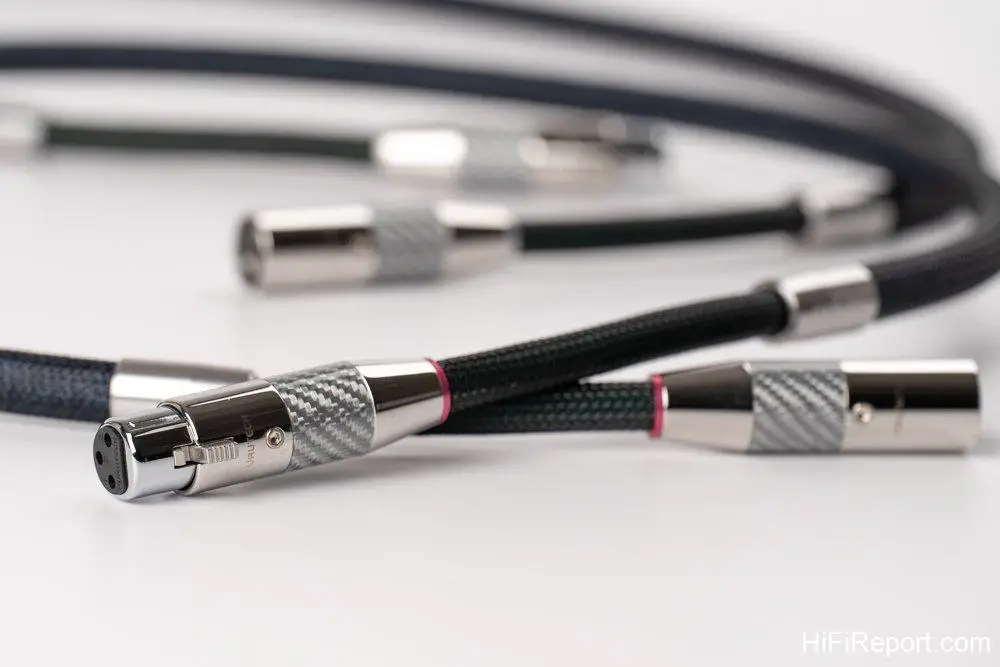
The Lineflux NCF interconnect boasts a remarkably intricate cable architecture. For a comprehensive understanding of its complexity, I encourage readers to consult the manufacturer’s detailed 3D structural diagram.
I will highlight a few key aspects. Firstly, the two conductors within the cable are crafted from alpha-processed OCC single-crystal copper, employing a solid-core design rather than the more common multi-strand configuration.
This conductor is not merely single-crystal copper; it undergoes Furutech’s proprietary alpha treatment, a dual-stage process involving super-cryogenic cooling and demagnetization. The aim is to achieve a tighter, more uniform crystal structure within the conductor and to enhance transmission stability and accuracy through demagnetization.
Dual-Layer Shielding, NCF Insulation
Secondly, to ensure optimal shielding performance, the Lineflux NCF XLR incorporates a dual-layer shielding system.
The first layer consists of a PET/Al aluminum foil tape shield, overlaid by a second layer of alpha-processed copper braid.
This robust shielding is designed to effectively block EMI (electromagnetic interference), preventing extraneous noise from corrupting the delicate audio signal.
Thirdly, vibration damping and resonance control are prioritized in the cable’s design. Yarn is applied around the two conductor cores to provide cushioning. Furthermore, the outermost PVC jacket is not ordinary PVC but a specialized NCF composite material infused with nano-ceramic particles and carbon microparticles. This NCF material offers superior resonance damping compared to conventional PVC.
Flagship XLR Connectors
While the cable’s internal structure is meticulously engineered, the connectors are where the Lineflux NCF truly distinguishes itself.
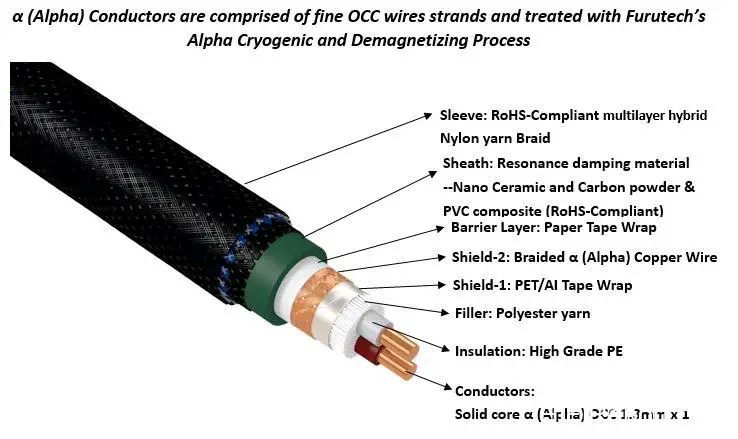
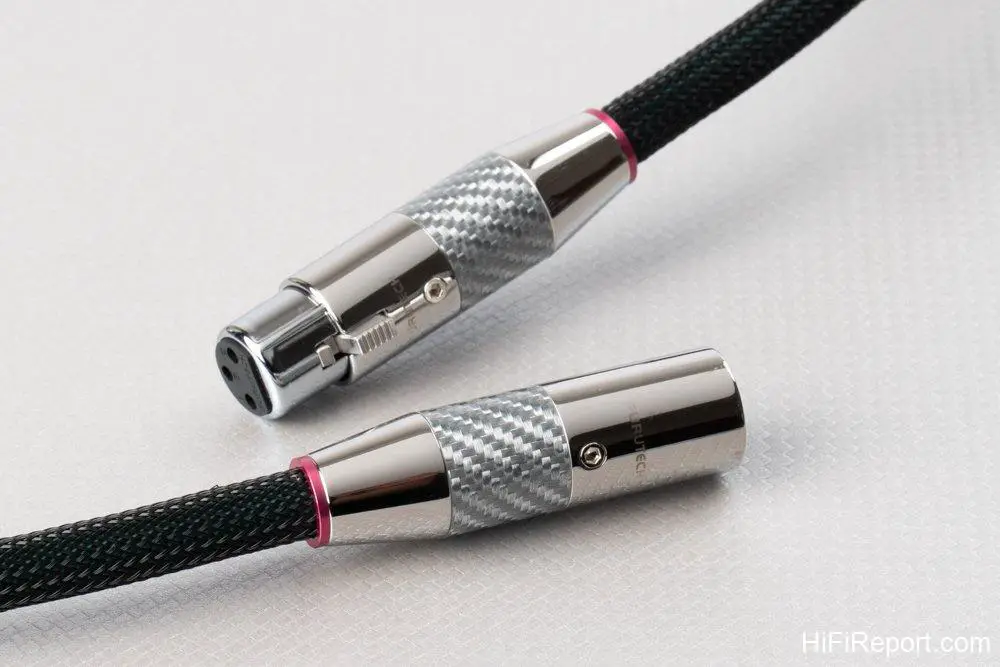
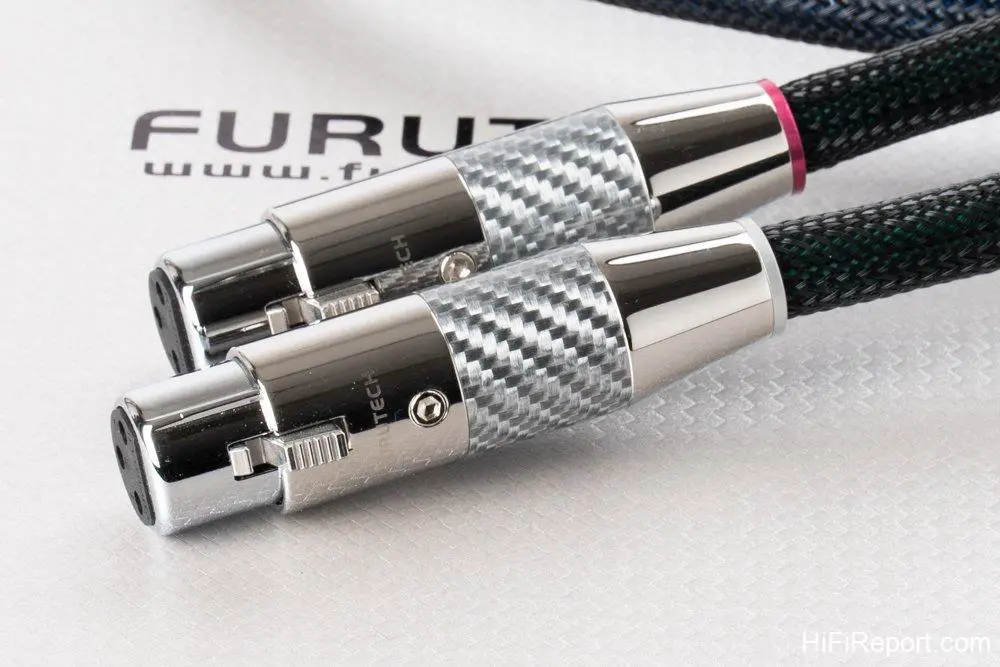
Both the RCA and XLR versions utilize Furutech’s flagship-grade connectors. The RCA version employs the CF-102 NCF, while the XLR version features the CF-601M NCF (male) and CF-602F NCF (female) connectors.
The pair of XLR connectors on the Lineflux NCF XLR interconnect, purchased as separate components, would cost over NTD 10,000 (approximately $333 USD) per set of male and female. A pair of interconnects requires two sets, meaning the connectors alone account for over NTD 20,000 (approximately $666 USD) of the cost.
However, even if you were to acquire these connectors, you could not DIY a Lineflux NCF XLR cable as the raw cable itself is not sold separately.
Silver-Plated Carbon Fiber Connectors
Continuing the discussion of connectors, Furutech connectors are renowned for their exceptional build quality and are frequently specified by high-end audio brands for both cables and componentry.
The CF-601M NCF and CF-602F NCF XLR connectors are Furutech’s flagship XLR offerings, and their premium price is justified by their sophisticated design and construction.
Like other high-end connectors, Furutech employs features such as rhodium-plated pure copper for the contact pins and stainless-steel housings with carbon fiber sleeves.
However, Furutech takes it a step further.
The carbon fiber sleeves of the CF-601M NCF and CF-602F NCF connectors are silver-plated, giving them a distinctive silver-white appearance that not only enhances their visual appeal but also modifies their damping characteristics.
Moreover, all metal parts undergo alpha processing, and the non-metallic fixing components incorporate NCF material, further setting them apart.
NCF Material Application
NCF, an acronym for Nano Crystal Formula, is a proprietary Furutech formulation that blends nano-ceramic particles and carbon powder. This unique material generates negative ions to eliminate static and converts thermal energy into far-infrared radiation. It is an exceptionally effective damping material and represents the culmination of Furutech’s thirty years of research and development.
In recent years, Furutech has extensively utilized NCF material, not only in their top-tier cables but also in a range of peripheral products, establishing the NCF Booster series as a testament to its versatility.
NCF has become a key differentiator for Furutech, enabling them to expand into new markets and challenge established players in the high-end audio arena.
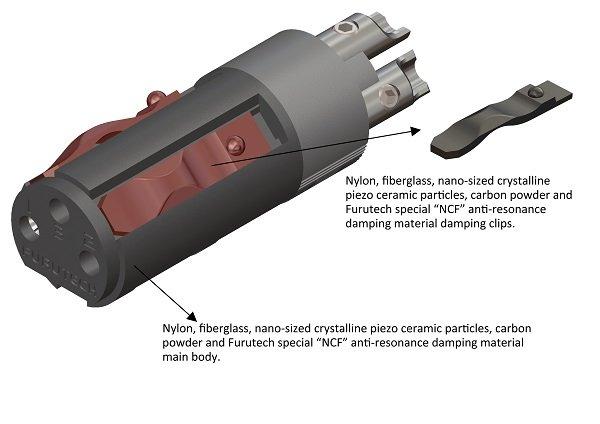
According to Furutech, the non-metallic bodies of the CF-601M NCF and CF-602F NCF connectors are constructed from a multi-material composite, including nylon, fiberglass, nano-crystalline piezo ceramic particles, carbon powder, and Furutech’s exclusive NCF anti-resonance damping material.
This composite material is also used in the pin center filler of the male CF-601M NCF connector and in the contact clamp of the female CF-602F NCF connector.
Furutech provides 3D exploded diagrams of these connectors, clearly detailing the composition and key features of each component. Examining these diagrams reveals the remarkable complexity and engineering within even a seemingly small connector.
Build and Design
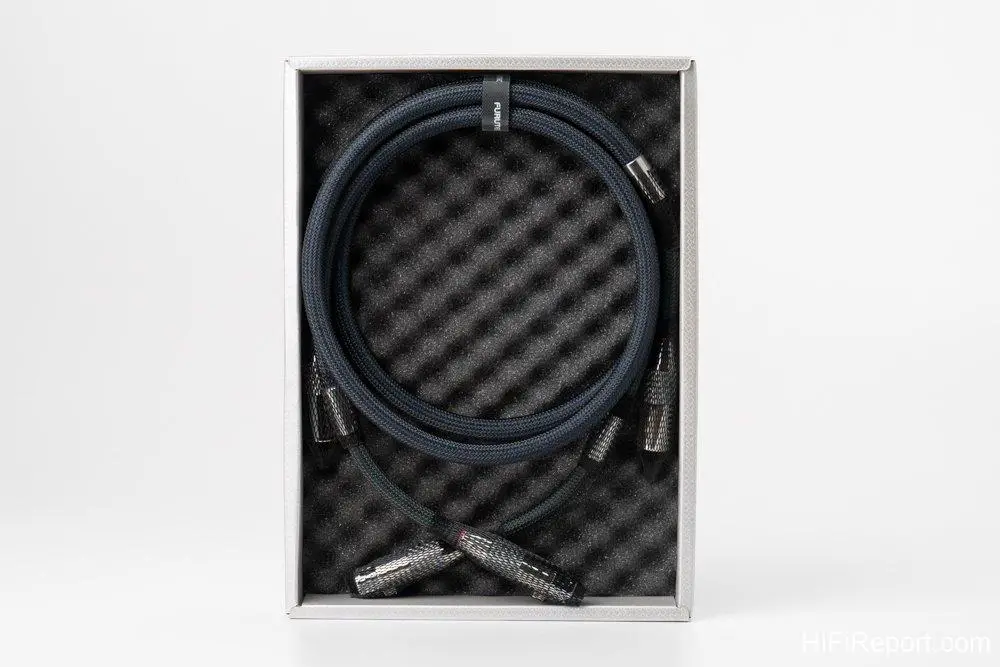
While the Lineflux NCF XLR cable is flexible enough to be coiled and placed in its box, it is not particularly supple, likely due to its solid-core conductors and dense, multi-layered construction. Careful consideration of equipment placement is necessary during installation.
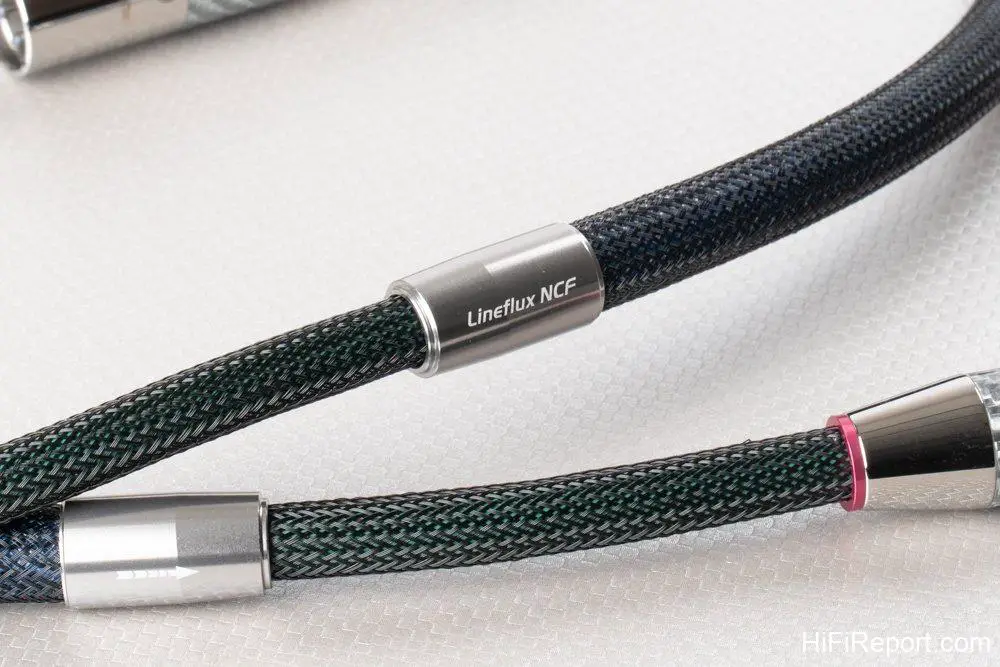
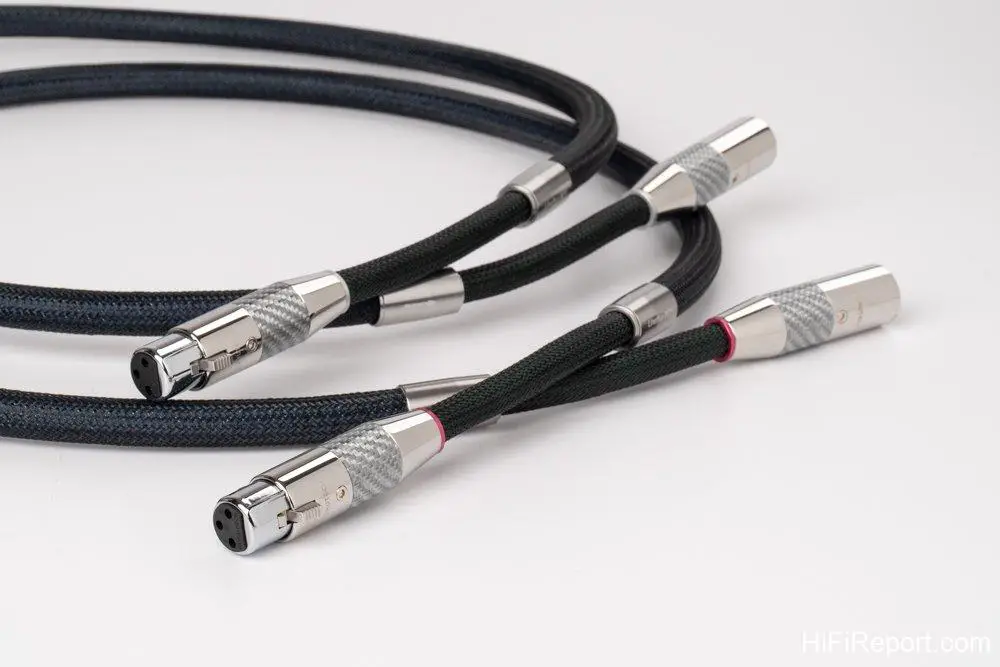
Near each XLR connector, a stainless-steel weighting ring is added to the cable. The cable diameter subtly differs on either side of this ring due to variations in the thickness of the nylon expansion braid (the braid near the connector is single-layered).
Overall, the substantial connectors significantly elevate the perceived quality and feel of the cable.
Sound Quality: Overview
How does it sound? I connected the Lineflux NCF XLR between a Rockna Wavelight and a NuPrime ST-10, utilizing the Wavelight as both DAC and preamplifier, directly feeding the power amplifier. Roon served as the music playback platform, with a Telos EMP as the Roon Bridge, and JMR Abscisse Jubile speakers completed the system.
The Lineflux NCF XLR immediately lowered the noise floor of the system, allowing details to emerge more readily. It possesses a rich information density, resulting in a full-bodied and textured sound.
Crucially, this richness does not come at the expense of vibrancy. The music remains lively and engaging, never becoming overly smooth or relaxed despite the enhanced body. Furthermore, even with its fullness, the sound maintains excellent density and focus.
The cable also exhibits substantial sonic energy, contributing to impressive transient response and dynamic range. Regardless of musical genre, the Lineflux NCF XLR consistently delivered a satisfying listening experience.
Eivor – Eivor Live
Listening to Eivor’s *Eivor Live* album, the sonic texture rendered by the Lineflux NCF XLR was truly captivating.
In “Where Are the Angels,” the guitar sounded full and lush, its simple, repetitive melody creating an atmosphere of profound peace and beauty.
Eivor’s vocals were focused and articulate, and the wealth of sonic detail conveyed a palpable sense of her presence and emotional expression.
The Lineflux NCF XLR employs OCC copper conductors, and perhaps their high purity, combined with the alpha treatment, contributes to the pristine and refined sonic character.
In “Natureboy,” the reverberating electric guitar notes and extended decays were remarkable. The cable excels in reproducing the nuances of reverb and harmonic richness.
Eivor’s versatile vocal techniques were showcased beautifully in these tracks, highlighting her vocal prowess. In moments of slower tempo, she employed a sweetly rounded vocal delivery, and the Lineflux NCF XLR allowed me to discern subtle vocal details – the tremor of her jaw, the nuances of mouth shaping – with remarkable clarity.
Her dolphin-like vocalizations were particularly striking, delivered with unwavering stability and a distinctive onomatopoeic quality, adding an air of mystery to the music.
Sara Bareilles – Brave Enough
Switching to another female vocalist, Sara Bareilles’ live album *Brave Enough* also proved to be utterly captivating.
Many tracks on this album feature Sara Bareilles accompanying herself on piano, guitar, ukulele, or electric piano.
While the electric piano lacked the percussive impact and string resonance of a true acoustic piano, the lingering resonances remained enchanting, and the piano notes were firm, solid, and well-defined.
The Lineflux NCF XLR imbues the sound with a rich palette of colors, making the music more flavorful and engaging.
It’s akin to meticulously seasoned food, where each taste unfolds in layers, bringing a succession of delightful surprises.
Sara Bareilles’ vocals are substantial, powerful, and dynamic, with constant shifts in intensity and a diverse range of vocal timbres achieved through resonance in different parts of her vocal tract.
In her soaring high notes, the vocal stability was exceptional, a testament to her technique, but also revealing the high fidelity of the playback system. The Lineflux NCF XLR ensured that every nuance was conveyed without compromise.
Yo-Yo Ma & Kathryn Stott – Songs of Comfort & Hope
The cable’s rich sonic foundation proved particularly well-suited to string-based chamber music, rendering it exceptionally inviting.
For example, in Yo-Yo Ma and Kathryn Stott’s *Songs of Comfort & Hope*, specifically their rendition of the folk song “Shenandoah,” the piano notes were solid, and the chords sounded grounded and weighty.
Yo-Yo Ma’s cello exhibited a full, relaxed quality, coupled with excellent resolution, allowing the texture of the bow moving across the strings to be clearly discerned.
The Lineflux NCF XLR brought forth musical details with exceptional clarity, enhancing the overall resolution of the sonic image.
In their arrangement of Dvořák’s Symphony No. 9, second movement, “Goin’ Home,” the opening piano chords were rich and somber, and the subsequent entry of the cello immediately evoked a sense of longing.
The cello, with a slightly nasal quality, wove melodies in the mid-to-high range, expressing a yearning for home.
The gentle, tender cello tones were simultaneously assured and substantial, their sonic blooming in layers like a fragrant aroma, instantly drawing the listener into the music’s emotional core.
Sigmund Groven & Iver Kleive – Harmonica & Organ
Another intriguing pairing further highlighted the capabilities of the Lineflux NCF XLR: a collaboration between harmonica virtuoso Sigmund Groven and organist Iver Kleive.
Could the diminutive harmonica and the colossal organ truly harmonize? The listening experience provided the answer.
Both instruments produce sound through vibrating reeds, albeit metal reeds in the harmonica and metal pipes in the organ. This shared principle of sound production contributes to a natural sonic synergy between them.
The harmonica’s sound possessed a bright, refreshing quality, its tone remarkably intimate and approachable.
The organ, in contrast, was immense, delivering deep, resonant bass that seemed to move the air in the room.
The organ’s flute stops produced rounded, ethereal tones, with notes articulated crisply yet possessing lingering, airy decays, creating a rich and layered tapestry of sound.
Pierre Boulez – Ravel Orchestral Works
The soundstage presented by the Lineflux NCF XLR was expansive, with excellent transparency and clear delineation of depth and width. The spatial organization within the musical performance was rendered with precision.
Pierre Boulez’s interpretation of Ravel’s orchestral works, conducting the Berlin Philharmonic, served as an excellent example.
Boulez sculpted a vast and colorful sonic landscape, and his composer’s insight provided an extra layer of clarity and structural understanding to the music.
In “Alborada del gracioso,” the opening bassoon melody was light and playful, accompanied by pizzicato strings, creating an agile and humorous atmosphere.
Oboes led woodwind runs, followed by a moment of near silence, before the orchestra surged forth with immense power.
The crisp, energetic sound of Spanish castanets added to the vibrant texture.
The Lineflux NCF XLR presented a well-defined stage, with instrumental sections precisely placed and clearly layered in depth.
The dynamic range of this piece is considerable, transitioning from near silence to powerful orchestral outbursts, demanding excellent dynamic performance from the system.
The Lineflux NCF XLR excelled in conveying both the quiet nuances of woodwind passages and the full force of orchestral crescendos with remarkable fidelity.
Switching to other interconnects in my collection revealed that while musical details were still present, they lacked the same vibrancy and immediacy.
“Flux” implies flow, and the Lineflux NCF XLR truly allows the music to flow, to be lively, to be vivid.
Flagship Performance
As Furutech’s current flagship interconnect, the Lineflux NCF XLR performs admirably across all critical parameters. It delivers detail, solid imaging, dynamic impact, and a grand soundstage in abundance.
The integration of NCF technology appears to address a wide range of sonic challenges, imbuing the sound with an enhanced sense of realism and vitality.
Is NCF truly this transformative? The only way to know for sure is to experience it firsthand.
Specifications
* Type: XLR Balanced Interconnect Cable
* Conductor: Alpha OCC Solid-Core Copper
* Shielding: Dual-Layer Shielding
* Connectors: Furutech CF-601M NCF, Furutech CF-602F NCF
* Length: 1.2 M