
Fyne Audio F500 Bookshelf Speaker Review
If you’ve never heard of Fyne Audio, it’s not surprising. This company was founded in 2017, making it very, very young.
However, consumers are fortunate because this brand, despite its recent inception, has already been brought in by discerning distributors.
Note my use of the term “discerning.” This indicates that Fyne Audio is worth paying attention to, worth considering for purchase – it’s genuinely good stuff.
Although the company is young, the people in charge are seasoned veterans of the audio industry.
The core team of seven at the factory boasts a combined experience of over 200 years in audio.
Averaging out to nearly 30 years of experience per person, can you still afford to underestimate a company like this?

Comprehensive Product Lineup
Currently, Fyne Audio has four series in its lineup. The entry-level series is the F300, which includes a full range of multi-channel products but is the only series that doesn’t use coaxial drivers.
Stepping up, we have the F500 series, which also offers a complete multi-channel selection, but incorporates Fyne’s acclaimed coaxial drivers, while still maintaining an accessible price point.
Moving further up, the F700 series features only bookshelf and two floor-standing speakers, specifically designed as high-end products for two-channel audio.
Finally, there’s the flagship F1-10 speaker, a class of its own, representing the culmination of Fyne Audio’s current technology.
To enable consumers to build complete Fyne Audio multi-channel systems, they also offer the F3 series subwoofers.
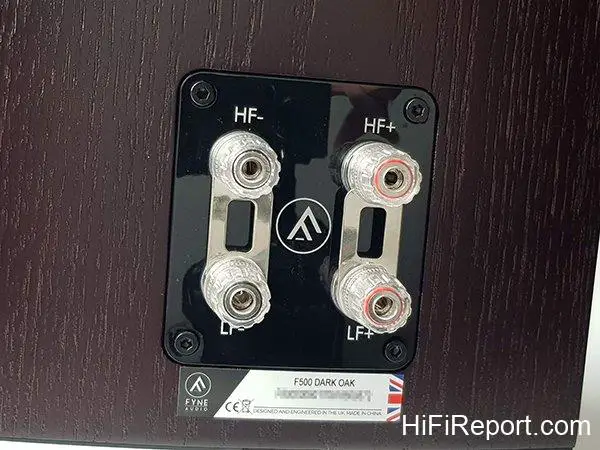
In less than two years, Fyne Audio has developed such a comprehensive product range, which is truly admirable in terms of their R&D capabilities.
The entry-to-mid-range F500 series includes four models: two floor-standing speakers, the F502 and F501, both employing a coaxial driver paired with a woofer in a 2.5-way configuration; the F500 bookshelf speaker, utilizing a single coaxial driver; and the F500C center channel speaker, which uses a coaxial driver with two woofers in a 2.5-way design.
Users can assemble both two-channel and multi-channel systems using the F500 series.
IsoFlare Coaxial Driver Technology
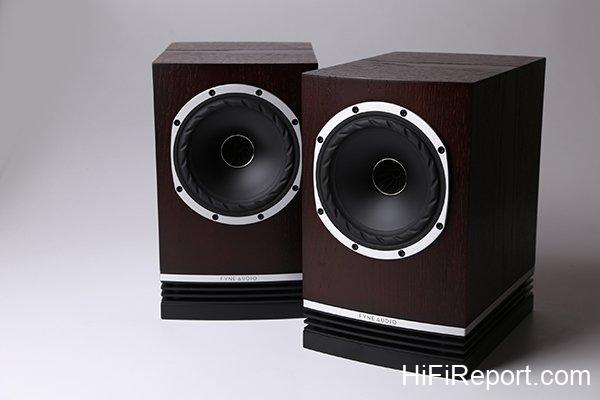
The F500 bookshelf speaker uses the same 150mm coaxial driver as the F501, in a 2-way bass-reflex design.
Coaxial drivers position the high-frequency and mid-bass drivers on the same central axis, eliminating phase differences between them, resulting in more precise imaging and localization.
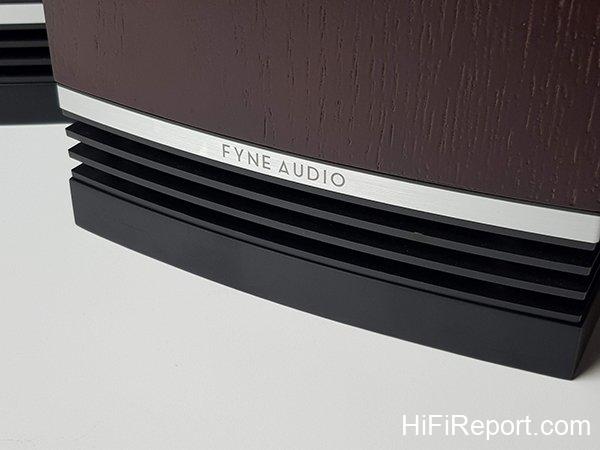
Dr. Paul Mills, Fyne Audio’s Technical Director, has extensive experience in coaxial driver development and firmly believes that coaxial drivers are the optimal audio solution. Therefore, if you want to understand Fyne Audio, first remember their signature technology: the IsoFlare coaxial driver.
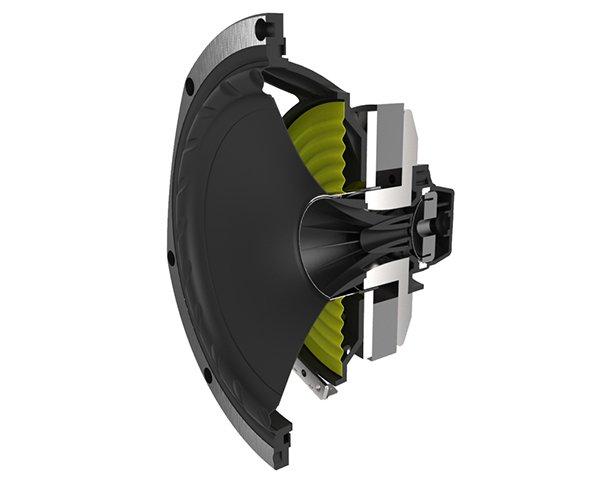
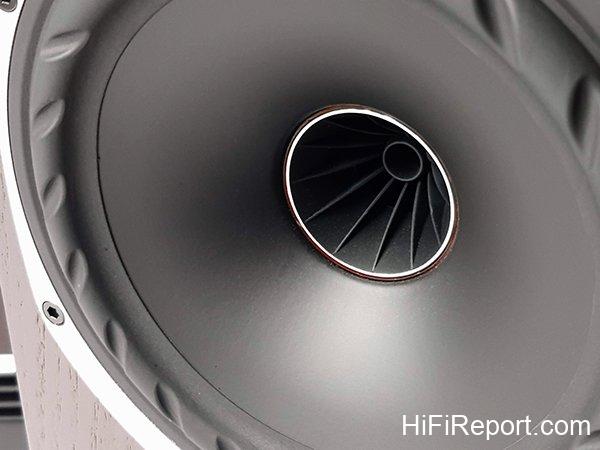
For the high-frequency section, it employs a neodymium magnet-driven titanium dome tweeter. Its inherent resonance frequency is very low, well below the driver’s operating range.
The tweeter operates similarly to a compression driver, projecting sound waves through a narrow throat. The specially shaped waveguide at the opening aids in sound wave dispersion. The overall design also has a coupling effect, allowing this 25mm tweeter to extend down to 1.7kHz.
FyneFlute Roll Surround Technology
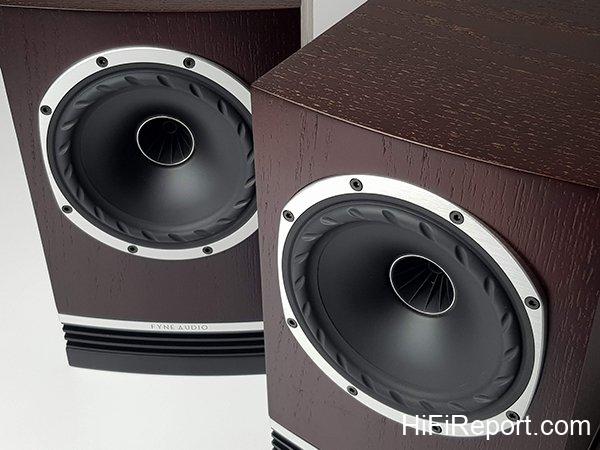
The mid-bass driver has a diameter of 150mm. The diaphragm material appears to be PP (polypropylene), but it’s not. The manufacturer states it’s a composite fiber material, lightweight yet strong.
The entire coaxial driver is built on an aluminum alloy frame, providing good stability and heat dissipation.
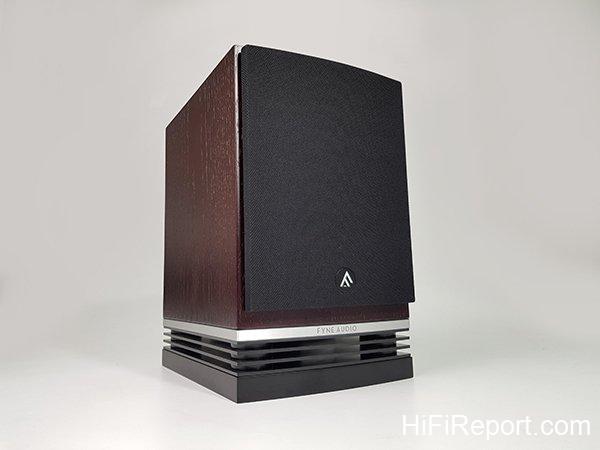
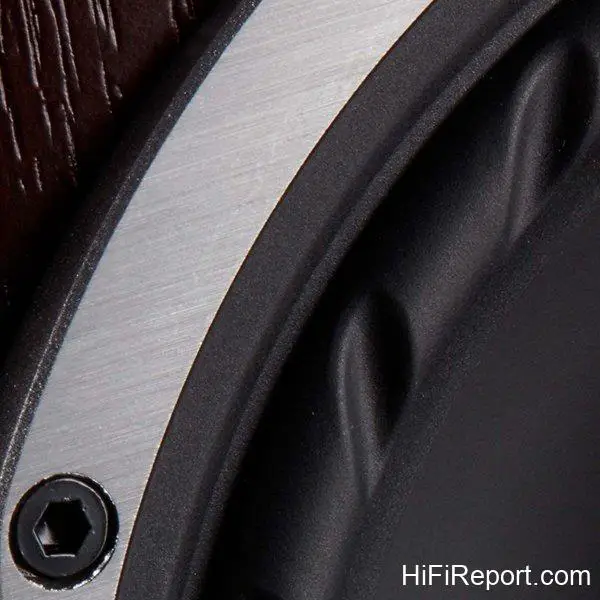
The most distinctive feature is the surround of the mid-bass driver, which incorporates a series of fluted grooves. These are designed using computer simulations to create a geometric structure that eliminates cone stress during driver movement, making piston motion more linear.
In simpler terms, this means lower distortion and less coloration.
This technology is called FyneFlute.
BassTrax Port Diffusion System
The cabinet is made of MDF (Medium Density Fiberboard) and feels quite weighty. Tapping on it produces a dull thud, indicating a solid structure.
Both the front and rear baffles have a slight curve to reduce diffraction.
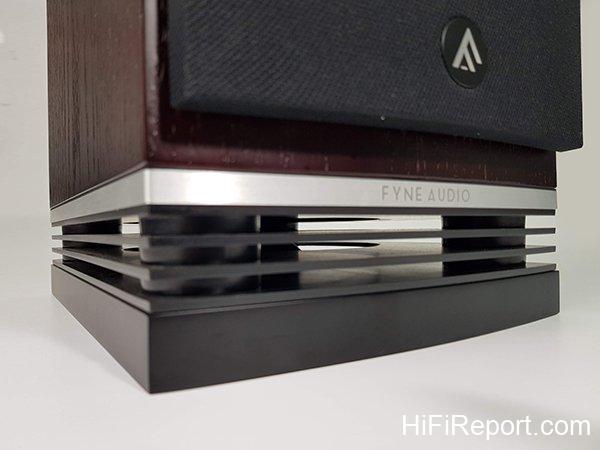
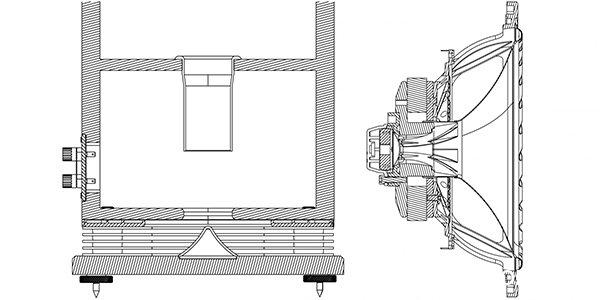
The bass-reflex port is located at the bottom, utilizing their BassTrax matrix diffusion technology. The manufacturer explains that the downward-firing port simplifies speaker placement. A volcano-shaped cone waveguide at the base helps to distribute the airflow from the port more naturally, and then disperses it through openings around the bottom, resulting in even and natural bass.
However, examining the internal structural diagram provided by the manufacturer, I discovered another aspect they didn’t mention, but which I sensed in my listening experience as a successful cabinet design element by Fyne’s engineers.
In the F500, for example, the actual bass-reflex channel is located inside the speaker. Horizontal baffles divide the interior into two chambers. The reflex channel runs from the upper chamber to the lower chamber, and the bottom of the lower chamber has openings facing the cone waveguide.
What does this mean? The lower chamber space provides a low-frequency gain effect for the F500.
I listened to the speakers first, and then went back to study the documentation. A single diagram explained all my questions.
Small Size, Big Sound, Impressive Bass
What were my questions? The F500’s bass is truly impressive.
Despite its compact size, the sound is expansive, especially the fullness of the bass, giving it the presence of a small floor-standing speaker.
With an 8-ohm impedance and 89dB sensitivity, the specifications might not seem particularly remarkable, but in practice, they are very easy to drive. In the HiFiReport listening room, using a Linear Acoustic LAV-60II amplifier, turning the volume knob to the 9 o’clock position while playing popular music albums was enough to raise my blood pressure. When playing orchestral pieces, the musical dynamics were also very sufficient.
Moreover, the sound produced is open, and the soundstage is expansive, not at all confined.
The high frequencies have a bright sheen, and the midrange is slightly rich, ensuring clear texture. This mid-high frequency performance, combined with the “surprisingly punchy” bass, makes these speakers immediately attention-grabbing.
Initially, seeing the F500’s small size, I worried that spacing them too far apart might create a hollow center image. So, I placed the speakers facing straight ahead, with a distance of about 1.4 meters between them. However, listening like this, the sound felt somewhat thick and sluggish. It was okay for low-volume, near-field listening, but at higher volumes, it felt a bit too dense.
I gradually widened the speaker spacing to 1.9 meters and slightly adjusted the toe-in angle, so that the central projection of the speakers landed about 20 cm outside my shoulders.
I achieved a moderate and universally applicable soundstage for all types of music. This soundstage was open, with ideal width and depth.
Detailed, Smooth, and Slightly Sweet Sound
Playing Celine Dion’s Paris concert recording, which has excellent live atmosphere, the Fyne F500 presented a wide stage. Celine Dion sang her heart out on stage, while the audience responded with fervent enthusiasm.
The cheers, the applause, and the shouts, carried a slightly feverish excitement, creating a strong live atmosphere.
Celine Dion’s vocals were very clear and three-dimensional, with a touch of nasal resonance.
The sound, propelled by the compression driver and emanating from the throat, was full of force, but rounded by the coaxial mid-bass cone’s horn-like coupling, resulting in a powerful yet non-irritating sound.
If you’ve heard horn speakers or Tannoy speakers, you’ll understand what I mean.
However, the Fyne F500 doesn’t sound old-fashioned. On the contrary, its sound is more modern. In the higher registers, it doesn’t have the sharpness often associated with horn speakers. Tonally, it has a hint of sweetness – not excessive, but enough to make vocals engaging.
The drum sounds had excellent impact, each beat round and full. Hearing such bold drum sounds from a small speaker was a surprising delight.
Well-Controlled and Pleasing Bass
If you enjoy jazz, the F500 will be perfect for jazz music.
For example, Holly Cole’s “Don’t Smoke in Bed” album is a favorite among audiophiles, known for its rich detail and full, well-defined bass.
Played through the F500, Holly Cole’s voice is clear and three-dimensional, with distinct lip and teeth sounds, throat resonance, and consonant articulation. Is this thanks to the titanium tweeter or the compression driver? I also appreciate the bass; it sounds substantial and detailed. While I think the F500 has a bit of a “boombox” quality, it doesn’t boom to the point of losing definition. This performance is excellent for bookshelf speakers in this price range. Typically, products in this class either sacrifice bass quantity or become overly bloated.
The F500’s BassTrax design doesn’t allow for stuffing the bass-reflex port with foam, but there’s no need to. This “punchy” bass is pleasing and enjoyable.
They can also play quite loud and are very satisfying at higher volumes.
For instance, Lee Ritenour’s “6 Strings Theory” album, featuring a gathering of guitar and bass virtuosos, all blues masters.
This recording is rich and full; the music is bluesy, and the recording is also bluesy in tone.
Listening on the F500, I particularly noticed the full, rounded bass notes. The sense of ease in the low end is rare for such small bookshelf speakers, and even more remarkable considering the price point.
The electric guitars are not harsh at all. The F500 renders these intense jam sessions as energetic yet not aggressive.
In “Am I Wrong,” Keb’ Mo’s vocals are lively and powerful. The bluesy, weathered feeling combined with the steady drum rhythm and harmonica harmonies is truly captivating.

Do you love the blues? Widen the speaker spacing, toe them in, crank up the volume, and let the F500’s music fill your room!
Solid Dynamics, Suitable for Home Theater
Its dynamic performance is also outstanding. I tested it with music that has significant dynamic contrast, and the F500 handled it with ease.
Which track did I use? How about “Tricycle”? The first track starts with soft and steady piano, playing a soothing melody. Suddenly, a powerful drum beat crashes in. If you’re not expecting it and have turned up the volume to hear the opening piano clearly, the first drum hit will definitely be startling.
The recording level of this track is relatively low, so the volume needs to be turned up. How loud did I push it? With the LAV-60II volume knob around 11 o’clock (or even slightly past), the F500 still held up.
Based on the experiences described above – clear vocals, precise imaging, ample energy, full bass, and strong dynamics – while listening, I thought: using the F500 series for a home theater system would be excellent. In fact, using five F500s for a 5-channel setup, paired with a subwoofer, would be both affordable and deliver outstanding performance.

(Though, it might be difficult to purchase a single F500 individually.)
Piano Brilliance, Orchestral Scale
Actually, it also performs very well with classical music. The F500’s soundstage is open, its imaging is precise, the sound images are solid, and the energy is sufficient. Playing large-scale orchestral works is very satisfying.
Listening to Martha Argerich playing Shostakovich’s Piano Concerto No. 1, which features piano, trumpet, and string orchestra. The composer incorporates many musical elements – romantic and passionate, humorous and witty, as well as intensely emotional.
The Fyne F500 presented an open and naturally extended stage. The sections of the string orchestra were clearly positioned. The richness of the low strings is quite exceptional for a bookshelf speaker of this size. If I were to narrow the speaker spacing slightly, I could make the low strings even thicker, but I didn’t want to sacrifice the soundstage.
Argerich’s piano in the first movement displayed assertive and confident authority. When the low-frequency chords were struck, the brilliance and weight that erupted simultaneously didn’t sound like they were coming from such small speakers.
As the piano notes ascended, they sparkled with brilliance and luster. That powerful, luminous, and colorful piano tone is precisely the persuasive performance of the piano queen.
The piano tone had a hint of golden hue, and the metallic string texture of the high notes was very pronounced.
This characteristic was even more advantageous for the trumpet’s playing, delivering a full sense of brilliance and warmth.
The Fyne F500’s 25mm titanium tweeter is truly remarkable, as it has to handle frequencies all the way down to 1700Hz!
Exceeds Expectations
There’s always a reason for choosing certain equipment to send to media for review.
Fyne Audio’s first review in HiFiReport is of the F500, indicating their confidence in these small speakers.
Our responsibility as media is to help readers and consumers understand products. Through our initial trials, we provide experience reports, allowing interested individuals to use our experiences to filter out equipment that suits them.
In this regard, I am willing to recommend the Fyne Audio F500 to those with limited budgets who don’t want to spend too much time on system matching. It can handle both pure music listening and movie watching needs, and is easy to pair with amplifiers, requiring minimal fuss.
Whether Fyne will become hugely popular, I don’t know. Whether the F500 will sell well, I can’t predict. However, I can say with certainty that the quality of these speakers exceeds expectations.
Specifications
* Type: 2-way coaxial driver bass-reflex bookshelf speaker
* Drivers: 150mm IsoFlare woofer x 1; 25mm Titanium dome compression tweeter x 1
* Frequency Response: 45~34kHz (-6dB)
* Sensitivity: 89dB
* Impedance: 8 Ohms
* Crossover Frequency: 1.7kHz
* Recommended Amplifier Power: 30~120 Watts
* Dimensions: 325 x 200 x 320 mm
* Weight: 7.3kg