
Innuos PULSEmini Review
In recent years, accessing music via online streaming platforms has become indispensable, making streaming audio products the mainstream. The question I’m most often asked is: “Which entry-level streamer offers the best value for money?” I embarked on a search through the vast ocean of available players, but as I reviewed more and more products, I found that each brand had its strengths, making it difficult for any single product to outperform its rivals in every respect.
That is, until I reviewed the Innuos PULSEmini, which felt like the answer I had been searching for.
Brand and Product Line Overview
Looking at the multitude of streaming audio brands today, Portugal’s Innuos appears like a dark horse that came out of nowhere. However, TiFai introduced the brand to Taiwan back in 2017. At that time, streaming audio was nowhere near as popular as it is now, and the brand went through some strategic changes that prevented continuous promotion in Taiwan. It wasn’t until 2023 that the brand was relaunched locally.
Innuos specializes in IT design and the development of music storage devices, and it’s one of the few technical companies that possesses both software and hardware R&D capabilities. Their product philosophy is clear: their current network streaming players are divided into three product lines. Besides the flagship Statement, the other two lines, PULSE and ZEN MK3, differ primarily in that the ZEN MK3 includes a CD drive and internal storage.
If you have a large CD collection, the ZEN MK3 is the choice for you, as it features a CD Ripper function and can store files for use as a music server.

However, if you only need pure network streaming capabilities, the PULSE series offers a more budget-conscious option. The series includes three models, from high to low: PULSAR, PULSE, and PULSEmini.
PULSEmini Features and Design
The PULSEmini, which is the subject of this review, is the entry-level model but also one of the most uniquely designed. It uses a half-size chassis and an external switching power supply. While it doesn’t feature the bespoke Recap 2 power system found in the higher-end models, it weighs only about one-third of the PULSE. I personally love this kind of compact, space-saving equipment, as it integrates more easily into a small desktop setup.

If your headphone system or two-channel monitoring system needs streaming functionality, the PULSEmini is an excellent fit. If you wish to upgrade in the future for more audiophile performance, you can add the optional Innuos ZENmini MK3 LPSU linear power supply, which I believe will significantly enhance the sound quality.
Furthermore, Innuos considered that entry-level users prefer simplified system setups, making the PULSEmini the only model in the PULSE series with a built-in DAC. The higher-end PULSAR and PULSE require an external DAC to produce sound. As experts in IT design, Innuos understands the impact of digital-to-analog conversion on sound quality. Therefore, the DAC is designed in collaboration with Italy’s M2Tech and utilizes the IT PCM5102 chip.
Even for an entry-level model, compatibility is generous, supporting PCM files up to 24bit/192kHz. It can play music files in formats like WAV, AIFF, FLAC, ALAC, AAC, and MP3, and supports MQA Renderer decoding, performing the first unfold of MQA files to achieve resolutions up to 96kHz or 88.2kHz. The PULSEmini also includes a digital volume control function, meaning it can function as a digital preamplifier.
Looking at the rear panel of the PULSEmini, you’ll find not only numerous digital inputs but also a single set of RCA analog outputs, allowing direct connection to a power amplifier or active speakers for a more streamlined two-channel system.

The PULSEmini’s rear panel also features four USB 3.0 ports. When used as inputs, these allow you to connect external hard drives or NAS drives for storage expansion, compensating for the lack of internal storage in the PULSEmini. When used as outputs, the USB ports support file transmission up to PCM 32bit/768kHz and DSD512.
Additionally, it provides optical and coaxial digital outputs, supporting up to 24bit/192kHz, allowing the PULSEmini to function as a “pure digital” streamer if you wish to connect a higher-quality external DAC. What’s even more unique is that the PULSEmini has two network ports, labeled “LAN” and “Ethernet,” indicating that the PULSEmini also functions like a “network switch.”
This allows you to output the network signal to the next streaming audio device, eliminating the need to run cables back to the router and reducing the impact of internet noise interference on the audio system’s performance.
Software and User Experience
The PULSEmini’s streaming support is also quite comprehensive. It runs on Innuos’s self-designed InnuOS operating system and is powered by a quad-core Intel N4200 2GHz processor. Operation is managed via the Innuos Sense application, which features an intuitive and aesthetically pleasing interface and supports streaming services like Tidal, Qobuz, Spotify, and more.
Even more conveniently, it can integrate files from NAS devices, music servers, and various streaming music platforms within your local network. When you search for a track or artist, it automatically displays files from all platforms for you to choose from, eliminating the hassle of switching between platforms to find songs. This powerful data integration capability is similar to Roon’s and provides a fast and smooth user experience.
In terms of usage, the PULSEmini offers two modes. The first is Standalone Mode, used as a typical streamer. In this mode, the PULSEmini acts as the streaming core, using the Innuos Sense app to play various streaming music services or accessing music files from a local network music server or NAS. For more advanced users, the manufacturer also provides a second mode: Endpoint Mode.
This allows the PULSEmini to be configured as an endpoint device, connected downstream from a primary music server (such as a Roon Core). In this setup, you not only benefit from Roon’s audio optimization technology but also reduce the workload on the PULSEmini, allowing it to focus solely on playback. This effective division of labor among components helps achieve optimal sound quality.
I must say, Innuos’s approach to streaming playback is indeed more flexible than many products, not only catering to the convenience of general users but also offering significant flexibility in system pairing if you’re looking for a more audiophile setup.
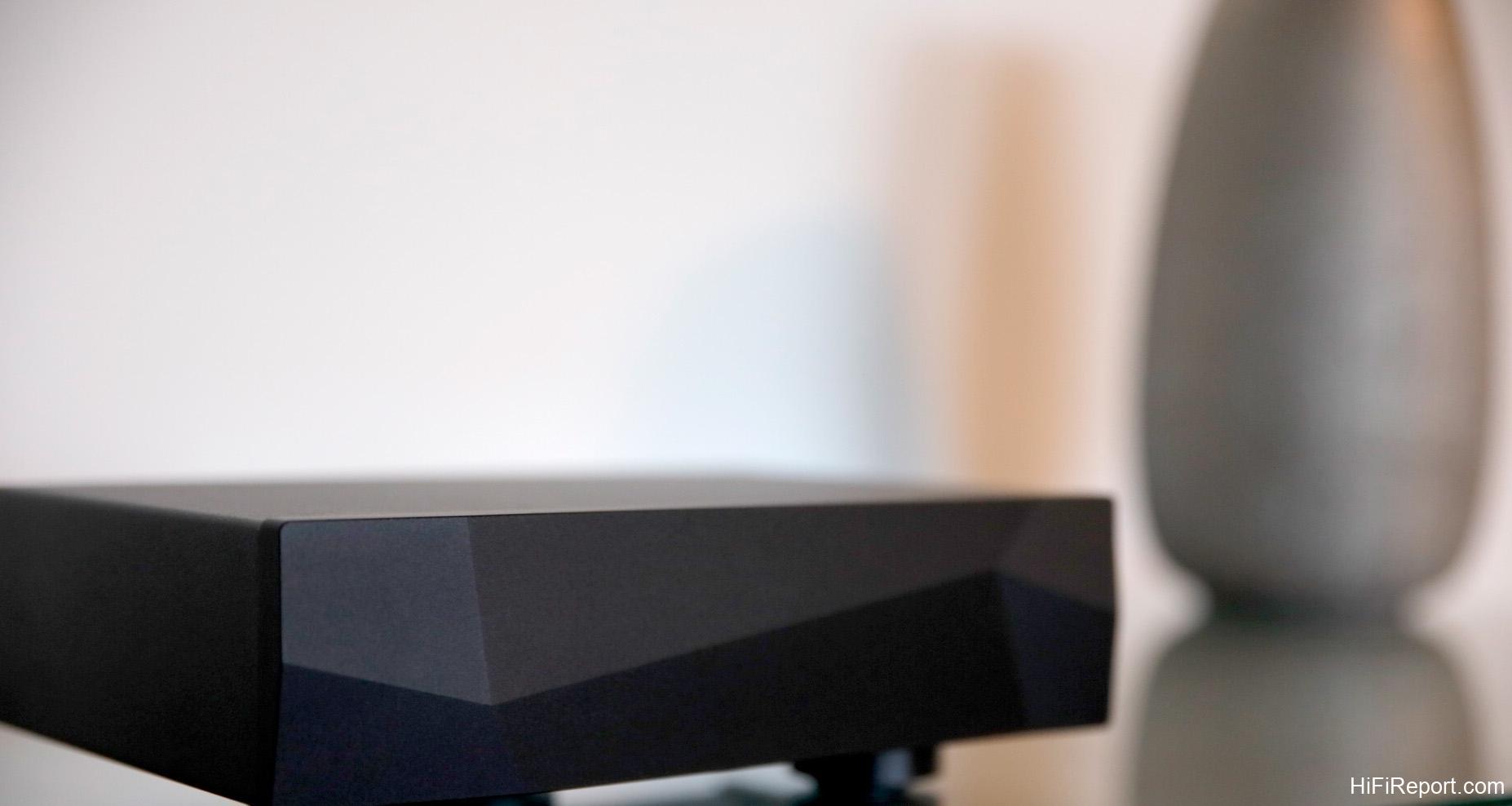
It’s evident from the preceding discussion that Innuos is a technology-driven company with products boasting high technical content. Such a company might not prioritize exterior design, right? Wrong! From the moment I first saw Innuos products, I fell completely in love with their appearance. They are arguably the most stylish and least “equipment-like” streaming sources I’ve seen. Take the PULSEmini, for example; its sandblasted metal chassis is paired with an anodized aluminum front panel.
The surface features an irregular geometric faceted design, with no buttons, screens, or even a brand logo, maintaining a minimalist and stylish look to the greatest extent. Someone not familiar with its purpose might genuinely mistake it for a lifestyle audio product.
Sound Quality Evaluation
Moving to the most anticipated stage, testing, I set the PULSEmini to Standalone Mode for use as a standard streamer, pairing it with a Linear Acoustic LA-V 120 integrated amplifier and Pioneer S-1EX floorstanding speakers. From the first note, the PULSEmini’s clean and transparent sonic foundation immediately caught my attention. It paired wonderfully with the LA-V 120 integrated amp’s warm and relaxed character, resulting in sound that was both fast and substantial.
Starting with simple vocals, playing “Sesame Open” from Hong Kong singer Gin Lee’s album “beGin” fully showcased the PULSEmini’s sonic strengths. Its most captivating quality is the vivid presence of vocals and instruments, with a density of sound that is quite rare in sources at this price point. Gin Lee’s voice felt like a distinct, three-dimensional outline firmly centered, the shape condensed and transparent, without overly thick midranges that would make the vocals sound bloated.
It effectively revealed the delicate and refined texture of the female voice. Even the sibilance, which can sometimes sound forward and sharp in this track, was smoothed out, sounding sweet and full of character.
Similarly, listening to “Swedish Pastry” from Bill Evans’ live album “At Shelly’s Manne-Hole.” The PULSEmini’s deep soundstage and instrument separation are also rare high-level performances among affordable streamers. The three instruments felt distinctly separated, with clear layers in the performance and no fuzzy boundaries between them. The piano texture was rounded and transparent, the key presses flowing smoothly and naturally.
The double bass energy in this live recording is very direct, and systems lacking control can sound blurred and bloated. Yet, the PULSEmini allowed me to hear the distinct plucking texture, with clear and fast string vibration details and a clean, unbloated wooden body resonance, while still delivering solid impact. The drum rolls also sounded direct and unmasked, the realistic impact feeling close at hand, with a solid sense of feedback that brought the piano trio vividly to life before me.
Finally, I challenging tested the PULSEmini’s dynamic capabilities by playing “Tempting Time” from the self-titled album by the progressive metal band Animals as Leaders. While this unit doesn’t particularly emphasize bass quantity, its speed and dynamics are excellent, handling rhythmically intense rock music without falter.
The electric bass in this track had plenty of punch, and paired with the relentless pounding of the kick drum, the low-frequency energy showed no sense of delay, still allowing deep and clear bass details to be heard. The electric guitar’s powerful distortion and lightning-fast playing in this track are also a significant test of system resolution. Unexpectedly, the PULSEmini passed with ease.
It seemed capable of dissecting complex musical phrases, allowing the texture of each guitar pick stroke to be felt distinctly, completely free from any blurring or loss of control. This made such rock music sound less chaotic and messy, revealing a more refined and layered side, enough to make any rock fan thoroughly satisfied!
Conclusion and Verdict
This Innuos PULSEmini has a beautiful design, and its app offers comprehensive practicality. What’s more, it possesses a refined sound quality rarely found in sources at this price point. Its only real competitor is probably Innuos’s other model, the ZENmini MK3.
But if you don’t need the CD ripper and internal storage functions, and simply want to stream music from the network, then the PULSEmini, based on overall evaluation, is undoubtedly the highest value entry-level streamer available today, bar none!
Specifications
* Type: Network Streamer
* CPU: Intel Quad Core N4200 2GHz
* Supported Digital File Formats: WAV, AIFF, FLAC, ALAC, AAC, MP3
* Supported Audio Sample Rates: 44.1kHz, 48kHz, 88.2kHz, 96kHz, 176.4kHz, 192kHz, 352.8kHz, 384kHz, DSD64, DSD128
* Input/Output Terminals: Coaxial Digital x1, Optical Digital x1, Analog Output (RCA) x1, RJ45 (Ethernet) x2, USB 3.0 x4
* Power Consumption: Max 13.7W
* Dimensions (W.H.D.): 227 x 74 x 160mm
* Weight: 1.8kg