
Integra DRX-8.4 Review
Integra’s “relaunch” in 2022 instantly captured the attention of numerous home theater enthusiasts. The DRX-5.4 notably featured the “Full-Frequency” version of Dirac Live right out of the gate, positioning it as one of the surround sound receivers with the most potent acoustic correction capabilities.
However, as I noted in my review at the time, the “5-series” occupied a second-tier flagship position, leaving me eager to see Integra introduce a true flagship product after their successful initial step.
2023 has indeed proven to be the “Year of the Flagship.” It’s a rare treat to simultaneously test the latest flagship source (UHD BD player) alongside the newest flagship surround sound receiver within the same month! The latest flagship receiver is this very unit, the Integra DRX-8.4.
Home theater aficionados, lend an ear: the DRX-8.4 generously includes the “Dirac Live Premium License” as standard, providing full-frequency Dirac Live correction from 20Hz to 20kHz without requiring an “upgrade purchase.”
The Significance of Full-Frequency Dirac Live
Currently, Dirac Live-equipped products remain relatively few. Aside from the new models introduced by Integra and Onkyo since 2022, most products under $7000 from other brands featuring Dirac Live are limited versions (Dirac Live LE).
Even so, seasoned users understand that even if Dirac Live LE only corrects below 500Hz, it’s already fully capable of resolving low-frequency peaks and dips caused by room modes, especially since many surround sound receivers fail to adequately correct the subwoofer frequencies (particularly below 63Hz) after automatic room calibration. Given how effective Dirac Live LE already is, how much more can the full-frequency version offer?
The difference, naturally, lies above 500Hz. The full-frequency version not only ensures the accuracy of the frequency response from the mid-midrange to the upper treble but, more importantly, reduces variations in the frequency response of each speaker measured at the listening position. This includes differences caused by adjacent walls, reflections, and absorption around each speaker, all of which negatively impact the clarity and focus of sound objects.
Many users might even mix and match speakers from different series within the same brand, or even create a “United Nations of Multi-channel Speakers” using various brands. In such cases, the tonal disparities between channels often cannot be fully rectified with just Dirac Live LE. This is where the full-frequency Dirac Live shines: after full-range testing and calibration, two-channel music playback achieves more accurate positioning and clearer soundstage definition.
Extending to multi-channel (movie sound), it ensures seamless integration and perfect synergy between speakers from front to back and top to bottom, resulting in a completely cohesive soundstage. Furthermore, if ceiling or in-wall speakers have fixed tweeter angles (no toe-in adjustment), the full-frequency Dirac Live can compensate for off-axis high-frequency roll-off.
Beyond the full-frequency correction offered by the included Dirac Live Premium License, users have the option to pay for an upgrade to the more advanced “Dirac Live Bass Control.” The Single Subwoofer version costs $349, while the Multi Subwoofer version of Dirac Live Bass Control is priced at $499.
According to Dirac, Bass Control achieves a more seamless integration in both phase and frequency response between the main speakers and the subwoofer(s) and can also help improve (shorten) decay times for some extremely low frequencies.
Design and Features
The DRX-8.4 was designed by a research and development team in Osaka, Japan. It retains Integra’s hallmark characteristic: being exceptionally well-suited for custom installation. It offers full compatibility with major control systems including Control4, Crestron, Savant, URC, Elan, and RTI. It supports IP control, allowing configuration via a web browser on a computer or mobile device. This is an 11.4 channel surround sound receiver that holds both THX and IMAX Enhanced certifications.
It not only supports current mainstream surround sound formats like Dolby Atmos and dts:X but will also add Auro-3D support via a firmware update provided by the manufacturer in June.
Considering its weight and channel count, I believe Integra took a very pragmatic approach with the DRX-8.4. Weighing a hefty 22.5 kilograms (net) but containing “only” 11 built-in amplifier channels indicates a deliberate decision to prioritize providing more robust driving power by carefully balancing the power supply and amplifier circuitry, rather than relying on “specification tricks” to boast more channels or high-power numbers that translate to limited real-world push.
The unit’s rated power output in two-channel, full-frequency drive is 150 watts per channel into 8 ohms with a total harmonic distortion below 0.08% (indicating it’s not being pushed to its limits). This is where flagship surround receivers excel: its ability to drive a pair of floorstanding speakers for music listening is stronger than many two-channel integrated amplifiers or even power amplifiers.
The DRX-8.4’s “total output channels” are specified as 11.4 channels. The “.4” essentially represents two independent subwoofer channels (each with separate level, distance, and frequency response calibration settings), which are then split into two parallel outputs. Users and installers can configure 7.1.4, 7.2.4, or 7.4.4 channel systems, offering a complete solution “all in one box” without needing external power amplifiers.
If you plan your multi-channel system and find the DRX-8.4 has “channels to spare,” bi-amping the left and right main speakers can yield better sound quality – something many two-channel integrated amps can’t do!

The DRX-8.4 also has a unique capability: if you only plan to install one pair or no height speakers, one pair of its speaker terminals, “HEIGHT 2 L/R,” can be used to drive two “passive subwoofers.” This truly shows consideration for custom system design, as many in-wall or in-ceiling subwoofers are passive. The DRX-8.4’s ability to drive them directly eliminates the need for an additional power amplifier.
Furthermore, the DRX-8.4 provides balanced “pre-out” connections (XLR) for the front three channels and the two subwoofer channels, totaling 5 channels. This is a rare feature on most surround receivers. The main advantage of balanced audio signal transmission is its ability to reject common-mode noise, making it ideal for long cable runs. Thus, the DRX-8.4 is better suited for custom installations in large spaces than most surround receivers.
Using balanced connections for the front three channels when adding power amps, when using passive subwoofers requiring power from the receiver, or when subwoofers are located far from the receiver, minimizes concerns about induced noise (especially hum).
Modern specifications for HDMI 2.1 ports require explicit listing. The newly designed HDMI interface on the DRX-8.4 includes six HDMI inputs on the rear panel, all of which support 8K/60p and 4K/120p. Importantly, they are full-bandwidth (40 Gbps), compatible with HDR10, HDR10+, VRR, ALLM, and HDCP 2.3. The HDMI outputs support eARC.
The DRX-8.4 includes built-in Wi-Fi and Bluetooth. The Bluetooth functionality is bidirectional, supporting both receiving and transmitting. It can receive SBC and AAC Bluetooth streams from portable devices and transmit high-quality Bluetooth streams (aptX, aptX HD) to Bluetooth headphones.
The DRX-8.4’s streaming capabilities include Chromecast, AirPlay 2 support, and Roon Ready certification, allowing users to stream music from internet services (like TIDAL and Spotify) and TuneIn internet radio.
For music file playback, the unit can play files shared from a NAS, mobile device, or computer over the network. Supported file types include WMA, MP3, WAV, AIFF, AAC, FLAC, LPCM, Apple Lossless, and DSD. Multi-bit lossless audio files are supported up to 192kHz/24bit (FLAC and WAV), and DSD is supported up to 11.2 MHz. Users can install the “Integra Control Pro” smartphone app for song selection and playback, or directly stream music files losslessly via Wi-Fi from their phone to the DRX-8.4.
If you have hundreds or even thousands of albums in lossless format, you can also directly connect a USB hard drive containing music files (I tested an NTFS-formatted USB HDD which worked, but an exFAT-formatted USB SSD did not) to the DRX-8.4’s USB port, using the app for song selection as well.
Inside the Chassis
Having experienced Integra since its early days, their successive flagship surround receivers have consistently left me with the impression of being “robust.” Upon removing the top cover of the DRX-8.4 and observing its internal structure, I could immediately confirm that it remains a powerful amplifier. Further observation reveals a significant evolution compared to previous Integra flagships.
The digital main board primarily houses the HDMI interface, network card, digital audio processing, and digital-to-analog conversion circuitry. The digital audio processing section utilizes two DSP chips. Observing the location of the two DSP chips and the DAC chips, I determined that after the Cirrus Logic CS49844A performs multi-channel decoding, the TI Aureus 4-core 32bit DSP chip TMS320DA808 (D808K013DPTP5) handles Dirac Live, AccuEQ, and other post-processing.
The two DSP chips used in the DRX-8.4’s digital audio processing are identical to those in the DRX-5.4 I reviewed last year. However, there’s a significant difference in the digital-to-analog converter chips: The DRX-5.4 used the TI PCM1690 32 bit 8-channel DAC chip for the main channels (and PCM5101A for secondary channels), which has a dynamic range of 113dB and THD of -94dB.
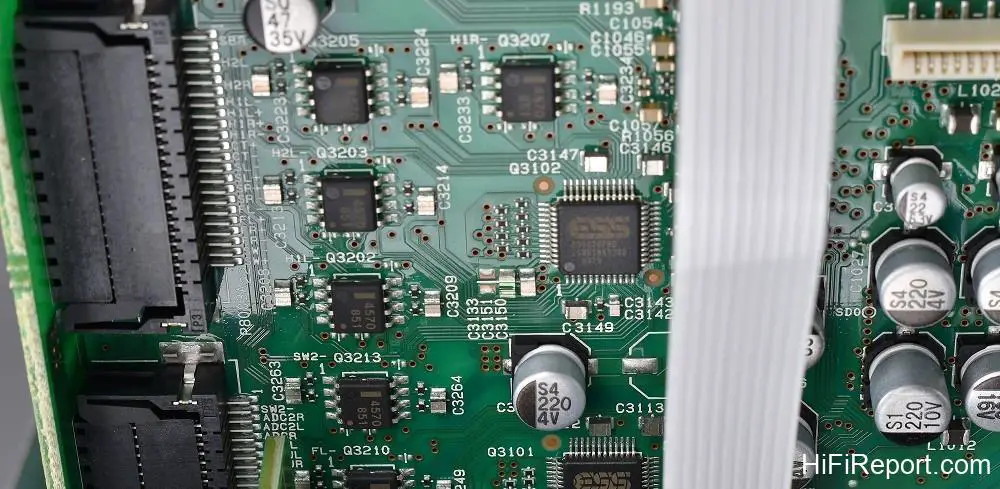
This unit, on the other hand, uses two significantly higher-grade ESS 32 bit Hyperstream II 8-channel DAC chips, the “ES9026PRO,” for digital-to-analog conversion across all channels (see diagram below). These offer a dynamic range of up to 124dB and THD of only -110dB. These two performance metrics translate into tangible sonic characteristics: “quietness,” “dynamic contrast,” and “purity and clarity.”

For the I/V conversion circuitry after the DAC chips, this unit employs the NEC μPC4570 dual OP Amp chip. The low noise and high slew rate characteristics of this chip indicate that Integra’s designers aimed to fully leverage the high dynamic performance of the ES9026PRO through this pairing.
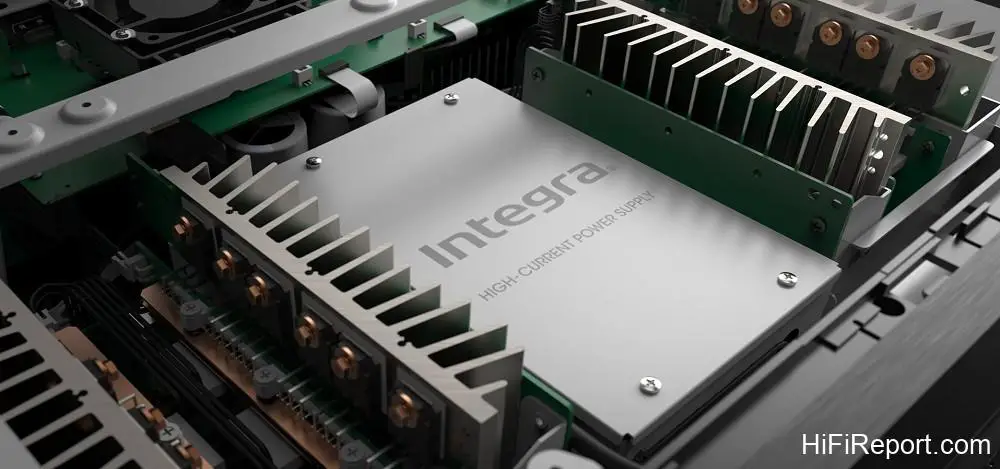
In terms of power amplification and power supply circuitry, Integra’s consistent approach has been to prioritize high current output capability, a philosophy executed even more thoroughly in their flagship models. The large, copper-shielded EI transformer, centrally located in the front half of the chassis and covered by a metal shield, is dedicated solely to powering the audio circuitry.
Achieving strong amplifier current output requires not just a large transformer but also a “short, low-impedance power path.” To shorten the path, the bridge rectifier and the two electrolytic capacitors used for filtering the power amplifier circuitry (two custom Integra high-current 18,000μF/75V electrolytic capacitors) are mounted directly behind the power transformer.
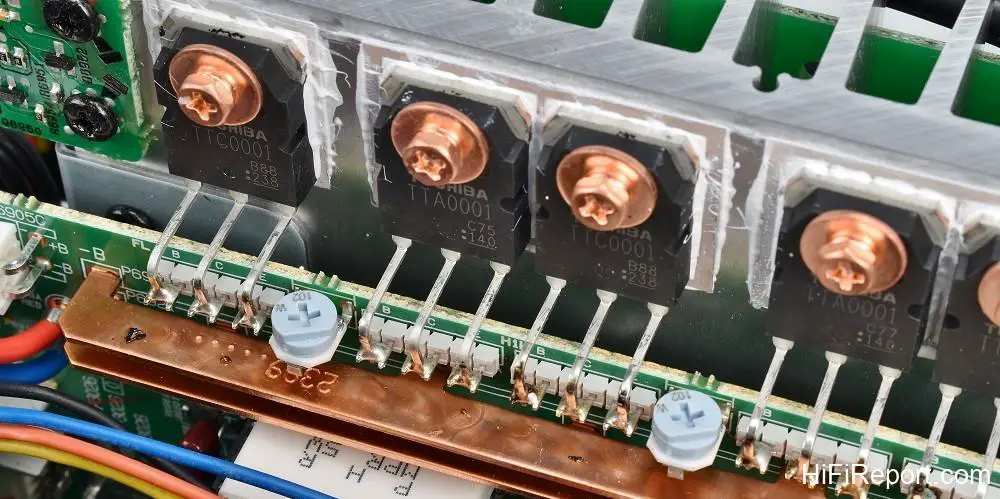
The power amplifier circuits are symmetrically arranged on either side of the transformer, with 5 channels on the left and 6 channels on the right. On the total of four power amplifier circuit boards, all power connections to the power transistors use “copper bars” instead of copper traces on the printed circuit board. These measures are all aimed at reducing internal resistance and increasing current output capability.
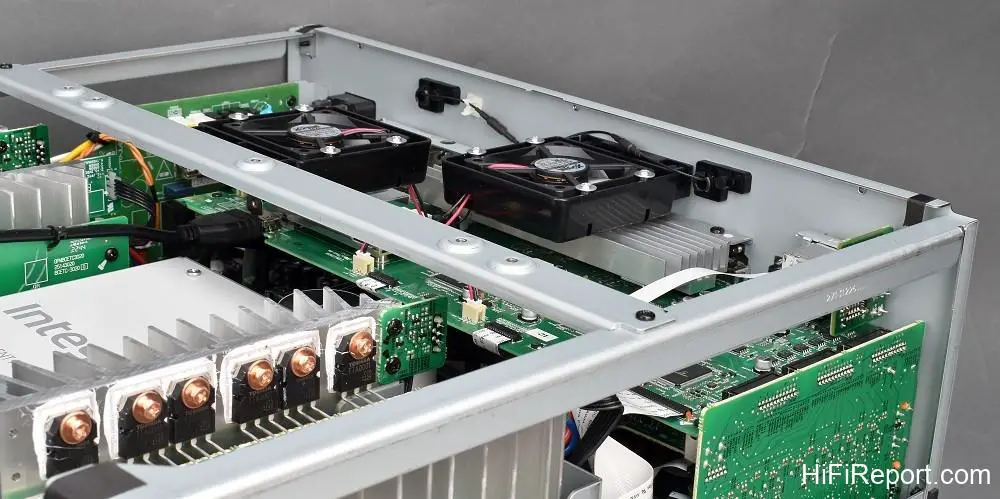
Integra consistently utilizes simple, low-negative-feedback Class AB amplifier circuits. Each channel in the DRX-8.4 uses a pair of Toshiba TTA0001/TTC0001 Darlington transistors in a push-pull configuration for the output stage. These are “Triple Diffused Type” bipolar power transistors, different from standard audio power transistors in having a wider bandwidth (30MHz) and higher current capability (up to 35 Amps instantaneous).
The low-negative-feedback design helps reduce transient intermodulation distortion, resulting in sound that is crisp, direct, and lively. It also minimizes the impact of back-EMF generated by the speakers returning through the negative feedback path to the input stage, thereby improving the stability of the amplifier circuit. This is a primary reason why amplifiers with low or no negative feedback at the output stage are often able to “handle difficult speakers.”
However, real-world driving power depends on more than just a strong power supply, low-impedance power path, high-output power transistors, and low negative feedback. Effective heat dissipation for the power transistors is also crucial. The DRX-8.4 uses significantly thick extruded aluminum heatsinks (including fins and the leading edge where the transistors are mounted) in the power amplifier circuits, ensuring more efficient heat transfer.
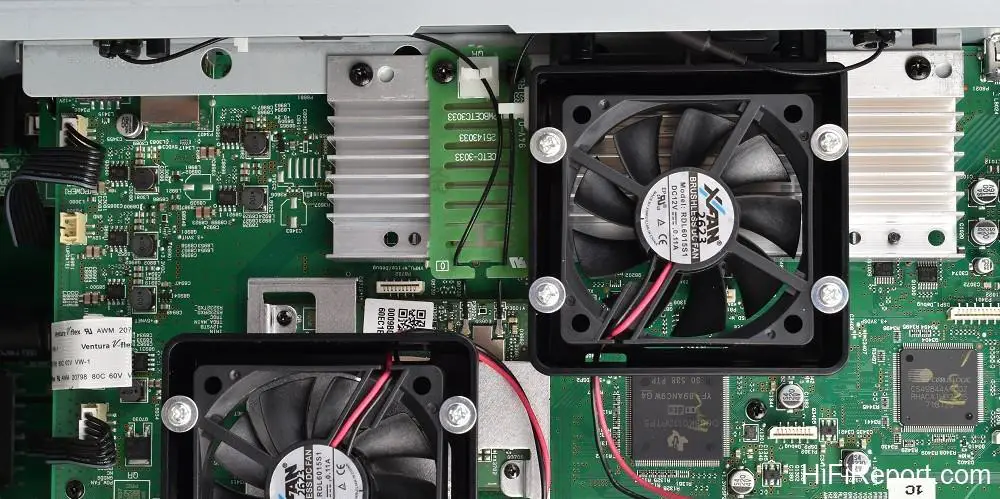
A fan located below the heatsinks activates only when the temperature rises. Good thermal management allows the DRX-8.4 not only to achieve high peak output but also to sustain high output for longer periods without “throttling down” while maintaining a safe operating temperature. During normal music listening, this keeps the power transistors at a lower temperature, reducing thermal noise and resulting in cleaner sound.

As seen in the diagram below, Integra’s designers have cleverly designed the heatsinks of the power amplifier circuits to also act as “shields” for the amplifier boards, particularly on the side facing the transformer, providing a second layer of shielding in addition to the transformer’s metal cover.
Calibration and Listening Impressions
Before beginning the listening tests, I needed to complete the Dirac Live calibration process. While the DRX-8.4 includes a test microphone that plugs into the unit’s dedicated mic input, and the “Integra Control Pro” smartphone app can be used to run the calibration, Integra recommends using a miniDSP UMIK-1 test microphone connected to a computer for executing Dirac Live. I am accustomed to using the UMIK-1 and a computer for setup.
The DRX-8.4 allows storing results from three different calibrations in separate “Slots.” So, I first performed a calibration using the included microphone and the app, saving it to Slot 1. Then, I used the UMIK-1 and a computer to perform a calibration, saving it to Slot 2. Slot 3 can be kept for “adjustments to personal preference.” Users can utilize these three memory slots for “basic calibration” and for calibrations with custom target curves optimized for “movies” and “music,” respectively.
For this review, I used a 7.2.4 channel speaker configuration, primarily pairing the DRX-8.4 with Pioneer EX series speakers and two M&K V12+ active subwoofers. I first listened to music files using the DRX-8.4 in Direct mode, driving the Pioneer S-1EX floorstanding speakers full-range without the subwoofers. I played tracks with abundant low frequencies at high volume to test its driving power. In this scenario, the DRX-8.4 demonstrated a clear evolution compared to previous Integra models.
The bass was not just powerful and expansive but felt remarkably solid and fast, indicating a genuine increase in the DRX-8.4’s driving capability and superior control over the speakers.
Regarding its sonic character, I believe any listener who has carefully evaluated it would describe it as “neutral.” The DRX-8.4, thanks to Dirac Live calibration, effectively eliminates the bloom and muddiness caused by room modes. The mid and high frequencies are clear and straightforward, presenting the entire frequency spectrum in a well-organized manner.
Without needing careful comparison, it’s immediately apparent that Dirac Live provides significantly sharper imaging and more precise focus than with Dirac turned off (even with painstaking manual speaker placement, the difference is easily audible). Eliminating low-frequency standing waves greatly reduces blurring and overhang, noticeably improving bass definition.
However, I also understand that most audio enthusiasts have grown up in an era without room correction and may have come to perceive low-frequency standing waves as part of the overall bass energy. Therefore, when first experiencing Dirac Live calibration “killing” the low-frequency standing waves, some might feel the bass is reduced. Furthermore, the DRX-8.4’s power amplifier circuitry, with its “high output, low distortion” characteristics, also reduces distortion-induced coloration.
With Dirac Live calibration engaged, the sound is closer to what you’d hear in a recording studio or through monitoring headphones. It allows listeners to directly experience the “flavor of the recording itself” without added coloration or embellishment. I then carefully compared the results of calibrations performed with the included microphone and the UMIK-1. The latter resulted in a slightly richer sound with a higher sense of density.
Ultimately, if you want to tailor the DRX-8.4’s inherent “neutrality” to better suit your personal preferences, setting a custom Dirac Live target curve is the way to go.
I believe the DRX-8.4’s performance with movie soundtracks is far more captivating than its musical performance. The “soundstage spatialization” is outstanding. It feels like transforming a “home” theater into a large cinema hall. The sound is completely unconstrained, very open, and with good speakers, the sound quality can easily surpass commercial cinema systems. The soundstage is exceptionally clear and deep, and even quiet sounds have very high “visibility.”
The incredibly high resolution it exhibits with movie effects is clearly related to its “ultra-black” background and high-purity sound. Watching the “divine punishment” scene from episode 15 of “The Glory” (from 1:58 to 4:25), you can fully feel the presence of various sounds surrounding you in space. Combined with slightly cooler air conditioning, the eerie and terrifying atmosphere is quite chilling!
Moving on to action and sci-fi films, the DRX-8.4 in “6 Underground” fully demonstrates the ferocity of a heavy-duty flagship unit. The impact force of car crashes is distinctly different from typical products. For years, Integra surround receivers have maintained a bold, American-style character. This time, the DRX-8.4 has further enhanced control and speed, thereby elevating the tension and excitement in action sequences.
In the diving scene at 12:25 in “Black Panther 2: Wakanda Forever,” you can feel the pressure upon entering the water and the very close water sounds. The three-dimensional spatial envelopment is tight and realistic. The transition between above-water and underwater scenes conveys a significant difference in spatiality and pressure.
Thanks to the precise calibration of Dirac Live and its inherent characteristic of wide soundstage spatialization, the DRX-8.4 in “Top Gun: Maverick” is even better at conveying the movement range of fighter jets changing direction, altitude, and location in space, as well as the shape and distance perspective of cliffs and the ground relative to the flying jets.
The energy and impact of the Darkstar jet engine will undoubtedly awaken memories for veteran enthusiasts: this wild, powerful feeling is the most prominent and beloved characteristic of Integra flagships when reproducing movie soundtracks for home theater aficionados.
Conclusion
The DRX-8.4 is Integra’s first flagship surround sound receiver with built-in Dirac Live. It maintains the excellent tradition of being “powerful” while achieving significant progress in terms of “precision,” “delicacy” (nuance), and “quietness” (low noise floor) compared to its predecessors. It is undoubtedly one of the best-performing products in its price range for movie soundtracks and deserves our highest recommendation.
Specifications
* Type: 11.2 Channel Surround Sound Receiver
* Output Power: 220 Watts per channel (6 ohms, 1kHz, 1% THD, 1 channel driven, IEC), Class AB amplification
* Total Harmonic Distortion: 0.08% (20Hz~20kHz, rated output)
* Frequency Response: 10Hz~100kHz (+1,-3dB)
* Signal-to-Noise Ratio: 107 dB
* Input Terminals: HDMI×7, Component Video×1, Composite Video×2, Digital Coaxial×2, Toslink Optical×3, 2-channel Analog RCA×6 (incl.Phono), 2-channel Analog XLR×1, USB×1, Network Port×1
* Main Outputs: 11.4 channel Pre-out (RCA), L/C/R/SW1/SW2 XLR Pre-out, Speaker Terminals×15 (max 11 channels simultaneously), HDMI×3, Headphone Output×1
* Control Terminals: RS232×1, IR In×2, IR Out×1, 12V Trigger Out×3
* Dimensions (W×H×D): 435×198×470mm
* Weight: 22.5kg