
Jeff Rowland Model 555 Power Amplifier Review
Every time I see an amplifier from Jeff Rowland Design Group, I can’t help but take a long look.
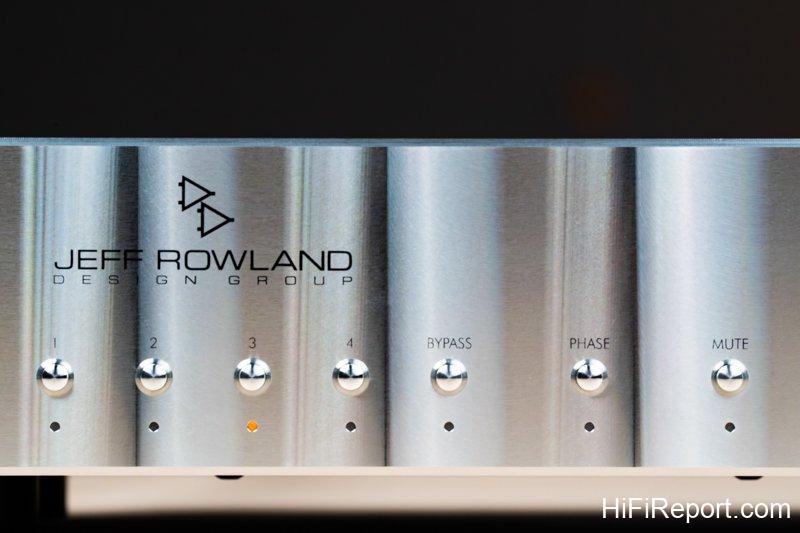
Their equipment isn’t flashy, and the color schemes are simple, but the striations, shimmering with a gentle luster under the light, showcase a sense of understated luxury rarely found in the industry.
This finish, reminiscent of the Geneva stripes (Côte de Genève) on a mechanical watch movement, gives Jeff Rowland Design Group (hereafter referred to as JRDG) products a high degree of recognition.

Improved Chassis Design for Better Cooling
In 2023, JRDG launched their latest power amplifier, the Model 555, as the successor to the Model 535.
The Model 555’s chassis design differs slightly from the previous Model 535. Like its predecessor, it’s CNC-machined from a solid block of aerospace-grade 6061-T aluminum alloy. The front panel retains the natural aluminum finish, while the main chassis undergoes black anodization.

The earlier Model 535 chassis had a flat design without dedicated heat sinks, relying on the entire aluminum chassis for heat dissipation, similar to their preamplifiers.
The Model 555, however, incorporates heat sinks. Rather than being on the sides, they are horizontal ribs cut directly into the entire chassis. These ribs are meticulously polished, with smooth, rounded edges that are comfortable to the touch.

What’s more, closer inspection reveals that the width of these heat sinks varies, some wider, some narrower, a deliberate design choice to prevent specific frequency resonances.
The marvel doesn’t stop there; the chassis still features the decorative striated pattern, seamlessly flowing from the front panel. This level of chassis craftsmanship is a first for a JRDG power amplifier, demanding considerable manufacturing complexity and cost.

Part of the joy of appreciating mechanical watches is admiring the movement’s finishing. Similarly, the industrial design and chassis craftsmanship of JRDG equipment offer their own distinct visual pleasure.
Power Output and Flexibility
The Model 555 is fundamentally a stereo power amplifier but can also be used as a monoblock, a common JRDG design that provides users with an upgrade path.

In stereo mode, the Model 555 delivers 150W per channel into an 8-ohm load and 250W per channel into 4 ohms. When bridged into monoblock operation, each Model 555 can output 330W. Switching modes is simple, requiring just a flip of a switch on the rear panel.
Its analog inputs and speaker outputs feature dedicated terminals for mono and stereo configurations, ensuring correct connections and adding to the unit’s user-friendly design.

Power Supply Excellence
For a 150W amplifier, the Model 555 is remarkably compact and lightweight, largely thanks to its use of a switched-mode power supply (SMPS). JRDG adopted SMPS technology quite early on.
Many who staunchly favor linear power supplies believe their quiet, low-noise characteristics represent the true path for power delivery. However, transformers—whether EI, C-core, or toroidal—are inherently bulky and heavy. Furthermore, linear power supplies suffer from high internal losses and lower efficiency. If a linear supply were used, the Model 555 could never be this compact.
The noise issues often associated with SMPS have largely been overcome today. JRDG has integrated power factor correction (PFC) into this SMPS, effectively reducing harmonic noise pollution from the mains supply and boosting AC power utilization to an impressive 97%.
Because SMPS are highly efficient and fast-responding, when properly designed, they can perform not just comparably to linear supplies, but even better. This is why several audio manufacturers, including JRDG, are embracing switched-mode power supplies.

Custom Input Transformer
After the signal enters the Model 555, it passes through an input transformer for coupling, effectively isolating the amplifier circuit from external noise. This design is a staple in JRDG amplifiers.
Transformer coupling can virtually eliminate all ground loop noise and interference from EMI/RFI. Additionally, when using single-ended input, the transformer coupling ensures the amplifier’s overall gain is maintained.
Notably, this transformer is a special specification customized for JRDG by the Swedish audiophile component manufacturer Lundahl. It uses a cobalt-based amorphous core, chosen not only for its high magnetic permeability and ultra-low iron loss but also because its magnetostriction is virtually zero – a tailored solution provided by Lundahl for JRDG.
Quality Components and Minimal Wiring
The Model 555 utilizes an ultra-rigid ceramic circuit board substrate manufactured by Rogers. This military-grade multilayer board boasts a very low dielectric constant and minimal energy storage and absorption. Its low ground impedance facilitates internal star grounding.

The circuit employs a balanced architecture from input to output, which helps to reduce distortion and noise under dynamic signal conditions. Some components on the board are through-hole mounted, while others are surface-mounted.
Many audiophiles consider through-hole circuits superior, but JRDG pragmatically notes that SMD (Surface-Mount Device) layouts reduce loop area, lowering circuit capacitance and inductance, which results in less noise. Thus, they don’t shy away from using SMD components. However, components are still carefully selected. For example, the thin-film resistors used have extremely low thermal noise. Any unavoidable internal wiring (used for input and output connections) employs silver-plated copper wire with Teflon insulation. Teflon’s low dielectric constant minimizes the wire’s self-capacitance, contributing to a more natural sound.

Dedicated Terminals for Stereo and Mono
In terms of external connections, the Model 555 is straightforward, offering only XLR balanced inputs with no RCA option. While JRDG preamplifiers and integrated amplifiers include RCA to accommodate various sources, their power amplifiers exclusively feature balanced inputs.
For speaker terminals, JRDG continues to use connectors manufactured by Cardas. Unlike standard speaker terminals, these only accept spade connectors. Furthermore, the positive and negative terminals are secured by a single locking mechanism; turning a large knob simultaneously tightens both wires.

In addition to the left and right stereo connections, there is an extra set of XLR inputs and speaker terminals specifically for bridging the Model 555 for monoblock use.
Let’s pause for a brief summary. The Model 555 has a compact chassis, making it ideal for home use. The bridgeable design offers users future upgrade potential. The highly efficient power supply can instantly provide the energy the amplifier needs. Its output power of 150W into 8 ohms and 250W into 4 ohms (330W when bridged) is certainly ample.

The unique input transformer design, a custom collaboration with Swedish high-end manufacturer Lundahl using a cobalt-based amorphous core, is a rare approach. The internal circuit layout is neat and follows the shortest path with no flying leads, which is visually satisfying. Now, let’s move on to how it sounds.
Preamplifier Synergy
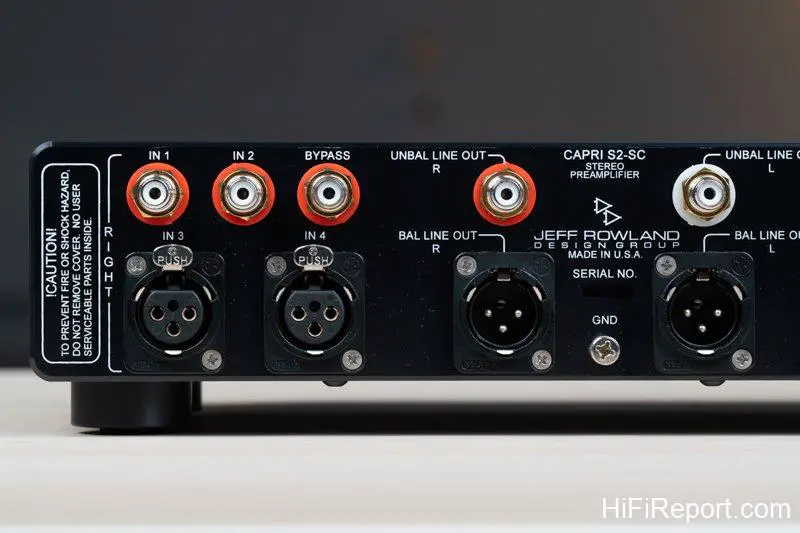
In our listening room, I paired the Model 555 with Wilson Audio Alexia V speakers. I cycled through three different preamplifiers: JRDG’s own Capri S2-SC, a German Physiks Emperor preamp, and an EAR Yoshino 868. The source was a YBA CDT450 transport combined with a Merging NADAC.

When paired with the German Physiks, the sound was the most refined and transparent. With the EAR 868, the listening experience was fuller and warmer. The Capri S2-SC sat in the middle, offering a sound that was smoother and softer than the German Physiks but with more apparent detail than the EAR 868.
All three preamps resulted in enjoyable listening. The following impressions are a synthesis of these three combinations, though the longest portion of the listening was spent with the Capri S2-SC. There are two reasons for this. First, JRDG “generously” sent brand new pre and power amps, with instructions that the units needed significant break-in, stating they wouldn’t reach their full potential until after 400 hours. Since I couldn’t possibly listen for several months before returning the gear, I simply kept them powered on and listened as much as possible. Second, JRDG components paired together simply look beautiful. Listening to the Capri S2-SC with the Model 555 while admiring the sparkling Geneva stripes on the panels under the light, resembling enlarged movement bridges or rotors, offered its own unique pleasure.

Crystal Clear Piano with Warm Luster
Despite its small size, the Model 555 possesses substantial power. Even when driving speakers like the Alexia V, it maintains a sense of effortless control. Listening to Lahav Shani conducting the Rotterdam Philharmonic Orchestra in Beethoven’s Piano Concerto No. 4, the Model 555 effortlessly delivered spacious, full-bodied bass while simultaneously presenting the piano’s brilliant, icy high notes and clearly delineating the orchestral layers in an orderly fashion.
Listening to this fantastical, elegant, and grand concerto beautifully showcased the musical aesthetic the Model 555 is capable of rendering. In the first movement, Beethoven’s extensive use of arpeggios and tremolos scattered round, crystalline notes across the soundstage. Each note was solid and bloomed with a warm luster – truly exquisite. The second movement is fascinating, featuring a dialogue between the low strings and the piano – one low, one high; one majestic and rugged, one elegant and refined. The Model 555’s bass is rich and powerful; when the low strings swelled, there was a wave-like force that was thoroughly enjoyable.

The third movement builds from soft to loud. The strings enter with a march-like, forceful, stepping theme, initially soft in intensity but becoming powerfully strong on repetition. The music then enters a majestic phase again, with the piano unfolding gloriously alongside. Beethoven gives the piano a significant performing role here, imbued with great emotional tension. Emotional expression lies in the control of dynamics and the transitions in timbre. Whether a musical performance is beautiful or intoxicating depends on how the musician understands, feels, and interprets the piece. When reproduced by the audio system, it depends on its ability to render those changes in intensity and those subtle nuances in timbre, one by one. Driving the Alexia V, the Model 555 was truly composed and effortless!
Exceptional Timbre and Intoxicating Music
In terms of timbre, Beethoven’s Piano Concerto No. 4, written in the sunny key of G major, is full of light and overflowing with joy. Switching to Mozart’s Piano Concerto No. 20 in D minor reveals a different character. The 2013 recording featuring Martha Argerich on piano and Claudio Abbado conducting the Orchestra Mozart is an emotionally expressive version.

Mozart often incorporates passages where different sections play in alternation, with clear dynamic contrasts between them. Furthermore, the typical ornaments of the Classical period are abundant here. These subtle yet concrete musical elements, when rendered by the Model 555, don’t just convey sound; they reproduce the music itself and even transmit the emotion. This is particularly true during the dramatic and poetic cadenza after the development section in the first movement – it’s truly beautiful! As for the romantic second movement, it has a serenade-like quality, but when the piano enters, the syncopation brings a sense of swaying, imbuing the music with a lyrical, song-like spirit. Is this music or wine? Why is it so intoxicating?
Don’t Judge by Size: Impressive Dynamics!
These two piano concertos primarily showcase musical beauty. While they have drama, it’s the drama of a “character study” or “romance” film. To assess the Model 555’s performance in terms of sheer audio fidelity, I turned to Reference Recordings’ “Tutti!” orchestral compilation.

The first track, Rimsky-Korsakov’s “Dance of the Tumblers” from *The Snow Maiden*, features massive dynamic contrasts. The forceful impact of the percussion during lively sections is matched by vivid detail during softer, dancing passages. I also found the Model 555’s background to be sufficiently dark – this isn’t just about not hearing noise when your ear is close to the speaker, but also a sense of certainty when rendering subtle sounds within the music.
Track eight is a segment of the second movement from Bruckner’s Symphony No. 9. This Scherzo is also full of energy. The delicate pizzicato and timpani in the soft passages contrast sharply with the powerful full orchestral tutti. The changes in intensity and the dramatic tension are clearly displayed by the Model 555’s dynamic capabilities. The brass sounds here are brilliant and bright. If paired with the German Physiks Emperor preamp, the brass would be even more glorious and sharp; with the Capri S2-SC, it’s a little softer and warmer. Which flavor do I prefer? If only listening to this excerpt, I’d choose the Emperor Pre. But for the entire Bruckner Ninth, I’d probably prefer the Capri S2-SC pairing. Ultimately, this combination offers a spacious soundstage, effortless dynamics, and a smooth tonal foundation. To put it plainly, it’s comfortable and listenable while still satisfying the audiophile itch.
Subtle Strength: Only Listening Reveals Its Power
Listening to Dave Brubeck’s “Time Out” album, the Model 555’s dense, rich, and yet resilient sound quality perfectly captured the nuanced flavor of this 1959 jazz classic. Paul Desmond plays the alto saxophone here, pitched slightly higher and brighter than the tenor saxophone commonly used in jazz, resulting in a more agile tone.
Joe Morello’s jazz drums provide the rhythmic foundation for the pieces, especially the rhythmically experimental “Take Five.” The drum kit, positioned in the left rear, produced neat and clear drum sounds, distinct cymbal details, and palpable impact when struck forcefully. I’ve always felt the Model 555 leans towards a smooth and gentle sound profile, but it’s not simply soft; it possesses a subtle strength, a clever force hidden within the softness. You can hear this clearly in the drum sounds on this track. Are they clear? Yes, and very clear. Do they have power? Yes, and the changes in intensity are distinct, with striking impact, but you know instinctively that it’s not an aggressive sound.
In “Three to Get Ready,” Desmond’s saxophone has a lively texture, presenting as three-dimensional and clearly defined. Eugene Wright’s bass sounds round and full, with clear definition, and even though it never takes a main solo, it serves as a stable and significant supporting role. The Model 555 never neglects the low-frequency aspects of the music; low-pitched instruments appear with the most appropriate presence and character.
Defined Vocals, Balanced Pace, and Articulate Bass
Despite its compact size, the Model 555 delivers a wide and expansive soundstage, along with full-bodied images that even seem slightly magnified. This brings the music a bit closer to the listener. Taking Yo-Yo Ma and friends’ album “Songs of Joy & Peace” as an example, the vocals are three-dimensional and prominent, with clear yet non-irritating vocal details. Whether listening softly up close or loudly from a distance, this characteristic is noticeable.
In the jazz standard “You Couldn’t Be Cuter” from this album, Diana Krall’s slightly husky and breathy voice sounds particularly flavorful through the Model 555. The amplifier possesses a warm, slightly wet tonal quality that is especially well-suited to rendering the voices of jazz singers like Diana Krall. James Taylor’s self-accompanied “Here Comes the Sun” with guitar, voice, and cello is truly harmonious and warm; who doesn’t love a warm vocal? Edgar Meyer’s double bass and Chris Thile’s mandolin playing the folk tune “Give Us Peace,” arranged in a playful and charming way, featured lively instrumental textures, whether the mandolin was plucked or the double bass was plucked or bowed.
Would I describe its speed as fast? Probably not. But would I call it slow? No, I don’t think so, otherwise how could it render such nimble mandolin and lively double bass? The next track is a suite joined by long-time collaborator Yo-Yo Ma. The bowed double bass notes are full and rich, deep yet capable of revealing texture and detail. This demonstrates that the Model 555’s bass has not only quantity and elasticity but also resolution; this piece provides clear evidence.
Capturing Adele’s Full, Powerful, and Emotional Voice
Adele’s “25” album begins with the award-winning track “Hello.” Adele’s vocals are intensely passionate and unrestrained, with all the emotional tension building as she reaches the higher notes in the chorus. The mixing creates a wide and deep soundstage, with layered accompaniment adding density to the sound.
The intro to “I Miss You” features a distant vocal effect in the background. When the stable, powerful drum rhythm enters, Adele joins in two bars later. Subsequently, layered backing vocals are introduced, and the accompaniment intensifies, leading into the chorus, where a sense of alienation emerges. “When We Are Young” is another grand ballad (under Adele’s performance, which song isn’t a grand ballad?). During the verses, Adele uses a slightly restrained voice, supported by a touch of soul in the melody and a hint of R&B in the beat, singing with an emotion so intense it’s overwhelming. As the chorus repeats, the mixing expands the soundstage. At the very end, the phase-inverted signals are quickly suppressed, returning the soundstage to normal – completing a journey through time and space, from reality to memory and back to reality. The Model 555 effortlessly portrayed a full, powerful, and deeply emotional Adele.
Things to Note
Before concluding, I want to mention two additional points. First, after powering on and operating, the Model 555’s chassis gets very hot – so hot that touching it prompts you to immediately withdraw your hand. The temperature is comparable to a pure Class A amplifier. Remember to place it in a well-ventilated location. Second, the Model 555 makes a “pop” sound when powered on. The first time I used it, it startled me; I wasn’t expecting a power-on notification like that. It’s rare to encounter such occurrences in high-end audio. However, this is considered “normal” for the Model 555 and is not a cause for concern.
Attractive, Engaging, Compact, and Powerful
Aside from these two points, I truly enjoyed the beautiful music delivered by the Model 555. (Frankly, the high temperature and “power-on reminder” are minor issues.) It is, firstly, attractive; secondly, engaging; thirdly, compact; and fourthly, powerful. Paired with other preamplifiers, it can produce different sonic flavors, while paired with JRDG’s own preamp, it fully embodies JRDG’s aesthetic. Its smooth, dense, and rich tonal foundation, combined with its elastic and full-bodied bass, lays a solid groundwork for being both listenable and enjoyable. Coupled with its exquisite appearance, this level of High WAF (Wife Acceptance Factor) High End Audio brings happiness that extends beyond a single person to an entire home!
Specifications
Jeff Rowland Model 555
* Type: Power amplifier
* Inputs: XLR x2 (Stereo), XLR x1 (Mono)
* Output Power: Stereo / 150W x2 (8 ohms), 250W x2 (4 ohms); Mono (BTL) / 330W x1
* Input Impedance: 40kΩ (Stereo), 20kΩ (Mono)
* Dimensions: 400 x 100 x 370 mm (WxHxD)
* Weight: 15 kg