
JL Audio E-Sub e112 Subwoofer Review
American JL Audio is a company steeped in history. Founded in 1975 by James Birch and Lucio Proni – with JL taking the first letters of their names – the brand is approaching its fiftieth anniversary in 2025. However, it was only recently introduced to the market here, making it relatively unfamiliar to many audiophiles. Even as Editor-in-Chief, this is my first time auditioning JL Audio equipment. It was a fresh experience, and quite frankly, astonishing.
[ Subscribe to the HiFiReport Youtube Channel and hit the bell icon ]
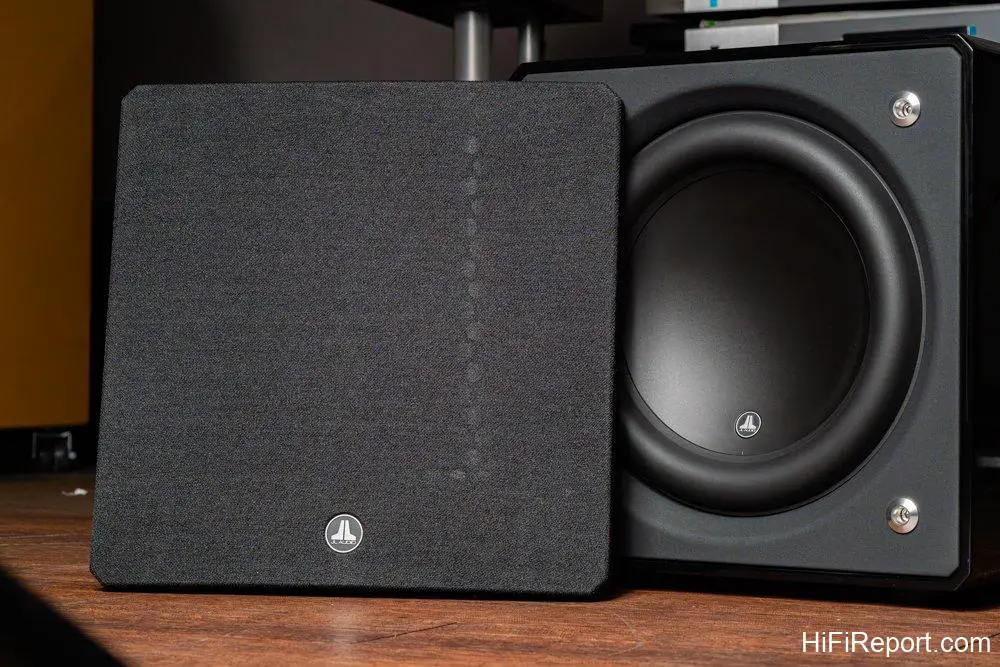
2.1 Channel: The Value Shortcut to Full-Range
Why do I describe listening to the E-Sub e112 as “astonishing”? Traditionally, achieving a “full-range” audio system required large speakers. This is because reproducing deep bass frequencies requires sufficiently large drivers and cabinets to extend down to 20 Hz while maintaining adequate sound pressure and quantity. This is a physical limitation of acoustics. Consequently, the investment in main speakers would be substantial. The 2.1 channel approach, using bookshelf speakers or smaller floorstanders paired with a subwoofer, offers a relatively cost-effective shortcut to approximating full-range sound.
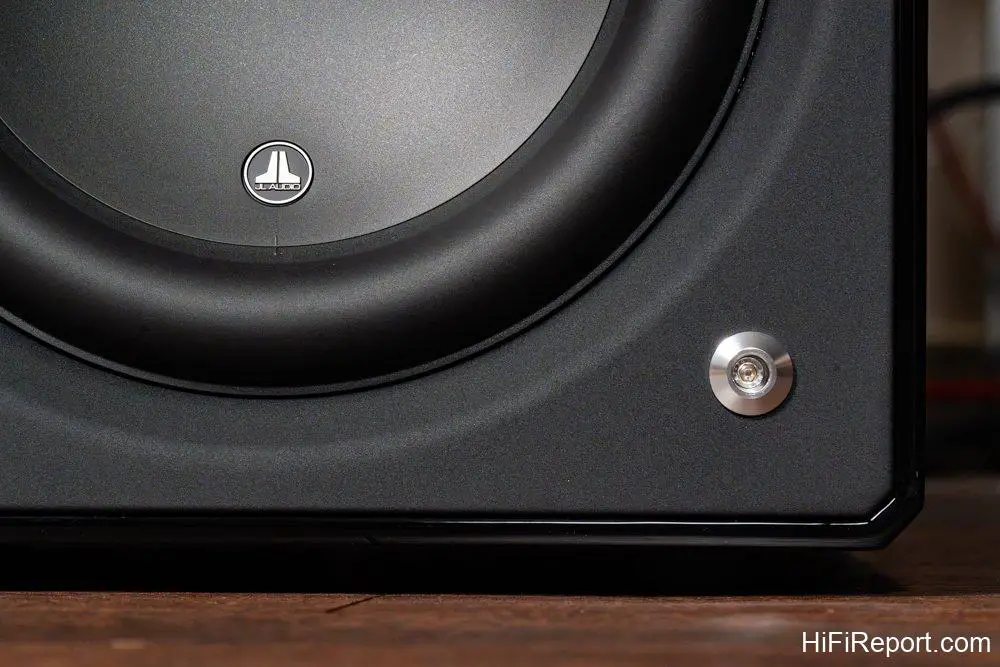
However, implementing a 2.1 channel system introduces another challenge: how to manage the crossover and low-frequency integration.
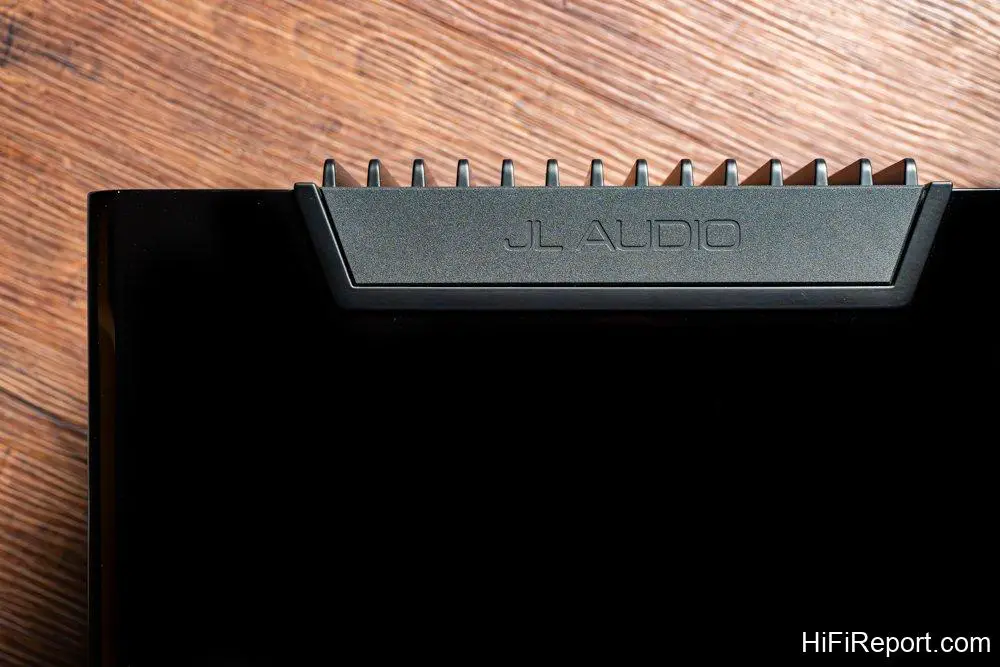
Compared to 2.1, multi-channel systems are simpler to set up in this regard. In a 5.1 system (or any other format ending in .1), the subwoofer receives an independent signal, which can be sent directly to the sub. A two-channel system, however, only has left and right channel signals; there’s no independent .1 subwoofer signal. Therefore, achieving a “seamless transition” between the subwoofer and the main speakers presents a significant challenge.
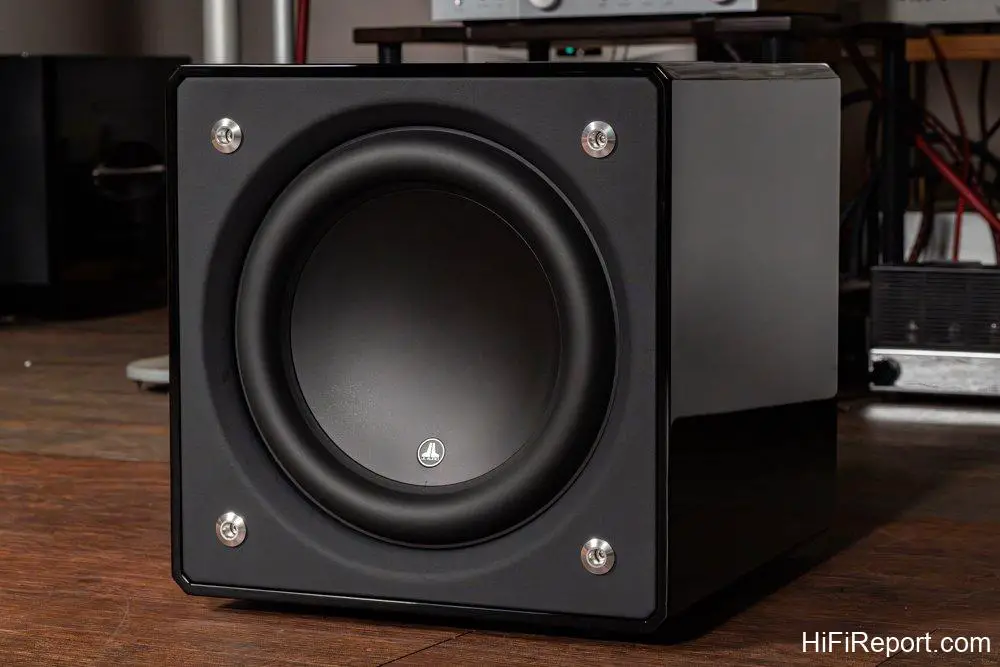
Two Secrets to Seamless 2-Channel Subwoofer Integration
During this review of the E-Sub e112, I discovered that it’s not only suitable for multi-channel use but also offers two key features that elegantly solve the integration challenges inherent in 2.1 channel setups. It’s easy to pair, enjoyable to use, and simple to adjust – this is where JL Audio truly impressed me.
Let’s highlight the E-Sub e112’s primary strength for 2.1 systems: its ability to facilitate seamless integration, making it a compelling option for two-channel enthusiasts. I’ll delve into how the e112 achieves this effortless integration during my practical setup and listening tests later in the review.
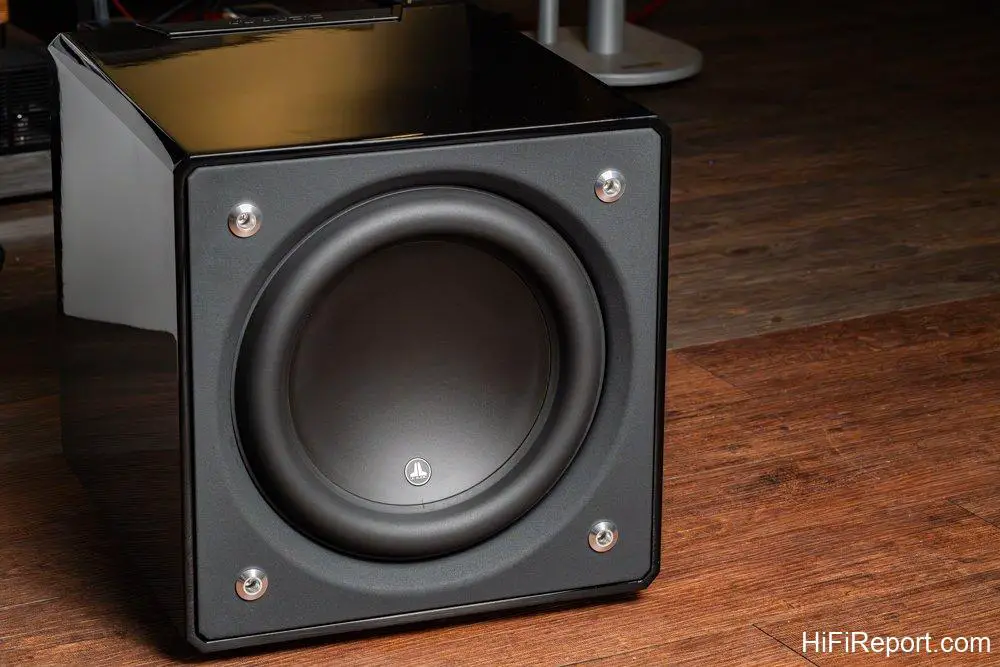
JL Audio: Packed with High-Value Technology
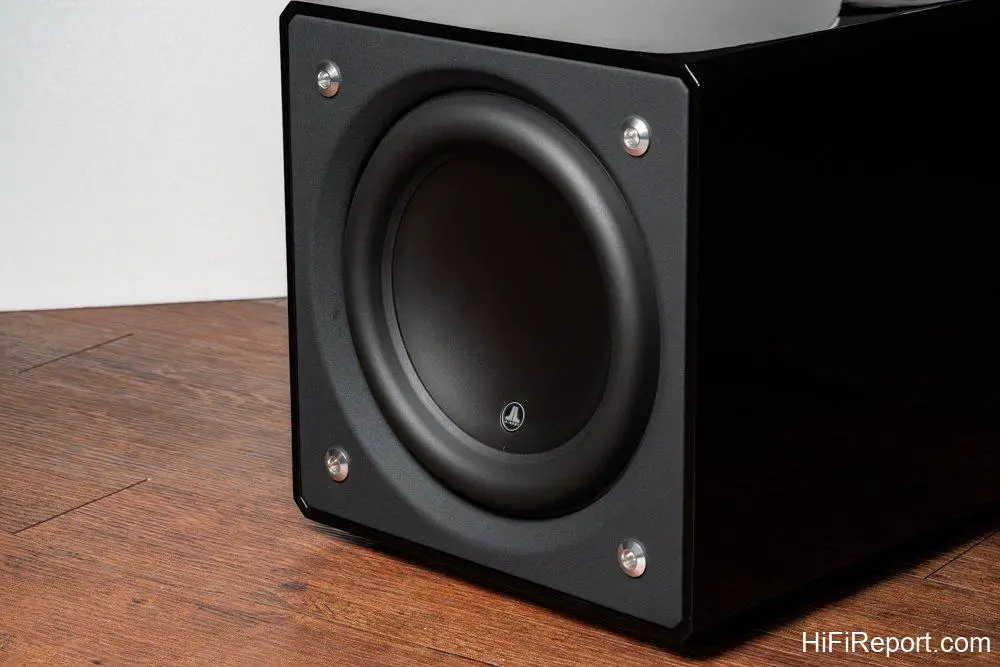
Before diving into the practical setup, I want to discuss the design of the E-Sub e112. JL Audio’s official technical documentation is quite substantial. The e112, for instance, incorporates five significant proprietary technologies: DMA Optimized Motor Design, True Two-Way Crossover, Vented Reinforced Collar (VRC), Floating Cone Attached Method (FCAM), and Engineered Lead-Wire System. Each of these is based on solid acoustic principles, indicating a subwoofer packed with substantial technological value.
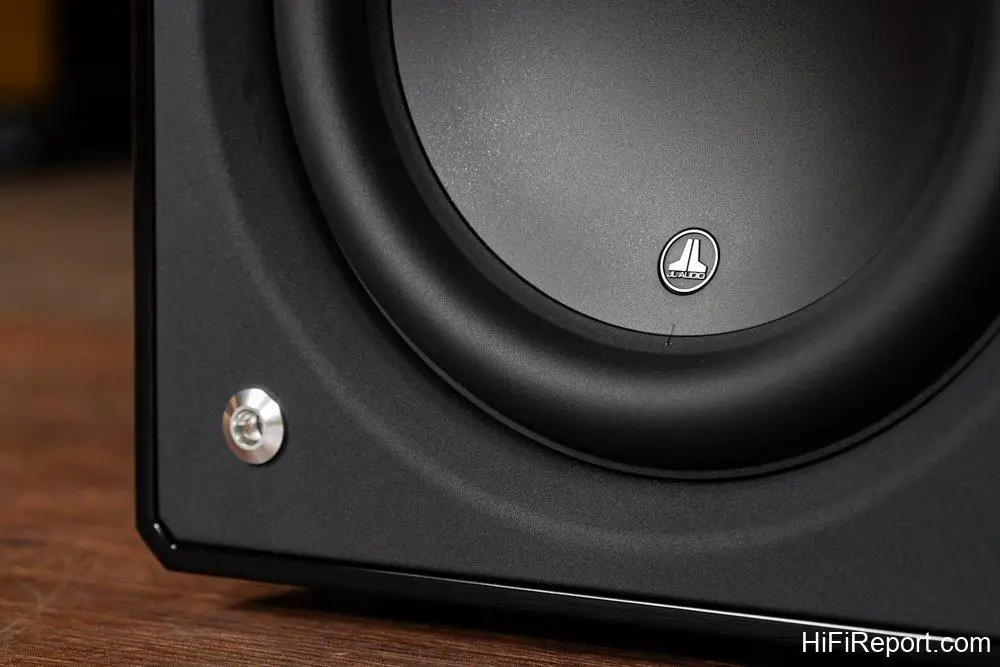
I’ll explain each feature individually below. If technical details don’t particularly interest you, feel free to skip the next few sections.
DMA: Dynamic Motor Analysis
The first unique technology in the E-Sub e112 is the DMA Optimized Motor Design. DMA stands for Dynamic Motor Analysis.
JL Audio began developing DMA in 1997, using Finite Element Analysis (FEA) for dynamic modeling to study the behavior of a subwoofer driver’s magnetic motor during dynamic operation. This contrasts with traditional Thiele-Small parameters or low-power measurements, which typically assume the magnetic motor provides a fixed field that doesn’t change with the driver’s mechanical movement. These are static measurements. DMA, however, uses dynamic measurement and modeling to understand the impact of the voice coil, suspension, and cone movement on the magnetic motor’s performance. This allows them to identify problems and address them directly.
What problems does DMA identify? Simply put, it reveals how the mechanical movement of the driver causes non-linearity in the magnetic motor’s operation. Through dynamic modeling, JL Audio found that variations in power, current, excursion, and other factors while driving the unit lead to non-linear changes in the magnetic field. Based on this dynamic modeling, JL Audio can design subwoofer drivers with the most linear operation possible, thereby reducing distortion.
Two-Way 4th Order Crossover for Frequency Integration
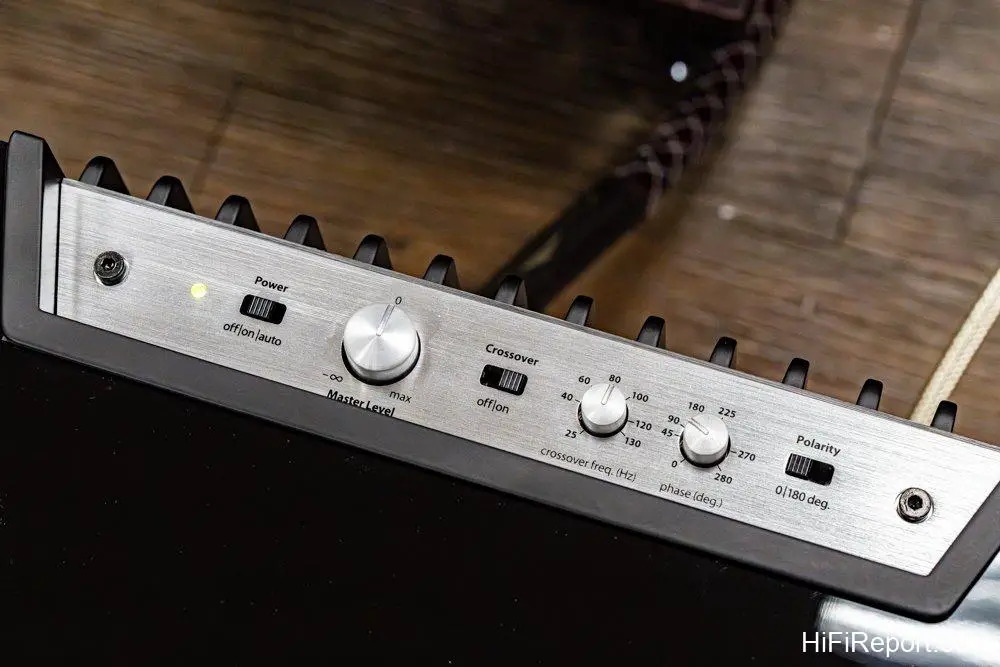
The second unique technology in the E-Sub e112 is the True Two-Way Crossover. This is specifically designed for integrating the subwoofer with two-channel systems to ensure excellent frequency coherence between the sub and the main speakers.
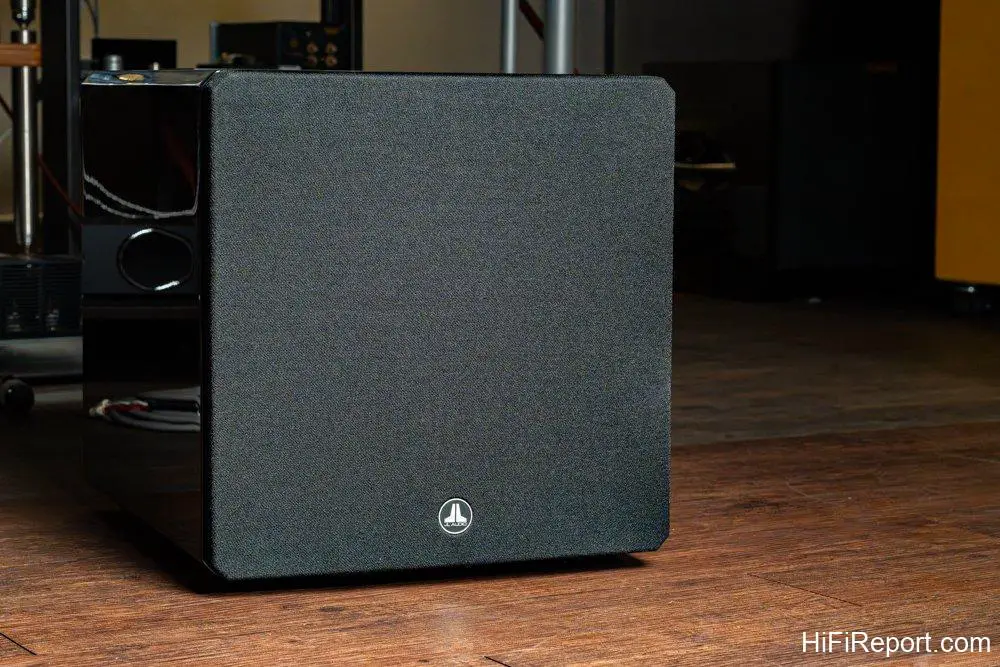
Two-channel systems output full-range signals, unlike 5.1 multi-channel systems where the .1 channel carries only the subwoofer signal. Therefore, when using the E-Sub e112 with a multi-channel system, the Crossover switch should be set to “off.” However, when pairing it with a 2.1 channel system, activating the Crossover is recommended.
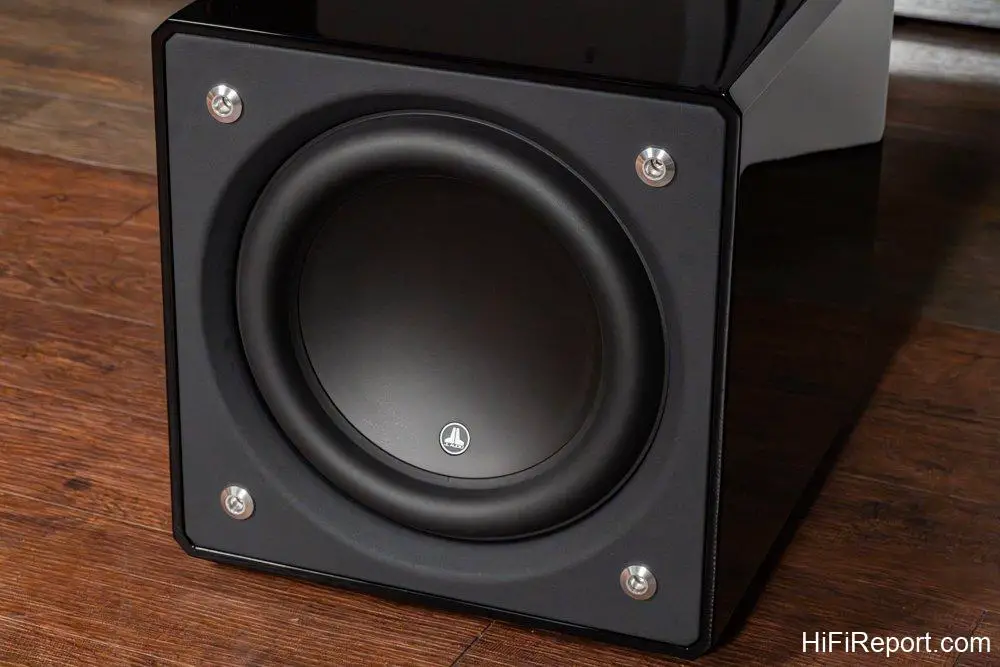
What does activating the two-way crossover do? When a two-channel line-level signal is fed into the E-Sub e112 with the Crossover engaged, the signal is processed by a 24 dB/octave (4th order) Linkwitz-Riley low-pass filter, ensuring the subwoofer operates only in the low-frequency range. Simultaneously, the Line-Out signal is subjected to a 24 dB/octave high-pass filter before being sent to the power amplifier driving the main speakers. This prevents the main speakers and the subwoofer from operating simultaneously in the low-frequency band, allowing the E-Sub e112’s 4th order crossover to effectively divide the workload between them.
VRC Enhances Cooling for Enduring Performance
The third technology is the VRC, or Vented Reinforced Collar. Due to their large size and relatively high mass, subwoofer drivers require significant power to operate. The voice coil generates considerable heat during intense use, making effective cooling crucial. The E-Sub e112 incorporates the VRC within the driver assembly, positioned where the cone, metal frame, and voice coil former meet. The vents on the VRC improve airflow, enhancing heat dissipation and preventing the subwoofer from “softening” or losing performance under heavy loads.
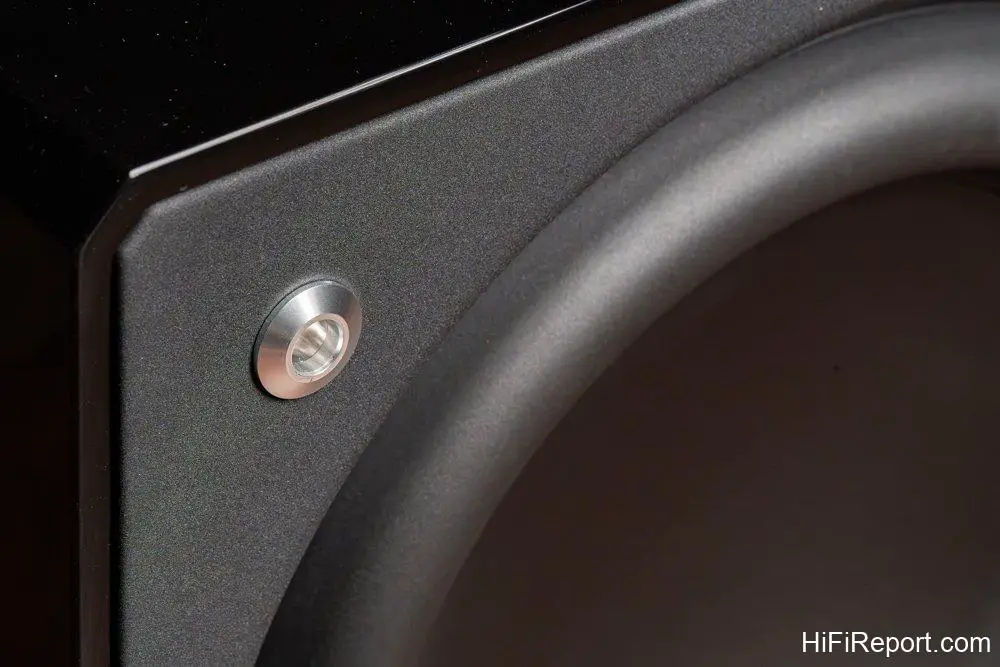
The fourth proprietary technology used in the E-Sub e112 is the FCAM, or Floating Cone Attached Method. This describes JL Audio’s unique driver assembly process. They use special tooling to precisely align the surround, cone, voice coil former, and spider at the center. When joining these components, they avoid high-pressure bonding. While this might introduce slight physical tolerances at the bonding points, FCAM ensures that the driver’s mechanical center remains perfectly aligned, crucial for linear movement.
Proprietary Lead-Wire Design
The fifth technology applied in the E-Sub e112 is JL Audio’s patented Engineered Lead-Wire System. Subwoofers, particularly those designed for long excursion to move sufficient air and reproduce extreme low frequencies, require voice coil lead wires of significant length to accommodate the large piston-like motion.
Generally, there are two main lead-wire designs. One involves making the wire long and tucking it into a groove behind the spider. This prevents the wire from interfering with the voice coil’s piston motion. However, bonding the wire to the spider can restrict the spider’s freedom of movement, which is a drawback. The other design is the “flying” lead wire, where the wire is made long enough to move freely in the space between the cone and the spider. The risk here is that during extreme excursions, the wire might contact the cone, creating mechanical noise, or it could break due to tension.
Simply put, both designs have their trade-offs.
However, JL Audio’s patented lead wire uses braided wire covered with a sheath. This dual-approach engineering gives the wire greater compliance for larger excursions without contacting the cone and causing mechanical distortion. The protective sheath also eliminates the risk of short circuits.
JL Audio’s patented lead-wire design appears to be an evolution of the flying lead wire concept. It maintains the wire’s freedom of movement but uses braided construction and a protective sheath to prevent mechanical distortion from contact with the cone and increase the driver’s reliability.
Unusually Assembled in Florida, USA
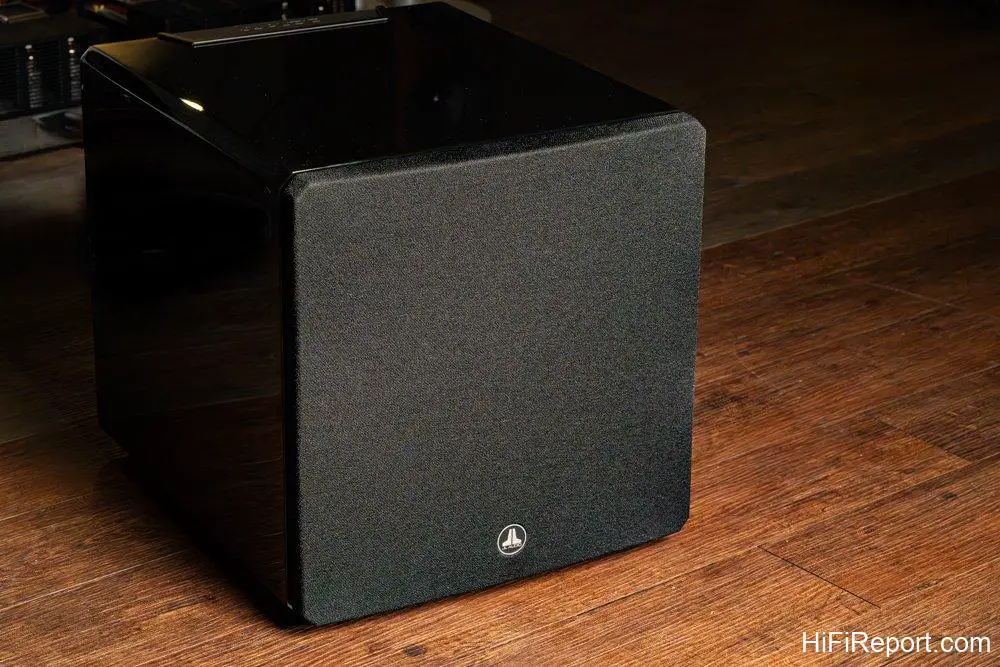
Finally, another noteworthy feature of the E-Sub e112 is that the manufacturer emphasizes its assembly at their Mirama factory in Florida, USA. For audiophiles who appreciate origin, US assembly is certainly one of JL Audio’s selling points.

So, those are the five unique subwoofer technologies in the E-Sub e112, focusing on reducing distortion, improving linearity, and enhancing subwoofer frequency integration. Now, let’s move on to the practical setup and listening!
Play with 1, 2, 3, 4, or 5 Subwoofers
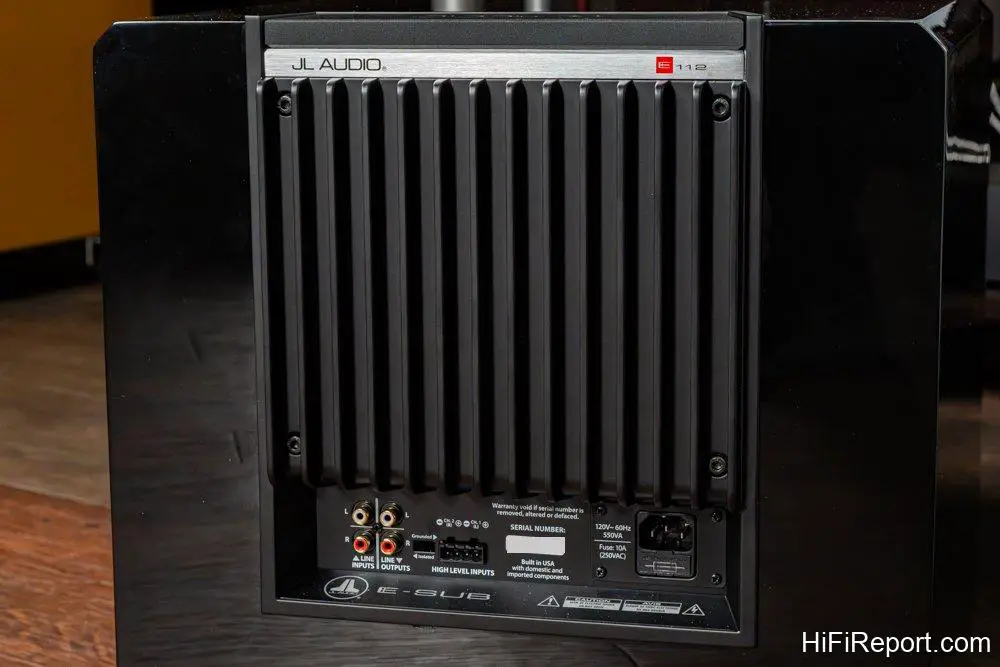
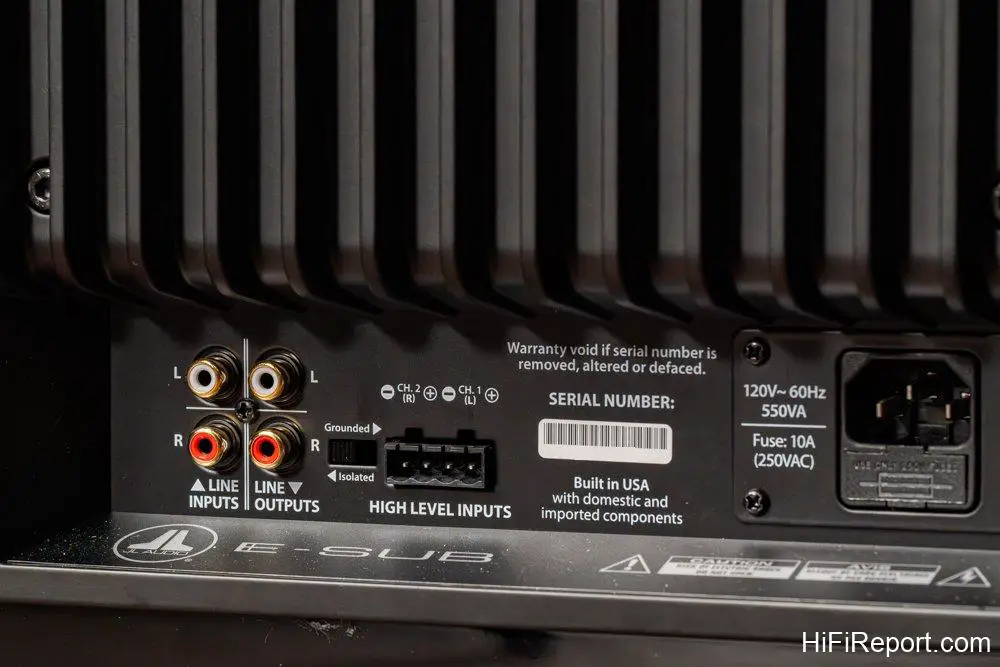
The E-Sub e112 offers both RCA Line-in and high-level speaker wire inputs. The package includes terminals for connecting speaker wires, though they require bare wire connections. I didn’t have suitable cables on hand, so I used the Line-in connection.

Here’s where the E-Sub e112 gets interesting! The Line-in is stereo. If you only have one E-Sub e112, you’d naturally connect it from your pre-out. But what if you want to chain two E-Sub e112s? Simple. You can either send signals from your pre-out to both the left and right channel inputs of two subwoofers respectively, or you can daisy-chain them using the Line-Out. Send the signal to the first subwoofer (left or right channel input), and then use its Line-Out to connect to the second subwoofer (right or left channel input, or even its own left/right input for stereo bass). This method allows you to connect not just two E-Sub e112s, but three, four, even five, simply by continuing the chain. JL Audio’s design is quite clever – it certainly encourages selling more subwoofers!
JL Audio Crossover is Essential for 2-Channel
Next is the crucial setup point for the E-Sub e112. Since I was listening to a two-channel 2.1 system, the Crossover is extremely important – it must be used! My first system pairing was a Cambridge Audio EXA100 integrated amplifier driving KEF Q Concerto Meta bookshelf speakers. I sent the signal from the EXA-100’s Pre-Out to the E-Sub e112. I set the subwoofer volume to “0” (the central position), the crossover point to 80 Hz, the phase to the manufacturer’s recommended value of 80, and the polarity to positive. I started by listening to AC/DC’s “Back In Black.”
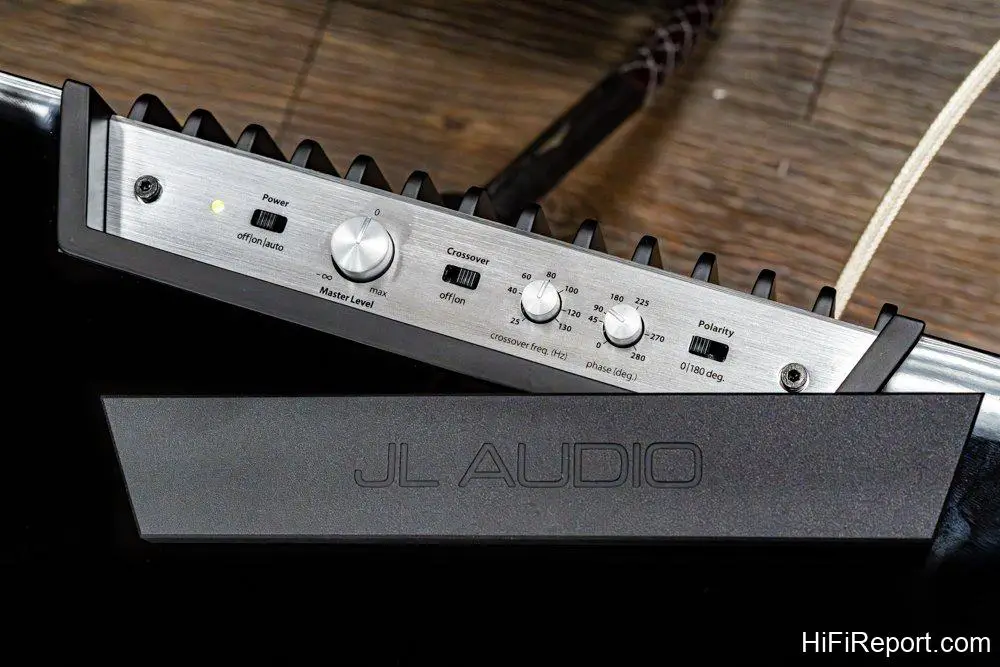
The opening muted power chords on electric guitar aren’t the focus. It’s the subsequent electric bass and drum rhythm that really benefits from the added low-end punch with the E-Sub e112. With the basic initial setup, the E-Sub e112’s built-in 4th order crossover integrated cleanly, and the Q Concerto Meta paired reasonably well with the E-Sub e112. So, I left the first three settings (volume, crossover, phase) as they were and focused on testing the Polarity setting.
The Correct Polarity Setting Offers Fuller Bass
While repeatedly listening to the intro of “Back In Black,” I switched the Polarity between 0 and 180 degrees. Which setting is correct? It depends on your listening room and the subwoofer’s placement – you have to trust your ears.
How do you listen for it? For “Back In Black,” I focused on the kick drum as the intro builds. The Polarity setting that results in a fuller, more impactful, and tighter kick drum is the correct one. After trying it back and forth five or six times, I decided on the 180-degree setting.
Movie Soundtracks Make the E-Sub e112 Driver Dance
Listening to the E-Sub e112 with rock music only made the 12-inch driver move slightly. If you want to see the E-Sub e112’s driver really jump, you need movie soundtracks.
Titles like “Dune” or “The Dark Knight” are perfect for this. I usually don’t push subwoofers this hard, but the photographer wanted a video showing the E-Sub e112’s driver in action, so I obliged. Even with a deliberately unbalanced adjustment “for video effect,” the E-Sub e112 maintained fast low-frequency response. Watching the driver move dramatically and produce booming movie sound effects, the E-Sub e112 proved itself truly powerful.
If the E-Sub e112 were a high-end JL Audio subwoofer, I might not be as impressed by its controlled performance. However, the E-Sub e112 is actually positioned as an entry-level/mid-range model. In the approximately $3,300 USD price range, its performance is outstanding – truly exceptional value for money.
Flexible Connection Methods with Pre/Power Amps
The EAX100 and Q Concerto Meta pairing with the E-Sub e112 was a good match. However, I then brought out the EAR 868P preamplifier and 509 MK II power amplifier to explore different connection methods with the E-Sub e112.
A key design feature of the E-Sub e112 is its internal 4th order crossover, making it very convenient for 2.1 setups. When pairing with the 868P and 509 MK II, you have options. You could use the 868P’s two sets of preamp outputs: one set feeding the 509 MK II and the other feeding the E-Sub e112. This allows the preamp’s volume control to simultaneously control both the main speakers and the subwoofer. Alternatively, you could connect the 868P preamp to the E-Sub e112’s Line-in, and then use the E-Sub e112’s Line-out to feed the 509 MK II power amplifier.
Both connection methods utilize the E-Sub e112’s internal 4th order Linkwitz-Riley crossover. What’s the difference? When connecting from the 868P’s two pre-outs, both the E-Sub e112 and the 509 MK II receive the same full-range audio signal. However, when connecting from the E-Sub e112’s Line-out, the analog audio signal received by the 509 MK II has already passed through the E-Sub’s high-pass filter, removing the low-frequency content. Thus, although both methods use the E-Sub e112’s crossover, the signal path delivers different audio signals.
Subtle Differences in Sound from Different Signal Paths
Which connection method is better? Naturally, you have to try both to find out. I started by using the 868P preamp to send two sets of signals, one to the 509 MK II and one to the E-Sub e112. Using the parameters I found effective with the EXA100 and Q Concerto Meta, I listened to “Back To Black” again. Although I hadn’t changed the E-Sub e112’s volume, the pairing with the 868P resulted in too much bass output from the E-Sub. I adjusted the volume and crossover point downwards to balance the output between the main speakers and the subwoofer. Then, I switched the connection, feeding the 509 MK II from the E-Sub e112’s Line-out.
Where was the difference between the two connection methods? The subwoofer’s volume is adjustable, so the overall bass quantity isn’t the issue. However, the frequency integration between the Q Concerto Meta and the E-Sub e112 felt cleaner and faster when connecting via the E-Sub e112’s Line-out. Using the 868P to output two sets of signals to the E-Sub e112 and 509 MK II resulted in better weight and slightly different tonality. Personally, I preferred the method using two analog outputs from the 868P, but the difference wasn’t about right or wrong, but rather a matter of listening preference. I recommend trying both before deciding.
Adding “That Little Bit Extra” Even with Large Floorstanders
Finally, it was time for the Wilson Audio Alexia V to make an appearance. I used the 868P to output two sets of signals to the 509 MK II and the E-Sub e112. With the Alexia V, I lowered the crossover point further, down to around 50 Hz. Why am I imprecise about the value? Because the dial marks were between 45 Hz and 60 Hz, making it hard to say exactly whether it was 50 Hz or 55 Hz. The goal was simply to find a setting that sounded natural, where the main speakers and subwoofer didn’t overlap too much, adding a little extra weight to the low end and creating a more expansive soundstage. That’s generally the sweet spot for adjustment.
When listening to a 2.1 channel system, you know you’ve adjusted it properly when you “can’t locate the subwoofer.” If you’re adjusting the subwoofer and constantly hear the bass instruments, like the electric bass, coming from the vicinity of the subwoofer, your adjustment isn’t quite right yet. But if you can adjust the E-Sub e112’s volume, crossover point, phase angle, and absolute phase to the sweet spot, you shouldn’t hear the subwoofer’s location. Instead, it should simply add “that little bit extra,” enriching the overall sound. That’s when you know you’ve got it right!
A Little Extra Bass Enhances Listening Immersion
Switching to the Alexia V, while still a 2.1 system, the scale was significantly larger than with bookshelf speakers. Although the Alexia V is certainly capable of reproducing full-range sound on its own, adding the E-Sub e112 to reinforce the very lowest frequencies didn’t just add a bit of thickness (though it did that too). What the subwoofer added was a more open and transparent sense of space. It was that tiny bit of extra air that significantly enhanced the immersion of the music.
Listening to rock music earlier was “a piece of cake.” With the Alexia V paired with the E-Sub e112, I brought out Mahler. I listened to Bernstein conducting the Vienna Philharmonic’s “Mahler’s Fifth Symphony.” In the first movement’s funeral march, the brass emerges from the depths of the soundstage. With the E-Sub e112, the depth of the soundstage was beautiful. The trumpet’s four-note motif urged the music forward, building upwards. Even when the trumpet played, frequencies typically not associated with subwoofers, if I touched the E-Sub e112’s cone, I could feel a subtle vibration. That was the faint low-frequency ambiance hidden within the recording, expanding the Alexia V’s already transparent and deep soundstage! As the funeral march progressed, the strings played their ethereal melody. The music itself had relatively little extreme low frequency content, and the E-Sub e112 appeared motionless, or perhaps only moving lazily with the plucking of the double basses. But when I approached the E-Sub e112 out of curiosity, touching the cone while listening, its movement hadn’t stopped at all. It was continuously working, not just responding to the double bass plucks, but reproducing all the low frequencies in the recording, making the orchestral atmosphere even more complete.
Having cycled through the EXA100, Q Concerto Meta, 868P, 509 MK II, and Alexia V pairings with the E-Sub e112, was I done exploring? Not quite, but time ran out for more extensive testing. With its Line-in/Line-out connections, the E-Sub e112 is actually very suitable for a 2.2 setup (two subs). And you can achieve this either by using two preamp outputs to feed two E-Sub e112s, or by feeding one signal to the first E-Sub e112 and then daisy-chaining its Line-Out to the second E-Sub e112. This opens the door not just to dual subwoofers, but potentially 3, 4, or even 5 E-Sub e112s in a truly wild configuration.
Practical Adjustment Was Effortlessly Seamless
Technologically, the E-Sub e112 boasts five major proprietary features, representing significant technical value. However, in practical use, I found its greatest strength to be its “ease of adjustment.” Regardless of the system I paired it with, I only needed to make minor tweaks to the crossover point and phase angle, and finally set the Polarity switch. Each time I switched speakers, I could get it adjusted properly within three to five minutes. Moreover, the subwoofer’s operation was highly linear, and its volume seamlessly integrated with the main speakers.
What did I miss during this review of the E-Sub e112? A 2.2 system with two E-Sub e112s, creating a four-piece speaker setup. Systems using four-piece speakers can often cost hundreds of thousands of dollars (USD). At its price point, around $3,300 USD, playing with four pieces using the E-Sub e112 could be less than half the cost of typical high-end four-piece systems. Perhaps next time I can borrow a pair of E-Sub e112s to experiment with a smaller four-piece setup and share my impressions.
Specifications
* **JL Audio E-Sub e112**
* **Type:** Sealed Subwoofer
* **Frequency Response:** 22–118 Hz (+/- 1.5 dB) / 21 Hz (-3 dB) / 17 Hz (-10 dB)
* **Built-in Power:** 1,500 Watts
* **Input Terminals:** RCA x 2 (Stereo or Mono), High-Level Speaker Terminals
* **Output Terminals:** RCA x 2 (Stereo or Mono)
* **Volume Control:** Mute to +15 dB
* **Filter Mode:** Low-Pass Filter
* **Low-Pass Roll-Off Slope:** 24 dB/Octave Linkwitz-Riley
* **Crossover Frequency Range:** 25 Hz to 130 Hz
* **Phase:** Adjustable from 0 to 280 degrees (Reference point 80 Hz)
* **Dimensions (W x H x D):** 394 x 412 x 467 mm
* **Weight:** 33.3 kg