
KECES P3 Linear Power Supply Review
For audiophiles and headphone enthusiasts, especially of the younger generation, KECES is undoubtedly a familiar name.
Founded by the legendary “Guru” Chang Kuo-ping, KECES started with DIY kits and later expanded to finished products for the convenience of consumers who were less adept at hands-on assembly.
The Guru frequently engaged with users on online forums, gathering feedback. It wouldn’t be long before these suggestions were incorporated into KECES products, either as new offerings or updated versions.
In the hearts of its users, KECES represented Hi-End sound for the budget-conscious. Whether it was their DACs, headphone amplifiers, isolation transformers, or linear power supplies, KECES consistently delivered a high-quality audio and build quality, and simple designs. For those with some electronic knowledge, there was also the allure of DIY modifications, with numerous modification experiences shared online.
KECES fulfilled the audiophile dreams of many young students and recent graduates.
Later, for various reasons, Chang Kuo-ping considered stepping away. Hui Kang Electronics, a long-time supplier of transformer components and a close partner, extended a helping hand. They allowed the Guru to remain as KECES’ spiritual leader and R&D consultant, while Hui Kang Electronics, with its capital, took over the operational reins.
It’s been about a decade since Hui Kang became involved.
Over the past decade, KECES has remained vibrant and has expanded its reach overseas. Today, KECES boasts a significant international user base.
They even exhibit at the Munich High End Show, releasing their latest products at the event, just like top-tier international audio brands.
This ambitious approach is rare among local brands, and it exemplifies the KECES of today.
KECES’ power-related products have always been highly regarded, including their affectionately nicknamed “isolation transformers” and “linear power supplies,” which have been their specialties for years.
A few months ago, Lin Chih-yu wrote several KECES reviews, including those of the BP-2400/BP-600 balanced isolation transformers and the P8 linear power supply.
During last year’s interview with KECES’ current CEO, Liao Kang-yu, Liao foreshadowed the 2018 release of a simplified version of the P8. At the time, their plan was for a 4-amp output model, tentatively named P4.
Ultimately, they finalized the product as the P3, with a 3-amp current output, making it the star of this review.
A Simplified Version of the P8: Smaller and More Affordable
In essence, the P3 is almost identical to the P8 that Lin Chih-yu reviewed, except for its lower current output and different applicable voltage range.

Due to the different output configurations, the chassis is slightly smaller, and the digital display has been omitted.
These cost savings naturally allow for a lower price.
The P8 retails for NTD$16,000 (approximately USD$516), already a reasonable price for its features and design. The P3’s price is even more attractive, dropping to NTD$9,000 (approximately USD$290), a point where one might impulsively click “buy.”
However, the P8 and P3 target different user needs and shouldn’t be judged solely on price.
The P8 was originally designed with the Mac Mini in mind.
KECES discovered that many digital streaming enthusiasts chose the Mac Mini as their digital transport. The Mac Mini requires 7 amps of current, and a linear power supply with ample power delivery can further enhance its performance as a digital transport.
Thus, the P8 was born.
However, considering the needs of other devices with similar small power requirements, KECES later introduced single-output and dual-output versions. The former can output 8 amps, while the latter can output 4 amps per channel.
Furthermore, KECES designed rocker switches to select the output voltage, meaning each output group offers two voltage options.
The single-output model offers two voltage combination options, while the dual-output model has four, allowing users to purchase according to their needs.
Two Outputs, Up to Six Voltage Options
The P3, on the other hand, is intended for devices with lower power consumption, hence the reduced output current to 3 amps.
In reality, this is more than sufficient.
Many devices that use switching power adapters, such as routers, network switches, TV set-top boxes, digital-to-analog converters, and streaming players, come with adapters providing only 1 to 1.5 amps of output. Therefore, the P3 is more than adequate for them.
Like the P8, the P3 offers different voltage outputs. The factory settings include two versions: one with 5V/7V/9V + 12V/15V/16V outputs, and another with 12V/15V/16V + 12V/15V/16V outputs.

While the P8 had only two output options per channel, the P3 boasts three per channel, providing greater adaptability.
The choice depends on the power specifications of your devices.
Before use, ensure you set the correct output voltage *before* connecting the power cord to your device.
Connecting the cable first and then adjusting the voltage might damage your equipment, so please be cautious.
Utilizing KECES’ Signature Power Processing Technology
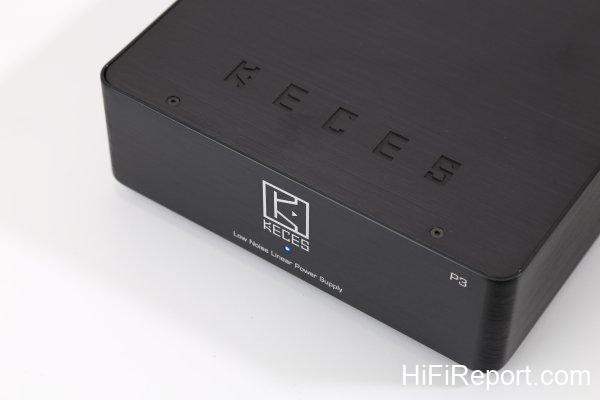
The P3’s chassis, like other KECES components, is made of 3mm thick aluminum alloy, providing shielding against EMI/RFI interference.
The all-black chassis features a brushed finish. However, perhaps due to its lower price point, the P3’s front panel lacks the etched logo found on the P8, opting instead for a white printed logo. Thankfully, the top cover still retains the KECES engraved logo, maintaining a consistent aesthetic with other current products.
Inside, it houses a custom-wound toroidal transformer. This delivers ultra-low ripple and is claimed to be 100% silent, free from any annoying vibrations or hum, providing a stable and clean power supply.
In actual use, even with continuous operation and power delivery, there was absolutely no noise.
Each output is equipped with independent grounding, which helps to eliminate noise and prevent mutual interference.
Additionally, the P3 incorporates temperature protection to prevent overheating and damage.
After a week of continuous operation and constant power delivery, the chassis felt only slightly warm, similar to the touch of a DAC chassis.
This demonstrates that even though the P3’s operation generates some heat, its chassis effectively dissipates it.
The unit I received has dual outputs, both 12V/15V/16V, which can power three of my devices: an iFi micro iPhono2 phono stage, an Auralic Aries Mini digital streaming transport, and a Netgear X4S Nighthawk R7800 wireless router.
Conveniently, these three devices represent analog, digital, and networking equipment, covering the main types of audio components.

Round One: Analog – The Phono Stage
First up is the iFi iPhono2 phono stage. This phono stage looks simple, but it’s anything but.
Within its price range, it boasts exceptionally rare capacitance and impedance adjustments, along with multiple RIAA EQ curve options. It even offers four gain settings to accommodate standard MM cartridges, high-output MC cartridges, standard MC cartridges, and ultra-low output MC cartridges.
Finding all these features in a phono stage under USD$1,600 is nearly impossible, but the iFi iPhono2 has them all.
Moreover, it’s packed with high-quality components, including audio-grade Japan TDK C0G capacitors and numerous Vishay MELF thin-film resistors. It also incorporates the circuit essence of its parent company AMR’s high-end PH-77 phono stage, achieving a signal-to-noise ratio of 85dB.
iFi is also generous enough to include their own iPower power supply. This adapter already provides a slightly higher current output; the iPhono2 requires 15V/1A, while the iPower delivers 15V/1.2A.
However, switching the power to the KECES P3 brought a noticeable difference.
The most obvious change was the expansion of the soundstage. No, everything was amplified.
Vocals became more resonant, the piano sounded more powerful, and the strings were more substantial.
Listening to Radu Lupu’s piano performance and André Previn conducting the London Symphony Orchestra in Schumann’s Piano Concerto, the entire stage expanded after switching to the P3. The piano notes became fuller and more distinct, the woodwinds appeared more three-dimensional and defined, and the low strings gained a more majestic thickness.
The expanded stage encompassed not only width but also height and depth.
The music became more imposing.
The benefits were also apparent with chamber music. Take the 2014 Kaohsiung Audio Show commemorative vinyl as an example. The first track is Richard Strauss’ Violin Sonata, second movement, featuring a romantic and deeply emotional dialogue between the violin and piano.
Since switching my cartridge to the Audio Technica AT-OC9 III, while the resolution and transparency had greatly improved compared to my previous Grado the Prestige Gold 1, revealing more detail and texture in the music, I sometimes missed the warm tonality and powerful rhythm of the Grado cartridge, especially when playing jazz and rock.
With the help of the P3, I rediscovered that full-bodied texture.
I always felt that the AT-OC9 III excelled in detail but lacked emotion; it was analytical but leaned towards intellectual.
With the iPhono2 connected to the P3, the music gained warmth. The roundness of the violin emerged, going beyond mere delicacy and softness, and the piano’s sustain lengthened with improved weight.
I had previously tried adding more tracking force or using different platter mats for adjustments, but now, with the P3, I didn’t need to do anything.
Power is power. With power, there is strength.
Round Two: Digital – The Digital Streaming Transport
The second round featured the Auralic Aries Mini digital streaming transport. Lin Chih-yu also owns one. After listening to Auralic’s equipment, we decided to order an Aries Mini.
Although it also has analog outputs, testing revealed that an external DAC yielded better results, so we used it solely as a digital streaming transport.
The adapter provided by Auralic is a very ordinary power supply with an output specification of 15V/1A.
Connecting it to the P3 changed everything.
The change in listening sensation was somewhat similar to the iPhono2, but even more pronounced. I suspect this is because the iPower supplied with the iPhono2 is of higher quality.
Where was the improvement? To put it simply, the P3 fully powered the Aries Mini.
When a person gets a full 8 hours of sleep, wakes up, does some exercise, gets ready, and eats breakfast, they are at their most energetic.
After half a day of work, even if they try to stay alert, there’s still a difference compared to the energetic morning state.
The Aries Mini connected to the P3 is like that energetic morning feeling, full of vitality. Switching back to the ordinary power adapter felt sluggish.
Take Diana Krall’s “Temptation” (FLAC, 24bit/96KHz) as an example. The difference in the power and fullness of the bass plucking was noticeable. With the P3, it was more decisive and assertive, with more prominent power. In contrast, without the P3, it sounded weaker.
The same applied to the vocals. With the P3, Diana Krall’s voice was noticeably thicker and fuller, with a more pronounced dynamic contrast and more obvious vocal details.
And, similarly, the soundstage opened up, with a greater sense of layering.
Round Three: Networking – The Wireless Router
The third round involved a networking product.
Lin Chih-yu previously told me that connecting a network switch to the P3 significantly improved the sound in his system. According to his review, “As soon as it started playing, there was another clear improvement, and the airiness also emerged… The sound became denser due to the increased detail, and the overall listening experience was more natural, more alive, more real.” I was puzzled by this, as it was just a networking device. Why would it have an impact? I asked him privately, and he further told me that, based on his experience with the P8, the most significant improvement among the DAC, Aries Mini, and switch was with the switch.
I don’t have a switch to use, so I connected it to my Netgear R7800 wireless router, which requires 12V/1A.
After repeated testing, I didn’t hear the same significant changes on the router as I did with the phono stage and digital transport.
Perhaps because Lin Chih-yu’s CAS and NAS, used for music playback, are connected to the switch, the effect was so pronounced.
I’ve presented both of our experiences for the reader’s reference.
At the very least, I can confirm that it has a noticeable effect on audio equipment.
Bonus Round: Cable Swapping, Further Improvements
I don’t have any video equipment with compatible voltage requirements, otherwise, the P3 could also be used with a TV set-top box, impacting not only the sound but also the image.
Furthermore, I discovered that changing the P3’s power cord also had an effect.
I initially used the included stock power cord but only felt the sound become more powerful, lacking a certain refinement.
On a whim, I switched to the DeCheng PS-800A power cord, an improved version of the classic P-800. It incorporates silver-plated wires into the oxygen-free copper conductor, with a substantial 12AWG gauge, suitable even for use with amplifiers.
After switching to the PS-800A, the sound gained a better luster. The music, which was previously somewhat dull, now had a brighter quality, making it more lively.
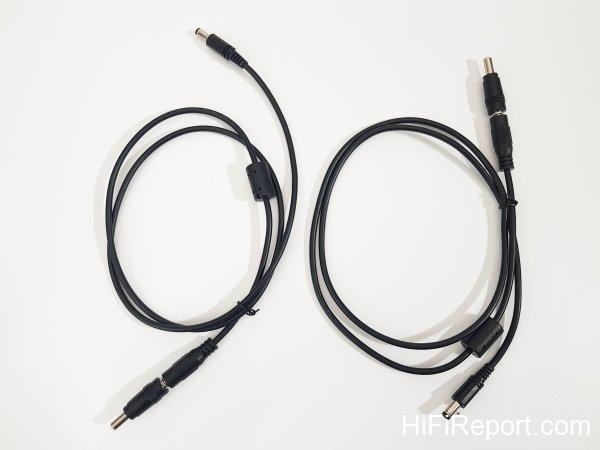
If possible, changing the DC power cord connecting the P3 to the equipment would also, I believe, be interesting.
Worthy of Being Your First KECES
Whether or not you’ve used KECES products before, the P3 is well worth trying.
Perhaps your budget allows for the purchase of higher-end audio equipment, but it’s rare to find audio manufacturers making universal linear power supplies.
Both the P8 and P3 can give you a boost. Those seemingly non-upgradable small devices? KECES offers a chance to experience them in a new light.
Specifications
* **Model:** KECES P3
* **Type:** Linear Power Supply
* **Input Voltage:** 110V-120V/60Hz, 220V-240V/50Hz (switchable)
* **Power Consumption:** 120 Watts (full output)
* **Output Voltage Options:**
* (1) 5V/7V/9V + 12V/15V/16V
* (2) 12V/15V/16V + 12V/15V/16V
* **Dimensions:** 220 x 66 x 220 mm (W x H x D)
* **Weight:** 3.5 kg