
Kharma Exquisite Classique Review
After listening to the Kharma Exquisite Classique in the listening room at Wen Hong Audio, my perception of Kharma speakers has fundamentally shifted, giving me a new appreciation for the meticulous effort invested by Kharma’s founder, Charles van Oosterum, in the field of audio.
Previously, I held the view that Kharma’s external opulence overshadowed its internal technical merit; their exhibition setups, styled like high-fashion brand launches, seemed deliberately extravagant, eclipsing many other brands.
However, experiencing the Exquisite Classique, a model launched over a decade ago, with its stunning sound quality and tonal performance, compelled me to revise my former opinion. The luxurious appearance of Kharma speakers is merely a concrete expression of the principal’s taste, not a detriment to their technical substance. Similarly, the high-fashion style of their exhibition displays is a means to pursue the pinnacle of High End audio, not simply an attempt to flaunt extravagance.
Design Philosophy and Technical Prowess
Why do I say that the appearance of Kharma speakers doesn’t detract from their technical merit? If you examine the evolution of Kharma’s cabinet designs closely, you’ll find that from the outset, their cabinet shapes were engineered to meet specific physical and acoustic requirements, avoiding mere showmanship.
Even in their latest Enigma Veyron series, the cabinets have evolved to be more streamlined, but the fundamental principle remains unchanged: the cabinet narrows around the tweeter and midrange drivers. In the Exquisite series, this tapering design was sometimes jokingly referred to as a “dumbbell”; in the Enigma Veyron series, the narrow sections are fully streamlined, exuding aesthetic charm. Regardless of how the shape changes, the drivers used in Kharma speakers are consistently top-tier.
The tweeters and midrange drivers are either diamond or ceramic diaphragms, while the woofers universally feature Nomex/Kevlar diaphragms – these are drivers with the highest technical pedigree.
Beyond Ostentation: Acoustic Design
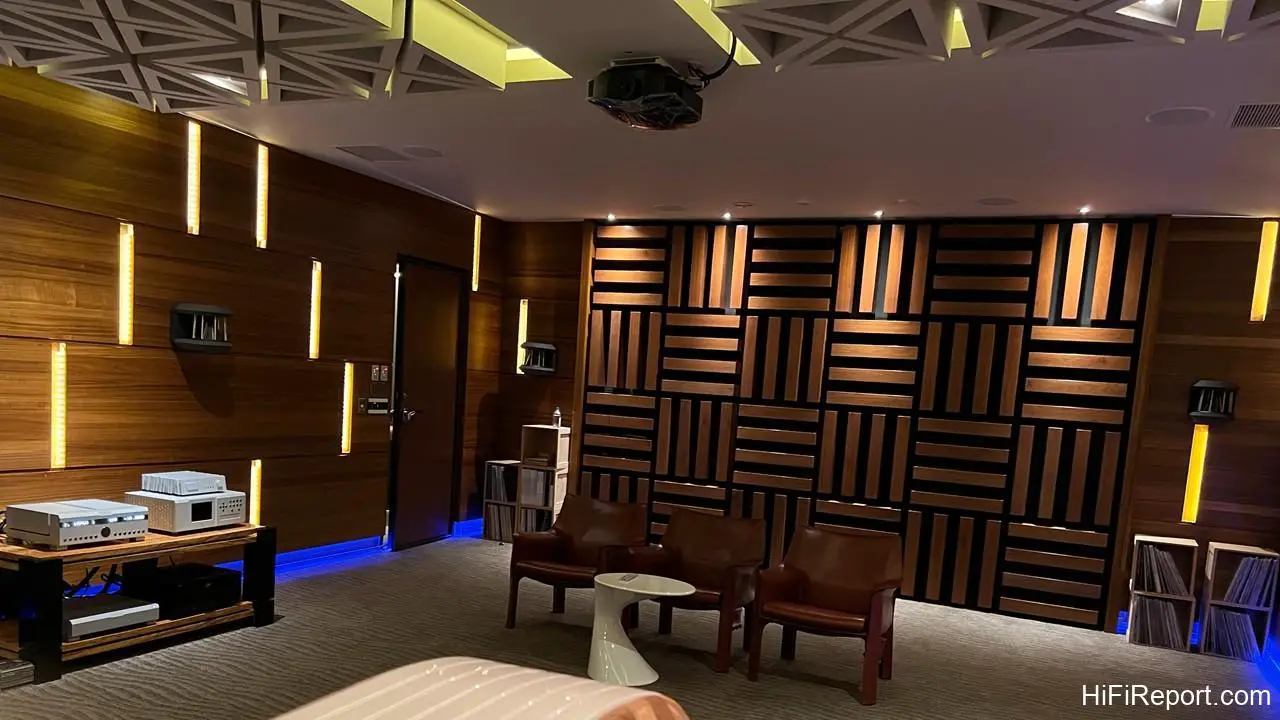
Regarding exhibition setups, Kharma goes the extra mile, laying leather floors embedded with foam, creating a soft feel underfoot. Beautiful wooden acoustic treatments or other devices adorn the walls. Both the flooring and wall treatments are installed to improve the acoustic environment of the exhibition space. Kharma simply pays special attention to coordinating shapes and colors, ensuring these setups present an elegant visual effect, much like a high-fashion collection unveiling.
Ultimately, the acoustic performance of the space is Kharma’s primary focus; the visually striking effect is merely a secondary achievement, not a display of ostentation. All of this is a reflection of Charles van Oosterum’s own profound understanding of audio and his artistic sensibility.
The Founder’s Journey
Charles van Oosterum’s father was a leather wholesaler, and his mother played the piano, though not exceptionally well. While his parents didn’t steer him towards audio, they didn’t hinder him either. The true catalyst for his deep dive into audio was his uncle. During a visit with his mother to another city, he heard Simon and Garfunkel’s “Mrs. Robinson” playing at his uncle’s house. His uncle was an audio enthusiast who frequently tinkered with DIY projects.
Hearing the music that day felt like experiencing heavenly sound to Charles van Oosterum, igniting his passion for audio. From the age of 14, he regularly bought used radios or speakers to disassemble and reassemble, discovering through this process the significant differences in sound performance, fueling his interest further. By 16, Charles van Oosterum had sold his first pair of self-built speakers.
Many of his customers were friends of his parents who, having heard his DIY creations, would refer new clients, cementing his decision during high school to pursue a career in audio.

From O.L.S. to Kharma: A Legacy
In 1982, he founded Oosterum Luidspreker Systems (O.L.S.), taking on projects under the O.L.S. brand to custom-build speakers for numerous clients. By 1985, Charles van Oosterum had introduced the Emotion Series, Lotus Series, and Ceramique Series. Notably, the Ceramique Series began incorporating ceramic drivers, which became a signature element of his brand.
The Grand Enigma: A Landmark System
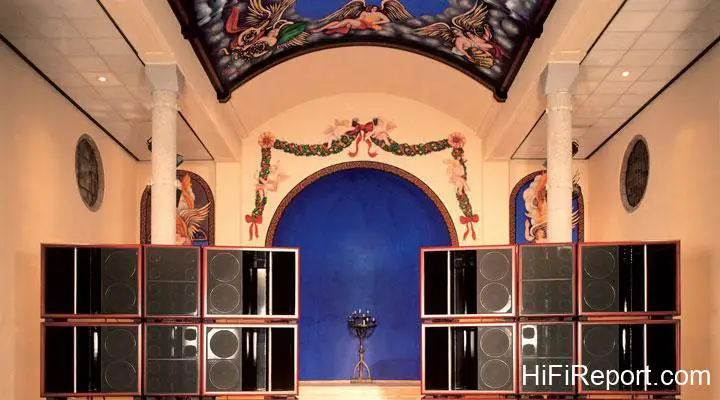
In 1992, he undertook a monumental project: to build the absolute best speaker system, regardless of cost or size. This system, once completed, was named the Grand Enigma Reference System and came with a price tag of one million US dollars at the time. It featured a total of 12 woofers utilizing a folded horn design, with a 15-inch woofer behind each horn, driven by a 1,500-watt amplifier to handle the 10Hz-100Hz frequency range.
The midrange was handled by 24 seven-inch midrange drivers, each powered by a 500-watt amplifier. The tweeter array was particularly unique, using 16 membrane tweeters, each weighing 24 kilograms and driven by a 100-watt amplifier. This unprecedented speaker system weighed a staggering 12,600 kilograms, stood 350 cm tall, was 380 cm wide, and 100 cm deep. The Grand Enigma Reference System catapulted Charles van Oosterum to fame.
If he were asked to replicate a set today, the price would undoubtedly exceed one million US dollars.
Kharma’s Speaker Lineup
After the audio world was astonished by the Grand Enigma Reference System, Charles van Oosterum officially founded Kharma in 1993. Why add an “h” to the word “Karma” for his brand name? Charles van Oosterum explained that firstly, it was necessary for registration (Karma is a common word and cannot be trademarked). Secondly, he deeply resonated with the meaning of the word Karma: “What you give is what you receive.”
Since 1993, Kharma has introduced numerous speakers and has expanded its product line to include amplifiers and cables. Particularly noteworthy are the custom projects, such as designing and building the audio system for the Spyker Aileron car. Here, I will focus solely on his speakers; amplifiers, cables, and other products can be discussed if an opportunity arises later.
Kharma’s speakers are divided into three main series: the most accessible is the Elegance series, followed by the Exquisite series (Exquisite meaning “beautifully crafted”), and the top-tier is the Enigma Veyron series. Each series, including subwoofers, offers five models. The Elegance series is the most affordable (within the Kharma lineup), with smaller cabinets and simpler designs.
The Exquisite series features cabinets of varying sizes; the smaller models are similar to the Elegance, while the larger ones rival the Enigma Veyron. The Enigma Veyron, in addition to larger cabinets, represents an overall enhancement in refinement.
The Exquisite Tier Defined
One could say that the Elegance series represents the best product achievable within cost constraints. The Exquisite, conversely, aims for the best possible product given current technical limitations, without regard for cost; it remained their flagship series until 2015.
The Enigma Veyron series embodies the highest achievable level in materials and technology, naturally also disregarding cost, especially the Tweeter Lotus in the 1D model, which boasts eight diamond tweeters, truly dazzling the senses.

Regarding resolution and the reproduction of subtle details, Charles van Oosterum states that the smallest Exquisite speaker surpasses all Elegance speakers, and the smallest Enigma Veyron speaker outperforms all Exquisite speakers. Although there is a significant price gap between these three series, they all utilize Kharma’s consistently high-quality drivers and technology.
Therefore, if you genuinely appreciate Kharma, it’s best to make your choice based on your personal circumstances and preferences.
A Closer Look: The Exquisite Classique
Within the Exquisite series, three models have very similar names: Midi 3.0, Grand 3.0, and Midi Grand 3.0, in addition to a Midi Subwoofer. Only the Exquisite Classique has a distinctly different name. Classifying by cabinet size, the Exquisite Classique and Midi 3.0 belong to one category, while the Grand 3.0 and Midi Grand 3.0 belong to another. Strictly speaking, the Exquisite Classique is the smallest speaker in the Exquisite series and was the first model launched in that series.
When the Exquisite Classique was first introduced over twenty years ago, it used Accuton ceramic drivers. It was later updated to use Accuton 1-inch diamond dome tweeters and Kharma’s proprietary 7-inch Omega 7 midrange drivers. As for the woofers, Kharma has consistently used Nomex/Kevlar diaphragm woofers over the long term, varying only the number and size used.
The diamond tweeter in the Exquisite Classique is manufactured using the CVD (Chemical Vapor Deposition) method. It appears transparent and is extremely thin, with a thickness of only 50 µm. What is 50 µm like? Compared to a human hair, the finest is about 17 µm, and the coarsest is about 180 µm, so 50 µm is comparable to a very fine hair.
The Omega 7 midrange driver employs a short voice coil and a powerful magnetic system. The diaphragm material is carbon fiber, and the “7” comes from its 7-inch diameter. The shape of the Omega 7 diaphragm is optimized through computer simulation, dividing the cone into several segments. This pushes the diaphragm’s intrinsic resonance frequency to a higher range and results in a stiffness of 960 GPa. What is GPa? Giga Pascal, which is one billion Pascals.
And Pascal (Pa) is the SI unit of pressure, defined as one Newton per square meter. As for Newton, it is the force required to accelerate a 1-kilogram mass at one meter per second squared. Audio enthusiasts don’t need to delve deeply into these physics terms; suffice it to say that the Omega 7 is an extremely rigid carbon fiber cone.
Perhaps you wonder why Kharma, after using ceramic diaphragms for so long, switched to the Omega 7? Besides the advantages mentioned above, there’s also a benefit in the crossover network. Ceramic diaphragms require compensation circuits in the crossover, whereas the Omega 7 does not, thereby simplifying the crossover network.
The woofer in the Exquisite Classique uses a 12-inch Nomex/Kevlar composite fiber. Nomex is a heat-resistant, fire-retardant textile developed by DuPont. It can be used 100% on its own or blended with Kevlar. Kevlar is a synthetic fiber, also heat-resistant, and also invented by DuPont. Kevlar is not only heat-resistant but also used in bulletproof vests. Nomex/Kevlar is frequently used in fire-retardant clothing and is also used to manufacture speaker driver diaphragms.
Some renowned speaker manufacturers, like Avalon and Kharma, are loyal users of this type of woofer.

Unique Cabinet Craftsmanship
Beyond the eye-catching cabinet shape and drivers, the Exquisite Classique possesses another hidden feature: its cabinet construction. While typical speaker cabinets are assembled by gluing together six panels, the Exquisite Classique’s cabinet is constructed by bonding multiple vertical cross-section panels. You can imagine slicing the Exquisite Classique cabinet vertically into many pieces.
Previously, when Andrew Jones took over as TAD’s speaker designer, he introduced the Model One speaker cabinet built by stacking horizontal cross-sections. However, due to the high cost and labor intensity, this cabinet method was not continued. Later, some Italian speaker brands also used a similar approach.
The Exquisite Classique’s cabinet, however, is formed by gluing together multiple longitudinal cross-sections. This type of cabinet requires designing the pattern on a computer first, then feeding the instructions into a computer-controlled panel cutting machine to slice out the multiple vertical cross-section panels, and finally bonding and fixing these panels to form the cabinet. The purpose of this painstaking process is, of course, to reduce vibrations originating from the cabinet itself.
As far as I know, it seems only the Exquisite Classique cabinet is constructed this way among Kharma’s speakers. I suspect that technically, larger models than the Exquisite Classique might not be suitable for this method, while smaller, lower-priced cabinets might not justify the cost, making the Exquisite Classique the only Kharma speaker with this specific cabinet construction.
Physical Presence and Appearance
The Exquisite Classique is a 3-way, 3-driver, bass-reflex floorstanding speaker.
* Drivers: 1 x 1-inch diamond diaphragm tweeter, 1 x 7-inch Omega 7 carbon fiber diaphragm midrange, 1 x 12-inch Nomex Kevlar diaphragm woofer
* Frequency Response: 22Hz – 90kHz
* Nominal Impedance: 4 ohms
* Sensitivity: 90dB (2.83V/1m)
* Maximum SPL: 113dB

* Recommended Amplifier Power: 250 watts
* Dimensions (WHD): 565 × 1,270 × 849 mm
* Reference Price: Approximately $200,000 USD
It stands at 1,270mm tall, with a width of 565mm and depth of 849mm. It’s not a particularly tall speaker, perhaps appearing somewhat short and stout, which is why some Hong Kong audiophiles affectionately nicknamed it the “Big Fat Lady.” In truth, calling it a “Big Fat Lady” is a bit crude; in my eyes, the Exquisite Classique is the picture of grace and opulence, like Yang Guifei (a famous beauty from Chinese history). Why do I say it’s graceful and opulent?
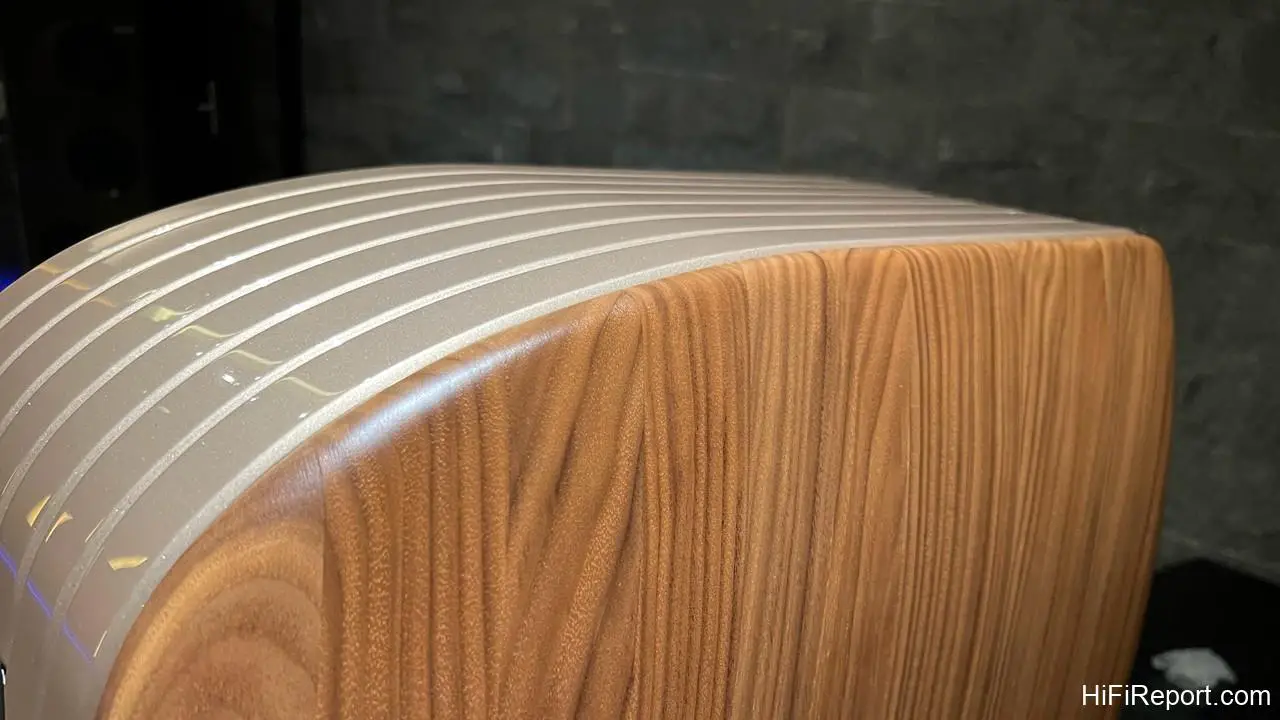
Firstly, observe its color – difficult to describe in words, but undeniably noble. Secondly, the two wooden panels on the upper sides, both in grain and finish, are absolutely stunning. Thirdly, notice the slight rearward tilt and the treatment of the cabinet edges; every detail looks perfectly proportioned. Fourthly, the golden frame around the bass reflex port and speaker terminals on the back panel looks incredibly luxurious.
Fifthly, the sturdy and refined base supporting the speaker instills a sense of stability. From any angle, the Exquisite Classique is a Yang Guifei.
The Listening Environment
The listening session took place in the second largest listening room at the distributor Wen Hong. Though described as the second largest, it visually appears to be around 10-20 ping (approximately 33-66 square meters). The Exquisite Classique didn’t look large in the space, appearing positively “petite” compared to the two larger speakers beside it. However, the sonic energy emitted by this seemingly small speaker was surprising, making me wonder if there was a hidden subwoofer.
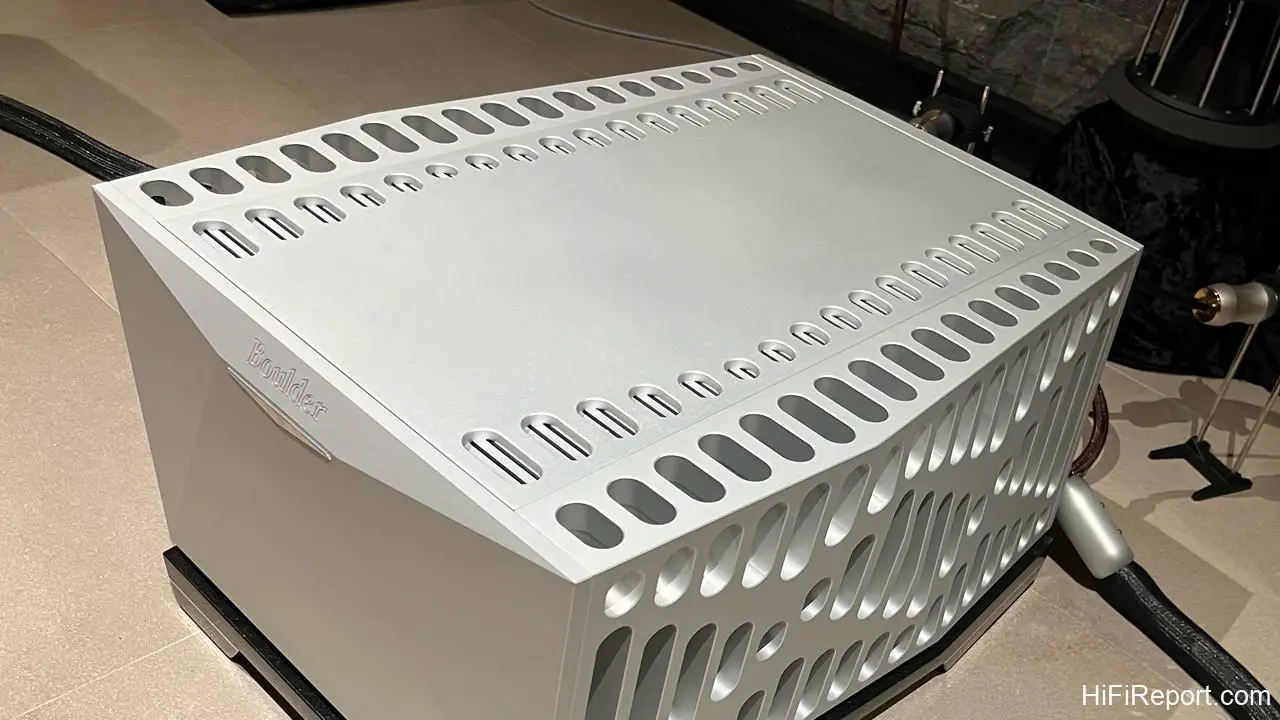
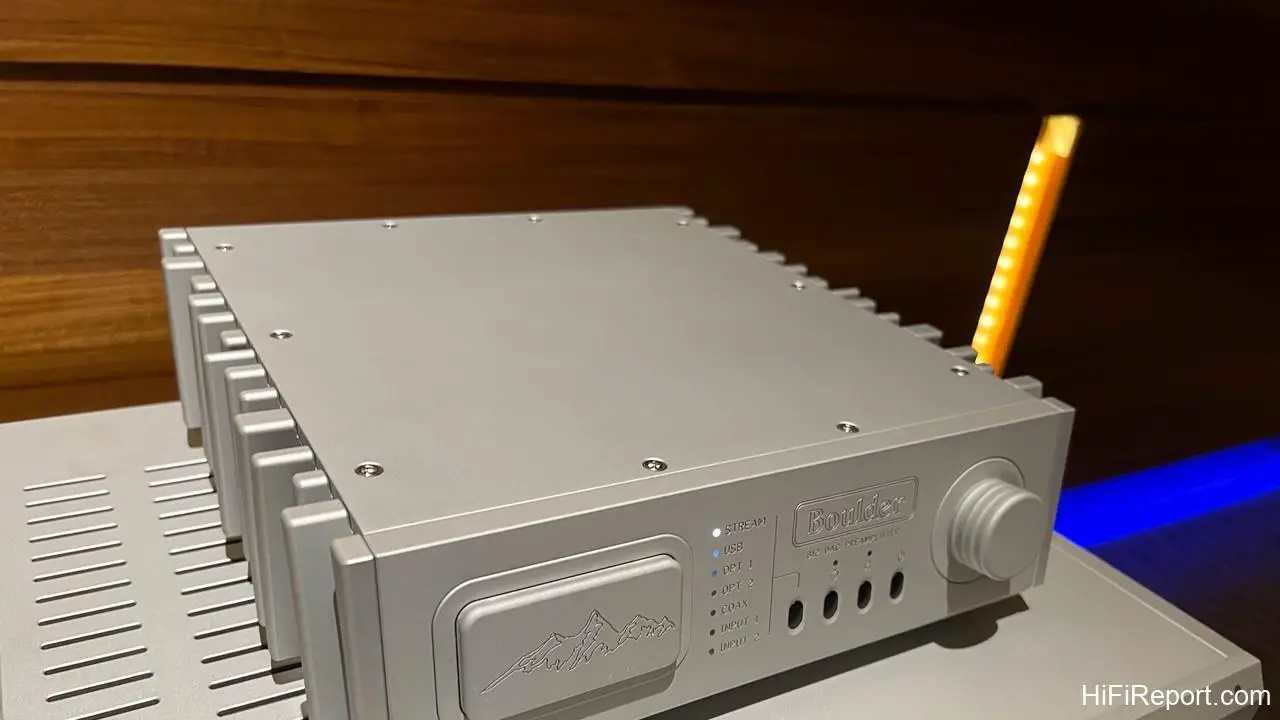
The system components included a Boulder 2110 preamplifier, a 3060 power amplifier (900 watts per channel), and an 812 digital source, primarily playing Tidal. The 812 is a multi-function device combining a preamplifier, DAC, headphone amplifier, and streamer; here, only its streaming and DAC functions were used. Since the 812 is Roon Ready, I first measured the room’s frequency response curve before listening and applied a slight compensation using Roon’s parametric EQ.
This allowed me to hear the true capabilities of the Exquisite Classique.
Unveiling Sonic Excellence: Sound Quality
I often say that the hardest qualities for audio equipment to achieve are sound quality and tone; other aspects, even with budget systems, can attain quite high levels of performance through various tuning methods. Simply put, sound quality and tone are inherent, innate qualities, and the more expensive the equipment, the better the sound quality and tonal performance tend to be – this is my experience from years of reviewing audio gear. The Exquisite Classique is no exception.

Although it might only be considered in the lower-to-mid range within the Kharma family, its sound quality performance is so exceptional that I must highlight it first.
Indeed, the Exquisite Classique features a diamond tweeter, an Omega 7 carbon fiber midrange, and a Nomex/Kevlar diaphragm woofer – these three types of drivers are all of the highest standard. While it doesn’t use the Omega F midrange driver found in the Enigma Veyron series, it is already more than capable. With such excellent drivers, a cabinet that exhibits minimal vibration, and a finely tuned crossover, it’s only natural that it produces incredibly beautiful sound quality.
Furthermore, pairing the Exquisite Classique with Boulder digital sources and amplification means the only factor that could potentially “uglify” this system is the room itself. Wen Hong’s listening room is acoustically designed and possesses excellent inherent qualities. Combined with the subtle compensation from Roon’s parametric EQ in three frequency areas, the inherent beauty of the sound quality was fully revealed to my ears.
Grand Scale Orchestral Sound
When I played Dvořák’s “Cello Concerto” performed by Pierre Fournier with the Berlin Philharmonic, the sheer beauty of the Exquisite Classique’s sound quality and its musical balance evoked a sense of awe – such beautiful music, such a beautiful recording, such a beautiful interpretation are rarely heard. I would say I am quite familiar with this performance version, having listened to it frequently, yet I had seldom heard the captivating sound quality rendered by the Exquisite Classique.
The woodwinds were round and sweet, the orchestra was delicate, the cello was relaxed yet retained texture from the bow, and the overall music was detailed, soft, and beautiful with perfectly clear layers. The soundstage was wide and grand. Honestly, just listening to this piece was enough to form a conclusion about the Exquisite Classique: incredibly beautiful sound quality, incredibly relaxed music, and an utterly comfortable and blissful listening experience.

To further elaborate on “incredibly comfortable,” I could say it felt as pleasant as stroking a cashmere garment, or as full of happiness as eating a juicy Japanese Kasugai peach.
Was it because this particular recording by Fournier is exceptionally good that it made me feel so comfortable and blissful? The recording quality of this Fournier version is certainly excellent, but the Exquisite Classique also sounds superb with other cello recordings. For example, listening to Sheku Kanneh-Mason and his siblings perform Rachmaninoff’s “14 Romances,” the sound quality and tone of both the cello and piano were exquisite.
The cello’s relaxed, resonant sound had a smooth nasal quality coupled with subtle vibrations that immediately captivated me. The accompanying piano notes were round and bouncy, resonant yet not harsh, evoking a feeling like quenching thirst on a hot summer day with a large glass of icy sour plum juice.
The recordings by Fournier and Sheku Kanneh-Mason are separated by decades, yet the Exquisite Classique makes both sound moving and engaging, bridging the time gap – a true hallmark of a great speaker.
The Exquisite Classique also renders violins and pianos beautifully. When I listened to Itzhak Perlman perform “Baal Shem: II Nigun” (arranged for violin and piano), I could not only hear the crisp texture of the bow on the strings and a sweetness like Muscat grapes but also sense the nuances in Perlman’s bowing force. Each piano key struck generated rich harmonics, like a stone dropped into a still lake, instantly sending out ripples.

Moreover, the forms of the violin and piano were incredibly three-dimensional and clear, absolutely solidified. Additionally, the subtle vibrations and decay of the piano’s lower keys descending were utterly captivating.
Listening to string quartets with the Exquisite Classique, the sense of relaxed elegance, fluidity, and balance is also rare. When I heard the Tokyo String Quartet perform Beethoven’s “String Quartet Op. 18, No. 2,” I found the Exquisite Classique’s harmony beautiful, with a balanced quantity across high, mid, and low frequencies, fully embodying the essence of the string quartet’s instrumentation.
A string quartet uses two violins because the violin’s volume is less than the cello’s, thus requiring two. One viola and one cello are used, creating balance across the high, mid, and low frequency ranges of the music. If an audio system or component cannot accurately reproduce the quantity of high, mid, and low frequencies as played by a string quartet, the music will sound unbalanced.
This is why I often say that if an audio system can reproduce a string quartet in a way that makes you love it and want to listen daily, then that system is well-tuned. Beyond relaxed elegance, fluidity, and balance, the Exquisite Classique adds exquisite sound quality – a rarity among speakers.
When the Exquisite Classique played Grieg’s “Piano Concerto in A minor” performed by Radu Lupu (conducted by Andre Previn with the London Symphony Orchestra), the scale was grand, and the piano’s energy was off the charts, making me marvel at the capability of that 7-inch midrange driver, as the powerful piano sound seemed almost entirely projected from it.

Not only that, but when playing this concerto, the Exquisite Classique presented the string section delicately and softly in the background, with the brass and woodwinds providing full support to the entire orchestra to contend with the piano, making the music feel like water boiling furiously, igniting passion. What is the charm of music? The sound the Exquisite Classique produced right then *was* the charm of music!
Power and Dynamics
The Exquisite Classique is not only capable of reproducing beautiful orchestral music but can also deliver explosive dynamics. When listening to Shostakovich’s “Symphony No. 4” conducted by Myung-Whun Chung, the immense sound pressure unleashed at the beginning of the first movement, like a stampede of horses, was handled effortlessly by the Exquisite Classique. It maintained clarity of layers, with the timpani and bass drum impact felt physically, and depth easily rendered.
Frankly, hearing such powerful music emanating from the speakers made me mistakenly think it was coming from the larger speakers positioned nearby.
When I listened to Shigeru Umebayashi’s film score “End of the War” from “Curse of the Golden Flower,” the large drum slowly started at the beginning, and with each beat, I could feel the texture of the mallet hitting the drumhead. Moving to the second section, a different kind of drum sound took over, and the Exquisite Classique equally clearly presented the impact and texture of these different drums.
The Exquisite Classique’s woofer is only 12 inches, yet in such a large space, it managed to reproduce such deep and powerful drum sounds. If listened to in a space of around ten ping (approx. 33 sq meters), the energy would be even more abundant and impactful, hitting like a physical blow.
More Orchestral Delights
The Exquisite Classique truly shines with orchestral music, sounding beautiful and moving. Here, I must also cite Ponchielli’s “Dance of the Hours” conducted by Eugene Ormandy with the Philadelphia Orchestra as an example. This piece begins with delicate, sweet strings and harp, like a spring breeze, followed by string playing with vibrations like cicada wings accompanied by woodwinds.
This section alone fully reveals the Exquisite Classique’s beautiful sound quality and the beauty of instrumental harmony. That sense of beauty is as delicate and smooth as stroking velvet, bringing pure comfort from within. After listening to the entire orchestral piece, there’s no doubt about the Exquisite Classique’s ability to faithfully reproduce the beautiful sound quality and tone of various instruments.
Pop and Rock Prowess
How does the Exquisite Classique perform with popular music? When I listened to John Campbell’s “Way Down in the Hole,” the Exquisite Classique transformed from its beautiful, delicate presentation to deliver a raw, bluesy rock vibe. John Campbell’s rich, powerful voice, full of (weathered experience), tested the midrange driver again, and the equally powerful electric guitar added to the challenge, yet the Exquisite Classique still sounded clean and clear.
The electric bass frequencies were distinct and incredibly bouncy, like Hakka mochi. Furthermore, the artificial reverb applied during the recording was clearly audible, highlighting the Exquisite Classique’s ability across all its drivers – tweeter, midrange, and woofer – to reproduce subtle reverberation and details. The Exquisite Classique’s specifications state 22Hz-90kHz; while it doesn’t specify the +/- dB tolerance, this song alone reveals its wide frequency range.
The Sweetness of Acoustic Instruments
And when I listened to Kate Wolf singing “Poet’s Heart,” I found that the Exquisite Classique rendered the steel-string guitar particularly soft, elastic, and sweet. Kate Wolf’s voice was bright and full, brimming with sweetness and a beautiful sheen. The overall music was delightfully sweet and refreshing, like biting into a juicy, firm, and sweet wax apple. This can also be described as the Exquisite Classique’s sonic personality.
When I heard Paul Simon’s “Diamonds on the Soles of Her Shoes,” the Exquisite Classique instantly shifted from lyrical to rocking. The music, full of high resolution, fast transient response, lively bounce, and impact, immediately grabbed my attention. Here, you notice the Exquisite Classique dissecting the entire music, allowing us to clearly hear the drum sounds, various accompanying instruments, and vocals spread across the soundstage, like a computer-generated anatomical illustration.
Jazz: Rhythm and Texture
How does the Exquisite Classique sound with jazz? Listening to Timo Lassy’s “Sointu,” I found that the Exquisite Classique rendered the plucked upright bass notes solid, elastic, and realistic in texture at the moment of plucking. The saxophone that followed had a large presence, allowing me to fully feel the hissing and rustling air friction as the airflow passed through the entire brass instrument.
Furthermore, I felt as if I could see the entire saxophone emitting countless rays of light, each representing a subtle vibration. Some might find this description hard to grasp; if you heard it live, you would feel it firsthand, requiring no further explanation from me.
A Dream Speaker
The Kharma Exquisite Classique is a pair of speakers with exquisite external craftsmanship and a remarkably noble color palette. However, if you view it from afar or look at pictures, I guarantee you won’t fully appreciate its refinement and nobility. You must approach it, examine it closely, before that urge to buy is spontaneously sparked.
Similarly, the sonic performance of the Exquisite Classique cannot be predicted from its neither-tall-nor-large physique; you must personally hear it reproduce music to truly appreciate the beauty of its sound quality and tone, alongside its outstanding performance in other aspects of the “Twenty Elements of Audio.” Given the Exquisite Classique’s price, I wouldn’t call it “value for money,” but it is absolutely a speaker that audiophiles dream of owning.
Specifications
* Type: 3-way, 3-driver, bass-reflex floorstanding speaker
* Drivers: 1 x 1-inch diamond diaphragm tweeter, 1 x 7-inch Omega 7 carbon fiber diaphragm midrange, 1 x 12-inch Nomex Kevlar diaphragm woofer
* Frequency Response: 22Hz – 90kHz
* Nominal Impedance: 4 ohms
* Sensitivity: 90dB (2.83V/1m)
* Maximum SPL: 113dB
* Recommended Amplifier Power: 250 watts
* Dimensions (WHD): 565 × 1,270 × 849 mm