
Marantz LINK 10n Review
The LINK 10n is not simply a “streaming player with variable volume output.” Instead, it represents the integration of two flagship components—a high-end streaming player and a high-end, pure analog preamplifier—into a single chassis. Its digital-to-analog conversion circuitry is identical to that of the SACD 10, while its fully balanced preamp stage is equivalent to the MODEL 10.
The positioning of the LINK 10n is clear. If you prefer physical media (SACDs, CDs, and vinyl), the combination of the SACD 10 and MODEL 10 is the logical path. However, the LINK 10n is tailored for streaming-centric audiophiles.
It can serve purely as a network streamer paired with an integrated amplifier (such as the MODEL 10). Alternatively, a more thorough application is to fully utilize its built-in preamp capabilities, allowing users to pair it with their choice of power amplifiers or reference-grade active loudspeakers.
Flagship Analog Preamp Stage
Although the LINK 10n is designed with a primary focus on streaming, it features a complete, reference-grade, fully functional analog preamplifier circuit. It accommodates vinyl enthusiasts with dedicated MM/MC phono inputs.
In terms of component quality, technical specifications, and build execution, this analog preamp stage is fully capable of competing with any top-tier, standalone pure analog preamplifier on the market today.
Streaming Capabilities
On the streaming front, the LINK 10n leverages the HEOS platform to support high-resolution streaming services including Tidal, Spotify, TuneIn, Pandora, Amazon Music HD, iHeartRadio, and others. It is also Roon Ready and supports AirPlay 2.
The unit can play back music files stored on network servers, NAS devices, or shared PCs over the local network. Additionally, the HEOS app can stream local files stored on a mobile device or manage playback from a connected USB hard drive.
Supported audio formats include MP3, AAC, WMA, WAV, FLAC, ALAC, and DSD. PCM files are supported up to 24-bit/192 kHz, while DSD compatibility extends to DSD64 (2.8 MHz) and DSD128 (5.6 MHz).
Connectivity & Digital Inputs
For digital audio inputs, the onboard USB DAC supports even higher resolution formats, with PCM up to 32-bit/384 kHz and native DSD up to 11.2 MHz (DSD256).
It also includes an HDMI ARC port for smart TV audio return, supporting up to 24-bit/192 kHz stereo PCM. When integrated with a television, the system seamlessly replaces the TV’s built-in speakers for everyday viewing. Thanks to HDMI CEC support, users can conveniently control the preamplifier’s volume directly using the TV remote.
Additionally, the unit features coaxial and optical digital inputs, both supporting up to 24-bit/192 kHz stereo PCM.
Design & Aesthetics
The development of the new “Series 10” took five years, led by Marantz Sound Master Yoshinori Ogata and a 30-member design team. Ogata is responsible for shaping the signature sonic character of all Marantz products.
According to industrial designer George Suzuki, the Marantz Series 10 is defined by simplicity and an absolute commitment to symmetry. The LINK 10n embodies this philosophy perfectly. Its front panel features identically sized, symmetrically arranged knobs for input selection and volume control, balanced by the headphone jack and power button.
Structural Isolation
Taichi Kamikawa, responsible for mechanical structure design, emphasized that the core development focus was “isolation.” The design objective was to eliminate all inter-departmental interference to maximize sound quality.
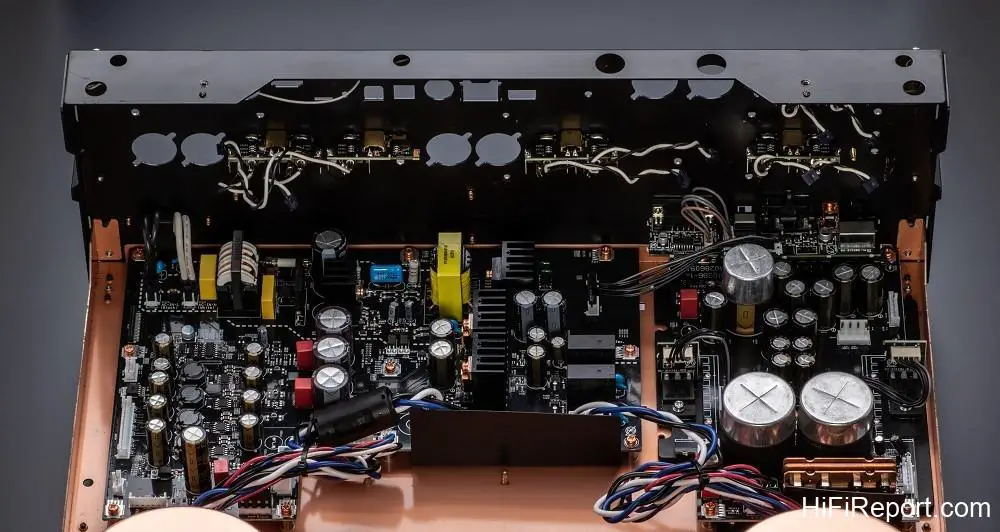
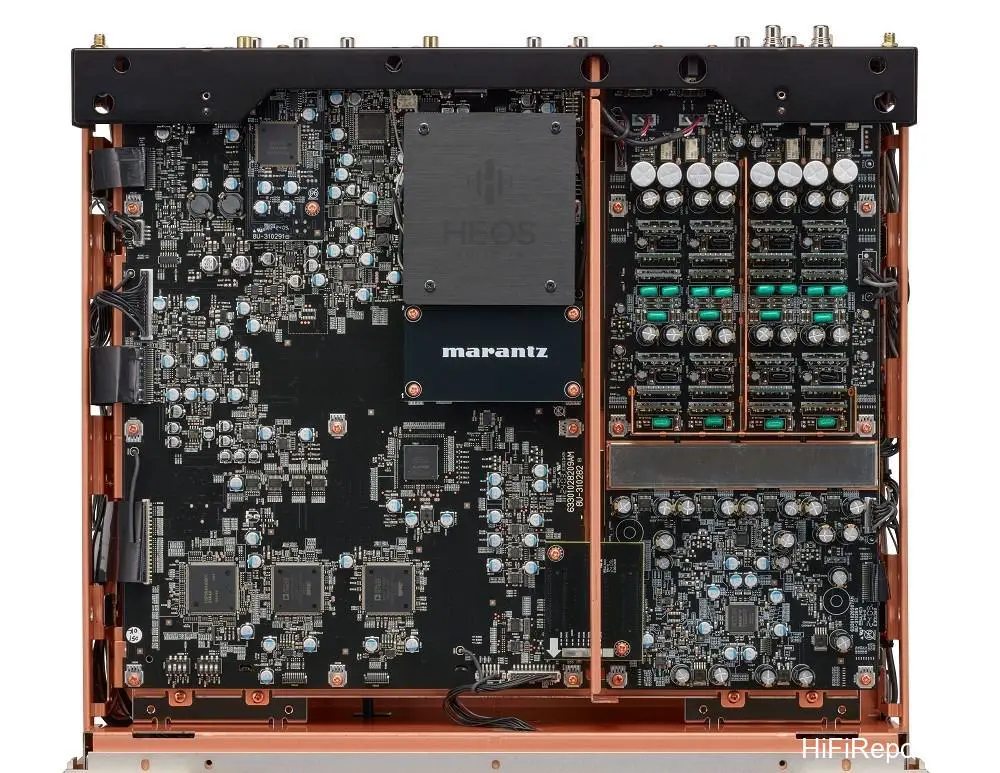
To implement this concept, the LINK 10n features a three-tier chassis structure. The top tier houses the digital inputs/outputs, the HEOS streaming module, and the DAC circuitry—effectively a standalone streamer (minus the power supply).
The middle tier contains the analog preamp circuitry, including the phono, balanced, and single-ended inputs. The bottom tier is dedicated to the dual-transformer power supply.
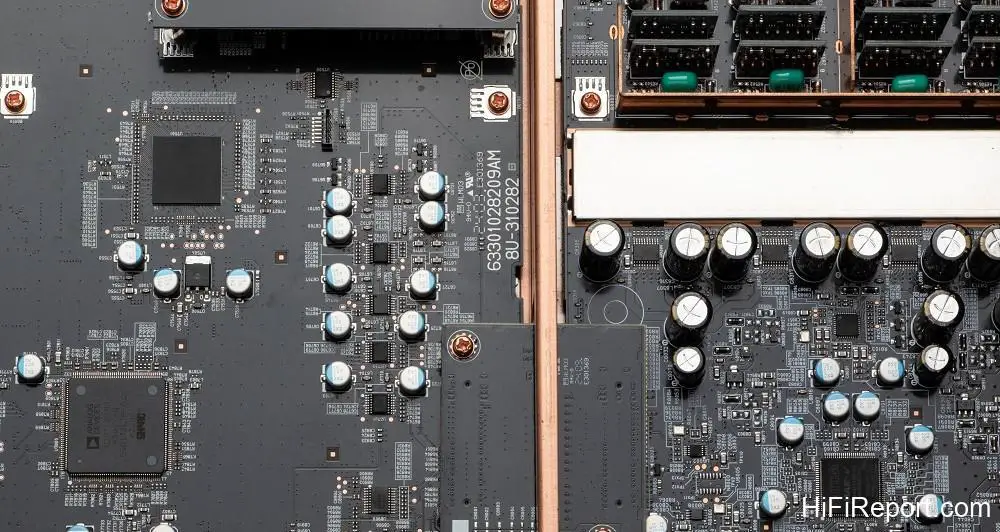
Internal partitions and the inner layer of the chassis bottom plate are constructed from copper-plated steel, a signature Marantz touch. The steel provides shielding against low-frequency electromagnetic waves, while the copper plating blocks high-frequency RF interference.
Kamikawa noted in Japanese media interviews that non-magnetic aluminum is theoretically ideal for the chassis. However, due to the extreme weight of the LINK 10n, an aluminum base sturdy enough to support it would have been excessively thick. Instead, they designed a highly rigid 5.6 mm “triple-layer bottom” steel chassis.
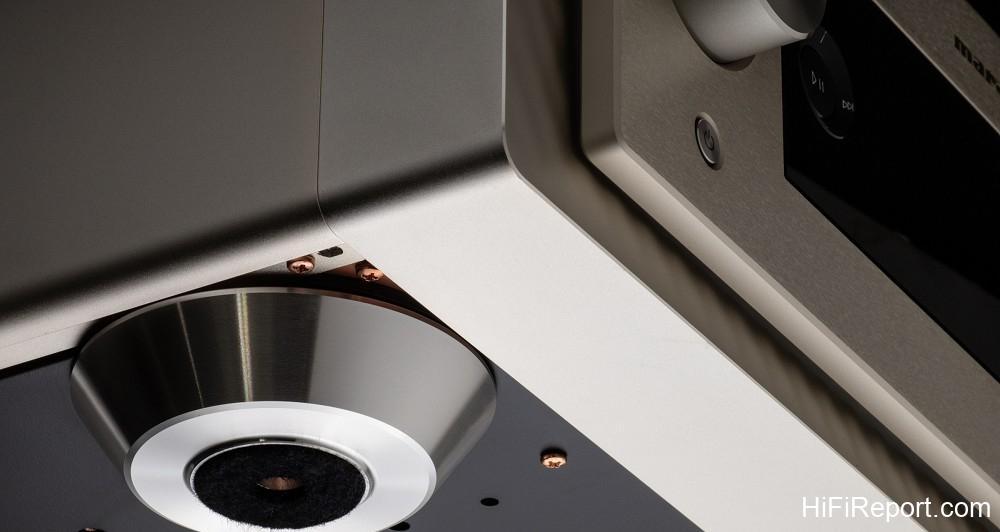
The chassis rests on massive vibration-damping feet (9.4 cm in diameter) crafted from a combination of solid aluminum and 4 mm thick copper plates. Solid milled aluminum blocks are used for the 45 mm thick front panel and the 15.8 mm thick side panels.
Meticulous Shielding
In addition to the vertical compartmentalization, the front panel display and digital control circuits are housed in separate, isolated chambers, isolated from the streaming, preamplification, and power supply sections.
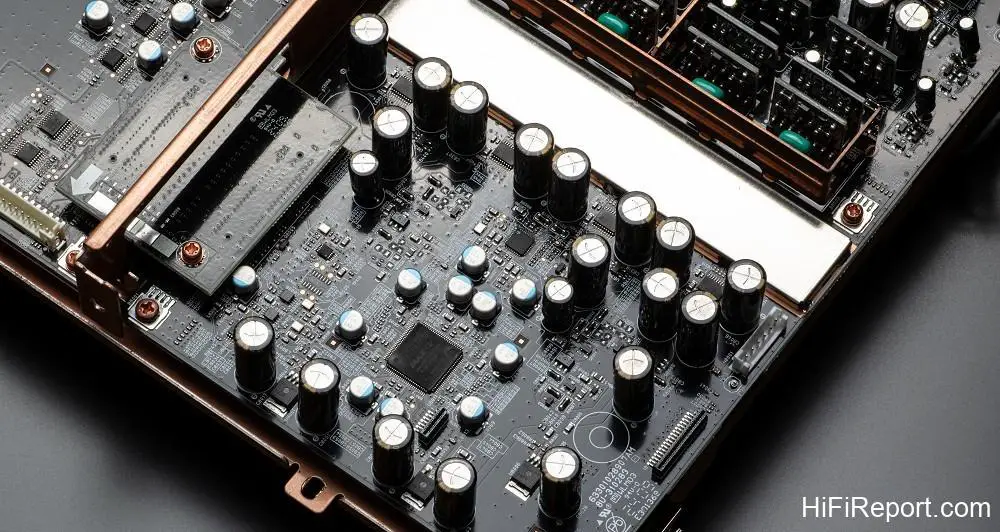
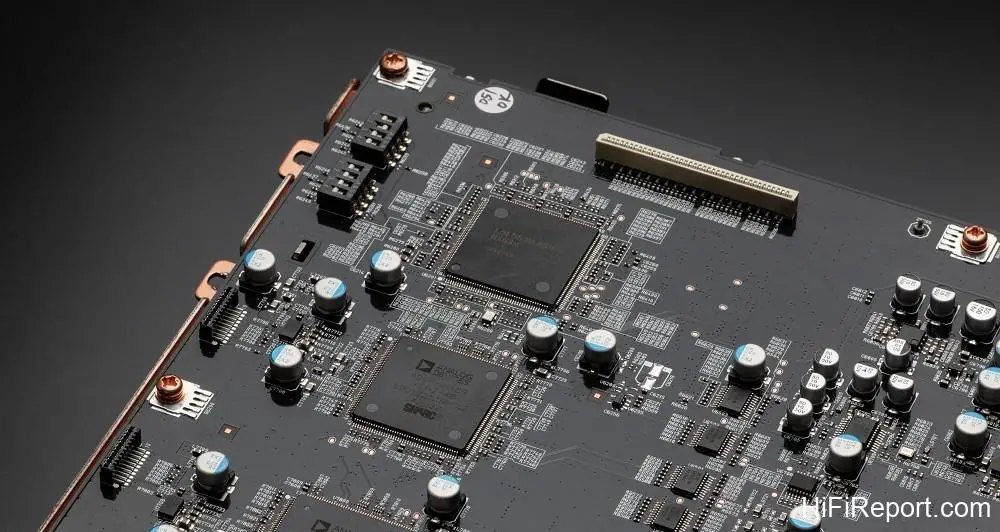
A closer look reveals extraordinary attention to detail. The HEOS network card on the streaming board is shielded with a top metal plate. The digital audio processing and DAC circuit boards have been upgraded from traditional 4-layer PCBs to 8-layer PCBs.
This design shortens signal paths, lowers impedance, and utilizes one or two layers of internal copper foil as shielding to prevent electromagnetic noise emission and ingress.
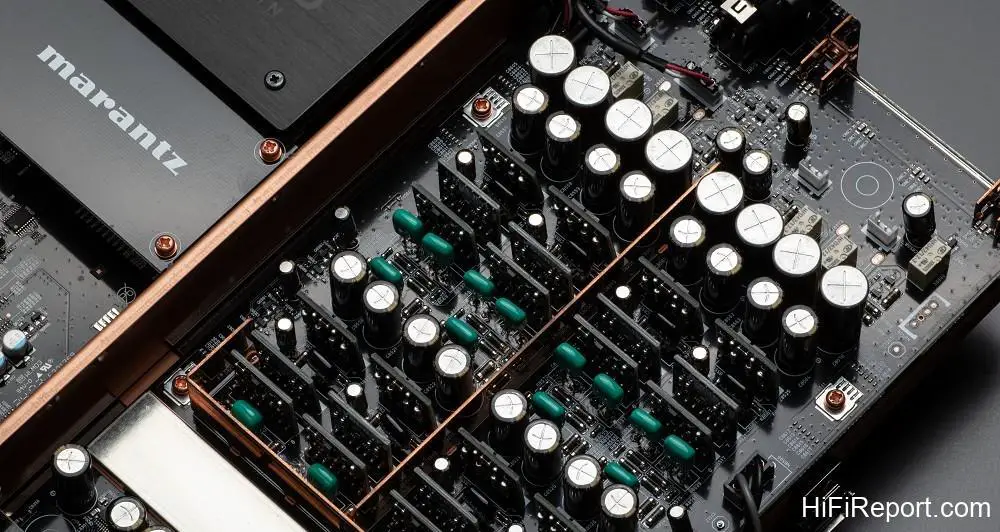
A copper-plated steel plate separates the digital audio processing from the digital-to-analog conversion circuitry. The flip-flops and resistor arrays of the DAC circuit are shielded with metal plates, and the left and right channels of the analog output stages are isolated by copper partitions.
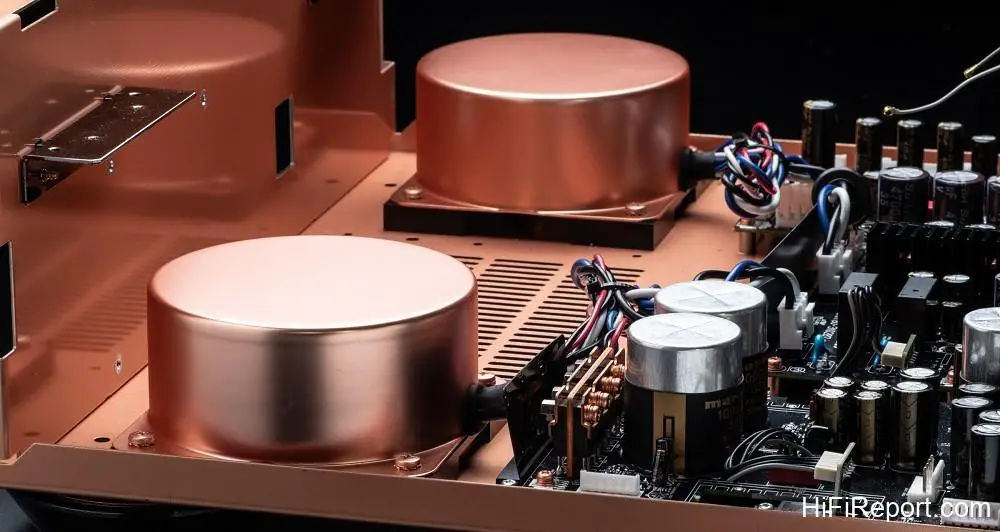
Furthermore, the phono preamplifier circuit is housed in an independent, copper-plated metal enclosure, and both toroidal transformers are fully sealed inside copper-plated metal casings.
Ultra-Low Noise Floor
With more than a dozen distinct shielding measures, one might wonder if Marantz has gone overboard. In truth, I listened to the LINK 10n first, driven by anticipation, before analyzing its circuitry or specifications.
From the very first note, the background silence was stunning. Having reviewed countless audio components, it is rare to find a device that leaves such an immediate impression of being “extraordinarily quiet.”
Later, when I checked the specifications, I discovered its signal-to-noise ratio is a staggering 122 dB. While typical preamplifiers hover around 100 dB and select high-end professional gear reaches 120 dB, the LINK 10n boasts an SNR roughly 20 dB higher than average. This means its noise floor is less than one-tenth of most preamplifiers—a massive, highly audible difference.
Marantz Musical Mastering
The digital circuitry was designed by Satoshi Okubo, who previously co-developed the Marantz Musical Mastering (MMM) discrete digital-to-analog converter technology (which eschews off-the-shelf DAC chips in favor of proprietary discrete components).
Okubo notes that mitigating high-frequency digital noise is one of the greatest challenges in digital design. The MMM stage in the SACD 10 and LINK 10n was engineered specifically for ultra-low noise performance.
Compared to the SACD 10, the LINK 10n lacks an optical drive mechanism. Its streaming board essentially integrates a HEOS network card with the SACD 10’s MMM architecture. The MMM system is divided into two primary stages: “MMM-Stream” and “MMM-Conversion.”
MMM-Stream utilizes two Analog Devices fourth-generation SHARC DSP chips (ADSP-21489) for digital audio processing. It upsamples incoming PCM audio to a 32-bit depth to increase dynamic range, applies 256 fs oversampling digital filtering, and introduces selectable dither.
It then performs Delta-Sigma modulation with noise shaping to push quantization noise far outside the audible spectrum, ultimately outputting an 11.2 MHz DSD stream.
As a result, whether playing back multi-bit PCM or DSD files, the LINK 10n converts all signals to DSD for final D/A conversion. Before the DSD stream transitions from MMM-Stream to MMM-Conversion, a series of digital isolators blocks any high-frequency digital and analog noise from entering the conversion stage.
MMM-Conversion performs D/A conversion of the DSD signal using an analog FIR filter topology, specifically a Switched-Resistor Filter (SRF) architecture. This circuit consists of D-type flip-flops (which Marantz refers to as data buffers) and resistor arrays in a fully balanced configuration. Each channel employs two conversion circuits, with each circuit utilizing eight D-type flip-flops and eight fixed resistors.
Discrete Design Advantages
In previous MMM implementations, the eight D-type flip-flops were contained in a single 8-channel IC. For the LINK 10n, Marantz transitioned to eight individual single-channel D-type flip-flops.
According to the designer, this modification boosts output current from 8mA to 24mA, significantly strengthening the signal output. By reducing the value of the fixed resistors to one-third of their previous value, they achieved an 8.1 dB improvement in signal-to-noise ratio—equivalent to an 84.51% reduction in noise. While both generations bear the “MMM” moniker, the performance levels are vastly different.
Designing a discrete DAC rather than deploying an off-the-shelf IC allows Marantz complete control over sonic voicing. While engineers cannot tune the internal silicon of a pre-packaged DAC chip, a discrete circuit opens up endless refinement possibilities.
For instance, the resistor array uses high-precision, cylindrical MELF (Metal Electrode Leadless Face) resistors rather than standard surface-mount SMD resistors. This choice was made strictly based on intensive listening tests rather than basic measurements.
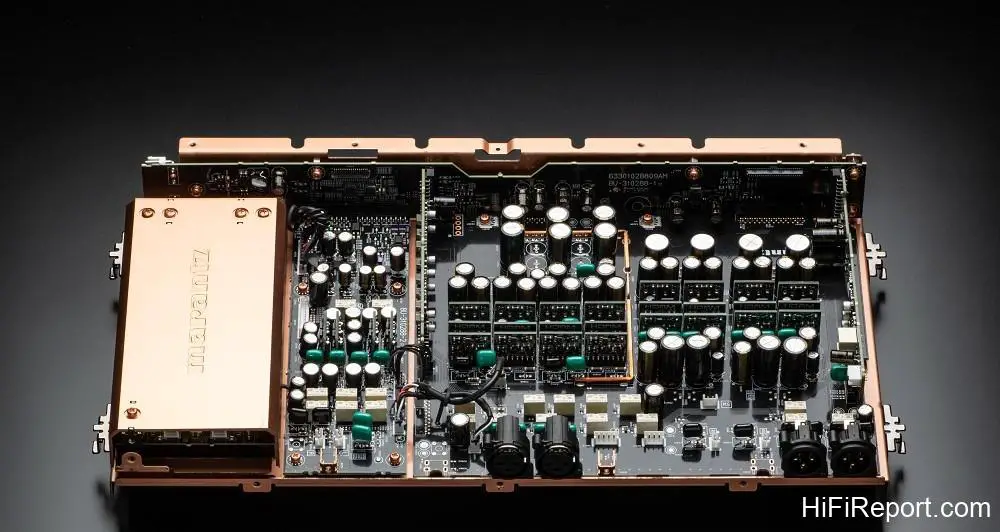
While most digital sources use op-amp chips for post-DAC analog filtering, the LINK 10n features Marantz’s latest custom-designed HDAM and HDAM-SA3 modules. These discrete circuits form a fully balanced low-pass filter and output buffer stage.
The input stage employs highly sensitive, dual-packaged JFET differential pairs for thermal and operational stability. Active stages feature low-noise, low-distortion transistors, while the passive parts list includes custom copper foil capacitors and MELF resistors.
Marantz engineers note that since modern component measurements are generally excellent, their selection process relies heavily on listening tests, resulting in numerous bespoke components throughout the Series 10.
Preamplifier Topology
The designer of the analog stages, Takumi Murayama, stated in interviews that his guiding principle was a “straight wire with gain”—recalling the famous words of QUAD founder Peter Walker. The goal is absolute transparency, avoiding any artificial coloration of the audio signal.
The preamplifier circuit in the LINK 10n is largely identical to the MODEL 10. The main difference is that the MODEL 10 features a dual-layer board layout to accommodate more single-ended outputs, whereas the LINK 10n uses a single-layer design to leave space for the power supply on the bottom tier.
For optimum symmetry and durability, the LINK 10n utilizes high-performance MUSES72323 volume control chips from JRC (now Nisshinbo Micro Devices). One chip is used per channel to execute fully balanced volume adjustment, enhancing channel separation and minimizing crosstalk.
The line-level stage employs HDAM and HDAM-SA3 modules to form a “variable gain” fully balanced preamplifier circuit. When listening at lower volumes (below -13dB), the stage acts effectively like a passive preamp with zero gain. This means any incoming signal noise is attenuated along with the volume, giving the LINK 10n an exceptional signal-to-noise ratio advantage at low-to-medium volume levels.
Furthermore, the LINK 10n preamp utilizes a DC servo configuration. The entire signal path, from input to output and between gain stages, is direct-coupled without any coupling capacitors, preventing signal degradation.
Phono & Power Stages
The “Marantz Musical Premium Phono EQ” stage is shielded inside a 1.2 mm thick copper-plated aluminum box. Compatible with both MM and MC cartridges, it features a dual-stage design.
The input stage provides 20 dB of gain for MC cartridges, with selectable load impedance settings of 33, 100, and 300 ohms. The second stage is a non-negative feedback Phono EQ utilizing HDAM and HDAM-SA3 modules, delivering 40 dB of gain.
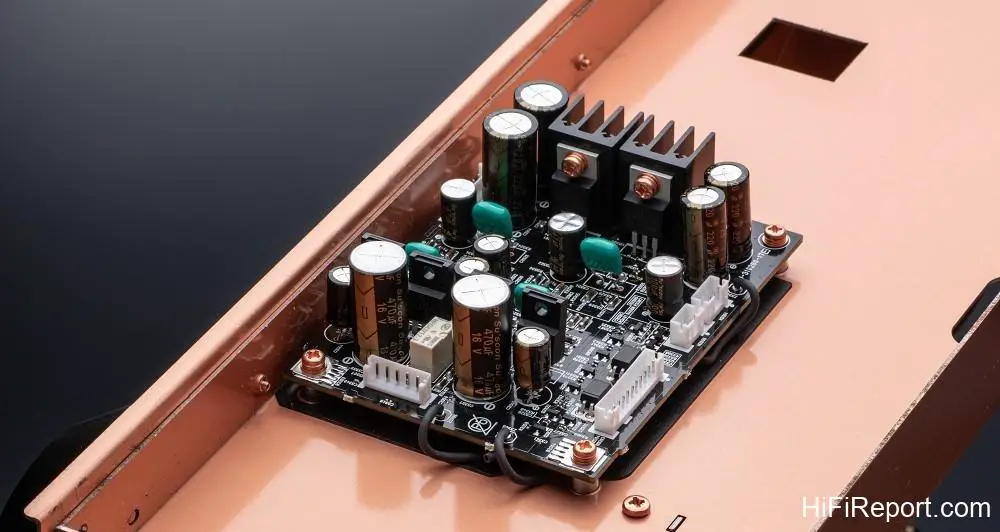
Behind the phono shield, a dedicated daughterboard houses the headphone amplifier, which features an HDAM-SA3 stage paired with a high-current Diamond Buffer circuit.
The power supply on the bottom deck features two toroidal transformers, each sealed in its own copper-plated metal enclosure to separate digital and analog power lines.
Both the digital and analog power boards contain dedicated rectification, filtering, and regulation stages. High-speed Silicon Carbide (SiC) Schottky diodes are used for rectification, alongside custom electrolytic filter capacitors. The main reservoir for the analog audio rail features two bespoke 10,000 μF capacitors.
Listening Impressions
Very few audio manufacturers can honestly claim their equipment is entirely “faithful to the original recording.” Achieving this requires relentless engineering effort to ensure the lowest distortion and noise levels across all measurable parameters.
Even for audiophiles who dismiss technical specifications, claiming they cannot hear minor differences in distortion, the LINK 10n makes a compelling case.
Before listening, I deliberately avoided looking at any specifications, focusing purely on what I heard. My initial impression of the LINK 10n remains vivid: even at conservative volumes, the sheer refinement of the sound was striking.
On tracks I have listened to hundreds of times, the preamplifier revealed low-level micro-details that had previously gone unnoticed.
To simulate late-night listening, I turned the volume down progressively. Remarkably, the delicate textures of the instruments, the acoustic space of the concert hall, and the natural decay of the reverberation remained completely intact and perfectly legible.
In its category, I can recall at most two other components that can rival the LINK 10n’s resolution of low-level detail.
Its greatest strength is delivering an incredibly high-resolution presentation that remains completely fatigue-free. It never sounds aggressive or forced, rendering fine details across the frequency spectrum with natural ease.
This ability to convey low-level dynamics and vivacity stems from an exceptionally “inky-black” background, which gives even the quietest sounds a distinct physical presence.
Sonically, the LINK 10n is pristine, offering a highly transparent view into the music. Yet, it is not sterile or devoid of character; rather, it possesses a subtle, natural sweetness.
The high frequencies are clear and silky, the midrange is warm and beautifully layered, and the low-end is full, stable, and carries convincing weight into the subterranean registers.
Tuning Options
Honestly, the LINK 10n sounds captivating in its default factory configuration. However, Marantz is a brand with a deep heritage. They understand that audiophiles are highly sensitive and have different system setups and individual sonic preferences.
To accommodate this, the engineers provided versatile tuning options to allow users to shape the sound to their liking. Here are my thoughts on the following three customizable parameters:
How should you experiment with these settings? If you find the differences hard to distinguish, leaving them at factory defaults is perfectly fine.
However, if you want to impart a highly personalized, analog-like character to this digital source, I recommend combining “Filter 2”, “Dither 1”, and “Noise Shaper Natural”.
Conclusion
The Marantz LINK 10n is built to the highest standard at the brand’s Shirakawa Audio Works factory in Japan. Every single detail of its design and manufacturing is executed with clarity and absolute purpose.
In my estimation, it stands as the closest approach to the perfect high-end streaming preamplifier available today, earning our highest recommendation.
If you have the opportunity, play some of your most familiar reference tracks through it. I suspect you will be astonished by the sheer difference from your past listening experiences. It is a revelation of how refined and incredibly real reproduced sound can be.
Specifications
* **Type**: Streaming Preamplifier
* **Inputs**:
* Phono (MC/MM) with GND terminal x 1
* Balanced Line In x 1
* Single-ended Line In x 1
* HDMI ARC x 1
* Coaxial Digital x 1
* Toslink Optical x 2
* USB-A x 1
* USB-B x 1
* **Outputs**:
* Balanced Line Out x 1
* Single-ended Line Out x 1
* Balanced Pre Out x 1
* Single-ended Pre Out x 1
* Subwoofer Pre Out (Single-ended) x 1
* Coaxial Digital x 1
* Optical Digital x 1
* Headphone Jack x 1
* **Signal-to-Noise Ratio**:
* Single-ended Input: 122 dB
* Balanced Input: 122 dB
* Phono MC Input: 76 dB
* Phono MM Input: 88 dB
* **Total Harmonic Distortion (20Hz – 20kHz)**: 0.001%
* **Frequency Response**: 5Hz – 120kHz (+0 dB / -3 dB)
* **Headphone Output Rated Power**: 130 mW (120 Ohm load, 1kHz, THD 0.7%)
* **Dimensions (W x H x D)**: 440 x 192 x 472 mm
* **Weight**: 33.3 kg