
Marantz MODEL 40n Review
Last year, the combination of the Marantz SACD 30n streaming player and the MODEL 30 integrated amplifier won the EISA Award 2021-2022 for “Stereo System.” The subject of this article, the MODEL 40n, was announced in February this year. Its appearance is remarkably similar to the MODEL 30, boasting a substantial, high-quality feel. However, there are two significant differences between the Model 40n and the MODEL 30.
The MODEL 30 is a “pure analog integrated amplifier” utilizing Class D amplification (equipped with Hypex NC500 modules), thus offering higher output power. The Model 40n, on the other hand, is a “streaming integrated amplifier.” It includes built-in streaming music functionality, meaning you only need to add a pair of speakers to assemble a complete audio system without needing a separate source component.
Its power amplification circuitry employs Marantz’s most acclaimed and extensively developed Class AB amplification, backed by over half a century of research and manufacturing experience.
The MODEL 40n is Marantz’s third streaming integrated amplifier. The first two were both unveiled at the end of 2019. The first was the NR1200, which was not introduced in Taiwan. It essentially reduced an AV receiver to 2.1 channels and included HDMI input/output terminals. The second was the PM7000N, which lacked HDMI terminals and adopted standard Hi-Fi audio design practices. I reviewed the PM7000N and found it to be an incredibly appealing streaming integrated amplifier.
When friends on a limited budget call me asking for the best integrated amplifier recommendation, and they are using entry-level or mid-range speakers from renowned European and American brands (such as B&W’s 600 or 700 series, or Focal’s Chorus series), I tell them the “basic entry point” is the Marantz PM7000N. It will help your speakers perform as they should. The two previously launched models belonged to the entry-level and mid-price segments.
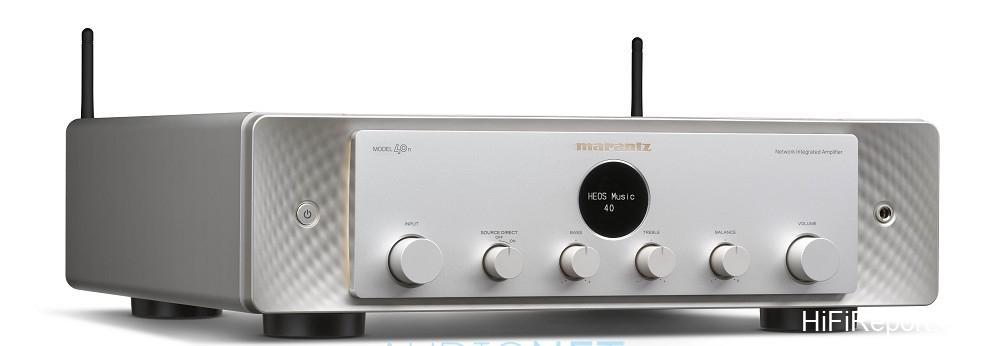
The newly introduced MODEL 40n is positioned as the highest-tier model among Marantz’s current streaming integrated amplifiers.
Streaming Features
The MODEL 40n is equipped with a HEOS network module specifically designed for music streaming, featuring built-in Wi-Fi and Bluetooth, as well as multi-room streaming capabilities. Supported internet streaming services include Spotify, Apple Music, Tidal, and TuneIn. Furthermore, being AirPlay 2 compatible, iPhone users listening to KKBOX can stream the audio to the MODEL 40n to listen through their audio system.
This unit can play music files shared from a NAS or PC. It can also play music files pushed from a mobile phone to the MODEL 40n via the HEOS App. If you use an Android phone or tablet that supports SDXC memory cards, newer models can accommodate large-capacity memory cards. Currently, a 1TB SDXC memory card costs just over $130 USD and can store over a thousand albums.
If your music collection isn’t huge, you can simply use your phone as a music library, enjoying your music at home or on the go.
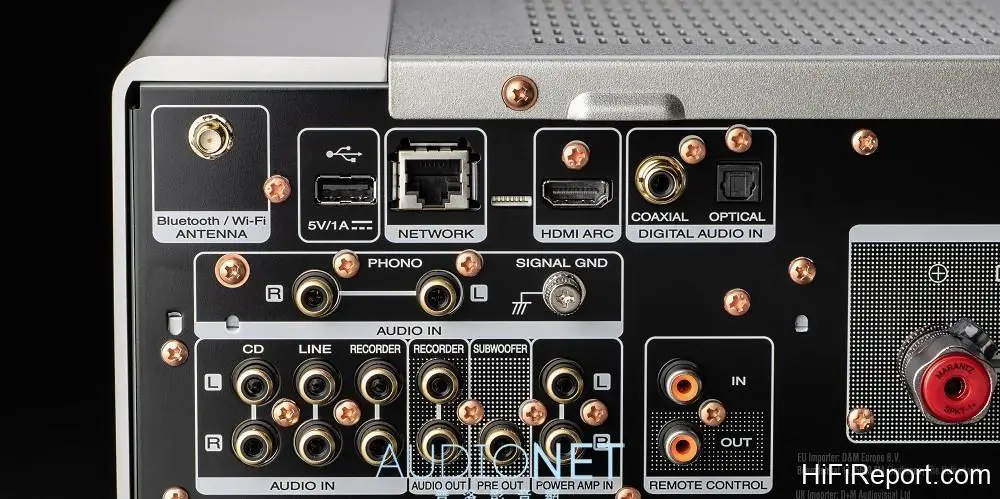
If you require a larger music library, the USB terminal on the back of the MODEL 40n is compatible with FAT32 and NTFS formatted USB storage devices (I tested and found exFAT USB SSDs are not compatible). Therefore, users can organize all their music albums, store them on a USB hard drive as a music library, and plug it into the unit’s USB terminal to select tracks via the HEOS App.
This method of use doesn’t consume home network bandwidth, so even if someone in the household is watching 4K streaming video simultaneously while you enjoy music, playing high-resolution audio files won’t stutter. Whether playing music files via the network or directly from a USB hard drive, the MODEL 40n supports playback of file types including WMA, MP3, WAV, MPEG-4 AAC, FLAC, Apple Lossless, and DSD.
Multi-bit Hi-Res music files are supported up to 192kHz/24bit, while DSD files (dsf and dff) can be played at 2.8/5.6MHz.
Internal Layout and Design
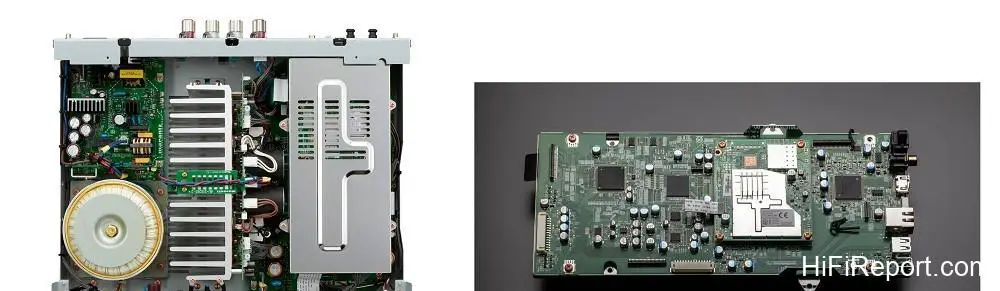
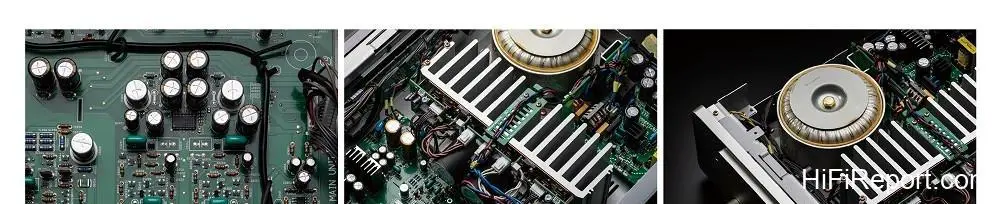
The internal structure of the MODEL 40n can be broadly divided into three sections from right to left: the streaming and preamplifier circuitry, the power amplification circuitry, and the power supply. Speaking of streaming preamplifiers, it might seem as simple as combining the circuit boards of a streaming player and a preamplifier and just finding space for them. However, achieving good sound quality is challenging.

We know that the preamplifier is at the forefront of the audio signal path and provides the highest gain amplification. Any small amount of noise picked up becomes a significant problem. This is why we see that the preamplifier circuits in most amplifiers are kept as far away as possible from the power transformer, as it is a primary source of low-frequency noise. What about the source of high-frequency noise? This largely comes from network modules and digital circuitry.
To protect the streaming preamplifier from high-frequency noise interference, not only is separate power supply crucial, but stringent shielding is also required to block electromagnetic waves.
Because of this, the factory has implemented a metal shielded box in the upper part of the MODEL 40n’s streaming preamplifier section. The metal box is divided into two layers: the upper layer houses the HEOS streaming main board, which includes the network module, USB, HDMI ARC, and S/PDIF digital inputs. There is a metal partition between the upper and lower layers of the metal box.
The lower layer is further divided into two compartments by a metal plate in the middle: the left side contains the digital-to-analog conversion circuitry. Here, after decoding by the HEOS streaming main board in the upper layer, the digital audio signal uses a 32-bit DAC chip, the ESS ES9016K2M, for digital-to-analog conversion. The ES9016K2M features a built-in Time Domain Jitter Eliminator, using a Digital Phase Locked Loop (DPLL) circuit to reduce clock jitter.
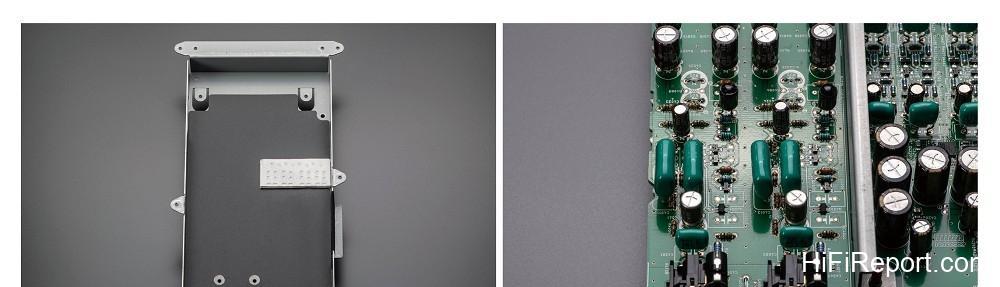
On the other side of the metal partition for the digital-to-analog conversion circuit is the NF-CR type “Marantz Musical Phono EQ” corresponding to the MM phono input for turntables. The factory’s design focus here is on shortening the signal path and reducing distortion.
The main preamplifier amplification circuit is located directly below the aforementioned metal box. It uses a JRC NJU72750 for source switching and employs JRC’s flagship volume control chip, the MUSES72323, the same grade as used in the MODEL 30. This volume control chip is combined with Marantz’s exclusively developed HDAM and HDAM-SA2 ultra-high-speed amplification modules, constructed from discrete components, to form a “variable gain type” amplification circuit.
Its unique characteristic is that under normal conditions with moderate power output, the preamplifier does not perform voltage amplification. This reduces the gain provided by the preamplifier and lowers the amplification factor of noise entering the preamplifier input. In other words, it makes the input stage of the unit’s amplification circuit “insensitive to noise,” thus effectively improving the signal-to-noise ratio.
This results in a 45% reduction in noise for the MODEL 40n compared to Marantz’s own PM8006 integrated amplifier. The MODEL 40n includes a headphone output. Based on my observation of the circuitry, I believe its headphone output also uses the preamplifier amplification circuit. I think this is a reasonable approach for driving headphones, as the output of this unit’s preamplifier amplification is buffered by HDAM-SA2.
Marantz’s renowned USB-DAC headphone amplifier, the HD-DAC1, also used HDAM-SA2 to drive headphones.
The power amplifier section of the MODEL 40n employs the HDAM-SA3 current feedback amplification circuit, which offers excellent bandwidth characteristics. The power transistors in the output stage are Sanken’s LAPT (Large Area Parallel Transistor). These multi-emitter power transistors possess very good high-frequency response characteristics and excellent linearity at high output levels.
Although the MODEL 40n’s stated power output isn’t exceptionally high on paper, Marantz uses two pairs of 2SA1303/2SC3284 in parallel push-pull configuration per channel, allowing for a maximum instantaneous current output of 68 amperes (equivalent to 1.5 times that of the PM8006). All power transistors are not directly bolted onto the relatively thick cast aluminum heat sinks.
Copper plates are added between the power transistors and heat sinks to enhance thermal conductivity, increasing heat dissipation efficiency, which not only ensures safety but also reduces thermal noise.

High current output capability in the power amplifier circuitry requires a corresponding robust power supply circuit as backup. The MODEL 40n features a power supply with separate sections: the unit’s digital circuitry (including the HEOS main board, system control, and front panel display) is powered by an internal switching power supply board. The audio circuitry, on the other hand, is powered by a large double-shielded toroidal transformer with a diameter of 129mm and weighing 3.4 kg.
The transformer has two secondary windings: one connects to the power supply circuit at the front edge of the preamplifier circuit board (including rectification, filtering, and regulation), and the other connects to the power amplifier circuit board. After rectification, two 18,000μF Nichicon audio-grade electrolytic capacitors are used for filtering. The capacitance of these filter capacitors is approximately 1.8 times that of the PM7000N.
From the pairing of the power amplifier circuitry and the power supply circuitry, it is already evident that the MODEL 40n surpasses the PM7000N in low-frequency solidity and stability.
Listening Impressions
For this review, I primarily used two pairs of speakers with the unit: ELAC Vela FS 408 floorstanding speakers and Dynaudio Emit 20 bookshelf speakers. Experienced audiophiles will immediately understand that my intention was to test the unit’s driving power, sound quality, and resolution. Below are my conclusions after listening with both pairs of speakers. For optimal sound quality, I initially set the MODEL 40n to Source Direct mode (bypassing bass and treble adjustments).
Without changing any factory settings, the unit exhibited a very pure, neutral, and uncolored character. The background was exceptionally quiet, allowing subtle details to emerge naturally even at low to moderate volumes without any effort.
During the listening sessions, the MODEL 40n drove the Emit 20 as if they were floorstanding speakers, and when listening to organ music with the Vela FS 408, one might even think a subwoofer was added. I believe such low-frequency performance is certainly related to the speakers’ inherent capabilities, but the fact that the MODEL 40n can bring them out demonstrates its prowess. The bottom end is stable and the bass has excellent control.
Electronic instruments and kick drums have sufficient and solid punch. The midrange is clear and uncolored, offering high sound visibility. Natural instruments like cello and piano possess rich harmonics and delicate textures. The treble is “as it should be,” without artificial coloration, fully revealing the shine and sparkle inherent in high frequencies. The tonal texture of violins and cymbals is very close to that of real instruments, complete and authentic.
The description above represents the first sonic profile presented by the MODEL 40n, which is the sound heard with the factory default setting of “Digital Filter” set to “Filter 1” in the Audio options. This digital filter has short and symmetrical pre and post echoes. I believe its sound characteristics are young, vibrant, clean, and realistic, making it very suitable for reproducing recent Hi-Res recordings.
Changing the digital filter to “Filter 2” provides a distinctly different feel. This filter type has a very short pre echo and a longer post echo, resulting in an asymmetrical impulse response. Don’t worry if you don’t understand the technical details; I’ll report on the listening experience: The sound with Filter 2 is noticeably more mature, moist, and warmer. The sound density is higher, feeling slightly fuller, and it has excellent approachability.
Instruments and vocals feel closer, as if they have entered my space. I really like this setting, which feels very close to the natural and real sound heard around us in daily life. If I plan to listen for an hour or more, or even all day, I would definitely use Filter 2. It simply sounds very engaging and flavorful. I think this is a sonic characteristic that experienced audiophiles will appreciate.
I also recommend users experiment with the “Narrow / Medium / Wide” settings for Lock Range. Narrowing the digital audio lock range can reduce clock jitter, so when comparing these three settings, you should be able to hear that Narrow provides the strongest soundstage focus and the most refined sound texture.
I believe the factory default of Wide is likely set to broaden the “sweet spot” to avoid issues with poor digital audio transmission quality, ensuring lock even under unstable timing conditions. Therefore, if you don’t encounter lock issues (abnormal sound or dropouts) when using Narrow, then I recommend using Narrow.

As the testing neared its end, I used Sennheiser HD 580 headphones to evaluate the unit’s headphone output performance. I believe it is very close to the level of a high-end dedicated headphone amplifier. I don’t care that it only drives headphones in single-ended mode (not balanced). Strong driving power and high dynamics are facts I heard. Moreover, compared to “listening with speakers,” it allowed me to hear even more, more subtle sound information in the recording.
This is because the unit’s preamplifier circuit is exceptionally good, and also because the audio path when listening with headphones is shorter (the audio signal doesn’t go through the power amplifier).
To be honest, I haven’t factored in the “Made in Japan” aspect. Evaluating purely on sound quality for its price, the MODEL 40n is deserving of the highest recommendation. Of course, the cleanliness of the internal construction, the shielding, the attention to detail in various assembly aspects, and the quality of components, all being “Made in Japan,” are also contributing factors to the MODEL 40n’s high sound quality.
In its price range, and even at twice its price, there are very few streaming amplifiers that can compare with its sound quality. I can already foresee it winning numerous international awards this year.
Specifications
* Type: Network Streaming Integrated Amplifier
* Signal-to-Noise Ratio:
* PHONO input (MM): 87 dB
* CD / LINE / RECORDER input: 113 dB (at rated power output)
* POWER AMP IN: 125 dB
* Rated Power (RMS):
* 70 watts per channel (8 ohms)
* 100 watts per channel (4 ohms)
* Damping Factor: 100 or more
* Frequency Response: 5Hz ~ 100kHz (±3dB)
* Total Harmonic Distortion (20Hz ~ 20kHz, 8-ohm load, both channels driven at full power): 0.02%
* RIAA Error: ±0.5 dB
* Inputs:
* Single-ended ×3
* PHONO ×1
* POWER AMP IN ×1
* HDMI ARC ×1
* Digital Coaxial ×1
* USB-A ×1
* Wi-Fi
* Bluetooth
* Output Terminals:
* Subwoofer signal ×1
* Recorder output ×1
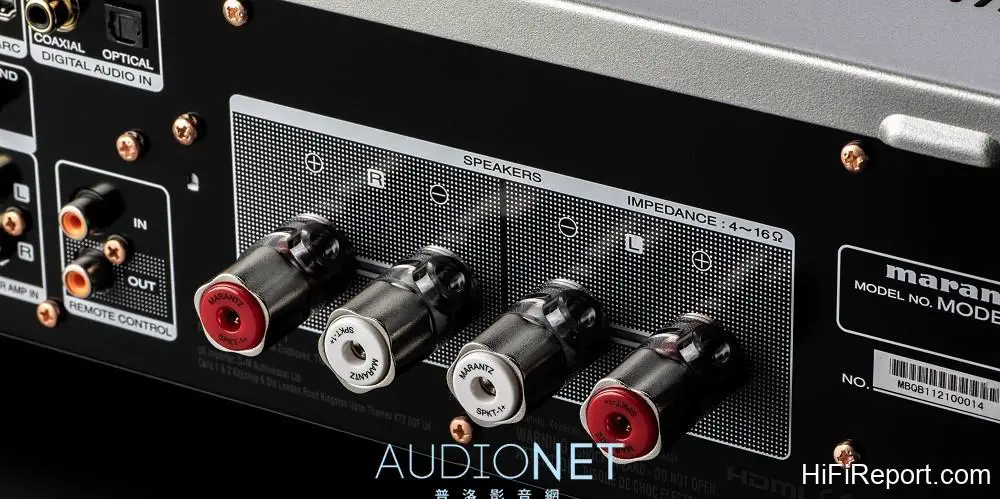
* Speaker output ×2
* Headphone ×1
* Dimensions (W × H × D): 443 × 130 × 432 mm
* Weight: 16.7 kg