
Marantz SR7015 Review
Just two months ago, I reviewed the Marantz SR6015, which stands as the third-highest model in the brand’s latest generation of surround sound receivers, positioned in the mid-range. This article introduces the SR7015, which sits above the SR6015. Outside of Japan, the SR7015 is the second-highest model in Marantz’s current lineup, just below the flagship SR8015, making it the “near-flagship” unit.
Purely looking at the price point, the SR7015 is slightly more expensive than the SR6015, placing it in the upper-mid-range, with a significant price gap between it and the flagship SR8015. A crucial evolution in this generation of new Marantz receivers compared to their predecessors is enhanced HDMI compatibility.
They are all equipped with one HDMI 2.1 input and output terminal, allowing them to connect to the latest digital sources (such as the Sony PS5 gaming console) and display equipment, supporting the pass-through of 4K/120P and 8K/60P digital video.
Channel Configuration and Processing
The SR7015 offers the exact same number of channels as the SR6015: it’s a 9.2-channel surround sound receiver with a built-in 9-channel power amplifier. Without adding an external power amplifier, this single unit can power a full 5.2.4 (5.1.4) or 7.2.2 (7.1.2) channel speaker setup. The SR7015 features 11.2 channels for digital audio decoding and processing, along with 11.2 channels for the main zone’s digital-to-analog conversion and preamplifier circuits.
Therefore, by simply adding a two-channel external power amplifier, it can simultaneously power up to 11.2 (7.2.4) channel speakers. In terms of power output, the SR7015 delivers 15 watts more per channel than the SR6015. The SR7015 not only decodes Dolby Atmos, DTS:X, and various past Dolby and DTS codecs but also supports Auro-3D and IMAX Enhanced.

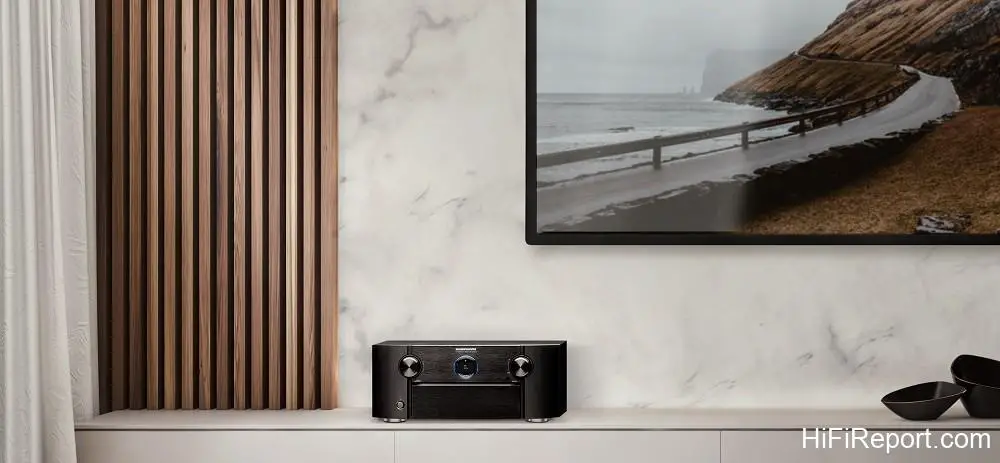
In today’s urban homes, space is often limited. Normally, the Marantz SR7015 is intended for users who want to set up a 5.1.4 (5.2.4) system. However, in reality, the proportion of users who utilize all output channels from a surround sound receiver in the main zone, and specifically install ceiling speakers, is not high, whether in Japan or Taiwan. Marantz conducted research many years ago and has a deep understanding of the realities and challenges faced by users.
This led them to be pioneers in offering comprehensive “virtual height speaker processing,” utilizing “Dolby Atmos Height Virtualization” for Dolby Atmos and “Virtual:X” for DTS:X. This technology allows the creation of a sense of height in the three-dimensional soundstage, envelopment from above, and the movement of sound images overhead, even without physical height speakers installed in the ceiling.
If the user of this unit doesn’t install height channel speakers, they will have 2 to 4 channels that can be used flexibly. In the SR7015’s “Amp Assign” settings, these can be configured as “5.1ch + Zone2/3.” For instance, you could have a 5.1-channel system in the living room and a pair of speakers in the study and dining room respectively.
This setup allows you to manage sound systems in three separate areas using just one SR7015 amplifier, effectively saving the cost of two integrated amplifiers. By installing the “Marantz AVR Remote” and HEOS App on your smartphone, you can control each room individually, perfectly balancing economy and convenience.
Connectivity and Streaming Features
The SR7015 has built-in Wi-Fi and Bluetooth (supporting wireless headphones). When connected to the network, it is compatible with AirPlay 2 and can access tune-in internet radio, TIDAL, and Spotify streaming services. Users can also use HEOS to select music stored on a smartphone or tablet and stream it losslessly via Wi-Fi to the SR7015 for playback. The SR7015 can also read music files shared from computers, NAS devices, and music servers in the home.
If you consider that family members might be using the network for online classes or watching videos, and you still wish to play Hi-Res music files, you can categorize and organize all your music files onto a USB storage device (including flash drives and USB hard drives formatted as FAT32 or NTFS) to create your music library. Simply insert it into the SR7015’s USB port, and you can select and play tracks via the HEOS App.
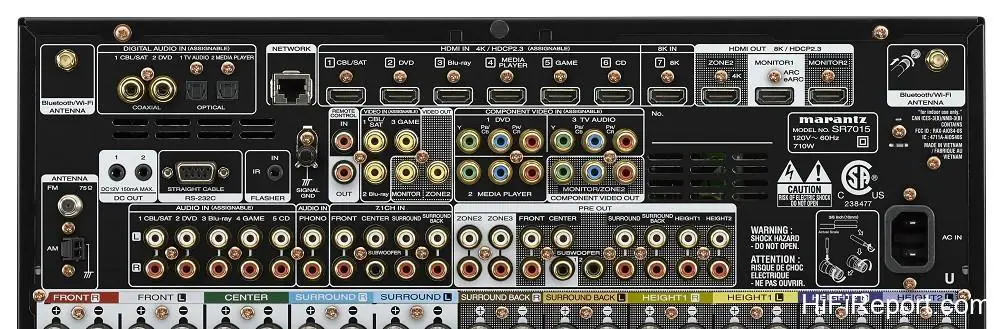
This ensures that even playing high bit-rate Hi-Res music files won’t affect the network’s performance for other family members.
The supported music file types on this unit include WMA, MP3, WAV, MPEG-4 AAC, FLAC, Apple Lossless, and DSD. Among these, FLAC, Apple Lossless, and WAV Hi-Res music files support formats up to 192kHz/24bit, while DSD (including dsf and dff) supports DSD64 and DSD128.

Internal Design and Components
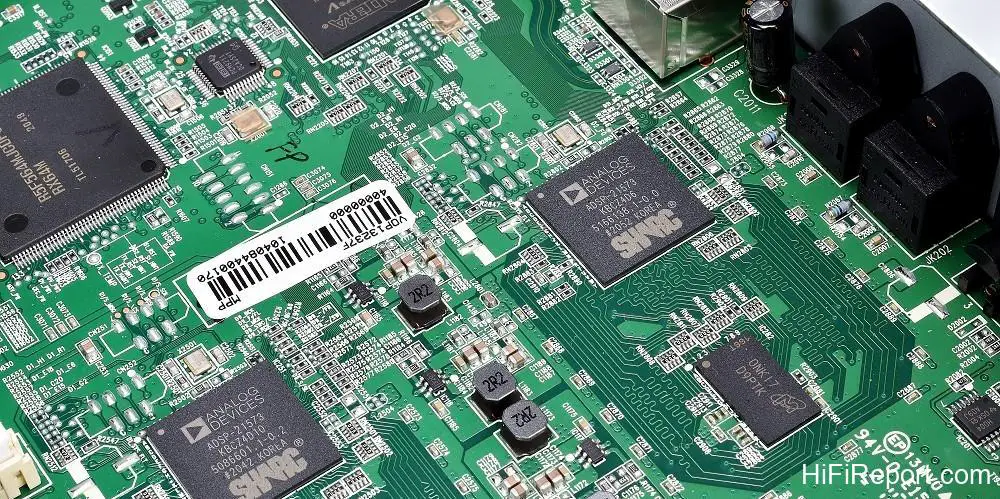
Next, let’s delve into the unit’s circuit structure. The internal layout of the SR7015 is similar to the SR6015, but there are significant differences in the actual components used. On the digital board, the SR6015’s digital audio processing circuitry utilizes a combination of a Cirrus Logic CS49844A 4-core DSP chip and an Analog Devices ADSP-21487 SHARC DSP. The SR7015, however, mirrors the flagship SR8015, using two dual-SHARC core Analog Devices ADSP-21573 chips for digital audio processing.
This results in a total processing capability of up to 2,000 MIPS, more than a twenty percent increase compared to the SR6015.

The digital audio circuitry is responsible not only for decoding multi-channel audio and two-channel music files but also for processing the highest level of Audyssey’s “MultEQ XT32” automatic room correction, IMAX Enhanced post-processing for IMAX and DTS related codecs, Dolby Atmos Height Virtualization and Virtual:X for virtual height channels, and Marantz’s “M-DAX2” processing which optimizes compressed audio quality by compensating for high and low-frequency response.
Mid-to-high-end surround sound receivers often incorporate a separate multi-channel digital-to-analog converter (DAC) board to achieve a higher signal-to-noise ratio (rather than placing the DAC circuitry on the main digital board), and the SR7015 is no exception. Marantz takes a somewhat unique approach by making the DAC board also function as a “connector board.”

This design minimizes the signal transmission path (reducing induced noise and noise emission) and reduces transmission loss caused by connections (connectors). Consequently, while other brands typically install their DAC boards horizontally, Marantz installs theirs vertically (standing up).
Before dismantling the unit, I already had a guess about where the SR7015’s DAC board was located. After opening it up and taking a closer look, I was surprised! It’s different from previous designs. Previously, Marantz’s mid-to-high-end surround sound receivers used “two” Asahi Kasei 32-bit “8-channel” DAC chips, the AK4458VN. This time, they’ve actually used “seven two-channel DAC chips,” specifically the TI (Burr-Brown) PCM5102A.

Could it be that Marantz is truly committed to making its surround sound receivers align completely with the design philosophy of two-channel audio equipment? In fact, this change was a design modification made in “response” to circumstances.
If you check the Marantz official website for the SR7015, the information you see states it uses two AK4458VN chips. This was the situation when the SR7015 was “just released internationally.” However, due to the fire at Asahi Kasei and the tight supply of chips, Marantz had previously announced that it would adjust the DAC chips used in some models, while also stating that the design change would not affect sound quality. Will it really not change?
Purely from component performance perspective, the PCM5102A’s dynamic range and distortion rate are slightly inferior to the AK4458VN. However, in terms of circuit structure, I believe grouping channels in pairs (using PCM5102A) will achieve higher channel separation than grouping them in sets of eight (using AK4458VN). This is one of the advantages of this “two-channelization” approach.
In the preamplifier section, this unit features proprietary high-speed amplifier modules (HDAMs) composed of transistors and passive components, replacing the OP Amp chips commonly used in typical surround sound receivers for high-level amplification. Employing a current feedback method allows for wide frequency response characteristics. Before the high-level amplification circuit, the Phono Stage corresponding to the turntable input also utilizes HDAM.
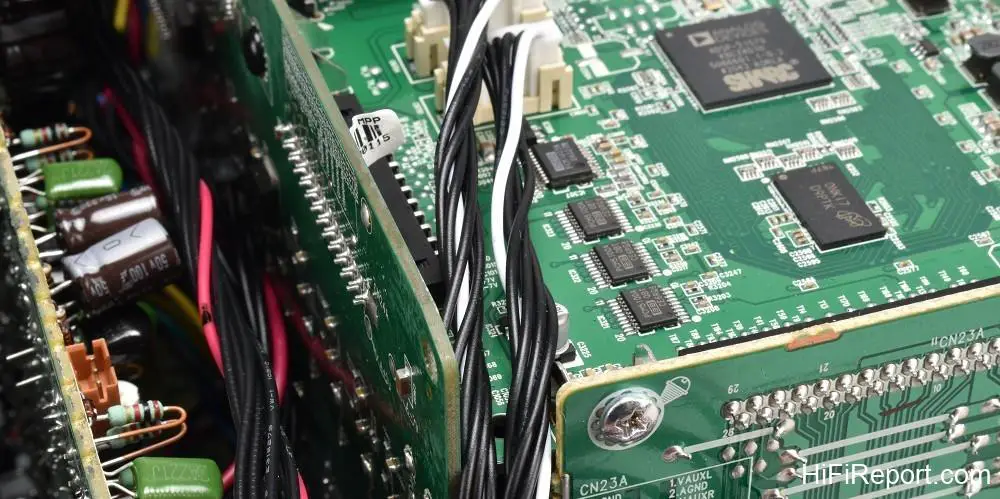
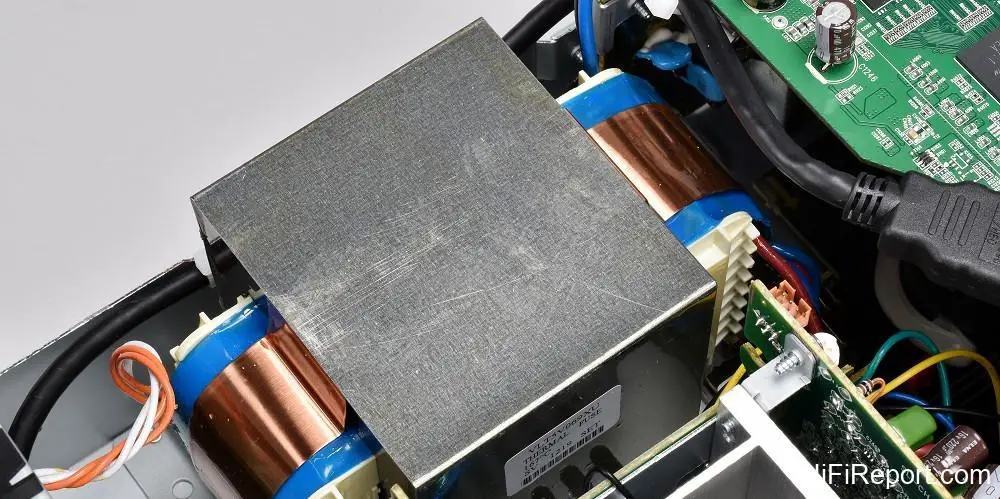
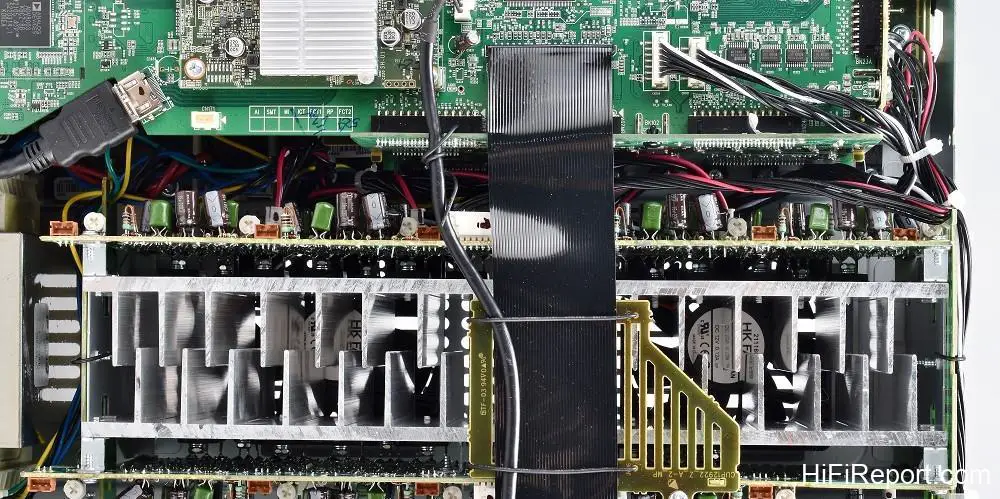
In terms of power amplification circuitry, the unit’s 9-channel power amplifier circuit adopts a configuration of “front 4 channels, rear 5 channels.” The circuit structure for each channel is identical, with each channel using a pair of Sanken Darlington transistors, 2SB1647 / 2SD2560, capable of 15 amperes of current output in a push-pull configuration. The power supply circuitry features separate power for digital (switching power supply board) and analog (EI transformer) sections.
The power supply for the power amplifier circuits uses two Nichicon audio-specific 15,000μF/71V filter capacitors custom-ordered by Marantz, resulting in a total filtering capacity that is twenty-five percent higher than the SR6015.
Listening Impressions
For this listening test, I used a 5.1.4 channel speaker configuration. The main accompanying equipment was still Pioneer EX series speakers and an M&K X10 subwoofer. Every time I enter the listening phase for a Marantz surround sound receiver, I inevitably find myself smiling when I start playing music in two-channel mode. This was even more true when listening to the SR7015. I began by selecting the Pure Direct mode (subwoofer off, full-range drive for the Pioneer S-1EX floorstanding speakers).
Its rounded, mature sonic character, sound quality, and warmth genuinely make it sound less like a surround sound receiver and more like a two-channel integrated amplifier.
Compared to its predecessor, the SR7013, I believe the SR7015’s sound is smoother, more dense, and richer in flavor. Listening to jazz and Western songs from the 60s and 70s, you can feel the taste of analog recording more distinctly. The SR7015’s low-frequency thickness and stability are quite impressive. Listening to Macy Gray sing “Stoned,” you can feel the warmth and thickness of the midrange. It fully expresses the luster of pianos and cymbals, and the tone of violins is sweet.
Even at high volumes, the treble doesn’t tend towards excessive brightness. I particularly appreciate how the SR7015 showcases texture and high-resolution characteristics with its “delicate yet direct midrange.”
If you are skilled at speaker placement, I highly recommend listening to music in Pure Direct mode. In Pure Direct, you can barely hear any hiss (the difference from Stereo is quite noticeable). The reduction in impurities results in pure and transparent sound, allowing the listener to better perceive subtle changes in instrument timbre and the presence of tiny sounds.
The Stereo mode, on the other hand, utilizes Audyssey MultEQ XT32 to help users overcome room response issues, especially left-right symmetry and low-frequency standing waves. In a 2.1-channel setup (subwoofer crossover point at 80Hz), the SR7015’s bass sounds solid, clean, and fast. The proportion of sound from the subwoofer is just right, and there are no noticeable gaps in the low-frequency transition between the left/right channels and the subwoofer.
In terms of movie sound performance, I believe the SR7015 exhibits three outstanding characteristics: First is its excellent sense of space. Perhaps because the structure of the digital-to-analog conversion circuit is conducive to improving separation, in outdoor scenes, you can feel the soundstage extending outwards very broadly, and you can clearly ” pinpoint” the location, height, and movement of various objects in the space by ear. Second is its “micro-detail resolution.”
The SR7015’s sound is quite realistic and pure. The sound of wind in quiet scenes, the dry rustling of withered leaves being blown across the ground, the sound of footsteps on a wet floor in a dark warehouse… these tiny, realistic sounds make you feel more immersed, especially for users watching movies in a dark environment with a projector.
The third characteristic is the excellent “virtual height soundstage” effect. In the final stage of the testing process, I set the height speakers to None and listened to the effects of Dolby Atmos Height Virtualization and Virtual:X. I believe the SR7015’s virtual height soundstage effect is close to about eighty percent of the effect achieved with a pair of “physical” height speakers.
Given that Marantz originated as a two-channel amplifier company, music performance has always been one of the strengths of their surround sound receivers. Evaluating based on price and actual sound performance, I believe it is truly remarkable that Marantz has managed to keep the reference price of this near-flagship model under the approximate equivalent of $2,900 USD, especially during this time of significant increases in material costs and shipping fees.
With its excellent cost-performance ratio, balancing both movie sound effects and music, the SR7015’s overall performance is truly commendable and deserves our Best Recommendation.
Specifications
* Type: 9.2-channel Surround Sound Receiver
* Number of Power Amplifier Channels: 9 channels
* Number of Processing Channels: 11.2 channels
* Power Output (Two-channel): 125 Watts per channel (8 ohms)
* Maximum Output Power (Single Channel): 235 Watts (6 ohms)
* Signal-to-Noise Ratio: 100dB
* Frequency Response: 10Hz~100kHz (+1,-3dB)
* Distortion Rate: 0.005% (20Hz~20kHz)
* HDMI Terminals: 8 in, 3 out
* Composite Video Terminals: 4 in, 2 out
* 3RCA Component Video Terminals: 3 in, 1 out
* Two-channel Audio Inputs: ×7
* Network Terminal: 1 set
* USB Terminal: 1 set
* Digital Audio: Optical Input ×2, Coaxial Input ×2
* 7.1 Channel Analog Input Terminal: 1 set
* Headphone Output Terminal: 1 set
* 11.2 Channel Pre-out Signal Terminal: 1 set
* 11 Channel Speaker Terminals (maximum simultaneous output of 9 channels): 1 set
* Wi-Fi/Bluetooth Antenna Terminals: ×2
* FM/AM Antenna Terminals: 1 set each
* Dimensions (W×H×D): 439×185×411mm
* Weight: 14.2 kg