
Marantz SR6014 Review
This review introduces the SR6014, Marantz’s latest mid-range AV receiver featuring 9.2 channels. It boasts built-in 9-channel power amplification and two subwoofer outputs, allowing users to configure 5.1.4 (5.2.4) or 7.1.2 (7.2.2) speaker setups right out of the box.
The main zone’s pre-amp processing capability extends to 11.2 channels, meaning you can expand the total channel count to 7.1.4 (7.2.4) by simply adding a two-channel power amplifier to drive either the “rear surrounds” or “rear heights.”
At this price point, having this channel count is expected. Newer mid-to-high-end AV receivers are now capable of decoding both Dolby Atmos and DTS:X audio and fully compatible with 4K video (including upscaling SD and HD video to 4K). Multichannel enthusiasts know that installing “height speakers” is the key to experiencing the sense of height that defines 3D audio.
However, realistically, many potential users are deterred by the time, effort, and significant cost involved in installing ceiling speakers, leaving them unable to experience the 3D audio capabilities of their newly purchased AV receiver.
Addressing the Height Speaker Hurdle
DTS recognized this practical problem early on and developed DTS Virtual:X technology. This technology not only allows soundbars to virtualize surround speakers but also virtualizes height channels. Marantz was quick to adopt this, releasing AV receivers with built-in DTS Virtual:X as early as 2017.
The previous generation model, the SR6013, already had this feature: even if the user “doesn’t have height speakers installed,” they could select the “DTS:X + Virtual:X” mode when playing DTS:X content to experience 3D audio. Furthermore, DTS-HD content could be upmixed using “DTS-HD + Virtual:X” to transform the original 5.1 or 7.1 channel sound into a soundstage with “virtual height channels,” which was a significant boon for users unable to install height speakers.
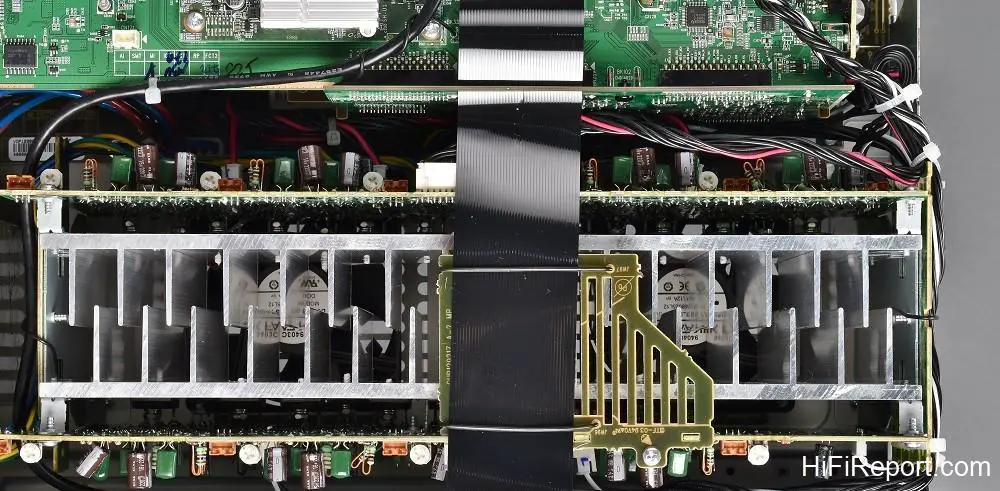
In addition, IMAX has partnered with DTS to promote “IMAX Enhanced.” Whether playing IMAX Enhanced content or standard DTS-HD and DTS:X audio, the SR6014 can use physical height speakers to reproduce the IMAX sound. Crucially, in the absence of height speakers, it can also utilize “IMAX DTS + Virtual:X” to virtualize the overhead soundstage.
However, did you notice the problem? DTS and Dolby are rivals. DTS Virtual:X could virtualize height speakers for DTS’s own encoded formats and even process multichannel PCM and two-channel audio. Yet, it completely ignored “Dolby-related” encodings. Therefore, the previous implementation of DTS Virtual:X for virtual height speakers felt like only half the job was done.
This time, the SR6014 finally completes the missing half: it includes “Dolby Atmos Height Virtualization.” While the name might suggest it only processes Dolby Atmos for virtual height channels, in reality, it can process not only Dolby Atmos but also any format that is “not DTS-related,” such as Dolby TrueHD, and even two-channel audio. By activating the Dolby mode, it can use this new feature to process a virtual overhead soundstage.
Connectivity and Features
In terms of streaming capabilities, the SR6014 is identical to the SR6013. It can play music files from a NAS or PC over the network, stream music from a smartphone, or play files from a connected USB storage device. Supported file types include WMA, MP3, WAV, MPEG-4 AAC, FLAC, Apple Lossless, and DSD. For multi-bit Hi-Res music files, it supports formats up to 192kHz/24bit, while DSD is supported up to DSD128 (5.6MHz).
The SR6014 also features a significant upgrade in Bluetooth capabilities: while the SR6013 used Bluetooth version 3.0 + EDR, this unit uses version 4.1. I was initially puzzled because I wasn’t the first to review the SR6014, and Bluetooth 4.1 should theoretically be bidirectional (able to receive and transmit digital audio). Why hadn’t I seen any reports online about the SR6014 being able to connect to Bluetooth headphones? Later, I understood.
After upgrading the SR6014 to the latest firmware, it truly *can* connect to Bluetooth headphones. Furthermore, you can even configure whether the main speakers should still output sound when Bluetooth headphones are connected. If the speakers are set to mute, they will resume normal playback once the Bluetooth headphones are turned off.

Internal Design and Audyssey Calibration
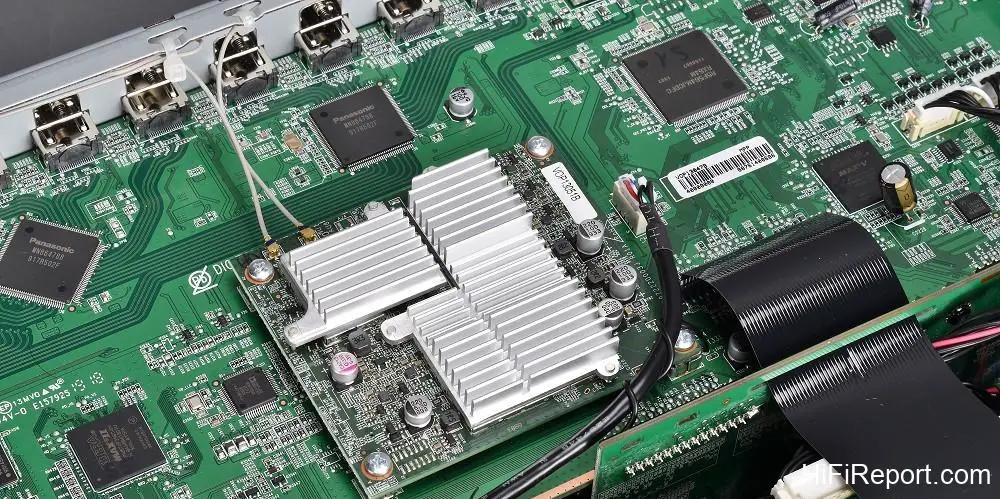
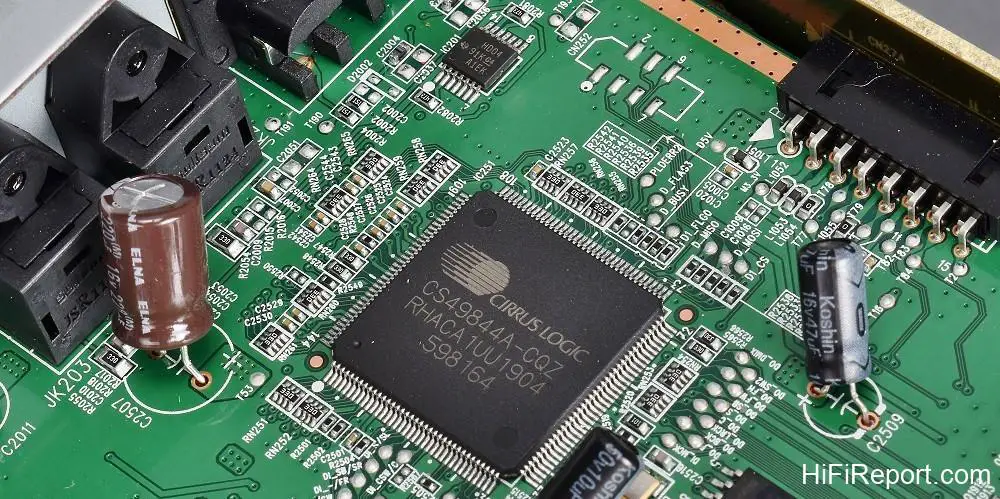
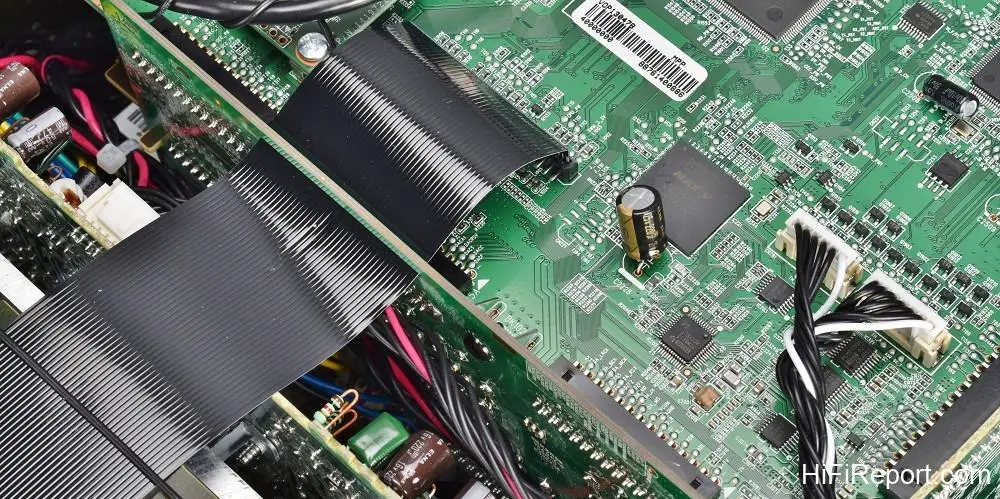
The SR6014 shares a high degree of circuit similarity with its upper-tier sibling, the SR7013, including circuit layout, technology application, and components. The digital main board also features the HEOS network card. The main difference lies in the digital audio processing circuitry; the SR7013 uses four SHARC DSP chips, whereas this unit uses a single Cirrus Logic CS49844A.
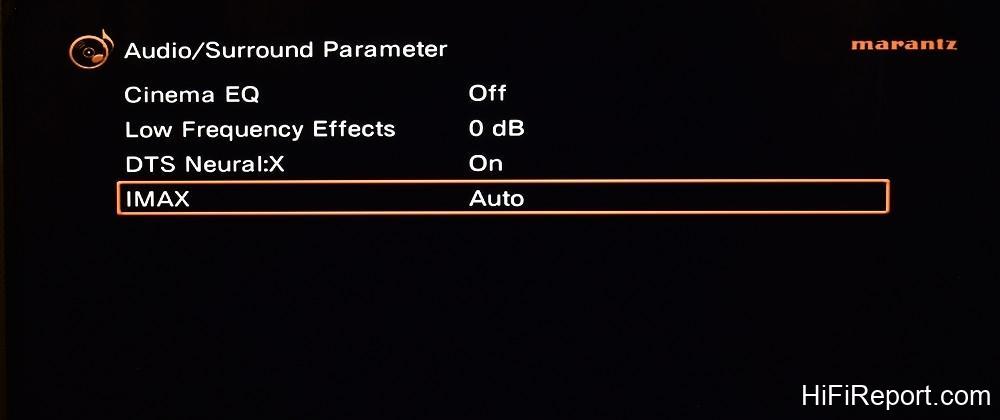
However, even with a simpler structure, the SR6014 still includes Audyssey’s highest-tier automatic room correction, MultEQ XT32.
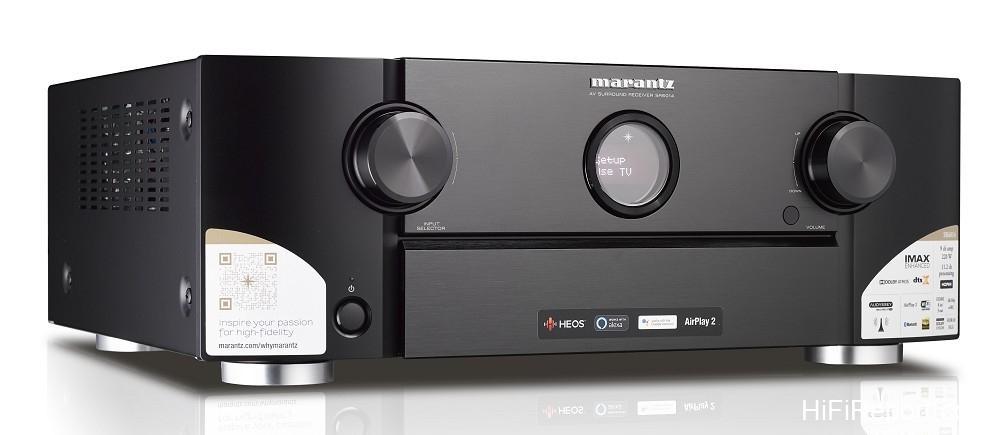
To reduce noise, the unit’s main zone digital-to-analog conversion (DAC) circuit is built on a separate board, utilizing two AKM 32-bit/8-channel DAC chips (AK4458VM) for conversion. The pre-amp section uses Marantz’s exclusively developed HDAM (Hyper Dynamic Amplifier Module) high-speed amplification circuits, composed of discrete components, which offer wide frequency response characteristics.
It includes a Phono input for connecting a turntable, and even the Phono Stage uses the same HDAM circuit for RIAA equalization, not just relying on simple OPA chips.
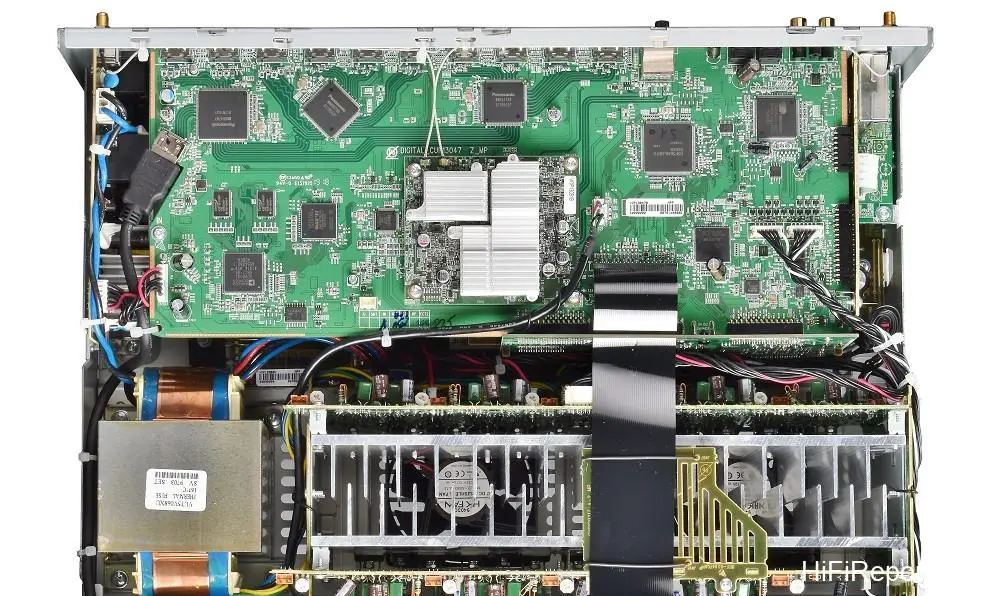
The unit’s 9-channel power amplification circuit is constructed on two separate boards. The amplifier boards for the main channels (front three channels and surround channels) are positioned closer to the pre-amp and power supply circuits to shorten the signal and power transmission paths. Following the design of the SR7013, each channel’s output stage uses a pair of Sanken Darlington transistors (2SB1647 / 2SD2560) in a push-pull configuration, capable of a maximum output current of 15 amperes.
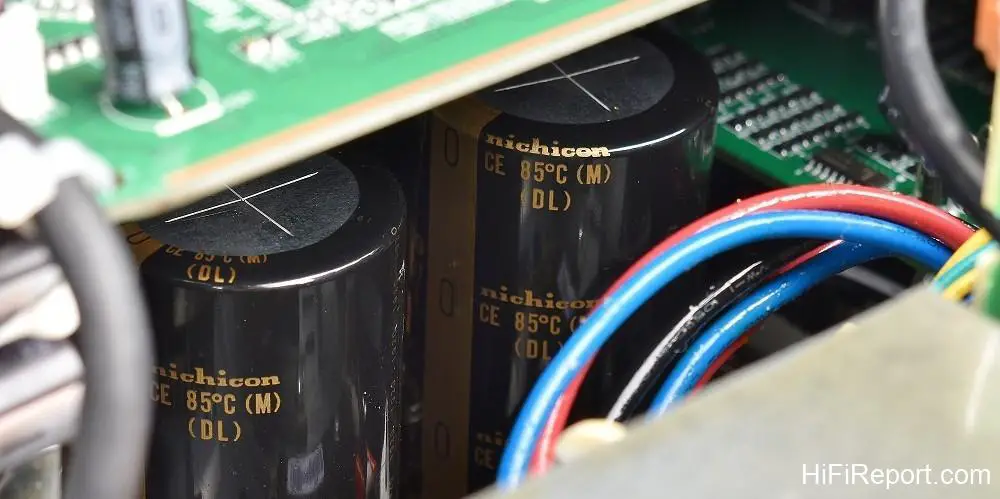
In the power supply section, the SR6014’s audio circuits are powered by a copper-shielded EI transformer. Two Nichicon 12,000μF/71V audio-grade electrolytic capacitors serve as the filtering capacitors for the 9-channel power amplifiers.
Listening Performance
I connected the unit to a 5.1.4 channel speaker setup. After completing the configuration, I first tested with two-channel music content. I could feel that the drive capability and sonic character of this new unit are quite similar to the upper-tier SR7013. Listening to music in Pure Direct mode, the background was quieter than in Stereo mode. Driving the Pioneer S-1EX floorstanding speakers across the full frequency range (with the subwoofer muted), the bass was solid and powerful.
The excellent control resulted in fast and clear low frequencies. The mid-range and treble were clear and direct. The entire frequency spectrum sounded pure, agile, and energetic.
Before testing multichannel movie sound, my usual approach is to “listen to multichannel music first.” My goal is to determine the nature of the AV receiver’s automatic room correction: is it the type that “deliberately exaggerates subwoofer volume” to overemphasize movie effects, or is it a “neutral and accurate calibration”?
While the former might make mid-to-low-priced units sound more powerful, it’s not the correct method; it falls apart when playing multichannel music, resulting in excessive and muddy bass below 100Hz.
The SR6014 belongs to the latter category. It adjusts the output level of the subwoofer very accurately. Provided the subwoofer itself is capable, it seamlessly integrates the active subwoofer’s output with the low-frequency response of each main channel speaker in terms of both speed and energy. Furthermore, it drives the bass frequencies handled by the main channel speakers “above the subwoofer’s crossover point” with great solidity.
Consequently, when playing movie soundtracks, it delivers powerful, “muscular” bass. The unit exhibits low coloration across the entire frequency range, resulting in a pure, “haze-free” sound. This gives the 3D soundstage high transparency, making it wide and deep. Even at moderate volumes, you can clearly discern the form of each sonic object and trace its movement path and distance/proximity within the space. Vertical movement is also very clearly defined.
I also used the two IMAX Enhanced titles, “Zombieland: Double Tap” and “The Angry Birds Movie 2,” to compare the difference with and without the IMAX effect. Clearly, with IMAX enabled on this unit, the sound density was higher, the 3D soundstage became richer and denser, and the physical presence of each sonic object was stronger (with more weight). Dialogue, especially male voices, sounded fuller and richer. This delivered a stronger sense of being “present in the scene” for the listener.
The richer movie sound also brought it closer to the experience of a cinema screening room. I also auditioned the SR6014’s post-processing effect using IMAX Enhanced on DTS-HD MA and DTS:X movie content. Frankly, I feel that IMAX can indeed optimize DTS-related audio, but the “degree” of optimization was not as significant as when playing native “IMAX Enhanced” content.
Evaluating Virtual Height Performance
The second phase of testing focused on the “virtual height speaker” effect. To activate this function, Top Front and Top Rear must be set to None. So, I was effectively using the SR6014 to “simulate the effect of a 5.1.4 channel setup using 5.1 speakers.” When playing Dolby Atmos content without using the virtual height speaker function, there was no overhead soundstage; the area above the listening position felt “empty.”
When the virtual height speaker function was enabled, there was a clear sense of overhead envelopment, and I could discern the differences in the height of various sonic objects. If I hadn’t set up the SR6014 myself and were listening without knowing, I would genuinely have thought there were height speakers present!
I was curious how big the difference is between “Dolby Atmos Height Virtualization” and “Dolby Atmos with physical height speakers.” So, I compared several identical movie clips by switching between setting the height speakers to small (physical) and none (virtual). After listening and comparing, I believe that when playing Dolby Atmos content, the SR6014’s virtual height speakers achieve approximately 80% of the effect of physical speakers.
The sense of overhead envelopment and density is very similar, only the virtual overhead soundstage’s impact and solidity directly above the head are slightly weaker compared to physical speakers.
The effect of the unit using DTS Virtual:X to virtualize DTS:X overhead channels is similar to Dolby Atmos. Under the condition of not having height speakers installed, using the “virtualization” creates an overhead soundstage and sense of envelopment, which is definitely much better than having “no virtualization.” You might want to ask whether Dolby or DTS has better virtual overhead audio.
I wish I could tell you, but Dolby and DTS primarily process “their own encodings,” and their virtual sound technologies cannot be used interchangeably. Therefore, it’s difficult to judge which is superior using identical movie content. However, when playing 5.1 or 2.0 (PCM) music content, my personal preference is to use Dolby Surround with virtual processing, as the overhead soundstage sounds more natural.
Conclusion and Value
In terms of performance, the SR6014 delivers excellent movie audio (especially IMAX Enhanced). When playing music, the sound quality is pure and balanced. Judging its performance relative to its price, its high value for money definitely qualifies it for a top recommendation. This time, I carefully auditioned the unit’s virtual overhead soundstage processing. I initially expected the virtual overhead audio to be subtle, almost imperceptible, but the actual results far exceeded my expectations.
The sense of overhead envelopment and density genuinely sounded like physical height speakers were installed. If you’ve concluded that your home environment simply cannot accommodate physical height speakers, please place the SR6014 at the top of your audition list.
And don’t let the “extra channels” go to waste if you don’t connect height speakers: they can be configured for bi-amping your left and right front speakers to improve two-channel music performance, or set up as “Zone 2” to drive a pair of speakers in another room for music listening.
Specifications
* Type: 9.2 Channel AV Receiver
* Number of Powered Channels: 9 Channels
* Processing Channels: 11.2 Channels
* Power Output (2 Channels Driven): 110 Watts per channel (8 Ohms)
* Maximum Output Power (1 Channel Driven): 220 Watts (6 Ohms)
* Signal-to-Noise Ratio: 100dB
* Frequency Response: 10Hz ~ 100kHz (+1, -3dB)
* Total Harmonic Distortion: 0.005% (20Hz ~ 20kHz)
* HDMI Terminals: 8 In / 3 Out
* Composite Video Terminals: 4 In / 1 Out
* Component Video Terminals: 2 In / 1 Out
* 2-Channel Audio Inputs: 6
* Network Terminal: 1
* USB Terminal: 1
* Digital Audio Inputs: Optical x2, Coaxial x2
* 7.1 Channel Analog Input Terminal: 1
* Headphone Output Terminal: 1
* 11.2 Channel Pre-out Terminals: 1
* Speaker Terminals: 11 Pairs (Maximum 9 channels simultaneously)
* Wi-Fi / Bluetooth Antenna Terminals: x2
* FM / AM Antenna Terminals: 1 each
* Dimensions (Width × Height × Depth): 440 × 161 × 398 mm
* Weight: 12.8 kg