
Matrix Silver Speaker Cables Review
Every time I encounter products from Stein Music, I find myself scratching my head. Their creations are so unique that it’s sometimes hard to know where to even begin describing them.
My first experience with Stein Music was their renowned Harmonizer, used in conjunction with Magic Stones tuning blocks. This combination could make music flow naturally, dramatically altering the listening experience. It’s been years since that encounter, but the memory remains vivid.
I’ve also used their Quantum Organizer, which, on the surface, appears to be just a simple piece of wood. Yet, mysteriously imbued with minerals, placing it under audio equipment audibly changed the sound.
Even more perplexing are the E-Pads Plus damping stickers. It’s genuinely difficult to comprehend how such tiny stickers can transform a system’s sonic performance. Throughout my experiences writing about their products, I’ve always proceeded with caution.
In today’s world of readily available information, everyone can position themselves as an expert offering definitive pronouncements. Anything I write can be scrutinized, criticized, and dissected. In this age where everyone can be a media outlet, professional media personnel should adopt an even humbler posture.
Nearly two thousand years ago, the Apostle Paul already articulated this wisdom in the New Testament’s First Epistle to the Corinthians: there is much we do not understand, and in what we think we know, we still remain ignorant (Chapter 8, Verse 2, paraphrased).

Faced with Stein Music products, I dare not claim definitive explanations, because I genuinely don’t fully grasp them. Any principles or theories I might touch upon are merely what the manufacturer states, perhaps rephrased in more accessible language. If something remains incomprehensible, I’m content to let it be. The crucial point is whether you can hear a difference, and if the direction of sonic change is to your liking.
These experiences have taught me a valuable lesson: in the realm of audio, humility is paramount. This is especially true for audio journalists and reviewers.
Natural Wood Connectors
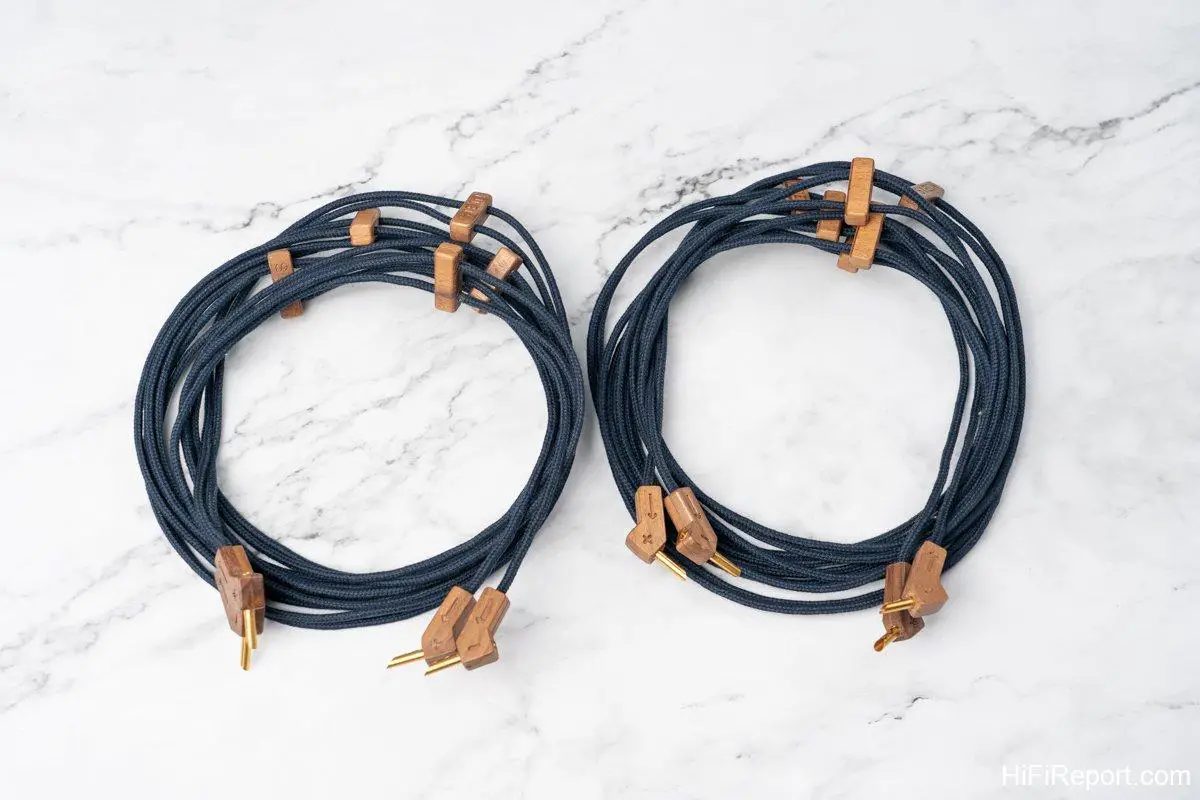
Stein Music’s newly released Matrix Silver speaker cables are deceptively unassuming. The slender, deep blue cable body, resembling a round shoelace or binding cord, is visually unremarkable. However, the wooden housings of the speaker connectors, combined with wooden blocks securing the cable every 50 centimeters, hint at something more intriguing, prompting deeper investigation.
The gold-plated banana plug connectors feature housings crafted from natural oak, shaped into a gun-like base. These are marked with “+” or “-” symbols to differentiate polarity, and arrows to indicate connection direction. While most connectors are made of metal, Stein Music opts for wood, recognizing that larger and heavier metal connectors can negatively impact sound. Utilizing non-magnetic wood significantly reduces the amount of metal in the connector area, mitigating the traditional connector-induced coloration.
Furthermore, the connector barrels are open at the back, allowing users to insert jumpers or Stein Music’s Speaker Match devices. This design is quite unconventional.

Separated Conductors, Pure Silver
The cable consists of two separate strands, one for positive and one for negative, each running independently. The conductors are made of pure silver, encased in a natural fiber braided jacket. The conductor surfaces are treated with Stein Music’s proprietary Maestro tuning lacquer, acting as resonance damping to minimize cable-borne vibrations. This tuning lacquer is also available for retail sale and has a wide range of applications, from cables and drivers to circuit boards and even CDs. I previously reviewed Stein Music speakers where the driver surfaces were coated with Maestro tuning lacquer.
The Matrix Silver’s separated positive and negative conductors are held apart and spaced by wooden blocks. This design aims to reduce capacitance, which can be elevated when conductors are placed too closely together. Holger Stein is known for his novel ideas, but in core products like speaker cables, his design principles remain grounded in fundamentals, addressing conduction, vibration damping, and capacitance.
Musicality and Single-Core Character
Beyond the somewhat enigmatic aspects of Stein Music products, they share a common trait: their inclusion invariably enhances the musicality of a system’s sound. I experienced this with their Harmonizer, and subsequently with their Quantum Organizer, record mats, damping pads, and power distributors. Their speakers and cables also share this characteristic – they don’t seek immediate sonic fireworks, but rather, over time, they warm and even melt your heart. They serve as conduits for music.
The Matrix Silver is no exception. It possesses its own distinct personality, which, to my ears, exhibits qualities reminiscent of single-core cables, particularly single-core silver cables. There’s a clear, defined sense of line, delineating precise and three-dimensional imaging, a rich, full-bodied texture, and a gentle, effortlessly extended sheen. Sonically, there’s no hint of unnatural coloration or bias. If one were to nitpick, it might be the subtle, delicate sweetness and fragrance, especially captivating when listening to piano.
Rich and Beautiful Piano Tone
Take, for instance, Chen Sa’s rendition of Chopin’s Nocturnes. While countless classic recordings of these pieces exist, Chen Sa’s complete set proudly stands alongside those of the masters. She demonstrates not only nimble, agile fingers but also nuanced touch, resulting in Nocturnes that are not just colorfully vibrant but also possess a sense of depth and perspective. In Op. 9, for example, Chen Sa avoids excessive personal indulgence, instead gently and clearly articulating the melodies and harmonies. The Matrix Silver effectively conveys the emotional shifts in the B-flat minor Op. 9, No. 1 as it modulates and crescendos, while also subtly portraying the nuanced emotions within the rubato tempo.

Listening to Chen Sa’s rendering of the breathtakingly ornate embellishments in Op. 9, No. 3, one marvels at how, after the dazzling arpeggios, the music immediately regains composure. The counterpoint between the left-hand accompaniment and the right-hand melody is like a mesmerizing pas de deux.
Textured, Rich, and Hydrated Sound
Moving to Yo-Yo Ma and Kathryn Stott’s “Songs of Comfort & Hope” album and their arrangement of the American folk song “Shenandoah,” the piano begins with steady single notes, while the cello hints at the thematic melody with pizzicato. Subsequently, the piano shifts to chords, and the cello switches to arco, revealing the lyrical and flowing main theme.
The piano’s texture is rich and beautiful, possessing not only density but also fullness and a sense of “hydration.” The reverberation is perfectly judged, carrying a touch of warmth and captivating sheen. The cello’s texture is authentic and intimate, allowing one to perceive not just the friction of bow on string but also the rich resonance of the instrument’s body.
In “Goin’ Home,” an adaptation of the second movement of Dvořák’s Symphony No. 9, the Matrix Silver’s rich and hydrated texture exquisitely refines and details the nostalgia conveyed in the interplay between cello and piano. Ultimately, fidelity is relatively easy to achieve; capturing the spirit is the true challenge. While others pursue high fidelity, Stein Music aims for soul, emotion, expression, and thought.
Deep, Full, and Clean Bass
Don’t let the Matrix Silver’s slender profile mislead you into thinking it lacks energy or bandwidth. On the contrary, the Matrix Silver boasts a wide bandwidth with naturally effortless extension at both ends. For example, Markusphilippe’s duo performance, featuring saxophone and double bass, not only highlights the Matrix Silver’s image delineation but also its rich yet clean low frequencies.
In “Angel Eyes,” the opening double bass pizzicato is crisp and clean, resulting in exceptionally clear and three-dimensional note articulation. It’s almost as if you can see the plucking motion, with each note released from the fingertips being full and substantial. This opening is truly captivating. The raspy and gritty saxophone then enters, connecting the melodies hinted at by the double bass. The saxophone’s sound, created by air compressing the reed and vibrating through the tube, constructs a weathered and masculine tone.
Moving to Arne Domnerus and Gustav Sjokvist’s “Antiphone Blues” album, recorded in a stone church, the organ resonates with rich harmonies. In the higher registers, the timbre is colorful and beautiful, while the pedal keyboard explores the depths, grounding the music. The organ’s majestic presence, even in a blues context, retains its grand scale. The saxophone, bathed in the rich reverberation, displays a powerful sonic presence rarely heard in typical jazz or popular music performances.
From these two saxophone-centric albums, we can appreciate the Matrix Silver’s impressive detail retrieval capabilities.
Layered, Powerful, Dynamic, and Lively
When reproducing large-scale works like Mahler’s Symphony No. 3, the Matrix Silver resolves clear and distinct layers while maintaining a cohesive and full-bodied sound. The former is a display of sonic performance, while the latter reflects its pursuit of musical essence. A layered and spatially defined soundstage is crucial for Mahler’s music, as it determines whether we merely perceive the musical content or truly experience the music’s presence.
The first movement opens with the first theme boldly stated by a unison horn fanfare, leaving no room for ambiguity. Mahler strategically places brass and percussion throughout the movement. The timpani, responding to the brass, are powerful, and the trumpets sound short, signaling motifs, both generous and passionate. The violins accompany with soft tremolo, and these subtle details are rendered clearly and vividly.
The third theme depicts the forest awakening as Pan awakens. The legato theme played by the oboe, subsequently repeated by a solo violin, showcases clear instrumental placement. The muted trombones, with their slightly rough, warm, yet resonant timbre, sound incredibly vibrant. Layered, powerful, dynamic, and lively – without hearing it firsthand, it’s hard to imagine that such a slender and unassuming cable like the Matrix Silver could deliver such outstanding performance.
Conveying Musical Nuance and Spirit
Have you tried Stein Music products? If you’re still hesitant about their unique accessories and devices, perhaps you should start with their core products, like the Matrix Silver speaker cables. While lacking a bulky, imposing build or opulent ornamentation, it excels at conveying the inner (yùnwèi – charm, appeal) and spirit of music. Do you seek the external or the internal? Matrix Silver poses this question to you.