
Stein Music Powerbar 6 Power Conditioner Review
Do you use a power conditioner for your home audio system? When it comes to power, every manufacturer has their own theories, and users often have strong opinions.
However, one thing is certain: power is crucial. Treating your power supply with care is treating your audio system well, and the system will reward you with improved sound.
Recently, I had the opportunity to experience Stein Music’s approach at HiFiReport, located in the bustling Gongguan district.
Mr. Chen of HiFiReport has been the distributor for German brand Stein Music for many years. Every time I meet him, he shares his latest insights and discoveries.
He is a passionate audiophile who turned his passion into a profession, a life change that occurred after encountering Stein Music.
He explains that Holger Stein, the head of Stein Music, has a simple philosophy: to achieve natural and balanced sound. However, the interplay between audio equipment and the listening space introduces numerous interferences. These interferences compromise musicality.
Therefore, Holger’s goal is to eliminate these interfering factors and restore the inherent musicality.
This philosophy deeply resonated with Mr. Chen. Although HiFiReport also distributes many other brands, their audio philosophy is essentially an embodiment of Stein Music’s principles.
Having known Mr. Chen for years, I’ve come to see HiFiReport as Stein Music in Taiwan.
To truly understand Stein Music’s products, hands-on experience and personal exploration are valuable, but asking Mr. Chen directly is the quickest and clearest path.
Therefore, even for a power conditioner, I had to visit HiFiReport to investigate.
Material Mix: Aluminum, Carbon, Wood Enclosure
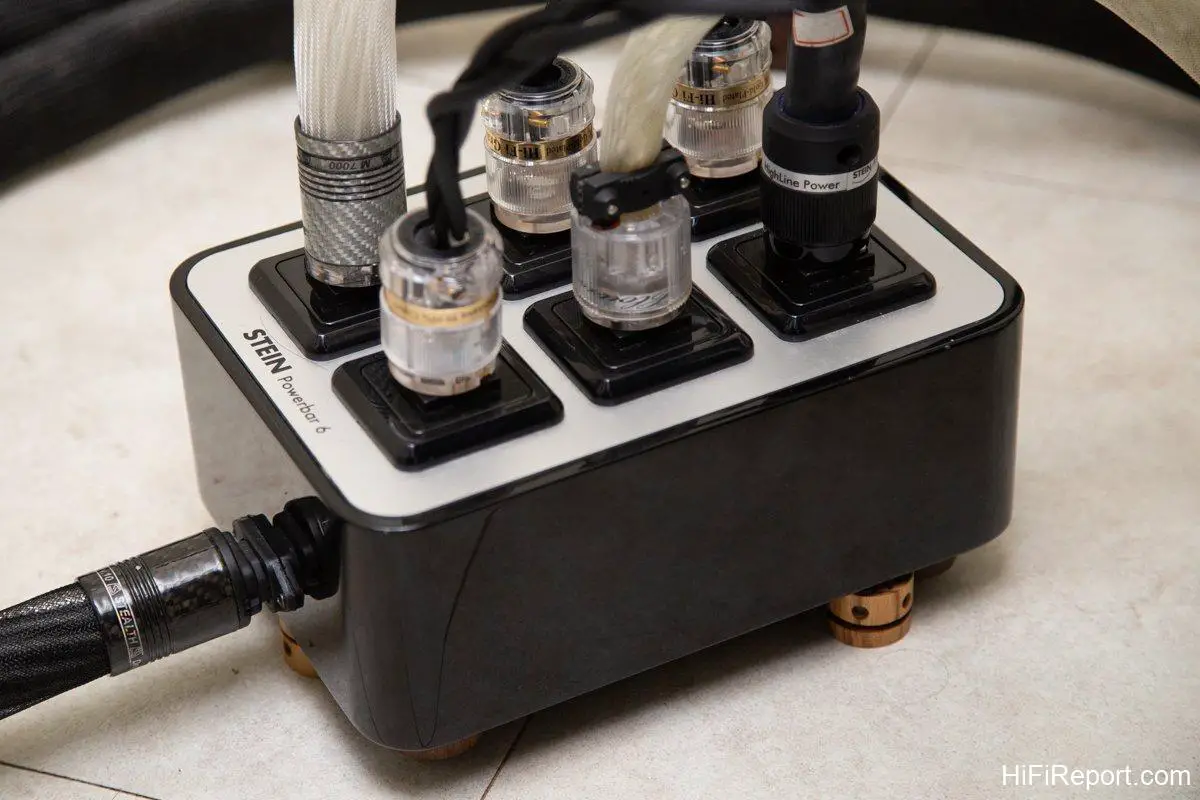
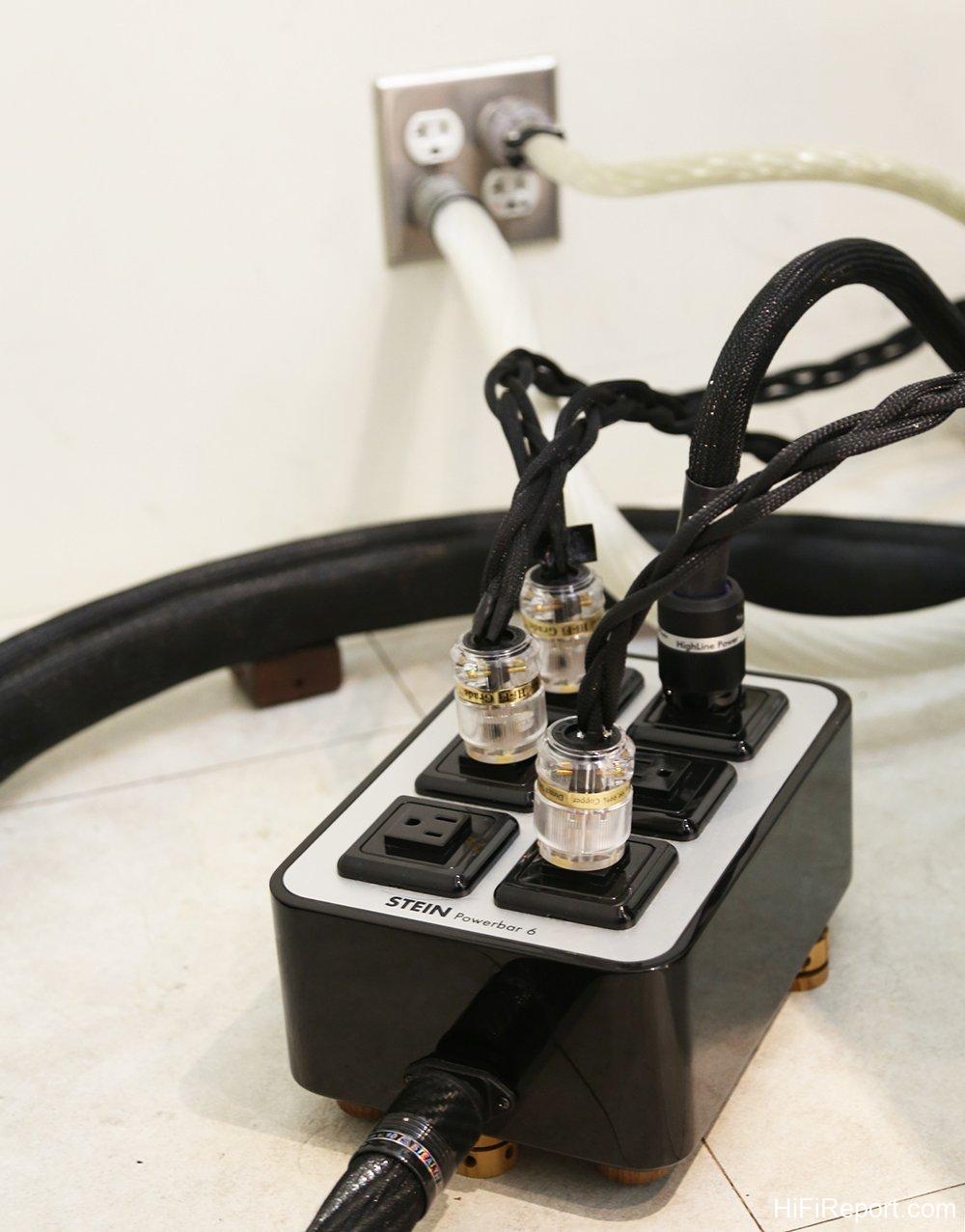
The power conditioner I tested is called the Powerbar 6. As the name suggests, it is a power strip with 6 output sockets.
Despite having only 6 outlets, the Powerbar 6 is not small. It is taller than typical power strips.
The US standard three-prong sockets are not the common dual outlets, but rather independent single outlets, which contributes to the Powerbar 6’s larger size.
Holger Stein believes that using a single material can easily lead to fixed resonant frequencies. Therefore, he strives to mix different materials to minimize resonance.
The top cover of the Powerbar 6 is a substantial aluminum plate, while the lower enclosure is made of carbon fiber.
For the feet, instead of common rubber pads or metal cones, he uses walnut wood feet, similar to his SuperNatural footers.
However, these feet are simple wooden pads without the complex multi-layered structure of the SuperNatural footers. The factory suggests that users can upgrade to SuperNatural footers for even better performance.
The cover plate and the enclosure are assembled without screws, giving a cleaner external appearance, but this design choice also stems from Holger Stein’s approach to managing resonance.
In-house Wiring and Construction
The internal wiring for each socket in the Powerbar 6 uses Stein Music’s own cables.
Holger Stein sources conductors and materials, and based on his research, uses his own factory’s stranding machines to create cables. Therefore, their cable products are all in-house manufactured.
The internal wiring of the Powerbar 6 is also in-house made, using high-quality solid-core copper wires and employing a star grounding configuration.
If you require more outlets, the factory also offers the Powerbar 10 with 10 output sockets.
For more discerning audiophiles with a higher budget, there is the Powerbar Signature version. Although significantly more expensive than the standard version, it incorporates Stein’s acclaimed quantum harmonization and InLine anti-magnetization technologies, which absorb electromagnetic waves and eliminate magnetic distortion. This enhances the clarity and layering of the soundstage.
The standard Powerbar 6, however, is a purely passive power conditioner without any additional components or active circuits.
“Actually, I believe that simple power strips like this produce a more natural sound,” Mr. Chen stated.
Upon learning that it was the standard Powerbar 6, not the Signature version, I felt a bit skeptical.
Could a simple power strip be that remarkable? Couldn’t we just buy an aluminum box, a couple of power sockets, and some wire from an electronics store and assemble a similar power strip ourselves? Many audiophiles have experience building their own power strips. What’s so special about the Stein Music Powerbar 6? If it were the Signature version, I’d be quite interested, especially since I’ve tried their Q1, Q2, and Q3 harmonizers and know Holger isn’t exaggerating.
The Signature version, with its anti-magnetization and harmonization technologies, would surely be something to behold.
The more I thought about it, the more I felt this visit might be in vain.
Turntable as Noise Source
Mr. Chen greeted me with a broad smile and invited me to sit down, eager to share his latest discovery.
“Do you know what the biggest source of pollution in an audio system is?” I hadn’t considered this question.
We usually emphasize external interference, such as household appliances, computers, and switching power supplies, as the culprits of power noise in electrical circuits.
Could there be a culprit within the audio system itself? “The answer is the turntable.”
“How so?” “Because of its motor. Turntables not only have a power supply but also a motor. Motors are made of coils, which generate electromagnetic waves when powered on and are susceptible to electromagnetic interference even when off, making them a significant source of pollution.”
For this reason, HiFiReport separates the power supply for turntables from the rest of the system.
Mr. Chen stated that, based on his experiments, connecting a turntable to the Powerbar 6 results in significant sonic improvements.
Even more surprisingly, if the turntable is left idle and music is played through a CD system instead, the sound of the CD system differs depending on whether the turntable is connected to the Powerbar 6 or not.
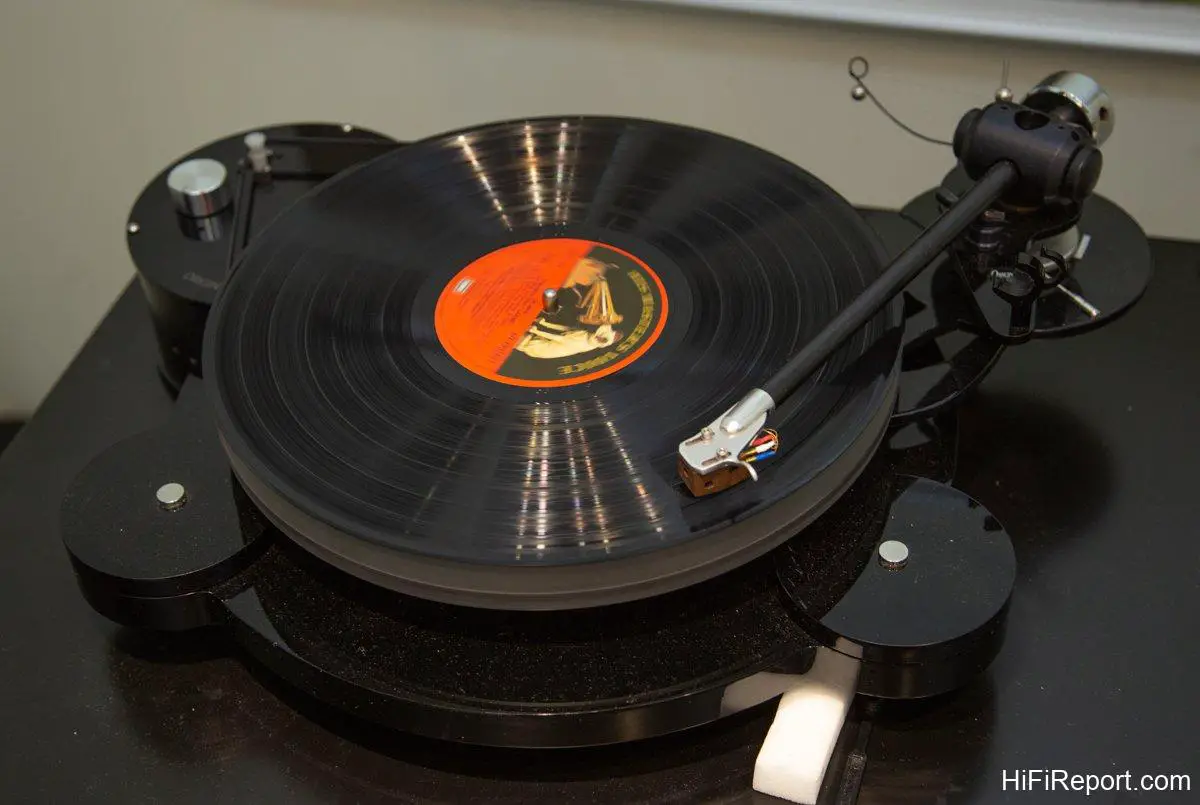
Could this be true? I immediately put it to the test, choosing a selection from Delibes’ opera “Lakmé,” specifically Mady Mesple singing “Lakmé,” with Alain Lombard conducting the Orchestre National de l’Opéra-Comique.
Side A of the record starts with the overture and then transitions directly to the “Flower Duet” for Lakmé and Mallika.
My experimental setup was as follows: first, connect the turntable power cord directly to a wall socket, then to another brand’s all-aluminum power strip, and finally to the Stein Music Powerbar 6.
The aim of this experiment was to compare the wall socket, the all-aluminum power strip, and a composite material power strip like the Powerbar 6.
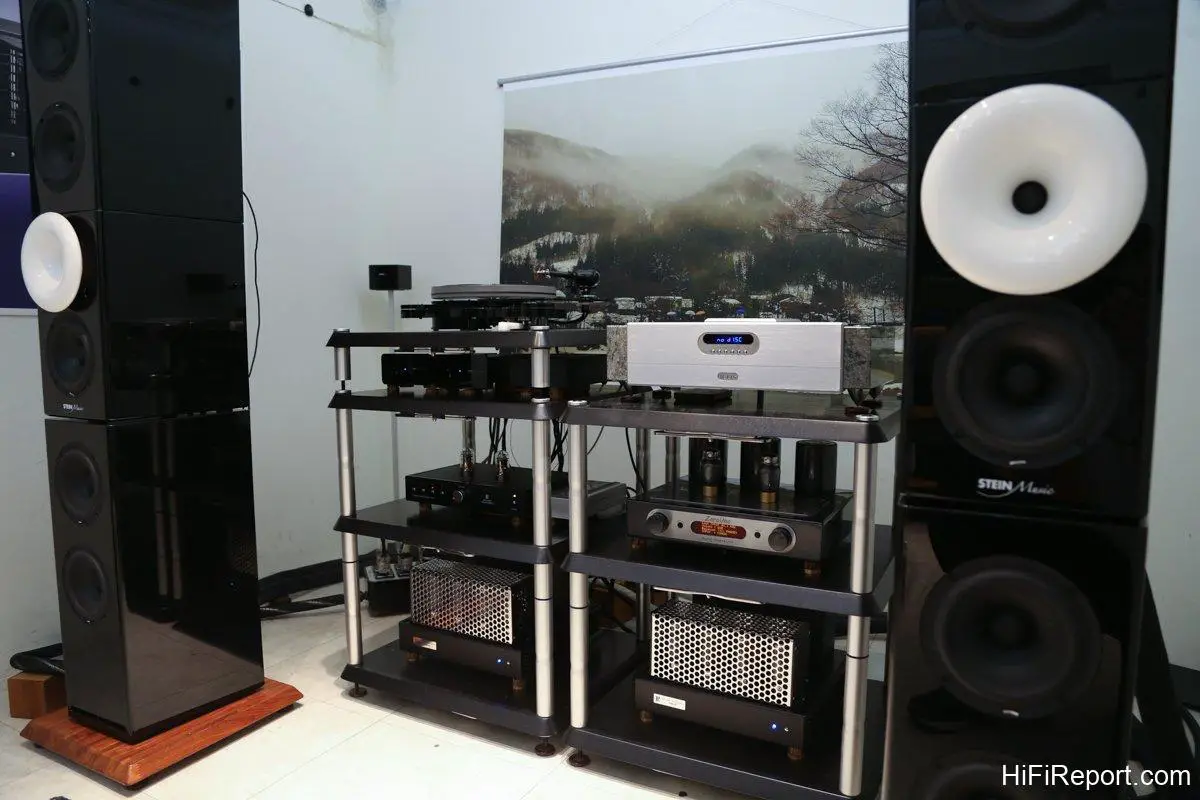
The analog source was a British Origin Live Aurora MK3 turntable, equipped with their Encounter tonearm, and a Stein Music Aventurin 6 MC cartridge, featuring a mahogany and carbon fiber composite housing.
A Perfect Interface π record mat was placed on the platter and under the record.
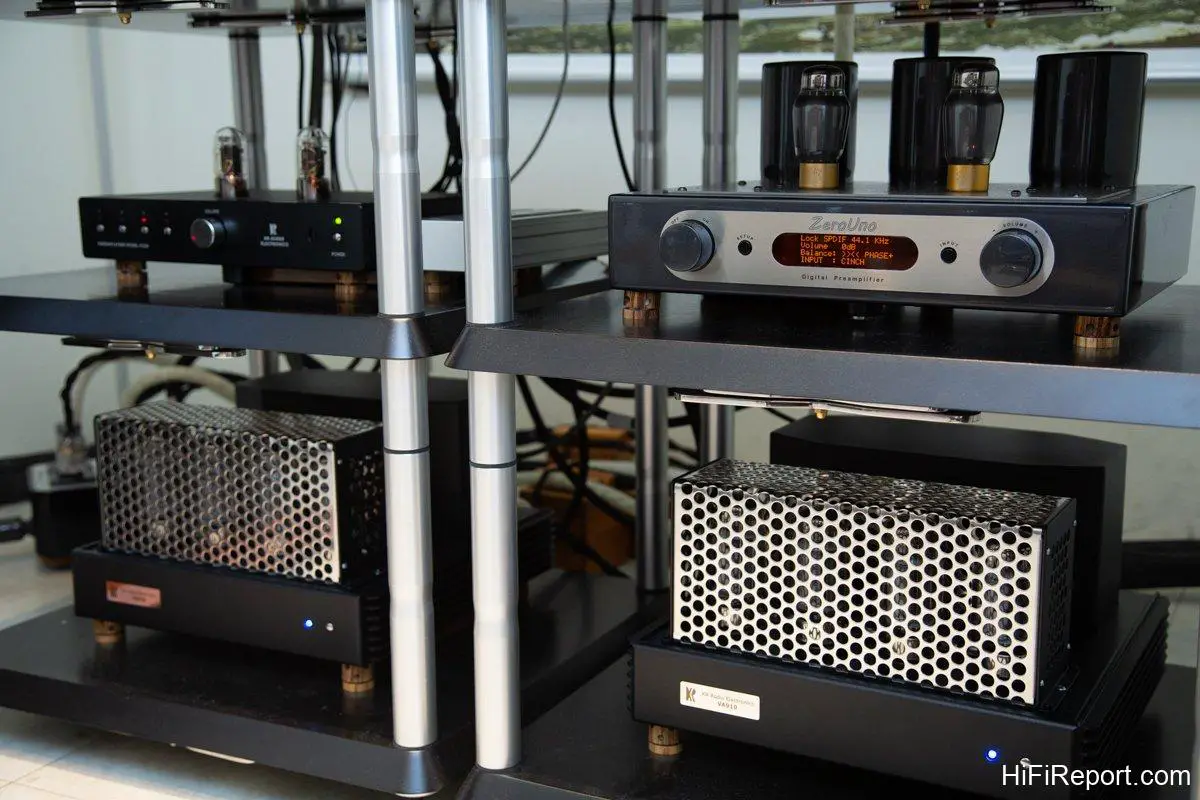
On the amplification side, a Czech KR Audio P130 preamplifier and VA910 monoblock tube power amplifiers, each using four KT120 tubes for 160W of driving power, were used.
The speakers were Stein Music HighLine Bobby S Signature with Bass Extension, which I had previously reviewed.
Organic Sound: Smooth and Rich
In the first “wall socket control group” listening session, I thoroughly enjoyed the system’s round, full, warm, and smooth sound quality. Mesple’s vocals were exceptionally beautiful.
After confirming the sound with the wall socket connection, I connected the turntable power cord to an all-aluminum power strip. This was not a DIY aluminum box power strip, but a well-known European/American brand, also using star grounding.
After switching to this power strip, the sound indeed improved.
I noticed more detail, sharper outlines, and a wider and deeper soundstage. The expanded stage brought out more layers, and the sound became brighter and more energetic. The brass instruments were brilliant, and the violins in forte passages exhibited ample brightness.
Vocals became denser and more focused, with greater penetration in the high notes. Compared to the wall socket connection, the bass seemed more restrained and controlled, with slightly less quantity.
Okay, the second control group was also assessed.
Next, we moved on to the main focus: the Stein Music Powerbar 6.
I knew that the turntable’s power supply was important, but I didn’t expect that even a power strip could make such a difference, and such a significant one at that.
After switching to the Powerbar 6, the sound noticeably gained thickness, harshness diminished, yet the music didn’t become sluggish; instead, it felt more fluid.
The low-frequency strings, in particular, exhibited a stable fullness.
However, despite the increased fullness, the vibrancy and detail remained, and the texture of the low-frequency strings was still discernible.
The overall sound performance was consistent with the Stein Music characteristics I know: organic and free from any artificiality or exaggeration.
Vocals were especially beautiful. The high-frequency harshness I heard with the all-aluminum power strip was smoothed out and softened here.
Resonance Impact on Sound
This was just a power strip, without filtering, harmonization, or active circuitry. How could it achieve such an effect? Mr. Chen explained that many people believe that power strips add multiple connection points and require additional power cable costs. If dedicated lines are installed at home with sufficient wall sockets, direct connection to the wall socket should be the best.
“In fact, this is not the case because we haven’t considered the issue of vibration,” Mr. Chen pointed to the wall and said. When you connect to a wall socket, the entire wall becomes a resonant body.

However, a power strip can additionally address vibration, so that the power reaching the equipment at the final stage is less affected by vibration and resonance interference.
“When you use an all-aluminum power strip, you get aluminum resonance. The Powerbar 6’s enclosure is made of composite materials, so it avoids the resonance issue of a single material.” Listening to Mr. Chen’s explanation, it seemed to make sense.
However, even if I couldn’t be certain about the underlying principles, the audible differences were undeniable.
The story wasn’t over yet. Mr. Chen mentioned that even without turning on the turntable, just listening to a CD system, the sound would still differ depending on whether the turntable’s power cord was plugged into the wall or the Powerbar 6.
This was truly surprising.
If the turntable power supply was on, allowing the motor to rotate, there might be some logic, as Mr. Chen had mentioned earlier about the “motor pollution theory.”
But in this case, the power was off, and it was even separated from the power supply of other equipment. How could the turntable still affect the sound?
Unplug Turntable When Not in Use
I switched to listening to CDs, using Beethoven’s Violin Sonata No. 10 performed by violinist Liza Ferschtman and pianist Inon Barnatan as reference music.
The HiFiReport listening room is equipped with a French Icos Fado CD Elsberg CD player. Although it has analog outputs, Mr. Chen used the digital output to feed an Italian CanEVER ZeroUno tube DAC for decoding.
In a direct comparison, I was puzzled: it really was different.
In comparison, with the turntable power cord plugged into the wall socket and the turntable off, the music from the CD system sounded looser and thinner, with fewer overtones, and the timbre was not as rich as before. In forte passages, there was even some harshness.
When plugged into the Powerbar 6, the sound regained some density, thickness, color, and richness.
However, the best sound was achieved by unplugging the turntable’s power cord entirely.
After this test, although I didn’t understand the reason, the first thing I did when I got home was to unplug my turntable’s power cord.
Benefits for Digital Systems
Mr. Chen had given me these two comparisons as homework, but I had more to explore.
Not everyone has a turntable system at home. Would digital equipment or amplifiers also experience the same kind of difference with the Stein Music Powerbar 6 as I heard with the turntable system? Yes, they would.
I unplugged the Aurora MK3 turntable’s power cord to simulate a CD-only audio system.
Focusing solely on the digital system as a comparison, I connected the Icos Fado CD Elsberg and CanEVER ZeroUno DAC to either the Powerbar 6 or directly to the wall socket.
Again, it was very obvious that once I plugged the CD player and DAC into the wall socket, the overtones diminished, the expression of the sound became dull, and the sound became muddier and grainier, lacking the smoothness and fluidity experienced with the Powerbar 6.
The brilliance dimmed, the reverberation shortened, and the texture of the sound was not as clear.
Similarly, in forte passages, the sound became oppressive.
Just changing the CD player’s power connection made a difference, and changing the DAC’s power connection as well made the difference even more pronounced.
Consistent Stein Music Sound Philosophy
Have you ever considered that a power strip could have such a significant impact on sound? I admit I hadn’t.
This visit to HiFiReport and these experiments provided me with new points of reference.
The Powerbar 6 embodies Stein Music’s consistent sound aesthetic. It doesn’t pursue extreme sonic effects. You won’t experience intense stimulation or shock from any of their products, whether speakers, accessories, or tuning devices.
Instead, they consistently deliver harmonious and rich musicality, allowing you to focus more on the music itself, rather than being distracted by the audio equipment.
If this is what you are seeking, feel free to contact HiFiReport to find out where you can try it out.
Specifications
* Type: AC Power Conditioner
* Outlets: 6 (Powerbar 6)
* Enclosure Material: Aluminum (top cover), Carbon Fiber (enclosure), American Walnut (feet)