
NuPrime SW-8 Network Switch Review
I have previously written equipment reviews on the SOtM sNH-10G and Melco S100 audiophile network switches. Furthermore, I have personally experienced the effects of Ansuz network switches at HiFiReport’s listening room. Editor-in-Chief Guo Han-cheng has also penned a detailed review of the Ansuz flagship switch, the Power Switch D-TC Supreme. Essentially, these switches share a common trait: a significant positive enhancement in the sound quality of network streaming playback.
This illustrates a crucial point: network transmission quality indeed has a substantial impact on streaming playback quality.
However, a pertinent question arises: must audiophile-grade switches be so expensive? Is high price a prerequisite for effectiveness? The answer might not necessarily be yes. The NuPrime SW-8 under review is considerably more affordable than the aforementioned models, yet its improvement in sound quality remains distinctly noticeable, making it a valuable asset for enhancing your home network transmission environment.
Noise Isolation
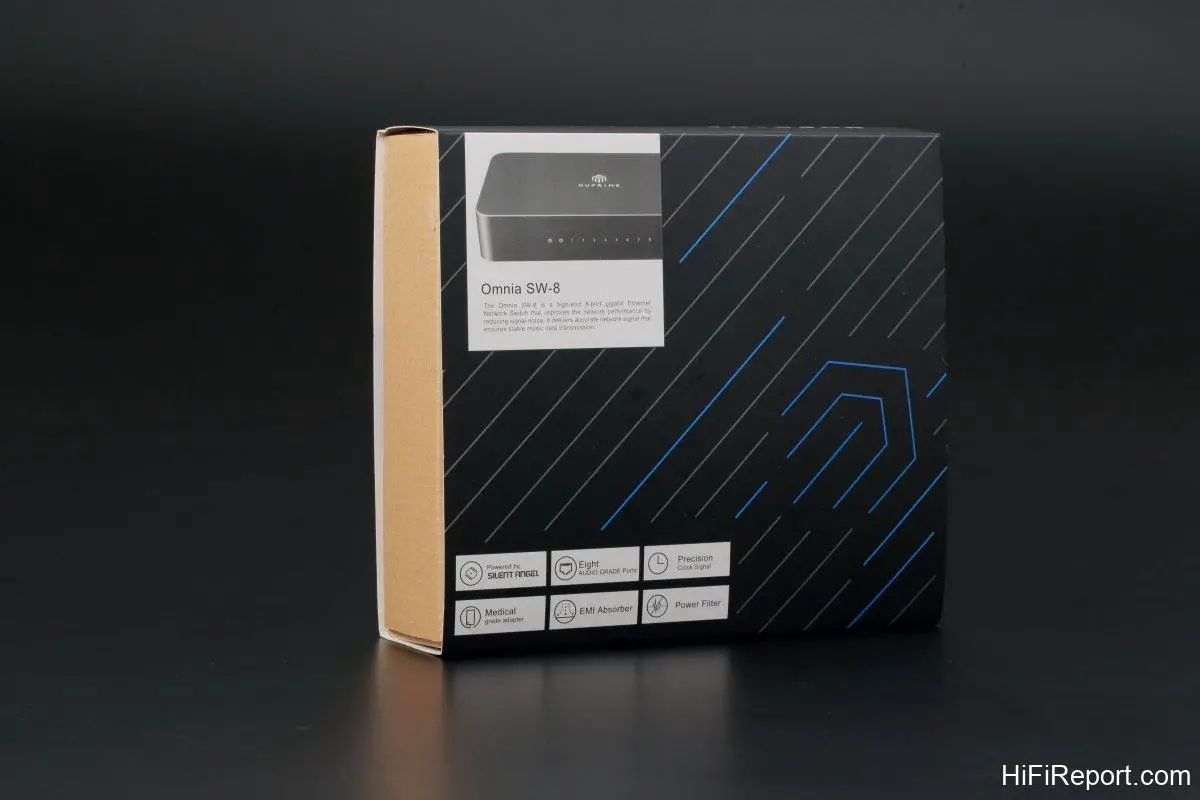
How does the SW-8 enhance network transmission quality and performance? It primarily achieves this through two key approaches: reducing noise and improving transmission precision.
In terms of noise reduction, the SW-8 aims to minimize noise generated not only by its internal circuitry but also by its power supply. Therefore, the SW-8’s master clock circuit is equipped with dual noise isolation measures, effectively reducing electrical noise by up to 20 dB. Additionally, the main power supply circuit also incorporates dual noise isolation measures, further reducing electrical noise by up to 17 dB.
Furthermore, the underside of the SW-8’s chassis is lined with a layer of high permeability EMI absorbing material, specifically designed to absorb noise within the circuit.
Through these multiple layers of noise isolation circuitry, the SW-8 ensures exceptionally stable network signal transmission, preventing transmission errors that could lead to data packet re-transmission and reduced network efficiency.
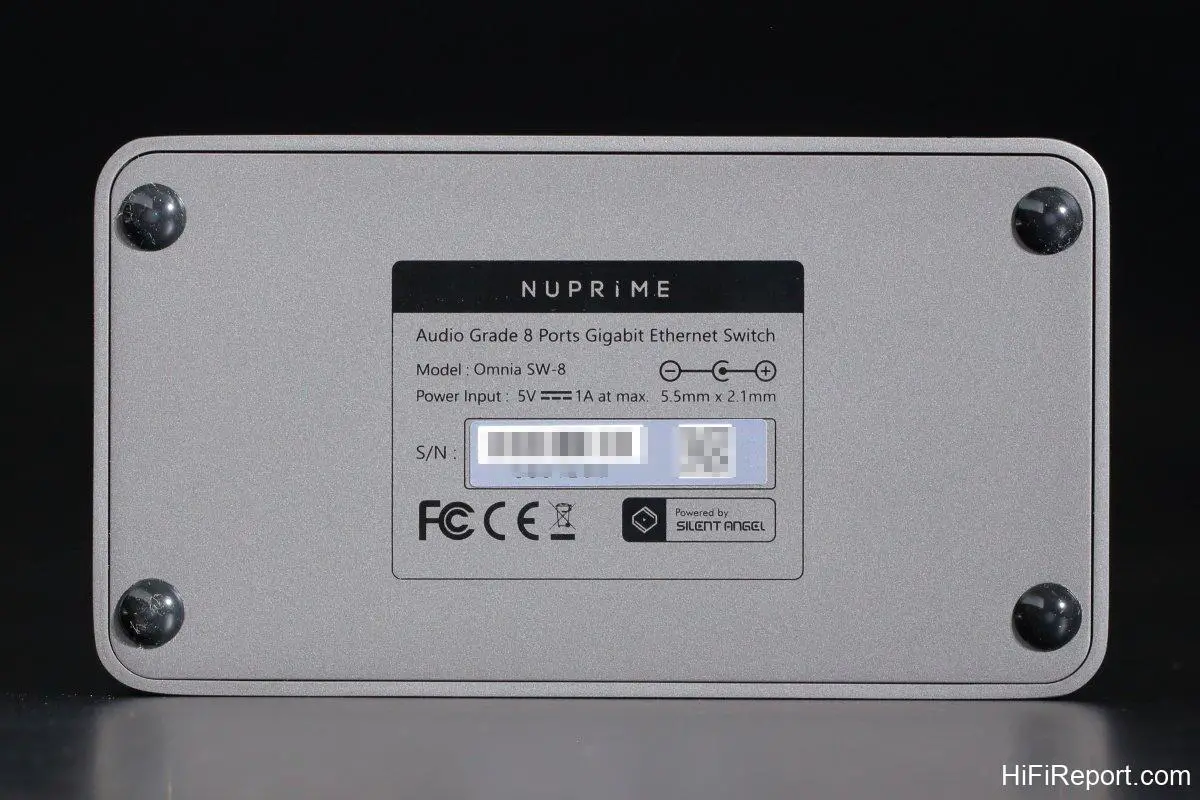
According to NuPrime’s website, high internal noise in network switches can cause square wave patterns of data packets to exhibit ripples instead of clean, sharp edges. This can lead to misinterpretations and data re-transmissions, thereby reducing transmission efficiency. However, the SW-8’s comprehensive noise reduction measures ensure a flatter square wave, where a ‘1’ is clearly a ‘1’ and a ‘0’ is unequivocally a ‘0’, eliminating ambiguity and resulting in more precise and efficient data packet transmission.
Moreover, the SW-8 utilizes a specially selected medical-grade switching power supply, guaranteeing exceptional quality and reliability.
Precision Clock
Regarding improved transmission precision, the SW-8 employs a high-accuracy clock generator to minimize jitter through a more precise clock signal.
Internally, the SW-8 is equipped with a custom-made TCXO (Temperature Compensated Crystal Oscillator) with an ultra-low error of only 0.1 ppm. This level of precision significantly surpasses that of TCXOs found in typical network switches from mainstream brands, ensuring more stable data packet transmission.
NuPrime states that the jitter measured in typical home-grade switches is approximately 705 ps, whereas the SW-8 exhibits a jitter of only 369 ps. This data clearly demonstrates the superior data quality provided by the SW-8.
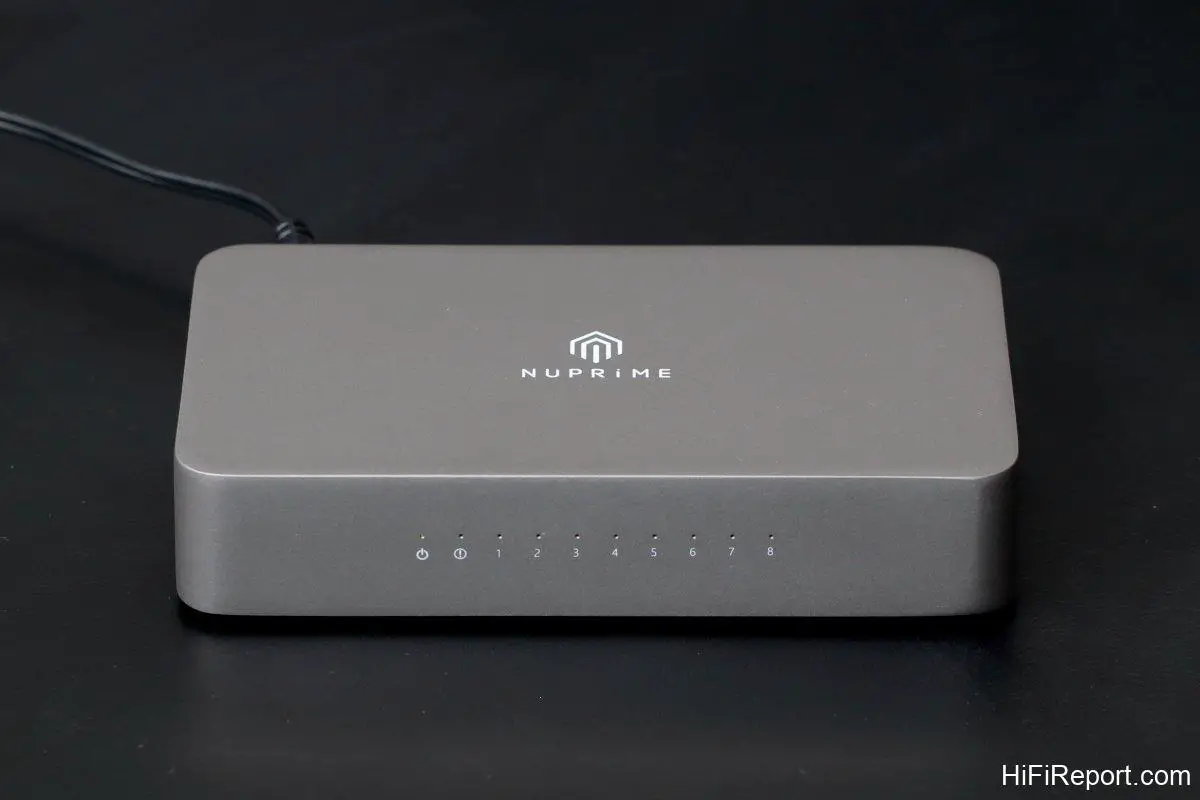
The SW-8’s enclosure is constructed from a remarkably solid aluminum alloy, feeling as heavy as a small brick in hand. Upon closer inspection, the SW-8’s chassis is a unibody aluminum construction, with the bottom plate screwed in from below. This design not only provides excellent shielding capability but also minimizes resonance due to the seamless enclosure, inherently offering superior vibration damping.
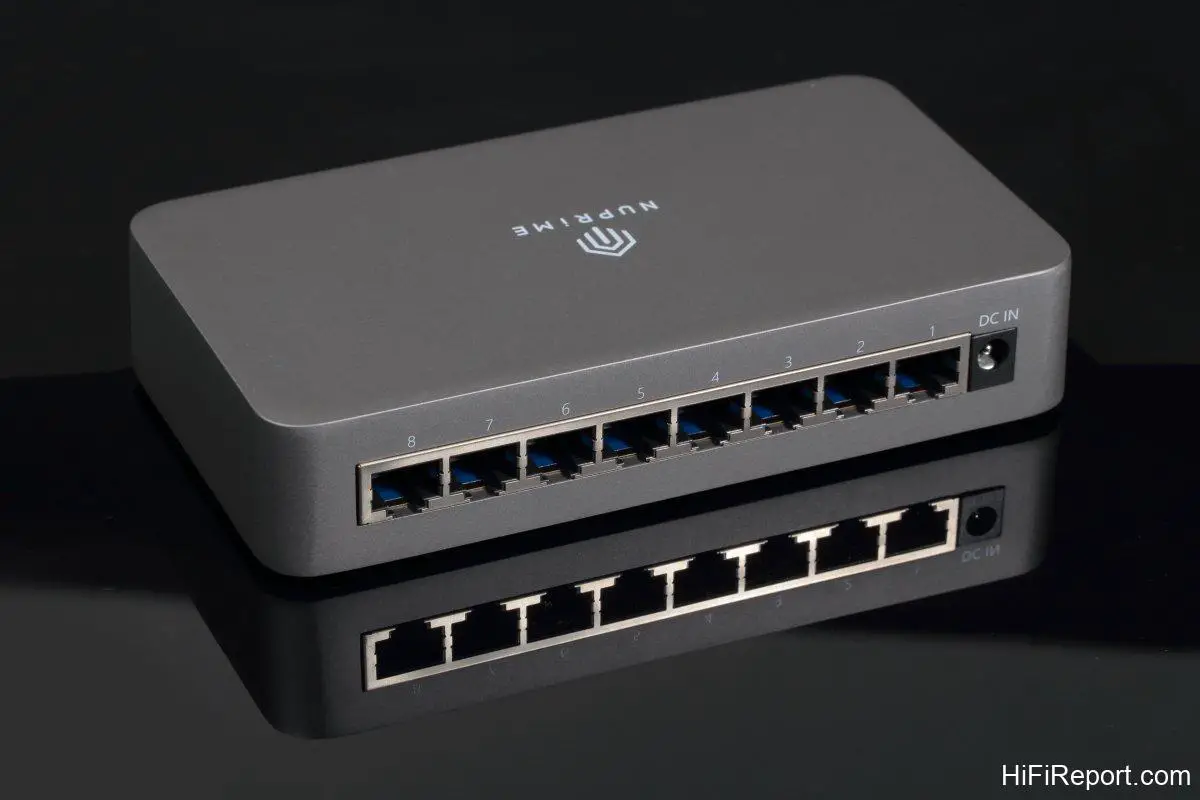
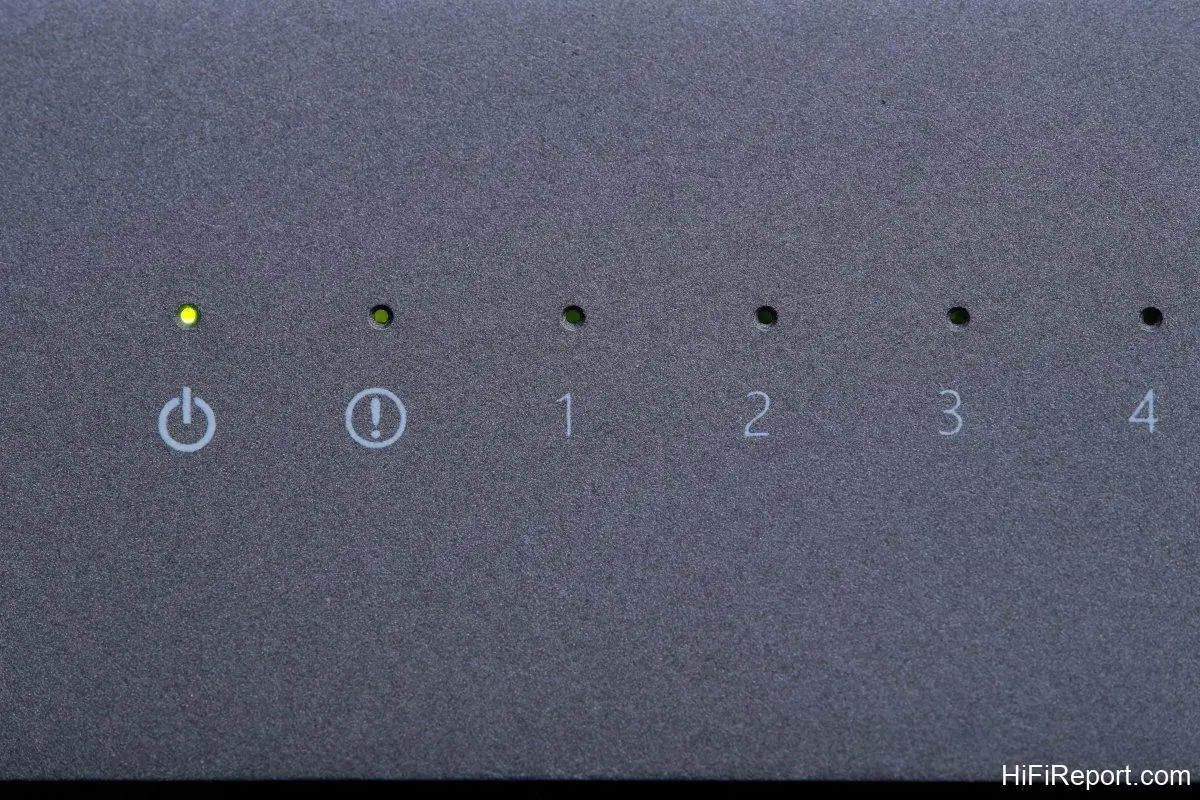
The status indicator LEDs on the SW-8’s front panel are also subtly designed. Minute pinholes are drilled into the aluminum alloy chassis, through which faint light emanates. Close up, they are sufficient to indicate connection status, while from a distance, they are unobtrusive, allowing you to place the understated yet elegant SW-8 in a visible location without causing visual distraction – a thoughtful design indeed.
The rear panel of the SW-8 offers eight audiophile-grade 100/1000 Base-T Ethernet ports, ample for connecting various streaming audio devices in a home setup.
Sound Improvement
The listening evaluation was conducted in the HiFiReport listening room, utilizing a high-end system comprising a Lumin U1 Mini streaming transport, a Lampizator The Pacific tube DAC, an Accuphase E-800 integrated amplifier, and Wilson Audio Alexia 2 loudspeakers. The reference switch for comparison was a ZyXEL GS-105B V2 five-port switch, also housed in a metal enclosure and offering some level of noise shielding.
We began by listening to the second track, “Première partie: Pastorale” from Berlioz’s “Les Nuits d’été, Op. 7” performed by Karen Cargill (mezzo-soprano) with the Scottish Chamber Orchestra, from the “Linn Super Audio Collection Vol.7” test disc. This piece is light and graceful, with the orchestra’s strings and winds providing a lively accompaniment with leaping notes, punctuated by long, flowing melodic phrases.
In comparison, the ZyXEL switch exhibited a slight graininess in the sound, with a less than pristine and transparent background ambiance. The overall musical presentation felt somewhat restless, and the lower frequencies lacked stability.
Regarding soundstage, the ZyXEL’s soundstage was more centrally focused, resulting in less distinct separation between instrumental sections, and the soundstage width did not extend to the width of the speakers.

The SW-8, on the other hand, refined Karen Cargill’s vocal image, making it slightly smaller, more focused, and more three-dimensional. This clarified the relative positions and proportions of the lead vocalist and instrumental sections.
In terms of soundstage, the SW-8 not only expanded the height and width but also enhanced the clarity of separation and imparted a sense of groundedness, making the music sound more stable and composed.
The distribution of high, mid, and low frequencies, as well as the structure of each instrumental section, became more organized and coherent.
Furthermore, the SW-8 improved dynamic contrast, rendering softer passages more clearly and louder passages with less strain. Even the perceived visual ‘picture’ became more transparent.
Thanks to the exceptional resolving power of the reference system, the improvements brought by the SW-8 were immediately apparent, once again demonstrating the significant impact of network switches on streaming playback quality.
Enhanced Musicality
Moving on to the third track, “Allegro vivace” from Chopin’s Piano Concerto No. 2, also from “Linn Super Audio Collection Vol.7,” the orchestral arrangement was larger than the previous track. I noticed that the SW-8 rendered the soundstage depth and layers with greater precision and richness. During fortissimo passages, the piano key strikes had more weight and impact, and the music’s intensity was conveyed with immediacy and decisiveness, making for a thrilling listening experience. Simultaneously, the piano’s lyrical quality improved, and the music flowed more smoothly.
In contrast, the ZyXEL switch lacked this decisiveness; the power seemed somewhat constrained, resulting in a slightly sluggish presentation.
Next, we played the soundtrack from the movie “Il Postino.” The first track, “Il Postino (Titoli),” begins with a string section crescendoing from pianissimo. Through the SW-8, the gradations from soft to loud were more distinct, the layering was improved, and the music flowed more seamlessly. Even from the very first crescendo of the strings, the SW-8 demonstrably outperformed the ZyXEL switch.
As the string section continued in unison, encompassing both melody and harmony, the SW-8 made it easy to distinguish the different string sections. The layers were interwoven yet well-separated and harmonious.
Around the 30-second mark, a prominent instrument in this soundtrack – the accordion – enters. With the ZyXEL, the accordion’s sound was harsher, harder, and excessively metallic, becoming somewhat uncomfortable to listen to at higher volumes.
This soundtrack can be challenging to reproduce well. Many systems often render it as harsh, hard, aggressive, and strident, resulting in an unpleasant listening experience. The ZyXEL exhibited some of these characteristics. However, the SW-8 still conveyed the necessary metallic texture but with a rounder, more fluid tone, less graininess, and a more pleasing sheen.
Moreover, the bass string section’s lines were clear and adequately deep and stable, providing a solid foundation at the rear of the soundstage. Despite the prominence of high-frequency instruments, the excellent low-frequency support ensured the overall musical presentation remained grounded and well-organized.
The second track from the “Il Postino” soundtrack, “In Bicicletta,” was even more captivating. The orchestra expands with numerous instruments, including mid- and low-range woodwinds, pizzicato double bass, guitar, and delicate cymbal taps and brushes. The accordion is also still present, along with a mandolin-like twinkling sound. The diverse timbres interweave, and through the SW-8, I experienced a remarkably rich and vibrant musical tapestry. The timbres radiated brilliance, captivating my attention – truly exquisite! Despite its modest price, the SW-8 effectively enhanced the performance of this high-end system, demonstrating its inherent value.
Synergy in Cascading
NuPrime, through their distributor, provided two SW-8 units, hoping I would experiment with cascading them. Without further ado, let’s proceed with this test.
How are two SW-8 units connected? Simple: connect a network cable from the wireless router to any port on the first SW-8, then use another network cable to link the first SW-8 to the second SW-8. Finally, connect the Lumin U1 Mini streaming transport and NAS to the second SW-8. In this configuration, the first SW-8 acts as a noise firewall, isolating network noise originating from the wireless router, thereby ensuring an even cleaner network environment built by the second SW-8.
After setting up the cascaded configuration, we listened again to the first track of the “Il Postino” soundtrack, “Il Postino (Titoli).” The overall graininess further diminished, the background blackness deepened, and the soundstage layering, separation, and musical flow all improved further.
Furthermore, the cascaded SW-8s enhanced image focus, rendering the soundstage more clearly defined. These improvements were immediately noticeable, requiring no A/B comparison to discern – even exhibiting a synergistic effect greater than the sum of their individual contributions.
Moving to the second track, “In Bicicletta,” the magnitude of improvement seemed even more pronounced.
With the greater instrumental density in track 2, the image of each instrument was rendered with enhanced precision. For example, the location of cymbal strikes and the dispersion of their delicate resonances, the articulation of pizzicato double bass notes, and the richness of wind instrument timbres were all more abundant and accurate compared to using a single SW-8. Crucially, as the sound became clearer and more precise, the sense of flow did not diminish but rather increased, naturally elevating the musicality.
The cascaded SW-8 configuration significantly improved image focus, making the outlines of each instrument more distinct, more prominent, and more tangible. This transformed the musical picture from something akin to 4K to 8K resolution. Soundstage structure, depth, and localization all improved, and subtle dynamic nuances became more apparent.
These enhancements became even more pronounced when playing large-scale orchestral music. The cascaded SW-8s improved structure, layering, depth, focus, and separation, resulting in a more organized and coherent musical presentation.
This experience strongly suggests that purchasing two SW-8 units is a worthwhile investment!
System Value Enhanced
The synergistic effect of cascading two SW-8 units reminded me that I could replicate this setup at home.
Currently, my home NAS and music server computer utilize 10GbE SFP+ fiber optic network transmission. This necessitates that my network switch supports 10GbE SFP+, precluding me from using most of the current popular audiophile-grade switches, as they typically lack 10GbE SFP+ support.
My current switch is a QNAP QSW-308S. I wondered if I could insert an SW-8 between my wireless router and the QSW-308S to achieve network noise isolation and improved transmission precision. So, I brought an SW-8 home to test this hypothesis.
The results mirrored my experience in the company listening room. Simply put, “clarity” and “organization” were the hallmarks of the system’s more composed and fluid performance.
When digital signal transmission becomes more precise and processing more accurate, the most immediate improvement is a clearer and more organized sound. This is precisely the benefit brought by the SW-8. It addresses bottlenecks in the home network environment and reduces the impact of network noise on sound quality. It not only preserves detail but actually reveals more detail, further highlighting the inherent value of the audio system.
Specifications
* Type: Network Switch
* Interface: 100/1000 Base-T
* Master Clock Accuracy: 0.1 ppm @ 25°C
* Power Supply: Medical-grade 5V Power Adapter
* Dimensions: 154.5 × 26 × 85 mm
* Weight: 1.2 kg