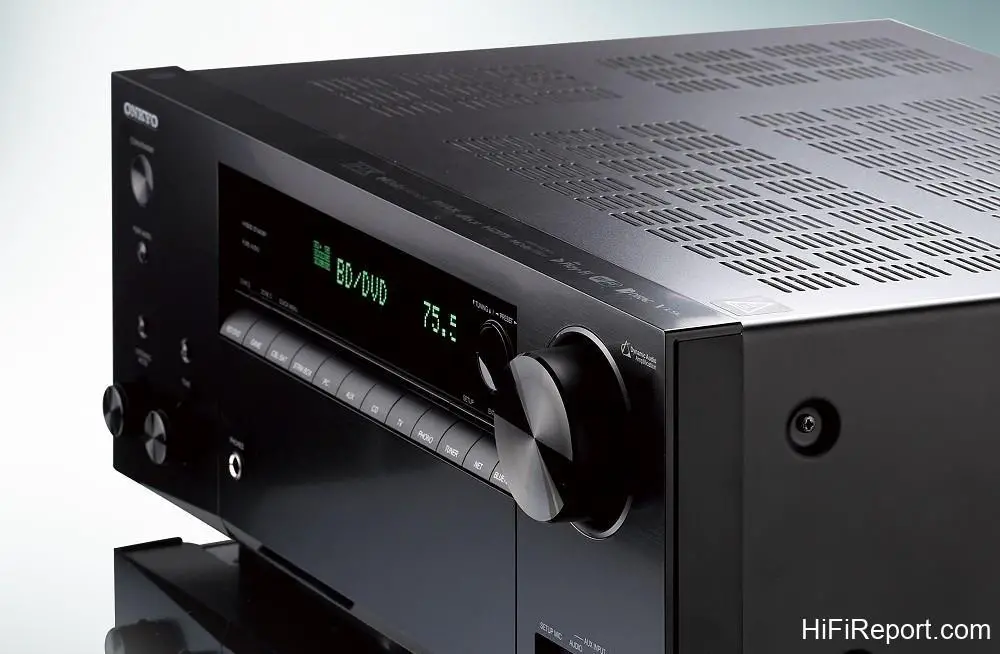
Onkyo TX-NR7100 Review
Compatibility with 8K and 4K video, Dolby Atmos and DTS:X decoding, and the ability to simulate overhead channels – these have become standard features for AV receivers over the past three years. As you move up in price points, differences typically appear in weight (correlated with driving power) and channel count. The notion of “you get what you pay for” usually holds true. But is that always the case?
While “you get what you pay for” often applies, sometimes you encounter an “unreasonable fellow” bent on “price disruption.” My reviews always focus heavily on value, so discovering such a “price disruptor” is genuinely exciting. The Onkyo TX-NR7100, which I’m introducing in this piece, is precisely that kind of product.
So, is the TX-NR7100 truly a price disruptor? Let’s compare its objective specifications directly. In terms of channel count, the TX-NR7100 is a 9.2-channel AV receiver, just like its higher-end sibling, the TX-RZ50. However, compared to other 9.2-channel AV receivers, the TX-RZ50’s suggested retail price of approximately $2070 seems “quite normal.” Other Japanese 9.2-channel receivers selling for around $1750 are considered “fairly inexpensive.”
Most AV receivers currently in the $1600-$2000 price range are still primarily 7.2-channel models. Yet, the TX-NR7100, a 9.2-channel receiver, has a suggested retail price of only approximately $1500. That’s at least $250 cheaper than comparable 9.2-channel models from other brands, making it a definite price disruptor.
The TX-NR7100 possesses an even more significant price-disrupting feature related to room correction. Over the past two years, the application of Sweden’s Dirac Live technology has grown, moving from multi-channel processors (AV receivers and pre/pros) to even Hi-Fi amplifiers.
Through practical demonstrations, more users have come to understand that this technology can effectively overcome room acoustic deficiencies, speaker placement issues, and problems with frequency response and symmetry inherent to the speakers themselves. Users don’t need expert knowledge or skills; by simply following the steps, they can achieve a flat and accurate frequency response that rivals professional calibration.
To my knowledge, the Onkyo TX-NR7100 is the most affordable product officially introduced in the Taiwan market that includes Dirac room correction. Furthermore, it comes with the “full-frequency version” of Dirac, capable of calibrating up to 20kHz, not the standard version (limited to 500Hz). This effectively saves users the $99 cost of upgrading from the standard to the full-frequency version.
Design and Connections
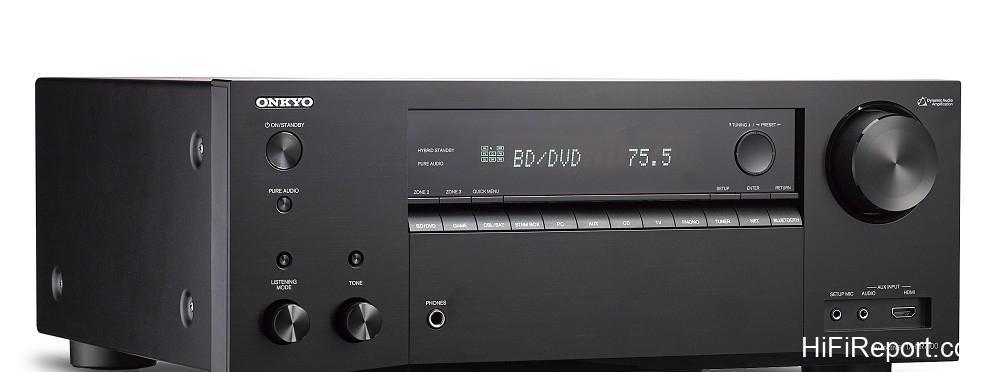
▲ The TX-NR7100 unit itself offers 9.2 channel outputs, allowing it to simultaneously power up to 5.2.4 (5.1.4) or 7.2.2 (7.1.2) speaker configurations, enabling immersive 3D sound with overhead effects from Dolby Atmos and DTS:X. Although there’s a noticeable price difference between this unit and the RZ50, it still holds both THX Select and IMAX Enhanced certifications.
However, I must be honest: the TX-NR7100 is comparable in net weight to other receivers in its class, so its speaker driving capability isn’t particularly outstanding. Its output power is about 20% lower than the RZ50. Additionally, the RZ50 features 11.2 channel pre-outs, allowing expansion to 7.2.4 channels by adding a two-channel power amplifier.
The NR7100’s “pre-processing channel count” is the same as its “built-in output channel count” at 9.2, with pre-outs limited to subwoofer outputs only. I think this design is very reasonable, as users purchasing a receiver in the approximately $1500 range are usually budget-conscious and are unlikely to add a separate two-channel power amplifier (which would cost at least around $960) to a $1500 receiver. A 9.2 channel setup is more than sufficient for most households.
Streaming and Network Features
In terms of streaming capabilities, the TX-NR7100 has built-in Wi-Fi and bidirectional Bluetooth, and is compatible with AirPlay 2, Roon, and Chromecast. When connected to the network, it can access streaming music services like Tidal, Spotify, and TuneIn. It can also integrate with other DTS Play-Fi compatible audio products to form a whole-house multi-room streaming audio system.
The TX-NR7100 can play music files shared or pushed from NAS devices, computers, and portable devices on the same network, and it can also play music files from USB devices formatted in FAT16 or FAT32. Supported music file types include WMA, MP3, WAV, AIFF, AAC, FLAC, LPCM, Apple Lossless, and DSD, with DSD support up to DSD128 and multi-bit audio files up to 192kHz/24bit resolution.
All six HDMI input terminals on the rear panel support 8K and 4K video, with HDMI 1 through HDMI 3 offering a maximum bandwidth of 40 Gbps, and the other three providing 18 Gbps.
Internal Design
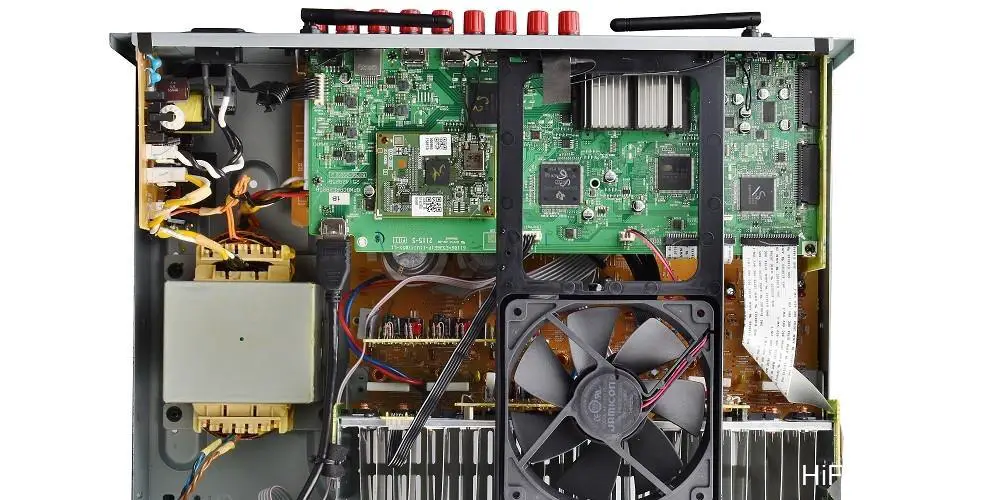
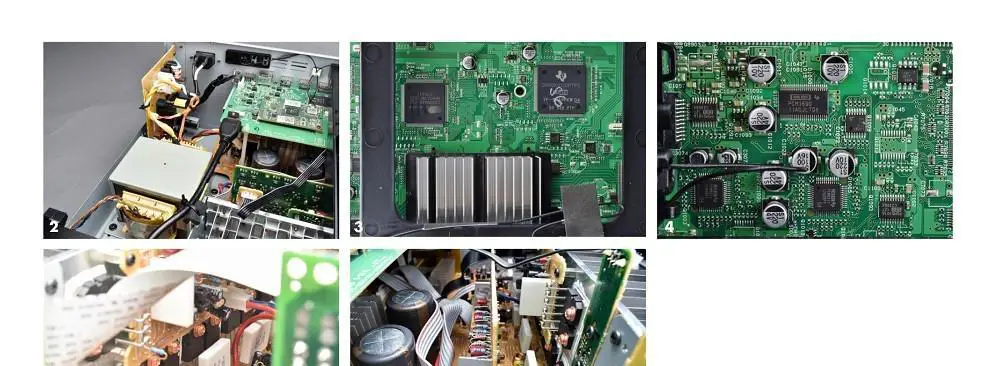
Next, let’s delve into the internal structure of the TX-NR7100. After observing and documenting it, I feel it’s essentially a “budget version of the TX-RZ50.” The similarity between the digital mainboards of the NR7100 and RZ50 is over 90%. Both utilize two DSP chips, the TI Aureus TMS320DA808 (D808K013DPTP5) and Cirrus Logic CS49844A, for digital audio processing.
In the digital-to-analog conversion circuit, the primary 7.1 channels use the TI PCM1690 32-bit 8-channel DAC (with a dynamic range of 113 dB), while the secondary channels use the TI PCM5101A (with a dynamic range of 106 dB). Onkyo’s proprietary VLSC technology is applied after the DAC chips to thoroughly eliminate digital pulse noise. The main components used for small signal amplification are low-noise JRC NJM4580 dual OP Amp chips.
Amplifier Philosophy
Regarding the power amplifier circuit, Onkyo’s consistent approach is simplicity. This simplicity isn’t about cutting costs; I believe it’s a crucial part of shaping Onkyo’s sound style. They select amplifying components with wide frequency response characteristics. The power amplifier circuit doesn’t need to rely on deep negative feedback to extend bandwidth.
When it comes to Transient Intermodulation Distortion (TIM) and Total Harmonic Distortion (THD), they believe that once THD is reduced to a certain level, further reduction has little significant impact (and is honestly barely audible). However, if TIM is high, the sound becomes rigid and “indirect.” Therefore, they adopt a circuit design with a simple structure, featuring fewer amplification stages and low negative feedback, similar in character to tube amplifiers.
Although the THD figures aren’t particularly impressive, it allows for reduced transient intermodulation distortion, resulting in a “more natural, more vibrant” sound.
I counted carefully, and the power amplifier circuit of the NR7100 has a total of 13 transistors per channel. Each channel uses a pair of “Triple Diffused” power transistors with wideband characteristics, the KEC 2SA1962A/2SC5242A, in a push-pull configuration. This approach is exactly the same as the RZ50, which also uses Triple Diffused power transistors TTA0001/TTC0001 in a push-pull output stage.
The main difference between the power transistors used in the two units is the output current: the 2SA1962A/2SC5242A have a maximum continuous output current of 15 Amps, while the TTA0001/TTC0001 have 18 Amps.
In the power supply section, the digital circuits of this unit are powered by a switching power supply board, while the audio circuits are powered by a copper-shielded EI transformer. The power path from the power transformer, rectification, filter capacitors (two 10,000μF/75V electrolytic capacitors) to the output stage of the power amplifier circuit is kept as short as possible to reduce internal resistance (increasing current output capability).
This method is identical to the RZ50, the only difference being that the transformer and filter capacitors (the RZ50 uses two 15,000μF capacitors) are slightly smaller.
Initial Listening Impressions
Having discussed everything from features to hardware configuration, I believe you now understand that the TX-NR7100 adopts the same structure as the higher-end TX-RZ50 but in a more affordable package. After a detailed comparison of the hardware build, even without listening to the TX-NR7100, I could accurately predict its sound character and performance based on my experience reviewing and listening to the RZ50 a few months ago.
Simply put (and this is the result after actual listening verification), I believe the TX-NR7100’s sound quality and tone are over 90% similar to the TX-RZ50. The main difference is that the TX-NR7100’s power supply and power amplifier output are smaller than the RZ50, so its “maximum loudness” and “bass thickness” are slightly inferior to the RZ50. However, I must remind you that I am comparing this unit to the RZ50, which is a step up.
Compared to other receivers in its class, the TX-NR7100 is by no means inferior in “loudness capability.” The inherent character of the amplifier circuit (when listening in Pure Direct mode) leans towards a warm tone, making the sound from the low frequencies through the mid-bass to the mid-range sound thicker and fuller than other models.
Dirac Live Calibration Process
All the listening impressions described above are based on the state where “Dirac is not activated.” I assume that users buying the TX-NR7100 will focus on Dirac. The TX-NR7100 can store settings for three Dirac Filter presets. This time, I used these three slots to experiment with three different approaches. First, I installed the “Onkyo Controller” app on my phone and used the microphone included with the TX-NR7100 for testing.
After completing the full measurement process according to the steps, I made no adjustments and transferred the measurement and automatic calibration results from the phone app to the TX-NR7100. After this process finished, Dirac Live’s automatic test and calibration directly populated all three filter slots on the TX-NR7100 (Slot 1, 2, 3).
Subsequently, I used the Dirac Live Manual Adjust feature in the Onkyo Controller App. I chose Slot 2 for editing. Except for the subwoofer channel which remained unchanged, I adjusted the upper frequency limit of the Dirac Live calibration for all channels downwards from around 20kHz to 3kHz. This means Dirac Live calibration was applied only to the 20Hz to 3kHz frequency band. After making the adjustments, I transferred the settings to the receiver.
Next, I connected my measurement microphone (miniDSP UMIK-1) to my PC and ran the computer version of Dirac Live 3 (available for free download from the Dirac website) for testing. Finally, I transferred and saved the full-frequency test and calibration results (without modification) to Slot 3 of the TX-NR7100. In summary, the three Dirac Live Filters stored on the TX-NR7100 were:
* Filter 1: Automatic calibration using the included microphone (full frequency range)
* Filter 2: Automatic calibration using the included microphone, manually adjusted to limit correction to 20Hz-3kHz
* Filter 3: Automatic calibration using a professional measurement microphone (UMIK-1) with the PC version of Dirac Live (full frequency range)
Auditory Results with Dirac Live
Applying three different Dirac measurement and calibration methods results in different listening experiences. I expect most users of this unit will adopt a calibration method similar to Filter 1 above. Compared to Filter OFF (no Dirac calibration), Filter 1 significantly makes the sound image more focused and solid, as if the lens has been brought into sharp focus. The sense of form and shape of the soundstage in the space becomes clear and defined.
When playing movie soundtracks, subtle elements (like rain, wind rustling leaves) become extremely clear, allowing me to hear more nuanced sounds scattered throughout the space. Furthermore, because the loudness, frequency response, and transient response of each speaker channel arriving at the listening position are corrected to a “precise and consistent” degree by Dirac, the soundstage from front, back, left, right, and overhead perfectly integrates.
The 3D soundstage provides strong envelopment, and in outdoor scenes, you can feel a wide sense of space extending into the distance. The movement of sound objects in space and the fluidity of scene transitions are extremely ideal.
Even after Dirac calibration, under these test conditions, the NR7100 still retains Onkyo’s characteristic “thick sound base” with full low and mid-low frequencies (which also gives movie sound effects higher density and stronger envelopment). Dirac tames the blurring and bloating caused by bass modes; the bass feels faster and more solid. The mid-range has a slightly warm tone, sounding gentle and clear. Compared to Filter OFF, the highs have stronger sibilance and sparkle.
Simply performing the basic Dirac calibration allows the NR7100 to deliver the sound performance described above. Following the user process, it’s like having a “true expert” calibrate the sound in your home. The accuracy and balance of the sound are unmatched among AV receivers in a similar price range (approximately $1280 to $1920). I believe the TX-NR7100’s bold, exciting, and lifelike sound is very suitable for users who prioritize movie sound effects.
In terms of music performance, when using the aforementioned Dirac Filter 1, I tend to use “All Ch Stereo” when listening to two-channel music files, converting the two channels into 5.1.4 channels and listening at high volume. If you are familiar with the feeling of listening to live music in a venue, this way of listening to rock and jazz will make you feel, “Yes, that’s the flavor”: strong energy, full of heat, and a strong sense of immersion.
Comparing this state to Dirac Filter OFF, you’ll feel the impact of the drums and the bite of the cymbals are completely different. The multi-channel surround sound effect provides a stronger sense of being present at a live performance.
If we’re comparing calibration accuracy, naturally, “Filter 3,” which I created using a measurement microphone, will be more accurate than Filter 1, which was measured with the included microphone. Bass modes are better tamed, and dips in the frequency response are filled in more precisely. The bass is cleaner, the mid-range is thicker, and the highs are natural. It is very neutral.
When listening to classical music in 2-channel or 2.1-channel, the sound of acoustic instruments is more natural and “closer to reality” than when using Filter 1. However, I can imagine that in reality, the probability of a buyer of this unit being willing to spend an additional approximately $130 on a measurement microphone and stand is low. The probability of buying a TX-NR7100 primarily for listening to classical music is even lower.
While using a measurement microphone with the PC version of Dirac Live can achieve very neutral calibration, this neutrality also removes the robust and powerful “American style” of Onkyo’s AV receivers that I really like. After all, most users prefer movie sound effects that are “appropriately exaggerated,” right?
Is there a way to make the highs smoother and more natural “using only the included microphone for Dirac setup”? This was the motivation behind my setting up Filter 2 as described above.
Limiting the Dirac calibration frequency response upper limit to 3kHz, on one hand, keeps the fundamental frequencies of most instruments within the calibration range (including vocals), and on the other hand, it allows for the correction of response deviations near the crossover point (usually between 2kHz and 3kHz) in most two-way speakers. This is sufficient to ensure soundstage symmetry and good transition between channels.
“Not calibrating above 3kHz” allows sibilance to sound natural, restoring the state preferred by audiophiles where highs have “a bit of smoothness” and are “not overly bright.” The highs are relatively smoother than Filter 1, the tone is wetter and a bit warmer, while retaining the “Onkyo style” bass and mid-bass.

This is where Dirac is fun: it can make the sound very neutral and direct, or it can allow users with ideas to shape their own unique sound characteristics through “customized” adjustments.
Conclusion and Recommendation
Writing this, I feel like I’m writing a “strategy guide” for the Onkyo TX-NR7100 review. I think my regular readers haven’t seen me this excited about reviewing an AV receiver under approximately $1600 in a long time. Well, it’s just fun! It’s incredibly generous to include full-frequency Dirac calibration in such an affordable AV receiver.
After all, most users don’t live in mansions; they use their living room’s semi-open space as a home theater and need to solve the problem of excessive bass due to speakers being too close to walls. Let Dirac handle these “real-world response issues” for you. I am certain that the TX-NR7100 is the product in its price range with the strongest room response correction capability, bar none.
I stated in the title of this piece that it “redefines the value standard for approximately $1600 class AV receivers.” In fact, its suggested retail price is considerably less than $1600. Given its unprecedentedly high price-performance ratio, it absolutely deserves our best recommendation.
Specifications
* **Type:** 9.2 Channel AV Receiver
* **Output Power (All Channels):** 220 W/Ch (6 Ohms, 1kHz, 10% THD, 1 channel driven), 100 W/Ch (8 Ohms, 20Hz~20kHz, 0.08% THD, 2 channels driven, FTC)
* **Total Harmonic Distortion (20Hz~20kHz, Half Rated Power):** 0.08%
* **Frequency Response:** 10Hz~100kHz (+1, -3dB)
* **Signal-to-Noise Ratio:** 106 dB
* **Headphone Output Power:** 80 mW + 80 mW (32 Ohms)
* **Input Terminals:** HDMI×7, Component Video×1, Composite Video×2, Digital Coaxial×1, Toslink Optical×1, 2 Channel Analog Audio×6, 3.5 mm mini Stereo×1, Phono(MM) ×1, USB×1, Network Terminal×1, FM/AM Antenna Terminal sets ×1 each
* **Main Outputs:** Speaker Terminals×9, Subwoofer Terminal×2, HDMI×2, Headphone Output×1
* **Dimensions (Width×Height×Depth):** 435×173×379.5 mm
* **Weight:** 10.4 kg

- IMAX ENHANCED MODE: IMAX digitally re–mastered content for the home environment is created to provide the same sharp 4K HDR images and powerful sound just as the filmmaker intended.
- SMART HOME COMPATIBLE WITH VOICE CONTROL: The Onkyo TX–NR7100 9.2–Channel THX Certified AV Receive easily integrates into your existing Smart Home ecosystem.
- BI–DIRECTIONAL BLUETOOTH WIRELESS TECHNOLOGY: Stream from your device to the receiver using SBC or AAC codecs, or transmit audio playing through the AVR to compatible wireless headphones.
- THX CERTIFIED: The TX–NR7100 offers four distinct THX listening modes: cinema, gaming, music, and surround EX.
- SMART AV RECEIVER: Works with Sonos, Chromecast built–in, AirPlay 2, and DTS Play–Fi; includes Spotify, Amazon Music HD, Pandora, TIDAL, Deezer, and TuneIn streaming services