
Onkyo TX-RZ50 Review
Back in October 2020, I reported on the partnership between Onkyo & Pioneer and Sweden’s Dirac Research on my hi-fi website. Last year, during CES, Onkyo announced that new AV receiver models would feature Dirac Live room correction, breaking the mold previously dominated by European and American brands like NAD, Lexicon, and Arcam. The TX-RZ50, the subject of this review, was among the models announced.
I was eagerly anticipating this new machine, but unfortunately, Onkyo Home Entertainment Corporation faced financial difficulties and was nearly delisted. Thankfully, Voxx International Corporation and SHARP stepped in, giving Onkyo a new lease on life, and I finally received this long-awaited unit.
Channel Configuration and Setup Flexibility
The TX-RZ50 is a 9.2-channel AV receiver with built-in 9-channel amplification. The unit itself can power configurations like 5.2.4 (5.1.4) or 7.2.2 (7.1.2) channels. Its pre-amp section, however, offers 11.2 channels of output (the two subwoofer outputs are paralleled).
This means the TX-RZ50 can connect an external 2-channel amplifier to power rear surround speakers, enabling a full 7.1.4 (or 7.2.4) channel system, with the main unit handling the 5.1.4 setup and the external amp covering the rear surrounds.
For most users, the TX-RZ50’s built-in channel count is more than sufficient; the primary challenge is often installing overhead speakers. The TX-RZ50 provides significant flexibility for overhead speaker placement: they can be configured as Top (ceiling-mounted), Height (high on front or rear walls), or using Dolby-enabled speakers.
Even without any overhead speakers installed, the TX-RZ50 offers comprehensive “virtual overhead speaker processing,” including Dolby Atmos Height Virtualization and DTS Virtual:X, allowing users to still experience a sense of overhead sound in a three-dimensional soundfield.
Streaming and Multi-Room Capabilities
The TX-RZ50 is comprehensively equipped with streaming features. It includes Wi-Fi and bi-directional Bluetooth (supporting aptX HD), is compatible with AirPlay 2 and Roon, and features built-in Chromecast. When connected to a network, it can play music files shared from a NAS, PC, or smartphone, supporting formats including WMA, MP3, WAV, AIFF, AAC, FLAC, LPCM, Apple Lossless, and DSD.

Multi-bit Hi-Res music files are supported up to 192kHz/24bit, while DSD (including dsf and dff) supports DSD64 and DSD128. Furthermore, users can store these music files on a USB storage device (formatted as FAT16 or FAT32), plug it into the USB terminal on the rear of the TX-RZ50, and browse/play them via the app.
When connected to the internet, the unit supports streaming music services like TIDAL, Spotify, and Tune-In internet radio. For multi-room functionality, the TX-RZ50 not only offers Zone 2 and Zone 3 outputs like other AV receivers, allowing speakers in other rooms to share the amplifier, but it also incorporates dts Play-Fi multi-room music capabilities. This allows the installation of dts Play-Fi compatible streaming speakers in other areas to create a whole-home multi-room audio system.
Internal Architecture and Components
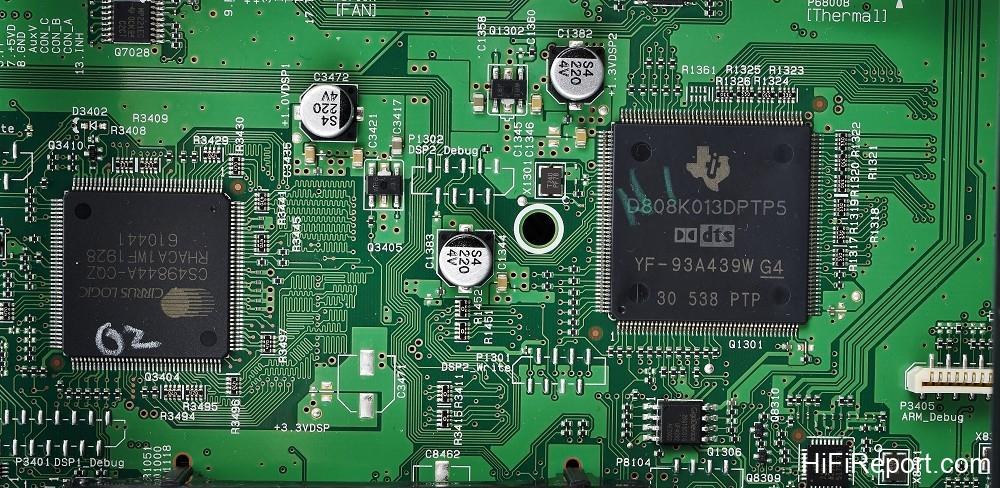
Let’s delve into the unit’s hardware structure. The TX-RZ50 employs a “dual DSP” configuration for digital audio processing: one is a Cirrus Logic CS49844A, and the other is a TI Aureus TMS320DA808 (D808K013DPTP5). Previously, comparable Onkyo models used these for multi-channel or music file decoding, THX post-processing, and AccuEQ digital room correction. This time, Dirac Live is integrated as well.

Following the digital audio processing, the unit’s digital-to-analog conversion circuit uses two types of DAC chips. The main 7.1 channels utilize a single TI 192kHz/24bit Multi-Level ΔΣ 8-channel DAC chip, the TI PCM1690 (with a dynamic range of 113 dB). Secondary channels (including rear surrounds or Zone 2/Zone 3) use two 2-channel DAC chips, the TI PCM5101A (with a dynamic range of 106 dB).
After the DAC chips, the unit incorporates Onkyo’s proprietary VLSC technology, as seen in previous models. This technology uses a comparator and vector generator to regenerate audio waveforms free from digital noise, effectively replacing typical analog filter circuits. The small-signal audio circuits after the DAC chips use JRC NJM4580 dual OP Amp chips, known for their wide bandwidth, low noise, and low distortion characteristics.
Amplifier Design Philosophy
Historically, we’ve experienced Onkyo AV receivers as having a robust, powerful American-style character. I believe this largely stems from their power amplifier circuit design and construction. Techniques like WRAT (Wide Range Amplifier Technology) focus on using fewer components and selecting wide-bandwidth amplification elements to create a simpler amplifier circuit structure with lower negative feedback.

This is done in contrast to circuits that use ordinary components but have complex structures and high negative feedback. Onkyo adopts this approach because they believe low noise and low distortion are merely standard characteristics; “high dynamics” are essential for listeners to fully appreciate the nuances of the sound. This concept is embodied in Onkyo’s recent Dynamic Audio Amplification circuits.
To realize this concept, Onkyo approached the design of this unit from two directions. First, they maintained the “simple structure, wide-bandwidth power amplifier” design style, utilizing low negative feedback to achieve excellent transient response and enhance dynamics. Second, they focused on power delivery, implementing a high-current design from the power supply to the power amplifier circuit.
The power supply circuit uses two custom-made Onkyo 15,000μF filter capacitors to act as “energy storage” between the rectifier and the power amplifier output stage. This larger capacity provides the unit with the comparative advantage of “instantaneous high-current output” and “stability under high output conditions.” Furthermore, they minimized the power supply path between the filter capacitors and the power transistors for the front three channel output stages to reduce internal resistance.
The unit’s power amplifier circuit operates in Class AB, with each channel using a pair of Toshiba “triple diffusion type” power transistors, TTA0001/TTC0001, in a push-pull configuration. These transistors have high current and wide bandwidth characteristics, with each transistor capable of a maximum continuous output current of 18 Amps and a peak instantaneous output current as high as 35 Amps.
Dirac Live Implementation
I recall seeing information about a year ago that Onkyo’s new models featuring Dirac Live would still retain the previous AccuEQ room correction. I speculated that this might be because the “standard version” of Dirac Live only corrected frequencies below 500Hz, requiring a $99 upgrade for the full-frequency version. I guessed AccuEQ was kept to “supplement the standard version’s” (shortcoming), handling frequency correction above 500Hz.
However, after actually testing this unit, I realized I was mistaken: Onkyo genuinely provides the “full-frequency version” of Dirac Live straight out of the box! This is the first time I’ve encountered a piece of equipment under $3,000 USD that includes full-frequency Dirac Live correction without an extra charge.

It’s important to clarify here: all previous Dirac-related models I tested used the Dirac official mobile app or PC application for calibration. Onkyo, however, has integrated the Dirac calibration process directly into the “Onkyo Controller” app. The reason I didn’t call it the “complete version” of Dirac Live earlier is that while it offers full-frequency correction, it currently doesn’t allow me to use my own measurement microphone connected to a computer for Dirac test setup.
I did attempt to use the “official Dirac version” app to calibrate the unit, but this is not the method recommended by the manufacturer. I actually compared the calibration results and found that the sound performance using the Onkyo Controller App’s Dirac calibration was superior (more lively sound, fuller bass). I believe the reason is likely that Onkyo has pre-compensated for the response of the included measurement microphone, resulting in more accurate Dirac test and calibration results.
Listening Impressions
For this listening test, I used Pioneer EX series speakers (with S-1EX floorstanding speakers for the left and right channels) and an M&K X10 active subwoofer. The speaker system was configured as 5.1.4 channels. I began by listening to music files in Pure Direct mode (Dirac inactive). In this state, the RZ50 presented the familiar Onkyo style I’ve come to know: full-frequency drive delivered rich and powerful bass from the floorstanding speakers, pushing them effectively.

The sound foundation was warm and heavy, with the treble being more reserved.
Subsequently, I used Stereo mode (2.1 channels) to compare the difference with and without Dirac. With Dirac OFF, the sound character was similar to Pure Direct. At this point, the RZ50 performed like “previous” Onkyo models in the same class: focusing on raw power, capable of driving speakers, delivering sufficient thickness, and boasting high dynamics – and that was about it.
However, as soon as Dirac was activated, the sound immediately felt younger, more energetic, fresh, direct, and realistic. Listening to “Tokyo Jihen – Music,” the sense of muddiness vanished entirely, and I distinctly felt closer to the stage, with a very clear sense of visual clarity.

Dirac Live compensates for some of the off-axis response roll-off of the speaker’s tweeter. Listening to Hilary Hahn’s performance, the violin gained more luster, had a more complete upper extension, and the texture between the bow and strings was rendered more finely. The midrange transformed from its original “warm and gentle” character to high resolution. The perceived midrange “flavor” became neutral, reducing coloration and stickiness.
Listening to symphonic and piano concertos, I could clearly discern that the inner voices, previously easily overlooked, now possessed remarkably rich layers and details. In terms of low-frequency performance, Dirac Live effectively controlled the booming and bloating caused by standing waves, resulting in bass that was tighter and faster. However, if listeners are accustomed to hearing the energy of bass standing waves as normal bass energy, they might perceive the unit’s bass as being less.
But I believe this is the correct bass – agile, highly resolute, with stronger contrast between dynamics. Once you hear it, you’ll understand what “high-resolution bass” means.
Surround Sound Performance
Provided the RZ50 accurately executes Dirac, it is an Onkyo AV receiver you must get to know anew. Dirac Live bestows upon the RZ50 the ability to “remove the listening room factors.” The auditory experience is as if the walls and ceiling cease to exist. When playing movie soundtracks with Dolby Atmos and DTS:X effects, outdoor scenes evoke a vast, boundless three-dimensional soundstage extending into the distance.
It not only gives “main” sound objects a very clear form and focus, precisely rendering their position, height, and movement in space, but in movie segments with “many and complex” sounds, it can also meticulously and systematically present the movement of “multiple” sound objects. In quiet scenes, one can perceive the space filled with subtle sounds.
With the assistance of Dirac Live, the TX-RZ50 is extremely neutral, accurate, fast, and realistic. The clarity of the sound surpasses all previous generations of Onkyo AV receivers. The correction of frequency response and timing delays results in the perfect blending of timbre across all speakers. It makes me feel as if all the speakers have disappeared, leaving only a “single, enveloping three-dimensional soundfield” surrounding me.
In terms of power delivery, while previous Onkyo AV receivers were like strongmen with solid foundations and powerful internal force, the RZ50 builds upon this foundation by strengthening its “core muscles,” increasing instantaneous explosive power at a faster speed. This makes the surround sound in war and action movies feel even more intense and thrilling.
Conclusion: Exceptional Value
Objectively comparing the hardware capabilities of the Onkyo TX-RZ50 (including channel count, component quality, and driving power), current AV receivers with similar specifications selling for around $2,200-$2,500 USD are already considered reasonably priced. The TX-RZ50, however, is priced like a 9.2-channel model from three years ago that hasn’t seen a price increase.
Moreover, it is not only the most affordable 9.2-channel AV receiver on the market with built-in Dirac Live but also the only unit under the $3,000 USD mark that natively provides full-frequency Dirac Live room correction. This advantage makes it one of the AV receivers under $3,000 USD with the highest sonic accuracy and the most neutral and realistic sound. Its rarely seen high cost-performance ratio undoubtedly earns it our highest recommendation!
Specifications
* **Type:** 9.2-channel AV Receiver
* **Output Power (All Channels):** 250 W/Ch (6 ohms, 1kHz, 10% THD, 1 channel driven), 120 W/Ch (8 ohms, 20Hz–20kHz, 0.08% THD, 2 channels driven, FTC)
* **Total Harmonic Distortion (20Hz–20kHz, half rated power):** 0.08%
* **Frequency Response:** 5Hz–100kHz (+1, -3dB)
* **Signal-to-Noise Ratio:** 106 dB
* **Headphone Output Impedance:** 330 ohms
* **Headphone Output Power:** 90 mW (32 ohms)
* **Input Terminals:** HDMI ×7, Analog Component ×1, Composite Video ×2, Digital Coaxial ×1, Toslink Optical ×1, 2-Channel Analog Audio ×7 (including Phono), USB ×1, Network Terminal ×1, FM/AM Antenna Terminals (1 set each)
* **Main Outputs:** Speaker Terminals ×11 (maximum 9 channels simultaneously), Subwoofer Terminals ×2, HDMI ×2, Headphone Output ×1
* **Dimensions (W×H×D):** 435×201.5×398mm
* **Weight:** 14 kg