
Onkyo TX-RZ70 Review
ONKYO TX-RZ70 review: thick, weighty sound, excellent surround immersion, and it’s the most affordable among 11-channel output models…
The biggest evidence of this is last year’s TX-RZ50. This was the first mid-to-high-end AV receiver released by Onkyo after being acquired by its new owner, and it was the first Japanese brand AV receiver on the market to support Dirac Live. Crucially, it offered the full-frequency version of Dirac Live (unlike some previous brands that only provided a partial version), allowing consumers to experience more advanced automatic room correction results.
At the same time, Onkyo developed a simple and easy-to-use App procedure to streamline the Dirac Live calibration process, making it accessible to average consumers. Onkyo’s traditional emphasis on drive capability was maintained, while the price remained very reasonable, making it an excellent value audio product supporting full-frequency Dirac Live that year. It even received the EISA Best Buy AV Receiver award for this.
Market Positioning and Key Features
This year, Onkyo continues to demonstrate its competitiveness by launching the new flagship model, the TX-RZ70. Naturally, this has attracted significant attention because it is Onkyo’s first 11.2-channel output AV receiver, elevating system configuration flexibility and performance to new heights. The internal circuitry has been completely redesigned, fundamentally departing from the layout of the previous TX-RZ50.
The pricing and features of the TX-RZ70 have also been strategically positioned. If you’ve been following the high-end AV receiver market this year, you’ll know that many flagship models from various brands have increased their subwoofer support to four, allowing for a .4 configuration. The TX-RZ70 deliberately avoids this, maintaining a .2 configuration.

This approach results in a significantly lower price point compared to other flagships, making the TX-RZ70 the “cheapest new 2023 model” capable of providing “11-channel output.”
Why am I confident that Onkyo deliberately chose this path? Because Onkyo’s sister brand, Integra, has the flagship DRX-8.4, which supports 11.4 channels, so Onkyo is clearly aware of this market trend. Furthermore, the TX-RZ70 is equipped with two 8-channel DAC chips internally, which means its channel processing capability far exceeds 11.2. The deliberate decision to configure it as 11.2 is likely aimed at creating market segmentation and enhancing product competitiveness.
After all, looking across the entire home theater market, most consumers still only use one subwoofer. Larger rooms or more enthusiastic enthusiasts might use two subwoofers, but using more than two is still quite rare. Using three, four, or more subwoofers has its own barriers; it requires a higher budget investment, and the space must also support it – it’s not something you can just decide to do.
If a consumer doesn’t plan to use more than two subwoofers but still desires 11-channel output capability, the TX-RZ70 will stand out as an excellent choice.
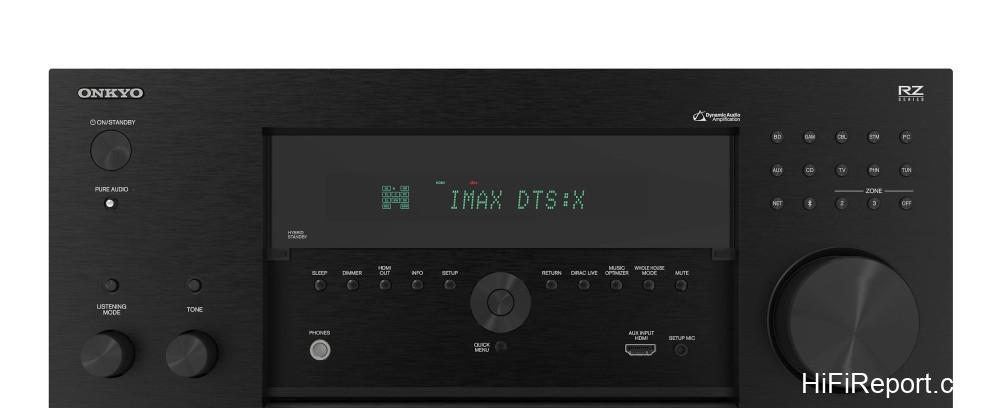
Let’s go over the features of the TX-RZ70. The TX-RZ70 is a THX-certified AV receiver that supports all next-generation multi-channel audio formats, including Dolby Atmos, DTS:X, IMAX Enhanced, Auro-3D, and more. As mentioned before, the TX-RZ70 is an 11.2-channel model, meaning it can form a 7.2.4 home theater system at maximum.
This configuration involves 7 speakers surrounding the listening position on the horizontal plane, allowing connection of two subwoofers, and four overhead speakers for height effects. This configuration already provides a very complete 3D soundstage with sufficient flexibility for overhead sound effects.
If you don’t need that many channels, they won’t go to waste. The TX-RZ70 supports Bi-Amping, allowing you to use the surplus channels to bi-amp your main left and right speakers. Alternatively, you can directly drive speakers in a second zone (Zone 2), allowing you to enjoy music in other parts of your home. In terms of drive capability, the TX-RZ70 employs Class AB amplification circuitry, providing 140 watts per channel into 8 ohms.
HDMI and Video Connectivity
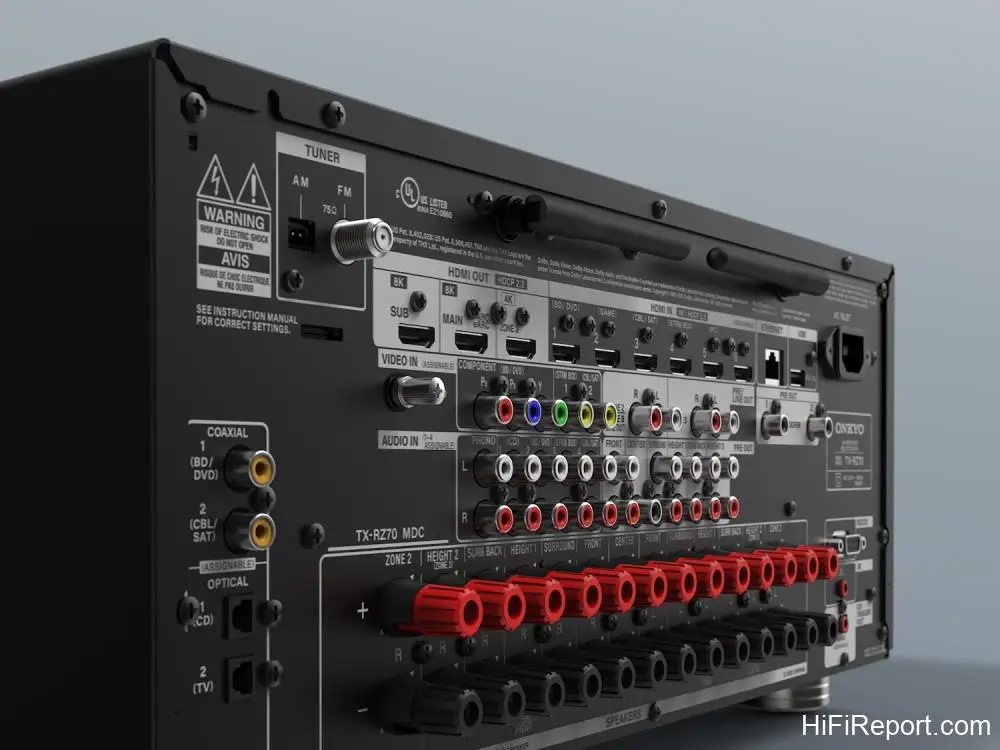
On the HDMI front, the TX-RZ70 offers 7 inputs and 3 outputs. All 6 rear panel inputs are HDMI 2.1 (unlike some models where only certain ports are), capable of passing through 8K/60P and 4K/120P video signals. It also supports high dynamic range standards like HDR10+ and Dolby Vision. Thanks to the inclusion of HDMI 2.1 ports, it supports many features beneficial for gaming performance, such as VRR (Variable Refresh Rate) and ALLM (Auto Low Latency Mode).
Two of the HDMI outputs also support 8K/60P, and the main output further supports eARC functionality, allowing playback of audio signals transmitted from the TV.
Room Correction: AccuEQ and Dirac Live
For automatic room correction, the TX-RZ70 provides two options. The first is Onkyo’s traditional AccuEQ, which can be completed simply by using the included test microphone and following the on-screen instructions on your TV. The second system is Dirac Live, which is the version capable of full-frequency testing. It also uses the test microphone, but the process is conducted via the Onkyo Controller App.
Another advantage of Dirac Live is that you can install the PC version of the Dirac Live software on a laptop and use a more accurate third-party microphone (you can load the microphone calibration file within the software) for even more precise measurements. Enthusiasts might want to try this approach.
So, what are the pros and cons of these three methods? The AccuEQ testing process is the simplest, and after completion, you can manually modify all parameters. With Dirac Live testing, its accuracy and performance are generally considered superior, but you hand over full control to it. Some parameters cannot be changed after testing is completed, such as “distance” (delay time); if you want to change them, you must redo the entire testing procedure.
If you use the Dirac Live PC software and a third-party microphone, the testing accuracy is even higher, the PC software interface is clearer, and there are more adjustment options. The downside is that you need to operate it with a laptop and invest in a microphone.
If you want better low-frequency performance or plan to use multiple subwoofers, the TX-RZ70 also supports a paid upgrade for Dirac Live’s low-frequency management function, known as Dirac Live Bass Control (DLBC). The price for Dirac Live DLBC with a single subwoofer is USD 349, while the multi-subwoofer version costs USD 499, depending on your needs.
How do you perform Dirac Live calibration using the Onkyo Controller App? First, plug the microphone into the front panel of the TX-RZ70. Enter the automatic test procedure. If you select Dirac Live, it will instruct you to download the App. Once in the test procedure, the App will ask if you want to perform a quick measurement (3 points) or a full measurement (9 points). If you’re not in a hurry, it’s recommended to do a full measurement for higher accuracy.
After completing all the measurements, the software will perform calculations and display the results. A great benefit of Dirac Live is that it can show the frequency response curves “before processing” and “after processing”. The curve before processing is significantly more chaotic, with many peaks and dips, while the curve after processing can be straightened out very effectively.
Furthermore, at the bottom of the page, you can see the corrected Delay Time, which ensures that the sound from each speaker arrives at the listening position simultaneously. You can also see the calibrated sound pressure level for each channel, ensuring consistent volume across all speakers at your listening position. After completing the entire test, remember to “Send to product” to upload the values to the TX-RZ70; only then is the entire process finished.
How do you perform calibration using the Dirac Live PC software? The specific method involves ensuring the laptop with the Dirac Live software and the TX-RZ70 are on the same network. Then, plug the test microphone into a USB port on the laptop and follow the software’s instructions. First, remember to load the microphone calibration file. Next, set the sound pressure levels for each channel. The software will then ask about the testing mode: single listener, multiple listeners, or wide area.
You can test up to 17 points.
After completing the test, you can see the frequency response curves for each channel, as well as the target curve. Here, you can freely set the target curve, modify the “correction processing range” for each channel, or load a predefined target curve. For example, many people want stronger bass effects when watching movies, so they can import a target curve with boosted low frequencies. After completing the entire test, remember to upload the results to the TX-RZ70 to finish the process.
Network, Streaming, and Bluetooth
The TX-RZ70 can play various streaming music platforms via network, such as Spotify, Tidal, Deezer, and Amazon Music. It can also stream TuneIn internet radio. The TX-RZ70 supports AirPlay 2 and Chromecast, making it easy to play audio from your mobile phone. Additionally, it supports DTS Play-Fi, allowing it to be integrated into a multi-room music system with other Play-Fi compatible audio equipment.
Furthermore, the TX-RZ70 is a Roon Ready device, allowing it to seamlessly integrate into a Roon streaming playback system.
The TX-RZ70 has DLNA functionality, allowing you to play music files from other devices on your local network. It supports PCM up to 192kHz/24bit and DSD up to 11.2MHz. If you prefer not to stream music over the network, the TX-RZ70 also supports Bluetooth, and it’s bidirectional Bluetooth. You can have it play music from your phone, or you can use Bluetooth headphones to listen to music played by the TX-RZ70. In Bluetooth receive mode, the TX-RZ70 supports SBC and AAC codecs.
In Bluetooth transmit mode, it also supports high-quality aptX and aptX HD codecs, the latter capable of transmitting 24bit high-resolution audio.
Operation and Quick Access
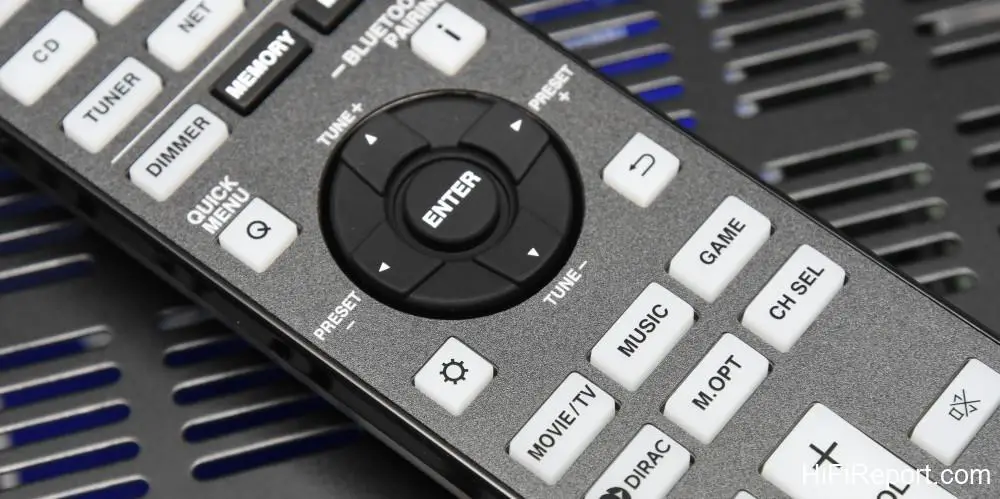
The TX-RZ70 has a wealth of features, but it’s actually quite simple to operate because key functions can be accessed by pressing the Quick Menu button on the remote. This allows for many important operations, including:
HDMI: For example, quickly enabling or disabling eARC is done here. Audio: Features like the Music Optimizer function, which can enhance compressed music, can be activated here. Room EQ: You can switch between the three Dirac Live memory slots (Slot 1~3) here.
Level: Allows quick adjustment of the relative volume levels of the front channels, center channel, and subwoofer without having to navigate deep into the Setup menu.
If you want to compare the effects of the Dirac Live automatic room correction, there’s another DIRAC shortcut button on the remote. Pressing it allows you to quickly switch between Slot 1, Slot 2, Slot 3, and OFF. This is very convenient for quick comparisons.
Internal Design and Build Quality
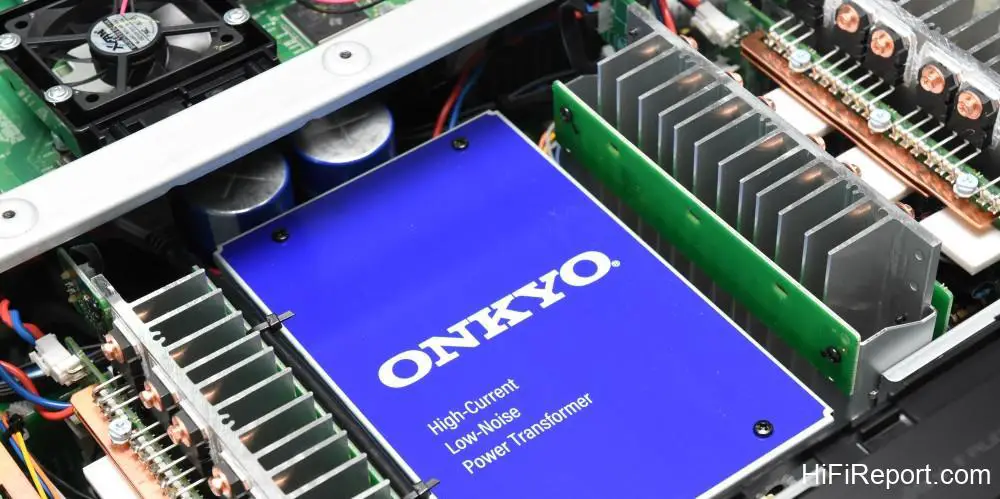
While the above covers the features, the TX-RZ70’s most noteworthy aspect is its internal design. Just by opening the top cover, you’ll find that the TX-RZ70 is completely different in design quality from last year’s TX-RZ50. The circuitry of the TX-RZ70 has undergone a significant overhaul and is clearly more advanced. Last year’s TX-RZ50 had a more traditional Onkyo layout with the transformer on the left side.
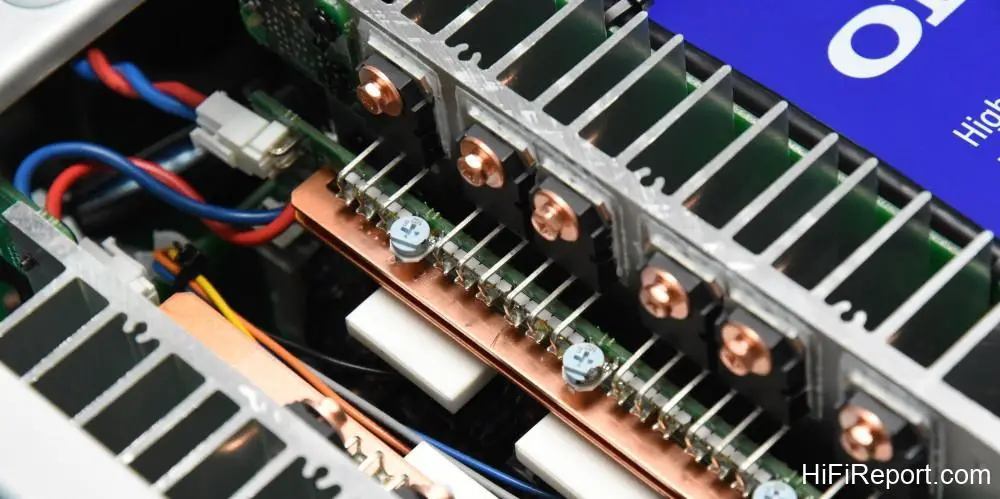
The TX-RZ70, however, adopts a symmetrical layout with a massive EI transformer positioned in the center of the chassis, fully enclosed by a metal shield. Directly behind the transformer are two large filter capacitors (totaling 36000uF). The power amplifier circuits are located on both sides of the transformer (5 channels on the left, 6 channels on the right). This compact arrangement helps shorten the power path.
To further reduce internal resistance, key circuits even use thick copper plates for conduction (instead of typical copper foil), giving the TX-RZ70 powerful current output capabilities.
To assist in cooling the power transistors and to isolate noise generated by the transformer and power amplifier circuits, large heat sinks are placed on both the front and back sides of the power amplifier boards. The spacing between these heat sinks is slightly varied to prevent specific resonances caused by uniform spacing, demonstrating the designer’s attention to sound quality details.
Thanks to these large heat sinks and the oversized transformer, the TX-RZ70 weighs in at 22 kilograms (48.5 lbs) and has a body depth of 480mm, more than 8cm deeper than the TX-RZ50.
The digital processing circuit board is located towards the rear panel on one side. There are two core chips responsible for multi-channel audio processing: one is the Cirrus Logic CS49844A, which handles standard multi-channel decoding. Following this is a Texas Instruments D808K013DPTP5, which handles Dirac Live, AccuEQ, and other post-processing. Both of these chips are 32-bit capable. For the DAC section after decoding, two ESS ES9026PRO chips are used.
These are 32-bit HyperStream II 8-channel DAC chips, capable of handling the 11.2 channel processing requirements. These DAC chips are high-grade, boasting a dynamic range of 124dB and total harmonic distortion of only -110dB, allowing the unit to deliver excellent detail and dynamics, and supporting high-resolution music.
In the corner of the chassis near the rear panel, you can also see a switching power supply. This is dedicated to providing power to the digital processing and video circuits, while the audio circuitry draws power from the traditional EI transformer. This essentially separates the power supply for digital and analog sections, ensuring the unit has low noise characteristics.
Listening Impressions
For this review, we set up a 5.2.4 system using our reference speakers. The TX-RZ70 can store three sets of automatic room correction parameters, so I created three configurations. The first set used Onkyo’s “factory settings,” meaning the factory microphone + Onkyo Controller App, and the results were saved to Slot 1. The second set used the Dirac Live PC software + miniDSP UMIK-1 microphone.
After testing, we used Dirac Live’s default target curve, which is the Harman curve that gradually rises from high frequencies to low frequencies, and saved it to Slot 2. The third set loaded a target curve with a +4dB bass boost, specifically for listening to action-packed movie soundtracks, and saved it to Slot 3.
Using the DIRAC shortcut button on the remote, we could quickly switch between OFF, Slot1, Slot2, and Slot3, allowing for immediate comparison of the effects of Dirac Live and different target curves. When OFF was selected, you could clearly hear that each speaker sounded somewhat independent, lacking seamless integration, and the volume would fluctuate when sound effects moved.
When Slot1 was selected (Dirac Live activated), the sound felt integrated, and there were no longer instances where certain channels sounded too loud or too quiet. When switching to Slot2, the integration felt even better, with smoother transitions and a more cohesive soundstage. The movement of sound objects also felt more natural. Slot3 was simply the bass-enhanced version of Slot2, providing more extreme low frequency presence and a stronger sonic impact.
After a listening session, it’s clear that Onkyo hasn’t changed its core character. The first thing I really appreciated was its power. Driving our reference speakers with the TX-RZ70 felt very dynamic and exhibited excellent density. The sound was also relatively relaxed, unlike some AV receivers that can sound tight or constrained. Supported by its excellent drive capability, the TX-RZ70 could effortlessly render large-scale scenes in movies.
For example, playing “Transformers: Rise of the Beasts” on 4K BD immediately revealed its impact. The narrator’s voice recounting the backstory sounded incredibly thick, conveying a sense of immense authority and ancient history, like a Transformer narrating an old legend. As Unicron’s ship approached the planet, you could feel a large mass of energy swirling in the listening room.
When the ground battle began, the sound of flying objects, laser beams, and Maximals all had a very weighty and energetic quality, making all moving objects sound robust. When the Maximals fled the planet in a spacecraft, you could feel the powerful energy of the ship appearing around the seating position, stirring the entire listening room.
In addition to its power, the TX-RZ70’s surround immersion is another highlight, especially the solid wrapping effect from the sides and rear. For instance, playing “GT: Based on a True Story” on 4K BD vividly reproduced the sounds on the racetrack. During intense racing, you could not only hear other competitors’ cars zipping past the sides or behind the listening position at high speed, but also, thanks to subtle ambient sounds, you felt the presence of the racetrack atmosphere.
During sharp turns, you could feel the entire soundstage shift. The TX-RZ70’s excellent drive capability made the engine roars of each race car sound powerful, accompanied by the screeching of tires on the asphalt, giving each car an aggressive presence.
Excellent surround sound wasn’t limited to intense moments; in certain scenes depicting distant race cars, the sound felt incredibly far away, with the soundstage extending beyond the boundaries of the listening room, providing a very lifelike experience.
With its thick sound and excellent surround immersion, the TX-RZ70 also excels at rendering multi-channel music. Playing “John Williams in Vienna” on BD, the opening segment with the orchestra tuning up immediately revealed the acoustics of the Golden Hall in Vienna. Furthermore, it highlighted the TX-RZ70’s commendable sound quality; the instruments produced sounds with beautiful timbres.
As John Williams walked towards the podium, the audience on the first and second floors erupted in thunderous applause, which completely enveloped the listening position. The first piece performed, “The Flight to Neverland,” featured trumpets and French horns playing together, and the system displayed high sound density. When the timpani were struck, you could hear deep and thick bass notes. When violins and flutes played in unison, you heard soft and graceful notes.
This passage made one feel as if they were soaring with the music – the effect was superb.
Conclusion
Reviewing the TX-RZ70 was a very pleasant experience. From all perspectives, you can feel Onkyo’s progress in AV receiver design reaching a new level. Specifically, the thick, weighty sound and excellent surround immersion deliver captivating effects whether playing movie soundtracks or multi-channel music. Its deliberate 11.2 configuration, resulting in a more affordable price point, demonstrates excellent value for money. It feels like Onkyo has found a sales sweet spot.
If you’re looking for 11-channel output and don’t plan to use more than two subwoofers, then the TX-RZ70 is definitely an outstanding choice. We’ve decided to give it our Best Buy recommendation.
Specifications
* 11-channel output, can connect 2 subwoofers
* Supports Dirac Live automatic room correction
* Optional paid upgrade for DLBC (Dirac Live Bass Control) low-frequency management
* THX certified, supports IMAX Enhanced
* Equipped with high-performance 32-bit ESS Sabre DAC chips
* Capable of passing through 8K/60Hz and 4K/120Hz video
* Bidirectional Bluetooth, Bluetooth headphones can use aptX and aptX HD
* Supports streaming music platforms like TIDAL, Spotify, etc.
* AirPlay 2, Chromecast, Roon Ready
* Supports Bi-Amping for driving left and right channels
* Supports Zone 2 and Zone 3 audio/video signal sharing
* Design: 11.2 Channel AV Receiver
* Amplification Technology: Class AB
* Power Output Capability: 140 Watts x 11 (8 ohms), 210 Watts x 11 (6 ohms)
* HDMI and Video Input Capability: Equipped with 7 inputs and 3 outputs (HDMI 2.1), supports HDCP 2.3, supports 8K/4K resolution, HDR10+/Dolby Vision, VRR, QFT, ALLM. Outputs support eARC.
Additionally, includes 1 component video input, 2 composite video inputs (RCA). * Audio Inputs and Outputs: 7 HDMI inputs, 4 RCA inputs, 1 RCA Phono input, 2 optical inputs, 2 digital coaxial inputs, 11.2 channel pre-outs, Zone2/Zone3 stereo RCA outputs. * THD+N (Total Harmonic Distortion + Noise): 0.08%
* Dimensions (W.H.D. ): 435 × 201.5 × 480mm
* Weight: 22 kg (48.5 lbs)

- 11 CHANNELS, 140 WATTS: Home theater buffs rejoice! The Onkyo TX-RZ70 is our most powerful AVR yet, giving you the power to design the ultimate entertainment space with discrete zones, multiple subwoofers, and high-performance components that won’t overheat or lag.
- STUDIO GRADE PROCESSING: Built by and for audiophiles, but intuitively built for the everyman. Utilizing the very latest audio technology including ESS Sabre DACs, THX Certification, and eARC functionality, the Onkyo TX-RZ70 overdelivers on premium home theater performance.
- DIRAC LIVE TECHNOLOGIES: You deserve an AVR that adapts to your life, not the other way around. With built-in Dirac Live Room Calibration Full Bandwidth, the Onkyo TX-RZ70 uses machine learning to perfectly adapt and calibrate your audio settings to your unique speaker system and room layout. And big bass fans will also be able to upgrade their system (firmware available June 2023) with Dirac Live Bass Control Single/Multi Subwoofer for optimal calibration of the lowest tones.
- IMAX ENHANCED MODE: Bring the theater experience to your home by recreating IMAX content just as filmmakers intended. The TX-RZ70 meets the precise quality standards established by IMAX to reduce noise and grain to produce brighter, clearer pictures, plus immersive sound for the ultimate cinema experience. IMAX Enhanced Mode also provides a stretched aspect ratio for up to 26% more picture on your screen.
- THX CERTIFIED: In 1993, Onkyo became the first consumer home theater electronics brand to be THX-certified, after thousands of tests. No matter what input is used, what combination of built-in features are used, what preamplifier or amplifier, there can be absolutely nothing added, nothing taken away from the source material. And the TX-RZ70 offers four distinct THX listening modes: cinema, gaming, music, and surround EX.