
PureTek Alpha Network Switch Review
Ever since Ansuz network switches were introduced to Taiwan, audiophiles have realized just how expensive an “audiophile-grade” network switch can be. It is not just Ansuz; the S1 released by Japan’s Melco in 2025 is also quite pricey. Looking at the price tags of these two network switches, Taiwan’s own Diva EX-7 suddenly doesn’t seem that expensive after all.
Of course, the Taiwanese market offers plenty of other audiophile-grade network switches from brands like COS, Innuos, Nordost, NuPrime, Silent Angel, SOtM, and Telegärtner, which are relatively more affordable.
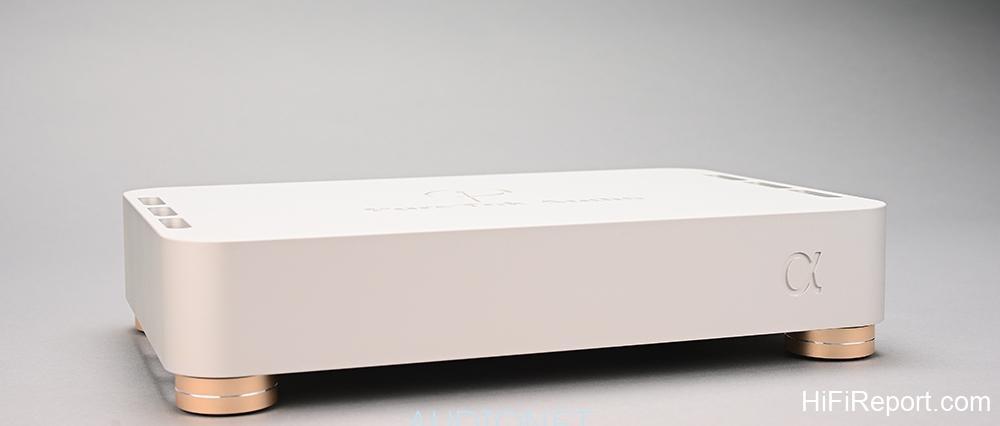
Now, another audiophile-grade network switch has emerged from Taiwan: the PureTek α. I first encountered this network switch at the TECA Audio Show in December 2024. Despite its compact chassis, it is CNC-milled from a solid block of aluminum. It looks incredibly premium and feels remarkably heavy in the hand, suggesting excellent vibration resistance. Today, this audiophile-grade network switch is sitting in my listening room.
Although the α is small, its visual design is exceptionally handsome. The faceplate features a large α symbol on the right, while the top cover is deeply engraved with the PureTek name and “P” logo. Additionally, there are three long, oval-shaped cutouts on both the left and right sides, which likely serve a decorative purpose. Moving to the rear panel, the connections are divided into separate input and output groups.
Each group features two RJ45 ports and one SFP optical port, alongside the DC power inputs and grounding terminals.
We all know that network switches facilitate bidirectional communication, and standard ports generally do not distinguish between inputs and outputs. Yet, PureTek has explicitly divided this switch into “Input” and “Output” sections, with only two RJ45 ports per group. Why design it this way? I called the designer at PureTek to inquire and asked him to send over their design documentation. Below is a faithful translation of the technical details he shared:
Technical Design
**Design Philosophy:** The goal is to use optical isolation to block source-side noise, preventing electrical noise from traveling down the network cables and reaching downstream audio equipment that is highly sensitive to power quality.
1. **Built-in Optical Isolation:** The unit houses two independent circuit boards, each powered by its own separate DC supply. They are linked internally using a custom optical module and fiber optic cable. This delivers the pristine cleanliness and high resolution typical of optical isolation, while the customized optical components resolve the cold, clinical sound often associated with standard off-the-shelf fiber optics.
2. **Chassis and Isolation Design:** The custom-engineered chassis ensures that the two internal circuit boards are completely isolated with no shared ground, and each board has its own dedicated grounding terminal. With only a fiber optic link connecting them internally, electrical signals are entirely decoupled. This effectively condenses a multi-switch cascading setup—a popular tweak among high-end audiophiles—into a single chassis.
In practice, it should be viewed as two completely independent switches cascaded in series.
3. **Multi-Group Low-Noise LDOs:** Features multiple built-in low-noise LDO regulators to provide independent, isolated power to different circuit zones.
4. **Dual Sonic Signatures:** Two different types of RJ45 network interfaces are provided, offering distinct sound profiles to suit different system configurations and personal preferences.
I also asked the designer about the class of internal clock used. He replied that they opted for a Temperature Compensated Crystal Oscillator (TCXO). When asked why they didn’t use a higher-grade Oven-Controlled Crystal Oscillator (OCXO), he explained that they had tested it, but it did not deliver superior sonic performance compared to the TCXO. Consequently, they finalized the design using the TCXO.
In reality, Ethernet is a packet-based, asynchronous transmission protocol. It does not rely on rigid clock synchronization nor does it perform reclocking in the traditional sense. As a result, the clock inside a network switch does not require the ultra-tight precision demanded by a DAC, making a high-quality TCXO more than accurate enough for the task.
Some might wonder: what is the actual difference between a consumer-grade network switch and an audiophile one? Is the chassis the only real difference? In truth, the primary differentiator lies in noise suppression and isolation, followed by the quality of the connectors and potential optimizations in power delivery. The digital “0s and 1s” themselves are transmitted in packets and remain unaffected.
So, what noise needs to be addressed? Electromagnetic interference (EMI) and radio frequency interference (RFI) are omnipresent in modern homes and must be dealt with. Combating EMI and RFI requires higher-grade components and superior shielding. PureTek’s decision to mill the chassis from a solid block of non-magnetic aluminum alloy, combined with internal isolation, proves highly effective at suppressing these two types of interference.
Then there is the power supply. Whenever a device is labeled “audiophile-grade,” power treatment inevitably comes up. In fact, almost all high-end audio gear places immense emphasis on power supply design, which is often highly costly to implement. PureTek’s solution here is remarkably direct: the input and output stages each have their own independent power feeds.
Out of the box, these power supplies are simply off-the-shelf Innergie universal chargers delivering DC power directly to the switch. This straightforward approach is as direct as it gets.
Why did they opt for such a basic, entry-level power solution? The manufacturer explained that there are already many excellent external linear and DC power supplies on the market, such as Taiwan’s EA Hibrid battery-powered supplies. Upgrading to these yields far better results. Thus, they package only a basic external supply, confident that buyers of the Alpha will likely upgrade to premium external power supplies anyway.
However, they recommend keeping the voltage at 9V; running it at 12V makes the unit run hotter, and excess heat can induce noise.
I also asked what would happen if the power supply were housed inside the main chassis. Their response was that doing so does more harm than good. Whether using a linear or switching power supply, housing it internally places it too close to the sensitive audio circuit boards. Furthermore, transformers are prone to physical vibration, making an outboard power supply the ideal configuration.
Additionally, the designers emphasized the importance of high-quality RJ45 connectors, as these terminals are highly sensitive to vibration. Consequently, they paid meticulous attention to both selecting and securely mounting these ports.
Sonic Performance
For my listening tests, I used both the stock Innergie universal chargers and the EA Hibrid Pure DC B1 battery power supply. I happen to own two EA Hibrid units: one is permanently hooked up to my main router, so I used the second unit to power the input stage, and then swapped it to the output stage to compare.
To my surprise, upgrading just one side with the EA Hibrid battery supply yielded a massive improvement. For instance, listening to Kuo Chin-fa’s *Unforgettable Phoenix Bridge*, the sonic gains were immediately obvious. When playing Edgar Moreau’s *Transmission*, both the orchestra and the cello sounded noticeably more robust. The sense of scale expanded, and the presentation felt fuller and more powerful.
I can only imagine that using two premium power supplies—one for the input and one for the output—would yield even greater results.
Do audiophile-grade network switches make sense? Absolutely. They genuinely elevate sonic performance. As for *why* they improve the sound, I’ll leave that to the scientists to decipher. Ultimately, to an audiophile’s ears, the improvement is undeniable. If you remain skeptical, that is perfectly fine—there will always be those who cannot hear a difference.
It is just like cable upgrades; I discovered their impact on sound quality decades ago when I first founded *Audio Art* magazine, and we ran a special feature on it. Decades later, some skeptics still refuse to believe it!
So, what does the PureTek α actually sound like? I guarantee that from the very first listen, you will experience an immediate sense of clarity and freshness. Instrument bodies become more focused and three-dimensional, transparency is heightened, and the trailing decay of notes floats more clearly within the soundstage.
I was able to spot all these improvements with just a single album: the Emerson String Quartet’s *Listening Guide*. On this record, the members explain a musical passage before performing it, alternating between spoken commentary and music. During the commentary, the spoken voices sounded noticeably more focused and holographic. When the quartet played, the sense of transparency and ambient room decay was vastly superior.
Next, I listened to Alina Ibragimova playing Schumann’s *Violin Sonatas*. The piano notes immediately possessed a stronger physical presence and weight, while the violin sounded far more realistic and lifelike. Following that, I put on Debussy’s *String Quartet* performed by The Nash Ensemble.
Similarly, the harmony of the quartet became more beautiful, the tonal quality of the four string instruments improved, and most importantly, the wooden resonance of the instrument bodies sounded richer and more organic.
Moving on to Sabine Meyer’s performance of Mozart’s *Clarinet Quintet in A major, K. 581*, one didn’t need to listen critically to notice that the clarinet’s timbre was more beautiful, with smoother, more rounded musical lines. Meanwhile, the friction and texture of the bow on the cello strings became clearer, and the overall sound quality was greatly enhanced.
When listening to Fausto Mesolella singing *Tulipani*, the accompanying steel-string acoustic guitar sounded tighter and snappier, while the vocalist’s voice was fuller, more focused, and prominently projected. On Aaron Neville’s *I Bid You Goodnight*, the most striking change was that his vocals sounded slightly firmer and more defined rather than soft and diffused.
Furthermore, the low-end pulses became tighter and decayed faster. It almost goes without saying that transparency was improved, ambient hall decay was longer and clearer, and fine details were much more abundant.
On Edgar Moreau’s *Great Dramatic Sonatas*, both the cello and piano images were more tightly focused, with clearer outlines, and the texture of the bow on the cello strings felt far more authentic. Listening to another piece, Myaskovsky’s *Cello Sonata* performed by Bruno Philippe, yielded the same result: the cello sounded more focused, and the bowing texture was incredibly realistic.
When listening to Chloe Chua and the Singapore Symphony Orchestra’s rendition of the *Butterfly Lovers Violin Concerto*, the entire soundstage felt wider and deeper, the timpani strikes packed a heavier punch, and the violin lines sounded more brilliant and incisive.
I then played Florence Price’s *Symphonies Nos. 1 & 3*, conducted by Yannick Nézet-Séguin with the Philadelphia Orchestra. All of the aforementioned improvements were beautifully illustrated in this symphonic work: the woodwinds were sweeter, the brass had a more gorgeous luster, the entire orchestra sounded more powerful, and the soundstage was impressively vast.
From these descriptions, you can likely understand why I describe the effect as “exhilarating and clear.” The entire musical presentation feels more vivid and crisp, making the listening experience far more enjoyable.
To break down this clarity: the sense of space expands dramatically, the soundstage becomes much more transparent, and the high frequencies are sweeter and more refined. The trailing decay of instruments and the natural acoustics of the recording venue surface with ease. The midrange is more focused with sharper instrument outlines, and the low end is tighter—not increased in volume, but significantly improved in density and weight.
I had planned to experiment with isolation feet, but my 1-meter network cable was too short to allow for any positioning adjustments, so I had to pass. It is highly likely that adding isolation feet would elevate the performance even further.
If you are currently using a standard consumer-grade network switch, swapping it out for the PureTek α is guaranteed to be a revelation—one that will leave you with a strong urge to buy.
However, if you are hoping a network switch will bloat your low end, make Tsai Chin’s vocal image artificially large and diffused, or soften up your system’s overall sound, then the PureTek α may not be what you are looking for. But for those seeking genuine fidelity, my final conclusion is simple: the PureTek Alpha network switch is an incredibly worthwhile investment.
Specifications
* *Product Type:* Network Switch
* *Release Year:* 2025
* *Inputs:* RJ45 × 2, SFP × 1
* *Outputs:* RJ45 × 2, SFP × 1