
Rockport Lyra Flagship Speaker Review
Finally, HiFiReport has experienced the Rockport Lyra, and I must say, this is the best audition experience I’ve ever had at HiFiReport. It’s not that previous experiences were bad, but the Lyra’s performance was simply outstanding and deeply impressive.
Profound Musicality
What makes it so good? Its strength lies in the fluid expression of musical emotion, captivating you to the point of losing track of time, wanting only to focus on the notes, savor every detail of the recording, and feel the artist’s intent. Perhaps the best audio equipment should be like this, allowing you to forget its existence and focus entirely on the music.
This principle is similar to how pianists choose Steinway or Bösendorfer pianos, or how string musicians aspire to own a Stradivarius. These dream instruments possess immense musical expressive power. In the hands of top musicians, they can speak entirely through notes. The instrument’s performance doesn’t hinder the musician; instead, its unique timbre inspires deeper interpretations of the music. The relationship between instrument and musician mirrors the relationship between audio equipment and listener. A great instrument allows musicians to effortlessly express themselves through music, while great audio equipment makes you forget its presence, immersing you completely in a sea of music. The Lyra is a speaker with such profound musicality.
Formidable Power at the Audio Show
This wasn’t my first encounter with the Lyra. Like most audiophiles, my first experience was at the TAA Audio Show in August 2022, where I first witnessed its power.
HiFiReport had actually placed an order with Rockport quite early on. However, due to the pandemic’s impact over the past two years, material shortages and port congestion became the norm. Originally intended to be prepared for the TAA Audio Show, the factory nearly couldn’t produce them in time despite advance planning. Pre-show news even suggested that the Avior II might be showcased instead. Fortunately, Rockport notified us a week before the show that the Lyra would be shipped, so the flagship Lyra naturally took center stage.
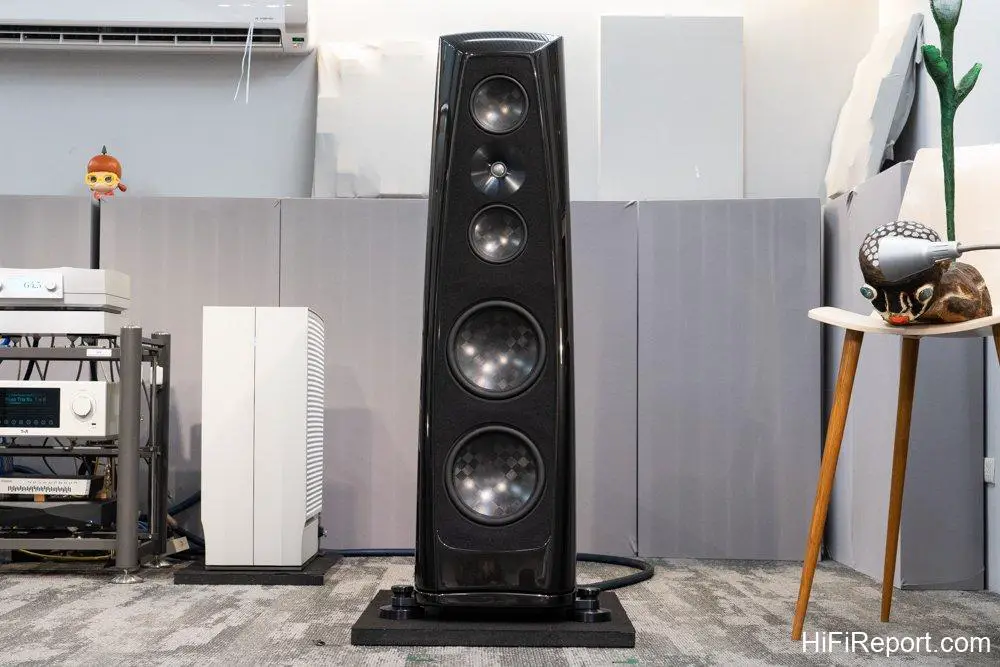
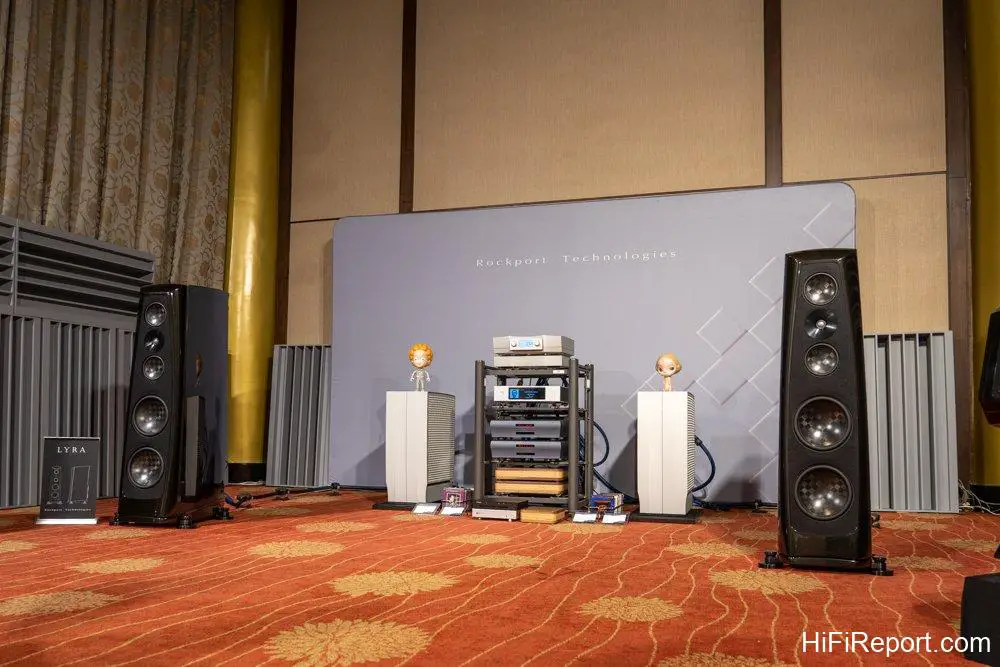
At the TAA Audio Show, the Lyra was showcased in the Grand Hi-Lai Hotel’s Huai An Hall, paired with a full suite of Constellation Audio amplifiers from the United States, along with Playback Design’s top-of-the-line Dream Transport SACD/CD player and Dream DAC, and a complete set of Siltech cables from the Netherlands. The setup was grand and impressive. In the Huai An Hall, I witnessed the Lyra’s formidable presence and scale, which was truly extraordinary. Even in a less-than-ideal acoustic environment, a large space with high ceilings, the Lyra still delivered an awe-inspiringly powerful performance. However, the bustling crowds at the audio show made it difficult to appreciate the Lyra’s finesse beyond its sheer power. Hence, my visit to HiFiReport after the audio show was to carefully savor the Lyra’s qualities in a quiet environment.
Super Speaker with Astonishing Weight
Rockport is one of my dream speaker brands. About twenty years ago (time truly flies), I first encountered Rockport speakers at an audiophile’s home. I was new to high-end audio at the time and didn’t recognize the brand. The drivers looked somewhat like Dynaudio’s. My friend told me they were custom-made Audio Technology drivers, even higher grade and more expensive, jokingly calling me ignorant. I quickly asked what speakers they were. My friend said they were Rockport Antares, quite valuable.
I circled the Antares speakers, examining them closely, but couldn’t discern much. After all, I was still a novice in high-end audio, not knowing much. My friend, seeing my furrowed brow, as if I couldn’t see what was so special about the not-so-large Antares, said to me, “Try pushing the speaker, see if you can move it?” I boldly reached out and touched the middle of the speaker cabinet, trying to push the Antares. Unbelievable, the speaker seemed rooted to the floor, firmly fixed in place, completely immovable. This speaker, which didn’t look large, was surprisingly heavy! This is Rockport! Without understanding its inner workings, it’s hard to appreciate its value.
“Hardcore” Cabinet Design Philosophy
Speaker cabinet design roughly falls into two camps. One camp believes speakers should resonate like musical instruments to beautify the sound, as is mostly the case with British thin-walled cabinet speakers. The other camp insists that speaker cabinets should be free of resonance to avoid coloration, a “hardcore” approach favored by most American speaker brands, including Rockport, Wilson Audio, YG Acoustics, and Magico.
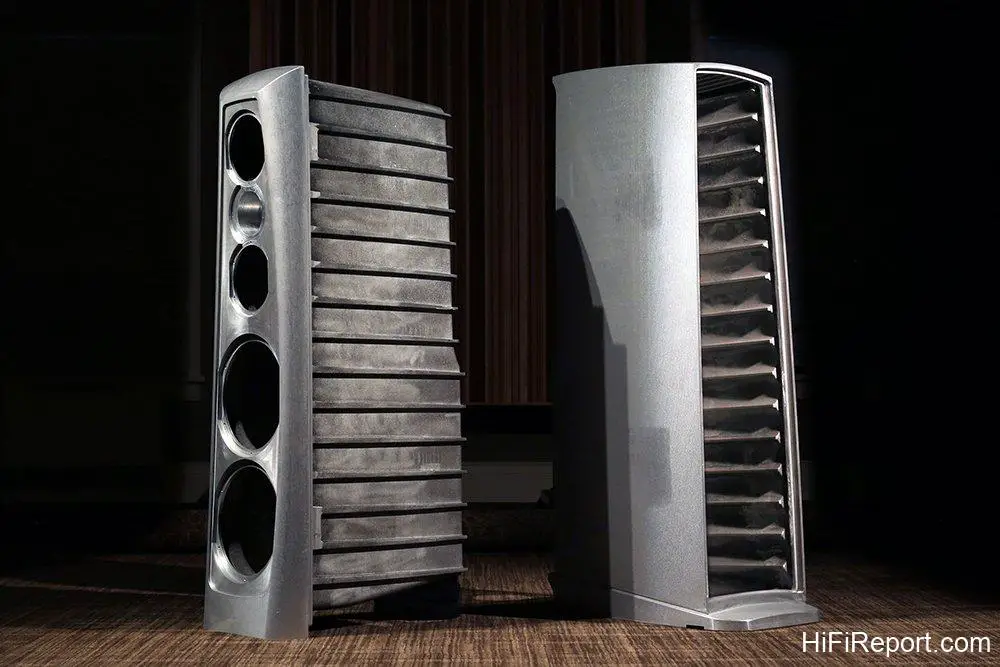
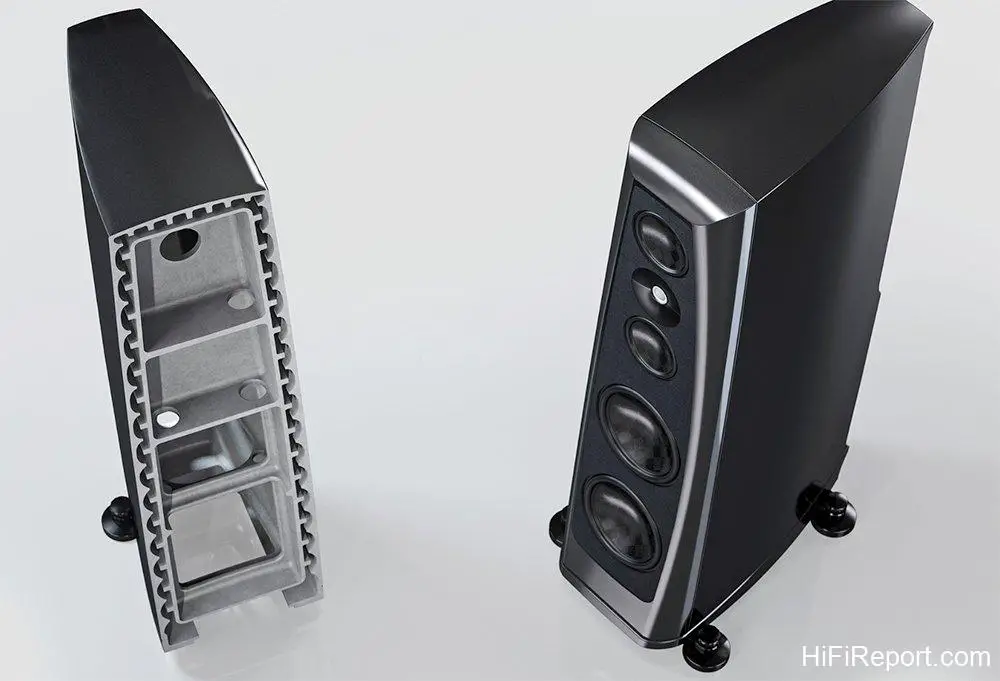
However, even within the “hardcore” camp, each brand has its own nuances. YG Acoustics and Magico use aluminum alloy for their speaker cabinets, while Rockport and Wilson Audio use composite materials. The Lyra, being Rockport’s latest generation flagship speaker, employs the exclusive DAMSTIF structure, integrating aluminum alloy and composite materials, elevating Rockport’s speaker cabinet technology to a new height.
Rockport has consistently used the most challenging manufacturing methods to build speakers, not intentionally choosing the difficult path, but because it is necessary to achieve high rigidity and high damping in speaker cabinets.
Just like Robert Frost’s poem: “Two roads diverged in a wood, and I—I took the one less traveled by, And that has made all the difference.”
Choosing the Road Less Traveled
Modern speaker cabinets are mostly made of MDF or HDF, valued for their uniform material density, easily controlled rigidity and damping, and readily available, stable processing costs. However, to transcend the limitations of these materials, one must abandon easily accessible and processed materials and explore new paths. Aluminum alloy, with its rigidity far exceeding MDF or HDF, is one option. Composite materials or sandwich construction are also options, but each presents technical challenges. For aluminum alloy, rigidity is undoubtedly the highest among various materials.
If simply choosing aluminum alloy, Rockport’s path wouldn’t be the less-traveled, difficult route. Most speaker cabinets made of aluminum alloy are constructed with aluminum alloy plates to form a sturdy cabinet, such as Goldmund or Magico. Another method is extruded aluminum cabinets, with Piega of Switzerland as a representative. However, Rockport’s DAMSTIF cabinet uses mold casting, which is extremely rare and difficult to manufacture.
Exclusive DAMSTIF Speaker Cabinet
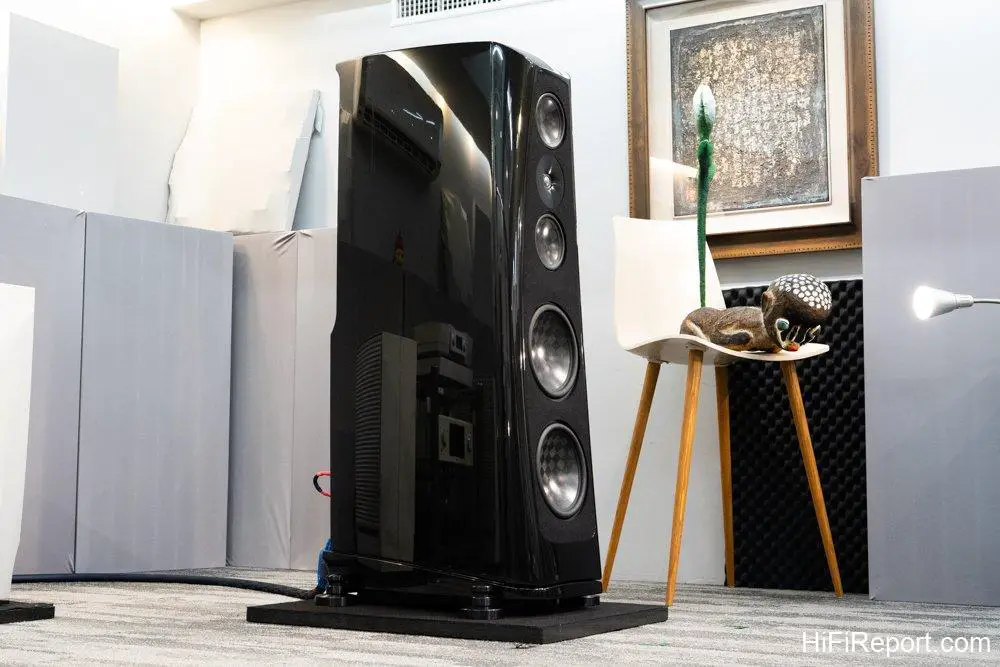
Why go through the trouble of casting aluminum alloy cabinets? This relates to Rockport’s early use of carbon fiber and fiberglass composites for speaker construction, all using integrated molding. Casting aluminum cabinets is a continuation of Rockport’s consistent philosophy. However, while aluminum alloy has the highest rigidity, its internal damping properties are not ideal. How to address the ringing of metal that causes coloration? This is where DAMSTIF becomes unique. The Lyra’s cast aluminum cabinet is divided into inner and outer shells. Between these shells, Rockport incorporates a special damping material, solving the ringing issue of aluminum alloy cabinets.
It sounds simple, but the manufacturing is undoubtedly extremely difficult. Do you know how heavy the Lyra is? Over 560 pounds per speaker. Even divided into inner and outer shells, each cast aluminum cabinet probably weighs close to a hundred kilograms. How to join the inner and outer shells and evenly inject the special damping material in between? Just thinking about it seems incredibly challenging.
Furthermore, the cast cabinet is not finished upon demolding. The freshly demolded cabinet is surely an ugly duckling, full of imperfections. It needs repeated grinding and polishing before the inner and outer shells can be joined. Finally, a beautiful piano lacquer finish is applied. Every step is labor-intensive and time-consuming.
(Image from Rockport official website) Looking at the price, the Lyra is not cheap. But considering the Lyra’s unique cast aluminum inner and outer cabinets, the DAMSTIF structure with special damping material, and the mirror-like piano lacquer finish, I would say, anyone who doubts Rockport’s pricing and wants to imitate and make it themselves, go ahead. Actually trying it will reveal the difficulties. This is truly an incredibly challenging cabinet to manufacture! Why would Rockport go to such great lengths to create such a complex DAMSTIF speaker cabinet? There’s only one answer: to achieve the highest cabinet quietness.
The extremely rigid aluminum alloy cabinet, combined with a special high-damping interlayer, is designed to eliminate any cabinet resonance, purely leaving the driver movement and the cabinet volume’s Helmholtz effect, achieving pure music reproduction.
(Image from Rockport official website)
In-House Designed and Manufactured Drivers
With the DAMSTIF speaker cabinet, next, we look at the Lyra’s speaker drivers. In its early days, Rockport designed its own drivers and contracted Danish Audio Technology for manufacturing. However, with the Arrakis, it became semi-in-house driver production. Since 2011, except for the beryllium tweeter, Rockport speakers have been using exclusively in-house manufactured drivers.
Why abandon outsourcing drivers and switch to in-house production? This is like “if you want milk, raise your own cows”. Is it troublesome? Of course, it’s very troublesome, but it’s the only way to ensure quality.
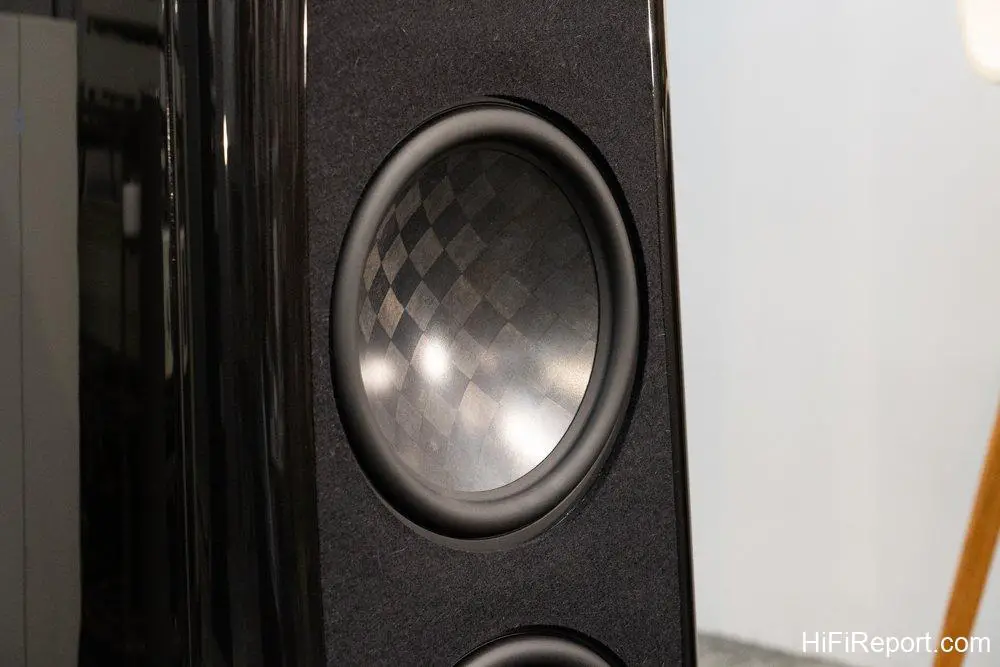
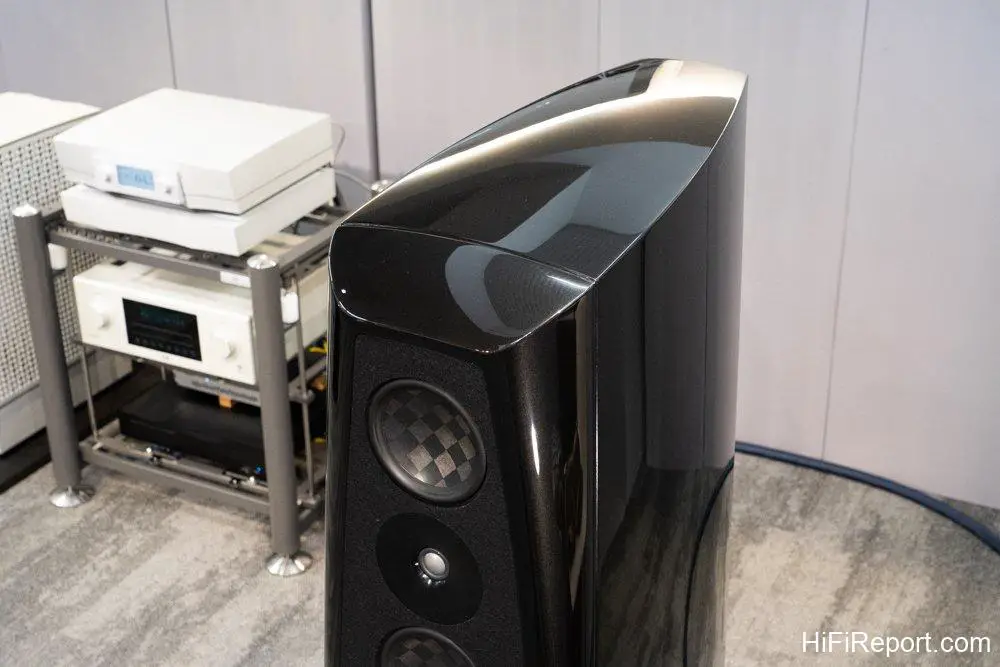
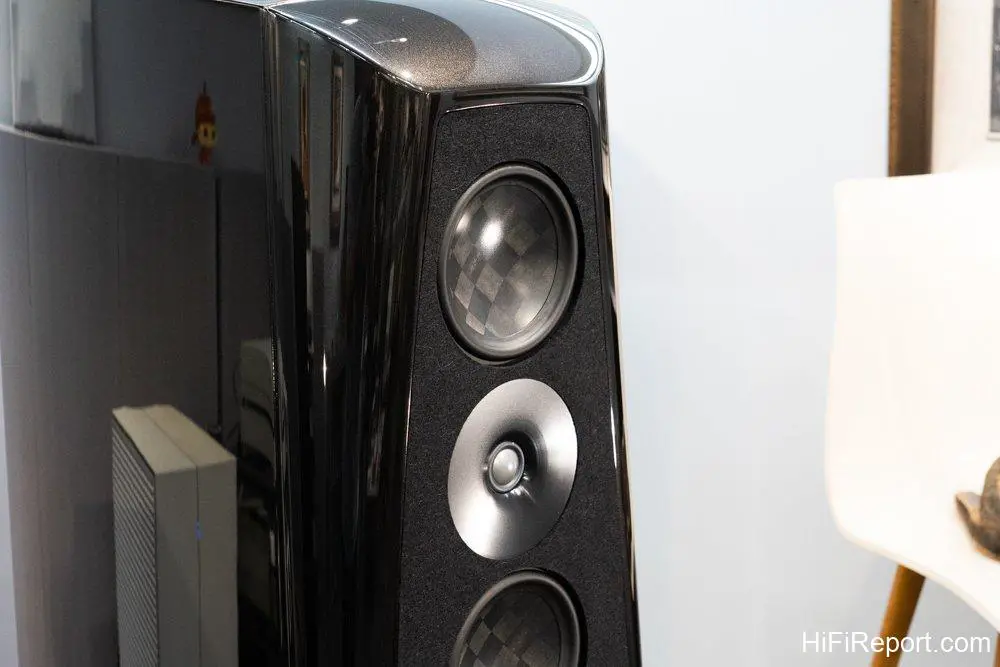
For a simple example, if you request driver tolerances to be less than 1 dB, you’d likely be rejected outright. No one wants to make them for you because achieving such low tolerances inevitably means discarding many finished products, potentially causing losses for the manufacturer. So Rockport simply developed its own tooling, manufactured its own carbon fiber materials, developed exclusive coatings, and combined them with ultra-light foam materials to create a sandwich carbon fiber diaphragm. This allows the midrange and bass drivers to possess extremely high rigidity while maintaining very light mass.
Hand-Wired Crossover, Tuned by Ear
The Lyra uses a total of 5 drivers in a 3.5-way configuration. One midrange driver extends up to 2.1 kHz, the crossover frequency with the tweeter. The other midrange driver only handles frequencies below 400 Hz, crossing over with the woofers. This arrangement enhances dynamics in the mid-bass range while maintaining purity in the mid-high frequencies.
For the tweeter, Rockport used silk soft dome tweeters in the past, but now has fully transitioned to beryllium tweeters, extending high-frequency response to 30 kHz.
As for the crucial crossover, it has always been Rockport’s closely guarded secret. Even disassembling the speaker won’t allow imitation. It’s not about the crossover points being particularly special, nor is it that the values of passive components are undetectable. The key is still “in-house manufacturing”. Commercially available capacitors or inductors are not good enough? No problem, Rockport makes them themselves, measures them themselves, and abandons PCB boards, adopting hand-wiring. These are not even the most difficult aspects to imitate. The most challenging part is the ear-tuning and fine-tuning in Rockport’s own listening room. As for what to listen for and what to adjust, that’s Rockport’s secret weapon, impossible for others to learn.
Choosing the most difficult path, making passive components in-house, designing and manufacturing drivers in-house, and combining them with the cast aluminum DAMSTIF speaker cabinet, the Lyra is undoubtedly hard-earned, and its production volume is naturally low. That’s why even though HiFiReport placed an order early on, it almost missed the audio show. Fortunately, it was air-freighted in a week before the show, allowing us to witness the Lyra’s magnificent presence at the audio show.
At the audio show, I heard the Lyra’s power. In such a large space, the musical energy could fill it so completely, with authoritative mid-bass presence. But high-end audio cannot be just about power and grandeur; it must also exhibit rich musicality, being both forceful and delicate. This is not easily discernible at an audio show. After all, the exhibition hall is crowded with people coming and going, many people listening while commenting, and the noisy environment obscured the Lyra’s finesse.
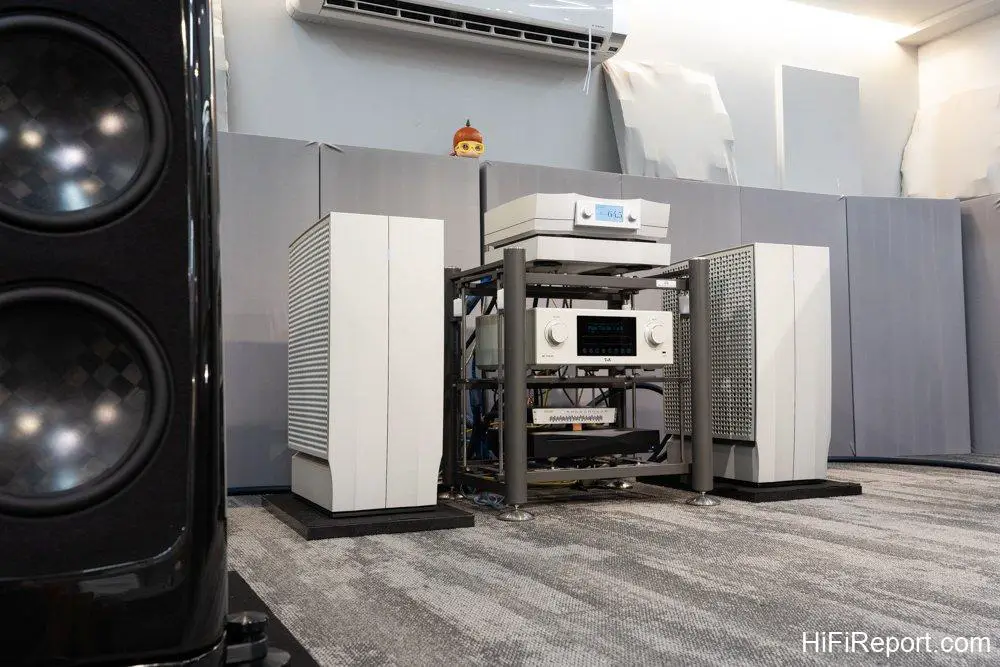
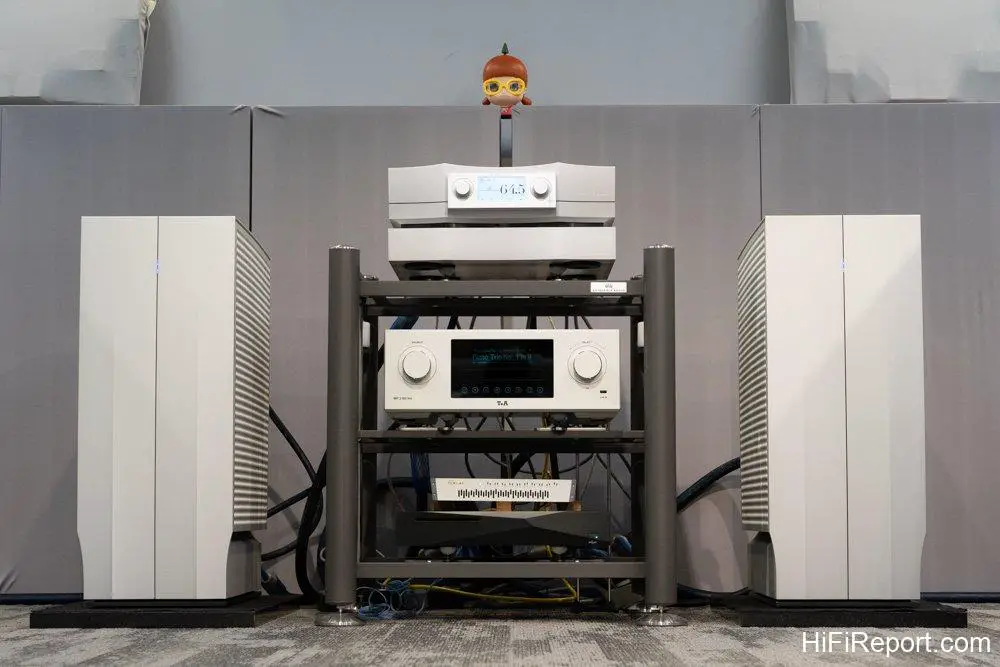
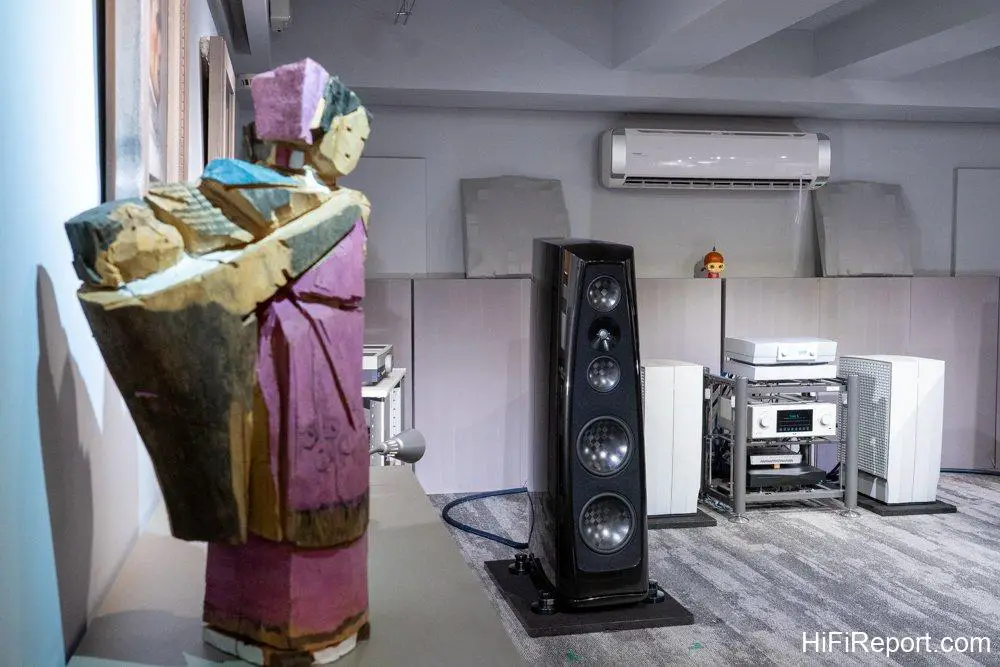
In HiFiReport’s listening room, the equipment paired with the Lyra was similar to the TAA Audio Show, all Constellation Audio pre- and power amplifiers and Siltech cables. However, the digital source was different, replaced with a German T+A MP-3100 HV, capable of both physical CD and digital streaming playback. Since I brought a lot of CDs with me, I started with CD playback.
Experiencing Lyra’s Refinement at HiFiReport
During the audition, Editor-in-Chief Zhu said to me, “The Lyra is very powerful and unfazed by demanding material.” I replied, “I witnessed its power at the audio show. It was more than capable even in such a large space. Today, I’m here to listen to its refinement.” Actually, before Editor-in-Chief Zhu spoke to me, he had already used Marcus Miller’s “Tutu Revisited” live recording to verify the Lyra’s power. For a live concert by an electric bassist, low frequencies are definitely the main focus. With the explosive kick drum, paired with fancy and fast funky bass lines, the Lyra not only delivered abundant bass quantity, but more importantly, the electric bass’s ferocity. The solid and deep sound when the right hand slaps the strings, the crisp and bouncy sound when plucking, and the note articulation when the right hand taps on the fretboard, falling like dense raindrops, the Lyra didn’t miss a single note’s clarity, showcasing Marcus Miller’s superb electric bass playing skills. To play bass like this, Marcus Miller has reached a divine level. But listening to a divine performance with the Lyra is even more enjoyable than being at the live venue, almost as shocking as standing in the front row of a rock concert.
The Lyra’s mid-bass authority, its immense dynamics and fast transient response, I believe anyone who heard it at the TAA Audio Show knows how impressive it is. But my purpose this time was truly to listen to the Lyra’s subtleties, to hear what kind of listening Rockport can create with its extremely quiet speaker cabinet.
Fully Immersed in the Music
I chose Gilels’ solo, Jochum conducting the Berlin Philharmonic’s “Brahms Piano Concerto No. 2”, listening to the romantic third movement, Andante.
Brahms didn’t write a cello concerto, but the third movement of Piano Concerto No. 2, opening with a cello solo, is essentially a gorgeous cello concerto.
This piece is very demanding to reproduce. The opening cello solo, with the orchestra’s soft pizzicato responses in the background, carefully supporting the cello protagonist’s status. The strings’ melodious sustained notes bring out an even more beautiful cello line. Then the orchestra takes over the theme, and the musical scene expands from the central cello solo to a full orchestral scale. The woodwind and cello responses, alternating in the foreground and background, create beautiful layers.
Wait, why haven’t I described how the Lyra performs? The music is too beautiful, the Lyra is too captivating. Most importantly, the Lyra presents the music’s progression from small to large scale, allowing the listening emotions for Brahms to gradually focus and intensify. As the orchestra expands the music’s scale, the Lyra opens up the soundstage, not only spacious and transparent but also layered and distinct. The effortless dynamics allow you to feel the conductor gradually increasing the orchestra’s power, pushing to a climax and then receding, with woodwind and cello responses, lingering and preparing to welcome the piano solo.
The piano quietly unfolds, a monologue-like loneliness expressed in a series of subtly connected notes. On the Lyra, the piano’s staccato notes in the right hand are underpinned by the left hand’s arpeggiated chords. The orchestral tutti brings out a romantic yet melancholic theme. The piano responds with powerful force, expanding Brahms’s musical tension. I truly forgot I was listening to the Lyra, fully immersed in the music.
Many people say they don’t understand classical music, but the third movement of Brahms Piano Concerto No. 2 actually has a discernible narrative. The main melody is from his art song “My slumber grows ever more shallow” (immer leiser wird mein schlummer), the second of the five art songs, Op. 105. Listening to the Lyra playing the slow movement of Brahms Piano Concerto No. 2, I thought of a poignant love story. The female protagonist, in her sleep, hears her boyfriend knocking at the door in the middle of the night, but is unable to answer, forced to let her slumber grow ever more shallow. Perhaps the female protagonist is seriously ill and cannot respond, having to spend the long night alone, thinking that next spring, her lover will kiss another woman’s lips, while she will already be asleep forever. Brahms’s piano concerto unfolds, the cello becomes the solo protagonist again, with the piano echoing. Perhaps, the cello is the female protagonist, and the piano is the male protagonist who visits late at night but to no avail. And the Lyra transforms the cello and piano’s interplay into lingering notes, echoing in the spacious soundstage, so beautiful.
Violin Exhibits Intense Musical Engagement
Let’s scale down the scene a bit, using a simpler ensemble to hear how pure the Lyra’s sound quality is. Listening to Rachel Barton and Samuel Sanders’ collaboration “Homage to Sarasate”, the first track “Andalusian Serenade” is a very beautiful piece. The piano’s quiet opening brings out the violin’s beautiful melody theme. The Lyra effortlessly creates the physical presence of the two instruments, the piano full and substantial, the violin focused and concentrated, standing in the center-right of the soundstage. When the piano brings in lively arpeggiated chords, the violin responds with passionate notes. The rapid note runs, the right-hand bowing technique is complex, then it transitions into soothing sustained notes, the romantic melody dispelling the previous tension.
In the allegro sections, the Lyra showcases a powerful violin, the note runs full of vibrancy. In the sustained, soothing melodies, the excited emotions subside, preparing for the next rapid violin virtuosity. This “Andalusian Serenade”, alternating between slow and fast tempos, exhibits rich Spanish flavor, tender as water, contrasting with fiery passion. The Lyra aptly presents both musical moods.
What’s challenging about this piece? When playing at high volumes, the violin’s passionate parts must not become shrill or harsh. The rapid note changes need to exhibit a lively character. The weight of double-stops and the soothing feel of single-string playing must bring out the dramatic changes in musical atmosphere, conveying rich musical engagement.
Indeed, what’s most difficult in audio? Not the full-frequency range reproduction, but the ability to possess strong musical engagement, which is also the Lyra’s captivating charm.
Extremely High Musical Discrimination
I know listening to chamber music is no challenge for the Lyra, but this captivating musicality made me couldn’t help but listen to another piece. Playing “Brahms Piano Trio No. 1”, I brought Suk, Katchen, and Starker’s Decca version. Cello and piano open, the piano’s warm timbre, the cello laying down a romantic and beautiful melody. The Lyra renders both timbres warmly. When the violin joins, the sonic line rises, with the cello underpinning in counterpoint. When the piano takes over the main melody, the violin and cello again provide background support. The three instruments take turns as protagonists, supporting each other. The Lyra portrays a realistic and romantic piano trio performance, so beautiful.
As I was immersed in the romantic and lingering theme of the first movement of “Brahms Piano Trio No. 1”, Lucas (a young colleague at HiFiReport) who was listening with me, suddenly picked up the CD case and examined it. I was a bit embarrassed because this CD has been with me for many years. In my early days in print magazines, CD covers often had to be sent to printing houses for scanning. They were sometimes lost in transit, so this CD lacks a cover, only the spine label remains.
Lucas told me he was checking the version because he also had the same version, and he also used the same CD during Lyra audition placement. The only difference was that he used music files ripped to a computer, but the sound quality was not as good as my CD.
Is that so? I asked Lucas to switch the MP3100 HV to network input and listen to the music files stored on his NAS. The format was also 16 bit/44.1 kHz. Indeed, playing the same version of the music files, the sound was thinner, the piano’s body weaker, and the cello and violin lines were not full and rich enough. Switching to CD for comparison, it was indeed far superior to music file playback. I speculated that it might be due to different CD versions, so I asked Lucas to rip my CD and listen again. The difference narrowed, but you could still feel that CD playback was slightly better than music file playback.
I’m not trying to compare the merits of physical CDs or ripped music files, because I believe both can achieve very good music reproduction. But the Lyra clearly presented the differences between the two, indicating the Lyra’s high musical discrimination. It was also a coincidence that both Lucas and I had the same CD, but different versions, which made us notice the difference between CD and music file playback.
Listening to Chopin is Truly Romantic
After listening to the Lyra for an afternoon, it was time to wrap up. For the last CD, I chose Rubinstein’s “Chopin Piano Concerto No. 2”, of course, listening to the romantic second movement, Larghetto. The strings open, the Lyra creates a spacious musical scene, with woodwinds echoing the strings from the depth of the soundstage, waiting for the protagonist piano to enter. The slowly rising piano notes bring in a hesitant theme. Rubinstein’s leisurely tempo makes the romantic notes even more romantic. The piano’s subtle dynamic variations bring out rich musical emotions.
Listening with the Lyra, the most beautiful aspect is precisely this. After the theme repeats, it rises an octave higher. The timbre should be brighter, but Rubinstein controls the piano, with brightness tinged with richness. This is the pianist’s subtle fingertip variation, revealing Chopin’s hidden melancholy in the notes. The Lyra allows these subtle touch variations to release the rich emotion in the recording, drawing the listener to focus more intently on the music.
Priceless Musical Emotion
Using the beautiful and romantic Chopin as the ending for the Lyra audition, I think, I can’t turn on my own audio system after going home, because I will remember the Lyra’s wonderful musical engagement, and this is precisely the Lyra’s value. Even with the most complex manufacturing process and the most challenging design, the ultimate goal is still to serve listeners, releasing every bit of emotion hidden in the recording, bringing musical listening pleasure. And such musical emotion is priceless?
Specifications
**Rockport Lyra**
* Type: 5-driver 3.5-way bass-reflex floorstanding speaker
* Drivers: 1″ Beryllium dome tweeter × 1, 6″ Carbon fiber sandwich composite cone midrange × 2, 10″ Carbon fiber sandwich composite cone woofer × 2
* Frequency Response: 20 Hz ~ 30 kHz / -3 dB
* Sensitivity: 90 dB
* Impedance: 4 ohms
* Recommended Amplifier Power: Minimum 30 watts
* Dimensions: 53.5 × 14.1 × 26.5 inches (H×W×D)
* Weight: 560 lbs / each