
Rockport Orion Review
I attended the Munich High End Show in 2023 and saw the Rockport Orion paired with a full Absolare pre/power amplifier setup. To be honest, I felt the sound was more balanced and listenable than when the Orion was exhibited in Taipei. Unexpectedly, a month after my return, the Orion, which had been on backorder at TaiFu Audio (the distributor), arrived in Taiwan and was shipped directly from customs to my home.
Due to the complex and highly precise manufacturing process Rockport employs, their output is very limited, and dealers worldwide have waiting lists. It’s truly a privilege to be able to listen to the Orion in my own home. TaiFu also sent the same Constellation Hercules monoblock power amplifiers (named after the mythical Greek strongman) that were used for the Orion demonstration at the TECA Grand Hotel Audio Show in December last year, to use for the review.
Orion differs from ‘Onion’ by only one letter. Onion is, well, an onion, while Orion is the constellation, and their pronunciations are quite different. You can Google the standard pronunciation if you’re unsure. The Orion was under development for three years. All three drivers are completely new designs, and the overall speaker design integrates Rockport’s previous experience.
Therefore, while not their flagship model (that title currently belongs to the Lyra), it absolutely deserves to be treated as a flagship-level speaker.
Design Philosophy and Features
Regarding Rockport’s history, I covered it extensively in my review of the Lyra, so I’ll skip that here and go straight to the main subject. In fact, the concept for the Orion began before the Lyra flagship was launched (in 2016). The primary goal was to create a new speaker with a smaller footprint but performance comparable to the flagship. Its position in the lineup is below the flagship Lyra ($190,000) and above the Cygnus ($70,000).
For this purpose, both the cabinet construction and the drivers are different from the Lyra. In terms of drivers, the Orion uses a 1.25-inch Beryllium tweeter, while the Lyra has a 1-inch; the Orion’s midrange driver is 7 inches, while the Lyra uses two 6-inch drivers; and the Orion’s woofer is 13 inches, compared to the Lyra’s two 10-inch drivers.
In terms of cabinet structure, Rockport pioneered using a double-layer fiberglass cabinet filled with epoxy as early as 1993 with the Procyon. By 2000, the front baffle of the Hyperion began to use carbon fiber. In 2005, the ultra-thick baffle of the Arrakis flagship also used carbon fiber, although the inner and outer cabinets were still made of composite materials.
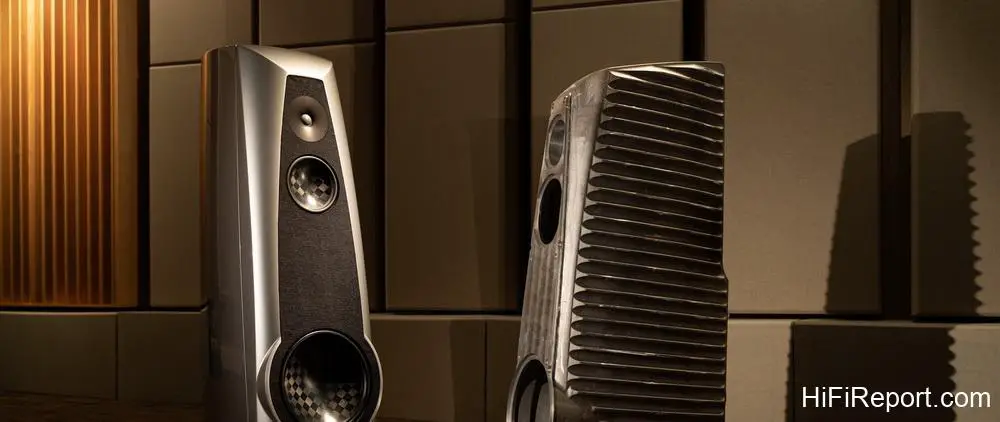
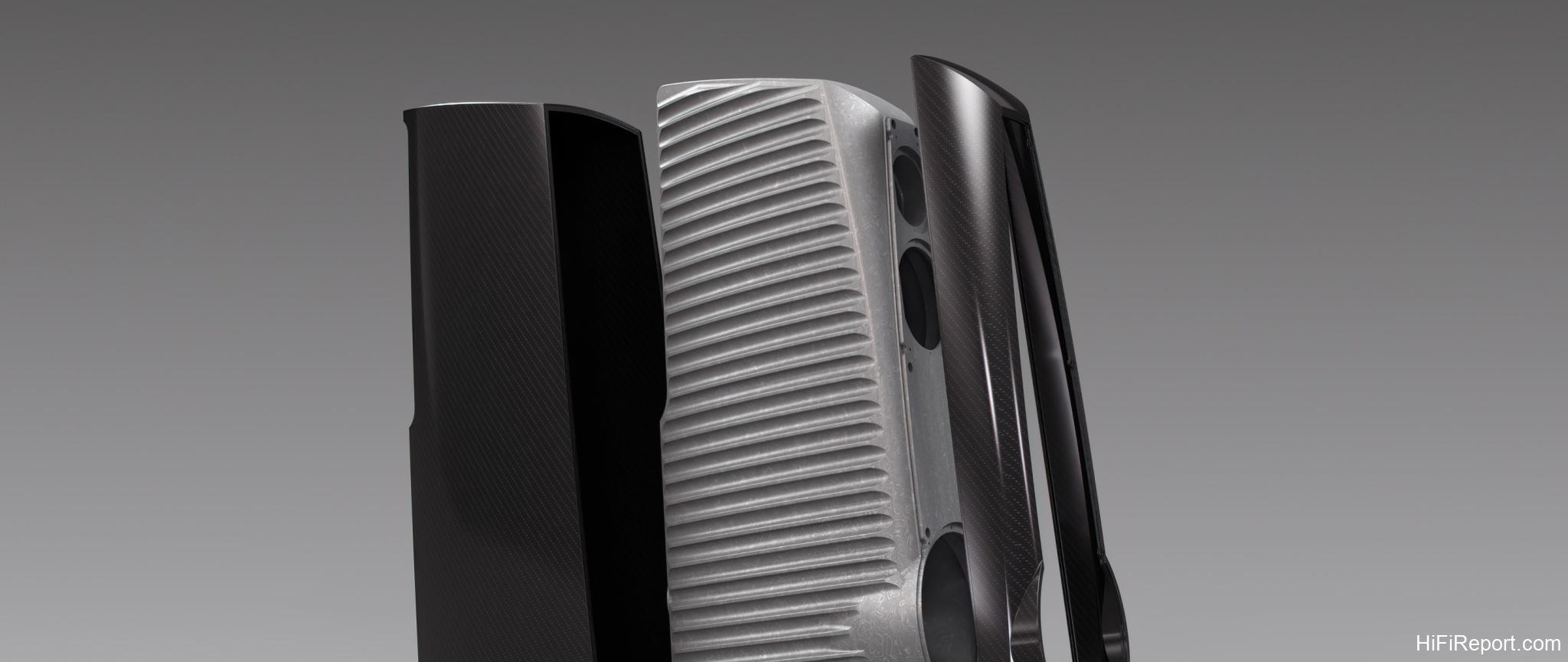
With the 2ra in 2016, Rockport introduced a unique dual-layer cast aluminum cabinet construction, which remains unparalleled in the speaker industry. The Orion’s inner cabinet is also cast from aluminum alloy, like the Lyra, but the outer cabinet and baffle are made of carbon fiber.
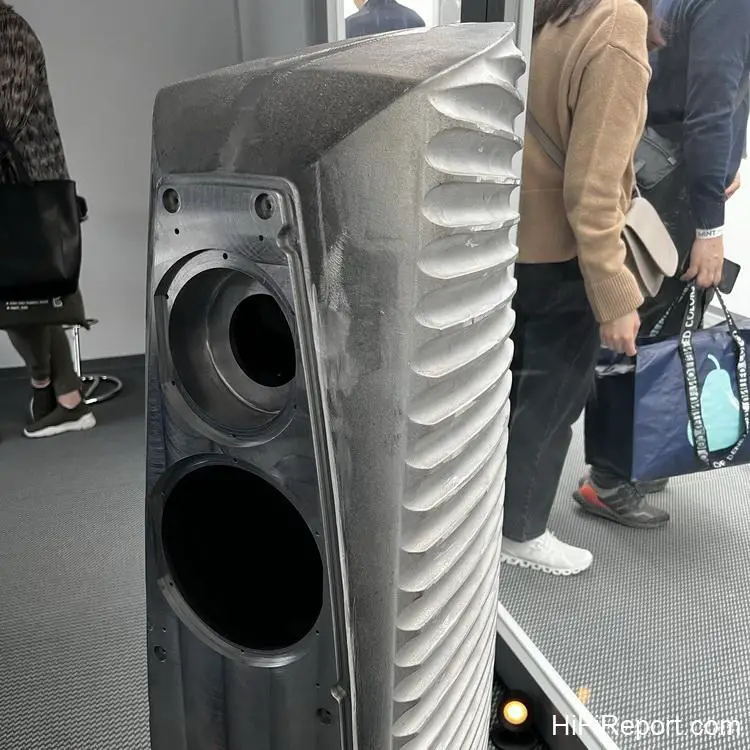
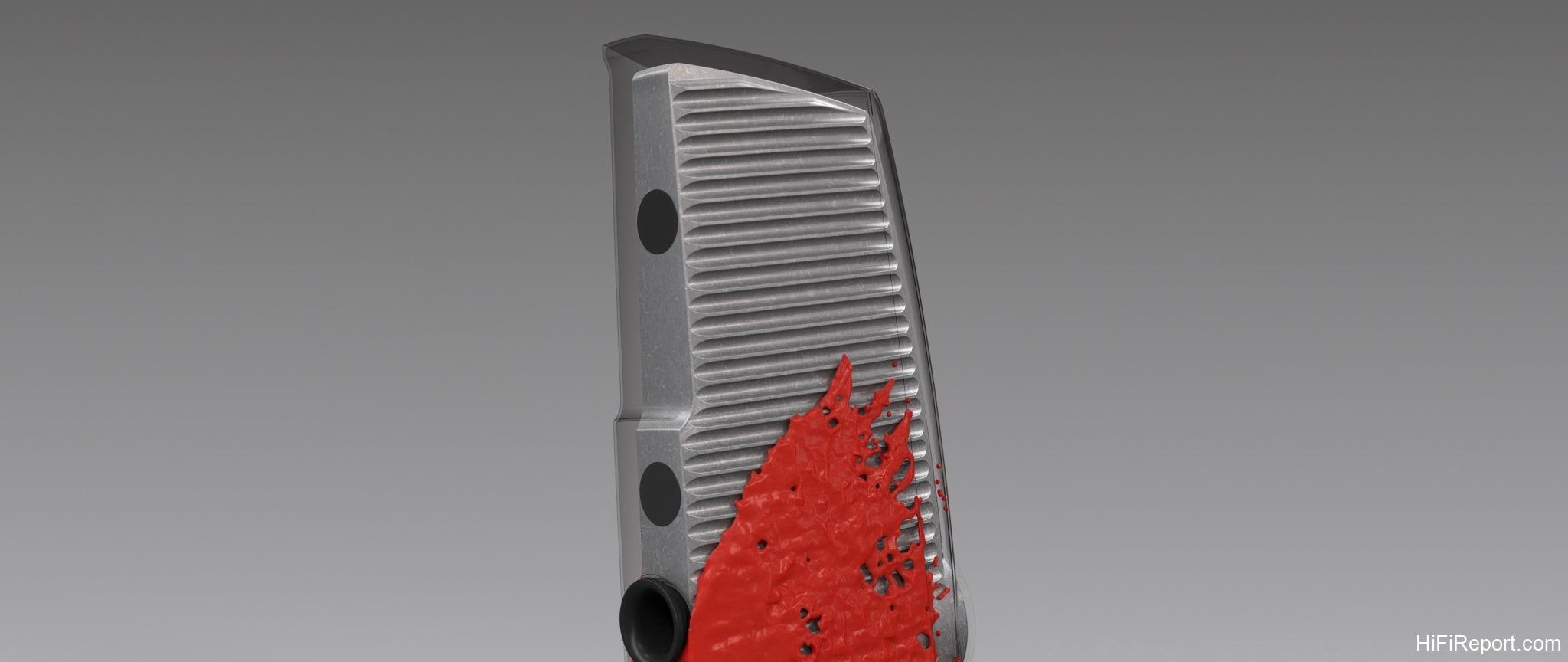
However, both models inject a high-damping, high-viscosity epoxy-like material between the inner and outer cabinets. The Lyra’s larger cabinet is filled with over 150 pounds, while the Orion’s smaller cabinet is filled with about 115 pounds. The material used for the Orion was also newly developed specifically for it, differing from the material used in the Lyra.
This method of cabinet construction by Rockport dates back to the Procyon launched in 1993, but the technology has become increasingly sophisticated over time.
Have you noticed that Rockport speakers are all three-way designs, differing only in the number of drivers (three, four, or five)? Furthermore, a characteristic of newly launched Rockport speakers is that the cabinet volume is kept as compact as possible. It seems they are thinking in terms of making the cabinet as small as possible while maximizing the sound output. Thus, large speakers like the old Altair, Hyperion, and Arrakis are no longer seen.
The Intricate Cabinet Construction
Even the current flagship Lyra doesn’t feel overwhelming in a small space, yet its massive musical scale was demonstrated to everyone at the Grand Hotel Audio Show – truly a case of small size, big sound. Rockport’s crossovers are similar to Wilson Audio’s in that they are top-secret and details are rarely disclosed publicly. I only found information stating that the crossover point between the midrange and tweeter is 1.8kHz, which is an unusually chosen frequency. In short, Andy Payor emphasizes that crossover design cannot simply follow textbook principles because too many variables are involved. They often design multiple versions of the crossover, connecting them to the speakers one by one.
In addition to instrument measurements, human ear listening is crucial, and only then is the final version decided. Furthermore, for precise matching, every crossover must be hand-tuned (by Andy Payor and Josh Clark) to maintain a 0.25dB tolerance between paired crossovers. This is one reason why Rockport speakers sound so precise.
The Orion’s cabinet is composed of four main parts: the inner cabinet cast from aluminum alloy, the outer cabinet made of carbon fiber, the baffle made of carbon fiber, and the high-damping viscous material filled between the inner and outer cabinets. Therefore, before building the cabinet, molds for the inner cabinet, outer cabinet, and baffle must be created.
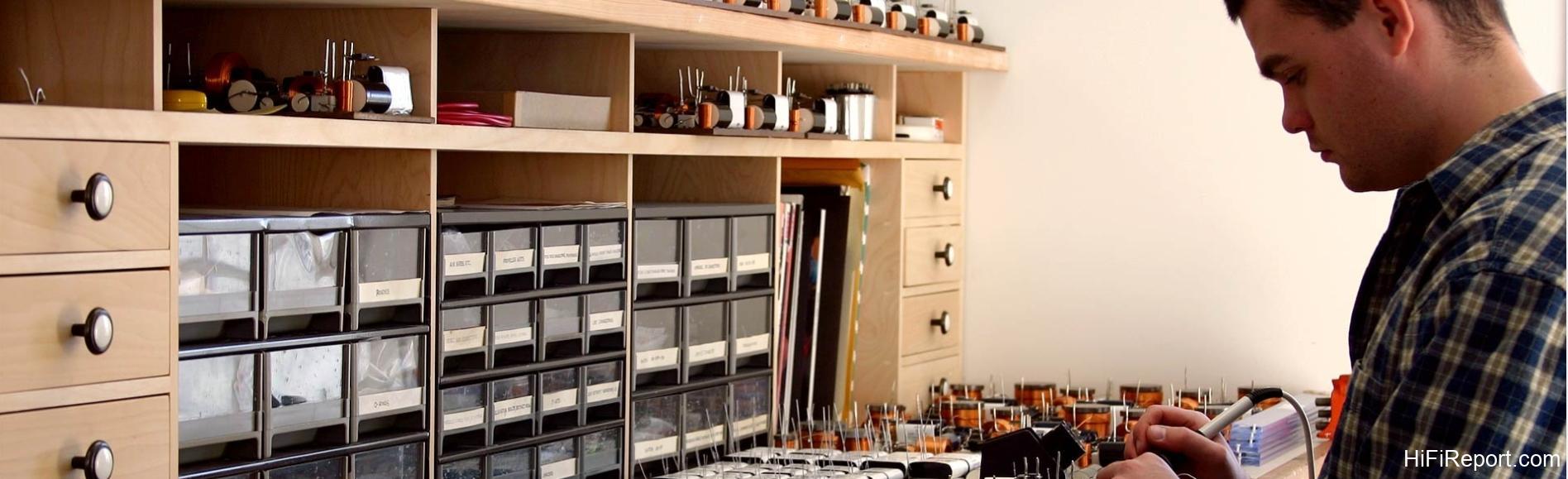
Additionally, the baffle of the cast aluminum inner cabinet is separately CNC-machined from a solid block of aluminum and directly bolted onto the cast aluminum cabinet. The positive mold for the outer cabinet is made of PU (polyurethane) and must first be polished and painted so that the negative mold created from it has a smooth surface, resulting in a smooth carbon fiber outer cabinet surface and reducing the time needed for polishing.
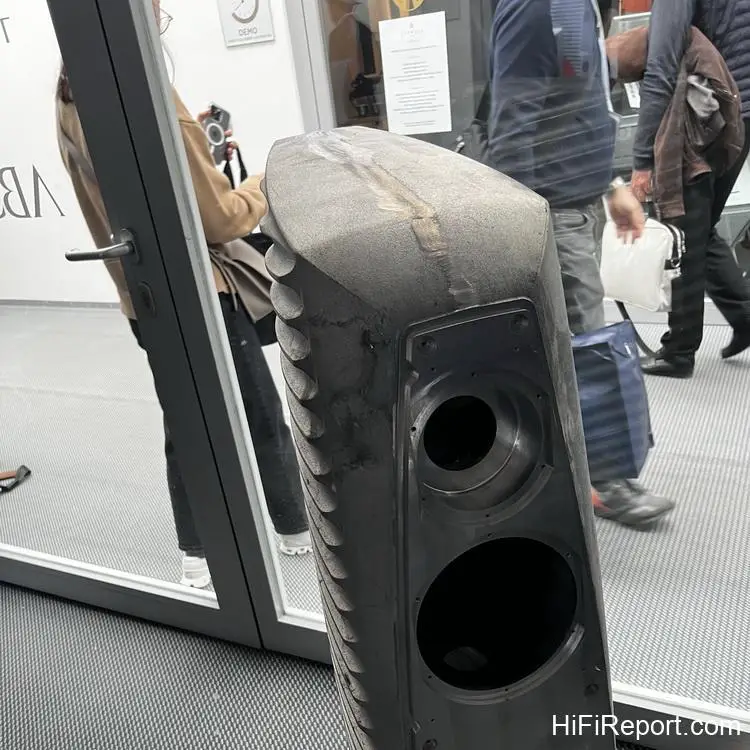
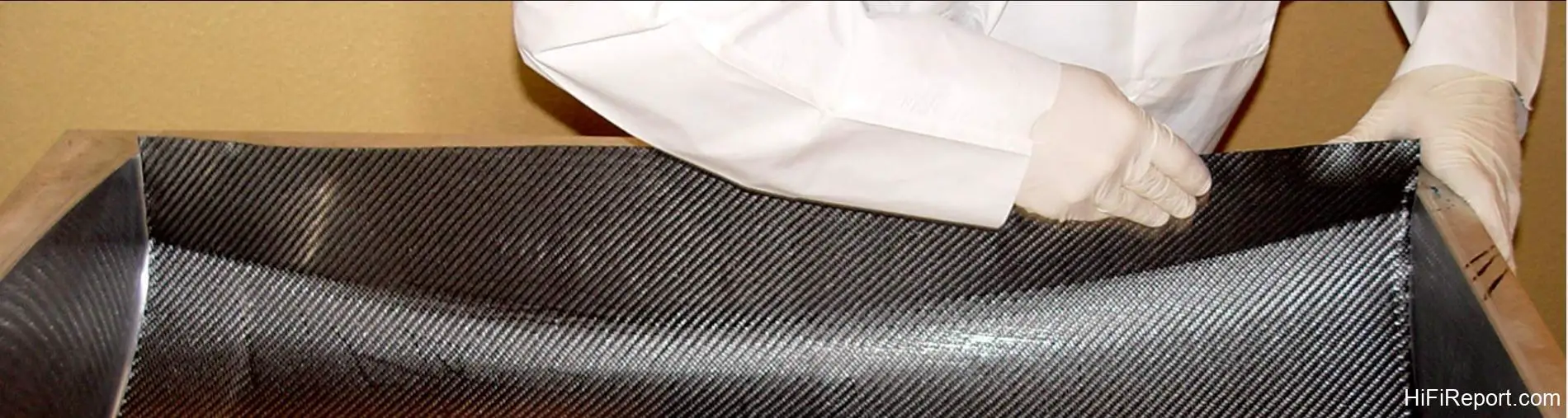
In fact, creating positive and negative molds is not that difficult. The challenge lies in layering carbon fiber with resin material, similar to manufacturing a carbon fiber car body, to create the carbon fiber outer cabinet. Since the aluminum alloy inner cabinet must be placed inside this carbon fiber outer cabinet, this carbon fiber outer cabinet has no “baffle,” allowing the aluminum alloy inner cabinet to be inserted.
The carbon fiber outer cabinet is made this way, and the carbon fiber baffle is also made similarly, although technically it’s much easier because the baffle is essentially just a frame, with the center being empty. The speaker drivers are bolted onto the aluminum alloy inner cabinet’s baffle, not the carbon fiber baffle.
Next is the aluminum alloy inner cabinet. Before manufacturing the inner cabinet, positive and negative molds must still be made, and these are split molds. In other words, the aluminum alloy inner cabinet, except for the baffle, is created by welding together two “half” cabinet sections. This is because the midrange driver requires a sealed bullet-shaped enclosure, making a single-piece mold impossible.
Molten aluminum is poured into the mold and cools and solidifies into a rough aluminum casting. This rough casting then undergoes processes like CNC machining and polishing. Finally, the split cabinet halves are welded together, and the separately manufactured aluminum baffle is bolted on to complete the aluminum alloy inner cabinet, as seen in the pictures.
Once the carbon fiber outer cabinet, carbon fiber baffle, and aluminum alloy inner cabinet are complete, the aluminum alloy inner cabinet is placed inside the carbon fiber outer cabinet. Then, the gap between the inner and outer cabinets is injected with over 115 pounds of high-damping viscous material, bonding the inner and outer cabinets into a single entity. Finally, the carbon fiber baffle (which is really just the frame) is bonded to the front of the cabinet.
After multiple layers of painting and polishing, and a final gloss coat, you get the beautiful cabinet you see.
Built with such complex processes, the cabinet is virtually “rock-solid.” Since there’s also an epoxy-like damping layer inside, this achieves Rockport’s three key cabinet priorities: Stiffness, Damping, and Mass. This is what Rockport calls the DAMSTIF2 cabinet structure. Looking at the many speaker cabinets on the market, most are made of MDF, with some more sophisticated ones using layered plywood pressure molding.
Even further, some use solid wood, solid aluminum alloy, solid composite materials, or even solid rock.
However, a design like the Orion’s, featuring an aluminum alloy inner cabinet, carbon fiber outer cabinet, plus a carbon fiber baffle and internal filling with epoxy-like material, is unique to Rockport. This complex approach’s ultimate goal is to eliminate cabinet vibrations. Perhaps you might ask: Is cabinet vibration really that serious?
Perhaps most people don’t think it’s that serious, but there is a very small minority of people who strive for the ultimate and cannot tolerate these cabinet vibrations – these are the buyers.
Driver and Crossover Design
Only after the cabinet is finished can the three drivers, crossover, and speaker terminals be installed. Consider how difficult it is to move and transport a speaker that stands 50.30 inches tall, is 14.30 inches wide, 26.40 inches deep, and weighs a hefty 360 pounds per side. Therefore, completing each Orion speaker is a major challenge for the staff involved.
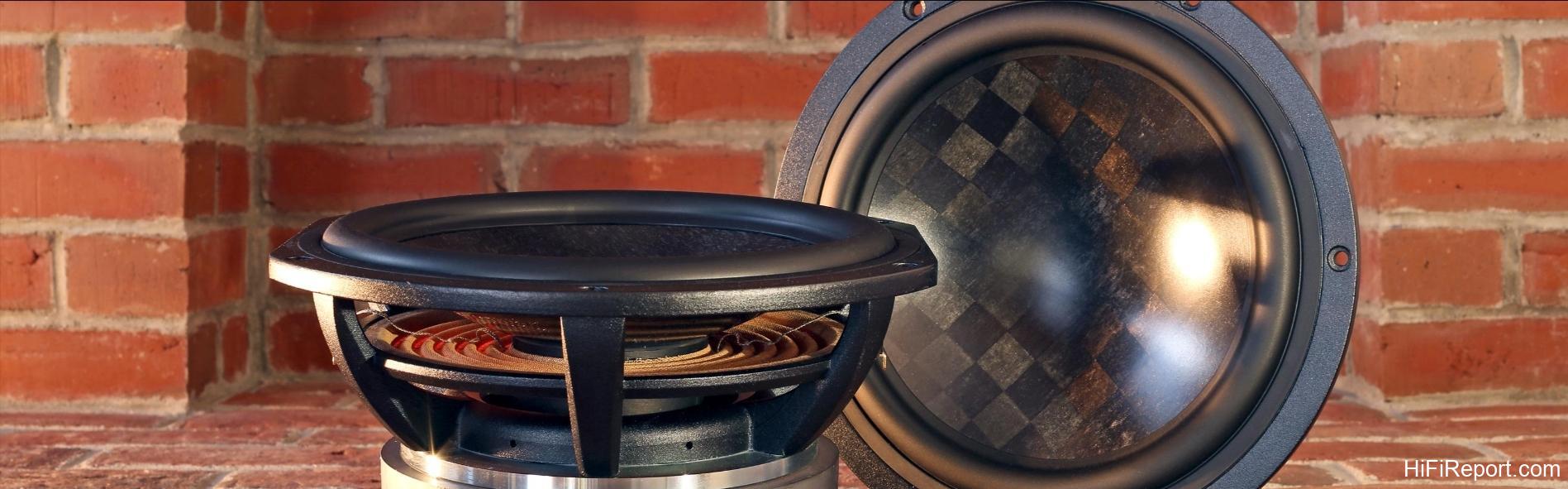
The Orion’s 1.25-inch Beryllium dome tweeter, 7-inch carbon fiber sandwich midrange driver, and 13-inch carbon fiber sandwich woofer were all developed as a package specifically for the Orion. Diamond and Beryllium dome tweeters are currently the two major highlights on the market. Given the Orion’s price point, using a diamond tweeter wouldn’t be unreasonable. I suspect Rockport chose the Beryllium tweeter likely as part of the overall system design consideration.
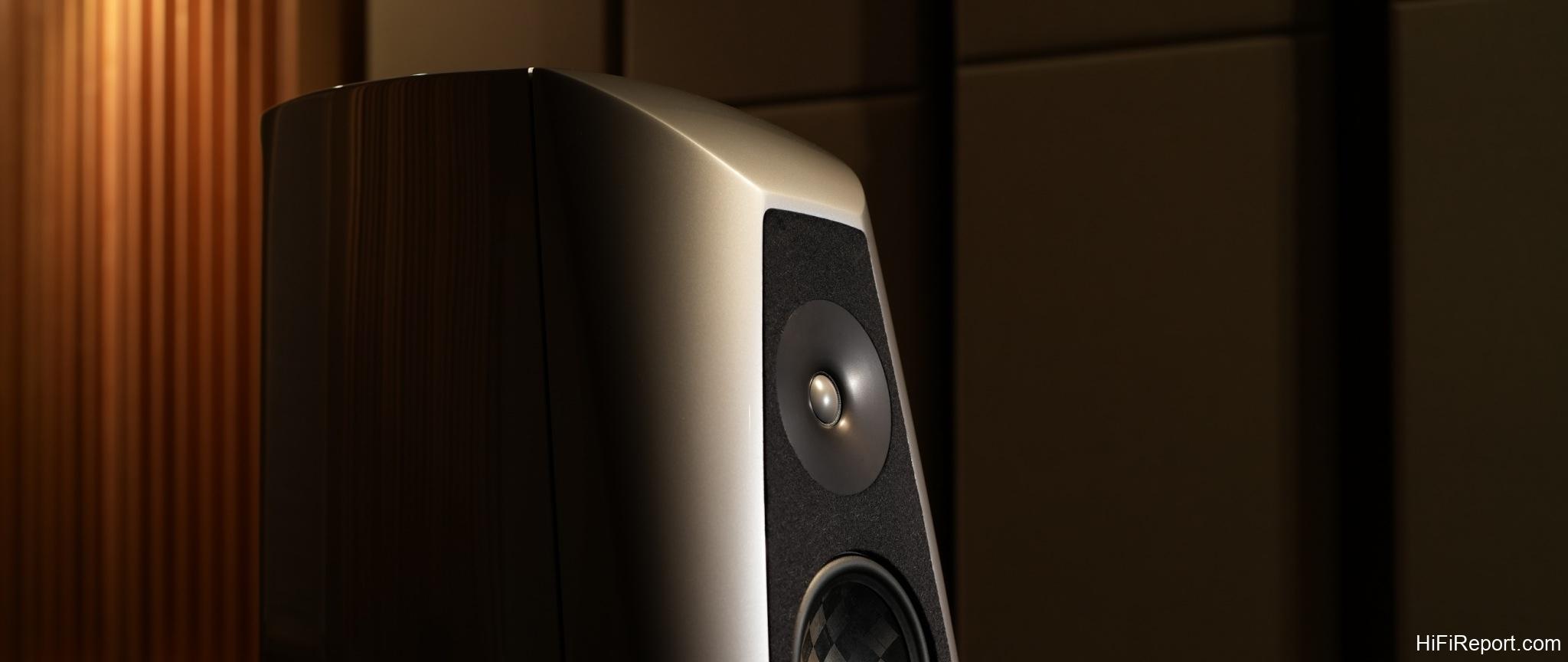
This 1.25-inch Beryllium tweeter has a shallow waveguide horn in front, just like the Lyra. Its purpose is to slightly increase sensitivity and narrow the dispersion angle of the sound waves to match the midrange driver.
Viewed from the side, the entire Orion cabinet has a rearward rake angle, which is a time alignment design. The front baffle is covered with a thick layer of felt, another characteristic Rockport design. On the rear panel, there is a considerably large bass reflex port, indicating that the Orion is a bass-reflex design.
Because the cabinet is wider at the front than the back, narrower at the top than the bottom, and features curved sides, there are no parallel internal surfaces, which greatly helps reduce internal standing waves. Furthermore, the standard wiring for the Orion is Single Wire, with a Bi Wire option available for an additional cost. Oh, and the standard finish for the Orion is Piano Black. Other colors can be ordered at an extra charge. The silver pair I listened to is a custom color.
Since each speaker weighs a net 360 pounds, the Orion comes packed with wheels attached to the base for easy unpacking and movement. Once the speaker’s placement is determined, the wheels are removed and replaced with spikes. So, even though the Orion is very heavy, moving it is quite effortless.
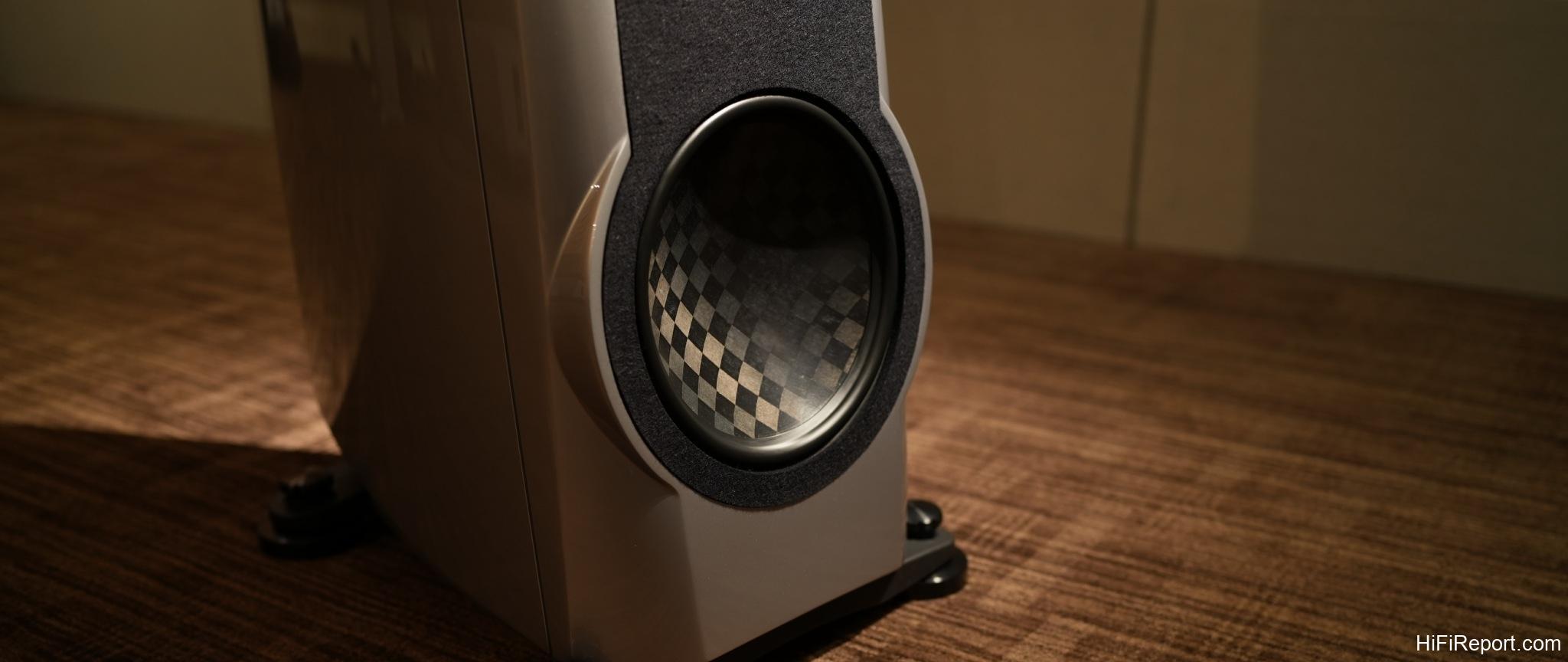
If you observe the Orion closely, you’ll notice that the 13-inch woofer is the key design element of the entire speaker. Remember that the flagship Lyra uses two 10-inch woofers? Since the Orion is the second-in-command, just below the flagship, its bass performance cannot be poor. Using two 10-inch drivers would be ideal, of course, but this would make it too similar to the Lyra and potentially affect sales of both. What about a single 12-inch woofer?
The quantity of bass might be significantly less than two 10-inch drivers. So, they decided to go with a 13-inch driver instead.
If a 13-inch woofer is chosen, the frequency range that the 6-inch midrange can extend downwards might not connect well with the upper end of the 13-inch woofer’s range. After all, the larger the driver size, the more limited its upper frequency range becomes. Therefore, if a 13-inch woofer is decided upon, the lower frequency range of the midrange driver needs to be lower. This necessitates using a 7-inch midrange driver. You might ask: Why not use an 8-inch midrange driver?
Because then there might be issues connecting the upper end of the midrange with the lower end of the tweeter.
Also, since a 13-inch woofer is used, the front width of the Orion speaker needs to be wider. However, the designers didn’t want the front of the cabinet to be too wide, so they placed the 13-inch woofer at the bottom of the cabinet, as the cabinet is narrower at the top and wider at the bottom. Previously, Rockport would place 13-inch or 15-inch woofers on the side to avoid a wide front baffle. Now, Rockport places all woofers on the front, so positioning the 13-inch woofer lower is logical.

You see, simply deciding to use a 13-inch woofer necessitated changing the midrange to 7 inches and the tweeter from 1 inch to 1.25 inches to properly integrate with the midrange. Fortunately, the drivers Rockport uses are designed in-house and manufactured by external driver manufacturers, allowing them to be built exactly according to the design requirements. This is another aspect that differentiates Rockport from typical speaker manufacturers.
Amplifier Pairing
I listened to the Orion in my large open-plan living space. Besides pairing it with the Constellation Hercules monoblock power amplifiers (delivering 1,000 watts per channel into 8 ohms), I also used a Pass Labs X350.5 power amplifier (350 watts per channel) and Audio Valve Baldur 70 monoblock tube amplifiers (70 watts per channel). The preamplifier was a Spectral DMC 30SS. Digital sources included an emmLabs TSDX SE CD transport and DAC 2 SE, and for streaming, a Weiss DAC 502 4ch.
The Orion has a sensitivity of 90dB (1m/2.83V) and a nominal impedance of 4 ohms. With this sensitivity, amplifiers up to 100 watts should theoretically be able to drive it. So, I first used the Spectral DMC 30SS preamplifier with the Audio Valve Baldur 70 tube power amplifiers to warm up the Orion. Frankly, theory is one thing, but practical application is key. While the 70-watt-per-channel tube amplifier drove the Orion’s tweeter and midrange quite well, it lacked control over the woofer.
When listening to solo piano or chamber music, the Baldur 70 sounded quite respectable and even very enjoyable. At these times, I reached out to touch the 13-inch woofer, and there was almost no vibration. Clearly, the Beryllium tweeter and 7-inch midrange alone were sufficient for chamber music.
However, when I listened to large orchestral works, such as Shostakovich’s “Symphony No. 4” or Andrew Lloyd Webber’s “Symphonic Suites,” the immense musical presence was clearly weak and lacking power. So, if you want to drive the Orion with tube power amplifiers, I believe they should ideally have 200 watts or more to do the Orion justice. Observe how McIntosh tube amplifiers often have hundreds of watts; they likely have significant experience in this area.
Next, I used the Spectral DMC 30 SS preamplifier paired with the Pass X350.5 power amplifier to drive the Orion. This 350-watt-per-channel amplifier undoubtedly drove the Orion quite well, especially the tight, full, and elastic bass, which would satisfy most people. If I didn’t have other amplifiers on hand, the X350.5 would have been sufficient to write a review of the Orion.
I recommend choosing amplifiers with higher power output. While listening to music, you might only use 10-30 watts of output power most of the time (easily seen if the amplifier has meters), but when powerful bass hits or a full-bodied vocal enters, the music might instantly require hundreds or even thousands of watts of output power. This is where a multi-hundred-watt-per-channel amplifier becomes necessary.
Beyond the specified output power, the amplifier’s actual power supply is also critically important. The weight of the X350.5 amplifier, weighing tens of kilograms, is essentially due to its massive power supply, which explains why it could drive the Orion so well.
However, there’s always something better. When I connected the Constellation Hercules monoblock amplifiers (first generation), the 1,000 watts per channel (into 8 ohms) sounded distinctly different. Just listening to the electronic music album “Convergence” by Malia & Boris Blank, the Orion’s bass performance improved by several levels. When listening to Shostakovich’s “Symphony No. 4,” not only was the large scale handled effortlessly, but the orchestral timbre was also significantly better.
Listening to Saint-Saëns’ “Symphony No. 3 with Organ,” conducted by Myung-whun Chung, the continuous organ bass and overall timbre also greatly impressed me. It’s no wonder TaiFu likes to use this amplifier setup to drive Rockport speakers at audio shows.
However, this amplifier setup does have one minor drawback: they are essentially two electric heaters! They would be perfect in winter, but in summer, even with the air conditioning on, I could still feel the heat they generated. So, I later used the Pass X350.5 to warm up the Orion, and only switched to the Hercules when I was doing critical listening. The final review was, of course, based on the pairing with the Hercules.
Listening Impressions
The first excellent impression the Orion gives is its pure, clean sound with beautiful timbre. “Pure and clean” means there are very few impurities, and the sound entering your ears brings a sense of tranquility. When I listened to Anne Bisson’s “Blue Mind,” after the first track, I immediately noticed the exceptionally beautiful timbre of the Orion.
I know this CD intimately, so it was easy to tell that the Orion elevated the timbral quality to a significantly higher level, making it more pleasant and comfortable to listen to. Of course, I believe the Constellation Hercules amplifier also played a role. Both components have beautiful timbres, and their combination naturally leads to impressive timbral performance. The beauty of the Orion’s timbre is evident on every recording, so I won’t elaborate further.
The second excellent impression the Orion gives is its relaxed quality. This characteristic is not only obvious with large-scale music but is also noticeable even when listening to string quartets. For example, when I listened to Dvořák’s 5 Bagatelles, Op. 47 (performed by Edgar Moreau and family), whether it was the piano or the strings, I could feel a sense of unforced relaxation. And it wasn’t just the violin that wasn’t tense; the cello and piano were also relaxed.
Actually, for this type of music, a two-way speaker can perform quite well. The Orion adds a 13-inch woofer, allowing the overall sound to extend naturally downwards, resulting in a relaxed listening experience.
Listening again to Haydn’s String Quartet Op. 76 No. 2 performed by Quatuor Modigliani, the four string instruments were clear and penetrating, while also conveying a sense of relaxation, not tension. It’s important to know that if a string quartet sounds tense, it not only loses its harmonious beauty but everything also becomes sharp.
I believe the ability of the Orion to sound relaxed is primarily due to the 7-inch midrange driver, followed by the crossover’s excellent integration between the tweeter and woofer.
The fourth excellent impression is that the sound is very round and sweet. This is particularly noticeable in piano recordings. When I listened to Alice Sara Ott’s “Echoes Of Life,” the piano notes were very round, lustrous, and sweet, with rich harmonics. You could even feel the elasticity of the keys. The piano has a very wide range; a simple piano solo can engage the full capabilities of the tweeter, midrange, and woofer.
Therefore, the piano performance also reveals the balance and seamless integration of the Orion’s high, mid, and low frequencies. You don’t need a spectrum analyzer; if you intuitively feel the piano sound is very beautiful and captivating, then these speakers are likely doing things right.
The Orion is just like that. Listening again to Daniel Barenboim playing Liszt’s Consolations S. 172-No. 3, it further verified the balance and seamless integration of the Orion’s high, mid, and low frequency ranges. The entire piece was genuinely moving. The roundness, woody tone, luster, sweetness, rich harmonics, and the palpability and weight of the notes created a beautiful sonic picture that was mesmerizing.
Bass Performance
The third excellent impression the Orion gives is its exceptional bass performance, especially the sound of the kick drum – it’s simply fantastic. Initially, I was concerned about the Orion’s 13-inch woofer, placed quite close to the floor. I knew the quantity of bass would be sufficient, but would it be too much or too muddy?

However, when I listened to Malia & Boris Blank’s “Convergence,” the electronic bass was not only full, rich, cohesive, and clear, but its position was also distinctly defined at the back, not pushing forward, and never muddy.
Listening to Eivor’s live album “Min Mooir,” the Orion also clearly resolved the bass contained within. It was easy to distinguish between percussion bass and the sustained bass of the synthesizer. Even the melodic lines of the synth bass were clearly present, never blurring together. When listening to Anne Bisson’s “Blue Mind,” the combination of the double bass and drum kit bass was simply superb. The “thump” of the low frequencies was soft, cohesive, and elastic, and decayed quickly.
This album is a brilliant work by Anne Bisson from 2008. Except for the fourth track “Dragonfly,” which has overdubbing, all other songs were recorded in a single take. No wonder the sound is so pure, clean, and the bass is so captivating.
I then listened to Mayumi Itsuwa’s “Koibito yo” (Lover). The first section of the song was very clean. In the second section, the “thump” of the kick drum and electric bass entered, giving the Orion’s 13-inch woofer a chance to shine. Again, the bass was very clear, palpable, and cohesive, and the thumps decayed quickly. There was absolutely no lingering tail often associated with large bass drivers. Because of this, you feel the bass quantity is ample, yet it remains very clean.
Even on “Thanks To You” from Bob Scaggs’ album “Dig,” the Orion managed to control the “massive” amount of bass, preventing it from becoming shapeless and uncontrolled. Here, I must praise the Constellation Hercules amplifier, as I’m sure it contributed significantly to the ability to hear such pure, cohesive, and mochi-like soft and elastic bass. I listened to the same track with the Audio Valve Baldur 70, and it was simply “two different stories.”
So, if the budget allows, the more powerful the amplifier, the better.
Detail, Texture, and Realism
The fifth excellent impression is that the Orion reveals an exceptional amount of detail in instruments and voices. This richness of detail seems to float in the air. Furthermore, the subtle sounds after a note or vocal line decays are particularly clear, including the process of the instrument sound disappearing into the space, and the natural ambient sounds present in the recording space.
When I listened to Zhao Cong’s “Listening to China – Moon Dance,” specifically “Spring River Flower Moon Night,” even though I knew the sense of space, soundstage, and detail I was hearing were mostly crafted by the mixing engineer, I still marveled at how lifelike these artificial details were. Listening to Patricia Barber’s “Café Blue,” similarly, the details of the instrument decays and the sense of air movement in the music were very clear.
Although the instrumental accompaniment on this album is simple, these decay details and spatial cues made the listening experience far from monotonous.
Also, when I listened to the familiar album “Bamboo” (), the sense of air from the bamboo wind instruments and the lingering decay of percussion instruments in the space were incredibly rich. This clearly shows that the Orion’s tweeter, midrange, and woofer are all highly sensitive; even with very subtle musical signals, they are able to clearly present the fine details within.
The sixth excellent impression is that the texture of instrument performances is particularly realistic, especially violins, cellos, and pianos. Let me put it this way: I listened to several violin recordings, and I could clearly distinguish the different timbres of each violin. This indicates that the Orion is essentially neutral. With low coloration, the realistic texture of instrumental performance is inevitable.
For example, listening to Leonid Kogan’s “Encores,” James Ehnes playing Wieniawski/Sarasate violin pieces, and Fabio Biondi playing Bach’s unaccompanied Partita, the violin performance texture on these three albums was all very realistic, and I could clearly distinguish the distinctly different timbres of the violins. Naturally, they were all captivating violin sounds.
Making the violin sound sweet and lustrous isn’t particularly difficult. I believe the cello performance is more challenging than the violin. Without care, a cello can sound dull, heavy, or even coarse. However, when the Orion plays the cello, the subtle vibrations are agile, and you can hear the elasticity of the strings and the bow.
When I listened to the arrangement for cello and harp duo by Martin Lohr and Marie-Pierre Langlamet, both instruments sounded very agile, not only full of subtle details but also with a sweet quality when the cello played in the higher register and rich resonance from the body when playing in the lower register. These characteristics made the cello sound very realistic, and the harp equally so.
As for the piano, it goes without saying. The Orion clearly presented the different mixing aesthetics of the recording engineers. While the piano notes consistently had excellent palpability and weight, each piano recording sounded as if it was recorded in a different space, and the distance between the piano and the listener that the engineer intended to portray also varied.
As mentioned before, the Orion’s rendering of the piano, from high to low, is seamlessly coherent, bringing out the qualities of a fine instrument, and of course, sounding very realistic.
The eighth excellent impression is that the Orion excels in presenting sonic palpability and weight. When listening to violins, you can feel the roundness and substance of the sonic lines; they are not flat or insubstantial. When listening to cellos, the resonance in the lower register is rich, and in the higher register, it has the graceful and beautiful sound like a violin, with very substantial sonic lines.
When listening to pianos, each note is clearly articulated, and the tactile feel of pressing the keys and the resulting palpability and weight of the erupting notes are excellent. Naturally, when listening to vocals, the singer’s presence is more pronounced, but without the drawback of sounding excessively bloated; instead, it’s full and cohesive, feeling like a tightly formed entity.
The thirteenth excellent impression is the Orion’s high resolution, which is particularly evident when listening to large orchestral works. For instance, when I listened to Daniele Gatti conducting the Royal Concertgebouw Orchestra in Bruckner’s “Symphony No. 9,” it felt entirely fresh, as if a different conductor was leading the performance. Why the sense of freshness?
Because the Orion’s resolution brings out many hidden details, allowing me to hear subtle variations in the inner voices that I hadn’t noticed before. Many people find Bruckner’s symphonies difficult to listen to, saying they make them sleepy. Besides the long duration of the pieces, I think it’s likely because the audio system lacks sufficient resolution and balance, causing the music to lose its appeal.
Not only Bruckner’s symphonies require superb resolution; Mahler’s and Shostakovich’s symphonies also demand high resolution. The Orion’s resolution is definitely capable of satisfying you when listening to such structurally vast, complex, and dynamically wide symphonies. As for the resolution required for jazz and popular music, that’s merely a piece of cake for the Orion.
Dynamics, Speed, and Scale
The seventh excellent impression the Orion gives is its grand and imposing presence. Playing it loudly does not feel compressed. When I listened to Wu Bai’s “Southern Wind Live Concert” and Jody Chiang’s “2015 Live Concert,” the immense scale and presence of the live performances were completely unleashed. This is partly due to the powerful driving force of the 1,000-watt amplifier and partly due to the Orion’s own ability to handle tremendous musical energy.
Listening to Andrew Lloyd Webber’s “Evita Symphony Suite,” the sound of the bass drum from the rear of the soundstage was clear from the start, with significant weight. The reverberant quality after the drum hit was also very realistic, fully presenting the grandeur of the entire orchestra.
When listening to “The End Of The War” from the film “Curse of the Golden Flower,” although the music is short, the powerful, forceful, and lingering drum sounds similarly demonstrated the Orion’s massive low-frequency energy and its grand presence.
The ninth excellent impression is that the quantity of high, mid, and low frequencies is abundant, especially the low-frequency quantity, which builds a solid bass foundation for the music. This provides support for the high and mid frequencies, and playing at high volume does not sound sharp or noisy. Frankly, this characteristic is typically only heard in large, multi-driver, expensive speakers because it signifies very low distortion from each driver when driven by strong musical signals.
This is why it doesn’t sound noisy (distortion sounds like noise). The bass foundation, in particular, is one of the souls of music. Andy Payor understands the important role bass plays in music, which is why he insisted on using a 13-inch driver to produce a thick and full low-frequency range. This way, even if the high and mid frequencies are abundant, they don’t sound harsh because the bass balances the listening experience.
The tenth excellent impression is the Orion’s fast transient response – it’s like a darting rabbit when active and a serene maiden when still – and its wide dynamic range, comfortably handling intense music. Honestly, I’m not surprised by the fast transient response of the high and mid frequencies, but it’s quite impressive that the 13-inch woofer can deliver such a quick response.
For example, listening to Charly Antolini’s “Knock Out 2000,” when the drums are struck, the rapid thudding of the kick drum, the pattering sound of the snare and toms, and the sizzle of the cymbals all exhibit extremely fast transient responses. Especially on “Arabian Desert Groove,” where a deep electric bass line is added, it is not only deep and supple but also very elastic, indicating excellent bass control from the Orion.
And when listening to “Duwadjuwandadu” (yes, that’s the weird title), the Orion’s rapid response from the cymbals to the kick drum is fully showcased. And there’s no fear in playing it loudly; it remains just as clear. Listening to “Godzilla’s Birthday,” both the drum kit and electric bass also demonstrated fast transient responses. Of course, if you dare to play this album loudly, you’ll know what wide dynamic range means; the Orion is completely unfazed.
Soundstage and Spatiality
The eleventh excellent impression is the Orion’s outstanding soundstage performance. When listening to various types of music, the Orion easily disappears into the musical background. For instance, listening to the movie soundtrack “House of Flying Daggers,” the Orion gives the listener the feeling that the entire soundstage expands from left to right, front to back, with excellent layering, positioning, width, and depth – utterly clear and transparent.
Listening to “Bubbles” from Yosi Horikawa’s “Wandering” album, the bouncing ping pong balls travel to the left side, outside and between the speakers; essentially, a large area of ping pong balls bounces around in the soundstage, and the textural portrayal of the impact is incredibly realistic.
Indeed, the Orion’s design with a narrow front baffle and curved surfaces throughout is intended to reduce the negative effects of sound diffraction, making the speakers disappear not only visually but also aurally, allowing the listener to focus only on the music and forget the physical presence of the speakers.
Elasticity
The twelfth excellent impression is that the Orion is very elastic. Whether it’s violins, cellos, pianos, bass, steel-string guitars, or even the kick drum, they are all imbued with elasticity. For example, listening to “Soli2de” from the Reference Recordings II album, although the music is very gentle, both the kick drum and other instruments sound very elastic.
Listening to Bela Fleck’s “Flight of the Cosmic Hippo” is even more so; not only is the bass soft and elastic, but even Bela Fleck’s banjo is very elastic. In fact, listening to this entire album is filled with the beauty of elasticity. If you aren’t captivated by the elastic bass, something is amiss.
Conclusion
Having listed thirteen impressive points, it’s time to wrap it up; continuing would be endless because the Orion’s sonic performance is simply too outstanding. Considering its relatively modest size and only three drivers, its exceptional performance capability exceeds my expectations.
The highs are not sharp, the mids are not dispersed, the bass is not muddy, the timbre is incredibly beautiful and clean, dynamics and transients are first-class, the speakers disappear, the kick drum hits you in the chest, chamber music is continuously captivating, and popular, jazz, and orchestral music have infinite power. With a speaker like this, I’ve given up trying to find its flaws. The only crucial factor is the amplifier you pair with the Orion.
Specifications
* Type: 3-way, 3-driver, bass-reflex floorstanding speaker
* Introduced: 2022
* Drivers:
* 1 x 1.25-inch Beryllium dome tweeter
* 1 x 7-inch Carbon Fiber Sandwich cone midrange
* 1 x 13-inch Carbon Fiber Sandwich cone woofer
* Frequency Response: 20Hz-25kHz (-3dB)
* Nominal Impedance: 4 ohms
* Sensitivity: 90dB (2.83V)
* Weight: 360 pounds (each)
* Dimensions (WHD): 14.30 inches × 50.30 inches × 26.40 inches