
Stenheim Alumine 5 Signature Review
Achieving a “harmonious blend of strength and grace” in music reproduction is a truly challenging feat. It requires delivering a robust and powerful bass, a rich and dense midrange, and an ethereal and transparent treble. Furthermore, these elements must coalesce seamlessly to convey the dynamic contrasts and emotional nuances inherent in music. It’s a tall order, but during my visit to Le Lin Audio in Kaohsiung to audition the Swiss Stenheim Alumine 5 Signature, I witnessed firsthand its mastery of this delicate balance.
Swiss Hi-End Audio Company Founded in the 21st Century
Stenheim was established in 2010 by five engineers with expertise across diverse fields. However, in 2013, Jean-Pascal Panchard, the current driving force, acquired the company. His business acumen propelled Stenheim onto the international stage, establishing a global sales network and streamlining their product line.
Currently, Stenheim offers two main series: Alumine and Reference. The Alumine series comprises five loudspeakers, capable of forming both refined two-channel and comprehensive multi-channel systems. The Reference series includes three models: Reference Ultime, Reference Infinite, and Reference Statement.
The Reference Statement made its debut at the 2015 TAA Audio Show, with Jean-Pascal Panchard himself present. I had the opportunity to interview him then, gaining initial insight into the Stenheim brand and its background. However, opportunities to hear Stenheim speakers have been scarce since then, until Bo-Yu Audio became their (agent/distributor), which has given our editorial team more chances to engage with this Swiss audio brand.
Unfortunately, I missed several listening sessions arranged by the editorial team, including auditions of the Alumine 5 and Alumine 2, which were reviewed by Mr. Dai Tiankai at Bo-Yu Audio. I will be referencing his reviews while writing this piece.
Signature Edition Endorsed by Film Score Maestro
The standard Alumine 5, which Mr. Dai Tiankai auditioned, already commands a price close to NTD 2 million. The Alumine 5 Signature I’m reviewing is the signature edition, reportedly adding another NTD 600,000 to the price tag.
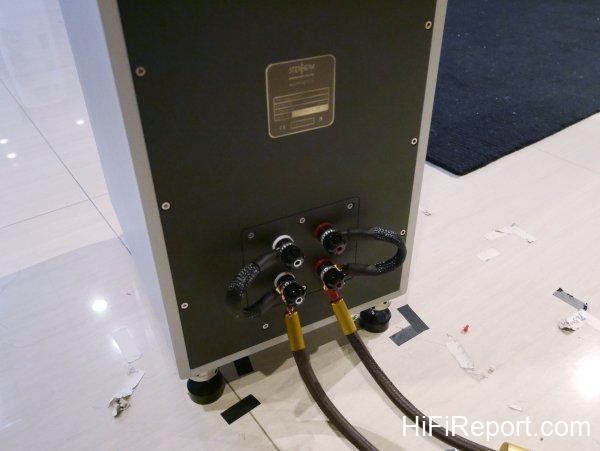
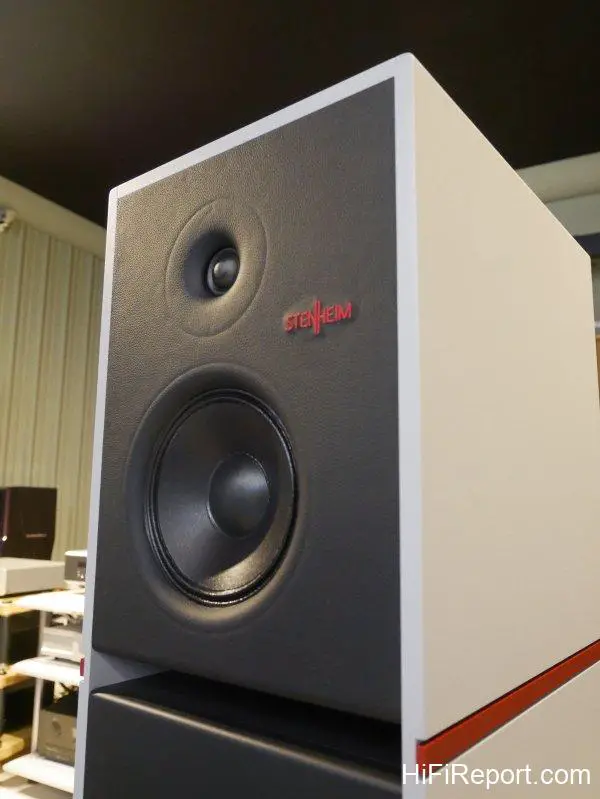
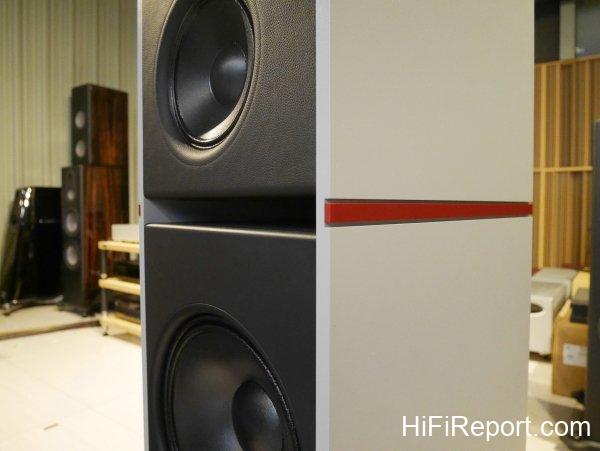
What are the differences? According to the manufacturer, beyond the standard Alumine 5, there are also the Alumine 5 SE Special Edition and the Alumine Signature Edition. The Alumine 5 SE distinguishes itself with upgraded crossover components. The Signature version further enhances the crossover with even higher-grade parts, and upgrades the internal wiring and all internal speaker terminals. Aesthetically, the Signature version adds a genuine leather wrap to the upper portion of the cabinet, with the Stenheim brand logo rendered in red stitching.
These enhancements – superior crossover components, upgraded internal wiring and terminals, and the luxurious leather wrap with red stitching – are all part of the Stenheim Signature. But the “signature” isn’t the owner’s, but that of JC Gaberel! He is the acclaimed composer behind the score for the film “Farinelli,” which won a César Award (French equivalent of the Academy Awards). Stenheim and JC Gaberel share a close collaborative relationship. For instance, Stenheim’s “Acoustic Sessions” service invites musicians to record their performances in acoustically optimized studios, using Alumine series speakers as monitors, and JC Gaberel is involved in this initiative. Therefore, the sonic upgrades in the Alumine 5 Signature are the result of fine-tuning by this film score maestro, hence the prestigious “signature” endorsement.
Aluminum Chassis, Leather, and Red Stitching: Echoes of Supercars
The Alumine 5 Signature’s material palette—aluminum alloy cabinet, leather wrap, and red stitching—strongly evokes the aesthetics of a supercar. While loudspeakers are not supercars, the use of aluminum alloy for speaker cabinets has a solid rationale in audio engineering.
Despite its seemingly modest size, each Alumine 5 Signature speaker weighs a substantial 100 kilograms, underscoring the heavy-duty materials employed by Stenheim. Stenheim isn’t alone in using aluminum for speaker cabinets; Goldmund, Piega, and Magico are also renowned for their aluminum speaker designs, demonstrating a convergence of engineering philosophies, albeit with differing approaches in execution.
Aluminum Cabinets: Shared Wisdom, Different Approaches
Why do so many top-tier Hi-End speaker brands independently gravitate towards aluminum cabinets? It’s not just coincidence; there are sound acoustic and physical principles at play. The primary functions of a speaker cabinet are twofold: first, to rigidly secure the speaker drivers, ensuring they remain fixed during pistonic motion; and second, to provide the drivers with sufficient internal volume to generate Helmholtz resonance, enhancing musical energy and extending frequency response.
Therefore, an ideal speaker cabinet must possess high mass and uniform material density. Furthermore, it needs adequate damping to firmly grip the drivers and prevent unwanted resonance-induced distortion.
Aluminum alloy, with its inherent high hardness and rigidity, perfectly meets these requirements. Thickness adds weight, and the Alumine 5 Signature’s aluminum cabinet is a full 1 cm thick! These substantial aluminum enclosures are crafted in collaboration with specialized Swiss metalworking firms, with each aluminum panel manufactured to a tolerance of no more than 0.1 mm – finer than a human hair. An anodized matte finish gives the Alumine 5 Signature a subtly luxurious appearance.
Hybrid Design: Sealed and Bass-Reflex Enclosures
Beneath the Alumine 5 Signature’s elegant exterior lies a complex internal structure.
Visually, the Alumine 5 Signature is divided into upper and lower sections. The upper part is a two-way bookshelf speaker, while the lower section is a bass column housing dual woofers. However, these sections are integrated, not a separate four-piece design.
The upper section houses the tweeter and midrange driver. The drivers are surrounded by shallow horn-like flares to improve sound wave dispersion. This upper enclosure is a sealed design, with separate sealed chambers for the tweeter and midrange driver to minimize interference.
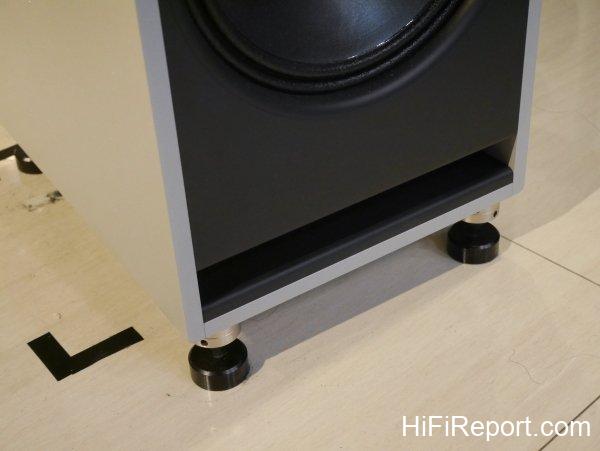
The lower bass column employs a bass-reflex design. Again, each of the two woofers has its own independent chamber. This results in two horizontal ports on the Alumine 5 Signature – one midway up the speaker and another at the base – serving as the bass-reflex ports for the two woofers.
By combining sealed and bass-reflex enclosures, Stenheim aims to leverage the advantages of both designs.
Sealed enclosures utilize internal air compression to enhance driver responsiveness, delivering clean, fast transient response. The trade-off is typically less extended low-frequency response and lower efficiency, requiring more amplifier power to produce deep bass. However, in the Alumine 5 Signature, the bass column handles the bulk of the low frequencies, so the sealed upper section doesn’t significantly compromise overall efficiency.
The bass-reflex bass column, on the other hand, enhances bass output and extension. This hybrid approach seeks to synergistically improve overall sonic performance.
Drivers of Unknown Origin
Regarding the Alumine 5 Signature’s drivers, Stenheim only specifies dimensions, not the source. In my 2015 interview with Jean-Pascal Panchard, he mentioned that Stenheim typically uses Seas or Scan-Speak tweeters, French PHL midrange drivers, and sometimes Danish Audio Technology drivers for the Reference series. However, on the Alumine 5 Signature, the driver origins are not immediately apparent. What is certain is that these drivers are designed by Stenheim and manufactured to their specifications by external suppliers.
Upon closer inspection, the Alumine 5 Signature’s midrange and woofer drivers feature pleated fabric surrounds, reminiscent of classic horn speaker mid-bass designs. This type of driver design generally offers higher efficiency and faster mid-bass response.
Furthermore, Stenheim favors high-order 24dB crossovers, and I suspect the Alumine 5 Signature follows suit. Despite this, the speaker maintains a high efficiency of 94dB.
Le Lin Audio Embraces Digital Streaming
Having covered Stenheim’s background and the Alumine 5 Signature’s design, let’s turn to my listening experience at Le Lin Audio in Kaohsiung.
Whenever I visit an audio store for a review, I always bring my own familiar CDs. This time at Le Lin Audio was no exception. However, Mr. Zhang, the owner of Le Lin Audio, has fully embraced digital streaming. The digital source he presented was an Aurender W20 music server. This meant my CDs were unusable. So, I picked up Le Lin Audio’s iPad and used an app to select music. Fortunately, Mr. Zhang’s music library is extensive, and I quickly found many familiar tracks, some even in higher-than-CD resolution, including DSD and 24/192 files.
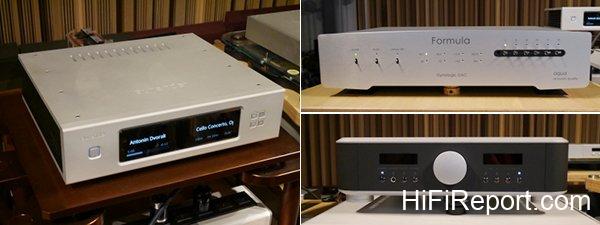
The system assembled at Le Lin Audio consisted of the W20 music server paired with an Italian Aqua Formula DAC. Amplification for the Alumine 5 Signature was provided by an Analog Domain ISIS integrated amplifier. Editor-in-Chief Lin Zhiyu had previously heard the ISIS at Le Lin Audio driving Kharma DB9 speakers, noting that the amplifier seemed to vanish from the equation, highlighting its exceptional transparency.
I spent an afternoon listening to the Alumine 5 Signature at Le Lin Audio, and chatted with Mr. Zhang about the story behind bringing in the Signature version. He explained that during negotiations with Bo-Yu Audio to start selling Stenheim in Kaohsiung, he traveled north to audition the speakers. Initially, he only intended to carry the standard Alumine 5. However, during his visit to Bo-Yu Audio, he happened to audition the Signature version. He found the Signature’s sonic performance – in terms of density, richness, and transparency – to be significantly improved. Despite the additional NTD 600,000 price increase, Mr. Zhang ultimately opted for the higher-priced Alumine 5 Signature.
At Le Lin Audio, only the Signature version was available, so I couldn’t directly compare it to the standard model. I can only share Mr. Zhang’s account.
Speaker Placement Closer to Listener
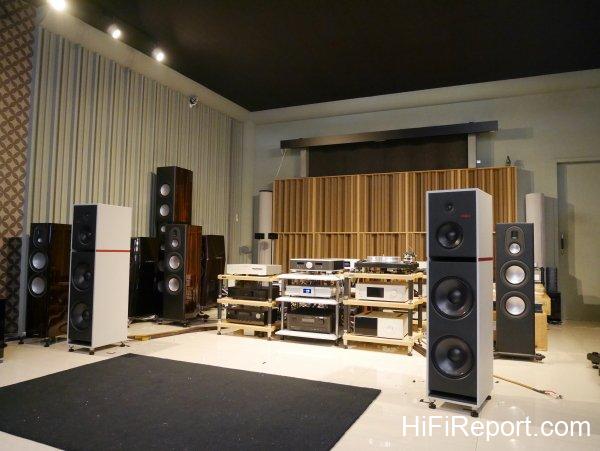
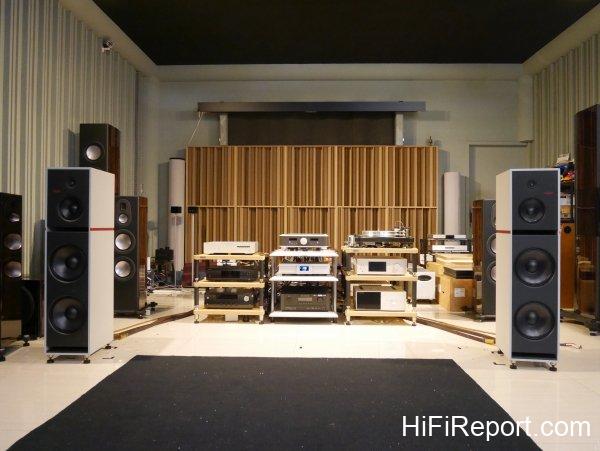
Mr. Zhang of Le Lin Audio is considered a younger generation audio store owner, and he has built a strong reputation for his system tuning skills, particularly in creating soundstage and imaging in two-channel systems. Each time I visit, he has different speaker placement configurations. For this Alumine 5 Signature audition, he positioned the speakers further forward compared to usual, while maintaining a similar lateral spacing. You can see the relative position compared to the Monitor Audio Gold 300s behind them.
The Alumine 5 Signature’s tweeter and midrange driver are not mounted on the cabinet’s central axis but are offset. Le Lin Audio’s placement has the offset axis pointing inwards.
Mr. Zhang explained that this configuration enhances image focus and coherence.
But why move the speakers further forward? He explained that while the Alumine 5 Signature doesn’t appear to be a large speaker, its bass output is remarkably substantial. Initially placed in his usual position, he found the bass to be excessive. He quickly adjusted, eventually moving the speakers significantly forward with a slight toe-in, achieving a balanced frequency response.
Speakers Disappear Effortlessly into the Space
Le Lin Audio’s meticulous setup saved me considerable effort. The immediately balanced sound allowed me to focus entirely on the listening experience.
To illustrate image focus and the speakers’ seamless disappearance, I’ll reference Xu Jingchun’s “The Moon in the Sky” album, specifically the track “Father’s Guitar.” The nylon-string guitar solo in a Japanese style emerged precisely from the right side of the soundstage. Then, the steel-string guitar, playing arpeggiated chords, appeared in corresponding position from the right. Xu Jingchun’s resonant vocals were firmly anchored at the center of the soundstage, creating a beautifully crafted and engaging musical scene. As the chorus began, the two guitars positioned themselves behind Xu Jingchun – one strumming chords, the other playing a solo embellishment – perfectly complementing her clear and emotionally rich voice.
Moving on to the soundtrack of the movie “Cape No. 7,” I selected “Wild Rose.” The music begins with Ma Bo’s moon lute solo, a traditional melody transitioning into Schubert’s “Wild Rose” tune. The Alumine 5 Signature effortlessly rendered the moon lute’s plucked notes with full body, resonating beautifully in Le Lin Audio’s open listening space. The accompanying harmonica soon emerged, followed by the thick, solid foundation of the electric bass. As the band joined in with a rock version of “Wild Rose,” the guitar’s full-bodied sound broadened the entire soundstage.
Fan Yichen’s vocals on the Alumine 5 Signature revealed clear throat-singing details, backed by substantial harmonies. The song concludes with Tanaka Chie’s Japanese lines, leading into a children’s choir chorus from deep within the soundstage. These recording effects, though studio-produced, were faithfully reproduced by the Alumine 5 Signature, revealing the nuanced details of the recording.
Jazz Sounds Soft, Relaxed, and “Q-” (Bouncy)
Mr. Zhang was right; the Alumine 5 Signature’s bass energy is indeed impressive – both focused and expansive. It can delineate precise bass lines while maintaining a relaxed and comfortable texture, almost with a “Q-” (bouncy) quality. Listening to Oscar Peterson’s “We Get Requests,” specifically “Quiet Nights of Quiet Stars,” the guitar’s opening chord struck directly and decisively. The double bass’s pizzicato and the jazz drums’ rhythmic swing entered seamlessly. The piano subtly sketched the melody, its slightly dark timbre adding to the richness of each note.
Although the piano intentionally played with a darker tone, the Alumine 5 Signature beautifully captured the delicate details of the brushed cymbal work, adding vibrancy to the swinging rhythm.
Mr. Zhang’s meticulous tuning allowed the Alumine 5 Signature to effortlessly disappear into the space, leaving behind a lively and engaging jazz music scene. My foot instinctively tapped along with the swinging rhythm.
Cello: Focused, Expansive, and Beautifully Textured
A good loudspeaker must convincingly reproduce diverse genres. Having listened to pop, rock, and jazz, it was time to return to classical music.
Starting simply, I chose Yo-Yo Ma’s “Bach Cello Suites,” specifically the Prelude from Suite No. 1, a universally familiar piece. The Alumine 5 Signature effortlessly presented a cello sound that was both focused and expansive. The instrument’s image, with its substantial form, floated between the speakers. The soundstage extended deeply and darkly behind, enhancing the cello’s focused image – a testament to Mr. Zhang’s tuning expertise. The nuanced presentation of timbre and tone, however, was the Alumine 5 Signature’s own achievement. No amount of tuning can compensate for a speaker lacking inherent sonic beauty and the ability to convey musical emotion.
After cello, it was time for violin, selecting Mutter’s “Tango, Song and Dance,” specifically Brahms’ “Hungarian Dance No. 1” (arranged for violin by Joachim). The violin’s opening in the lower register of the Hungarian Dance was rendered by the Alumine 5 Signature with a rich tone, delivering a smooth and substantial sonic texture. Mutter’s piano partner, Lambert Orkis, consistently provides a warm and gentle piano foundation, emphasizing Mutter’s violin as the protagonist, and this album was no exception. When the violin entered the more intense passages, the Alumine 5 Signature remained composed, presenting clear and distinct violin notes. Brahms’ Hungarian Dances carry a distinct Eastern European flavor, especially in the violin’s transitions, imbued with a swaying, graceful quality. Mutter’s interpretation is deeply expressive, and through the Alumine 5 Signature, the violin sounded not only polished and smooth but also revealed subtle nuances with captivating charm and rich emotion.
Mahler: A Test of True Power
For a grander scale, I searched Le Lin Audio’s music library and found Mahler’s “Symphony No. 2, ‘Resurrection’.” Perfect – this piece, with its nearly 200 musicians and chorus, offers a formidable challenge. I added it to the playlist and selected the fifth movement to test the Alumine 5 Signature. I turned up the volume on the ISIS integrated amplifier. The ferocious percussion and brass created an apocalyptic soundscape. The ISIS powerfully drove the Alumine 5 Signature, delivering the orchestra’s immense presence. As the music softened, the brass played the Resurrection theme, punctuated by the shimmering triangle, conveying the recording’s spaciousness within Le Lin Audio’s open listening room, with depth and expansiveness.
This movement is nearly 40 minutes long. I used the iPad to skip to the final choral section.
The choir began with a soft chant, then suddenly swelled in volume. The Alumine 5 Signature naturally presented this dynamic contrast. The mezzo-soprano and soprano soloists emerged in front of the chorus, clearly delineating the soundstage layers. My focus was entirely absorbed by the music as I awaited the final “To die in order to live (Resurrection).” The chorus repeated the same phrase, layering and reinforcing the music’s density. The strings provided a soft foundation, gradually building the music’s weight. The bright brass joined, preparing for the climactic finale. The timpani thundered, and as the choir sang “To die in order to live,” the organ entered, the Alumine 5 Signature delivering its power in waves. The expansive music enveloped me, each powerful timpani strike propelling towards the final redemption.
Verify for Yourself at Le Lin Audio
This was my first close encounter with the Alumine 5 Signature. This new acquaintance proved its exceptional capabilities, demonstrating a character that is both powerful and refined. In Mahler’s massive symphony, with its soaring brass, powerful percussion, and rich vocal textures, the Alumine 5 Signature effortlessly presented a vast musical panorama, while also clearly conveying the subtle details and distinct layers.
Is it due to Mr. Zhang’s excellent tuning, or the inherent prowess of the Alumine 5 Signature? I believe both are crucial. More importantly, Le Lin Audio has already broken in the Alumine 5 Signature. Audiophiles in the Kaohsiung area and HiFiReport readers, I encourage you to visit and listen for yourselves. See if the editor-in-chief is exaggerating, and experience Mr. Zhang’s tuning skills firsthand!
Specifications
**Stenheim Alumine Five SE**
* Type: 3-way, 4-driver floorstanding speaker
* Frequency Response: 28Hz – 35kHz
* Drivers: 1″ silk soft dome tweeter x 1, 6.5″ midrange x 1, 10″ woofer x 2
* Maximum Power Handling: 200 W RMS, 400 W (peak)
* Sensitivity: 94 dB SPL/2.83V/1m
* Impedance: 8 Ohms (minimum 3 Ohms)
* Dimensions: H 1200mm x W 280mm x D 380mm
* Weight: 130 kg each