
Stenheim Alumine Five Review Review
Visit Stenheim’s website, click on the “History” section, and after a short paragraph, you’ll find a photograph.
It depicts a towering mountain range, its snow-capped peaks proclaiming its grandeur.
An ancient glacier, it seems, carved a deep, lateral gorge, accentuating the mountain’s rugged and imposing form.
At the foot of the mountain, neat rows of houses are interspersed with small plots of land, arranged in a pattern suggestive of vineyards.
Stenheim’s factory, with its red roof and white walls, sits nestled at this mountain’s base, embraced by the earth’s magnificent power and the beauty of the surrounding forests.
Scrolling further down the page, we enter the building, where a photo wall showcases Stenheim’s listening room, the factory, semi-finished products in assembly, construction photos, event records – objects, scenery, and people.
There isn’t much text, just a few brief descriptions, barely skimming the surface. Yet, these few photographs speak volumes, more powerfully than words ever could.
A New Brand with Professional Pedigree
Founded in 2010, Stenheim may be a young brand, but it boasts a wealth of expertise.
Five like-minded engineers, passionate about audio and music, who was emplyed at Goldmund.
Perhaps it was this very passion that made them want to go their own way, to create what they truly desired, to realize their ultimate vision for audio.
After two years of incubation, in 2011, they launched their first product, the Alumine, an all-aluminum bookshelf speaker that left a lasting impression.
In 2013, they entrusted the company’s management to Jean-Pascal Panchard.
Panchard himself had extensive sales experience and had even founded an audio enthusiast association, providing a platform for French and Swiss audio enthusiasts and manufacturers to exchange information. Subsequently, he joined Nagra as a product manager.
With a long immersion in the audio industry and a deep understanding of both the manufacturing and market sides, Panchard naturally brought a new look to Stenheim.
Following the leadership transition, Stenheim introduced the second generation of Alumine, the Alumine 2. By adding a bass column, it could be transformed into the Alumine 3.
This clever design allows Stenheim speakers to be purchased “à la carte” or as a “set meal.”
Panchard, with his wide network, collaborated with fellow Swiss brand CH Precision, enlisted ABC PCB to manufacture the crossover circuit boards, and established partnerships with the Geneva University of Applied Sciences and the University of Applied Sciences of Western Switzerland.
The initial five founders were engineers, but Panchard was not. Although he initially studied electronics, his career focused on business practices. He knew that to lead Stenheim, he needed technical support. In addition to Chief Technology Officer Lucas Perrin, he sought external resources, strengthening Stenheim’s research and development capabilities.
He recognized the development of the audio market, in order to create a different products, must not head towards low price, that will face the challenge to 3C and IT manufacturers. The only way to allow the young brand Stenheim to become a well-know brand to climb all the way up to the peak of Hi End gear.
In 2014, Stenheim launched the Reference series, including the mirror-symmetrical Reference Ultime and the four-piece Reference Statement, solidifying Stenheim’s position as a Hi-End speaker brand.
The Alumine Five, released in 2017, incorporates the technological essence of the Reference series, bringing the pinnacle of achievement to a more accessible product, allowing one to glimpse the grandeur of Stenheim’s Reference series within the Alumine Five.
The Alumine Five, released in 2017, incorporates the technological essence of the Reference series, bringing the pinnacle of achievement to a more accessible product, allowing one to glimpse the grandeur of Stenheim’s Reference series within the Alumine Five.
(Source: Stenheim)
A Cabinet Crafted with 1cm Thick Precision-Machined Aluminum
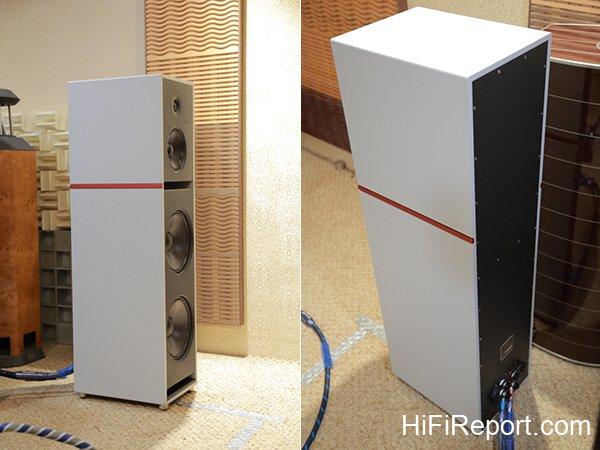
As the flagship of the Alumine series, the Alumine Five boasts substantial weight, with each speaker weighing a hefty 100 kilograms.
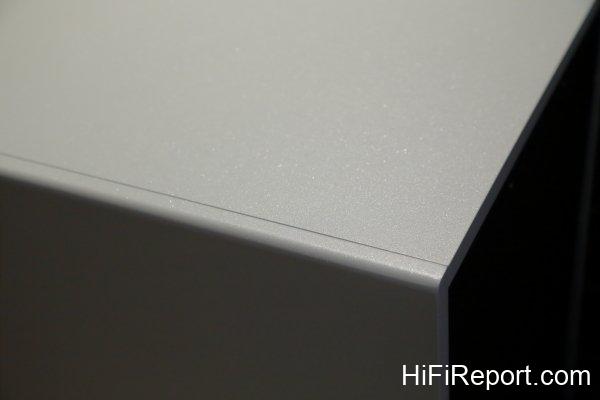
A significant portion of this weight comes from the all-aluminum cabinet. Each aluminum plate is a full 1 centimeter thick, manufactured by a specialized Swiss metal processing company. The tolerance for each plate is no more than 0.1mm, less than the diameter of a human hair.
The panels are anodized, giving them a sandblasted texture.
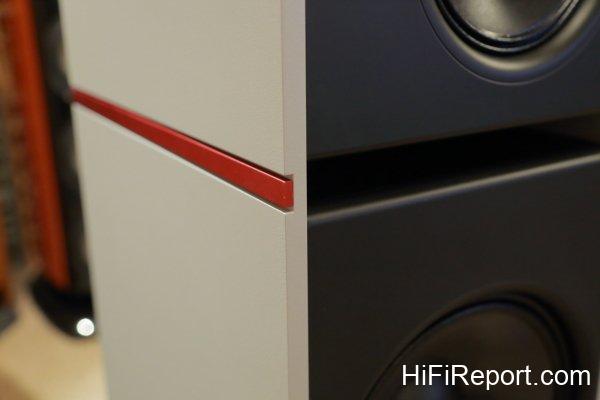
Magnetic trim strips on the sides allow users to change the color to suit their mood.
Switzerland is renowned for its metalworking and precision engineering, which, when applied to Hi-End audio, often leaves people in awe. Stenheim speakers are no exception, showcasing exquisite detail within their minimalist design.
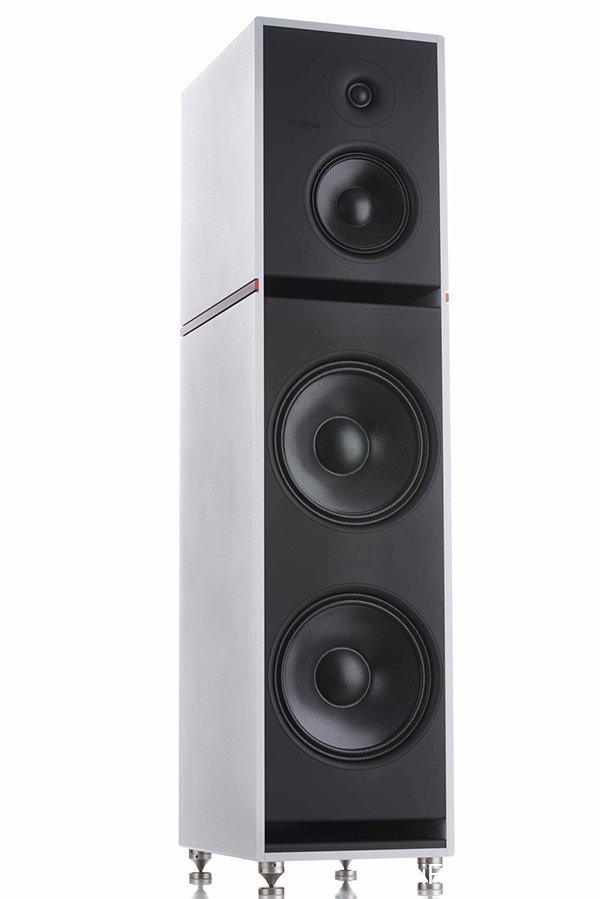
The Alumine Five appears to be divided into upper and lower sections, but the cabinet is actually a single piece. Each driver has its own independent chamber to prevent backwave interference.
Each of the two woofers has a long, slot-shaped bass reflex port, located above and below the woofer.
The entire speaker is made of aluminum alloy, with each plate being a full 1 centimeter thick. It is manufactured by a specialized Swiss metal processing company, with a tolerance of no more than 0.1mm.
Magnetic trim strips on the sides allow users to change the color to suit their mood.
The panels are anodized, giving them a sandblasted texture.
Each Driver Features a Waveguide and a Dedicated Chamber
The internal structure of the cabinet is divided into four chambers based on the driver configuration, with the partitions also made of aluminum.
The tweeter and midrange drivers each have their own sealed, independent chambers. The chambers used by the woofers below are connected by a channel and have openings that lead out. These openings are located on the upper and lower sides of the lower woofer cabinet, forming long, slot-shaped channels, constituting a bass-reflex design.
As mentioned earlier, the Alumine Five benefits from the technological transfer from the Reference series. The most crucial aspect is the use of the Reference series’ tweeter and midrange drivers.
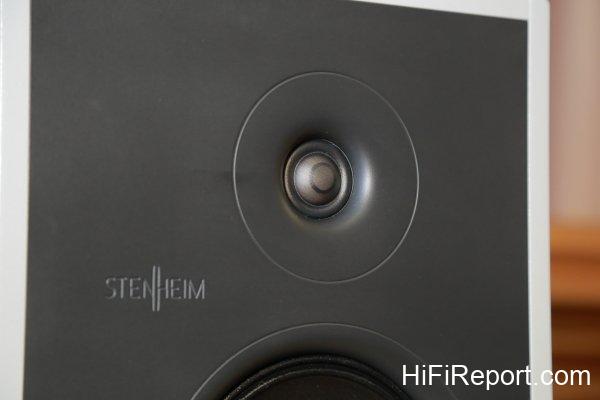
The tweeter is a 1-inch silk soft-dome driven by a neodymium magnet. The midrange driver is also driven by a neodymium magnet system and has a diameter of 6.5 inches. The woofers consist of two 10-inch drivers.
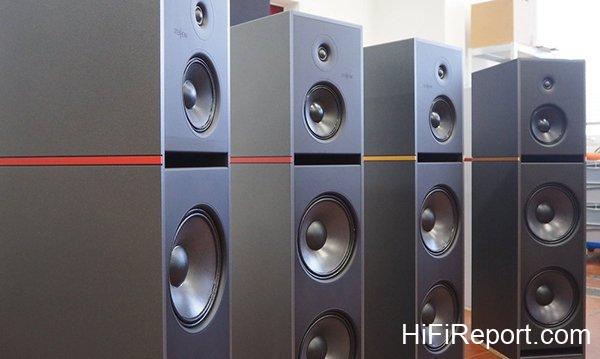
It’s worth noting that, for a speaker as high-priced as the Alumine Five, Stenheim hasn’t followed the current Hi-End market trend of using exotic materials like diamond or beryllium for the diaphragms. While the manufacturer doesn’t specify the material of the midrange and woofer diaphragms, it’s rare to see pleated cloth surrounds used on the midrange and woofer drivers’ suspension.
Stenheim has also designed shallow horn openings for each driver, visible on the tweeter, midrange, and woofers. These serve to control the dispersion angle, increase driver efficiency, and enhance the projection distance.
It’s not uncommon for speaker manufacturers to source parts and cabinet materials from external suppliers. It’s rare these days to find a company capable of developing and producing everything in-house.
The key is for the manufacturer to know what they’re doing, why they’re doing it, and to possess sufficient know-how for production.
Stenheim operates in this manner, sourcing the necessary components and providing their specifications to external manufacturers. Ultimately, they receive parts that meet their standards, but they avoid the costs of maintaining production lines and machinery, making it more economically efficient.
The tweeter is a 1-inch silk soft-dome driven by a neodymium magnet, with a shallow horn waveguide design at the front.
The 6.5-inch midrange driver features a pleated cloth surround and a horn-shaped waveguide at the opening.
The Domestic Stenheim Experts are at Resound Audio
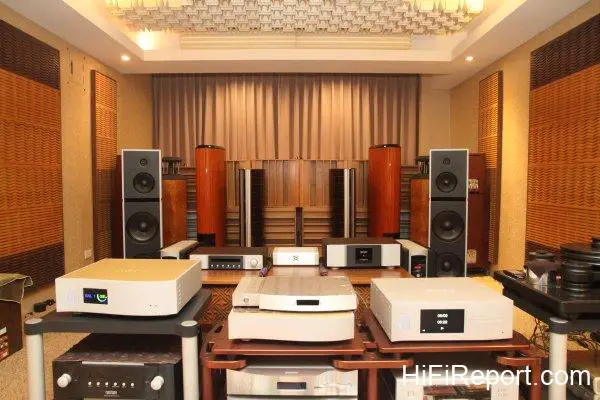
The listening session took place in the listening room of Resound Audio.
Located on Beian Road in Dazhi, Resound Audio has been a fixture in the area for 25 years.
The floor area of the old apartment building is not large. To run a Hi-End audio business here, owner Vincent Yang needs to be quite skilled.
Resound focuses on two-channel audio, offering products across low, mid, and high price ranges. The brands are few, but the market segmentation is clear, and each brand has been carefully selected by Vincent.
Even Stenheim is no exception. Vincent has been selling it for many years, since the brand was first introduced. Most Stenheim speakers have been sold by him, and these Resound customers are fortunate to have the opportunity to experience the sound of Stenheim.
The store knows best how to match speakers.
Although the Alumine Five has a sensitivity of 94dB, Vincent’s experience is that low-power amplifiers can drive them without issue. He’s had good experiences with several high-end integrated amplifiers. “I’ve used the Mark Levinson No.585 and the Orpheus Absolute Integrated, and they both sounded great. But once you use better separates, there’s no going back.” Switching to a more powerful power amplifier results in a more relaxed sound, with greater dynamic headroom.
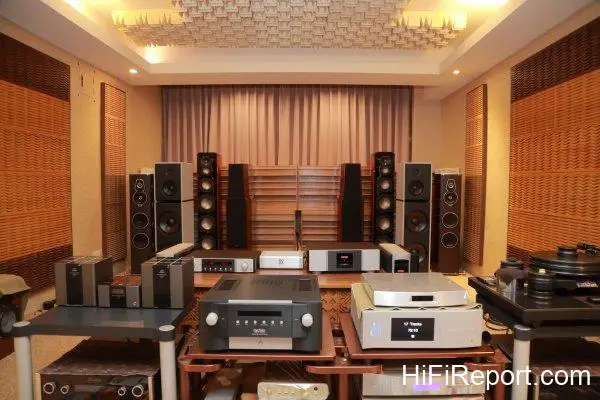
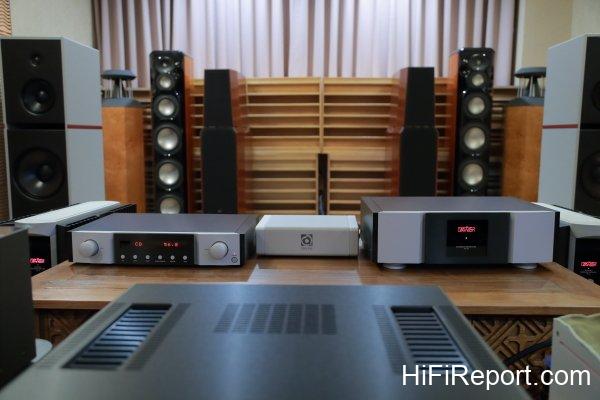
Based on this experience, Vincent brought out the Mark Levinson No.52 and No.53 preamplifier and power amplifier to drive the Alumine Five, aiming to extract the best performance from the speakers.
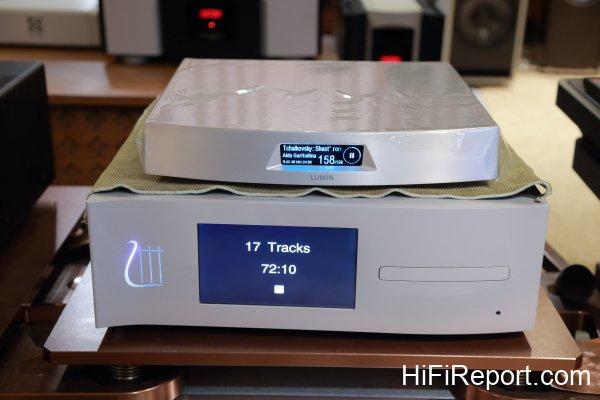
The source was the Orpheus Absolute CD, also from Switzerland. The wiring combined ART cables and Audience, with the source also connected to a Nordost QKore ground unit. The speaker cables were equipped with VertexAQ vibration dampers.
Having been a Stenheim dealer for several years, Vincent speaks highly of their speakers.
I believe him. Otherwise, how could he have transitioned from dealer to distributor? Dealers don’t have to bear the risks of importing, trading, and stocking, but distributors do.
However, if you encounter true love, what’s the harm in taking a risk? I believe Vincent genuinely loves Stenheim, because after an afternoon, I was almost falling in love with it too.
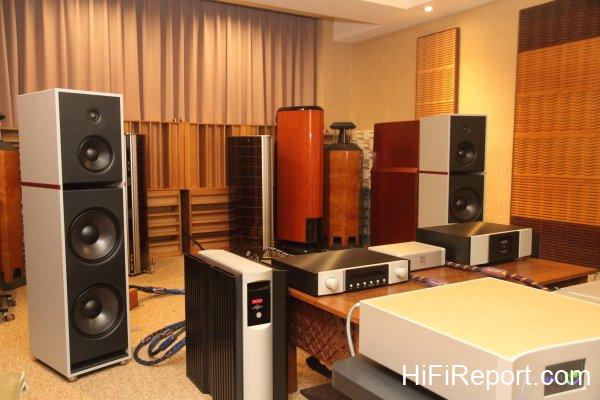
Resound’s second-floor listening room is roughly the size of a typical residential listening room. It has sufficient depth, but the width and height are slightly lacking, requiring some time for adjustment.
The main source for the listening session was the Absolute SACD from Orpheus, another Swiss brand. Its metalworking craftsmanship is equally impressive.
The amplifiers used that day included the Mark Levinson No.52 two-piece preamplifier. This unit houses the power supply and logic control circuitry in one chassis (left), while the main preamplifier circuitry is in another chassis without a display (right), completely isolating any potential sources of interference.
The power amplifier was the Mono-Mono No.53 monoblock.
Like the Fresh Air of the Swiss Countryside, Like the Clear Springs of the Alps
The sound of the Alumine Five is direct, honest, without pretense or concealment.
The sound quality is pure, the timbre natural.
Remember the photo I mentioned at the beginning, from Stenheim’s website? That’s the scenery surrounding their company.
The Alps traverse Switzerland, the entire mountain range resembling the intertwined roots of an old tree, firmly grasping the entire Swiss territory.
Their company is nestled among the Alps, with a snow-capped peak as its backdrop.
I feel that the sound of the Stenheim Alumine Five is like the air of the Swiss countryside, and like the clear springs flowing from the Alpine water veins.
Is this purity only in the midrange? No, it extends all the way, from top to bottom, pure, clean, transparent, and unadulterated.
Would this be too boring? No, distilled water is devoid of anything, while mineral water, even though its texture and tone are pure, can express the richness of sound. The music flows out unimpeded and untainted, coming straight at you.
The inherent qualities of the music are there, audible, even visible.
Saint-Saëns’ Symphony No. 3, “Organ,” features a rich and extensive orchestration, incorporating not only the organ but also two pianos.
I sat there, listening from beginning to end, and the Alumine Five provided a listening experience akin to being in a concert hall. Its sound is open, the soundstage expansive.
During this, Vincent and I discussed the coordination of the space and the sound.
He mentioned that his room was too small, with a noticeable peak in the upper bass. We listened to the music and discussed how to address it.
Given the existing room conditions, apart from adjusting the speaker placement, there were few other options.
So we started to adjust the speakers.
Initially, the speakers were positioned close to the rear wall, resulting in a dry, muddy, and lifeless sound, especially with booming bass. This performance was completely unworthy of the speakers’ and the system’s pedigree..
We tried moving the speakers forward, listening and adjusting as we went. Finally, we moved them forward by almost a meter and increased the toe-in angle. The sound then blossomed.
Vincent even turned all the speakers displayed near the back wall to face backward, with the drivers pointing away. At this point, the vibrant colors and rich layering of Saint-Saëns’ music emerged.
The first half of the first movement is joyful. The music starts softly and gradually increases in volume, a progressive crescendo that showcased the Alumine Five’s exceptional micro-dynamics.
The violins begin softly, gradually increasing in intensity. The English horn enters with a mournful tone, its texture solid and its positioning clear. The strings continue with tremolo, and the timpani beats out a confident rhythm in the background. The layering is excellent.
Why did I mention Alpine springs and the air of the Swiss countryside earlier? The Alumine Five’s sound possesses a high degree of transparency, yet it’s not dull or flat. The music is lively, vibrant. You don’t need to have been to Switzerland; just listen to the Stenheim Alumine Five, and you’ll understand.
Listening to the subsequent introduction and development of the theme, the dialogue between strings and woodwinds, and then the addition of the soaring brass, interweaving with each other.
As long as the system’s transparency is good enough, it can reveal Saint-Saëns’ layering here, layer upon layer, upon layer, upon layer.
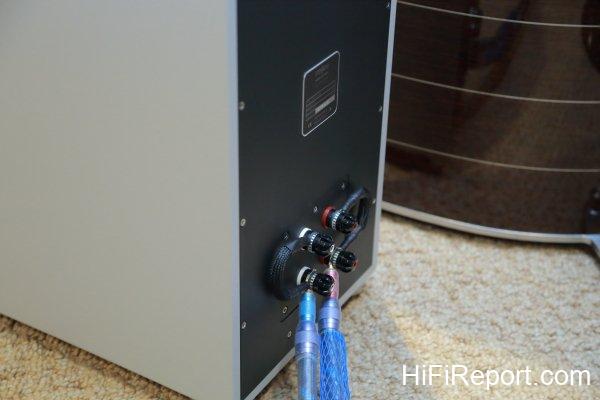
The Alumine Five uses WBT speaker terminals, with two sets for bi-wiring.
Additionally, Vincent is a fan of Italian ART cables, using them almost exclusively throughout the system.
Relaxed and Detailed Bass, Exquisite and Lustrous Highs
The excellent texture is evident in the latter half of the first movement, a slow section so beautiful it could melt the world.
How can the Alumine Five, with its rigid lines and solid cabinet, produce such a beautiful sound? The melody is beautiful, and if the texture of the sound within it can be clearly articulated, the beauty is even more profound.
The Alumine Five allows the strings to exhibit a silky, delicate sheen, dense and soft. The organ underpinning it provides a passage of pure, hymn-like quality, which the Alumine Five renders seemingly even more flawless.
The organ here is not aggressive but soft and gentle, yet it plumbs the very depths of the piece. The Alumine Five’s cabinet is not large, and the manufacturer’s specifications indicate a low frequency of 28Hz. I believe the extension is not a major issue. What’s important is that its bass is both relaxed and detailed.
Speakers are most afraid of muddy bass. Some speakers can produce very clean midrange and highs, but the resonance of the bass ruins the texture.
The Alumine Five doesn’t have this problem. The two 10-inch woofers seem to work effortlessly, handling the organ and double bass naturally.
The scherzo-like music of the first half of the second movement tests the speed and layering of the speakers or the system. Although the Alumine Five has two 10-inch woofers, I found its response speed to be agile, following the music’s rapid pace without losing composure.
If this is what Panchard was aiming for, it’s no wonder he used this pleated cloth surround.
In the latter half of the second movement, the organ roars, and the orchestra joins in a powerful unison. The harp beside it plays crystalline notes alongside the organ’s hymn-like melody, followed by another unison climax, then a fugue, and then a canon between woodwinds and strings.
It was exhilarating! I was so engrossed in listening that I didn’t even notice when Vincent came upstairs and stood behind me.
If I hadn’t gotten up during the unison to touch the speaker, I wouldn’t have known he had arrived.
What was I touching? I was feeling the vibration of the cabinet.
During the orchestra’s powerful unison, the Alumine Five’s cabinet vibration was minimal.
With so little vibration, it’s no wonder the sound is so clean. Furthermore, this aluminum cabinet doesn’t exhibit any metallic sound. Isn’t that remarkable?
Natural and Balanced Timbre, Without Intentional Coloration
With such good sound quality, chamber music is a must.
I put on the recording of Schubert’s “Trout” Quintet by the Capuçon brothers and their friends. This was one of the best experiences I’ve ever had listening to this recording.
How so? The violin possessed both a delicate texture and a considerable roundness. A noble sheen made this trout more lively than any other.
The double bass provided a depth and thickness rarely found in chamber music. This fullness, elasticity, and looseness – the two 10-inch woofers certainly lived up to expectations.
The piano sound was crystalline with solid notes, positioned centrally and slightly towards the rear. It was like the splashing of a mountain stream and the shimmering of light on the water – truly beautiful.
The cello had a nasal tone, not overly pronounced but just right, indicating that the Alumine Five doesn’t intentionally add coloration to the midrange.
As long as the system is balanced and natural, this Virgin recording of the “Trout” will sound wonderful. The Alumine Five allowed me to enjoyably grapple with this lively fish at high volume. Only when I ejected the CD did I release it.
Adjusting the speakers step by step, each adjustment brought a change. Vincent eventually moved the speakers forward by almost a meter, away from the corner where room modes accumulate near the back wall and ceiling. The bass became much cleaner.
Additionally, Vincent carefully turned all the speakers displayed behind them to face backward, reducing resonance interference.
Fast Speed, Powerful Impact, Rich Colors
What better way to showcase speed, power, timbre, dynamics, and extension than with the piano?
I put on Pogorelich playing Mussorgsky’s “Pictures at an Exhibition.”
The opening “Promenade” begins with a steady pace, the piano sound firm and powerful, with a substantial weight to the chords, and abundant string vibrations.
The “Gnomus” track has an eerie atmosphere, with distinct piano notes, even the tremolos and arpeggios clearly defined.
When a chord is struck and the sustain pedal is pressed, the piano sound reverberates and lingers. The string vibrations and the sustained piano notes sound just like having a concert grand in front of me – such an intimate listening experience.
When played forcefully, the piano, due to its sound production mechanism, can express layers of power more effectively than any other instrument, and it can also showcase the tonal differences brought about by speed variations.
The piano on the Alumine Five sounds truly pure and natural.
Listening to “The Old Castle,” the music slows down. Here, the refinement of timbre tests the pianist’s skill.
Pogorelich draws out the tonal scale, and the Alumine Five, in front of me, clearly presents the light and shade, and the tonal scale, that the pianist expresses.
To hear the layers of chords and the power of the piano sound, how can one not listen to “Bydło”? The Alumine Five flawlessly reproduced the intensity of the performance. I sat there, feeling the piano sound striking me directly.
Mussorgsky wrote this piece to describe the oxen pulling the cart, but he was actually referring to the oppressed and bullied Russian people. This heaviness, Pogorelich played it, and the Alumine Five delivered it.
I don’t know what speakers Pogorelich uses in his home system, but I know that there are pianists who are Stenheim users. And I believe that if he were to hear this piece played here, he might be tempted.
Can expensive audio systems only play classical music? Why have I been writing about classical music all along? Of course not. The job of an audio system is only one: to reproduce the recording, to restore the music as faithfully as possible. It should be able to play any music, and play it well.
But I test with classical music first because it uses natural instruments. It has a reference point, unlike the sound of electric instruments, which can be adjusted and changed.
However, what moves people is not just authenticity. There are many elements that can touch the heart, and authenticity is just one of them.
Music using electric instruments can still be moving, and good audio reproduction should also convey this emotion to people.
Crisp and Solid Drums, Distinct Mixing Layers
Listening to Dire Straits’ “Love over Gold” album, the track “Telegraph Road” begins with an extremely faint sound, gradually increasing from a mosquito-like hum. The synthesized electronic bass is like distant thunder.
Then guitars and electric piano are added, the accompaniment gradually becoming richer. It’s not until the drums appear that the prelude’s build-up is complete, and the main verse is about to begin.
The drums, so powerful! They’re not loose and fluffy drums, nor are they full and thick drums. They’re fast, powerful drums.
I really enjoy listening to the sound of the rim shots on the Alumine Five, crisp and clean. Combined with the solid and fast bass drum, it’s the sound of rock from that era!
The guitar sound in “Private Investigations” is truly beautiful, with a warm tone from the wooden body. The steel strings burst forth with a resolute energy that makes it impossible to be distracted, instantly drawing you in.
Mark Knopfler’s voice emerges, a deep and melancholic voice, deliberately lowered, contrasting with the brightness of the guitar and the uplift of the accompaniment.
Electric piano, synthesizer, guitar, and vocals weave together an organic texture, and it’s three-dimensional.
The Alumine Five’s sound has a liveliness and vibrancy. Knopfler’s voice sounds particularly vivid. The forcefully strummed steel strings strike like lightning, no, the electric guitar behind it is! As for the drums, they’re thunderclaps falling from the sky. Hearing such drum sounds makes one appreciate Stenheim’s clever choice of drivers.
Pleated cloth surrounds are commonly found on old speakers and horn speakers, but while those speakers’ bass is fast and clean, they often lack a certain fullness.
Typical rubber surrounds don’t sound as crisp and fast as the Alumine Five’s.
I asked Vincent, how does the bass of the Alumine 3’s bass column compare to this? “It’s very different. The Alumine Five’s bass performance is more comprehensive, and the texture is completely different from the Alumine 3.”
Initially, Vincent paired the speakers with the Mark Levinson No.52 preamplifier. Later, he also used the Orpheus Heritage preamplifier, which added a touch of musicality.
Vivid Vocals, Expressive Performance
Vincent had another idea. He brought up the Orpheus Heritage Preamplifier, also a two-piece preamplifier, and like the Mark Levinson No.52, it also separates the power supply and digital logic circuitry from the analog audio circuitry.
What’s the purpose of this change? “The No.52’s sound is more on the analytical side. The Orpheus preamplifier has better musicality.” He hadn’t tried it himself either, but this pairing turned out to be quite harmonious. The sound gained a touch of warmth and(musicality) , the Alumine Five is already leaning towards freshness and purity, transparent, and the pairing with Mark Levinson, even if it emphasizes this characteristic, the match with Orpheus adds a bit of tenderness.
This improvement is particularly noticeable when listening to vocals.
The Alumine Five’s sonic foundation gives vocals a sweet, fresh, and lively quality, full of flavor.
I didn’t play any audiophile recordings. I put on an old jazz vocal recording from 1957, a duet between Ella Fitzgerald and Louis Armstrong.
Although it’s a mono recording, the vocals are warm, full, and brimming with analog musicality.
The Alumine Five, when playing such vintage recordings, doesn’t produce an old-fashioned sound. Instead, it gives the old recording a new life and a new sound.
To play the songs of Louis Armstrong and Ella Fitzgerald, it tests the detail reproduction ability of the speakers.
Armstrong’s hoarse and(weathered) voice often uses vibrato to add variation to his singing. Fitzgerald has impeccable vocal technique, and the fluctuations in her vocal line rely on the system’s ability to reproduce detail.
As soon as the Alumine Five started playing the first track, “Let’s Call the Whole Thing Off,” it was stunning.
The sound quality, the details, the expression – truly exceptional.
Because it’s mono, there are no soundstage issues, so one can focus on the vocals.
The sound quality is solid but not heavy, instead, it’s agile and nimble. Every turn of phrase is distinct and clear.
Regarding details, I’ve already mentioned this in my previous listening. Here, listening to Armstrong singing, it’s utterly unmasked, direct, and honest, without a hint of warm coloration.
Because of the detail, because the texture is pure, the singing easily conveys emotion.
As for Armstrong’s trumpet, it’s bright and powerful, with the metallic texture of the brass, the sound of air friction against the tube walls, possessing a brilliant and dazzling sheen.
So good, listening to this album like this, so good.
Although this is related to the entire system, and the Mark Levinson also has this upright character, I believe that the Alumine Five, as the final executor, truly controls all the sound output.
When it plays the song, it’s Fitzgerald and Armstrong singing, live, in front of me.
Ah! Yes, how could I not have thought of it! Throughout my listening, regardless of the CDs I mentioned earlier or the records I didn’t mention, the Alumine Five brought the music very naturally to me. Especially after Vincent’s final adjustment of the speakers, I truly felt that it wasn’t a recording anymore, it was a live performance, and I was naturally transported to the scene of that performance.
However, to have such an experience, the Alumine Five must be properly adjusted. Placement is crucial.
If it’s not set up correctly, you won’t be able to appreciate the value of these two-million-NTD (approximately $62,500 USD) speakers.
When everything is sorted out, you can’t help but exclaim, as I did: So, the live experience can be bought after all.
Initially, the speakers were facing forward. Then, the toe-in angle was gradually increased, reducing reflected sound interference and improving focus.
Still Wanting More
I ejected the CD, packed my belongings, and walked down the stairs. Vincent and his wife were waiting below.
I thanked them and apologized: I thanked them for allowing me to spend an afternoon getting to know the Stenheim Alumine Five, and for giving me a new understanding of the music I listened to that afternoon. I also apologized for delaying their mealtime, spending so long listening to the speakers. How could I possibly ask Vincent to schedule another listening session?
If possible, why not try driving the Alumine Five with a low-power amplifier? What would that sound like? The McIntosh 1.25K power amplifiers on the first floor also piqued my curiosity. And…
The Alumine Five’s slightly offset design makes each pair of speakers left and right specific.
The manufacturer offers silver and black cabinet options, with red and gold trim choices.
In fact, it’s more than that. The manufacturer also offers customization, allowing colors to be tailored to customer needs.
The shallow horn waveguides serve to control the dispersion angle, increase driver efficiency, and enhance the projection distance.
The base is equipped with adjustable spikes.
(Source: Stenheim)
Specifications
* Type: 3-way, 4-driver floor-standing speaker
* Frequency Response: 28Hz – 35kHz
* Drivers: 1-inch silk soft-dome tweeter x1, 6.5-inch midrange x1, 10-inch woofers x2
* Maximum Power Handling: 200 W RMS, 400 W (peak)
* Sensitivity: 94 dB SPL/2.83V/1m
* Impedance: 8 Ohms (minimum 3 Ohms)
* Dimensions: 1200 x 280 x 380 mm (HxWxD)
* Weight: 100 Kg each