
Thorens TD 124 DD Review
Why did Gunter Kürten choose to reissue the TD 124? Because this turntable is currently the most popular Thorens model on the used market. You can still find them trading online, with prices varying depending on condition, typically fetching around USD 1,500 to USD 1,800. There are even specialized companies that modify, repair, and manufacture new parts for them.
The Original TD 124’s Legacy
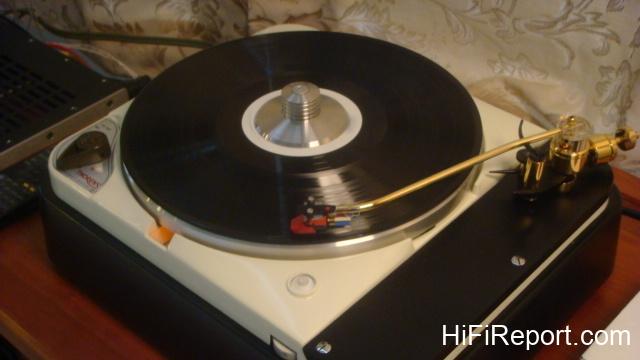
The TD 124 was introduced in 1957 and remained in production until around 1966-1968 (the official website lists 1956-1968, including the MKII; specifications list 1957-1966). Back then, it was renowned for its mixed belt and idler wheel drive system. In addition to 9-inch and 12-inch tonearms, it could even accommodate 16-inch arms with separately purchased special armboards. The stated Wow & Flutter specification for the TD 124 was “Estimated less than 0.05%”.

Why “estimated”? I suspect it might be because the test equipment available at the time could only measure down to 0.05%. In fact, this specification holds up remarkably well even today, sixty years later, comparing favorably with many top-tier belt-driven turntables. Moreover, achieving such low Wow & Flutter with an idler wheel driving the platter demonstrates the extremely high precision of the flywheel and idler wheel’s circularity.
A Century of Thorens History
To discuss the reissued TD 124 DD, we first need a brief overview of Thorens’ history. Thorens’ origins trace back to 1883, founded by Hermann Thorens in Sainte-Croix, Switzerland, where they initially produced music boxes and clock parts. It wasn’t until 1903 that they began manufacturing Edison gramophones. They started making turntables for shellac records in 1906 and even produced cigar lighters between 1913 and 1964.

Harmonicas were added to the lineup from 1914 to 1952 (with a production pause from 1921-1938).

In 1927, the company transitioned from a family business to a public limited company. By 1928, Thorens produced its first electrically driven direct-drive gramophone. Their first cartridge followed in 1929. In 1933, they collaborated with a German company to produce radio products. During the 1940s and 1950s, they manufactured cutting machines and cartridges. The first automatic record changer was introduced in 1943, and mechanical razors were produced from 1954 to 1960.

The TD 124 turntable, launched between 1957 and 1966, initially came without a tonearm or plinth but included an arm mount. Later, the TP 14 tonearm was offered. The TD 150 was released in 1965, followed by the TD 125 in 1968. The TD 150 MKII arrived in 1969, the TD 125 MKII in 1972, and the TD 126 in 1974. The flagship Reference, limited to 100 units, was introduced in 1979. It weighed 90 kilograms and boasted a Wow & Flutter spec of less than 0.02%.

Rumors persist that more than 100 units were actually produced, leaving the numbering scheme for units beyond 100 a bit of a mystery. From 1981 to 1983, they released the TD 226, a large turntable featuring vacuum hold-down and designed to accommodate two tonearms.

In 1983, the Prestige was introduced, smaller than the Reference at 55 kg but still substantial, with Wow & Flutter as low as 0.02%. This turntable was launched to celebrate Thorens’ 101st anniversary. Officially, only 101 units were claimed to be produced, but the Prestige remained in production until 1993, with a final price of USD 15,000. It’s highly probable that more than 101 units were made.
This brief historical overview skips many other models, many of which are still active in the secondhand market at reasonable prices, offering an opportunity for enthusiasts to experience a piece of history.

The Reissued TD 124 DD: A New Approach
The zenith of Thorens’ hundred-plus-year history culminated in the Reference and Prestige. Replicating these turntables today wouldn’t be a technical challenge, but the cost would likely be prohibitive. Therefore, the new owner, Gunter Kürten, chose to reissue the TD 124, the model with the highest discussion and transaction volume.

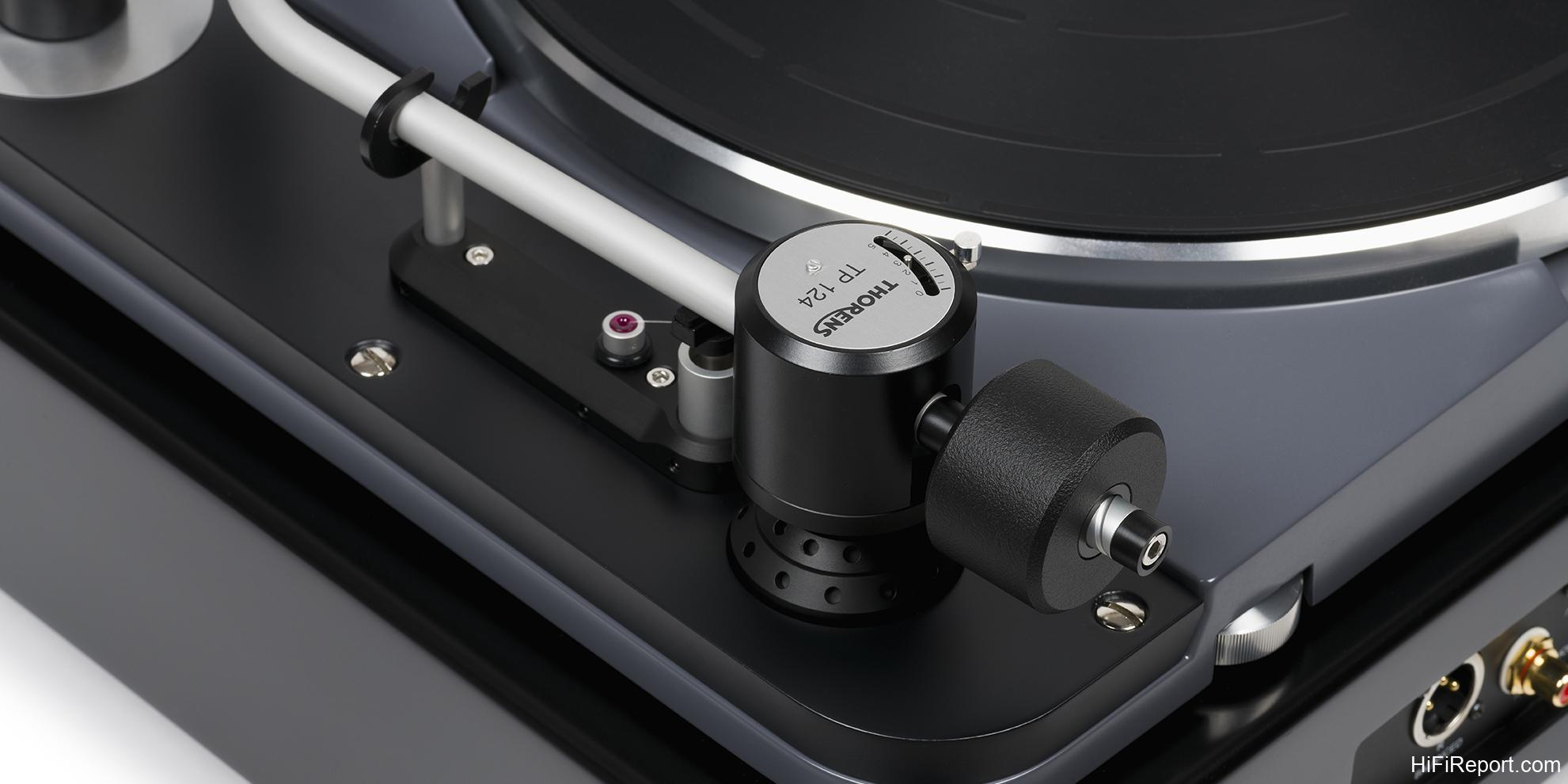
Although it’s called a reissue, the drive system has been changed from the original belt+flywheel+idler configuration to direct drive, and the power supply is now external. What remains are the external aesthetics of the TD 124. While the tonearm (TP 124) also visually resembles the original TD 124’s arm, its internal bearings have been improved.

Strictly speaking, the TD 124 DD has been enhanced according to contemporary standards and requirements, including the drive method, power supply, and tonearm. Furthermore, it incorporates the electronic tonearm lift system derived from the TD 1601. In fact, the external power supply for the TD 124 DD is also similar to that of the TD 1601. Perhaps the TD 124 DD and TD 1601 were developed concurrently?

Why didn’t they replicate the old drive system where a belt first drove a flywheel, which then frictionally drove an idler wheel, and finally the idler wheel frictionally drove the inner sub-platter (made of cast iron)? I suspect such an approach is no longer practical, and achieving the required precision would be difficult, leading them to abandon it. If so, why opt for direct drive instead of a simpler belt drive?

Perhaps it’s because Thorens already has manufacturing experience with the TD 402 DD and TD 403 DD direct-drive turntables, which influenced the decision to make the TD 124 a Direct Drive model.
Design Details and Modern Features
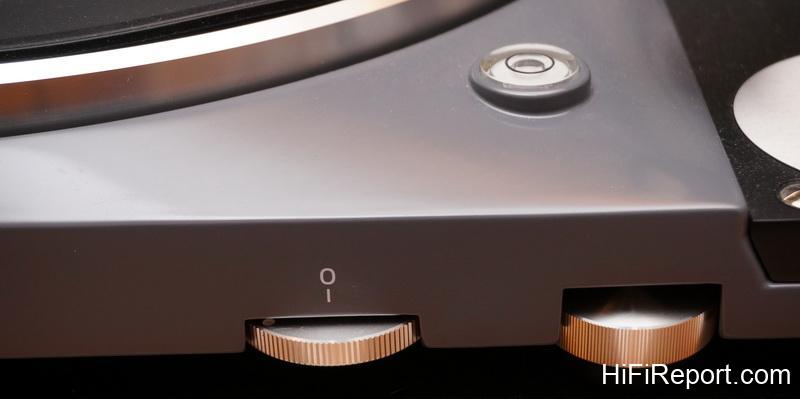
Observing the TD 124 DD closely, the preserved original designs include the external appearance and the base construction. The four small leveling discs located at the front right, front left, and rear are also the same. The spirit level on the right side is identical, as is the brake lever on the front left. However, the TD 124 had a mechanical brake, while the TD 124 DD features an electronic brake. The original TD 124 had four speeds: 16, 33, 45, and 78 RPM.

The TD 124 DD simplifies this to 33 and 45 RPM, with the selector lever in the same position on the left side. Additionally, the cueing lever on the right side has been changed to electronic control.
Furthermore, there is a viewing window at the front center of the platter to check speed accuracy, a design shared with the original TD 124. What differs is the speed fine-tuning mechanism. On the original TD 124, the speed fine-tuning was integrated with the speed selector lever. The initial TD 124 DD prototype shown in 2019 also featured this design, but the final production version changed it, placing the speed fine-tuning knob on the front right side, next to the leveling disc.

Why the change? I presume it was for user convenience.
The record mat on top of the TD 124 DD’s platter appears similar to that of the TD 124. The small disc in the center of the platter is for old 45 RPM records with large center holes. Simply press it down and turn to the right, and this small disc pops up for use with 45s. To return to 33 RPM records, press it down again, but this time turn to the left to lock it in place.
Although modern 45 RPM records now have the same center hole size as 33s, making this feature unnecessary, Thorens thoughtfully retained this design for compatibility with old 45s.
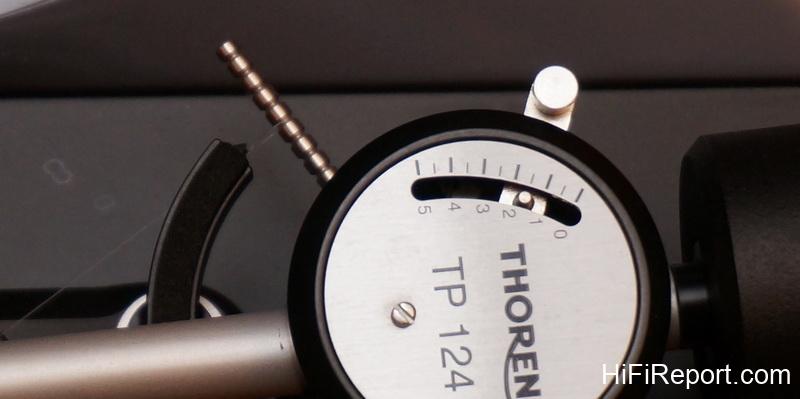
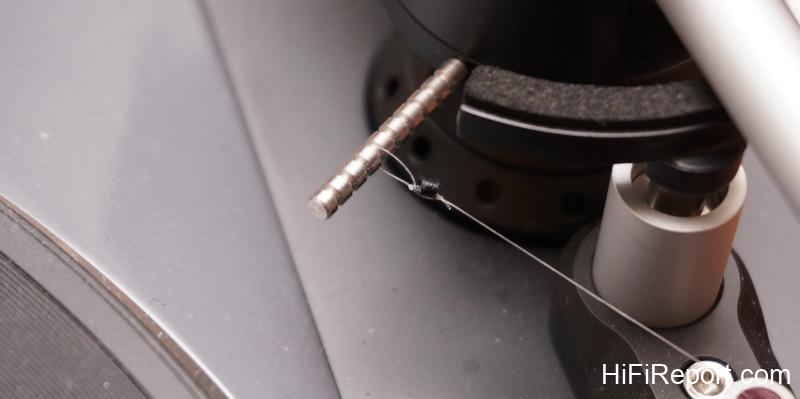
The TD 124 used the TP 14 tonearm, while the TD 124 DD uses the TP 124 arm, employing Lofgren alignment for the offset angle. Visually, these two tonearms look similar, and tracking force is applied via a spring on both. The anti-skate mechanism also uses a fishing line with a weight placed on a scale, with the weight passing through a hole and hidden inside. However, the hole in the TP 124 is made of ruby. Also, the TP 124’s pivot design likely differs from the TP 14’s.
The TP 14 used Gimbal bearings, whereas the current bearings employ Delrin, an engineering plastic from DuPont. I tried removing the top cap of the tonearm pivot to see inside but couldn’t discern anything.
Incidentally, the earliest models of the TP 14 tonearm had tracking force marked on the side, later moving to the top (like EMT arms, used on the TD 124 and TD 125). In fact, Thorens did not produce tonearms themselves in the past; EMT manufactured them on their behalf.
The tonearm cable connection on the TD 124 DD has also been changed to Thorens’ current standard, featuring fixed RCA and XLR output terminals on a back panel, along with the external power connector. This design is very convenient for the user, allowing the choice of either RCA or XLR tonearm cables.
Sound Performance
So, how does this reissued turntable perform sound-wise? I tested the TD 124 DD in my home’s open-plan space. The system included a Spectral DMC30SS preamplifier directly feeding ATC SCM100 ASL active loudspeakers. The phono preamplifiers used were an ASR Mini Basis Exclusive MKIII and an EAR 324. The cartridge was a Supex SD-909 Gold MC. The ASR is a purely electronic design, offering a more refined, clear sound with beautiful treble extension.
The EAR is a hybrid electronic circuit with a step-up transformer, providing a fuller sound, more bass, and a wider soundstage.
The choice of which phono preamplifier to use depends on your cartridge and the sonic characteristics of your audio system; you really need to try them yourself to decide. In my setup, both phono preamplifiers were satisfying.
First, I must commend the electronic tonearm lift on the TD 124 DD. The raising and lowering movements are very smooth, which is a great help for vinyl enthusiasts of all ages, reducing the risk of damaging the stylus. However, note that this cueing mechanism does not automatically lift at the end of the record; it merely assists in lowering and raising the stylus. When the cueing mechanism operates, you can hear a subtle sound, likely from the internal mechanical structure.
Furthermore, when changing records, you don’t need to stop the turntable. Just use the brake lever on the left side to stop the platter from spinning. After changing the record, release the brake, and the platter quickly returns to the correct speed – very convenient. As for the speed, it can also be fine-tuned quickly, meeting the standards of modern turntables.
The TD 124 DD’s isolation performance is quite good. In fact, it features double isolation: the first layer comes from the four rubber feet under the base, and the second layer is provided by the four spring and rubber elements supporting the plinth (used for leveling). Tapping the surface where the turntable sits produces a faint “thud” sound, comparable to the isolation of contemporary turntables.
Of course, you shouldn’t tap the platter itself while a record is playing, as that is not isolated.
Some might worry if direct-drive turntables sound less stable than belt-driven ones, or if the background noise is higher. Honestly, I experienced none of these issues. Comparing it to my reference vinyl system, I could say my system has more bass and sounds more dynamic, but these are two entirely different systems, so such a comparison is meaningless.
Listening to the TD 124 DD, I played various genres of music as usual. The timbre of violins, cellos, and pianos was excellent. Orchestral music sounded grand and expansive, with intricate detail. Pop music remained full and lively. Vocals were focused and well-defined.
In short, I cannot definitively rank the TD 124 DD’s performance based solely on what I heard, but I can certainly confirm that, through my audio system, the music produced by the TD 124 DD was captivating and sounded just as good as other vinyl systems I’ve experienced.
Old vs. New and Final Thoughts
Will the reissued TD 124 DD sound better than the original TD 124? To make a truly accurate comparison, you would need to mount the same tonearm and cartridge on both the reissue and the original turntable, use the same phono stage, and have the same person perform the setup and listening. Frankly, such a comparison has limited practical meaning.
If you truly love the original TD 124, you can still find them online, although after several decades, many internal parts will require replacement or upgrading, depending on your technical skills. However, if you’re looking for an excellent turntable with a classic aesthetic, the TD 124 DD, offering old charm with new sound, will undoubtedly satisfy your needs.
Technical Specifications
* Drive: Direct Drive
* Release Year: 2019
* Speeds: 33, 45 RPM
* Cueing: Semi-automatic electronic lift
* Wow & Flutter: ≤ 0.04%
* Platter Weight: 3.5 kg
* Tonearm: TP 124
* Effective Length: 232.8 mm
* Offset Angle: 23.66 degrees
* Overhang: 17.8 mm
* Effective Mass: 15 g
* Dimensions: 425 x 350 x 185 mm
* Weight: 17 kg