
Thorens TD1601 Turntable Review
Turntable design has traditionally diverged into two main paths: rigid plinth and suspended chassis designs.
The market is dominated by rigid plinth turntables, which emphasize high-mass construction to suppress or counteract vibrations. Many high-end turntables adopt this approach.
The other school of thought employs suspension systems to isolate the platter and tonearm from vibrations, preventing them from reaching sensitive components. This is the essence of the suspended chassis, or “soft” turntable.
Neither approach is inherently superior; each has its own strengths and weaknesses. In fact, one approach’s advantage might be the other’s shortfall. Judging them in terms of which is “better” is overly simplistic.
Consider German cuisine: pork knuckle can be roasted or boiled. Northern Germans favor boiled Eisbein, while Southern Germans relish crispy roasted Schweinshaxe. Can you definitively say one is better than the other? Rigid plinth designs are, in terms of the plinth itself, simpler in design and use compared to suspended designs.
Users of rigid plinth turntables primarily need to ensure the plinth is level, focusing their attention on tonearm adjustments and other aspects. However, while leveling is also crucial for suspended turntables, they introduce the additional complexity of suspension system adjustment.
Three-Point Suspension: One of the “Last Two”
Currently, only two manufacturers, Linn from the UK and Thorens from Switzerland, prominently utilize suspended chassis designs. Remarkably, both have independently adopted the three-point suspension system. This design employs three springs to support an MDF sub-chassis. The platter and tonearm board, along with the tonearm, are mounted on this sub-chassis. The spring suspension effectively isolates them from external vibrations.
This classic design gained popularity after Acoustic Research developed the AR XA, sparking a surge in three-point suspension turntables in the 1960s and 70s. Manufacturers strived to develop their own variations of suspended turntables.
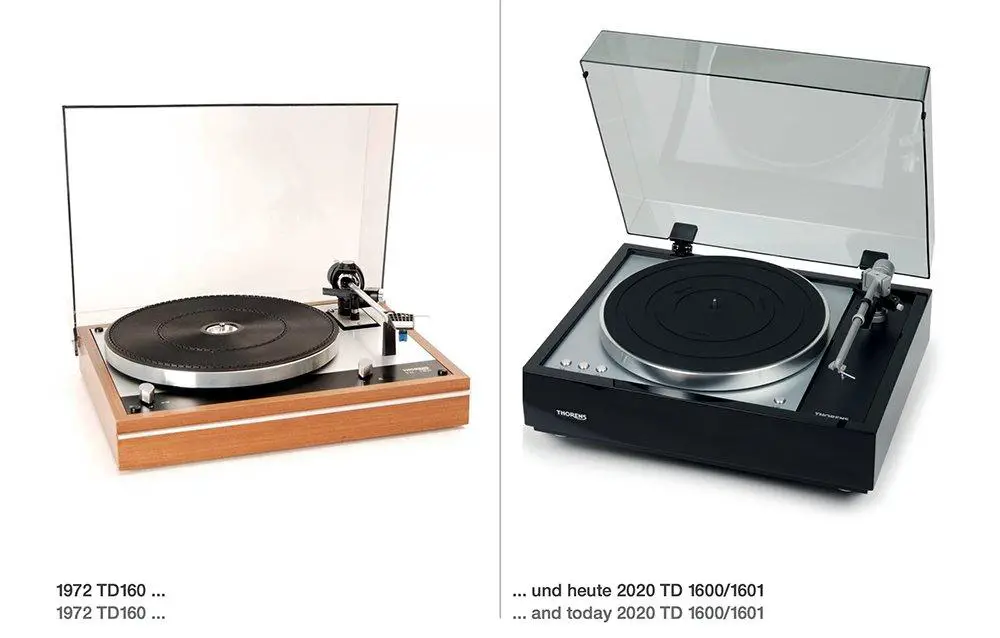
In 1965, Thorens successfully developed the TD150, establishing their foundation in three-point suspension turntable design using springs. In 1972, they introduced the larger TD160, the predecessor to today’s TD1601 and TD1600.
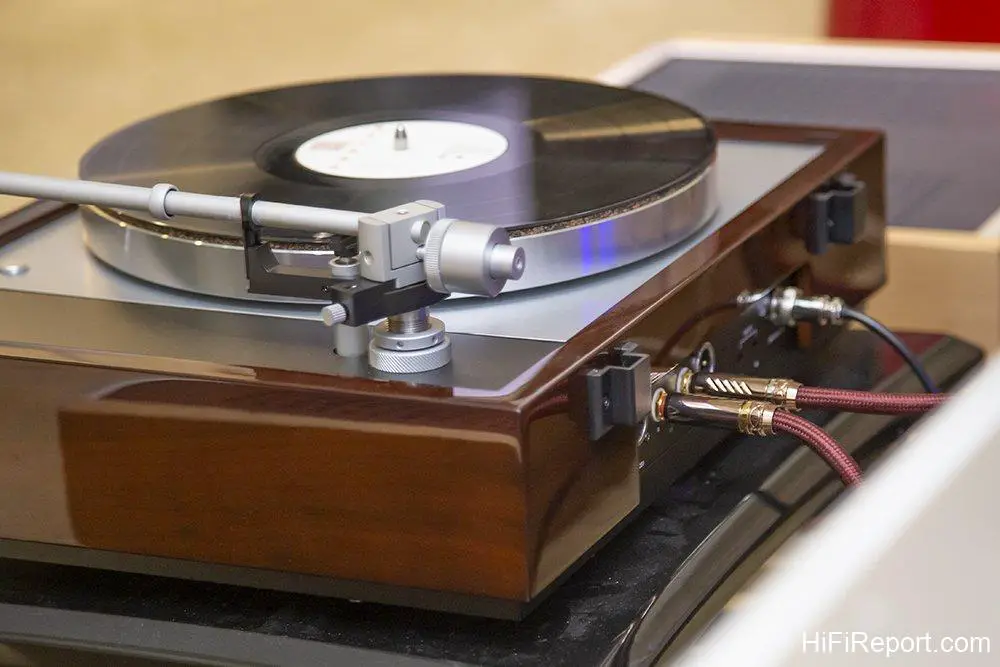
The TD1601 and TD1600 are fundamentally the same turntable in terms of their core components. They even share the same Thorens TP92 9-inch straight tonearm. The key difference is that the TD1601 incorporates an electronic sensor to detect stylus movement.
When playback is complete and the stylus reaches the run-out groove, it triggers an automatic tonearm lift function. During playback, after positioning the stylus over the desired track, pressing a button initiates an automatic stylus lowering sequence.
The TD1600, in contrast, is more traditional, lacking automatic lift and lowering features. These functions are manually controlled using the tonearm’s cueing lever.
TD1601’s Auto-Lift: Protecting Your Stylus
What are the benefits of automatic tonearm lift? Thorens listened to customer feedback. Many users expressed concern about falling asleep while listening to music or getting distracted and forgetting to lift the tonearm. The thought of the stylus needlessly scraping in the run-out groove caused distress. This prompted Thorens to incorporate an automatic lift function into the near-flagship TD1601.
It’s crucial not to confuse the TD1601 with budget-friendly, fully automatic turntables. This feature isn’t about mere convenience; it’s about stylus protection.
[Image of Thorens TD1601 automatic tonearm lift mechanism]
(Source: Thorens Official Website)
Classic Origins, Modern Refinement
While the new generation TD1601/TD1600 and the older TD160 all utilize a three-point spring suspension design, there are significant differences. In the TD160, the sub-chassis was suspended from the top plate. In the TD1601/TD1600, however, the conical springs are mounted and secured to the bottom of the base. Furthermore, foam damping is added at the contact points to absorb vibrations.
The entire sub-chassis is now a substantial aluminum plate, far more robust than the thinner plate of the original TD160.
How are these springs adjusted? In fact, the factory pre-calibrates all springs before shipment. Users only need to ensure the turntable is level. However, after several years of use, springs may fatigue or shift. In such cases, returning the turntable for adjustment is recommended.
The Thorens manual doesn’t detail spring adjustment procedures. This is a task best left to the professionals. Let the experts handle the expert work! [Left image: 1972 TD160. Right image: 2020 TD1600/1601] (Source: Thorens Official Website)
Electronically Controlled Synchronous Motor with External Linear Power Supply
The motor is the heart of a turntable. Just like a human heart, a healthy motor ensures stable power and speed, vital for performance. Every turntable motor is important.
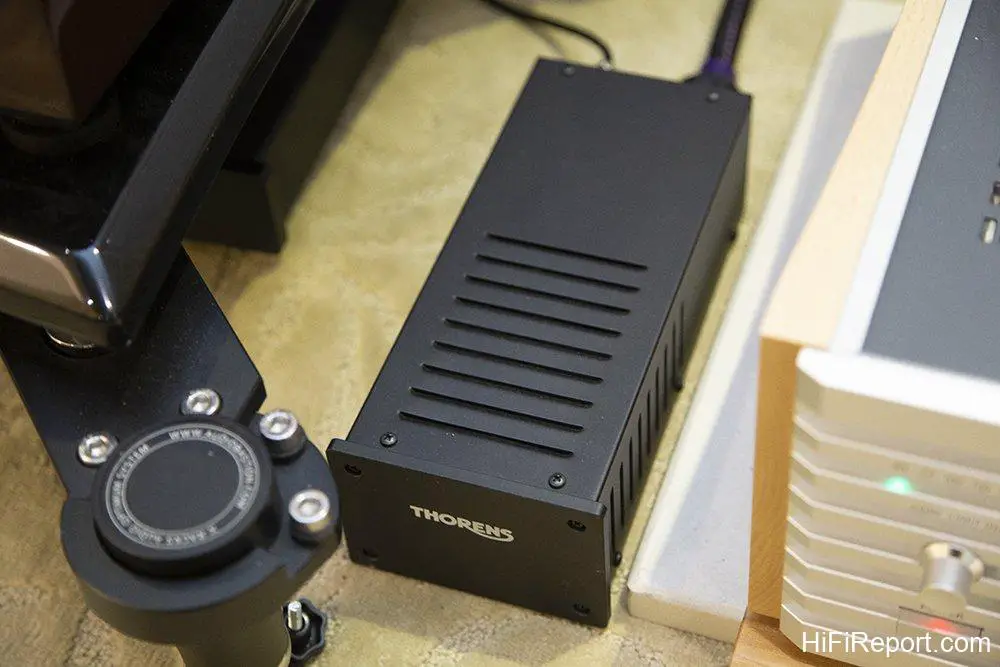
The TD1601 employs a newly designed, electronically speed-controlled AC synchronous motor. Switching between 33 1/3 rpm and 45 rpm speeds is achieved with a button press, eliminating the need to change pulleys.
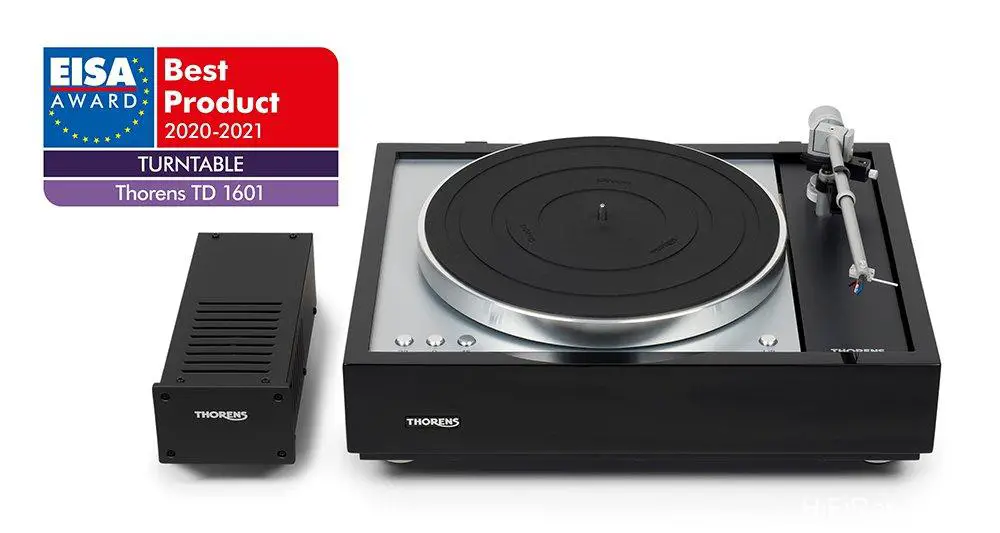
To ensure stable power delivery to the motor, Thorens designed an external power supply unit. This linear power supply incorporates a large toroidal transformer to convert mains voltage into 16V AC for driving the motor.
Thorens eschews “wall-wart” power adapters and eliminates the need for future power supply upgrades by including a linear power supply right out of the box – a decisive and commendable approach! [Image of TD1601 motor and external linear power supply]
Unique Steel Wire Balance: Counteracting Belt Tension
The belt-drive TD1601/TD1600 operates by using a belt to drive an aluminum sub-platter, which in turn rotates the substantial 4.2 kg aluminum main platter. This sub-platter drive system is a classic design.
However, Thorens engineers observed that over time, the belt tension could cause the main platter bearing and motor shaft to deviate from perfect vertical alignment. While some manufacturers might ignore this common belt-drive issue, Thorens devised a solution. They added an adjustable steel wire at the extension of the line connecting the motor shaft and platter bearing. The tension of this wire counteracts the belt’s pull, ensuring both motor and platter shafts remain vertically aligned.
Furthermore, if the belt ages and becomes looser, the steel wire tension can be adjusted to increase belt friction, preventing speed reduction and extending belt lifespan. Ingenious, isn’t it? This is a technology absent in the 50-year-old TD160.
[3D simulation showing Thorens three-point suspension and steel wire balance] The blue wire is the belt tension balancing steel wire.
Dedicated TP92 Tonearm: Thoughtful Design
Thorens offers a complete, integrated system approach. Both the TD1601 and TD1600 are sold with the TP92 tonearm. Users are spared the hassle of tonearm selection, as the factory-matched TP92 is presented as the optimal choice.
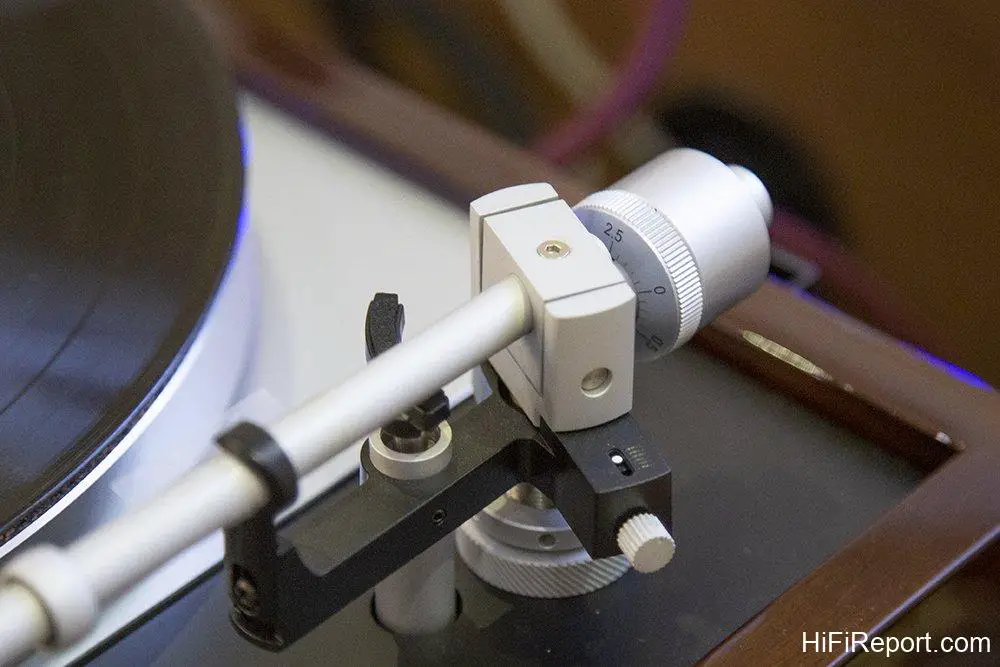
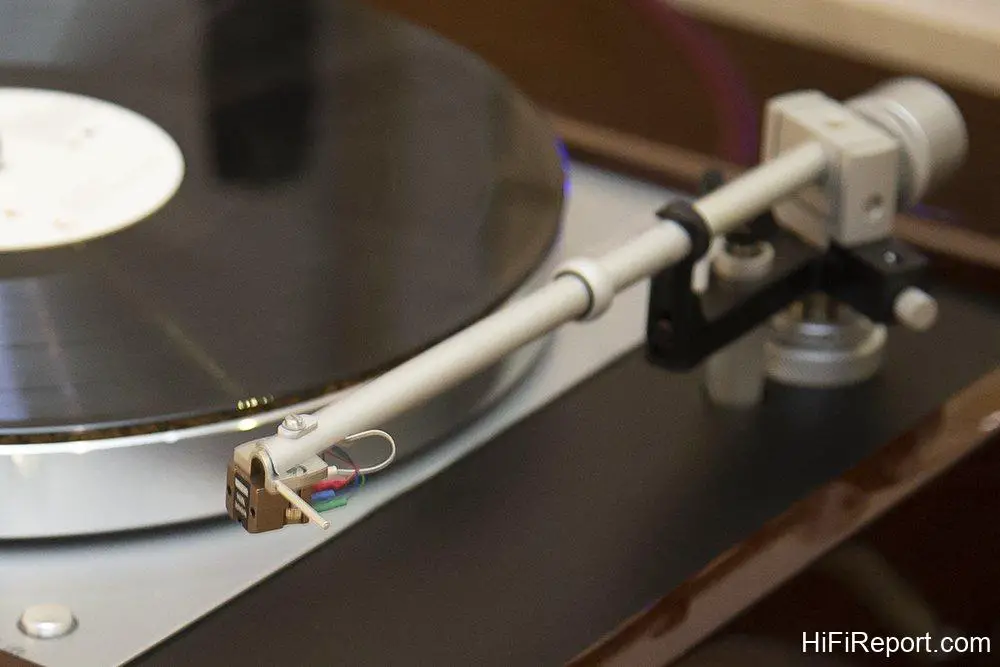
Despite its clean and minimalist appearance, the TP92 is a thoughtfully engineered tonearm with extensive adjustability. Thorens incorporates internal damping within the arm tube. A ring encircling the tonearm near its center marks the resonance point. This damping ring effectively addresses tonearm resonance issues.
This 9-inch straight TP92 tonearm offers adjustments for tracking force, anti-skating, VTA (Vertical Tracking Angle), and azimuth. Whether for novice practice or seasoned cartridge experimentation, it is well-equipped.
The TP92’s counterweight is positioned lower than the tonearm’s horizontal axis, lowering the center of gravity for improved stability. The TP92 is a low-mass tonearm, ideally suited for low-mass cartridges. For heavier cartridges, Thorens offers a heavier optional counterweight, providing greater cartridge compatibility.
[Image of TP92 tonearm adjustments] Simple yet comprehensive tonearm design, adjustable for tracking force, anti-skating, VTA, and azimuth.
VTA adjustment on the TP92 is remarkably easy. After loosening the locking screw, simply rotating the base dial raises or lowers the tonearm height. Without such a mechanism, fine-tuning VTA often involves awkwardly holding the tonearm while tightening screws, making precise adjustments difficult. The TP92’s design is particularly user-friendly for those who enjoy experimenting with record mats.
[Image highlighting TP92 damping ring] The damping ring in the tonearm’s mid-section is used to suppress tonearm resonance.
Balanced Output for Optimal MC Cartridge Performance
Thorens also caters to advanced users. The TD1601/TD1600 provides both single-ended (RCA) and balanced (XLR) analog outputs. Users with balanced phono preamplifiers can leverage XLR connectivity.
The manufacturer strongly recommends using the XLR output, especially for MC (Moving Coil) cartridges, to maximize their performance potential.
Pressure: Following in the Editor-in-Chief’s Footsteps
Truthfully, Editor-in-Chief Guo already reviewed the Thorens TD1601 last year. His listening session took place at 38 Degree C, paired with the ARRIBA A-6035 preamplifier and A-3050 power amplifier from Crown Bridge, driving Rogers LS3/5A speakers. That combination was classic, analog, and nostalgic, embodying a vintage spirit.
At that time, Ms. Tsai at 38 Degree C chose a Danish Ortofon 2M MM cartridge for Editor-in-Chief Guo, allowing for playback through the built-in phono stage of the Crown Bridge A-6035 preamplifier.
[Image of TD1601/1600 rear panel] TD1601/1600 equipped with both XLR balanced and RCA single-ended outputs for user flexibility.
Fortune: Superior System, More Comprehensive Performance
This time, my listening session was at JADEN AUDIO in Neihu. The accompanying equipment was different, showcasing a thoroughly modern and refined character.
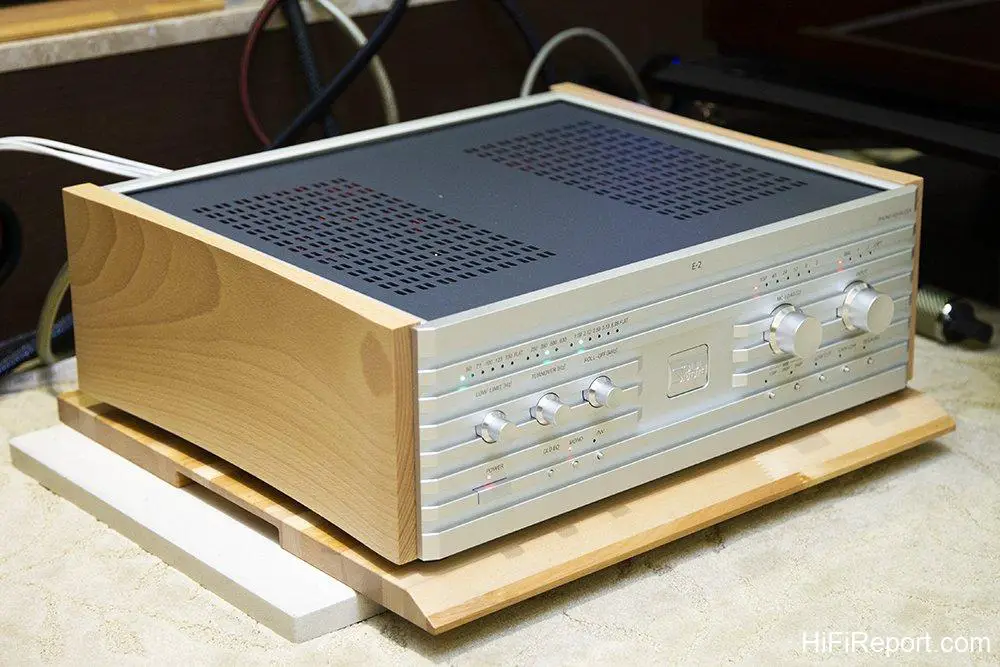
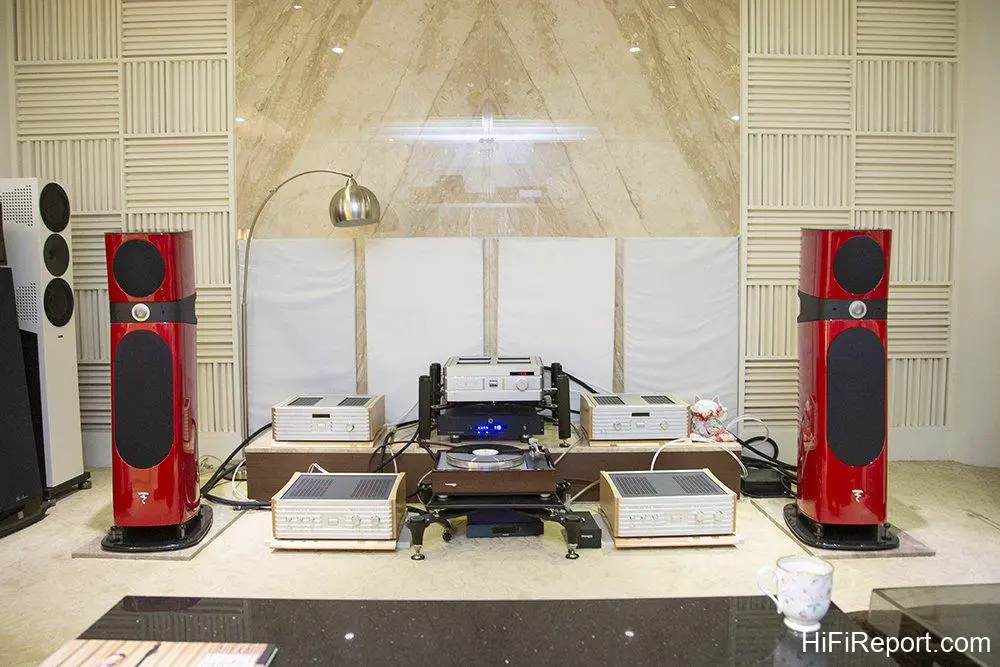
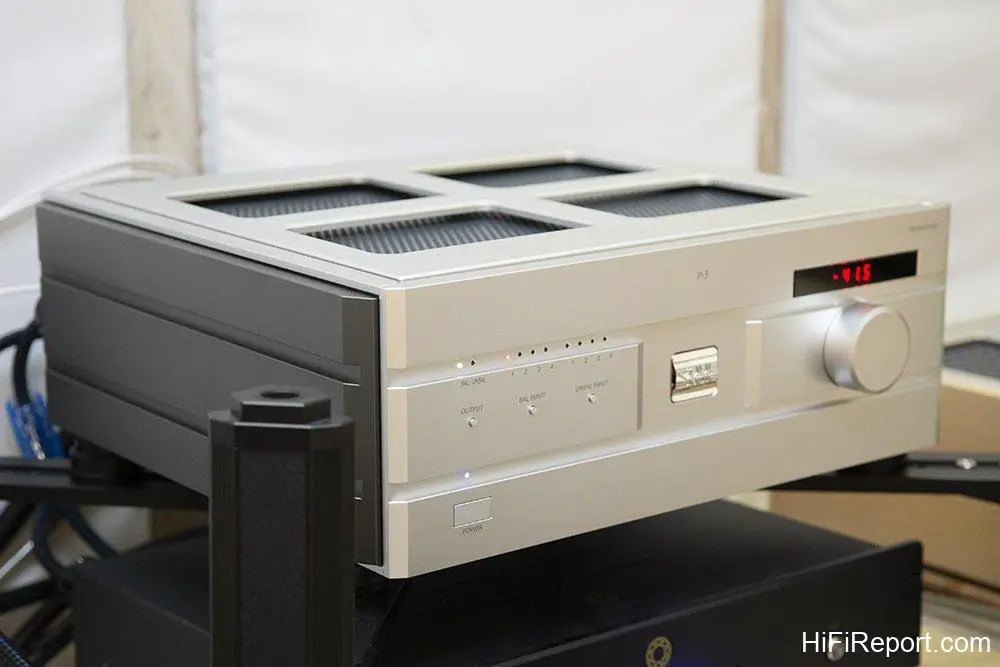
JADEN AUDIO prepared a Soulnote P-3 preamplifier and A-2 power amplifier for this audition, along with a Soulnote E-2 phono stage, and Focal Sopra No2 loudspeakers. Westminster cables were used throughout the system.
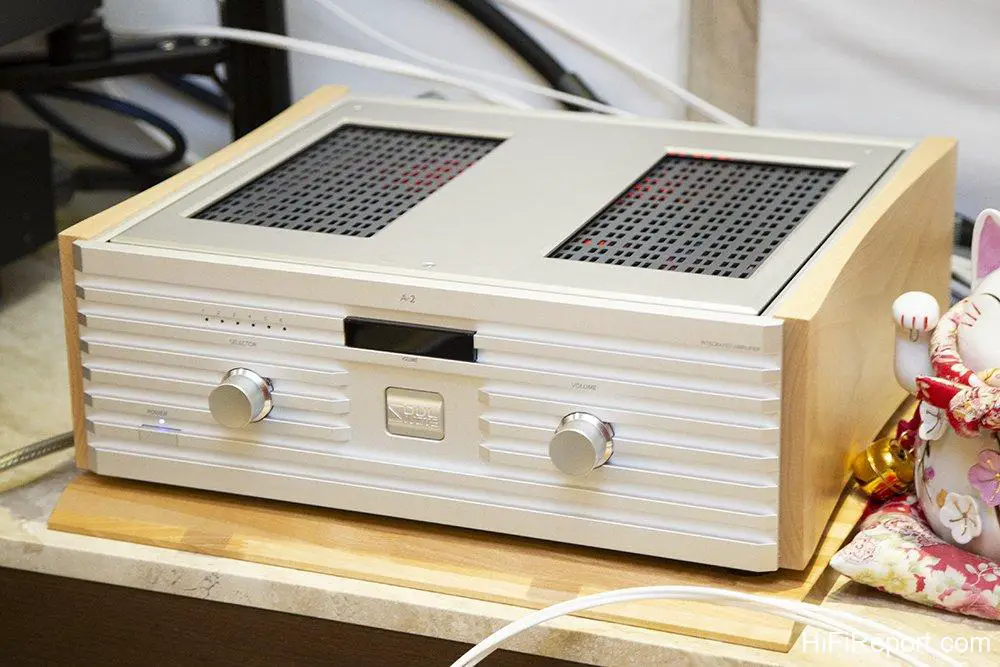
The Soulnote A-2 is actually an integrated amplifier, a complete unit including a preamplifier section. However, the manufacturer suggests using the A-2 as a power amplifier, bypassing its internal preamp and using the dedicated P-3 preamplifier for enhanced sonic refinement, a wider soundstage, and improved dynamics.
Intriguingly, JADEN AUDIO connected two E-2 phono stages. This leverages a special feature of the Soulnote E-2: it can be switched to monaural mode, dedicating its power supply entirely to a single channel. Using two E-2 units effectively creates a mono-mono phono amplification setup.
This was the luxurious system JADEN AUDIO assembled for the audition – exceeding even Editor-in-Chief Guo’s experience. I was indeed fortunate.
[Image of Soulnote P-3 preamplifier and A-2 integrated amplifier] Soulnote P-3 preamplifier and A-2 integrated amplifier. The A-2 can be used as a power amplifier or switched to monaural operation.
[Image of Soulnote E-2 phono stage] Soulnote E-2 phono stage. It features adjustable capacitance, impedance, EQ curves, supports optical cartridges, and can be switched to monaural operation.
But the extravagance didn’t stop there. Given the deluxe phono amplification, JADEN AUDIO’s Mr. Yen wanted to push the TD1601 to its performance limits.
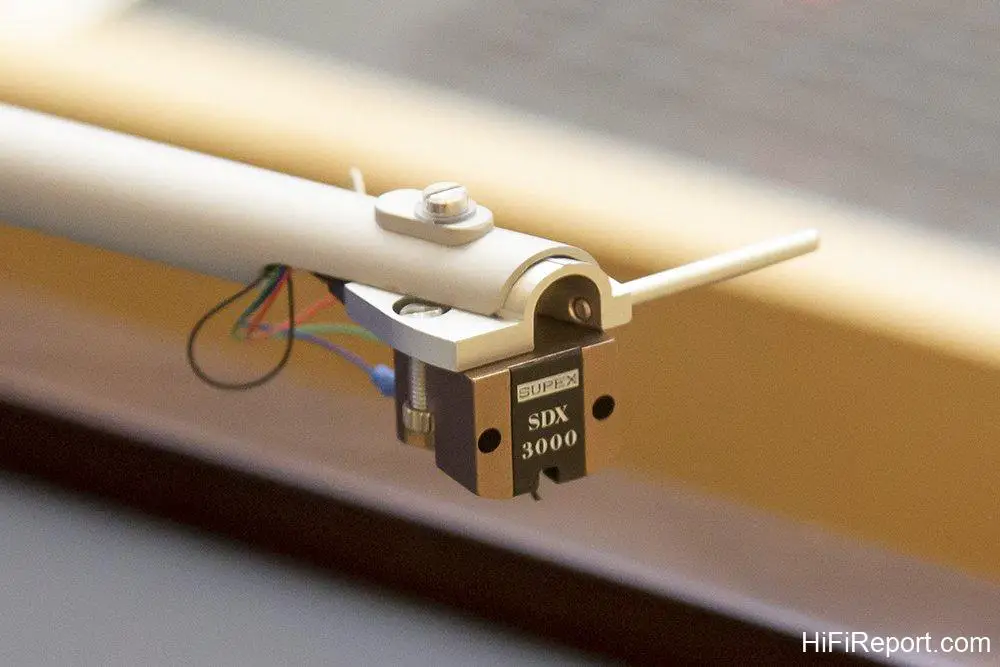
Mr. Yen specially mounted a newly reissued Supex SDX 3000 cartridge on the TD1601. This cartridge boasts a 50µm wide titanium nitride cantilever, a bi-radial elliptical diamond stylus, a special synthetic rubber push-pull damper, a resonance-free lightweight alloy housing, and a powerful rare-earth magnet with 11500 Gauss of magnetic flux. Priced at $4667 USD (NTD 140,000), with a limited production run of only 60 units, its performance is naturally in a different league compared to mass-produced MM cartridges. The TD1601 I heard that day was in a different class altogether.
Wasn’t I incredibly fortunate? [Image of SUPEX SDX 3000 cartridge] SUPEX SDX 3000 cartridge reissue, limited to 60 units, featuring titanium nitride cantilever and diamond stylus.
Indiscernible Contributions: Listening to a System
What about the sound? Frankly, I can’t isolate the TD1601’s individual contribution.
I couldn’t definitively discern whether I was hearing the Thorens TD1601, primarily the Supex SDX 3000 cartridge, the entire Soulnote system, or the Focal Sopra No2 speakers, not to mention the influence of the Westminster cables (all utilizing single-core wires made of special alloys). How can I accurately describe the “sound” of the TD1601 in such a complex system? I shared this sentiment with Mr. Yen at JADEN AUDIO.
What I can convey is the overall sonic impression of the entire system.
Clean Sound, Refined Texture, Wide Dynamics, Rich Detail
Was it good? Extremely good.
What made it good? Its cleanliness. The system’s sound was remarkably clean, devoid of any noticeable distortion or noise.
Its texture. The sonic texture was superb – smooth yet refined, with a touch of warmth and richness, and a vibrant, colorful character.
Its dynamics. The dynamic range was exceptional. Whether handling large-scale orchestral pieces or sudden crescendos, the system remained composed and articulate.
Its detail. The system unearthed a wealth of musical detail. Over half of the records I brought were familiar, and I knew their content intimately. The level of information retrieval was remarkable.
Vivid and Realistic: An Immersive, Live-Like Presence
Listening to Miles Davis’ “So What,” Paul Chambers’ double bass plucks were full, weighty, and richly textured, with palpable string resonance and a captivating depth and elasticity.
Miles Davis’ trumpet was incredibly vivid and lifelike. The abundance of sonic information formed a complete and coherent sonic structure, lending the trumpet sound a high degree of realism and immediacy.
The saxophone texture was equally captivating. There were two saxophones present: John Coltrane’s tenor saxophone on the left and Cannonball Adderley’s alto saxophone on the right. Beyond the distinct timbres and textures of the instruments, the contrasting playing styles of the two musicians were clearly discernible. Through this system, I wasn’t just hearing tone and timbre; the expressive nuances of Coltrane and Cannonball’s playing were vividly present.
Drums: Crisp, Lively, Powerful, and Rhythmic
In “So What,” drummer Jimmy Cobb’s role is relatively restrained. Yet, even the subtle, delicate details were clearly rendered. The shimmering cymbal work added a layer of vibrant color to the music.
Switching to Dave Brubeck’s “Take Five,” Joe Morello’s drumming takes center stage, with extended solos and a recording that prominently features the drummer. The drum sound was crisp and lively. Delicate and nimble in softer passages, yet weighty and impactful when the kick drum struck.
Nimbleness and crispness require system speed. Do suspended turntables sound slow or sluggish? Do they produce a soft, mushy sound? Not in the slightest.
Furthermore, Paul Desmond’s alto saxophone was full-bodied, warm, and richly textured, with subtle reed vibrations clearly audible. I had always associated digital playback with detail retrieval, but on this system, the level of information was equally impressive, if not surpassing it.
“Unsquare Dance” is a short but fascinating piece. The piano leads the melody, while the bass provides a simple harmonic foundation. A rich tapestry of rhythms is woven from bass, handclaps, percussion, and foot stomps. These sounds were remarkably lifelike, possessing not only spatial information and layering but also dimensionality and palpable form. Truly remarkable!
Organ Music: Deep, Majestic, and Resplendent
Playing organ music further showcased the system’s capabilities. I started with Karl Richter’s performance of Bach’s famous Toccata and Fugue in D minor, BWV 565. This was a West German DECCA pressing, not a rare or expensive version, but in excellent condition, resulting in clear and clean sound.
The organ’s deep, resonant bass, coupled with the clear, extended high frequencies of the melodic lines, created a majestic and richly colored soundstage in the toccata section. In the fugue, the system delineated the complex layers with impressive clarity.
“This organ recording is really quite good,” Mr. Yen remarked, examining the record jacket before placing it back on the table.
Astonishing Dynamics and Microdynamics
Next, I played Herbert von Karajan’s Vienna Philharmonic recording of Strauss’s “Also Sprach Zarathustra.” Again, a standard, affordable pressing, but the opening fanfare was breathtaking.
The organ and low-frequency orchestral instruments plumbed the depths of the bass range, while the brass section ascended, illuminating the soundstage with a radiant sonic sunrise, revealing a vast scale and rich sonic tapestry. The timpani strikes possessed a resolute authority, maintaining impressive soundstage depth while conveying tremendous power.
The “Von den Hinterweltlern” (Of the Backworldsmen) section, beginning with tremolo strings, followed by the entry of organ, clarinets, and bassoons, was filled with restless unease and hushed murmuring. The system’s reproduction of microdynamics and subtle details was truly captivating.
Again, I must emphasize that I was hearing the sound of the entire system, making it difficult to pinpoint the contribution of any single component. However, I can confidently say that the TD1601 did not disappoint in terms of either macro or microdynamics. It provided a solid foundation, allowing the Supex SDX 3000 to extract the maximum amount of musical information.
Speed, Dynamics, Impact: Nothing Lacking
After sharing my impressions with Mr. Yen, he brought out a cherished record – Telarc’s recording of Robert Shaw conducting the Atlanta Symphony Orchestra in Carl Orff’s “Carmina Burana.”
“I bought this record as soon as it was released, decades ago. It’s still in mint condition,” he said. This record is a must-have for audiophiles, renowned for its exceptional sound quality. “This LP, like the 1812 Overture, is an audiophile torture test,” Mr. Yen added, referring to Erich Kunzel’s Cincinnati Pops Orchestra recording of Tchaikovsky’s 1812 Overture. The cannon shots in the 1812 are so intense that poor tracking can cause the stylus to jump, potentially damaging records and cartridges.
He hadn’t brought the 1812 Overture, and even if he had, I wouldn’t have dared to ask him to play it for me. While “Carmina Burana” isn’t quite as extreme as the 1812, it’s still a demanding test.
The opening “O Fortuna” was already immensely powerful. I intentionally increased the volume, and even under the onslaught of bass drum strikes, orchestral crescendos, and powerful choral passages, the stylus tracked flawlessly. The drum sound was robust, full, and forceful, each note striking with visceral impact.
So, do suspended turntables sound “soft”? While their sonic presentation may not be razor-edged, they are certainly not lacking in speed, dynamics, or impact. Editor-in-Chief Guo’s previous listening experience with tube amplification and Rogers LS3/5A speakers yielded excellent musicality, but my experience today, allowing for high-volume playback of Bach’s Toccata and Fugue, Strauss’s Zarathustra, and Orff’s Carmina Burana, was even more rewarding.
Versatile Performance: Exquisite Op. 111
Playing piano music, the TD1601 showed no signs of strain or limitations. It not only conveyed the density and solidity of the piano tone but also revealed rich resonance and extended decay.
I brought a recording from the 2019 Audiophile Exhibition, Chen Pi-hsien’s live solo recital, featuring Beethoven’s Piano Sonata No. 32, Op. 111. This sonata, with only two movements, is full of power and contrast, offering a wide range of sonic textures.
The piano tone was full-bodied and rounded, devoid of dryness or sluggishness. Chen Pi-hsien didn’t emphasize a somber atmosphere in the opening movement. Instead, she conveyed a profound sense of introspection. The powerfully struck notes and chords produced a glorious and radiant sound. On this system, the monumental, passionate, and majestic musical architecture posed no challenge.
Remarkably, the deep bass notes were both weighty and clearly defined. The Sopra No2 speakers are exceptional, the Soulnote pre/power amplification is outstanding, the E-2 mono phono stages are superb, and the TD1601 with the SDX 3000 cartridge is truly impressive.
Beyond sheer power, there’s also refinement. The second movement is a study in delicacy and nuance. Refinement and nuance are strengths of the Soulnote system, and the Thorens TD1601 also handled them effortlessly.
The variation theme itself is deeply lyrical, marked “Adagio Molto Semplice e Cantabile” – very slow and simple, songlike. The notes descended like snowflakes, gently falling, as if time itself had frozen. The triplet figures of the first variation, combined with the legato right-hand melody, lead into the second variation, which transitions into arpeggiated passages that dance across the keyboard with fervor and passion. By the fourth variation, the music returns to a delicate and tender character, with tremolo passages creating an ethereal atmosphere.
From the fourth variation onward, the JADEN AUDIO listening room fell silent. No one spoke. I listened intently, completely absorbed in the music, until the final, barely audible notes faded into silence.
I shared a concert anecdote with Mr. Yen. I was in the audience at the National Concert Hall when Chen Pi-hsien performed this piece. Every time I listen to this recording, I am transported back to that wonderful live performance. Later, when Chen Pi-hsien auditioned the master tapes at Yanghuo Recording Studio, she was very pleased with the work of recording engineer Wu Dong-yan and mastering engineer Wang Bing-huang. However, upon reaching the end of the piece, she suddenly paused. “Where is the audience applause?” she asked. Wang Bing-huang had not anticipated that Chen Pi-hsien would want the applause included. Chen Pi-hsien explained that in all her performances of this piece around the world, no audience had ever connected with her music so deeply, allowing the emotional arc of the ending to unfold so completely. “We need to include the applause, and the silence before it,” Chen Pi-hsien insisted. Wang Bing-huang then retrieved the original files and restored the silence and applause he had removed. This is what we hear in the final recording – a pregnant pause after the final notes, followed by the audience’s applause.
Waiting for Connoisseurs: Showcasing the Elegance of Suspended Design
Even acclaimed masters like Chen Pi-hsien seek discerning listeners who truly appreciate their art. The vinyl playback system I experienced that day – Thorens TD1601, Supex SDX-3000, and Soulnote E-2 – is also waiting for connoisseurs.
The Thorens TD1601 builds upon decades of the company’s turntable design and manufacturing expertise. It incorporates new materials, technologies, and design elements to address past limitations while embracing a retro-modern philosophy. The TD1601 pays homage to the classic TD160 of half a century ago through its innovative yet familiar execution.
For seasoned audiophiles who might dismiss it as “too affordable” and lacking “upgrade potential,” and for newcomers who might hesitate at the price, wondering if it’s too ambitious a first step, I say this: buying a Thorens TD1601 is not just acquiring a turntable; it’s embracing a classic design philosophy – the three-point suspension – that few dare to pursue today.
As you watch the TD1601’s platter spin and listen to the music, you are stepping through a portal, transported back to the 1950s and 60s, the golden age of suspended turntables, experiencing their enduring elegance firsthand.
The Thorens TD1601/1600 was recognized as the “Best Turntable” by EISA (Expert Imaging and Sound Association) upon its release, a testament to its excellence.
Specifications
* Type: Belt-Drive Turntable
* Drive Method: Belt Drive
* Speeds: 33 1/3 RPM, 45 RPM
* Tonearm: Thorens TP 92
* Outputs: XLR x 1, RCA x 1
* Platter Weight: 4.2 kg (Aluminum)
* Dimensions: 454 x 180 x 369 mm (W x H x D)
* Weight: 11 kg