
Vincent SV-237MK Integrated Amplifier Review
Vincent SV-237MK Integrated Amplifier
Vincent, originally known as Sintron, was established in 1995. However, Sintron’s primary business was not in audio but rather as a trading company specializing in the import and export of electronic components.
In 1996, they imported amplifiers from a certain country. Unexpectedly, after being introduced to Germany, these amplifiers received positive reviews from the local audio media. This sparked a new idea for Uwe Bartel, the owner with an electronics engineering background. He thought, “Since this Chinese factory has manufacturing capabilities, why not develop my own products and have them manufactured by this factory?” And so, in 1997, Bartel founded Vincent Audio, outsourcing production to that Chinese electronics factory – German design, made in China.
His philosophy was straightforward: to leverage the low costs of China, the “world’s factory,” to create affordable Hi-End audio equipment.
Furthermore, he set a goal: Vincent products should be two levels above the competition.
This “two levels above” is a bit nebulous, but essentially it means Vincent’s equipment should outperform similarly priced competitors, with performance capable of challenging more expensive models.
Is this claim credible? Let’s examine the SV-237MK to find out. Frankly, I’m curious myself.
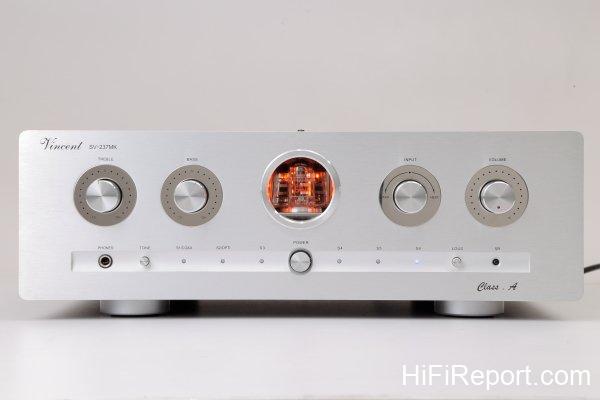
The Vincent SV-237MK, a hybrid integrated amplifier with a tube preamp stage and solid-state power amp, boasts a simple and intuitive design. Four knobs and a display window, which allows you to see the tubes, enhance the listening experience.
Classic Hybrid Integrated Amplifier Flagship – Latest Version
Vincent’s product line is divided into two categories: all-solid-state and tube-solid-state hybrids, encompassing both CD players and amplifiers.
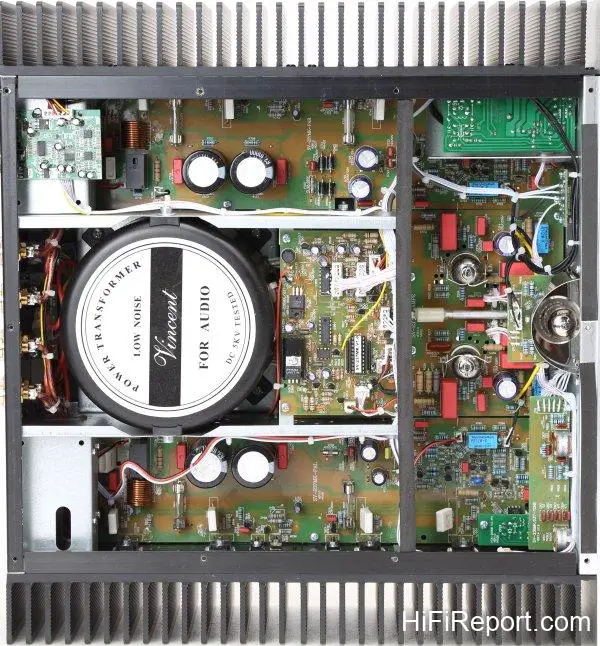
The SV-237MK falls into the latter category, a hybrid integrated amplifier employing a tube preamp stage and a solid-state power amplifier.
Previously, they released the SV-237, which featured a USB input for digital connections. Responding to customer feedback, it seems, the new SV-237MK replaces the USB with coaxial and optical inputs. This allows users to connect a wider range of digital sources, including CD transports, set-top boxes, and Apple TVs, to the SV-237MK.
Vincent’s naming convention is rather peculiar. They released a new version, simply adding “MK” to the model name, without specifying “MK what.” Typically, “MK” stands for “Mark,” so “MK2” would indicate “Mark 2.” This lack of clear designation seems to be a Vincent habit, and it does feel a bit odd.
The main designer of the SV-237MK integrated amplifier is Frank Blöhbaum. He previously worked in R&D at Thorens and designed automatic bias systems for T.A.C., a German tube amplifier manufacturer. He is undoubtedly a circuit design expert.
While the model number of the SV-237MK is only slightly changed, the internal circuitry has been refined, particularly in the output stage. These improvements enhance the SV-237MK’s control over loudspeakers and allow it to more accurately reproduce the rapid dynamics of music signals.
Another key modification is an increase in the signal-to-noise ratio of the SV-237MK, resulting in a quieter background. This is beneficial even when using high-efficiency speakers. A high signal-to-noise ratio is crucial for improving the overall dynamic range of an audio system.
Point-to-Point Circuit Boards, Metal Shielding, and Large Heatsinks
Opening the top cover reveals a well-organized amplifier layout with neat and symmetrical circuit arrangement.
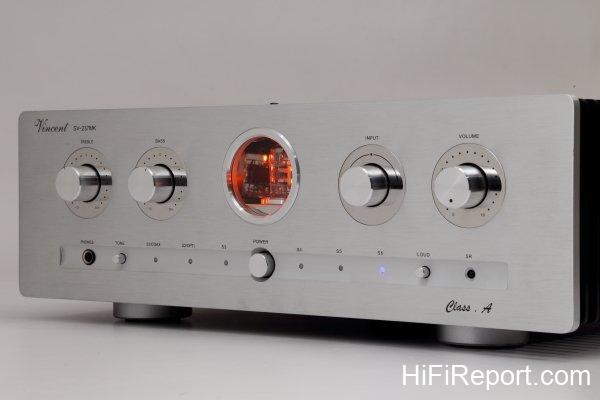
Remarkably, for an amplifier in this price range, all circuit boards are constructed using point-to-point wiring. Even upon close inspection, no surface-mount devices (SMD) are found.
SMD components can be machine-produced with precision and speed, offering higher production capacity and lower error rates compared to manual assembly. They also reduce labor costs associated with soldering and assembly, thus lowering overall production costs.
However, the SV-237MK’s internal circuitry is entirely point-to-point construction, with each component individually inserted and each connection meticulously soldered. This requires both manpower and time. Vincent’s willingness to adopt this approach, while still offering the SV-237MK at this price point, is undoubtedly a source of pride.
The internal circuitry is roughly divided into three longitudinal sections, separated by galvanized steel plates for metal shielding.
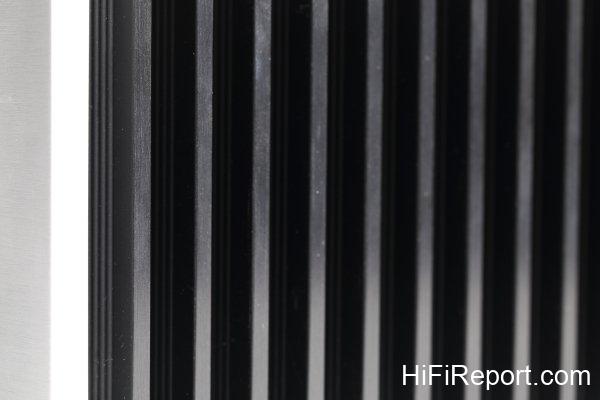
The left and right sections house the power amplifier circuits, with the power transistors mounted on heatsinks on either side. Upon closer examination, you’ll notice the heatsink surfaces are not flat but have subtle wave-like patterns. What’s the purpose? To increase the surface area, thereby improving heat dissipation efficiency. This level of design is rare in amplifiers under $3,000 USD.
The rear half of the central area is dedicated to the power supply, while the front half houses the preamp stage. Vincent has equipped the SV-237MK with a large toroidal transformer, enclosed in a metal shield to prevent magnetic leakage from interfering with the signal.
The preamp circuitry is located on a separate circuit board in the front of the central area, shielded from the power supply section by a metal partition. This compartmentalized design not only provides shielding but also enhances the structural rigidity of the chassis.

Simply removing the top cover and observing this internal design, without knowing the price, and concealing the brand, one might guess a price tag of $6,000 USD or more, fearing even that might be an underestimate.
The image on the right shows the front panel of the SV-237MK, rotated 90 degrees to maximize resolution for clearer viewing.
As seen in the photos, the SV-237MK’s layout is logical and straightforward, employing the shortest possible signal paths: preamp in the front, power amplifier circuits on the sides, and power supply in the center. Heatsinks on both sides aid in heat dissipation for the power transistors. Internal crossbeams provide support and structural reinforcement, while also offering shielding.
The preamp section of the SV-237MK utilizes one 12AX7 tube in the first gain stage and two 6N1P-EV tubes in the second stage, leveraging the latter’s higher voltage gain for greater signal stability.
Each heatsink fin features a wave-like texture to increase surface area and improve heat dissipation efficiency.
Adjustable EQ Adds to the Fun
The preamp stage of the SV-237MK employs a 12AX7 tube for the first stage amplification and two 6N1P-EV tubes for the second stage, utilizing the latter’s higher voltage amplification to ensure signal stability.
Due to the use of tubes in the preamp stage, the signal-to-noise ratio is slightly lower compared to solid-state amplifiers. However, this also imparts a touch of warm tube character to the SV-237MK’s sound.
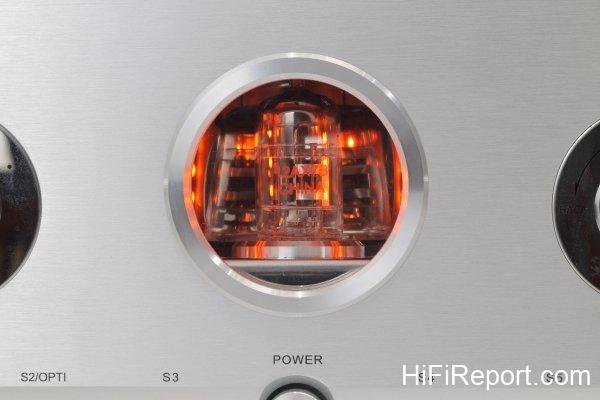
This tube character is not only audible but also visible. Vincent has incorporated a circular viewing window on the front panel, illuminated by an orange LED. When powered on, the 12AX7 tube is visible through this window, adding visual appeal.
In actual use, I found the LED light to be too bright, appearing somewhat obtrusive in both bright and dim environments. I suggest the manufacturer consider removing this light and the curved reflector. If a window is deemed necessary, it should be a direct view into the chassis, allowing observation of the three tubes in the preamp section. I suspect this lighting idea didn’t originate from the German designers. The designers should have more confidence; the equipment is good enough without such embellishments.
The front panel features four aluminum knobs. The two on the left are for treble and bass EQ adjustment, allowing fine-tuning based on personal preference or room acoustics.
If you need to adjust the treble and bass levels, press the “Tone” button. Otherwise, the signal bypasses the EQ circuitry for a more direct and cleaner sound path. When the “Tone” button is engaged, even without adjusting the treble and bass knobs, the sound becomes slightly grainy, and the soundstage tends to move forward and flatten somewhat. If EQ adjustment is not required, it’s advisable not to press the “Tone” button.
The 12AX7 tube in the first gain stage is shielded by a curved metal plate, illuminated by an LED to enhance the visual effect of the tube.
A simple and unadorned design, the two knobs on the left are for treble and bass EQ adjustment, while the two on the right are for signal selection and volume control.
It also includes a 6.3mm headphone jack. The headphone output closely mirrors the speaker output in sound characteristics, offering a similarly warm, rich, and full-bodied sonic experience.
The two knobs on the right are for source selection and volume control, which are standard features. However, there’s an additional button below, a feature rarely seen on modern two-channel amplifiers: the “Loudness” button.
What’s its purpose? Driving loudspeakers, especially in the bass frequencies, is most challenging for amplifiers. At low volumes, amplifiers may not output enough power to properly drive the bass drivers, resulting in a thin and weak sound. In older amplifiers, a “Loudness” EQ control was common. Pressing this button boosted the low-frequency response, allowing for a fuller bass perception even at low listening levels.
The SV-237MK retains this function, adding another element of fun and usability.
For late-night listening, when concerned about disturbing family or neighbors, the SV-237MK also includes a 6.3mm headphone output jack on the lower left of the front panel. The manufacturer states it can drive headphones with impedances ranging from 32 to 600 ohms.
Once headphones are plugged in, the speaker output is automatically muted, with only headphone output active. In practice, when using only the headphone output, the power amplifier heatsinks remain cold, indicating that the power amplifier circuitry is indeed deactivated. Furthermore, the treble and bass EQ adjustments and the Loudness control remain effective for the headphone output as well.
Bi-amping and Bi-wiring Options, Built-in DAC for Convenience
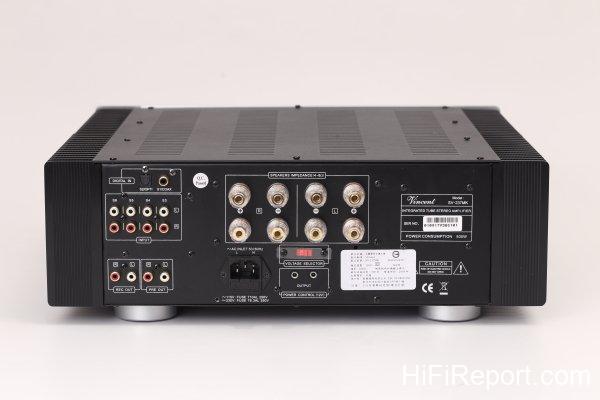
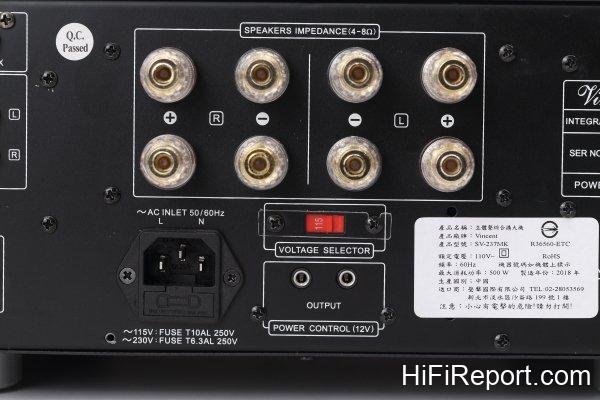
The power amplifier section delivers 150W per channel into 8 ohms and 250W per channel into 4 ohms. It operates in Class A mode up to 10W output. In reality, for typical home listening levels, amplifier power output rarely exceeds 10W. This means the SV-237MK operates almost entirely in Class A, minimizing distortion.
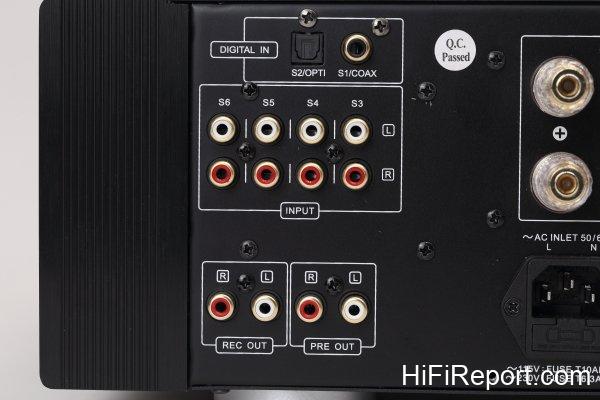
The rear panel terminal array is comprehensive. Four sets of RCA analog inputs allow connection of at least four sources. A preamp output enables bi-amping with an additional power amplifier. Additionally, it offers two sets of speaker outputs. If your speakers have dual binding posts, you can bi-wire them, connecting one set of speaker cables to the tweeter terminals and another to the woofer terminals. Theoretically, bi-wiring reduces signal interference between high and low frequency drivers fed back to the amplifier, resulting in a cleaner and more open sound.
Offering both bi-amping and bi-wiring options, Vincent truly understands what audiophiles desire.
As for the built-in DAC, it features one coaxial and one optical input, supporting resolutions up to 24bit/192kHz. If you prefer to avoid additional expense, this is sufficient. Connecting your TV’s audio output to the SV-237MK, and further connecting a subwoofer via the preamp output, you can significantly enhance your HBO movie viewing experience without investing in a separate home theater system.
The Vincent SV-237MK has undergone product verification by the Bureau of Standards, Metrology and Inspection, MOEA, and the certification mark includes a product verification registration number. This is extremely rare in today’s audio market. Undergoing such certification incurs fees, which Vincent absorbs to ensure consumer peace of mind.
The Vincent SV-237MK offers a total of four RCA analog inputs, along with recording and preamp outputs. Furthermore, the built-in DAC provides coaxial and optical inputs, allowing connection to Blu-ray players, digital set-top boxes, and TVs, enhancing the audio performance of video equipment.
Firmly Gripping the Contour 60’s Bass
As mentioned earlier, Vincent’s owner expects his equipment to not only excel within its price range but also to challenge and surpass more expensive competitors. Is this mere marketing rhetoric? Initially, I was skeptical, assuming it was just self-promotion. However, after listening, I must admit Uwe Bartel is not exaggerating; the SV-237MK is indeed capable.
Driving the Dynaudio Contour 60 speakers, the SV-237MK firmly grips the Contour 60’s dual 10-inch woofers, delivering bass that is powerful, full, solid, and energetic. This strength is most evident when listening to blues and pop music.
Playing James Blood Ulmer’s live performance recording, listening to “Cry,” the opening guitar on the left recedes to create stage depth, followed by the drum kit entering. The drums are exceptionally well-recorded, with both impact and detail of the drum strikes being top-notch. The VS-237MK, a relatively affordable amplifier, manages to drive the Contour 60 to produce such bold and powerful drum sounds. In my memory, this is almost the most powerful and full-bodied drum performance I’ve heard with Contour 60 in the HiFiReport listening room.
I couldn’t resist turning up the volume past the 12 o’clock position. The drum sounds were massive and palpable, with chest-thumping impact, truly exhilarating. Editor-in-chief, Lin Zhiyu, also enjoys this track. He couldn’t resist coming downstairs to listen with me, and his first words were, “This amplifier is really something!” Being even more familiar with the Contour 60’s capabilities than I am, he immediately grasped the SV-237MK’s prowess upon hearing these drum sounds.
Warm and Rich Tone, Highly Appealing
Furthermore, the SV-237MK’s sound is full-bodied, not just in the bass but also in the midrange, especially vocals. James Blood Ulmer’s voice immediately reveals the benefit of this fullness. The vocal image is substantial, with warmth and thickness. This sonic character is particularly enjoyable for blues music. If you’re concerned about the potential harshness of electric guitar distortion, the SV-237MK’s warm and rich tone ensures you only perceive power and emotion, without any harshness or shrillness.
I can’t definitively say if this is solely due to the tube preamp stage, but this warm and rich quality is undeniably appealing.
Listening to Michael Jackson’s “Jam” from the Dangerous album, the sound of breaking glass at the beginning is remarkably vivid, not only realistic but also conveying a particularly large soundstage, as if the shattered glass is scattering over a greater distance. When the electronic rhythm kicks in, it’s time to get hyped.
While I wouldn’t describe the SV-237MK’s speed as lightning-fast, its agility is sufficient. It performs admirably with rhythmically intense music like Michael Jackson’s tracks. I believe if someone enjoys rhythm-driven music, the SV-237MK is a very worthwhile choice.
When home alone with windows closed, cranking up the volume delivers truly exhilarating impact. Even without a party, how do you have a solo party? Rely on this.
Grand Stage, Grand Scale, Driving Large Speakers is a True Delight
Listening to orchestral music, the SV-237MK delivers a grand stage and scale. Driving large speakers with it is a true delight.
Listening to Schumann’s Piano Concerto with Radu Lupu on piano and André Previn conducting the London Symphony Orchestra, the SV-237MK paired with the Contour 60 reveals another facet of this piece. The SV-237MK’s ample power allows the Contour 60 to express Schumann’s intense passion.
Firstly, it delivers a forceful opening, Schumann’s unusual assertive start, driven by the SV-237MK, making the agitated emotion particularly evident. Then, the mood shifts immediately, the music becoming softer. The piano sound is full and clear, with a slightly warm sustain, comfortable and pleasant to listen to. Woodwinds are prominent and three-dimensional, lacking a certain smooth and refined delicacy in texture, but direct and authentic. The SV-237MK has an unpretentious character.
Earlier, I mentioned its bold drum performance. Now, listening to the concerto, while Schumann doesn’t offer any dramatic drum passages, the rich and sustained texture of the low strings in the orchestra is still impressive.
Schumann is ultimately more romantic and refined. Let’s switch to Mahler’s Symphony No. 1, fourth movement, to see if it can deliver more impact. No problem at all.
Mahler indicates “stormily agitated” for the fourth movement. Listening from the third movement onwards, the third movement ends softly and quietly, followed by a dramatic outburst in the fourth movement. The orchestra’s powerful tutti, with a rough tone and explosive emotion, is captivating. The version I listened to is the Harmonia Mundi recording with James Judd conducting the Florida Orchestra (HiFiReport recording). To preserve the full dynamic range, the recording level is slightly lower. I turned up the volume to 1 o’clock (or perhaps slightly past?), and the music became truly frenzied! Blaring brass, coupled with woodwinds playing slightly dissonant chromatic phrases, strings energetically driving forward, the entire orchestra paints a dramatic picture.
I believe not only those who enjoy blues and heavy beat music should consider Vincent, but also Mahler enthusiasts.
The listening room also houses an Audio Research Reference Ref 6 preamp paired with 160M monoblocks. The SV-237MK driving the Contour 60, in terms of drum performance and orchestral soundstage scale, almost rivals the Audio Research Reference separates. Regarding sonic fullness and richness, the SV-237MK even surpasses the Audio Research separates. Comparing these two, you can appreciate the exceptional value of the SV-237MK.
Solid Form Gives Sound Presence
For an amplifier to possess a full, grand, and powerful sound while also exhibiting delicacy and texture is not easy. However, it’s not impossible, but the price is unlikely to be as affordable as the Vincent SV-237MK.
Listening to soprano Patricia Petibon singing Spanish songs, this realization becomes even clearer. Petibon’s voice is relatively light and clear, a common characteristic of French sopranos. The SV-237MK renders her voice full and dynamic, but in the delicate nuances of vocal runs, it doesn’t quite achieve the same refinement and completeness as Hi-End equipment. Combined with its full-bodied sonic character, it magnifies Petibon’s vocal image, which felt slightly unfamiliar to me, having listened to this recording many times.
The accompaniment from the small chamber orchestra, originally light and lively, becomes heavier and more weighty with the SV-237MK’s solid and grounded presentation. Some of the most subtle textures within the music are rendered slightly less refined by the SV-237MK.
However, the guitar in the ensemble still retains its projection and possesses a full-bodied tone, giving the guitar, nestled within the orchestra, a strong sense of presence. Only one double bass is present, but when the player plucks the strings, deep, full bass notes surge forth. This character, compared to more refined amplifiers in the same price range, is likely to be more pronounced.
The Audio Research Reference 160M monoblocks have a power output of 140W, similar to the Vincent SV-237MK’s 150W. However, regardless of the setup or listening, the Audio Research separates clearly exhibit a higher level of sonic refinement. The sound is more delicate, the soundstage more transparent, the sonic lines smoother, the texture purer, and the nuances of dynamic contrasts are more meticulously rendered.
Nevertheless, compared to such expensive separates, the Vincent is not completely outclassed. Its strengths lie in its sonic richness and fullness, surpassing many competitors in these aspects. Even when compared to million-dollar integrated amplifiers like the darTZeel CTH-8550 or Esoteric Grandioso F1, in terms of fullness and richness, the Vincent SV-237MK holds its own.
If you drive a Jeep or pickup truck, you want to enjoy the ruggedness of four-wheel drive and the high torque output. You wouldn’t be concerned about the smoothness of gear changes provided by a close-ratio gearbox, nor demand the chassis and suspension to provide refined and comfortable ride stability.
Headphone Output Equally Warm and Rich, Comfortable for Extended Listening
The headphone output’s sonic performance is very similar to its loudspeaker output – warm, rich, full-bodied, and powerful.
Using Sennheiser HD700 headphones, the SV-237MK adds a touch of masculinity to the inherently refined HD700s. Listening to Johnny Hartman’s vocals, the magnetic charm is fully revealed. Listening to Louis Armstrong, the rich texture slightly softens some of the lip, teeth, and throat sounds. Listening to the Eagles’ Hell Freezes Over album, this slightly bright live recording, with the SV-237MK’s assistance, presents drums that are full and solid. This powerful character is something rarely heard from the HD700s. Furthermore, the previously pronounced sibilance is slightly softened, making it more comfortable for extended listening.
A Highly Recommended Powerful Integrated Amplifier Under $3,000 USD
The Vincent SV-237MK is priced affordably, yet within this price range, it showcases impressive driving power, richness, and fullness, along with a satisfying soundstage and rounded tonal quality. Whether with large-scale orchestral music or rhythmically driven pop music, the Vincent SV-237MK’s every beat is compelling.
Its most impressive feature is its ability to deliver high volume levels, satisfying your craving for loudness without becoming harsh or fatiguing. This alone puts most similarly priced amplifiers to shame. It’s not the best, nor is it perfect, but without a doubt, it is one of the most highly recommended powerful integrated amplifiers under $3,000 USD.
Specifications
* Type: Hybrid Integrated Amplifier
* Digital Inputs: Coaxial x1; Optical x1
* Analog Inputs: RCA x4
* Analog Outputs: Preamp Output x1; Recording Output x1
* Frequency Response: 20 Hz – 20 kHz ±0.5 dB, 20 Hz – 50 kHz ±2 dB
* Output Power: 2 x 150 W @ 8 Ω; 2 x 250 W @ 4 Ω
* Tubes Used: 1 x 12AX7; 2 x 6N1P-EV
* Input Sensitivity: 300 mV
* Total Harmonic Distortion: < 0.1 % (1 kHz, 1 W)
* Signal-to-Noise Ratio: > 90 dB
* Input Impedance: 47 k Ω
* Dimensions: 430 x 152 x 435 mm (W x H x D)
* Weight: 20.4 kg