
Vivid Audio Giya G2 Review
The initial encounter with Vivid Audio’s Giya series loudspeakers is invariably one of surprise. Our preconceived notions of loudspeaker design, barring planar or horn configurations, typically involve a rectilinear enclosure. Perhaps some curvature, a subtle angling, or decorative flourishes might be incorporated, yet the fundamental form remains predictably box-like.
However, Vivid Audio, from their inception, has sought to challenge such expectations.
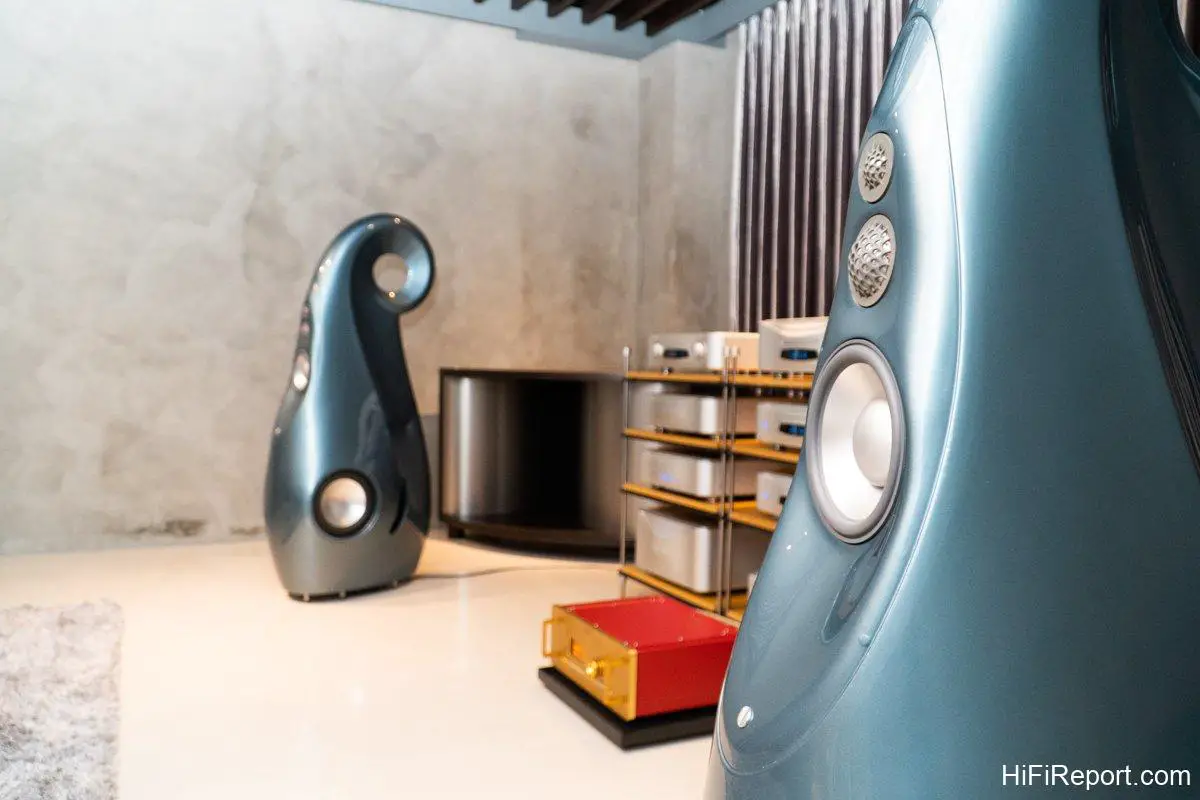
The Giya series, Vivid Audio’s flagship and most iconic range, presents a teardrop silhouette from the front. Narrowing towards the top and broadening downwards, it features a rounded, substantial mid-lower section, while the upper portion gracefully loops back—evoking a jester’s cap or even an extraterrestrial form from science fiction. To suggest a cartoonish personality in its design would not be an unreasonable observation.
Vivid Audio’s Giya series loudspeakers make an indelible first impression.
Design Philosophy: Form Follows Function
Yet, the Giya series’ distinctive aesthetic is not born of mere stylistic whim.
Vivid Audio’s entire portfolio, encompassing the Giya, Kaya, and Oval series, showcases unconventional visual designs.
These designs stand as prime examples of the principle of “form follows function,” where engineering dictates aesthetics.
Engineering Innovations: Eliminating Diffraction
Vivid Audio posits that traditional rectangular loudspeaker cabinets, characterized by flat planes and right-angled corners, are inherently prone to diffraction.
Consequently, their core design imperative is the elimination of parallel surfaces. This minimizes diffraction artifacts, fostering a more natural and linear frequency response.
This fundamental principle explains why no Vivid Audio loudspeaker adopts a box-like shape, and indeed, why none of their cabinets feature parallel surfaces.
Furthermore, what of the Giya series’ distinctive “hat”-like structure? This is, in fact, Vivid Audio’s proprietary acoustic technology: Tapered Tube Loading (TTL).
When a loudspeaker driver operates, it radiates sound waves forward, but its pistonic motion also generates rearward-propagating waves. While the forward waves constitute the desired output, the backward waves are undesirable. If left unmanaged, these rearward waves can interfere with the driver’s motion, thereby degrading sonic fidelity.
To address this, Vivid Audio ingeniously engineered a rearward-tapering tube. This tapered waveguide effectively absorbs and dissipates the driver’s back waves, preventing them from interfering with the primary sound radiation.
The annular structure crowning the Giya series is, therefore, the TTL loading channel for the mid-bass driver.
Designer Pedigree: The Nautilus Legacy
Where did such innovative concepts originate? To understand this, we must delve into Vivid Audio’s history.
Following the passing of John Bowers, Robert Trunz assumed leadership of Bowers & Wilkins. Teaming up with chief R&D engineer Laurence Dickie, they conceived the Nautilus loudspeaker—a groundbreaking design that captivated the market and remains a timeless classic three decades later.
Upon immigrating to South Africa, Trunz encountered Philip Guttentag, an audio distributor with aspirations to launch a brand. With Trunz’s experience and the design acumen of Nautilus architect Laurence Dickie, Vivid Audio was established in 2002.
Trunz and Dickie’s collaboration began with Bowers & Wilkins’ Nautilus, and their partnership rekindled to forge the Vivid Audio narrative.
Much like the Nautilus’s enduring influence on subsequent generations of Bowers & Wilkins loudspeakers, Dickie’s TTL technology became the foundational DNA of every Vivid Audio design.
While Vivid Audio, founded in 2002, boasts a relatively short 20-year history, its product lineage traces back to the golden era of Bowers & Wilkins in the 1980s and 1990s.
(Indeed, Laurence Dickie also designed the Bowers & Wilkins 800 Matrix series, launched in 1987, a range still lauded and cherished by audiophiles today.)
Cabinet Construction: Advanced Composites
What constitutes the cabinet material, enabling such curvaceous forms devoid of flat surfaces? Vivid Audio emphasizes the importance of high cabinet rigidity to minimize resonance.
To achieve this, they employ a composite material akin to that used in shipbuilding and aerospace. This material offers a remarkable combination of lightness and exceptional stiffness, allowing Giya series loudspeakers to attain high cabinet rigidity without incurring excessive weight.
For instance, the flagship Giya G1S, standing at 160cm, weighs a mere 80kg. The Giya G2, at approximately 120cm tall, weighs only 36kg.
Driver Technologies: Innovation at Every Level
Beyond the TTL backwave management, Vivid Audio drivers incorporate a wealth of technological advancements.
Laurence Dickie favors aluminum alloy diaphragms, prized for their low mass and high stiffness.
However, metal diaphragms are susceptible to metallic resonances when breakup modes occur, leading to the perceived “metallic sound” coloration.
Conventional approaches involve applying damping materials to mitigate metallic resonance. Dickie, however, deems this a compromise. His radical solution is to “prevent breakup from occurring altogether.”
How is this achieved? Firstly, a carbon fiber ring is affixed to the periphery of the tweeter diaphragm, reinforcing its rigidity.
Secondly, utilizing finite element analysis (FEA), a catenary dome profile was identified—akin to the natural curve of a suspended power line or spider web. This profile elevates the breakup frequency by a full octave, significantly reducing the likelihood of breakup within the audible range.
The manufacturer designates this tweeter diaphragm technology as CDP (Catenary Dome Profile). This innovation empowers Dickie to confidently employ aluminum alloy diaphragms without the customary “metallic” sonic signature.
Their driver magnet systems are equally sophisticated.
Given the presence of TTL tubes behind Vivid Audio loudspeaker drivers, the magnet structure must adopt a donut-like configuration to accommodate a sufficiently large central aperture for backwave propagation. This constraint inherently limits magnet size.
To overcome this size limitation and achieve ample flux density, Vivid Audio employs Super Flux Magnet (SFM) technology. The D26 tweeter, for example, boasts a peak flux density of 2.5 Tesla, double that of a typical 25mm tweeter.
Furthermore, maximizing flux density necessitates minimizing the gap between the magnet and the voice coil.
However, during driver operation, the voice coil’s rapid movement within the magnetic gap compresses the air, generating a damping force.
The ideal remedy is to vent the voice coil former. Vivid Audio incorporates numerous perforations in the voice coil former, with the aggregate area of these holes approaching half of the former’s surface area.
This design successfully elevates the magnetic system’s resonant frequency beyond audibility, reduces the Q value to near-immeasurable levels, and even eliminates noise generated by air passing through the voice coil former’s perforations.
The manufacturer terms this technology HVF (Highly Vented Former).
The midrange and woofer frames are also meticulously engineered.
Vivid Audio identifies resonance and reflection as the primary concerns with driver frames.
To combat resonance, they utilize cast aluminum frames, inherently rigid and geometrically optimized for robust support.
To mitigate reflections, Vivid Audio minimizes the reflective surface area behind the driver frame, employing exceptionally narrow frame struts.
Their C125 mid-bass driver frame, for example, is a mere 3mm thick. Viewed from above, the frame occupies only 10% of the driver diaphragm area, allowing 90% of the air behind the driver unimpeded rearward passage.
(This energy is subsequently managed by the TTL technology and cabinet damping.) This effectively eliminates backwave reflection issues.
This technology is designated HAC (Highly Aligned Chassis) by the manufacturer.
And the innovations extend to the bass section.
The Giya series (and Kaya series K90 and K45) incorporate RCCM (Reaction Cancelling Compliant Mount) bass configuration. In essence, this involves mounting woofers in a back-to-back, opposed arrangement. The opposing forces generated by the drivers effectively cancel each other out, mitigating vibration issues originating from the woofers.
Vivid Audio also employs a bass-reflex design to enhance low-frequency extension and richness.
They have integrated smile-shaped ports, designated RCP (Reaction Cancelling Ports), adjacent to the woofers on both sides of the Giya series loudspeakers. These ports, arranged symmetrically mirroring the woofer configuration, counteract cabinet reaction forces arising from air ingress and egress due to air pressure fluctuations.
Technology & Lineup: Flagship Performance Across the Range
Now, having comprehensively explored the technological underpinnings, let’s consider the Giya lineup.
Vivid Audio’s aesthetic is undeniably distinctive, resembling modern sculpture more than conventional loudspeakers. Coupled with a diverse palette of color options, it’s easy to form a superficial impression, perhaps mistaking them for style-centric designs lacking substance.
However, this is far from the truth.
Vivid Audio is the creation of Laurence Dickie, the engineer behind legendary loudspeaker designs. He is not an artist, but a rigorous engineer.

His curves and shapes are not arbitrary artistic expressions. He eschews vague creative pronouncements, focusing instead on sonic performance, engineering calculations, rigorous testing, and scientific rationale.
Therefore, my detailed exposition is not mere verbosity; Vivid Audio loudspeakers genuinely embody a wealth of technological innovation.
The Vivid Audio Giya series currently comprises four models. The flagship, of course, is the original Giya G1, now evolved into the G1 Spirit (G1S), effectively its second generation. This is followed by the Giya G2, Giya G3, and Giya G4. The latter three have now been refined into second-generation Series 2 iterations.
The 160cm tall G1S remains a substantial floorstanding loudspeaker, while the G2 and smaller models are less imposing. The diminutive Giya G4 stands just over 1 meter tall.
The entire series shares a consistent aesthetic and a 5-driver, 4-way, bass-reflex configuration, embodying complete technological parity. The entire Giya series is, in essence, flagship-caliber, allowing users to select the most appropriate model based on room size.
HiFiReport auditioned the Giya G2 Series 2 (hereafter, Giya G2), the second model in the range.
The tweeter is a model D26 26mm metal dome tweeter (Vivid Audio specifications list “metal dome,” but technical documentation specifies aluminum diaphragm), handling frequencies above 3,500Hz. The midrange is a model D50 50mm dome metal midrange, covering the 880Hz to 3,500Hz band.
While most midrange drivers employ cone diaphragms, the Giya utilizes a dome midrange. Both midrange and tweeter are protected by grey circular perforated grilles.
A front-firing model C125s 125mm alloy diaphragm mid-bass driver handles the mid-bass range from 880Hz down to 220Hz.
The side-mounted woofers are model C175 175mm metal diaphragm woofers, responsible for bass reproduction below 220Hz.
Intriguingly, the Giya series loudspeaker terminals are located at the base, preserving the uninterrupted curvature of the cabinet from the rear.
Associated Equipment: Esoteric & darTZeel Amplification
To fully realize the Giya G2’s potential, HiFiReport assembled a system of commensurate caliber. The digital source comprised the Esoteric Grandioso P1X transport and Grandioso D1X dual-mono DAC, widely regarded as among the finest CD/SACD playback systems available, augmented by a flagship Grandioso G1X clock generator. This digital front-end rivals any top-tier source on the market.
Amplification was entrusted to the newly released darTZeel CTH-8550 MK2 integrated amplifier.
darTZeel CTH-8550 MK2 Updates: Refinement in Detail
The CTH-8550 is an integrated amplifier I hold in high esteem. Its richly textured, full-bodied, yet clean, articulate, and natural sound, combined with formidable driving power, has remained a vivid memory since my initial audition many years ago.
Indeed, the CTH-8550 has served as my personal reference integrated amplifier. In my view, any high-end integrated amplifier should aspire to the CTH-8550’s benchmark performance. Similarly, pre-power amplifier combinations costing hundreds of thousands should demonstrably surpass the CTH-8550’s capabilities.
Now, darTZeel has unveiled the MK2 iteration.
What are the enhancements? Visually, there is no discernible difference. The amplifier’s appearance remains identical to its predecessor.
However, the CTH-8550 MK2 incorporates at least three significant refinements compared to the original model: Firstly, the chassis is now constructed from 2.5mm thick aluminum alloy, offering superior electromagnetic shielding compared to the previous steel chassis.
Secondly, the integrated MC phono stage boasts a 6dB increase in headroom, better accommodating low-output moving coil cartridges.
Thirdly, the power supply has been redesigned, reducing overall noise levels, resulting in blacker backgrounds and enhanced retrieval of low-level detail.
This Giya G2 audition provided an opportune moment to also appreciate the sonic refinements of the CTH-8550 MK2.
Sonic Performance – No Metallic Sound: A Harmonious Blend
With such a distinguished supporting cast and the Giya G2’s own substantial price tag of $52,400 USD, disappointment was simply not an option. (While I resist judging solely on price, the presence of the darTZeel CTH-8550 MK2 does instill a degree of confidence—it’s difficult to imagine any loudspeaker sounding subpar when paired with a darTZeel CTH-8550, wouldn’t you agree?) Overall, the Giya G2’s sonic character embodies both rationality and sensuality. It exhibits clarity and abundant detail, exceptional imaging precision and soundstage delineation, a naturally expansive soundstage, and a timbre that is both natural and subtly warm.
The most intriguing aspect is how a loudspeaker employing all-metal drivers can sound so effortlessly smooth, devoid of metallic harshness, and even possess warmth and remarkable body. The answer, perhaps, lies partly in its bass performance.
The Giya G2’s back-to-back dual-woofer configuration endows its bass with a full and rich quality. If you appreciate a weighty low-end, the Giya G2 will undoubtedly appeal.
However, while the bass is undeniably full, it is not aggressively punchy or sharply defined.
The side-firing woofers are capable of moving a considerable volume of air, generating ample bass energy, but the delivery is nuanced, rather than overtly forceful.
This rich, full bass can also influence the midrange and treble via octave harmonics. Perhaps this is the key to resolving my initial query.
While the manufacturer emphasizes CDP and TTL technologies, I cannot definitively establish a direct causal link between these technologies and the perceived sonic qualities solely through musical listening. I can only relay my subjective impressions: the Giya G2’s sound is inherently pleasing, effortlessly enjoyable, devoid of strain, and invitingly approachable.
Orchestral Dynamics: Mastering the Grand Scale
Upon entering the HiFiReport listening room, Herbert von Karajan conducting the Berlin Philharmonic in Richard Strauss’s “An Alpine Symphony” was playing softly, an Esoteric SACD release.
This composition serves as a formidable test for any audio system, characterized by dramatic dynamic shifts. The opening and closing “Night” movements are pianissimo, while “On the Summit” must radiate brilliance, and “Storm” must convey violent intensity.
Very well, let us put it to the test.
Having done so, I am gratified to have experienced this piece through the Giya G2.
The Giya G2, despite its moderate size and cabinet volume, which position it as a mid-sized floorstanding loudspeaker at best, demonstrated exceptional detail retrieval, painting a lucid sonic landscape.
The intricate interplay of instrumental sections and Richard Strauss’s complex counterpoint were all rendered with crystalline clarity.
In the prelude, bassoons and strings softly intone the “Night” motif. As dawn breaks, the mountain vista gradually materializes, and the “Mountain” motif, played by brass instruments, begins to stir.
This entire passage demands exceptional micro-dynamic resolution from an audio system. The Giya G2 demonstrably excels in this domain, exhibiting outstanding low-level detail retrieval, rendering every nuance with precision.
During the “Sunrise” movement, the “Sun” motif is brilliantly radiant and intensely passionate.
From the outset to this point, a mere 3-4 minutes, the dynamic range is breathtaking.
The Giya G2 convincingly conveyed the brass section’s exuberance. Was it aggressive? Was it strident? Yes, but this is not attributable to the Giya G2; it is inherent to the music itself.
Just as one requires sunglasses to gaze at the sunrise, the composer and conductor here aim to evoke that dazzling, intensely radiant sunlight.
Stable Soundstage at High SPL: Composure Under Pressure
As the music transitions to the “Ascent” movement, the low strings vigorously articulate the “Ascent” motif, the string texture dense and substantial. Mountain climbing is never a leisurely endeavor, is it? Following a sustained crescendo, the brass section intones the “Cliff” motif, accompanied by the distant echo of hunting horns – a vivid forest tableau unfolds.
HiFiReport’s listening room is generously proportioned, capable of accommodating substantial sound energy. I increased the volume, setting the CTH-8550 MK2 to -9dB. (I was informed that during their internal testing, a volume setting around -10dB already reveals all musical information with clarity, consistent with my own findings.) However, the room features minimal soft, sound-absorbing treatments, primarily a long-pile carpet and a leather sofa.
Yet, even at this elevated volume level, I detected no audible harshness.
While the HiFiReport listening space undoubtedly contributes favorably, I believe Dickie’s meticulous engineering of the Giya series is undeniably effective.
Reaching the summit, the panoramic grandeur is vividly presented.
Trombones lead with solemnity, intoning the “Sun” motif, while the strings contribute a sense of vastness, the breathtaking beauty of the landscape under the radiant sunlight.
The Giya G2 rendered the oboe lines in the “Elegy” movement with clarity and precise localization, exhibiting exceptional definition and form.
Strings and woodwinds engaged in delicate interplay, with low strings gradually emerging, the music transitioning from sorrowful to ominous.
Subsequently, beneath sustained violin notes, woodwinds interject with brief, legato phrases—the calm before the storm.
Drums foreshadow distant thunder, followed by the tempestuous onslaught of the storm.
Wind machines whirl, creating eerie wind effects, the orchestra powerfully delivering wild ensemble passages, with percussion providing rhythmic reinforcement, vividly depicting this sudden tempestuous scene.
Balanced Sound – Rational & Sensual: A Compelling Synthesis
The Giya G2 delivers a dynamic range and sense of scale in large-scale orchestral works that belies its physical dimensions.
Consider John Williams in Vienna as another illustration. In “Flight to the Neverland” from “Hook,” a simple theme, masterfully orchestrated, unfolds in waves, layer upon layer, each iteration exhibiting subtle variations and captivating nuances. John Williams masterfully utilizes the full orchestral palette.
String textures are richly layered, violins delicate, clear, and shimmering. Percussion is vibrant and varied, drum sounds powerful and well-defined. Woodwinds add layers of tonal color.
The Giya G2’s lucid imaging vividly conveys the music’s multifaceted emotional landscape, in a coherent and organized manner, with timbre and texture rendered authentically warm, never harsh or strident. This embodies what I previously described as the Giya G2’s “rational and sensual” character.
Treble Performance: Extended and Refined
In the excerpt from “Close Encounters of the Third Kind,” this concert version, re-arranged, features the themes of alien visitation and the UFO mothership landing. The music is avant-garde and modern. The Vienna Philharmonic’s ensemble precision is exemplary. The Giya G2, with its clear and transparent imaging, meticulously reveals the musical brilliance.
The opening violins’ icy timbre establishes the science fiction atmosphere, low strings swell, the music gradually crescendoing from near silence to explosive energy.
Here, I must commend the Giya G2’s bass performance. It renders bassoons and low strings with clearly defined lines, bass that is both weighty and articulate.
The piccolo’s piercing whistle is sharp yet not abrasive, retaining the piccolo’s inherent sonic character and conveying the intended atmosphere.
Again, praise is warranted, this time for its treble performance. Treble with substantial body, ample extension, rich in shimmer and tonal color, yet possessing a full-bodied character, never grating or fatiguing.
A farewell theme then emerges, characterized by romantic and tender strings. John Williams here transforms into a late Romantic master, reminiscent of Richard Strauss and Wagner.
The music builds layer upon layer, string textures incredibly dense, brass instruments intone a five-note motif, propelling the music to a dramatic climax.
Truly remarkable. John Williams’s compositional genius is undeniable. The Vienna Philharmonic’s performance is flawless. And the Vivid Giya G2 masterfully reproduces this music with captivating fidelity.
Bass & Drum Performance: Weight and Control
Turning to the “Sabrina” theme, re-arranged by John Williams, the solo violin carries the melodic thread. In this concert rendition, the soloist is Anne-Sophie Mutter, marking her second collaboration with the maestro following “Across the Stars.”
The solo violin is both powerful and expressive, at times exhibiting Gypsy-like flair, at others echoing Prokofiev’s style.
The violin tone is solid, full yet focused, the melodic lines clear and luminous. Even in the upper registers, it maintains admirable body, without any hint of harshness.
Bass drum strikes possess weight, yet convey a sense of relaxation rather than sheer impact, making the drum sound seem to envelop from the front, like air slowly washing over. This characteristic is particularly well-suited for classical music drum sounds.
Piano & Strings Performance: Warmth and Realism
The Vivid Giya G2 also excels in piano reproduction.
Consider Martha Argerich’s 2006 Lugano Festival live performance of Shostakovich’s Piano Concerto No. 1.
While titled a piano concerto, it is, in fact, a concerto for piano, trumpet, and string orchestra.
Following a brief arpeggiated introduction, the piano boldly presents the main theme, initially a whimsical descending phrase, followed by a romantic melody.
After repetitions by the strings, the piano re-enters playfully, revealing the first movement’s underlying spirit.
The piano tone is solid and full, imbued with a subtle warmth and sweetness—a truly beautiful piano sound.
Low-register chords possess substantial weight, while piano notes exploring the upper registers produce solid, brilliant tones.
Dismiss any preconceived notions that the Giya G2, employing metal drivers, must exhibit “metallic sound.” Its sonic character is devoid of any metallic coloration, even possessing a warm, full-bodied texture.
The second movement slows the tempo. Strings initially present a lyrical and romantic melody, with violins in the upper register and low strings providing soft harmonies.
Here, the violins exhibit a silky, delicate quality, while the low strings sound full and substantial. The Giya G2 clearly delineates both sonic lines.
The piano then enters with elegant and measured poise. As the music ascends to a peak, a low chord dramatically plunges into the depths.
The Giya G2 does not strive for bass extension beyond its physical capabilities, but rather excels in fulfilling its inherent potential. The left-hand chords sound weighty and sufficiently deep, and the clearly resolved string vibration texture transports us to the piano’s very presence.
As for the strings in this passage, their texture is incredibly dense and solid. The trumpet tone is warm and bright, with a moist quality, showcasing diverse sonic personalities in accordance with the musical context.
At this juncture, I cannot help but ponder: while Giya G2 owners will undoubtedly pair them with exceptional amplifiers, could the performance be this composed, rich, sweet, and nuanced without the darTZeel CTH-8550 MK2? Perhaps, but certainly with a different sonic character.
Vocal Performance: Intimate and Engaging
Vocal reproduction is another forte of the Giya G2.
With its excellent resolution, it clearly renders the subtleties of vocal performance, not merely sibilance or breath sounds, but vividly brings singing to life.
Listening to Diana Krall’s Love Scenes, the double bass pizzicato is full-bodied, its texture supple and slightly soft. Diana Krall’s voice is focused and well-defined, with remarkable presence.
The Giya G2’s ability to delineate sonic lines and contours is truly exceptional. Its linear precision is evident in its rendering of solo woodwind passages in orchestral works, and even more pronounced in vocal recordings.
Diana Krall’s vocal inflections, when she allows her voice to resonate in her throat, emphasizing lip and dental articulation with less chest resonance, the textural nuances of her voice are rendered with remarkable clarity.
Abundant sonic information constructs rich detail, resulting in a vivid, three-dimensional, and lifelike portrayal of the vocalist.
Do you appreciate this type of vocal performance? The Vivid Giya G2 warrants your audition.
Pop & Rock Performance: Energetic and Dynamic
When reproducing pop and rock music, the Vivid Giya G2 delivers energetic and engaging performances. Robust, full-bodied rhythms and unrestrained, vibrant electric guitars are elements that ignite excitement.
Consider the “A Star Is Born” soundtrack. The Vivid Giya G2 effectively conveys the untamed, rebellious spirit in Bradley Cooper’s “Black Eyes.”
Drum sounds are powerful and full, cymbal sounds clear and brilliant. Bradley Cooper’s restrained, slightly gravelly vocals, imbued with forceful singing, radiate intense emotion.
As for Lady Gaga’s rendition of “La Vie en rose,” she imbues this chanson with strength and resolve, akin to a Broadway musical performance.
At high vocal registers, the sonic energy is ample. Through the Giya G2’s reproduction, the solid, substantial vocals resonate deeply.
In “Out of Time,” drumstick strikes are bright and crisp. While I initially anticipated the metal-diaphragm Giya G2 to produce even crisper sounds, it instead delivered more precisely defined sonic textures.
Listening to the unrestrained electric guitar, coupled with the thick, heavy drums, the blues spirit is palpable, radiating an almost palpable heat.
Another unexpected strength is its reproduction of spoken word.
This soundtrack incorporates dialogue excerpts from the film, allowing listeners to relive movie scenes while enjoying the music.
The Giya G2 vividly reproduces these dialogues, voices possessing both fullness and substance, and imaging that is solid and clear, not diffuse.
Despite being a two-channel loudspeaker system, the vocal imaging is so distinct and focused, it almost simulates the presence of a center channel.
If you place Giya G2s in your living room, even without a dedicated home theater setup, the Giya G2 is capable of rendering dialogue with enhanced clarity and immersive impact when enjoying dramas and films.
Final Verdict: A Lasting Impression
It possesses a certain allure, compelling you to listen further…
Many observing Vivid Audio Giya series loudspeakers fixate solely on their distinctive visual design.
However, as I have emphasized, Laurence Dickie conceived the Giya series based on rigorous acoustic principles.
Therefore, set aside any preconceived notions, and resist judging solely on aesthetics. All evaluations should be based on listening experience.
Despite numerous encounters with the Giya series at audio shows, spending an afternoon in HiFiReport’s listening room has allowed me to gain a deeper appreciation for this Vivid Audio second-in-line model, the Giya G2.
Given the opportunity, I would gladly extend my listening session, exploring its capabilities with Mahler symphonies, Widor’s organ symphonies, Verdi’s Aida, and countless other musical genres.
Specifications
* Type: 4-way 5-driver bass-reflex floorstanding loudspeaker
* Drivers: 26mm metal dome tweeter (D26), 50mm metal dome midrange (D50), 125mm mid-bass (C125S), 2 x 175mm woofers (C135)
* Sensitivity: 89 dB (@ 2.83 V/ 1m)
* Impedance: 6 ohms (minimum 4 ohms)
* Frequency Response: 33 – 33,000Hz (- 2dB)
* Crossover Frequencies: 220, 880, 3500 Hz
* Maximum Power Handling: 800 W
* Dimensions: 1161 x 341 x 578 mm (HxWxD)
* Weight: 36 kg