
WiiM Ultra Review
Overview
The WiiM Ultra is a mid-range network music streamer, DAC, digital preamp, phono stage, and headphone amplifier — all housed in a compact aluminum shell with a 3.5-inch color touchscreen, and sold at a price that would have bought a bare-bones streamer without a display just two years ago. It is the flagship product from WiiM, a brand spun out of Linkplay Technology — the company that has spent over a decade building streaming audio hardware and software for major names including Harman, JBL, and Yamaha. That background matters: the WiiM Ultra is not a startup’s first product built from scratch, but the consumer-facing application of years of streaming engineering experience applied to a single, coherent, ambitious device.
The mid-range network streamer market has been disrupted more dramatically in the past 24 months than in any comparable period before it. The WiiM Pro Plus was already considered outstanding value; the Ultra steps significantly further, adding a built-in phono stage, HDMI ARC for TV integration, a dedicated subwoofer output, a TPA6120A2 headphone amplifier chip, and — most visibly — a touchscreen that turns album art into a genuine piece of functional display design. Independent measurements published by Audio Science Review confirmed a DAC SINAD of 115dB, placing the Ultra firmly in the “transparent” performance tier — meaning the DAC itself introduces no audible distortion or noise under normal operating conditions. That result, at this price point, is remarkable.
Professional reviews across multiple respected outlets — WhatHiFi, FutureAudiophile, AV.com, and Audioholics — converge on the same assessment: the Ultra delivers more features, better connectivity, and competitive audio performance compared to rival streamers from established hi-fi brands that frequently cost 50–100% more. The WhatHiFi review went so far as to note that the Ultra makes even their long-reigning benchmark look “a little dated and plain.” With over 3,100 Amazon reviews averaging 4.6 out of 5, user confidence is unusually high for a product at this price tier. This review unpacks exactly what makes the WiiM Ultra earn that reception — and where it still leaves room for growth.
Key Features & Tech Specs Explained
ESS ES9038Q2M SABRE DAC: What a SINAD of 115dB Actually Means
The heart of the WiiM Ultra’s audio processing is the ESS ES9038Q2M — a 32-bit stereo DAC chip capable of processing up to 384kHz sample rates, ranking third from the top of ESS Technology’s two-channel DAC product lineup. A DAC (Digital-to-Analog Converter) is the component that translates the digital 1s and 0s of your streaming music into the analog voltage waveforms that an amplifier can work with. The quality of this conversion determines how much of the original recording’s detail is preserved and how much noise or distortion is introduced.
SINAD (Signal to Noise and Distortion) is the composite measurement that captures both noise and harmonic distortion in a single number — the higher, the better. The WiiM Ultra measured 115dB SINAD in independent testing, which exceeds the threshold generally considered to represent transparent performance — the point at which the DAC’s own artifacts fall below what human hearing can detect under typical listening conditions. To put that in perspective: most smartphone DACs measure in the 60–80dB SINAD range; budget dedicated DACs reach 90–100dB; and the WiiM Ultra’s 115dB places it alongside dedicated DACs that sell as standalone components for considerably more. The ES9038Q2M is also paired with OPA1611 operational amplifiers in four locations in the output stage — a professional-grade audio op amp known for low noise and high linearity — which supports the clean measured output. (© hifireport.com — content licensed for editorial use)
One important setup note confirmed by the WiiM technical community: if you are using the Ultra as a DAC via an optical (TOSLINK) input carrying a 16-bit/48kHz signal — such as from a CD player or TV — the measured performance is noticeably lower than when operating at 24-bit resolutions. This is a known firmware behavior, not a hardware defect. Streaming services at 24-bit resolution through the network input do not exhibit this limitation, and the device performs at its full 115dB SINAD capability in that context.
3.5″ Touchscreen: Function and Form in One Panel
The WiiM Ultra is the first product in WiiM’s lineup to include a display, and the execution is genuinely impressive relative to expectation. The 3.5-inch color touchscreen responds with smartphone-like fluidity — taps and swipes register cleanly, transitions are smooth, and the glass surface curves at the edges where it meets the aluminum chassis in a detail that elevates the perceived build quality noticeably. In practice, the screen is large enough to display album art, playback controls, queue listings, EQ settings, and device configuration — essentially a complete control interface that removes the need to reach for a phone for most day-to-day interactions. The display is also customizable: users can set wallpapers, configure clock faces for standby mode, and choose from multiple widget layouts.
The practical limitation is viewing distance. The WhatHiFi review noted that the 3.5-inch screen is difficult to read from a standard seated position across the room — a fair point for living room setups. On a desk, in a home office, or on a shelf within arm’s reach, the screen is entirely practical and genuinely enjoyable. WiiM’s design intent appears to be exactly this: the screen as a rich secondary control surface and album art display for closer-range setups, with the WiiM Home app on a phone or tablet serving as the primary interface in more traditional hi-fi racks across the room. Both modes work well, and the coexistence of touchscreen and app is better implemented here than in most competing products.
Connectivity: The Specification Sheet That Surprises
The back panel of the WiiM Ultra is one of the more revealing things about what the product represents. Starting from the input side: stereo RCA analog inputs, a moving magnet phono input with dedicated grounding post (for turntables), optical digital input, and an HDMI ARC port. Starting from the output side: stereo RCA line-level output (for external amplifiers or active speakers), optical digital output, coaxial digital output, a dedicated subwoofer RCA output, a USB-A port for playing files from a thumb drive or hard disk, and an ethernet port for wired network connection. The front panel adds a 3.5mm headphone output driven by the TPA6120A2 chip, rated at SNR 119dB and THD+N -99dB. There is also a 12V trigger output for automating amplifier power with the Ultra’s state.
HDMI ARC deserves specific mention because it is the feature that most clearly separates the Ultra from competing streamers at its price point. ARC (Audio Return Channel) allows the HDMI connection between the Ultra and a compatible TV to carry audio in both directions — the TV can send its audio output (from streaming apps, broadcast TV, gaming consoles connected to the TV) back down the HDMI cable to the Ultra, which then plays it through your speakers. The practical result: your hi-fi system becomes the audio output for everything your TV does, without needing a separate optical cable or a second input. This single feature meaningfully simplifies the wiring and control requirements for anyone whose primary listening also involves television watching.
The phono stage for moving magnet turntables is equally significant for the vinyl-interested buyer. Most streamers at this price simply do not include one. The built-in phono stage means you can connect a turntable directly to the Ultra and digitize the signal for playback through your system — no separate phono preamp box required. (© hifireport.com — content licensed for editorial use)
WiiM Room Correction and Parametric EQ: DSP That Actually Works
WiiM’s built-in room correction system is one of the most practically accessible implementations available at any price. Using a measurement microphone (the iPhone’s built-in microphone is supported), the WiiM Home app measures your room’s acoustic response and generates a correction filter that compensates for the frequency irregularities caused by room geometry, furniture, and speaker placement. Room acoustics are the single biggest variable in how your system sounds — more important in most situations than amplifier quality or cable choices — and having a capable correction tool built into the streamer removes what is typically a significant expense and complexity hurdle.
The parametric EQ in the WiiM Home app provides 10 bands of independently adjustable filters per channel, with full control over frequency, gain, and Q (the sharpness of the filter). This level of EQ depth is typically found in dedicated DSP processors or high-end room correction systems. Combined with the room correction measurement capability, the WiiM Ultra gives the user meaningful control over their system’s sound character that would otherwise require external hardware and software costing multiples of the Ultra’s price.
The system also supports a dedicated subwoofer output with bass management — setting a crossover frequency so that frequencies below a defined point (typically 80Hz) are redirected to a connected powered subwoofer. Engagement with the app to configure this takes under five minutes and the results are immediately audible.
Wi-Fi 6 and Streaming Protocol Support: Never Losing the Signal
Wi-Fi 6 (the latest generation of the 802.11 wireless standard) offers meaningfully improved performance over Wi-Fi 5 in crowded wireless environments — better at handling multiple simultaneously-connected devices, more efficient in maintaining connection stability at longer ranges, and capable of higher throughput for the large uncompressed audio files that hi-res streaming requires. Dual antennas further improve reception reliability. For a device whose primary job is streaming music continuously without dropout, this is a relevant hardware investment rather than marketing language.
Supported streaming protocols include Spotify Connect, TIDAL Connect, Qobuz, Amazon Music, Deezer, Google Chromecast Audio, Alexa Built-in, DLNA, Roon Tested (as a Roon endpoint), and Squeezelite. This breadth of protocol support means the Ultra integrates with virtually every significant streaming platform and ecosystem currently in use. AirPlay 2 is the notable absence — important for Apple-heavy households where iPhone-to-speaker casting is the preferred workflow. WiiM has acknowledged this limitation, and it remains the most frequently cited missing feature in user reviews.
Build Quality & Design
The WiiM Ultra measures 205mm × 205mm × 73mm — approximately square and compact, with proportions that recall a small-format Mac Mini. Available in space grey and silver, both finished in a brushed aluminum outer shell over a plastic interior frame. The build quality presents well above price expectation: panel alignment is precise, the volume knob turns with a smooth, weighted feel, and the glass touchscreen surface feels genuinely premium rather than budget. The WhatHiFi review described the Ultra as making competing products “look a little dated and plain” on the shelf — which aligns with the consistent first-impression feedback from buyers who note the unboxing experience feels Apple-like in its presentation and material quality.
One ergonomic note that comes up in multiple reviews: the volume knob, while smooth, has a slightly shallow profile and sits close to the touchscreen panel, which gives it a slightly cramped feel compared to the more substantive knobs found on dedicated preamps in higher price tiers. This is a minor point but a real one for listeners who reach for the volume control frequently. The remote control included in the box is compact and functions reliably for basic playback and volume adjustment — a useful addition for users who would rather not reach for a phone or tablet during casual listening.
The chassis runs cool even during extended listening sessions. The internal circuitry generates modest heat at typical listening levels, and there is no fan. Setup from box to music takes approximately ten minutes — the WiiM Home app guides the process clearly, handles firmware updates automatically, and integrates the room correction workflow without technical expertise. First-time streamer buyers and experienced audiophiles alike cite setup ease as a genuine highlight, not an oversell.
Sound / Performance
The WiiM Ultra’s DAC section produces a clean, transparent, neutral sound character — a direct consequence of a 115dB SINAD measurement that leaves no meaningful audible distortion or noise in the signal. Independent listeners across professional and community reviews describe the Ultra as detailed, wide-stage, and uncolored — an amplifier and speaker system downstream hears exactly the recording as transferred, without the Ultra imposing its own character. This is both the strength and the appropriate expectation: the Ultra excels at fidelity to the source material.
The WhatHiFi review compared the Ultra directly to the Cambridge Audio MXN10, a product that was their reference recommendation at a higher price point, and found the Ultra’s sonic performance “very close” — with the Ultra’s advantage in connectivity and interface substantially widening the value gap. A FutureAudiophile review placed the Ultra slightly behind the Bluesound Node in absolute DAC performance in a highly revealing system, but noted that the differences were “likely negligible” in less resolving setups and that the Ultra’s connectivity depth was considerably broader.
The headphone output, powered by the TPA6120A2 chip (a well-regarded Texas Instruments headphone amplifier used across premium portable and desktop devices), measures at SNR 119dB and THD+N -99dB — solid performance for a secondary output on an all-in-one device. It handles headphones from 16Ω sensitive in-ears to 300Ω high-impedance designs adequately, though dedicated headphone amplifiers with more current delivery will outperform it for the most demanding loads. The phono stage performs well for a built-in MM implementation — detailed and quiet enough for most turntable/cartridge combinations in its price context, though turntable enthusiasts running premium cartridges may find a dedicated phono preamp more satisfying at the top end.
Real-World Use Cases
The WiiM Ultra is most powerfully deployed as the nerve center of a modern 2.0 or 2.1 home audio system. Connect it via RCA to a stereo power amplifier or integrated amplifier without a built-in streamer, and you gain high-resolution streaming from every major platform, room correction, parametric EQ, and volume control from a single box that handles the digital-to-analog conversion and signal routing. Users who previously operated a power amplifier with no smart features alongside a DAC and separate streaming device consolidate three boxes into one with no sonic penalty and meaningful gains in interface convenience.
The HDMI ARC connection enables an equally important second use case: combining the TV audio and hi-fi system into a single managed output. Users who run the Ultra as their primary audio hub describe the experience of having both music streaming and TV audio coming through the same speakers — controlled by the same app, subject to the same room correction and EQ — as the kind of quality-of-life improvement that makes the purchase feel justified by the HDMI feature alone. For anyone setting up a first apartment system, a home office audio setup, or a secondary room system where simplicity is as important as performance, the Ultra covers every audio source category — streaming, TV, turntable, headphones, and local files — from a single device that takes up less shelf space than most routers.
The WiiM Home app ecosystem also enables multi-room audio grouping with other WiiM devices, Amazon Echo speakers, and Google Home devices — useful for users who want synchronized music across multiple rooms without investing in a dedicated whole-home audio system.
What Real Users Are Saying
Amazon buyers with over 3,100 reviews averaging 4.6 out of 5 describe a consistent picture: the Ultra arrived, setup took under fifteen minutes, and the experience was immediately and meaningfully better than what it replaced. The most common themes across verified reviews are the interface quality of the WiiM Home app (“the best streaming app I’ve used”), the visual appeal of the touchscreen (“makes the system look complete”), and the HDMI ARC integration (“I didn’t realize how much I wanted my TV audio through my hi-fi until this made it effortless”). Buyers upgrading from older streamers without displays repeatedly mention that album art on the front panel changes the experience of passive listening — the visual connection to the music feels more deliberate.
Community discussions on the WiiM forum reveal a technically sophisticated and engaged user base. Long-term Ultra owners document firmware improvements that arrived post-launch — expanded PEQ band counts, additional streaming protocol support, and display customization options added through software updates — and describe a manufacturer that listens and responds to user feedback. This software improvement trajectory is a meaningful differentiator: the WiiM Ultra has become a better product over time than it was at launch, and there is evidence of continued development.
The AirPlay 2 absence is the most consistently noted frustration in reviews from Apple-ecosystem users — mentioned in enough reviews that it clearly represents a real limitation for a meaningful segment of the user base. A smaller number of reviews note that the touchscreen is not readable from a seated position across a typical living room, reinforcing that the screen works best in closer-range setups. Both are genuine trade-offs worth knowing before purchase, not oversights that undermine the product’s core value.
Pros & Cons
Pros:
- DAC SINAD of 115dB confirmed by independent third-party measurement — fully transparent performance that exceeds what most standalone DACs achieve at this price point, based on third-party measurements.
- Exceptional connectivity breadth including HDMI ARC, built-in MM phono stage, subwoofer output, headphone output, optical in/out, coaxial out, and USB-A — arguably double the connections of any direct competitor, based on spec analysis.
- 3.5″ glass-covered color touchscreen with smartphone-like responsiveness brings album art, playback control, and configuration to the front panel — a genuine first for the brand and rare at this price tier, based on user feedback and professional reviews.
- Built-in room correction and 10-band per channel parametric EQ provide DSP tools that typically require separate hardware, making system optimization accessible without additional cost, based on spec analysis and user feedback.
- WiiM Home app consistently rated among the best in category for music streamer interfaces — wide streaming service support, multi-room grouping, and deep configuration control in a clean, responsive UI, based on user feedback and professional reviews.
- Software update trajectory has actively improved the product post-launch, with firmware additions expanding capabilities over time, based on user community feedback.
Cons:
- No AirPlay 2 support — a significant limitation for users invested in Apple’s smart home and casting ecosystem, who cannot natively stream from iPhone/Mac to the Ultra, based on spec analysis and user feedback.
- The 3.5″ touchscreen is difficult to read from a standard seated listening position across the room — best suited to desk or shelf setups within arm’s reach rather than traditional hi-fi rack across a living room, based on professional reviews.
- Optical (TOSLINK) input at 16-bit/48kHz exhibits lower DAC performance than the unit’s peak spec due to a firmware-level processing behavior — users routing CD player or TV optical output into the Ultra should be aware and configure output settings to 24-bit where possible, based on third-party technical community documentation.
- Headphone output is capable rather than exceptional — suitable for most headphones up to 300Ω but not a substitute for a dedicated headphone amplifier with demanding high-impedance loads, based on spec analysis.
Who Should Buy This?
The WiiM Ultra is an ideal match for anyone upgrading an existing amplifier or active speaker system that lacks built-in streaming. If your power amplifier, integrated amplifier, or active speakers sound excellent but require a separate streamer and DAC to work with modern services like Tidal, Qobuz, or Spotify, the Ultra provides that function — plus room correction, phono support, HDMI ARC, and a headphone output — in a single compact box at a price that makes the combined capability look extraordinary.
It is particularly well-suited to buyers building a combined TV and hi-fi system who want a single control point for all audio. The HDMI ARC integration is the rare feature that justifies the product for this use case almost on its own, and no competing product at a similar mid-range price point matches the Ultra’s combination of TV audio integration and high-resolution music streaming. Turntable owners who want to avoid a separate phono preamp will find the built-in MM stage a practical and cost-effective inclusion. Listeners interested in room correction as a meaningful upgrade to their system sound will find the WiiM implementation among the most accessible available.
Buyers for whom AirPlay 2 is essential — those streaming primarily from iPhones, iPads, or Macs and who expect native AirPlay casting to work — should evaluate the Bluesound Node (which includes AirPlay 2 but lacks HDMI ARC and costs more) before committing. Users who want the absolute highest DAC performance in a standalone form factor, or who require USB audio input from a computer, may find dedicated DAC/streamer separates more suited to their priorities. The Eversolo DMP-A6 Gen 2 and FiiO R7 both offer larger displays and deeper audiophile customization at a higher price point for users who want more screen real estate and more granular internal control.
Verdict
Overall Score: 9.1 / 10 (Sound: 9.0/10 — 50% weight | Build Quality: 8.5/10 — 20% weight | Features: 10.0/10 — 20% weight | Value: 9.5/10 — 10% weight)
The WiiM Ultra is the most complete mid-range network streamer available today. That statement carries real weight given how seriously competitive this category has become, and the evidence supporting it is broad: independent measurements that confirm transparent DAC performance, professional reviews from multiple respected outlets that place the Ultra ahead of more expensive competitors on feature-to-price ratio, and a user community that has sustained a 4.6-star rating across over 3,100 verified purchases. The connectivity package alone — HDMI ARC, MM phono, subwoofer out, headphone out, dual digital outputs, and USB-A — represents a feature density that competing products at this price level do not approach.
The WiiM app ecosystem, the room correction DSP, and the firmware update trajectory round out a product that is not just excellent at launch but improving with each software release. The AirPlay 2 absence is a genuine gap that WiiM needs to address for Apple-ecosystem households, and the screen’s limited usability from across the room is a design trade-off worth acknowledging. But neither of these shortcomings changes the fundamental reality: the WiiM Ultra resets the expectation for what a mid-range streamer should offer.
Recommendation: Strongly Recommended — for anyone upgrading an amplifier or active speaker system to include streaming, listeners who want TV audio and hi-fi audio managed through a single hub, and buyers building a complete modern audio system at a mid-range price. Pair with a quality stereo power amplifier or integrated amp, connect via ethernet for best streaming stability, and take twenty minutes to run the room correction measurement — the results will justify the full purchase price on their own.
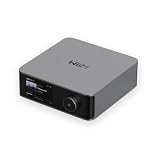
- Looks Good, Sounds Great: The WiiM Ultra redefines your audio experience with its sleek aluminum design and premium components. This all-in-one music streamer boasts a ESS ES9038 Q2M DAC, a vibrant 3.5” touchscreen, state-of-the-art Wi-Fi 6, and Bluetooth 5.3 connectivity. Engineered for excellence, it delivers outstanding audio clarity with a THD+N of -116dB and an SNR of 121dB, making it a perfect addition to any sound system.
- Versatile Connectivity Options: The WiiM Ultra offers versatile audio integration with its wide array of connection options. It features USB, Optical, Coaxial, RCA, a dedicated headphone output; HDMI ARC, and inputs for RCA, Phono, and Optical. It seamlessly integrates with both digital and analog sources, offering unparalleled flexibility for any audio setup.
- Home Theater Magic, Made Easy: Quickly enhance your entertainment with the WiiM Ultra’s HDMI ARC and Subwoofer Out. Experience rich stereo sound for movies, shows, and games. Customize your sound experience with tailored EQ settings. Add a powered subwoofer for deep, cinematic bass. The WiiM Ultra ensures your home audio setup is both powerful and straightforward, bringing superb sound quality with minimal effort.