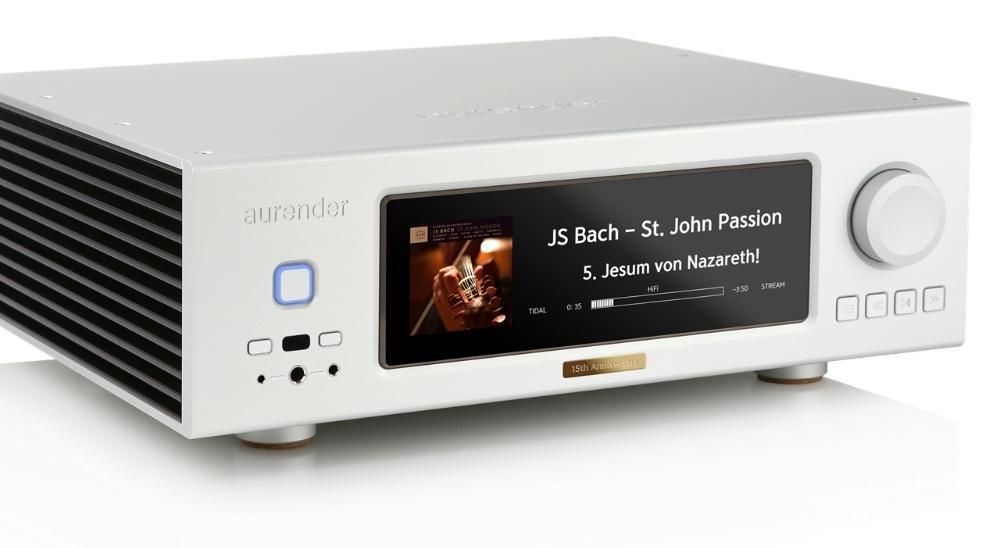
Aurender A1 15th Anniversary Edition Streamer Review
What surprises me most is that just one year after Aurender was founded, they had already developed their own proprietary music database and streaming playback app. After 15 years of continuous optimization, Aurender’s hardware and software architectures are deeply integrated and have matured to an exceptional degree. In this regard, Aurender’s technical prowess places them far ahead of the competition, with virtually no rivals in the high-end audio industry.
As for the A1 under review today, although it is not as expensive as the N50 and houses all its circuitry within a single chassis, it is actually the most feature-rich streaming source Aurender has ever created. In fact, its design was even more challenging than the N50.
The A1 represents not only Aurender’s peak achievement in streaming technology but also the culmination of their years of R&D in DACs and analog circuitry. Since these elements have a more direct impact on the final sound quality, they pose a major test of Aurender’s tuning philosophy and serve as the primary benchmark for audiophiles evaluating the A1.
The sonic performance must be absolutely top-tier to prove that Aurender’s brand status is truly on par with the world’s leading high-end audio manufacturers from Europe and North America.
Understandably, developing the A1 was the ultimate test for Aurender. It is no wonder that while both the N50 and the A1 are 15th-anniversary commemorative models, only the A1 is limited to 300 units worldwide and features a physical 15th-anniversary gold badge on its front panel. This highlights just how much importance Aurender places on this product.
Connectivity & eARC
Of particular note is the eARC interface. If your television supports this feature, a single HDMI cable connecting your TV and the A1 is all you need. You can then use your TV remote to power on the A1 and route your TV’s audio through your high-fidelity audio system with the A1 serving as the source.
It is also worth mentioning that the A1 supports Bluetooth wireless transmission, including the near-lossless aptX Lossless codec. While hardcore audiophiles might bypass this feature, it offers other family members the most direct and convenient way to stream music to the system. This further demonstrates Aurender’s determination to make the A1 an all-in-one, compromise-free streaming source.
Digital Outputs & Cache
Looking at the digital output interfaces, the N50 functions more like a traditional CD transport. To facilitate connection to an external, independent DAC, it features an extensive array of digital outputs: one RCA coaxial, one BNC, one Toslink optical, one Dual AES/EBU, one I2S HDMI, and even a proprietary Pro ISL x1 optical output specifically designed for the top-tier American digital source brand, MSB.
What about the A1? Although it houses an exceptional internal DAC and analog output stage, it still provides the option to bypass them and output raw digital signals. It includes a coaxial RCA digital output as well as a dedicated USB-A port for connecting to an external USB DAC.
What truly sets both the N50 and the A1 apart is the massive SSD cache implemented in their digital processing circuits. The N50 features a 480GB NVMe SSD, while the A1 is equipped with a 500GB NVMe SSD—capacities that far exceed those of any other Aurender digital source.
Why equip them with such massive caching space? The primary purpose is to cache music data onto the SSD before playback begins, allowing the system to read the data directly from the SSD rather than streaming it on the fly. This caching technology is Aurender’s core technique for elevating streaming playback quality.
However, note that this caching mechanism only works when using Aurender’s proprietary Conductor App. This is one of the main reasons why music played through the Conductor App sounds significantly better than when played through generic streaming apps.
Conductor App vs. Roon
Crucially, the Conductor App actually delivers better sonic performance than Roon—a conclusion I reached through direct listening comparisons. One reason, as mentioned, is that controlling Aurender sources via Conductor activates their proprietary caching technology. Another reason is the streamlined nature of the Conductor App. Its simpler features impose a much lighter processing load on the digital circuitry and CPU, minimizing interference during playback.
While Roon offers incredibly rich metadata and features, it must constantly manage databases, fetch album art, and retrieve artist bio details online in the background. This keeps the CPU and network interfaces active during playback, which inevitably degrades audio performance.
In fact, Aurender resisted Roon support for years, only lifting the restriction last year to offer Roon Ready certification, allowing Roon loyalists to easily integrate Aurender streamers into their systems.
Quad AK4499EX DAC Architecture
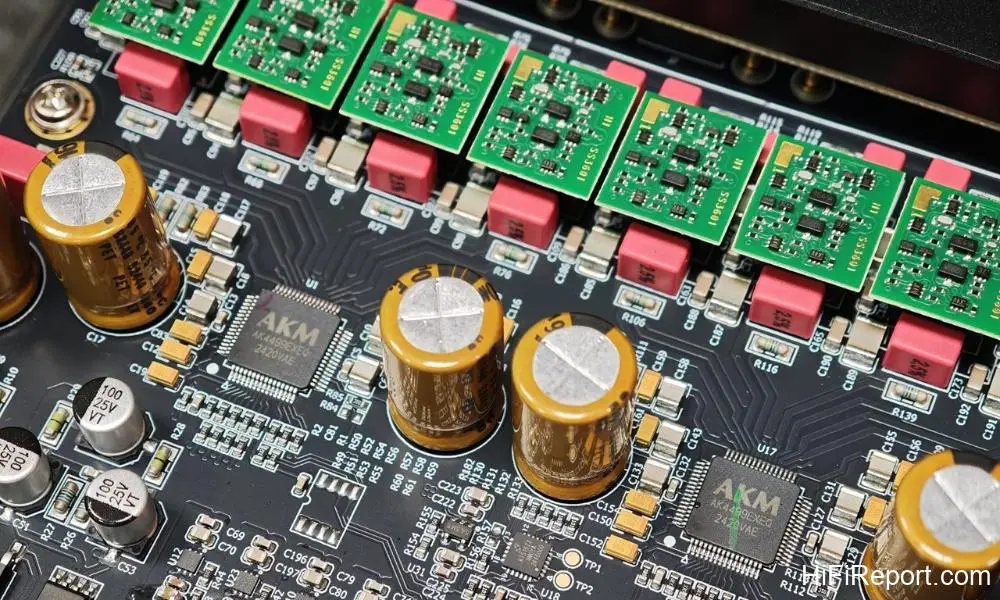
The defining feature of the AK4499EX is that it does not pack all functions onto a single silicon die. Instead, it utilizes a two-chip architecture consisting of the AK4499EX and the AK4191. The former focuses solely on digital-to-analog conversion, while the latter handles digital filtering and Delta-Sigma modulation.
This separation completely isolates the D/A conversion stage from the high-frequency noise generated by digital processing, realizing AKM’s ultimate philosophy of “Velvet Sound” to achieve a truly “sound as if you were there” experience.
While the AK4499EX is already an incredibly capable chip, Aurender has gone three steps further to unlock its absolute maximum potential:
First, the A1 runs two AK4499EX chips in parallel per channel. This design doubles the current output and lowers the noise floor, fully realizing the chip’s outstanding specifications, including a signal-to-noise ratio of up to 138dB and total harmonic distortion as low as -124dB. It supports sample rates up to PCM 1,536kHz/64-bit and DSD1024 (44.8MHz), which represents the absolute pinnacle of current DAC chip capabilities.
Second, Aurender has integrated a high-grade Oven Controlled Crystal Oscillator (OCXO) clock system. They use an FPGA to replace traditional phase-locked loop (PLL) circuits, which are prone to jitter. By using digital algorithms to generate highly precise clock-locking signals, the system eliminates jitter introduced by network streaming or USB interfaces and ensures that the clock frequencies of all four DAC channels are perfectly synchronized.
This approach vastly improves the performance of the quad-AK4499EX array.
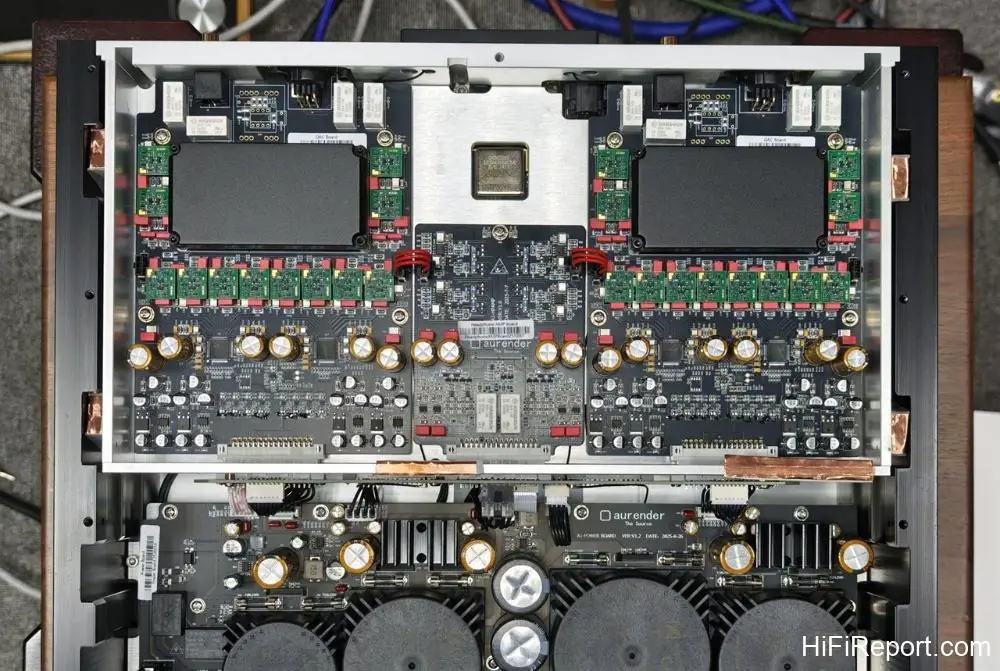
For those seeking even greater heights, the A1 supports external clock inputs. Pairing it with Aurender’s own MC20 master clock—which combines a Rubidium clock with an OCXO—will undoubtedly elevate the sonic performance to another level.
Third, to pursue ultimate audio performance, the AK4499EX does not integrate internal I/V (current-to-voltage) conversion. This makes the downstream analog output stage critical. The A1 employs a fully discrete, pure Class-A output stage to ensure that the massive dynamic range of the AK4499EX is unleashed without compromise.
R2R Volume Control & Headphone Amp
As a side note, while digging through the Conductor App settings, I discovered that the A1 allows users to bypass the built-in R2R volume control and use a silent digital volume control (which does not make the relay clicking sounds). This presumably relies on the AK4499EX’s internal digital volume control.
Comparing the two, the R2R volume control delivers a noticeably rounder, fuller sound, imparting a natural and fluid analog texture to the presentation. It is clear that Aurender’s meticulously designed R2R volume control provides a highly perceptible upgrade in playback quality.
Finally, we must talk about the A1’s headphone outputs. Located on the left side of the front panel, the A1 offers three headphone jacks: 3.5mm, 6.3mm, and 4.4mm balanced. The headphone amplifier section taps directly into the A1’s discrete, pure Class-A analog circuit, providing ample power to drive even the most demanding high-impedance headphones.
For head-fi enthusiasts looking to experience a flagship headphone amp backed by quad AK4499EX decoding, the A1 may very well be your ultimate destination.
Listening Impressions
During my evaluation, several albums stood out. The first was Krystian Zimerman’s performance of Schubert’s Piano Sonata D. 959, Second Movement. This is an exceptional modern recording where the piano tone is already incredibly transparent and lifelike. Yet, through the A1, the transparency of the keystrokes reached an even higher level, bringing micro-dynamics and subtle performance nuances into sharper focus.
I noticed that the A1 renders an incredibly black, quiet background, akin to stepping into a sonic cleanroom where all non-musical impurities vanish. Does playing a piano in a cleanroom sound unnatural? Not at all. With all extraneous noise stripped away, every single one of Zimerman’s keystrokes felt clearer and more emotionally direct.
Even during the tempestuous, storm-like crescendos, the overall musical structure remained rock-solid, allowing me to fully absorb the profound emotion Zimerman poured into the performance.
Next, I listened to violinist Lisa Batiashvili’s lead performance of “Dance of the Knights” from the Romeo and Juliet Ballet Suite on the album *Visions of Prokofiev*. Simply listening to the opening bass drum roll on the right side of the orchestra tells you everything you need to know about a system’s mid-bass balance. When I reviewed the AT23 Pro speakers in Issue 446, this track exhibited an over-prominent and somewhat loose low-frequency response.
Playing it this time through the AT21 Pro speakers, those issues completely vanished. The bass drum was beautifully defined, the balance of the mid-bass was highly cohesive, and the system effortlessly portrayed a vast, layered, and grand orchestral stage.
What accounted for the difference between these two systems? Beyond the fact that the previous audition involved floorstanding speakers while this one used bookshelf speakers, the primary variable was the source component. This further proves that while the A1’s mid-bass possesses a rich, analog warmth, it never becomes boomy or bloated. The low-frequency resolution remains top-tier.
Specifications
* Type: Streaming DAC and Music Server
* Motherboard: RK3588 2.4GHz octa-core processor, 500GB PCIe 3.0 NVMe SSD, 8GB/32GB RAM
* Internal Storage: Supports up to two 2.5-inch SSDs or HDDs (sold separately)
* Digital Outputs: 1 x Coaxial RCA, 1 x USB-A
* Digital Inputs: 1 x Ethernet, 2 x USB-A (for external storage), 1 x S/PDIF Coaxial RCA, 1 x AES/EBU, 1 x Toslink optical, 1 x USB-B, 1 x I2S HDMI, 1 x eARC HDMI
* Analog Outputs: 1 pair x RCA, 1 pair x XLR
* Headphone Outputs: 1 x 3.5mm, 1 x 6.3mm, 1 x 4.4mm balanced
* Clock Input: 1 x BNC
* Maximum Resolution: PCM 1,536kHz/64-bit, DSD1024 (44.8 MHz)
* Supported Streaming Services & Protocols: Tidal, Qobuz, Spotify Connect, Google Cast, Roon Ready, Bluetooth (aptX Lossless)
* Dimensions (W x H x D): 430 x 130 x 355 mm
* Weight: 13.5 kg
Key Features
* The only streaming source on the market featuring a lavish array of four flagship AKM4499EX DACs. * Built-in top-tier OCXO (Oven Controlled Crystal Oscillator) master clock, paired with FPGA clock-locking technology to minimize jitter. * Complete streaming suite including Bluetooth and eARC HDMI support. * Discrete I/V conversion and pure Class-A analog output stages fully unleash the dynamic potential of the AKM4499EX.
* Exceptionally quiet background, outstanding resolution, and a full-bodied, organic sound signature rich with analog warmth.
Summary & Recommendations
* To further elevate playback performance, consider adding Aurender’s MC20 master clock processor.
* For the best sound quality, we highly recommend storing your music files on the A1’s internal storage and controlling playback using Aurender’s proprietary Conductor App.