Bluesound PULSE FLEX (P130) Review
History & Evolution
After establishing its market presence with streamers and streaming integrated amplifiers, Bluesound subsequently launched soundbars and various active speakers. Among them, the most convenient and easiest to get started with is the PULSE FLEX series, introduced in 2015.
The PULSE FLEX series combines a streamer, preamp, power amp, and speaker into a single unit. A single speaker lets you enjoy the streaming music playback advantages of the BluOS core, and its affordable price made it popular upon release. Consequently, Bluesound has continuously refined this product, making it almost a witness to the brand’s development history in the wireless audio field.
The first-generation PULSE FLEX debuted in 2015 with an ultra-compact two-way design, supporting high-resolution music streaming. With an optional battery module, it quickly became a favorite among entry-level Hi-Fi enthusiasts. The second generation, released around 2018 and known as the 2i generation, featured more powerful drivers, upgraded amplifier power, added AirPlay 2 support, plus more stable Wi-Fi and Bluetooth connectivity.
Sound quality and multi-room integration capabilities improved significantly, allowing the PULSE FLEX to be more than just a small speaker—it could easily integrate into the entire Bluesound ecosystem.
Beyond hardware, successive generations have continuously optimized the BluOS platform via firmware updates, adding more streaming services and control features while maintaining the brand’s consistently simple and user-friendly character, accumulating a large global user base.
The latest model, announced in 2025 (marking the product’s tenth anniversary) and officially imported to Taiwan in 2026, bears the same name: PULSE FLEX. Reusing the model name is Bluesound’s recent strategy to give consumers a stronger impression and brand recognition. However, it may also cause confusion between different generations.
To verify if it’s the latest version, check for the internal model number P130, or simply look for “PULSE FLEX 2025”; this article will refer to it uniformly as the P130.
Although it retains the classic name, Bluesound emphasizes that this is by no means old wine in a new bottle, but rather the most thorough reinvention in ten years.
Design & Build
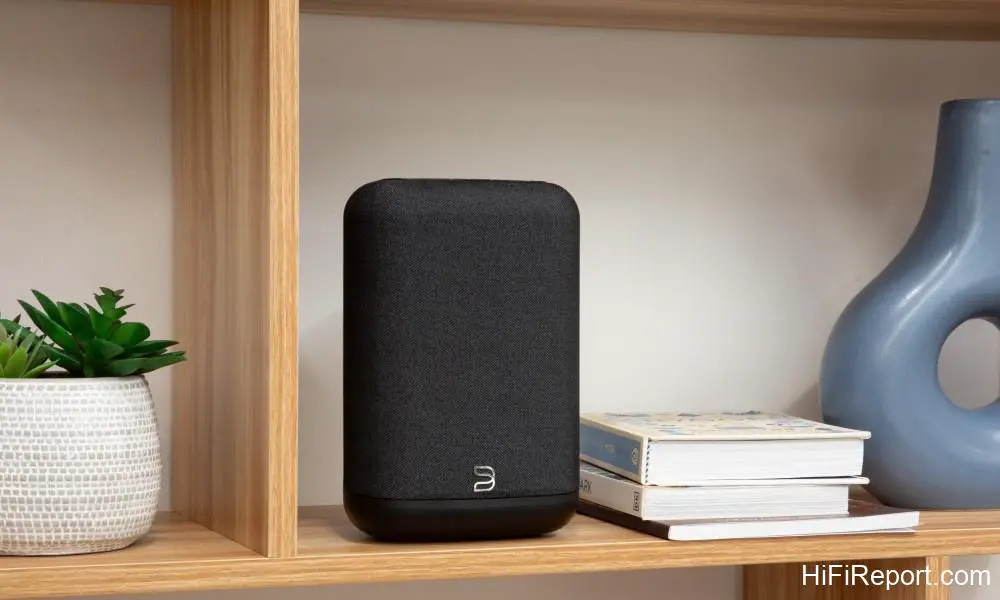
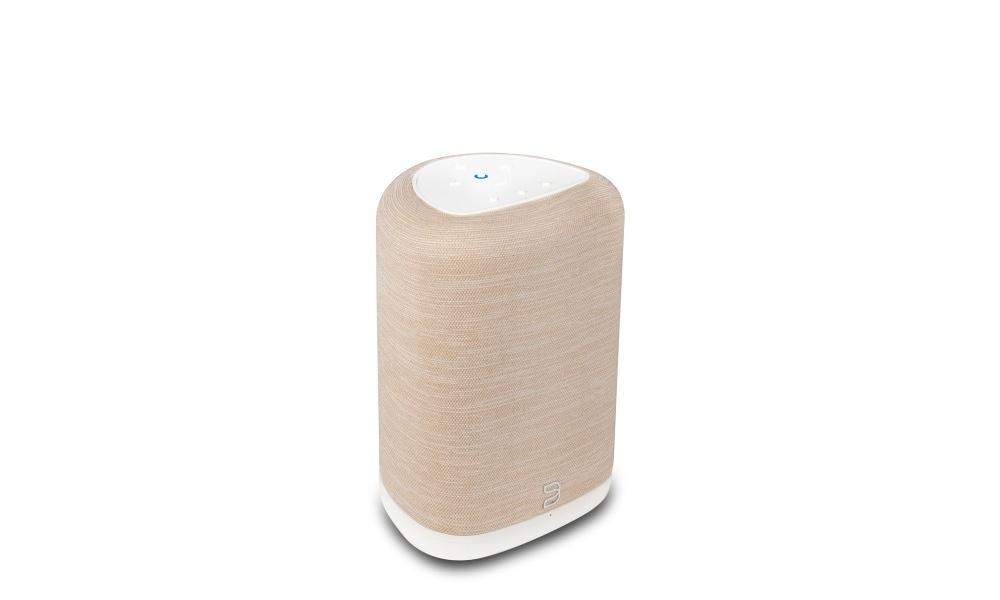
Compared to its predecessor, the P130 shows a clear evolution in appearance. It adopts an all-new industrial design, shifting from the previous boxier shape to a more rounded, streamlined modern look that appears visually lighter. The P130 is compact, measuring just 131×196×111 mm and weighing 1.61 kg—extremely petite. Whether placed on a bookshelf, desktop, or cabinet, it blends effortlessly into any home decor.
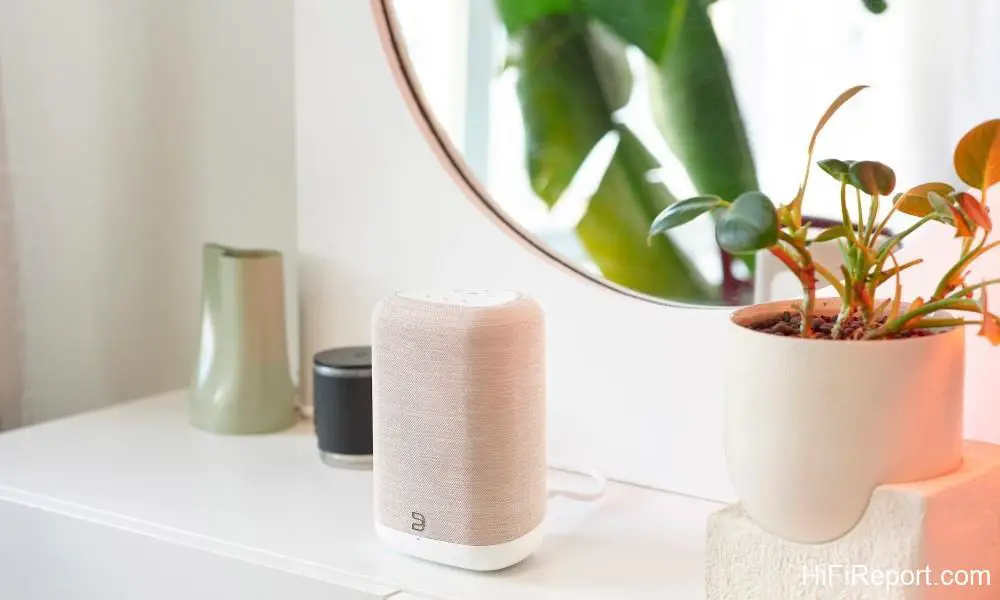
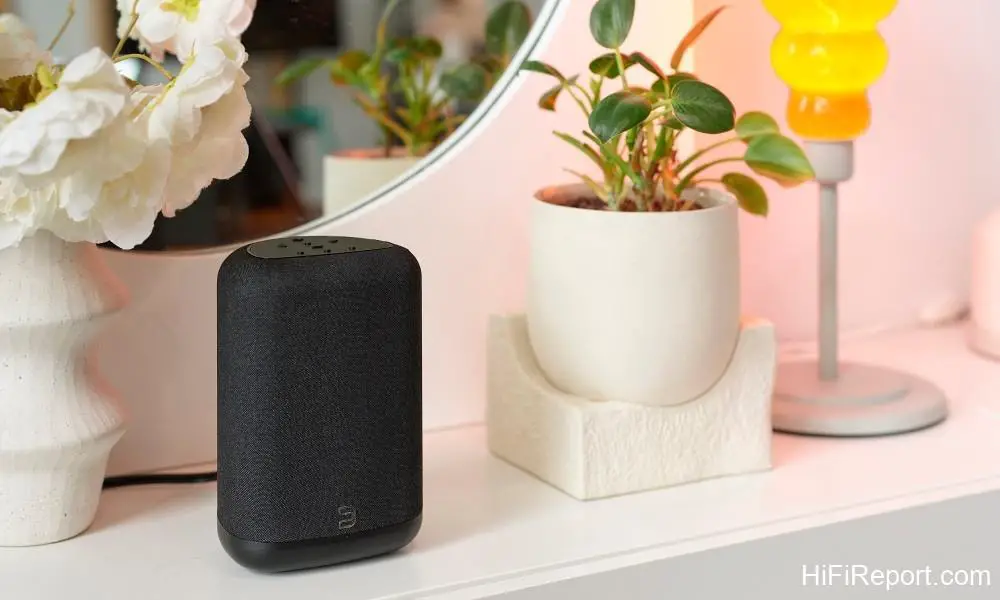
It offers three elegant color options: Black, Gray-White, and Pink-Brown, paired with interchangeable fabric grilles, allowing users to choose freely according to their space’s ambiance.
Acoustic Architecture
In terms of acoustic design, the P130 employs a 2-way, 2-driver configuration, equipped with a 0.75-inch (21 mm) tweeter and a 4-inch (102 mm) mid-bass driver. The internal amplifier delivers a total power output of 50 W (10 W for the tweeter, 40 W for the mid-bass).
Bluesound also highlights that the P130 features a “Smart DSP” intelligent digital amplifier, which uses DSP digital audio processing capabilities to achieve coordinated operation between the amplifier and drivers, delivering optimized sound performance. Compared to the previous generation, the P130’s driver sizes and configuration have been re-optimized, and amplifier power has doubled from 25 W to 50 W, resulting in superior bass extension and overall dynamic performance.
Connectivity & Formats
Connectivity has also been upgraded. Besides a physical Ethernet port, it supports dual-band Wi-Fi 5 (802.11ac), Bluetooth 5.3 (including aptX HD codec). Other interfaces include a 3.5 mm optical/analog combo input, USB Type-C (PC input), and USB Type-A (external storage). The P130 plays common formats like MP3 and AAC, as well as FLAC, MQA, ALAC, WAV, and AIFF (up to 192 kHz/24-bit), and supports DSD up to DSD256.
The BluOS Ecosystem
For streaming, it uses the signature BluOS streaming interface. Its app, matured over years of development, supports playback from over twenty streaming music platforms and internet radio stations. Besides the usual Spotify, Tidal, and Qobuz, it notably includes KKBOX, which fewer audio brands support, and the interface operates smoothly.
Through the BluOS App, you can link all BluOS-enabled audio gear (e.g., Bluesound and NAD) to achieve multi-room music sharing.
Versatile Playback Modes
Another crucial point is the variety of playback modes supported. Beyond single-speaker playback and the aforementioned multi-room sharing, it supports stereo pairing—using two P130s as left and right channels for a stereo soundstage with depth. It can even serve as surround speakers for the brand’s own soundbars, providing “physical” surround effects when using a soundbar for a better sense of envelopment.
Listening Impressions: Single Speaker
Moving on to the actual user experience, the impression was excellent right from unboxing. The new version’s new colors look gorgeous, with overall lines rounder than before, visually softer, and great-looking in a room. This is important for a multi-room music system because speakers are no longer serious, fixed equipment confined to a listening room; they are lifestyle audio that can be moved to any space.
Now for the sound. I started with a single speaker. Given the P130’s size, bass performance is easily predictable: limited extension and shallow depth. The actual listening experience confirms this, but that’s simply a physical limitation inherent to small speakers. What truly deserves attention is whether the frequencies above the deep bass can create an engaging texture. The result is not just good—it’s surprisingly good.
Playing thick male vocals like Allan Taylor, the vocals actually possess thickness, with a magnetic timbre, never sounding thin or constricted. More importantly, output isn’t small; a single P130 can already fill a listening space of roughly 8 ping (approx. 26 m² / 280 ft²) with sound. This kind of energy is usually associated with larger speakers.
Sound quality also maintains a commendable standard. Compared to similar small speakers, its sound is ideal and natural—no obvious boxiness, no cheap digital glare. The tonal balance is very easy on the ears while maintaining good clarity, never sounding loose or muddy. As a single speaker, the P130 is perfectly competent for background music and atmosphere creation, and in some cases, even under critical, serious listening, its performance is noteworthy.
Listening Impressions: Stereo Pair
However, the bigger shock came from using two P130s configured as a 2.0 system, set up in an equilateral triangle for serious listening. Sound stability and body immediately improved, with overall performance clearly upgraded.
For example, playing Melody Gardot’s female vocals, her voice sounds natural and magnetic, with the thickness of the low-mids clearly rendered. The vocals aren’t just clear; they have weight and emotion. Switching to Cheer Chen’s works, the sound presents a different style: slightly ethereal, slightly warm, yet retaining appropriate body, never feeling forced or affected. The overall listening impression is enduring and attractive.
Beyond that, I could sense the soundstage is open, not compressed. At this point, a clear soundstage emerges behind the two speakers, establishing a sense of space. For instance, playing Diana Krall’s live recordings, the soundstage is quite apparent. Meanwhile, the piano timbre is natural, the snare drum rhythm is light and agile, the mid-bass vocals have sufficient energy, constructing a clear, slightly forward vocal position.
The sound responds swiftly without dragging, while also conveying front-to-back layering in the soundstage.
Another example: “Call Me” from Eliane Elias’s *Dreamer* album. The distance between guitar and vocals opens naturally in the intro, with clear spatial sense. The vocals possess moisture and body, yet retain a relaxed, slightly lazy atmosphere.
Switching to rhythmically driven genres that don’t rely on sub-bass, like Bossa Nova or Lounge, the P130 performs equally well. These styles emphasize mid-bass rhythm and groove, which the P130 renders effortlessly. Combined with relaxed melodies, it easily creates a laid-back atmosphere.
Conclusion
After a round of testing, the P130 feels like a clear step up from previous Bluesound speakers, especially with its captivating vocal reproduction. Although its sub-bass has definite limits, for those on a budget, with limited space, or seeking casual listening, this hardly constitutes a flaw. Its comfort and pleasantness are enough to bring a better atmosphere to your life.
Whether you’re a newcomer just discovering Bluesound or a veteran deeply invested in a multi-room system, this little speaker will become the most versatile and satisfying audio companion in your home.
Specifications
* **Drivers:** 0.75-inch tweeter, 4-inch mid-bass
* **Amplifier:** Smart DSP amplifier, total 50 W (10 W tweeter, 40 W mid-bass)
* **Sound Control & EQ:** BluOS Control App
* **Native Sample Rate Support:** 192 kHz
* **Native Bit Depth Support:** 16–24-bit
* **DSD Support:** Up to DSD256
* **Supported Hi-Res Audio Formats:** FLAC, MQA, ALAC, WAV, AIFF, MPEG-4 SLS
* **Inputs/Outputs:** Wi-Fi 5, Bluetooth 5.3, 3.5 mm analog/optical combo, USB Type-C (PC input), USB Type-A (external storage)
* **Dimensions (W×H×D):** 131×196×111 mm
* **Weight:** 1.61 kg