
Marantz CINEMA 30 Review
Enthusiasts seem increasingly less concerned with “channel count” these days. However, I’m acutely aware that the proportion of “knowledgeable enthusiasts” has significantly increased over the past few years. AV receivers were among the earliest audio components to incorporate soundfield analysis and built-in DRC (Digital Room Correction) for calibrating spatial response.
Interestingly, DRC technologies, such as the now-famous Dirac Live, gained prominence first in advanced two-channel streaming amplifiers before making a comeback into the multi-channel market. Thus, in recent years where specifications have seemingly stagnated, “Dirac Live support” has become a primary justification for launching new AVR models.
But now, with all the “toothpaste squeezed out,” the only rationale for releasing a new AVR is “making good even better.” Over the past year, multi-channel music streaming has gained traction, and we see many “complex solutions” demonstrated at audio shows. I believe the optimal solution is to use an AVR with “high sound quality.” This involves meticulous design focused on audio performance, delving into sound quality technical details even more deeply than some two-channel amplifiers.
This is the key differentiator between the subject of this review, the Marantz CINEMA 30, and most other AVRs. Before this review was even published, it had already won this year’s EISA Award for Best Home Theatre Receiver.

Model Positioning and Key Features
Traditionally, Marantz has approached its flagship AVRs as “multi-channel Hi-Fi amplifiers.” The CINEMA 30 replaces the SR8015, their previous flagship AVR launched four years ago (late 2020). The CINEMA 30 is an 11.4 channel AVR with built-in 11 channel amplification. Compared to the SR8015, it adds “.2”, supporting up to four subwoofers. This means a single CINEMA 30 unit can power a 7.2.4 channel system. The CINEMA 30 offers 13.4 channel pre-processing.
By adding a two-channel power amplifier or integrating with a two-channel integrated amplifier featuring “HT Bypass,” you can configure 7.4.6 or 9.4.4 channel systems.
Purely comparing specifications, the amplifier output power of the CINEMA 30 and SR8015 is almost identical. However, the new model features HDMI inputs that are all compatible with 8K/60p and 4K/120p (whereas the SR8015 only had one such input). One of the most significant differences between the two units is that the CINEMA 30 offers paid upgrades for Dirac Live Limited Bandwidth, Full Bandwidth, or Dirac Live Bass Control.
With the addition of a test microphone and stand, users can achieve more precise spatial response correction, especially for low frequencies, after calibration.
Streaming & Connectivity
Regarding music streaming capabilities, the unit retains the built-in HEOS system, supporting TIDAL, Spotify, Tune-In, Roon, and AirPlay. It can play music files shared from your home network or pushed from mobile devices. Compatible file types include WMA, MP3, WAV, MPEG-4 AAC, FLAC, Apple Lossless, and DSD. Multi-bit lossless music files and DSD support sample rates up to 192kHz and 5.6MHz, respectively.
The USB terminal located behind the front panel cover allows playback from USB flash drives or hard drives containing music files, with the same compatible file types and specifications as network playback.
Flagship Design Philosophy and Team
Although the CINEMA 30 is Marantz’s latest “flagship” AVR, its price is less than that of “one part” of their flagship separates combination, the AV 10 surround processor and AMP 10 16-channel power amplifier. However, Marantz has a fine tradition: their “10” series flagship models often serve as pioneers of technology or benchmarks for subsequent models.
This time, Marantz explicitly stated that the CINEMA 30, as an integrated AVR, aims to carry forward the design philosophy of the AV 10 and AMP 10 separates, specifically targeting a sound quality “close to the AV 10 and AMP 10.”
Don’t dismiss this as mere marketing speak. The manufacturer genuinely set this as the goal for the CINEMA 30. They even brought in Hiroki Iihara, the circuit designer of the AV 10, to oversee the development of the CINEMA 30’s preamplifier circuitry, and Keita Watanabe, the circuit designer of the AMP 10, to develop the CINEMA 30’s power amplifier section.
These two senior engineers, along with Marantz’s “Sound Master” Yoshinori Ogata, form the original development team behind the AV 10 and AMP 10. The same development team, the same Japanese manufacturing (at the Shirakawa factory), make the stated goal seem “not too difficult” on the surface.
In reality, however, it is extremely challenging due to different product tiers, vastly different manufacturing costs, distinct circuit designs, and the constraints of available physical space for circuitry.
Engineering Philosophy
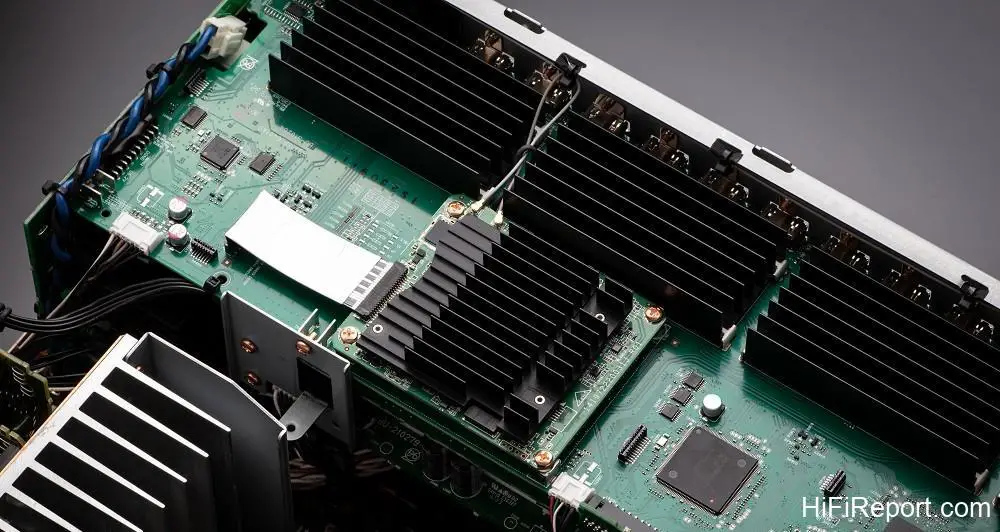
The CINEMA 30’s preamplifier section is located in the rear half of the chassis. The top-most digital circuit board extensively applies technology used in the AV 10’s digital board. Specifically, for HDMI inputs, it replaces the external (source) clock with its own more precise clock. The “jitter elimination circuit” and high-precision oscillator on the digital-to-analog conversion board are positioned close to the DAC chip.
Efforts were made to shorten the distance of the clock signal to the digital board’s DSP. This required the two boards to be placed very close together. To achieve this, significant effort was invested in the digital board’s layout, including local voltage regulation circuits for components like HDMI transmitters/receivers, DSP, and MCUs where current changes are significant.
The positioning and routing of the network module (including using parts of the multilayer circuit board for shielding) were optimized to minimize noise leakage and maintain the purity of the audio signal in the DAC circuitry.
It’s quite remarkable for an AVR’s digital circuitry to exhibit this level of sophistication, typically seen in high-end two-channel digital sources. This is largely attributable to the designer. Hiroki Iihara was previously the developer behind the Denon 110th Anniversary SACD/CD player and the earlier Denon streaming player DNP-2500NE. When designing the AV 10, his self-set goal was to “thoroughly pursue sound separation.” This time, he aimed for the CINEMA 30 to achieve a similar standard.
There are significant inherent differences in the DAC circuitry between the CINEMA 30 and the AV 10. The AV 10 uses two-channel DAC chips for all multi-channel conversions, essentially employing a two-channel source design approach, which inherently enhances separation. The CINEMA 30 uses two high-end ESS ES9017S 8-channel DAC chips for the main channels.
Although this chip boasts a significantly higher dynamic range (120dB) compared to the AKM AK4458VN (115dB) used in the early SR8015 versions, and also offers lower total harmonic distortion, achieving the same level of channel separation and reducing crosstalk to match the AV 10 presented a considerable challenge.
Advanced Circuit Design
Hiroki Iihara pointed out that crosstalk issues in multi-channel DAC circuits primarily occur in frequencies above 1kHz and are caused by induction. Anyone with basic circuit knowledge understands that crosstalk is more severe between channels with closer circuit board traces. The development team carefully evaluated the design of the DAC chips and the channel arrangement in the DAC circuit layout.
They strategically separated channels with “limited current variation” from those with “frequent current variation.” Furthermore, they utilized the differences in audio frequency ranges transmitted by different channels for separation. For instance, instead of placing the three front channels sequentially, the three subwoofer channels (SW2 / SW3 / SW4), which only handle frequencies below 250Hz (or lower), are grouped with the left, right, and center channels respectively.
This arrangement helps reduce crosstalk between the left, center, and right channels, improving separation.
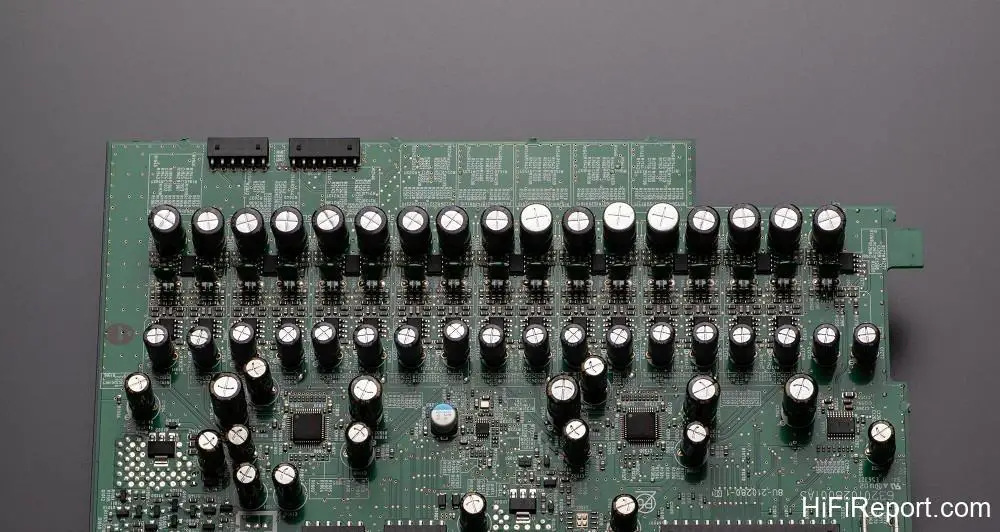
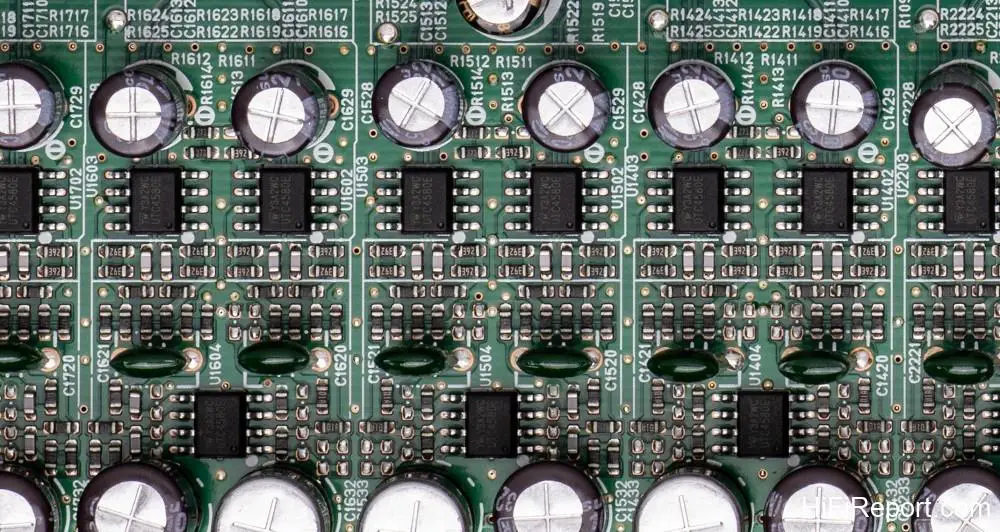
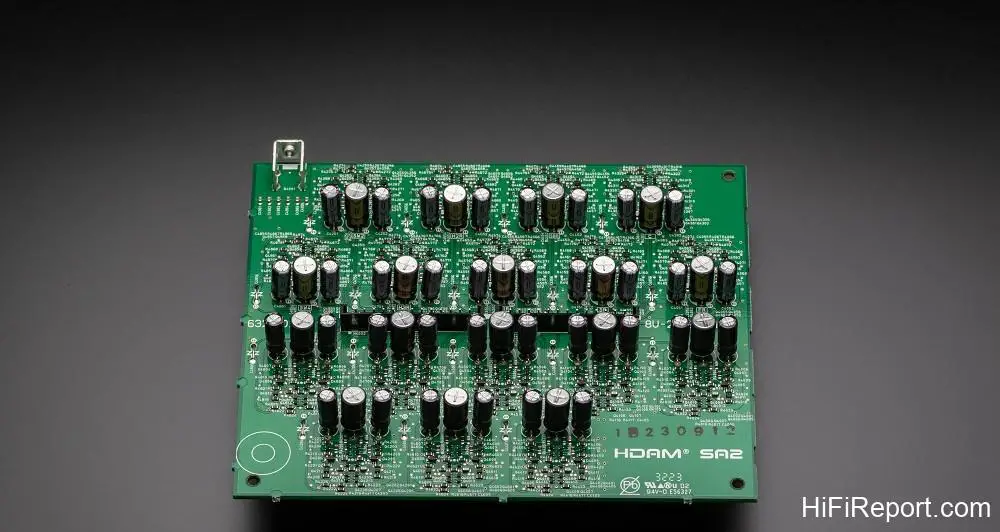
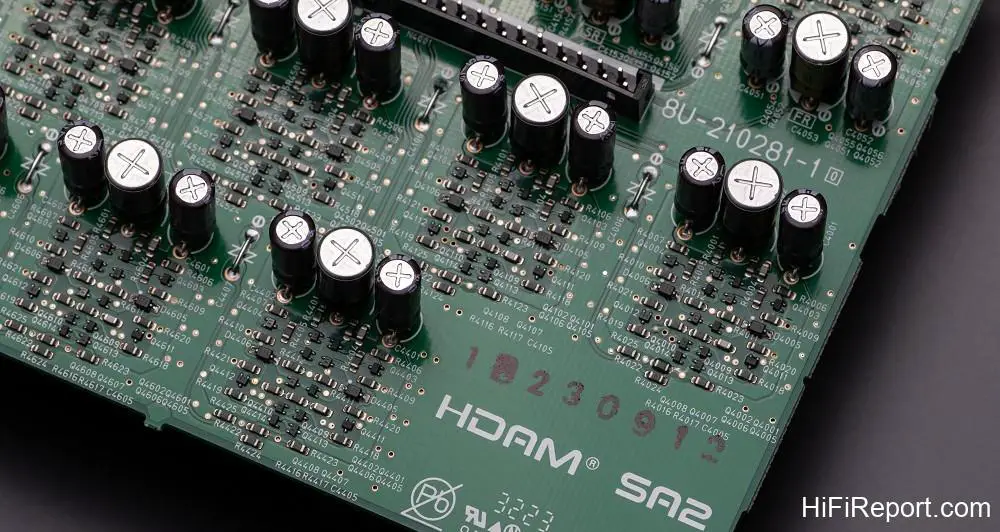
Most AVR preamplifiers use off-the-shelf operational amplifier chips (Op Amps). While I don’t dispute the performance of Op Amps, they are integrated circuits (ICs), and using chips for the preamplifier inevitably limits the design and tuning flexibility for the circuit designer and sound master. For many years, Marantz has used its proprietary high-speed amplifier modules, HDAM (Hyper Dynamic Amplifier Module), for the small signal amplification circuits in its high-end models.
HDAM modules are amplifier circuits built using discrete components (various passive components and transistors).
The CINEMA 30’s preamplifier is located after the volume control circuit. Each channel uses one current feedback type “HDAM-SA2” module for amplification. It employs the same low-noise transistors for differential amplification as the AV 10 and features custom capacitors carefully selected by Yoshinori Ogata. The overall amplification structure is kept simple, utilizing a five-layer circuit board layout.
This not only shortens the connections between electronic components but also uses an interleaved arrangement for the 17-channel HDMI amplifier circuits in the preamplifier section. The goal is to minimize the audio signal transmission path from input to output, thereby preserving maximum sound information and purity. The CINEMA 30 also includes a Phono input for turntables. Its Phono Stage uses HDAM-SA2 amplification after the RIAA circuit.
Power Amplifier Design
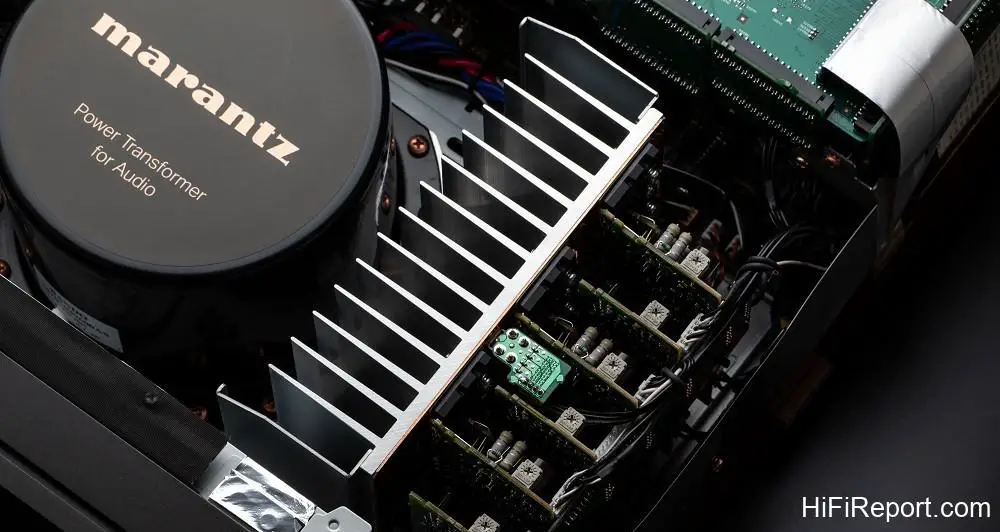
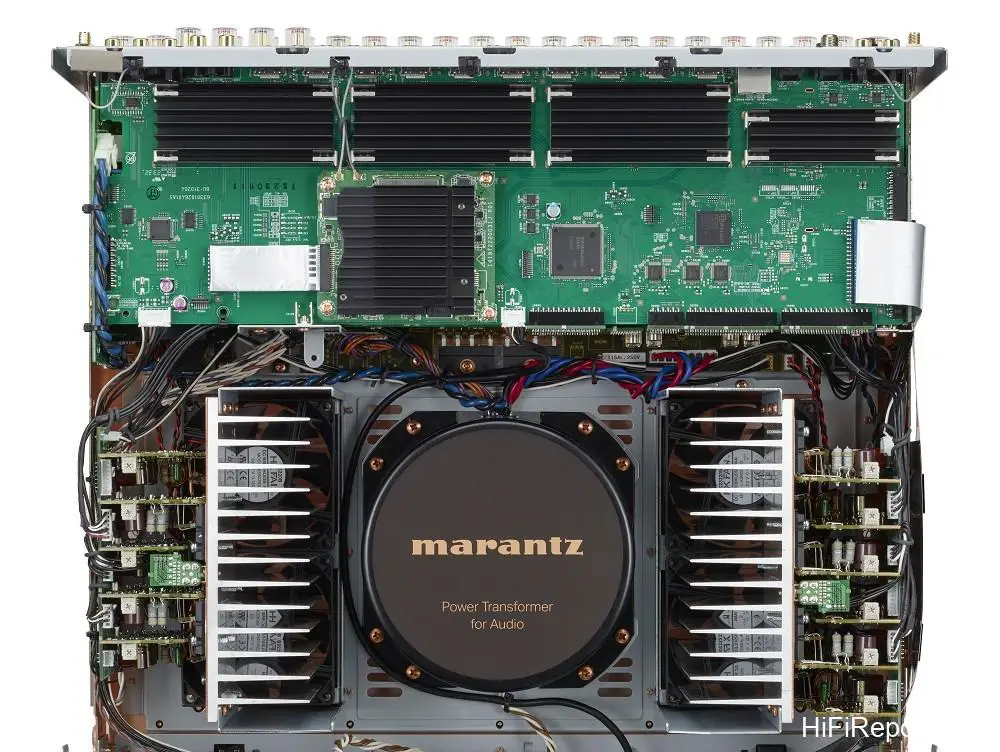
The CINEMA 30’s power amplifier circuit continues the “monoblock-like” construction philosophy seen in the SR8015. Each channel’s power amplifier circuit is on an independent board, a practice beneficial for channel separation. The total of 11 channels are symmetrically arranged with “5 on the left, 6 on the right” around the toroidal transformer. Heatsinks on both sides face the transformer, utilizing the heatsinks effectively as shielding.
Compared to the AMP 10, although the CINEMA 30 has fewer power amplifier channels, it is limited to about half the chassis space within the AVR. Moreover, the AMP 10 uses Class D amplification (Marantz’s own Japanese-made ICEpower), while the CINEMA 30 uses Class AB. How then can the CINEMA 30 sound like the AV 10? Keita Watanabe designed the AV 10’s circuits, so he naturally understands the key points: “pursuing faithful sound, without coloring the original audio.”
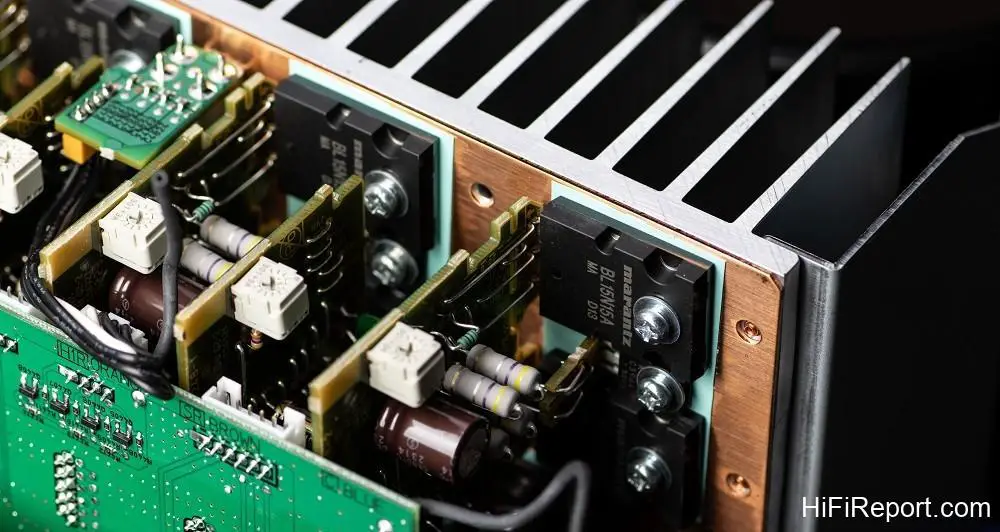
Keita Watanabe believes that the foundation of transistor power amplifiers lies in the power transistors, especially those used to drive speakers. As early as 2019, they began collaborating with a semiconductor company to prototype samples. They experimented with all materials used in the power transistors, from the internal wire bonding to materials like internal wiring, pins, plating, lead frames, and even the external packaging material (resin).
The size of the power transistors was also evaluated through extensive listening tests. It took a full four years to create the “custom-made” Marantz BL15N15A / BL15P15A power transistors. They even tuned the sound *inside* the transistors! Very few audio manufacturers worldwide have ever done this.
Objectively, the Sanken power transistors 2SD2560 / 2SB1647 (Pc 130W, size 16×20 mm, weight 6.0g) typically used by Marantz in AVRs (including the CINEMA 40) are smaller than the BL15N15A / BL15P15A (Pc 160W, size 20×26 mm, weight 9.4g). Making the power transistors larger allows for wider internal leads (within the transistor), which reduces internal resistance, beneficial for current output.
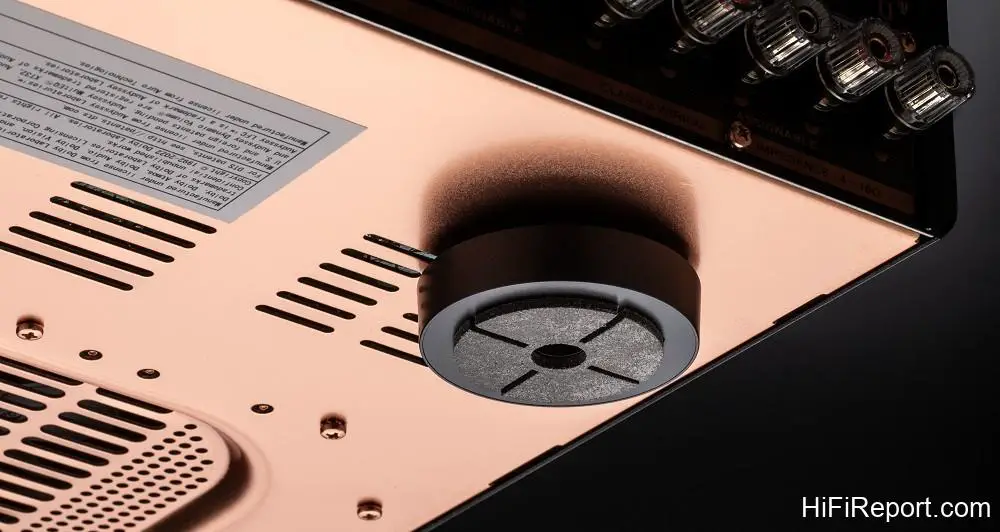
With larger power transistors, the metal plate behind them naturally becomes larger, aiding heat dissipation. The back of power transistors is typically insulated from the heatsink using a mica sheet coated with thermal paste. The CINEMA 30 replaces the mica sheet with a low thermal resistance heat conduction film made of silicone resin. Additionally, a layer of copper is placed between the power transistor and the heatsink to further improve heat transfer.
The unit’s power amplifiers are constructed as monoblocks, and adjacent channel power transistors are arranged in a staggered pattern (checkerboard fashion) on the heatsink to maximize heat dissipation and reduce interference. Marantz has put considerable effort into the thermal design to reduce thermal noise and minimize distortion in the power amplifier circuits.
Power Supply & Listening Impressions
To make the CINEMA 30 sound like the separates, driving capability is naturally very important. As I’ve mentioned, an AVR’s ability to drive speakers is largely determined by its power supply. The CINEMA 30’s main power supply is a 5.7 kg (the CINEMA 40 uses a 4.8 kg EI transformer) toroidal transformer with a magnetic shield. The main power supply for the power amplifier circuits, after rectification, uses two custom-made 22,000μF/80V electrolytic capacitors for filtering.
These capacitors not only have a large capacitance, providing higher power supply voltage stability under high output conditions, but they were also “developed specifically for the CINEMA 30.” Silicone sand is filled between the capacitor casing and the internal capacitor body to suppress vibration.
After completing the initial setup (including Audyssey room correction), I immediately began listening. I started with music to assess the CINEMA 30’s sonic character. I truly admire the skill of Marantz’s Sound Master and the two senior engineers: the CINEMA 30 sounds exactly as they described.
If listeners were to blind test the CINEMA 30 against the AV 10 / AMP 10 at the same volume, I believe it would be very difficult to definitively distinguish which system they were hearing based purely on listening. The CINEMA 30 exhibits the same neutral, realistic style as the AV 10 / AMP 10. Listening to music in Pure Direct mode reveals an exceptionally clean, pure sound, free of impurities. It delivers high resolution with very high sonic purity (low coloration).
At this point, I fully understood what Hiroki Iihara meant by “sound separation”; it also encompasses a very clear “layering of sound” and detail, with no sense of congestion. As for “channel separation,” it’s not just about the ideally wide soundstage; when playing network videos using only two-channel or 2.1-channel speakers, it can even create a sense of multi-channel envelopment!
The CINEMA 30 allows users to select between two digital filter (DAC Filter) modes. Comparing the two: Filter 2 emphasizes ‘hi-fi’ qualities and is better at rendering subtle sonic textures. It is very transparent. If your speakers are sufficiently neutral, the CINEMA 30 makes the music sound almost as if it were back in the recording studio – completely uncolored, delivering the pure essence of the musical content. I believe the CINEMA 30 absolutely does not lack resolution or speed.
Therefore, I preferred the factory default Filter 1 for most music. This setting presents a slightly warmer tonal balance and a slightly softer texture, which is closer to the traditional Marantz style favored by older enthusiasts – a sound that is inviting and easy to listen to for extended periods. However, its sound is not syrupy; the high notes of a violin remain bright, glorious, and rich in overtones, completely free from dullness or compression.
Performance & Conclusion
When the unit drives floorstanding speakers in two-channel full-range mode (or via bi-amping), with the power amplifier’s power supply circuits primarily dedicated to two channels, the CINEMA 30 sounds like a high-power two-channel integrated amplifier. Playing bass-heavy pop music at high volumes maintains excellent sonic stability. The weight and authority in the “bottom end” of the bass are quite convincing.
The fast attack and decay, coupled with clear low and sub-low frequency lines, demonstrate the CINEMA 30’s significantly superior bass control compared to most other AVRs.
If Dolby Atmos music is important to you, the sound quality-focused CINEMA 30 is an excellent choice. I also offer some pairing advice for this unit. I compared the Pure Direct mode when playing multi-channel music and found the sound quality superior to any other mode. However, Pure Direct mode bypasses all spatial response equalization. Therefore, I recommend pairing it with active subwoofers that have PEQ capabilities.
Users should also hone their “advanced basics” of speaker placement and subwoofer response testing/calibration. In the Pure Direct mode, prioritizing sound quality, you can achieve a balanced very low-frequency response. Of course, users must still complete the soundfield calibration procedure to ensure better soundstage coherence and image localization for movie soundtracks.
In terms of multi-channel performance, both music and movie soundstages are remarkably expansive. The visibility is extremely high, and the spatial extension of the surrounding and overhead soundfields, from “near to far,” is clearly superior. It excels at rendering image movement. While typical AVRs can clearly portray sound objects moving around and front-to-back, the CINEMA 30 makes movement feel more significant in the “up and down” and “near and far” dimensions.
Effects of objects “flying out of the screen” and rapidly approaching have a more aggressive impact. The “punch” and excellent speed of this flagship AVR create a palpable sense of tension in action and war films.
When using Audyssey room correction, the unit automatically adjusts the bass quantity to be neutral, not exaggerated. Users familiar with Dirac Live calibration know that it also aims for a “correct and balanced response.” Therefore, if you’re a “heavy bass” movie enthusiast and want the CINEMA 30 to deliver exaggerated bass weight and impact, you’ll need to “add spice” yourself.
From an objective standpoint, considering the quality of components used (including custom parts), the high-quality manufacturing from the original Japanese factory, the meticulously designed “audio paths,” the robust power supply, and the channel count, this is arguably one of the most refined AVRs currently available.
The CINEMA 30’s sonic character and actual listening experience are remarkably similar to its flagship separates siblings, the AV 10 / AMP 10, yet its price is less than one-third of their combined total. Therefore, I believe the Marantz CINEMA 30 is a flagship AVR that brings together numerous “excellent value” conditions, and it rightly earns our highest recommendation.
Specifications
* **Type:** 11.4 Channel Surround Receiver
* **Power Output:** 250 W (6 ohms, 1 kHz, THD 10%, 1 ch driven), 175 W (6 ohms, 1 kHz, THD 0.7%, 2 ch driven), 140 W (8 ohms, 20Hz~20kHz, THD 0.05%, 2 ch driven)
* **Frequency Response:** 10Hz~100kHz (+1,-3dB)
* **Signal to Noise Ratio:** 102 dB
* **Input Terminals:** HDMI×7, Component Video×1, Composite Video×2, Analog Audio×6, Phono (MM)×1, Toslink Optical×2, Digital Coaxial×2
* **Output Terminals:** HDMI×3, 13.4 Ch Preamp Output×1, 2 Ch Zone 2 Output×2
* **Other Terminals:** USB×1 (Front), USB×1 (Rear, Power supply only), Ethernet×1, Setup Microphone Jack×1, RS-232C×1, DC Trigger Out×2, IR In/Out×1 each, Wi-Fi/Bluetooth Antenna Terminals×2, FM Antenna×1, AM Antenna×1
* **Dimensions (W×H×D):** 442×189×457mm
* **Weight:** 19.4 kg