
StormAudio ISP Evo Review
In 2023, Sweden’s Dirac unveiled its most advanced room correction technology, Dirac Live Active Room Treatment (hereafter referred to as Dirac Live ART). The StormAudio ISP Elite MK3 was not only the multichannel processor used to demonstrate this technology at major exhibitions worldwide (including CES and Munich High End), but it also deeply impressed me during my 2023 review of the StormAudio ISP Elite Analog MK3.
Its performance made it clear that full-frequency response and phase correction were merely baseline capabilities for StormAudio.
Dirac Live ART’s ability to actively eliminate low-frequency and ultra-low-frequency room reverberation, to put it simply, allows the speakers and active subwoofers to precisely emit out-of-phase sound waves, effectively “canceling out” all unwanted low frequencies, including reverberation, reflected from room surfaces. This delivers an unprecedented level of pure low-frequency reproduction, utterly devoid of any lingering decay, with dynamics that are incredibly distinct and impactful.
Evolution Beyond Perfection
With its top-tier full-frequency correction, phase correction, and bass reflection elimination, the StormAudio ISP Elite Analog MK3 could reasonably be considered the closest thing to a perfect multichannel processor. What more could evolve? A cosmetic revamp? A higher price tag? After all, as of 2025, StormAudio remains the sole brand offering products with Dirac Live ART built-in from the factory.
Installers and enthusiasts seeking bespoke super-multichannel systems would undoubtedly still invest. Yet, StormAudio sought to innovate further, forging a path no one else had taken.
Dirac Live ART had already brought StormAudio products to an almost perfect state of room response. However, top-tier audiophiles chase something beyond objective measurements: sensation, psychological impact, musical emotion, texture, and aesthetic beauty. These subjective preferences regarding sound quality are not something audio developers can fully satisfy, nor can they be resolved by mere sales rhetoric. The most legitimate solution is singular: maximizing openness.
This means handing over complete freedom to top-tier enthusiasts regarding sound tuning, system matching, and subjective preferences. This, I believe, is the unique capability of the StormAudio ISP Evo, our protagonist today. Moreover, the StormAudio ISP Evo is currently the only cross-industry processor (for both home theater and commercial cinema) capable of use in true digital cinemas.
The Smart Design of ISP Evo
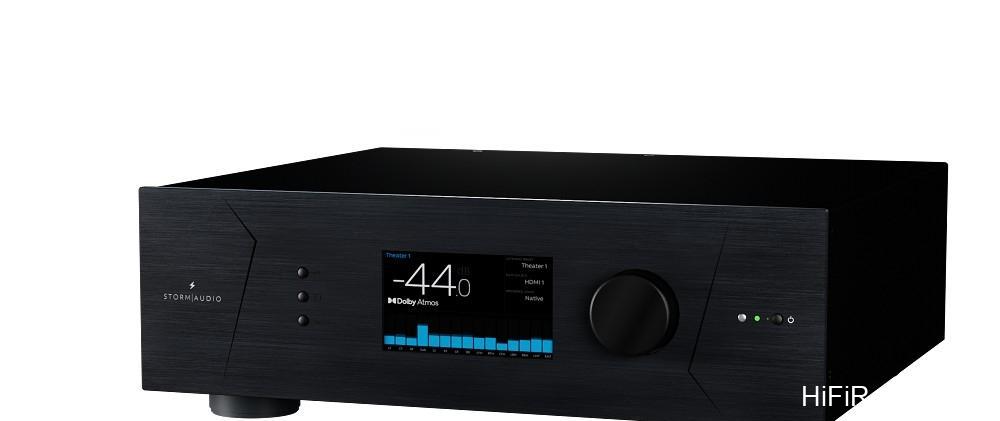
The ISP Evo’s design is remarkably clever, leveraging StormAudio’s existing resources for maximum efficiency. A quick comparison of the ISP Evo with other StormAudio family members immediately reveals its striking resemblance to the ISP Core 16. Indeed, it shares the ISP Core 16’s more compact chassis. However, while the ISP Core 16 is a 16-channel surround sound processor, the highest version of the ISP Evo is a 32-channel surround sound preamplifier.
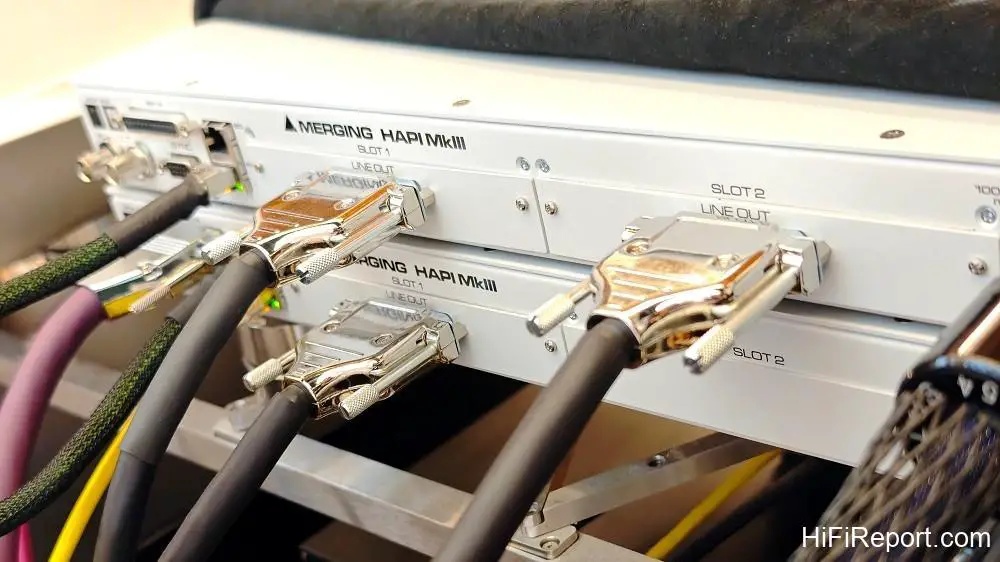
In terms of actual circuit structure, the ISP Evo builds upon the flagship ISP Elite MK3 but adopts an “all-digital” design. After multichannel processing (including decoding and room correction), there are no digital-to-analog conversion circuits. Instead, it outputs multichannel audio via an AoIP (Audio over IP) interface, making it a digital multichannel surround sound processor.
This allows users or system designers the freedom to choose any compatible DAC for all channels or pair it with active speakers featuring digital inputs.
Core Capabilities: Connectivity and Processing
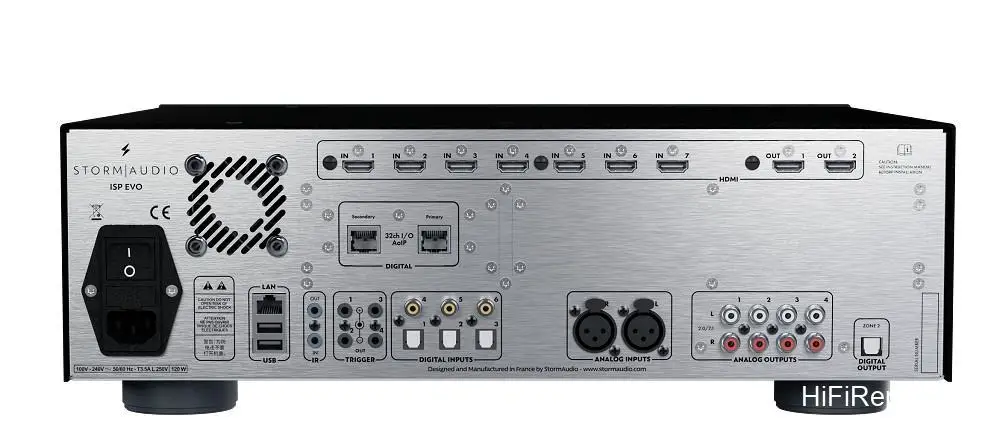
The ISP Evo is equipped with 7 HDMI inputs and 2 outputs, all compatible with HDMI 2.1a / HDCP 2.3 40 Gbps. UHD digital video supports 8K/60Hz and 4K/120Hz, with HDR support for HDR10, HDR10+, Dolby Vision, and HLG. Within the core digital audio processing section, I observed a significant number of high-end DSP chips, including Analog Devices SigmaDSP ADAU1445 and the more familiar SHARC DSP chip ADSP-21489.
It is only logical that these DSP chips, which could power several surround sound receivers, are instead integrated into an ISP Evo capable of many times the channel count (the version I am reviewing is a 32-channel model). Beyond the sheer number of channels, it not only handles standard Dolby Atmos, Auro-3D, DTS:X Pro decoding, and IMAX Enhanced compatibility, but it can also utilize StormAudio’s proprietary StormXT to “add” (supplement) channels not present in the native audio.
For instance, a multichannel audio track originally limited to planar channels, such as DTS-HD or Dolby TrueHD, can be up-mixed by StormXT to engage the overhead channels (upper surround speakers), transforming a native “two-dimensional soundfield” into a three-dimensional immersive experience with overhead envelopment.
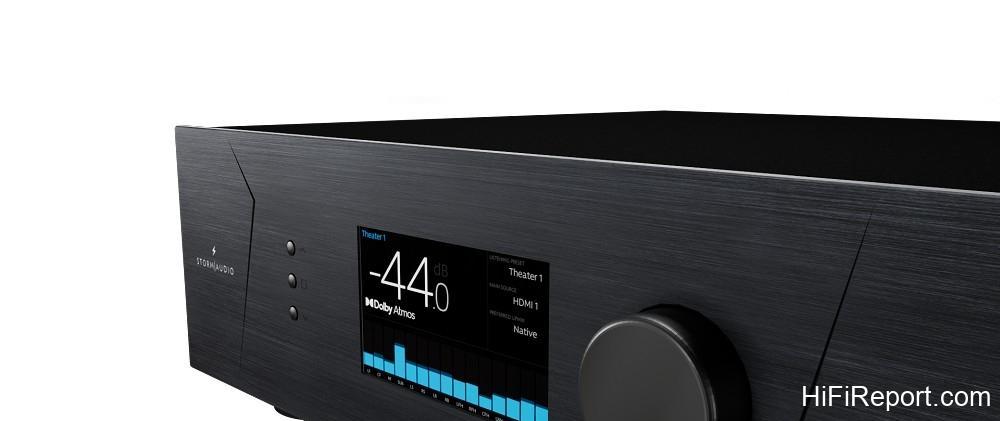
Even with the ISP Evo’s extensive channel count, standard decoding and channel upmixing utilize only a fraction of the unit’s digital audio processing power. The majority of the computational horsepower is dedicated to Dirac Live ART. Looking directly at the price, the StormAudio ISP Evo, at approximately $23,500 USD for the AoIP 32-channel version, might seem expensive.
Redefining Room Acoustics with Dirac Live ART
However, the pivotal role of Dirac Live ART lies in “active acoustic treatment,” a concept that completely overturns traditional room acoustics. Conventionally, a listening room’s length, width, and height ratios determine room modes, causing booming (bass boom) or cancellations (bass null) at specific frequencies within the 20Hz to 300Hz range due to in-phase overlap or out-of-phase cancellation of speaker output and room reflections.
The reality is that most people use existing spaces as listening rooms rather than building dedicated ones with theoretically ideal dimensions. This necessitates professional acoustic treatment planning. The typical solution for the aforementioned low-frequency issues is bass traps, which are often custom-made, expensive, and bulky. It’s almost impossible to install a sufficient number in a typical home.
In contrast, Dirac Live ART utilizes speakers and subwoofers to “cancel out” excess low frequencies. This entirely eliminates the need for traditional methods, requiring only adequate sound insulation and basic mid-to-high frequency absorption on walls. The savings in money and space from not needing physical low-frequency acoustic treatment alone can easily offset the price difference between the ISP Evo and most other surround processors.
The system offers precise, on-site measurement and correction for each channel, and can be combined with StormAudio’s exclusive Expert Bass Management for independent low-frequency control in up to 6 zones. This allows for seamless integration and calibration of multiple subwoofers, ensuring balanced frequency response at all listening positions within the designated area.
Furthermore, the fundamental frequency response correction allows users to customize target curves. By correcting the frequency response for each speaker, the system not only resolves imaging and soundstage issues caused by asymmetrical room acoustics but also maintains excellent tonal balance even when mixing different speaker brands in a multichannel setup.
The ISP configuration interface provides up to 20 PEQ filters per channel, which can be custom-defined or loaded from REW StormAudio format filter profiles for precise tuning. In fact, the adjustment parameters offered by StormAudio far exceed the needs (or even the knowledge) of typical home theater enthusiasts. It’s a “weapon arsenal” where everything is available; it’s just a matter of whether the owner chooses to use it.
The Power of AoIP Multichannel Output
For multichannel output, the ISP Evo adopts AoIP (Audio over Internet Protocol). AoIP transmits digital audio over standard Ethernet (RJ-45) CAT6 network cables, eschewing traditional digital audio transmission cables (such as XLR, coaxial, and HDMI). Currently, AoIP is primarily used in professional audio fields, including cinemas and recording studios, allowing real-time transmission of 16, 32, 64, or even more channels of digital audio over a single network cable.
StormAudio is currently the only brand producing home theater surround processors with AoIP multichannel output. The ISP Evo supports transmission protocols including Dante (up to 512 channels at 48kHz sample rate) and Ravenna / AES67, commonly used in recording studios, with multichannel digital audio output at Hi-Res quality of 192kHz/24bit.
AoIP provides lossless, high-resolution long-distance audio transmission with extremely low latency. Being digital, it is completely immune to external noise interference during transmission and unaffected by signal attenuation or coloration from analog audio cables, preserving the original audio’s essence.
It also grants users the freedom to select their preferred DACs, potentially achieving sound performance that comprehensively surpasses traditional surround preamplifiers, provided the chosen DACs are of high enough quality.
Local Implementation and Review Experience
While seemingly perfect, the ISP Evo is the first AoIP surround sound processor introduced locally. Even if I wanted to review the top-tier ISP Evo 32-channel model, typical home DACs not only lack the necessary channel count but also AoIP input compatibility. Fortunately, this challenge was overcome a few months ago.
In a Facebook group for enthusiasts, Mr. Dan Hsu and Mr. Tang Wen-Chi (referred to as “Dan-da” and “Tang-da” by group members) successfully navigated the setup, going from no sound to full channel utilization, accumulating rich experience in system matching and calibration. I decided to review the system at Mr. Tang Wen-Chi’s residence. I’ve known him for over 27 years, having collaborated since the early days of this publication, ensuring seamless communication and setting adjustments.
A Unique Audition System Configuration
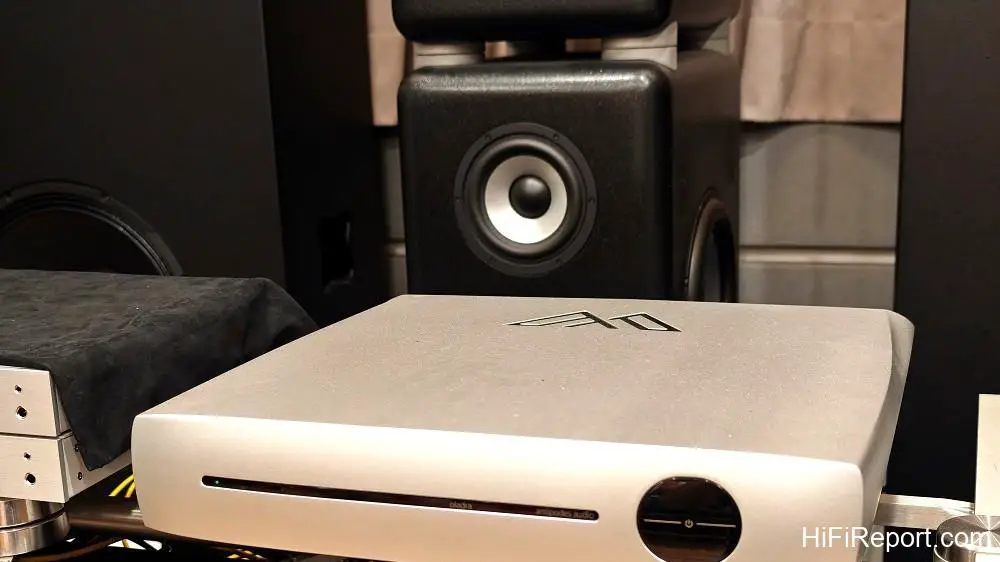
Mr. Tang’s system configuration is quite unique; it demonstrates how the StormAudio ISP Evo’s capabilities can be leveraged for planning that normal users and integrators might not conceive. I’ll first list the main components of his multichannel system: the StormAudio ISP Evo AoIP 32-channel surround processor, two Merging HAPI MkIII DACs, a Diva Switch distributor, an Esoteric G-0S clock generator, a Zidoo UHD8000 media player, and a two-channel high-end source, the Antipodes Oladra.
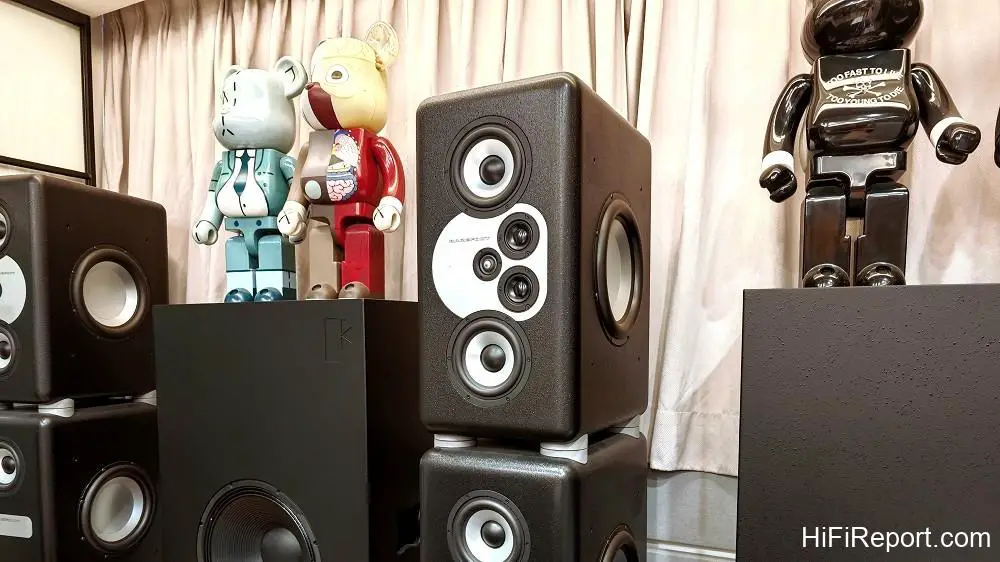
The multichannel speaker setup features Barefoot MasterStack12 for the front three channels and Barefoot MiniMain12 for the rear surround channels—these are professional active studio monitors with full-range analog inputs. Subwoofers include a Paradigm SUB2 and two Starke P18s. Most notably, the Front Wide channels are handled by high-end digital active floorstanding speakers, the Goldmund Theia.
Other speakers are passive, driven by two Starke Sound A8S 320 8-channel power amplifiers, including four KK KS700s for side surrounds, three KK K700pro and a pair of KK KS700s for the two layers of overhead channels, and six KK IW600s with one KK S150 for the third layer of overheads.
I don’t have the space to elaborate on all the top-tier equipment here, but I must first unravel the biggest mystery: why use such an expensive Goldmund Theia “just as Front Wide speakers”? This highlights the “flexibility” of the ISP Evo in system planning. It can define “speaker channels for multiple spaces” or “multiple definitions for all speakers in a single space.” Mr. Tang Wen-Chi adopted the latter. The setup listed above is the first definition, “for movie sound effects.”
Using the same speaker model for left, center, and right channels allows for perfectly matched (consistent) front sound. The Goldmund Theia, acting as FW, are secondary channels and are less likely to be damaged by overload during intense movie explosions.
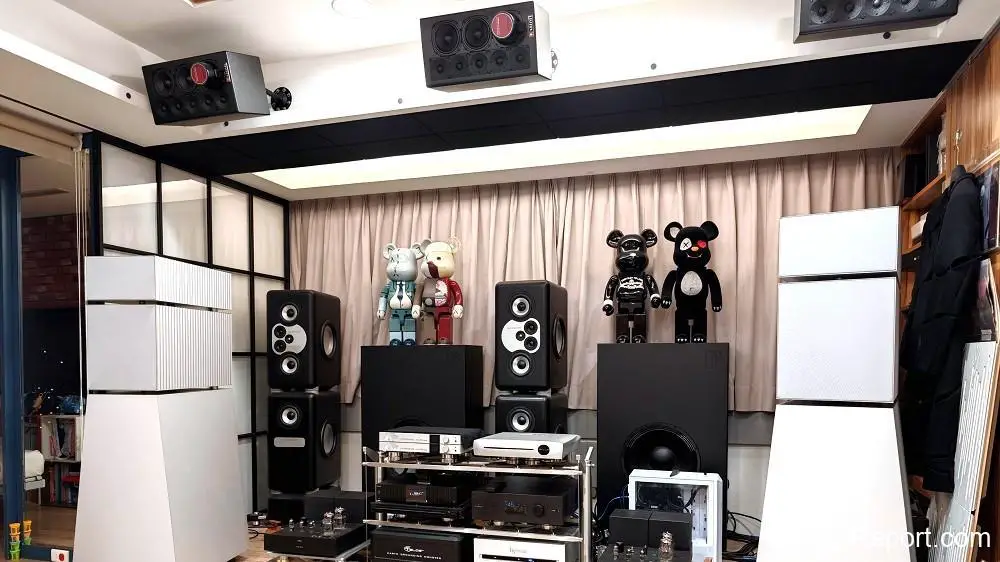
The second definition is specifically for multichannel music. In this configuration, the “movie-defined front three-channel speakers” are entirely repurposed as subwoofers. The main vocal and instrumental duties originally performed by the front three channels are fully taken over by the Goldmund Theia. To put it clearly, the Goldmund Theia simultaneously acts as the center, left, and right channels when playing multichannel music.
I find this a very insightful approach: finding a center channel speaker with matching sound quality and timbre to the Goldmund Theia is nearly impossible. Using the Goldmund Theia with careful placement to create excellent imaging and focus for a “virtual center channel” is a fundamental skill for advanced enthusiasts and poses no difficulty. This intelligently maximizes the Goldmund Theia’s role in multichannel music playback.
These speakers excel at music, and they are utilized to deliver superior sound quality for multichannel music.
Audition: Cinematic Immersion
How did it sound? I began with movie soundtracks. Despite the astonishing firepower of the speakers and active subwoofers in this system, Mr. Tang Wen-Chi’s calibration was not about exaggerating low-frequency output for sensational effect, which suited my preferences perfectly. However, responding to movie soundtracks naturally requires some enhancement to elevate the visceral impact of ultra-low frequencies.
In this system, the full-range front three channels and three subwoofers had their average levels below 100Hz raised by only about 2 to 4dB (with higher levels at lower frequencies).
During the Golden Pavilion fight scene in “The Grandmaster,” the sheer power and impact were undeniable. However, what I believe would truly impress top-tier audiophiles is the incredibly fast, clear, and pure, high-quality low-frequency and ultra-low-frequency reproduction. Without Dirac Live ART in the ISP Evo, it would be absolutely impossible to control excess low frequencies so cleanly, allowing for such high bass resolution.
The powerful impact was so strong it caused physical vibrations, creating a sense of tension, high sound density, and an open soundstage, free from any uncomfortable sense of congestion.
Another outstanding quality of the ISP Evo, in my opinion, is its completeness and descriptive capability in a three-dimensional soundstage. At audio shows and friends’ homes, we typically listen to “demonstration clips.” However, when watching an entire movie from beginning to end at home, much of the time is relatively “calm.” In this state, I believe the key to surround sound performance is “the presentation of subtle elements in three-dimensional space.”
For instance, in the familiar “American Civil War lake scene,” you can feel how sounds of varying sizes within the space create a more tangible three-dimensional environment, with the soundfield extending boundlessly from near to far, and a helicopter circling in the distant sky above… All of this is what the creators intended for the viewer to “see” beyond the visual frame, expressed through sound. The ISP Evo delivered this with astonishing vividness.
Audition: Musical Fidelity
Moving on to musical performance, I requested that the ISP Evo be set to a flat response target curve (without bass boost), which was already among Mr. Tang Wen-Chi’s pre-saved settings. Using the digitally-output ISP Evo and featuring the top-tier DSP speakers (which inherently correct phase with DSP) Goldmund Theia as the stars of multichannel music is truly luxurious!
Yet, precisely because of the all-digital processing and transmission (including the preamplifier and main speakers), this system’s sound becomes exquisitely delicate and sensitive. Initially, listening to Apple Music’s Spatial audio streams via Apple TV felt quite good. However, without a comparison, there’s no harm.
Then, playing a DTS-HD MA encoded music disc, and then using StormXT to up-mix and engage the “originally excluded” overhead speakers, the latter’s sound quality and richness felt significantly superior to the “compressed Dolby Atmos music” from streaming. There’s no escaping it; the truth is, the ISP Evo paired with the Goldmund Theia offers such high fidelity that the difference between compressed and lossless audio becomes startlingly apparent.
Whether it was streamed Dolby Atmos or 5.1/7.1 up-mixed with StormXT, the system’s numerous surround speakers (including overheads) were sufficient to make me tangibly feel immersed “within” the music space. The three-dimensional soundstage created a much stronger sense of immersion than traditional two-channel audio. Yet, Mr. Tang Wen-Chi stated that he spends most of his time listening to music in two-channel mode (compared to multichannel). There must be something extraordinary about it.
At this point, a third speaker channel definition was employed: only two-channel speakers were active for music listening (other channels rested).
It goes without saying! With an Antipodes Oladra source and Goldmund Theia speakers, exceptional sound quality should be expected, right? Not necessarily! If it were that easy, audiophiles wouldn’t need to master complex speaker placement. Many enthusiasts now recognize the benefits of modern digital room correction (DRC) to overcome room and placement deficiencies, ensuring accurate reproduction of musical content.
However, high-end audiophiles are often concerned whether DRC affects sound quality. The Dirac Live technology implemented in the ISP Evo is a form of DRC. My previous understanding was that it processed digital audio at a 48kHz sampling rate. But Mr. Tang Wen-Chi informed me that in the ISP Evo’s two-channel Native mode, it can not only apply Dirac’s room correction but also output digital audio in the same format as the input.
For instance, when playing 96kHz/24bit and 192kHz/24bit Hi-Res music from the Antipodes Oladra, the ISP Evo can output the audio in the same high-resolution format.
During the actual listening session, I genuinely could not detect any sound quality degradation from the ISP Evo’s DRC. It allowed me to perceive that high-sample-rate music indeed sounded superior to CD-quality standard sample rates. We even compared the sound differences when altering Roon’s Clock Master Priority settings, discerning even the subtle sonic characteristics and flavors associated with clock changes. I can only advise two-channel enthusiasts to “confidently embrace” the ISP Evo.
It is fully qualified as a high-end two-channel preamplifier, and moreover, it is a rare pure digital preamplifier with DRC that offers “digital in, digital out.”
Conclusion
With its incredibly high channel count (32 channels), superb Dirac Live ART room correction technology, and pure digital output free from coloration and interference, I believe the ISP Evo AoIP 32-channel surround processor delivers top-tier immersion, accuracy, and detail for both movie and music content. It successfully blends multichannel and high-end two-channel audio, with sound quality genuinely reaching high-end audio standards.
The StormAudio ISP Evo unequivocally earns our highest recommendation.
Specifications
* Type: All-Digital Surround Processor
* HDMI Inputs/Outputs: 7 In / 2 Out (ARC/eARC), HDMI 2.1 / HDCP 2.3, All ports support 4K UHD / 8K 40 Gbps compatible with HDR10+, Dolby Vision, HLG
* Audio Outputs: 32 channels digital AES/EBU, 32 channels AoIP (AES67/Dante)
* Audio Inputs: 16 channels digital (AES/EBU), 32 channels AoIP (AES67/Dante), 4x RCA analog (7.1 or 2-channel), 1x XLR analog (2-channel), 3x digital coaxial, 3x Toslink optical
* Decoders: Auro-3D, Dolby Atmos, DTS:X Pro, IMAX Enhanced, MPEG-H, Sony 360 Reality Audio
* Processed Channels: 32 channels
* Acoustic Correction System: Dirac Live with Room Correction, Bass Control, Active Room Treatment, and REW plugin
* Reference Price: Approximately $23,500 USD (AoIP 32-channel version).