
Marantz PM7000N Review
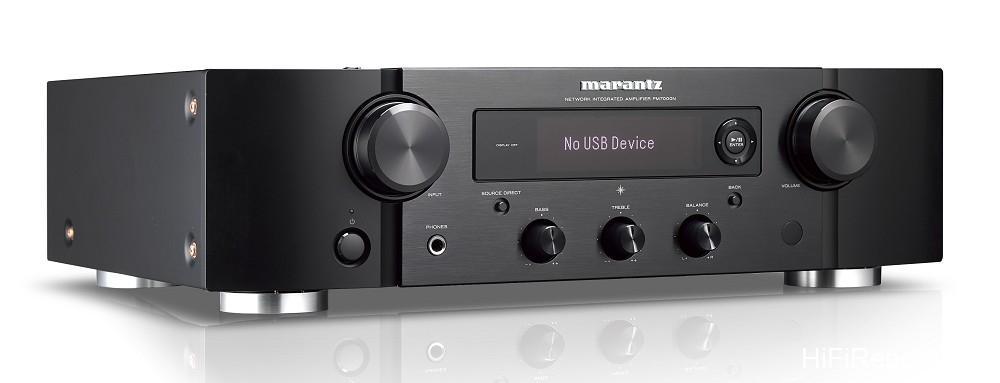
When I first saw reports online about Marantz launching the PM7000N in Japan, my interest was immediately piqued. Over the years, Marantz integrated amplifiers have garnered high praise from both enthusiasts and professional reviewers. Historically, Marantz’s standard-sized integrated amps primarily focused on pure analog circuits, with only a select few featuring built-in USB DACs. Network streaming capabilities were typically confined to their AV receivers and mini-systems.
However, the PM7000N breaks this mold, marking Marantz’s debut in the realm of standard-format streaming Hi-Fi amplifiers.
Key Features and Connectivity
The PM7000N serves as the successor to the PM7005, an integrated amplifier with a built-in USB DAC that Marantz released back in 2014. It’s been a full five years since that model, and the time was certainly ripe for an upgrade. Increasingly, audiophiles are building systems without physical CD players, and the demand for network streaming is growing rapidly, along with the variety of usage methods.
Recognizing this, Marantz engineered the PM7000N to feature comprehensive streaming functionalities.

The unit is equipped with dual-band Wi-Fi and is AirPlay 2 compatible. When connected to your home network, it can play music files stored on music servers, including NAS drives and PCs. You can also push music from your smartphone or tablet for lossless transmission via Wi-Fi. Connecting to the internet unlocks access to streaming services like Spotify and internet radio via TuneIn.
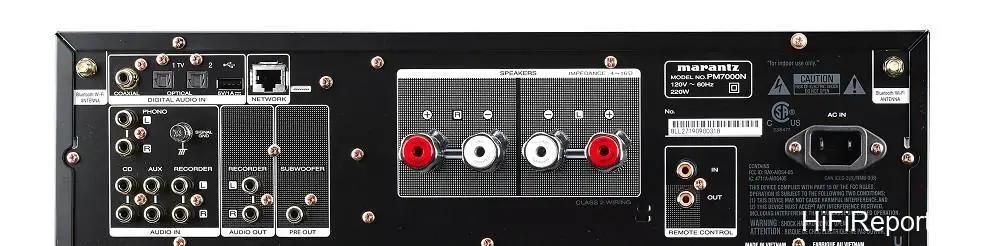
On the rear panel of the PM7000N, there’s a USB-A terminal designed for plugging in a USB hard drive or flash drive containing music files (both FAT32 and NTFS formats are supported). By installing the HEOS App on your smartphone, you can browse and select tracks, allowing the PM7000N to play them directly. This method of playback doesn’t rely on network traffic at all, ensuring smooth, stutter-free playback of high-resolution audio files.
Whether using USB or network streaming from a music server, the PM7000N supports a wide range of file types including WMA, MP3, WAV, MPEG-4 AAC, FLAC, Apple Lossless, and DSD. For Hi-Res audio, it handles multi-bit files up to 192kHz/24bit and DSD files up to 2.8MHz and 5.6MHz.
Advanced Engineering
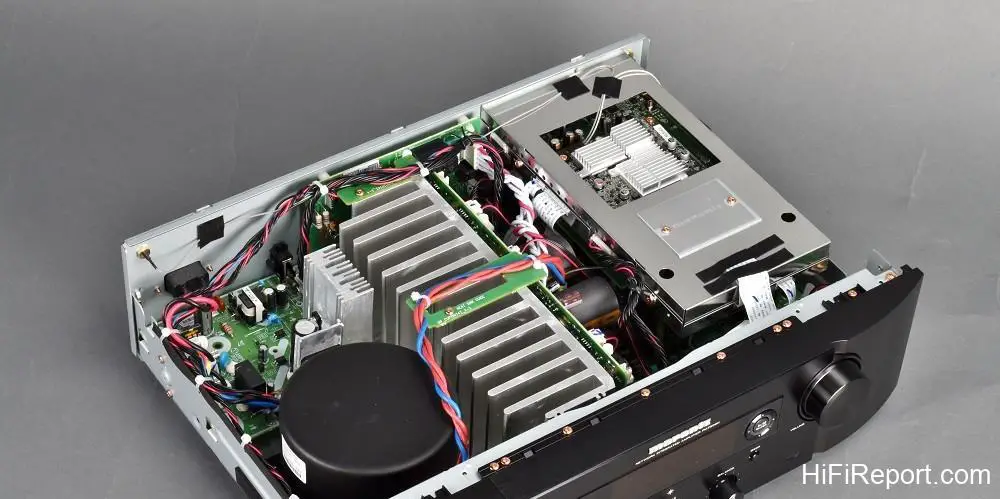
In terms of hardware construction, Marantz has always placed a strong emphasis on minimizing the negative impact of electromagnetic noise on audio circuitry. In the previous PM7005 model, the USB DAC circuit board was enclosed in a metal box for rigorous shielding, preventing high-frequency digital noise leakage. The PM7000N employs the same technique, wrapping the digital circuits in a metal enclosure.
Furthermore, it implements automatic independent power control for the network, Bluetooth, and USB digital sections. For example, if the system detects that Bluetooth is not in use, it automatically shuts down the Bluetooth power supply, directly eliminating the high-frequency noise generated by that circuit. If the user selects an analog input source, the power to all three digital sections is automatically switched off entirely.
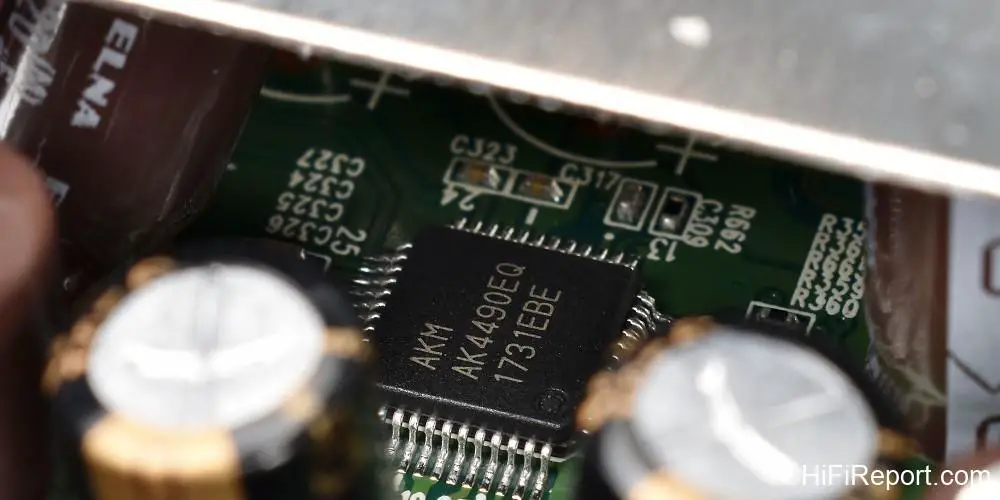
The main digital board of the PM7000N features a HEOS network card, S/PDIF digital inputs, and a high-end 32-bit AKM AK4490EQ DAC chip. This DAC boasts impressive performance with a high signal-to-noise ratio (120dB) and a THD+N of -112dB, significantly lower distortion than the Cirrus Logic CS4398 (-107dB) used in the PM7005.

Crucially, the analog conversion stage after the DAC chip uses no operational amplifier (OPA) chips. Instead, Marantz’s proprietary technology is utilized, employing discrete component HDAM (High Definition Amplifier Module) as the low-pass filter circuit, followed by the HDAM-SA3 buffer amplifier circuit in the output stage.
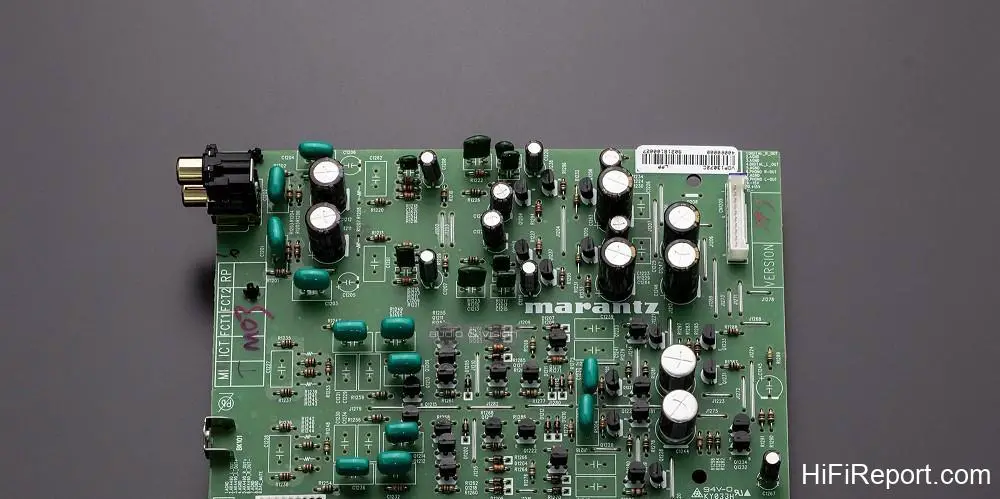
On the analog input side, the PM7000N not only provides line-level inputs but also includes a Phono Stage for turntables (supporting MM cartridges). This circuit board, located beneath the main digital board, follows the design philosophy of the higher-end PM8006, using J-FETs in the input stage for improved signal-to-noise ratio and lower distortion. A filter is also added in the power path to reduce ripple and ensure a cleaner power supply for the phono stage.
Noise Suppression Design
From the descriptions above, it should be evident that the PM7000N is designed with a strong focus on achieving low noise. Such a design requires a fully integrated approach, because even a single weak link in the audio path can compromise the overall low-noise performance. In this new model, Marantz has implemented a special design for the preamplifier section (including volume control and line-level amplification).
This section uses HDAM and HDAM-SA2 high-speed amplifier modules combined with the JRC NJU72322 volume control chip to create a “variable gain” preamplifier circuit. During normal or low-volume listening, the preamplifier circuit applies no gain (zero amplification). In this state, only the power amplifier stage is active, effectively allowing the audio signal to “directly enter the power amplifier,” minimizing noise contributed by the preamp circuitry.
This innovative design enables the PM7000N to achieve a signal-to-noise ratio of 115dB, an impressive 11dB improvement over the PM7005.
Power Amplification and Supply
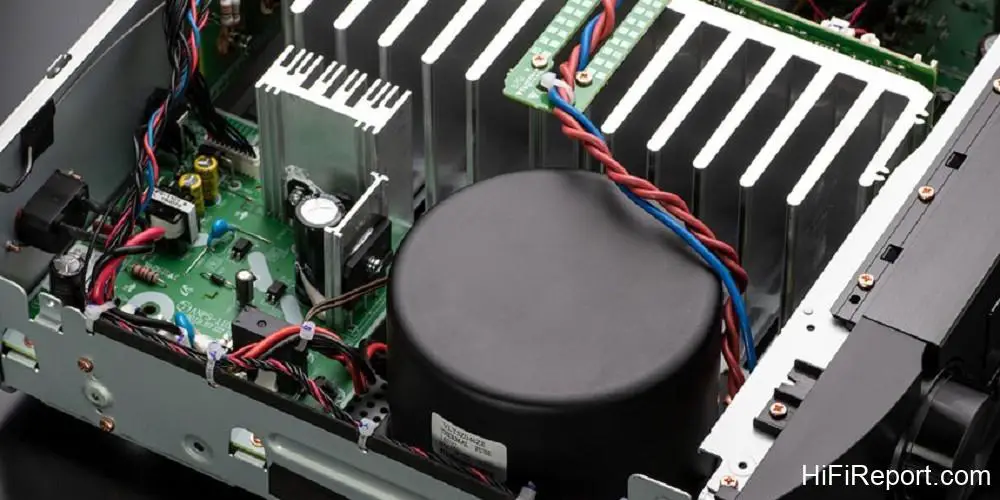
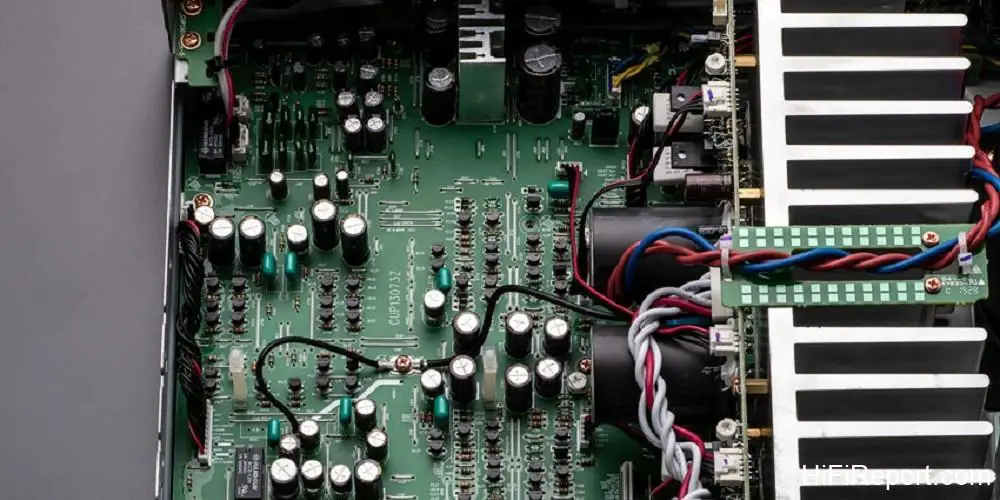
The power amplifier section employs a current feedback design using discrete component HDAM-SA3 modules. This configuration is known for its high signal-to-noise ratio, low distortion, high slew rate, and wide bandwidth characteristics. Each channel uses a pair of new LAPT power transistors (Sanken 2SA1303 / 2SC3284) in a push-pull configuration. The instantaneous peak current output exceeds 32 amperes, a significant improvement of over 45% compared to the PM7005.
Beyond boosting the current output capability of the power amplifier, Marantz also adopted a “Short Power Line Layout.” The large power supply filter capacitors (two 15,000μF/63V electrolytic capacitors custom-ordered from Elna) are mounted directly next to the power transistors. This shortest possible path minimizes transmission impedance, enhancing current delivery.
Furthermore, separate filter capacitors are used for the left and right channels, reducing crosstalk and improving channel separation for a wider soundstage.
Listening Impressions
Before formal listening, I conducted a quick comparison of different methods for playing music files. The PM7000N proved quite sensitive; I could clearly discern differences in sound quality even when using a laptop as a music server and sharing files with different software. However, I would advise users of this unit against using a PC or laptop for network sharing. The sound quality is notably better when playing music files directly from a USB hard drive plugged into the PM7000N.
Compared to PC network sharing, the sound is significantly more stable and composed, with lower impurities, greater richness, and better density. If you still prefer using a network server, considering both price and sound quality, I would recommend pairing it with a dedicated music server like the I-O DATA Soundgenic HDL-RA2HF.
During listening, users can choose whether to engage or disengage the Source Direct mode. The sonic characteristics between the two are quite distinct. With Source Direct “Off,” you can utilize the treble, bass, and balance controls. In the untouched state, the PM7000N sounds somewhat like earlier Marantz integrated amplifiers – the treble is gentle, details are slightly reserved, and the focus is more on the richness of the midrange, leaning towards a warm tonal balance.
With Source Direct “On,” the signal bypasses the treble, bass, and balance adjustment circuits. A shorter signal path is naturally expected to result in higher resolution and a more direct sound, but I was surprised by just how significant the difference was. The sound signature changes so dramatically that it feels like listening to two different units compared to Source Direct “Off.” Consequently, after my initial testing, I opted to keep Source Direct engaged for the formal listening session.
Many classic Hi-Fi amplifiers tend to make the treble sound more reserved and smooth, resulting in a richer, more mature sound. These characteristics can lend a certain charm to classical music and analog jazz recordings. However, they can also make popular music sound a bit too mellow and conservative, lacking realism for younger listeners. In Source Direct mode, the PM7000N presents a stark contrast to these “traditionalist” units.
There’s no sluggishness, no artificial coloring or embellishment to create a specific character. The sound is remarkably neutral, youthful, robust, and full of energy.
Even though its rated power output is listed at only 60 watts per channel, it was able to drive the Pioneer S-1EX floorstanding speakers with fast, punchy, “muscular” bass. The impact of the kick drum had strong, tight thrust. Deep bass in hip-hop music was rendered with significant weight, demonstrating clear and quick reaction to dynamics and rhythm, proving its excellent speaker driving capability and control. The midrange felt very direct, with vocals sounding bright and full of presence.
It presented treble details quite boldly and without embellishment. Violin timbres were open and their texture refined, and the sound of drumsticks hitting cymbals was lustrous without being harsh.
Although the PM7000N’s driving power is quite impressive, after listening at high volume for a while, I gradually lowered the volume to a comfortable level and immediately noticed that it didn’t need to be played loudly at all. At medium and low volumes, the background is exceptionally quiet. As long as your listening environment is sufficiently silent, you can effortlessly hear the rich, subtle details of the musical performance space. The soundstage is wide and deep.
The pure, low-distortion sound quality allows it to exhibit high-resolution characteristics even at medium and low volumes, making the sound transparent and lively.
Even when the singer on stage is singing softly, or the musicians are playing gently, the beautiful music flows clearly and naturally through the space. Under conditions where “volume must be limited” on a quiet night, it can still deliver a strong sense of presence even at low volumes, thanks to its pure and transparent sound. The ability to elegantly portray intricate sound quality and vibrancy at under one watt is something that previously required spending upwards of 100,000 NTD (approx.
3,300 USD) on high-end streaming amplifiers or combinations of streaming players and integrated amplifiers. For a unit as affordable as the PM7000N to achieve this level of performance is absolutely exceptional. Its sound characteristics and quality immediately brought to mind the combination of the Marantz ND8006 streaming player (with the digital filter set to “Filter 1”) and the PM8006 integrated amplifier.
If you’ve heard and liked that combination but it’s beyond your budget, I believe the PM7000N is the perfect product for you.
Conclusion and Recommendation
We often say “you get what you pay for,” but I don’t think that saying applies to the PM7000N. Instead, “attitude determines everything” is more apt. The Marantz R&D team did not take the development and design of such an affordable product lightly. Within the constraints of the production budget, they poured their expertise into minimizing noise and distortion at every stage, extensively applying their proprietary HDAM amplification technology.
This effort has resulted in a streaming integrated amplifier whose sonic performance significantly surpasses its price category. It’s capable of driving medium to high-sensitivity speakers in the 100,000 to 200,000 NTD (approx. 3,300 to 6,600 USD) price range. Given its exceptional value, it is certainly deserving of our Best Recommendation award.
Specifications
* Type: Network Streaming Integrated Amplifier
* Signal-to-Noise Ratio: 115 dB (Normal), 87 dB (MM Phono Input)
* Rated Power (RMS): 60 Watts per channel (8 ohms), 80 Watts per channel (4 ohms)
* Damping Factor: 100 or more
* Frequency Response: 5Hz ~ 100kHz (±3dB)
* Total Harmonic Distortion (20Hz ~ 20kHz, 8 ohm load, both channels driven at full power output): 0.02%
* Inputs: Toslink Optical × 2, Digital Coaxial × 1, Two-channel Analog (RCA) × 4 (including PHONO), USB-A × 1, Wi-Fi, Bluetooth
* Output Terminals: Subwoofer Pre-out × 1, Recording Output × 1, Speaker Outputs × 2, Headphone Output × 1
* Dimensions (Width × Height × Depth): 440 × 125 × 379 mm
* Weight: 10.8 kg