
PureTek Alpha Network Switch Review
Since audiophile-grade network switches were introduced in Taiwan, enthusiasts have discovered just how expensive these specialized components can be. Beyond brands like Ansuz, even models like the Japanese Melco S1, set for release in 2025, carry a significant price tag. Considering the cost of these units, the local Taiwanese Diva EX-7 network switch suddenly seems quite reasonably priced.
Of course, the Taiwanese market offers a wide selection of other audiophile-grade network switches from brands such as COS, Innuos, Nordost, NuPrime, Silent Angel, SOtM, and Telegärtner, though their prices tend to be more accessible.
Now, another audiophile-grade network switch has arrived in Taiwan: the PureTek α. I first laid eyes on this switch at the TECA Audio Show in December 2024. Its small chassis, carved from a solid block of aluminum, immediately conveyed a sense of luxury and robust build quality. Holding it, you feel its considerable heft, suggesting strong vibration resistance. Today, this very network switch resides in my listening room.
Design and Connectivity
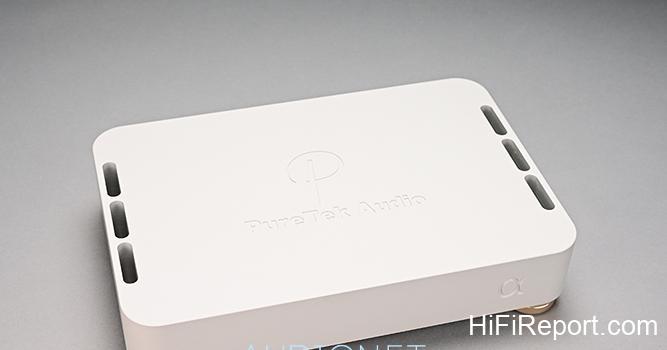
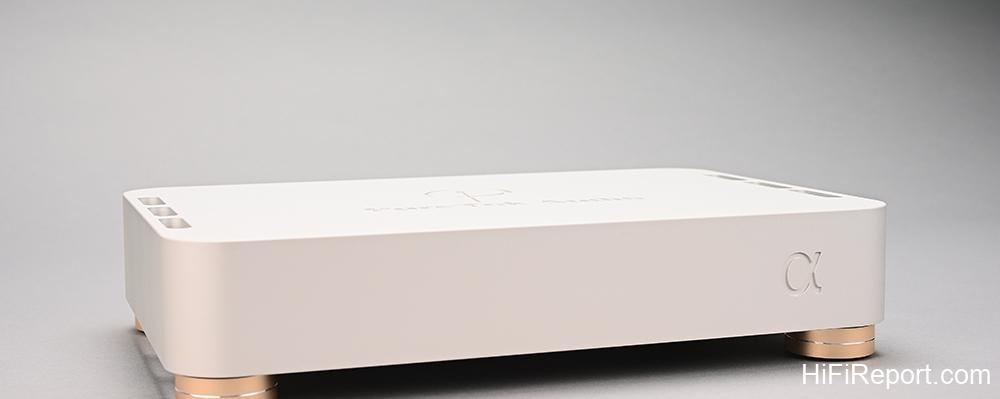
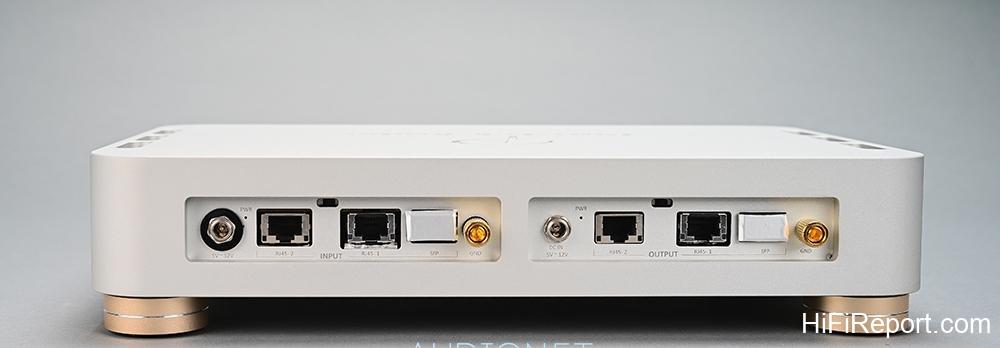
Though compact, the α is beautifully designed. The front panel is adorned with a large ‘α’ symbol on the right side, while the top cover features deeply engraved “PureTek” lettering and the brand’s ‘P’ logo. Intriguing, three long elliptical cutouts are present on each side, seemingly for decorative purposes. Around the back, the connectivity is divided into two sections: Input and Output. Each section houses two RJ45 ports and one SFP fiber optic port.
A DC power input and a grounding terminal complete the rear panel layout.
We understand that network switches typically function as bidirectional communication devices, with ports not strictly designated as input or output. However, the PureTek switch deviates from this, explicitly labeling Input and Output sections, each with only two RJ45 ports. Why this unusual design? I contacted PureTek’s designer for clarification and requested their design documentation. Here, I will faithfully present the information they provided:
Manufacturer’s Design Philosophy
“Design Concept: To isolate noise from the source endpoint using optical isolation, preventing it from traveling through the network cable and affecting downstream audio equipment that is highly sensitive to power supply quality.
1. Built-in Optical Isolation: The unit contains two independent circuit boards, each with its own DC power supply. This is paired with a custom-designed optical module and fiber optic cable. This approach leverages the clean, high-resolution sound benefits of optical isolation while mitigating the commonly perceived cold or sterile sound often associated with standard fiber optic implementations, through the use of custom components. 2.
Special Chassis Design: The internal structure ensures complete separation and isolation of the two circuit boards, with no shared ground connection. Each board possesses its own independent grounding terminal. Only optical signals connect the two internal sections, thoroughly separating electrical signals. This design effectively integrates the functionality of two cascaded switches, often seen in high-end setups, into a single unit.
It should be considered as two complete, independent switches connected via fiber optic. 3. Multiple Built-in Low-Noise LDOs: Independent power supply is provided to different zones of the circuitry. 4. Two Different Sound Characteristics for the RJ45 Ports: This allows users to choose based on their sonic preferences.”
This is the information provided by PureTek. I also inquired about the grade of the internal clock. The designer stated they use a Temperature Compensated Crystal Oscillator (TCXO). I asked why they didn’t opt for a higher-grade Oven-Controlled Crystal Oscillator (OCXO). They explained that they had tested OCXO, but the sonic performance wasn’t superior to TCXO, so they ultimately decided to use TCXO.
In reality, Ethernet is a packet-based, asynchronous transmission protocol. It doesn’t rely on a fixed clock for synchronization or perform reclocking. Therefore, the role of the clock in a network switch is not as demanding in terms of precision as it is in a DAC. A TCXO clock is certainly precise enough for this application.
Technical Considerations
Perhaps you wonder what the significant difference is between a consumer-grade network switch and one designed for audio applications. Is the only major difference the chassis? In fact, the primary difference lies in the treatment and isolation of noise, followed by the quality of the connectors. Additionally, power supply design is a critical area for optimization. As for the digital 0s and 1s themselves, they are transmitted as packets and should, theoretically, not be affected.
What kinds of noise need to be addressed? Common household electromagnetic interference (EMI) and radio frequency interference (RFI) are ubiquitous and must be mitigated. Effective handling of EMI and RFI requires using better components and superior shielding measures. PureTek’s approach, utilizing a chassis milled from a solid block of non-magnetic aluminum alloy combined with internal isolation, should be effective in suppressing these two types of noise.
Power Supply Implementation
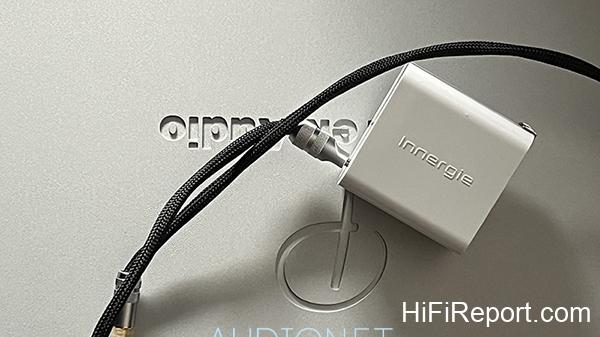
Next is power supply treatment. Any discussion of audiophile-grade equipment inevitably highlights the power supply. Indeed, nearly all audio components pay close attention to power supply design, often at a significant cost. PureTek’s solution seems quite direct: the input and output sections each have independent DC power inputs. The included “power supply” is merely a standard Innergie universal charger, providing DC power directly to the switch’s internal circuitry.
This power supply approach is strikingly simple.
Why did they opt for such a basic power supply? The manufacturer explained that the market offers many high-quality external DC power supplies, such as Taiwan’s EA Hibrid battery power supplies, and using these external options yields significantly better results. Therefore, they only include a simple external supply, trusting that customers purchasing the Alpha will invest in a better external power supply.
They also recommended using a 9V supply rather than 12V, as 12V operation generates more heat, potentially introducing noise.
I also asked what would happen if the power supply were housed within the chassis. Their response was that it would be detrimental, not beneficial. Whether a linear or switching power supply, placing it too close to the circuit boards is undesirable, especially since transformers themselves are prone to vibration. Thus, locating the power supply externally is considered ideal.
Furthermore, the manufacturer emphasized the importance of RJ45 connector quality, as these connectors are sensitive to vibration. They have taken great care in selecting and fixing these connectors.
Listening Experience
For my listening tests, I first used the provided Innergie universal charger. Then, I switched to an EA Hibrid Pure DC B1 battery supply. I own two EA Hibrid units; one is dedicated to my router and cannot be removed, but the other was available. I tried using it on the input side power input and then on the output side. To my surprise, even using just one EA Hibrid battery supply resulted in a noticeable improvement.
For instance, listening to Guo Jin Fa’s “Unforgettable Phoenix Bridge,” the aforementioned improvements were clearly audible. With Edgar Moreau’s performance of “Transmission,” both the orchestra and cello sounded more powerful, the sense of musical scale expanded, and the music felt more full-bodied and dynamic. I imagine using two EA Hibrid units, one for both input and output, would yield even greater benefits.
Does an audiophile-grade network switch truly make a difference? Yes, it absolutely elevates the sonic performance. As for *why* it improves the sound, that’s a question for scientists to unravel. What matters to the audiophile’s ear is that it genuinely enhances the listening experience. If you remain skeptical, that’s perfectly fine; some people simply won’t hear the difference.
It’s similar to the effect of changing cables on sound quality, something I discovered back when I founded “Audio Art” magazine and dedicated a special feature to it. Decades later, some still don’t believe it!
So, how does the PureTek α sound? I guarantee that upon first listen, you will experience a feeling of sonic “refreshment.” Instrumental shapes become more focused and palpable; transparency improves, and the decay of instruments becomes clearer within the soundstage. I heard all these improvements distinctly with just one album. Which album? The Emerson Quartet’s “Listening Guide,” where the musicians first explain a piece, then perform a section, followed by more explanation and performance.
During the spoken explanations, the voice immediately sounded more focused and palpable. During the quartet performances, the transparency and spatial reverberation were notably enhanced.
Next, I listened to Alina Ibragimova’s performance of Schumann’s Violin Sonatas. Instantly, I noticed the improved substance and weight of the piano notes, and the cello’s realism was heightened. Moving on to The Nash Ensemble’s performance of Debussy’s String Quartet, the overall harmony of the quartet sounded more beautiful, the timbre of the four string instruments was elevated, and importantly, the resonance of the string instrument bodies was richer.
Listening to Sabine Meyer’s rendition of Mozart’s Clarinet Quintet K581. Again, without needing to listen critically, I could immediately discern the clarinet’s more beautiful tone and rounder sound lines. The textural detail of the cello’s bowing became clearer, and its timbre improved.
When listening to Fausto Mesolella singing “Tulipani,” the accompanying steel-string guitar was tighter, and the singer’s voice became fuller and more focused, crucially, with enhanced palpability. Listening to Aaron Neville’s “I Bid You Goodnight,” the most striking improvement was the increased strength in his voice, rather than sounding softer. Furthermore, the low-frequency “thump” was more solid and tightened up faster.
The improved transparency, clearer and richer reverberation within the recording space, and increased detail are almost redundant to mention again.
Listening to Edgar Moreau’s “Great Dramatic Sonata,” both the cello and piano exhibited more focused forms and clearer outlines. The texture of the cello’s bowing also became more realistic. Hearing Bruno Philippe’s performance of Myaskovsky’s Cello Sonata, similarly, the cello sound was more focused, and the bowing texture was more realistic.
Listening to Cai Keyi with the Singapore Symphony Orchestra performing the “Butterfly Lovers Violin Concerto,” the entire soundstage seemed to expand, the timpani gained more power, and the violin became more incisive. Then, listening to Yannick Nezet-Seguin conducting the Philadelphia Orchestra in Price’s Symphonies 1 & 3, all the previously mentioned improvements were evident in the symphony.
Woodwinds were sweeter, brass had a more beautiful sheen, the overall orchestra sounded more powerful, and the soundstage was grander.
Having read these descriptions, you can likely understand why I described the feeling as “sonic refreshment.” The overall music sounds clearer, more vibrant, and simply more engaging. To elaborate on what “sonic refreshment” entails: the sense of space expands significantly, the soundstage becomes more transparent, the high frequencies are sweeter and more (perhaps ‘smoothly sweet’ or ‘richly sweet’), and the decay of instruments and recording space reverberation emerge more clearly.
The mid-range becomes more focused, and instrumental outlines are sharper. The low frequencies are tighter; there isn’t necessarily *more* quantity, but the density and weight are improved. I had initially considered trying isolation cones under the unit, but my network cable is only 1 meter long, making it impossible to position the unit conveniently, so I didn’t proceed. Perhaps adding cones would further enhance the overall effect.
If you are currently using a standard consumer-grade network switch, upgrading to the PureTek α is guaranteed to yield a significant, palpable improvement – one that will likely trigger an immediate urge to purchase it. However, if you are hoping that changing your network switch will result in increased bass quantity, a larger and more diffused rendition of a voice like Cai Qin’s, or a softer overall sound, then the PureTek α might not be for you.
Conclusion
The final conclusion is this: the PureTek Alpha network switch is absolutely worth buying.
Specifications
* Product Type: Network Switch
* Release Year: 2025
* Input Ports: RJ45 × 2, SFP × 1
* Output Ports: RJ45 × 2, SFP × 1