
Stein Music Q5 Power Conditioner Review
Founded by German Holger Stein, Stein Music has been introducing a plethora of products over the past four decades, many of which are exceptionally intriguing.
For instance, their Harmonizer stands out. By employing two or four Harmonizer units, coupled with dedicated tuning bases, it purports to enhance the realism of music playback.
Another example is their E-Pads Plus stickers. These diminutive, seemingly simple adhesive patches are claimed to alter sound and have a wide array of applications.
Furthermore, their RCA and XLR Demagnetizers, resembling signal cable terminals, are designed to be plugged into unused amplifier inputs to purportedly improve image focus and clarity.
These items may appear unremarkable at first glance. The underlying principles, even when explained by the manufacturer, can be somewhat opaque, and their effects are challenging to quantify through scientific instruments. Yet, users consistently report discernible differences when these devices are implemented.
This is precisely where the challenge lies. The difficulty in articulating the exact mechanism of action makes it hard to convince those with a strong scientific inclination, often leading to skepticism and accusations of pseudoscience or quackery.
Such derisive comments are not uncommon online, and can be found across various international forums.
For audio reviewers like myself, this presents a dilemma.
When the rationale is unclear (often because manufacturers themselves haven’t fully elucidated it), it can invite cynical and malicious attacks from online commentators, who dismiss our subjective experiences as mere marketing collaboration.
Consequently, I had long resolved to avoid such products to protect my professional reputation.
Difficult to Explain, Easy to Criticize
But have I truly avoided them? If I abstain, leaving it all to my colleagues, wouldn’t that be unfairly burdening them with potential criticism?
The truth is, personal experience is key with these products. Only through hands-on testing, and finding the effects to be both valid and aligned with one’s sonic preferences, can one consider a purchase.
In my experience, these products almost always produce some effect, varying only in degree. When the impact is pronounced and immediately noticeable, writing about it is straightforward. For more subtle changes, repeated listening and careful observation are necessary before forming a solid impression and putting pen to paper.
I confess, on several occasions, when faced with seemingly unassuming products lacking clear explanations, I’ve initially grumbled about taking the less conventional path.
However, almost every time, after testing and grasping the direction of sonic alteration, those initial reservations dissipate.
Direct experience is the ultimate arbiter.
Even if the principle is simple and the logic seems sound, there’s no need for hasty judgment.
After all, someone who can transform a simple concept into a marketable product is already a step ahead of mere armchair critics.
The Stein Music Q5 Power Conditioner, which I received this time, was initially something I felt reluctant to review.
I’m well-acquainted with Stein Music’s offerings. I know their products are effective, even if the underlying principles are not easily articulated. The effects are palpable.
However, even an honest review could still attract unwarranted criticism.
Part of the Quantum Q Family
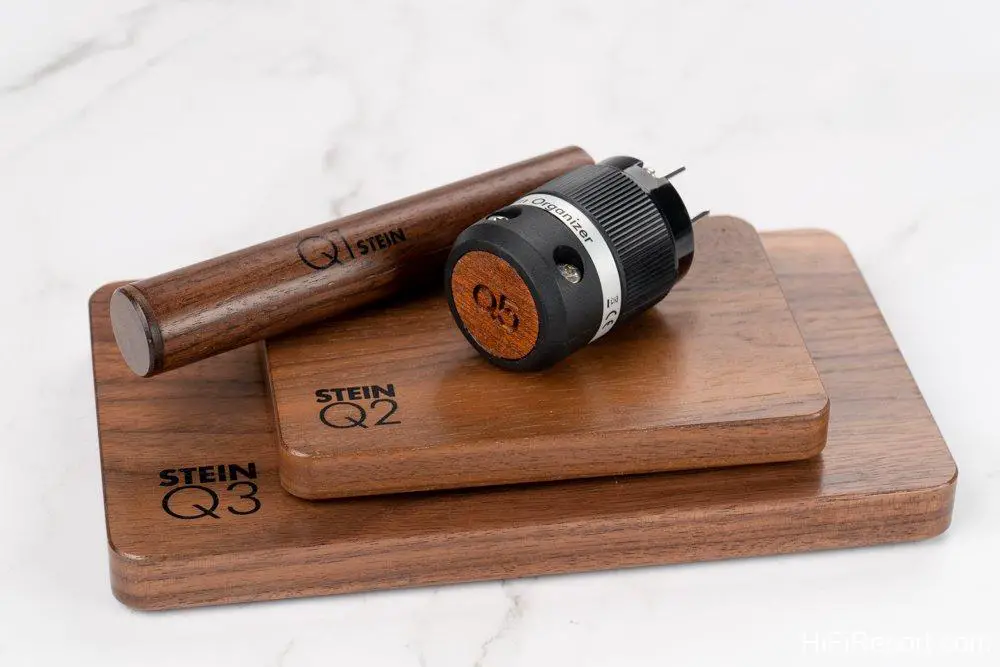
The Q5 is a new experience for me, although I previously encountered the Q1, Q2, and Q3 Quantum Conditioners, which also operate on quantum physics principles, about two years ago.
I proactively requested to review those quantum conditioners because, during a visit to HiFiReport’s listening room to audition Stein Music speakers, the system incorporated several Q2 and Q3 units. I witnessed firsthand the effect of adding or removing these small boards – they undeniably made a difference.
Based on that prior experience, I didn’t hesitate to request a review of the three conditioners sent at that time.
This time, when the Q5 arrived at the editorial office, my initial inclination was to pass on it. Yet, curiosity prevailed, and I volunteered to review it. I was intrigued to discover how the Q5 would compare to the Q1, Q2, and Q3, all of which I had used before.
Power Plug Disguise, Hidden Technology
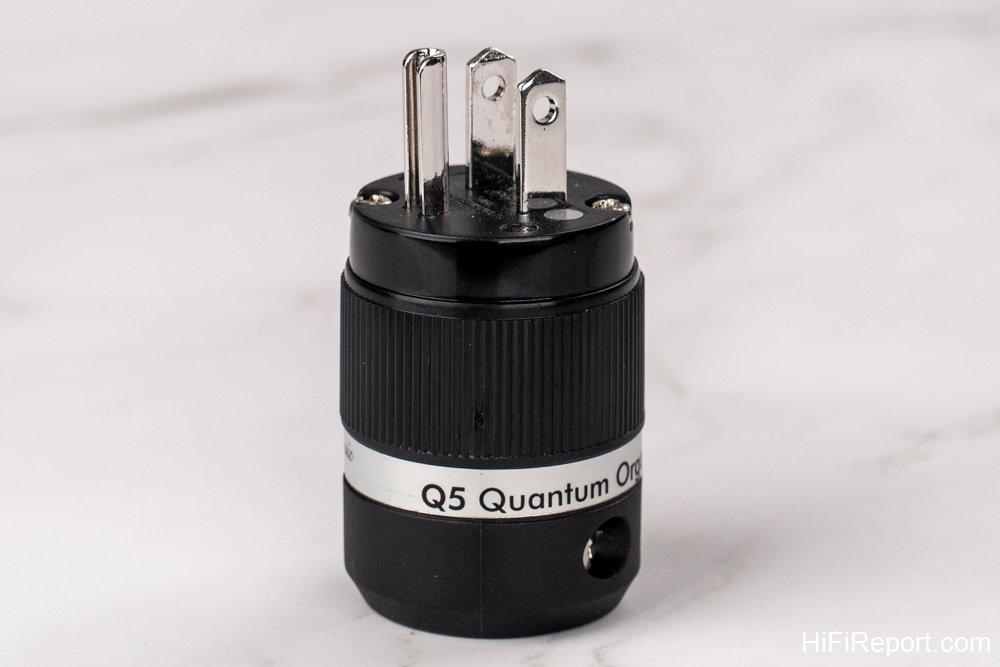
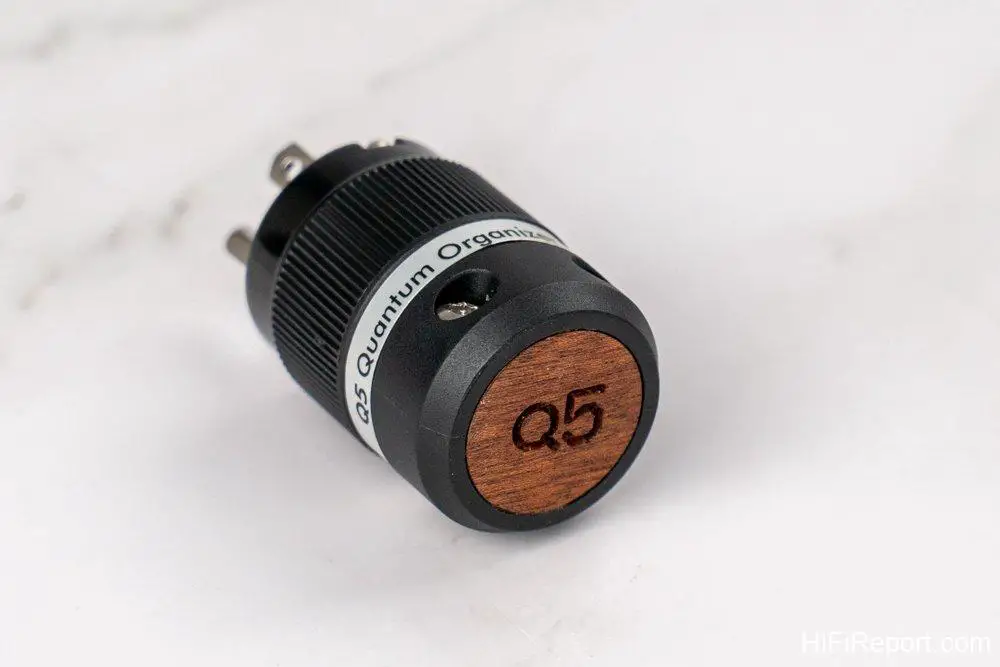
The Q5 represents Stein’s latest generation of products. The most noticeable external change from older models is the adoption of rhodium-plated pins for the plug, and a wooden top cover replacing the previous backplate.
Visually, the Q5 is simply a male power plug. While some manufacturers of similar products might enlarge the plug housing, Stein Music’s Q5 retains the dimensions of a standard plug.
However, its weight is noticeably heavier than a typical plug, suggesting internal components.
What’s inside? Lacking X-ray vision and unable to disassemble loaned equipment, I can only reiterate the manufacturer’s explanation.
Gemstone Matrix and Magnetic Field Conversion
According to Stein Music, the Q5 incorporates their proprietary magnetic field conditioning technology.
Beneath the wooden cover, marked with the “Q5” designation, is a matrix of gemstones and semi-precious stones in a specific ratio. The Q5 leverages these particles to absorb and convert external electromagnetic waves, achieving a magnetic conditioning effect.
Furthermore, two single-core silver wires internally connect to the Q5 plug’s live and neutral pins, passively integrating magnetic fields to control the magnetic environment within the socket.
Several other manufacturers offer passive tuning products in similar power plug formats, such as Nordost’s QV2, Ansuz’s Sparkz, and Furutech’s NCF Cleaner Line.
Each employs different approaches. Furutech utilizes their NCF (Nano Crystalline Formula) material to suppress vibration and eliminate static electricity, aiming to enhance power purity.
Ansuz integrates their Tesla coil noise reduction technology within the Sparkz.
Nordost’s QV2 actively introduces precisely tuned pulse frequencies.
Their shared objective, and arguably their common effect, is to reduce noise, deepen the background silence, enhance musical dynamics, and improve image focus and clarity.

Holger Stein is aware of other AC power noise reduction products on the market. However, he points out a perceived drawback of typical filtering noise reduction products: while they may filter out high-frequency noise, resulting in a smoother sound, they can also inadvertently remove subtle musical details. Additionally, many filters suffer from dielectric losses, absorbing energy and thereby potentially limiting the power available to connected components.
Therefore, his design philosophy for the Q5 prioritizes a purely passive approach to avoid energy loss. The manufacturer claims the Q5 is an extremely high Q-value filter, exhibiting only a minimal 3dB attenuation even at extremely high frequencies of 10MHz.
Enhanced Image Focus, Depth, and Detail
Does the Q5 work? Absolutely, and demonstrably so.
The sonic change is audible upon immediate insertion and removal. Even simply moving around the outlet area, one can perceive the alteration in sound.
The direction of change aligns closely with my experience with the Q1, Q2, and Q3: improved image focus, enhanced three-dimensionality, greater sonic solidity, and finer detail retrieval, all while lending a more impactful punch to percussion. Consequently, the music becomes more vibrant and engaging overall.
For example, listening to Brass United’s brass quintet performance of Albeniz’s Spanish Suite, the addition of the Q5 clarified the brass instruments, smoothed their timbral texture, and improved their separation.
The trumpet’s brilliance, the French horn’s mellowness, the trombone’s richness, and the tuba’s deep resonance were all enhanced, providing excellent interplay and support.
The inclusion of percussion further enriched the musical tapestry and liveliness.
The Q5 rendered the brass instruments more tangible and made the percussion more impactful.
The percussive strikes became more defined. While these sounds were already present, the Q5 tightened the sonic edges, resulting in a more three-dimensional and clearer sound, making the percussion sound more agile.
Does it darken the sound? Does it thicken it? These were my initial concerns as well.
However, to my ears, there was no perceptible loss of brightness. In this particular recording, the metallic sheen of the brass and the distinct character of each brass instrument were actually more clearly delineated.
Drum Impact and Guitar Clarity
Consider another example: “Out of Time” and “Alibi” from the “A Star is Born” soundtrack. In “Out of Time,” with the Q5 in place, the drumstick strikes become crisper and more articulate. The audience ambience and stage performance sounds become more distinct, creating greater separation. The background shouts of “hey!” gain more palpable form, and the guitars sound more dimensional and clear.
In “Alibi,” the track opens with a prominent bass drum. With the Q5, the drum sound becomes more focused, defined, and impactful.
The wall of sound created by the electric guitars initially sounded somewhat chaotic without the Q5. With it in place, the sonic canvas becomes clearer, revealing the intricate details within.
The difference is quite noticeable.
Best at System Outlet, Less So Downstream
How did I implement the Q5? I plugged the Q5 into a power strip, which was connected to a wall outlet. My amplifier was also plugged into this power strip, while the digital source was connected to a NuPrime Pure AC-4 power filter, which was also fed from the same power strip.
This placement, in my opinion, yielded the most direct and significant impact on the system with a single Q5 unit.
Placing it in other outlets on the same circuit produced less pronounced effects, but the changes were still perceptible.
When plugged into outlets on a different circuit, the effect became largely indiscernible.
This is my personal experience. The manufacturer suggests purchasing two units, placing one in the power strip or wall outlet serving the system, as I did, and the other in another outlet within the room.
I surmise that “another outlet in the room,” as suggested by the manufacturer, still refers to outlets on the same electrical circuit, as my experience indicates that circuit proximity does indeed influence the effectiveness.
Audible to All, No Golden Ears Required
In conclusion, if your audio budget is tight, consider this type of tuning product as informative reading material.
However, if you have some discretionary income and are open to experimentation and new experiences, Stein Music’s Q5, like their Q1, Q2, and Q3, is a fascinating product. Its effects are readily apparent, discernible to anyone, not just those with “golden ears.”